
Vehicle Armor Materials Market Size and Share
Market Overview
| Study Period | 2022 - 2032 |
|---|---|
| Market Size (2027) | USD 8.85 Billion |
| Market Size (2032) | USD 12.28 Billion |
| Fastest Growing Market | Asia-Pacific |
| Largest Market | North America |
| Market Concentration | Medium |
Major Players *Disclaimer: Major Players sorted in no particular order Image © Mordor Intelligence. Reuse requires attribution under CC BY 4.0. | |
Vehicle Armor Materials Market Analysis by Mordor Intelligence
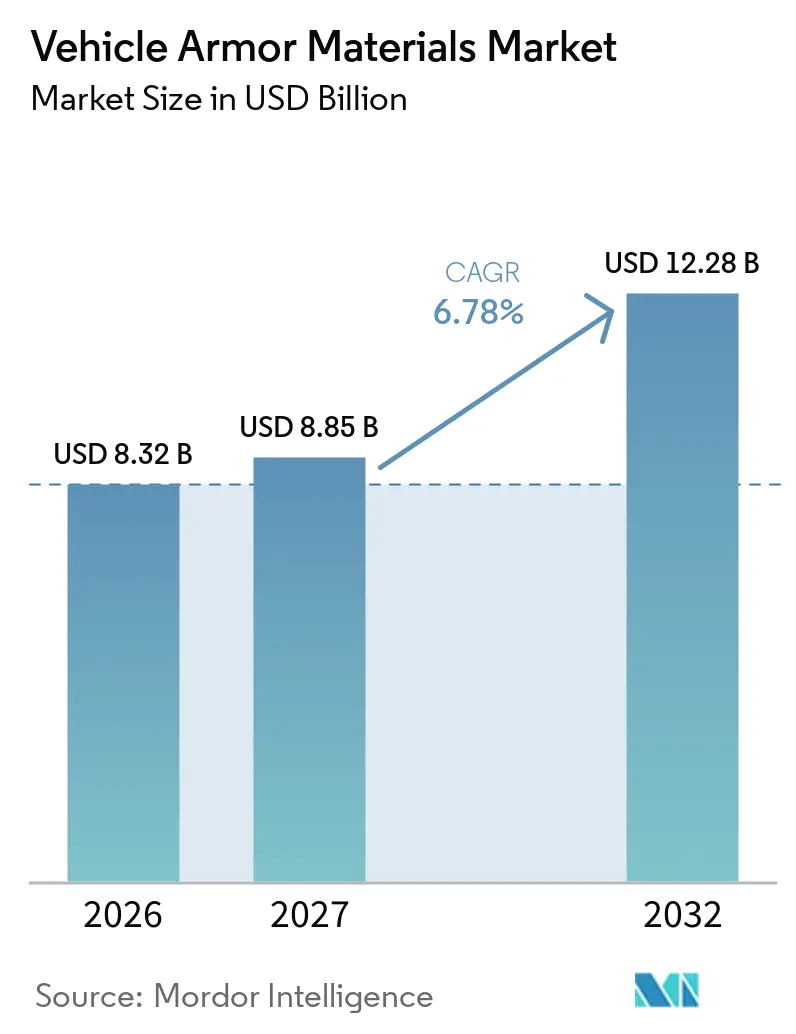
The Vehicle Armor Materials Market size was valued at USD 8.32 billion in 2026 and is estimated to grow from USD 8.85 billion in 2027 to reach USD 12.28 billion by 2032, at a CAGR of 6.78% during the forecast period (2027-2032). Defense fleet renewal, changing battlefield threats, and demand for lighter protection systems support spending across the vehicle armor materials market. Procurement is increasingly focused on protection against ballistic, blast, mine, drone, and top-attack threats rather than conventional ballistic threats alone. The vehicle armor materials market also benefits when suppliers can combine material performance with vehicle integration support and dependable production capacity. European procurement frameworks and Indo-Pacific modernization programs provide longer planning horizons for producers, while qualification requirements and concentrated supplies of ceramics and specialty fibers can slow adoption. The vehicle armor materials market, therefore, favors suppliers that can meet protection, weight, certification, and delivery requirements at the same time.
Key Report Takeaways
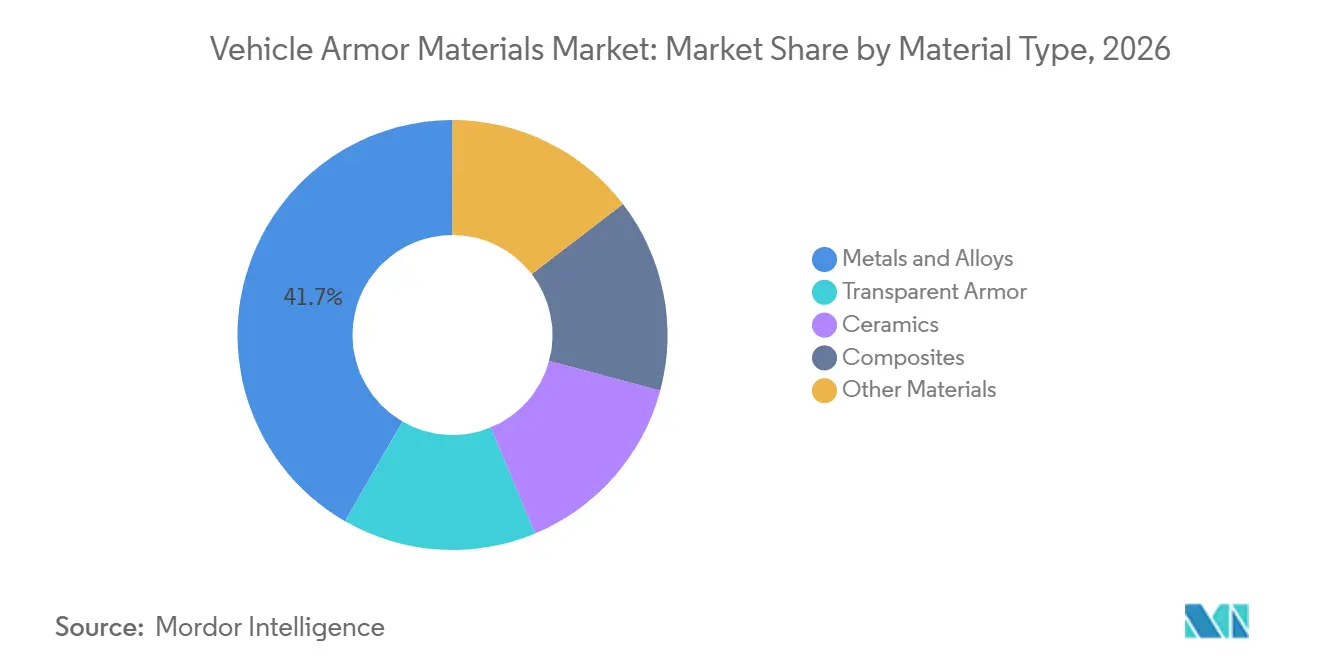
- By material type, metals and alloys held 41.67% of the vehicle armor materials market share in 2026, while ceramics are forecast to advance at a 7.34% CAGR through 2032.
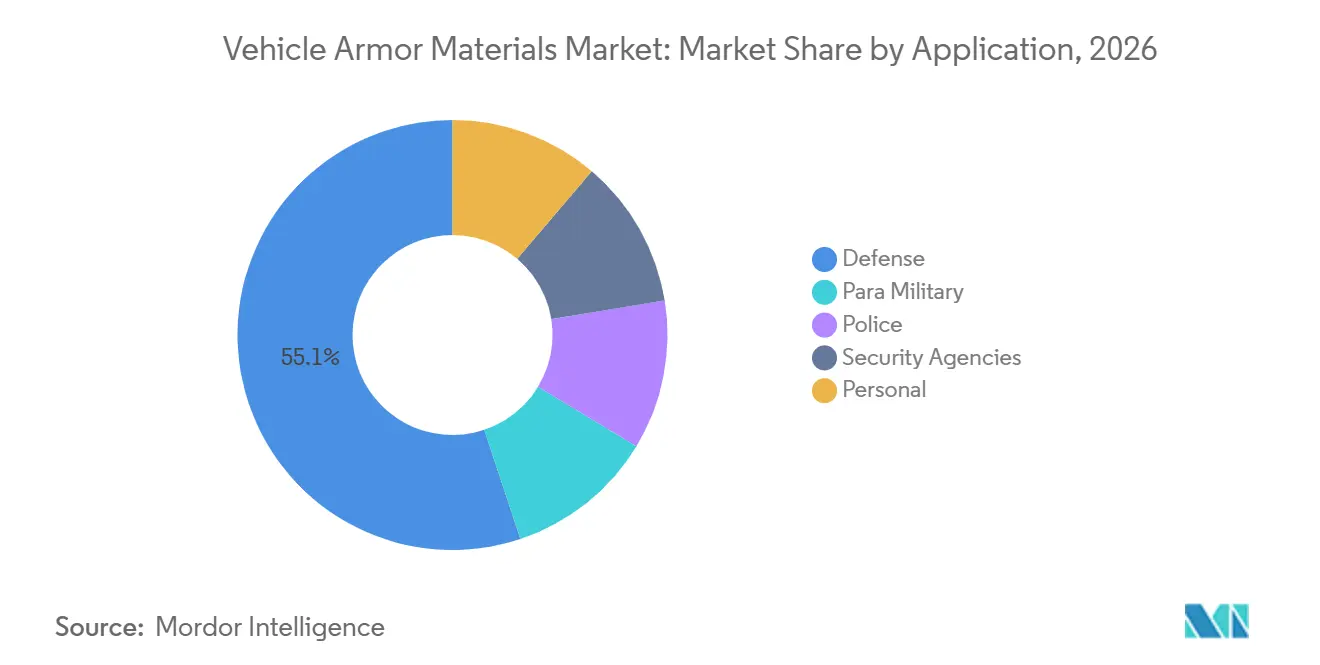
- By application, defense held 55.13% of the vehicle armor materials market share in 2026 and is forecast to advance at a 7.81% CAGR through 2032.
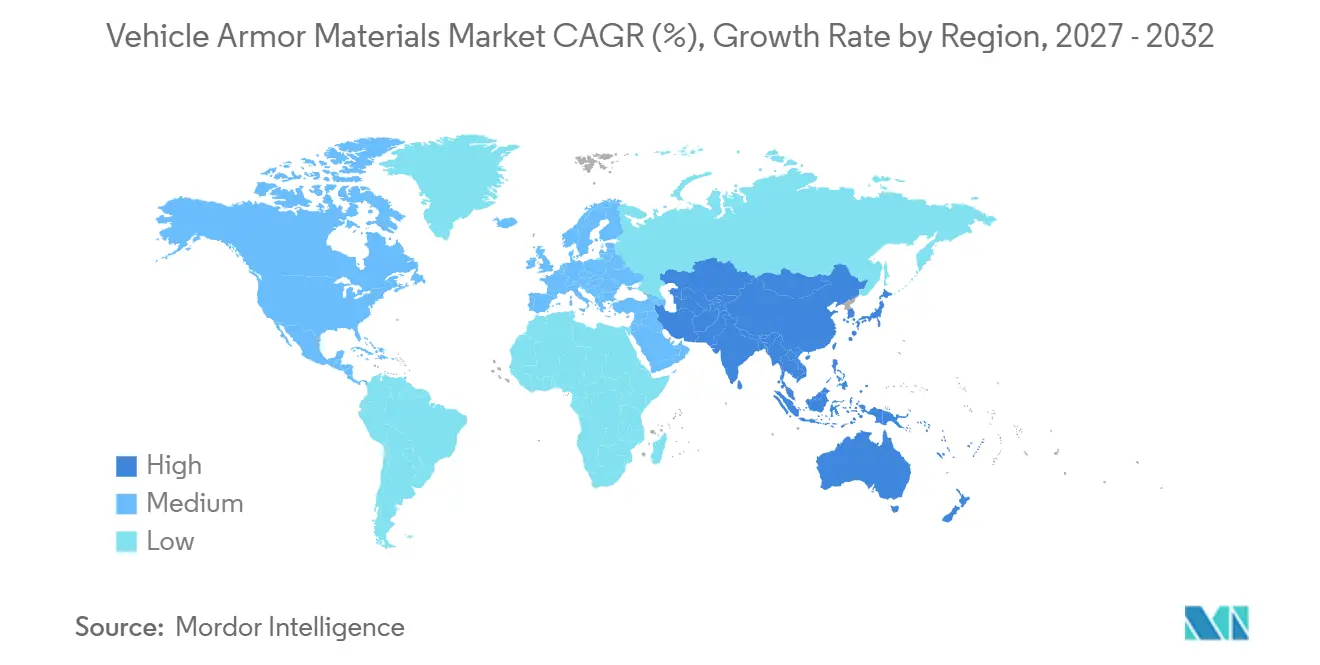
- By geography, North America held 34.51% of the vehicle armor materials market share in 2026, while Asia-Pacific is forecast to advance at a 7.63% CAGR through 2032.
Note: Market numbers in this report are based on Mordor Intelligence's proprietary estimation framework, which combines nine months of actuals with Q4 projections for base year 2026.
Market Trends and Insights
Drivers Impact Analysis of Vehicle Armor Materials Market*
| Driver | (~) % Impact on CAGR Forecast | Geographic Relevance | Impact Timeline |
|---|---|---|---|
| Military Fleet Modernization and Vehicle Upgrade Programs | +2.5% | Global, led by US, Germany, India, and South Korea | Medium term (2-4 years) |
| Rising Ballistic, Blast, Mine and Drone Threats | +1.8% | Global, concentrated in APAC, MEA, and Eastern Europe | Short term (≤ 2 years) |
| Lightweight Armor Substitution for Mobility and Payload Preservation | +1.2% | Global, led by US, Germany, and Israel | Medium term (2-4 years) |
| European Rearmament and Joint Defense Procurement | +0.9% | Europe-wide, with procurement links to North America and APAC supply chains | Short term (≤ 2 years) |
| Civilian, VIP, Cash-in-Transit and Critical-Infrastructure Protection | +0.6% | Global, led by MEA, Latin America, and high-risk urban centers | Long term (≥ 4 years) |
| Source: Mordor Intelligence | |||
Military Fleet Modernization and Vehicle Upgrade Programs
Major replacement and upgrade programs are creating multi-year material demand for the vehicle armor materials market. The U.S. Army advanced 2 industry teams for the XM30 program and planned delivery of 8 initial prototypes in 2026. The Fiscal Year (FY) 2027 request included USD 547 million for XM30 procurement activities. BAE Systems had delivered more than 500 Armored Multi-Purpose Vehicles to the U.S. Army by 2025. The program also received a USD 139.6 million contract modification for ongoing production. These programs sustain demand for armor during both new vehicle production and the modernization of existing fleets.
Rising Ballistic, Blast, Mine and Drone Threats
The range of threats addressed by vehicle protection requirements has widened since 2022. The U.S. Army allocated USD 91.7 million in its FY2026 budget for passive top-attack protection kits. The funding covers an Armored Brigade Combat Team fleet rather than a single vehicle platform. A 2025 Korean study identified active and electromagnetic protection as requirements alongside conventional ballistic armor for next-generation wheeled armored vehicles. These requirements make material selection part of a broader protection architecture. The vehicle armor materials market increasingly serves systems that combine armor with sensors, active protection, and vehicle survivability features.
Lightweight Armor Substitution for Mobility and Payload Preservation
Weight reduction has become central to vehicle protection decisions because mobility and payload remain operational requirements. Avient introduced Dyneema HB330 and HB332 hard ballistic materials in January 2025. The company stated that these materials can enable an armor system 45% lighter than first-generation Dyneema systems with equivalent ballistic performance. A 2025 research study found that layered Hardox 450, para-aramid, and ultra-high-molecular-weight polyethylene structures met NATO Standardization Agreement (STANAG) 4569 Level I requirements at 52.9 kg/m². The vehicle armor materials market is consequently shifting toward material combinations rather than single-material protection solutions. This shift links material selection directly to transportability and vehicle operating range.
European Rearmament and Joint Defense Procurement
European procurement is moving from broad policy commitments toward funded vehicle programs. Germany ordered 424 wheeled armored vehicles for EUR 7 billion in October 2026, including a EUR 3.5 billion framework agreement for 274 scout vehicles. The package also included a EUR 3.4 billion agreement for Schakal infantry fighting vehicles through the Organisation for Joint Armament Co-operation. Finland established a multinational program office for the Common Armoured Vehicle System in September 2025[1]. The program had nearly 1,000 vehicles on order and EUR 60 million in European Union funding. These frameworks create a clearer demand base for the vehicle armor materials market across participating countries.
Restraints Impact Analysis of Vehicle Armor Materials Market*
| Restraint | (~) % Impact on CAGR Forecast | Geographic Relevance | Impact Timeline |
|---|---|---|---|
| High Qualification, Certification and Retesting Costs | -0.5% | Global, most acute in North America and Europe | Medium term (2-4 years) |
| Supply Concentration in Silicon Carbide and Specialty Fibers | -0.3% | Global, with risk concentrated in North America, EU, and APAC supplier hubs | Short term (≤ 2 years) |
| Protection-to-Weight Trade-offs and Vehicle Integration Constraints | -0.2% | Global, intensified for light tactical vehicle and air-transportable platforms | Long term (≥ 4 years) |
| Source: Mordor Intelligence | |||
High Qualification, Certification and Retesting Costs
Qualification and certification costs can delay the adoption of new armor materials. The National Institute of Justice issued 3 addenda to NIJ Standard 0101.07 through 2025[2]. The program also maintained an older compliant products list under NIJ Standard 0101.06 through at least 2029. Vehicle-scale testing under NATO STANAG 4569 covers multiple assessment stages and must be repeated when material or geometry changes. These requirements can extend development schedules and increase the financial burden for smaller producers. The vehicle armor materials market, therefore, has higher barriers to entry than standard industrial materials markets.
Supply Concentration in Silicon Carbide and Specialty Fibers
Silicon carbide and specialty fiber supply chains can constrain production of advanced armor systems. Silicon carbide provides a hard and lightweight strike face for ceramic armor designed for high protection levels. Para-aramid fiber also has a limited global supplier base, which increases exposure to disruption and export-control changes. ARCLIN completed its acquisition of DuPont’s Kevlar and Nomex businesses in April 2026 for USD 1.8 billion. The transaction changes the ownership structure for a widely specified source of para-aramid materials. Supply certainty is therefore an important consideration for the vehicle armor materials market.
*Our forecasts treat driver/restraint impacts as directional, not additive. The impact forecasts reflect baseline growth, mix effects, and variable interactions.
Vehicle Armor Materials Market Segment Analysis
By Material Type:
Metals and Alloys Anchor Revenue While Ceramics Drive InnovationMetals and alloys held 41.67% of the vehicle armor materials market share in 2026. Their position reflects their weldability, repairability, and cost performance for large vehicle structures. SSAB AB produces the Armox protection steel family for vehicle protection applications. Armox 500T is produced at SSAB AB’s Mobile, Alabama facility. ATI reported a 14% increase in defense sales during fiscal year 2025. Its titanium and nickel-based alloys support lightweight components in defense applications. Aluminum alloys also serve lighter armored personnel carriers and amphibious platforms where weight and buoyancy are important. Metals and alloys remain the practical base material for many hull panels, structural elements, and upgrade packages. Their established processing routes also support maintenance across long vehicle service lives.
Ceramics are projected to advance at a 7.34% CAGR through 2032 within the vehicle armor materials market. A 2025 study found that silicon carbide front layers dissipated 70% of kinetic energy in multilayer armor structures. CeramTec GmbH produces ALOTEC and SICADUR ballistic ceramics for high-protection applications. Its PERLUCOR transparent ceramic is used for vehicle vision systems and protected windows. CoorsTek Inc. and Morgan Advanced Materials also supply ceramic and advanced material options for protection programs. Composites based on ultra-high-molecular-weight polyethylene and para-aramid are used in add-on armor and spall liners. Transparent armor demand also grows when patrol and command vehicles require wider protected visibility. Material selection increasingly combines metals, ceramics, fibers, and transparent systems to meet the required protection level.

By Application:
Defense Drives Both Revenue and GrowthDefense held 55.13% of the vehicle armor materials market share in 2026 and is projected to advance at a 7.81% CAGR through 2032. The U.S. Congress provided USD 5 billion for selected ground systems in FY2026. This included funding for Abrams modifications, Armored Multi-Purpose Vehicles, Stryker upgrades, and XM30 development. Defense demand combines new vehicle programs with the modernization of fielded fleets. That combination supports consumption of armor steel, ceramic tiles, composite panels, and specialty fibers. Program scale also allows suppliers to validate materials across large production runs. Defense customers generally require materials that can meet defined specifications and sustain delivery over many years. This application, therefore, remains central to the vehicle armor materials market.
Larsen & Toubro and BAE Systems received an Indian Army contract in November 2025 for licensed production of BvS10 Sindhu all-terrain armored vehicles. The arrangement uses local production with technical support from BAE Systems Hägglunds. Para Military, Police, Security Agencies, and Personal applications are smaller contributors to demand. They use many of the same lightweight panels and modular inserts proven through defense procurement. The National Institute of Justice’s revised protection taxonomy can influence law-enforcement procurement requirements. Civilian security buyers also value lower vehicle weight because it can support maneuverability and payload. The Vehicle Armor Materials industry can apply defense-developed materials across these related protection needs. The vehicle armor materials market thus benefits when platforms and protection requirements transfer across public safety and security uses.
Geography Analysis
North America held 34.51% of the vehicle armor materials market share in 2026. The region combines major ground vehicle procurement programs with a dense base of armor material producers. General Dynamics described active programs that include Abrams, Stryker, Armored Multi-Purpose Vehicle, Ajax, Light Armored Vehicle (LAV), and Piranha platforms. The U.S. Army’s planned ground-system spending provides an important demand foundation for steel, ceramics, and composite materials. Oshkosh Corporation received a USD 167 million order for its Family of Heavy Tactical Vehicles program in 2025. These programs support material demand through both production and sustainment cycles.
Europe is supported by funded vehicle programs and multinational procurement structures. Germany’s October 2026 vehicle package adds visibility for platform builders and armor suppliers. The Common Armoured Vehicle System demonstrates how shared programs can aggregate requirements across national fleets. The European Commission’s roadmap identifies armored mobility as a capability priority. European vehicle programs use protection steels, ceramics, and composite systems from regional and international suppliers. The vehicle armor materials market is supported when vehicle production, upgrades, and long-term logistics are coordinated across several countries.
Asia-Pacific is projected to advance at a 7.63% CAGR through 2032 in the vehicle armor materials market. India’s Future Ready Combat Vehicle program is intended to replace nearly 1,800 T-72 tanks. Armoured Vehicles Nigam Limited received contracts in September 2025 to overhaul 40 T-90 tanks and 100 BMP-2 vehicles. South America and Middle East and Africa remain smaller regional contributors, with demand linked to tactical vehicle purchases and security requirements. Morocco received its first Oshkosh M-ATV vehicles in June 2025, while Uruguay deployed M-ATV and MK23 vehicles in May 2025.
Competitive Landscape
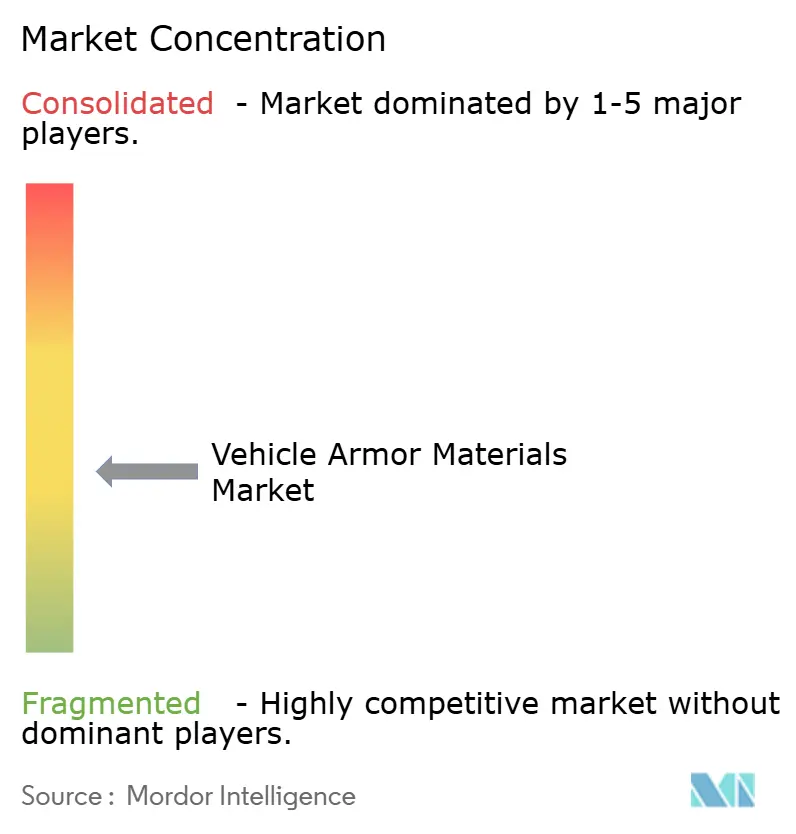
The vehicle armor materials market is moderately concentrated, with the top five players including DuPont, SSAB AB, CeramTec GmbH, Morgan Advanced Materials, and Teijin Limited. Producers compete on protection performance, weight, certification, technical support, and reliable supply. ARCLIN completed the acquisition of DuPont’s Kevlar and Nomex businesses in April 2026 for USD 1.8 billion. The transaction consolidated an important source of para-aramid materials under ARCLIN. Hexcel Corporation and KONGSBERG signed a 5-year agreement in June 2025 covering HexWeb honeycomb and HexPly prepreg materials for defense production. Hexcel Corporation also introduced Hy-Bor carbon-boron fiber prepreg technology under a Phase II Small Business Innovation Research contract. These moves show how suppliers seek long-term positions in platform supply chains. The vehicle armor materials industry rewards material producers who establish specifications before vehicle procurement decisions are finalized.
Teijin Limited introduced Twaron Next in November 2025 as a circular-content para-aramid that retained the ballistic performance of its virgin-fiber variant. SSAB AB is investing in an electric arc furnace-based steel mill in Luleå that is expected to begin operations by late 2029. The project is intended to support recycled steel and fossil-free energy production. Research is also examining additive-manufactured ceramic parts and bio-inspired ceramic composite structures. A 2025 study reported 20% higher energy absorption for a bio-inspired aluminum oxide and ultra-high-molecular-weight polyethylene configuration than a conventional flat plate design. These developments expand the choices available to the vehicle armor materials market without eliminating the need for proven materials and platform qualification.
Vehicle Armor Materials Industry Leaders
-
DuPont
-
SSAB AB
-
CeramTec GmbH
-
Morgan Advanced Materials
-
Teijin Limited
- *Disclaimer: Major Players sorted in no particular order
Vehicle Armor Materials Market Companies Covered in this Report
- ARCLIN
- Alcoa Corporation
- ATI Inc.
- Avient Corporation
- BAE Systems
- CeramTec GmbH
- CoorsTek Inc.
- DuPont
- General Dynamics Corporation
- Hexcel Corporation
- Honeywell International Inc.
- Jankel Tactical Systems
- Morgan Advanced Materials
- Northrop Grumman
- Oshkosh Corporation
- SSAB AB
- Teijin Limited
Recent Industry Developments in Vehicle Armor Materials Market
- July 2026: AGP sGlass introduced its i-B33 PRO transparent armor solution, designed to reduce the weight of ballistic glass while maintaining optical clarity and protective performance. The development supports the vehicle armor materials market by advancing lightweight transparent protection for armored vehicles and reducing the weight burden associated with conventional ballistic glazing.
- February 2026: Rheinmetall AG presented a modular military body armor system at Enforce Tac 2026, combining soft ballistic protection with configurable hard armor inserts. Although designed primarily for personnel rather than vehicles, the development supports the broader vehicle armor materials market indirectly by highlighting advances in modular ballistic protection and high-performance armor materials.
Global Vehicle Armor Materials Market Report Scope
Vehicle armor materials are specialized materials designed to protect vehicles and occupants against ballistic threats, blasts, and other physical impacts. They provide protection while balancing weight, structural integrity, and mobility requirements across defense and security applications.
The Vehicle Armor Materials Market is segmented by material type, application, and geography. By material type, the market is segmented into metals and alloys, ceramics, composites, transparent armor, and other materials. By application, the market is segmented into defense, para military, police, security agencies, and personal use. The report also covers the market size and forecasts for vehicle armor materials across 16 countries. For each segment, the market sizing and forecasts have been done on the basis of value (USD).
Segmentation Overview
| Metals and Alloys |
| Ceramics |
| Composites |
| Transparent Armor |
| Other Materials |
| Defense |
| Para Military |
| Police |
| Security Agencies |
| Personal |
| Asia-Pacific | China |
| India | |
| Japan | |
| South Korea | |
| ASEAN Countries | |
| Rest of Asia-Pacific | |
| North America | United States |
| Canada | |
| Mexico | |
| Europe | Germany |
| United Kingdom | |
| France | |
| Italy | |
| NORDIC Countries | |
| Russia | |
| Rest of Europe | |
| South America | Brazil |
| Argentina | |
| Rest of South America | |
| Middle East and Africa | Saudi Arabia |
| South Africa | |
| Rest of Middle East and Africa |
| By Material Type | Metals and Alloys | |
| Ceramics | ||
| Composites | ||
| Transparent Armor | ||
| Other Materials | ||
| By Application | Defense | |
| Para Military | ||
| Police | ||
| Security Agencies | ||
| Personal | ||
| By Geography | Asia-Pacific | China |
| India | ||
| Japan | ||
| South Korea | ||
| ASEAN Countries | ||
| Rest of Asia-Pacific | ||
| North America | United States | |
| Canada | ||
| Mexico | ||
| Europe | Germany | |
| United Kingdom | ||
| France | ||
| Italy | ||
| NORDIC Countries | ||
| Russia | ||
| Rest of Europe | ||
| South America | Brazil | |
| Argentina | ||
| Rest of South America | ||
| Middle East and Africa | Saudi Arabia | |
| South Africa | ||
| Rest of Middle East and Africa | ||
Key Questions Answered in the Report
What is the size of the vehicle armor materials market?
The vehicle armor materials market size was valued at USD 8.32 billion in 2026 and is estimated to grow from USD 8.85 billion in 2027 to reach USD 12.28 billion by 2032, at a CAGR of 6.78% during the forecast period (2027-2032).
Which material type held the largest share in 2026?
Metals and alloys held 41.67% share in 2026 because they remain widely used in vehicle structures, hull panels, and armor upgrades.
Which material type is projected to advance fastest through 2032?
Ceramics are projected to advance at a 7.34% CAGR through 2032, supported by their role in lightweight, high-protection multilayer systems.
What application held the largest share in 2026?
Defense held a 55.13% share in 2026, supported by new vehicle programs and fleet upgrades.