
Vegetable Capsules Market Size and Share
Market Overview
| Study Period | 2021 - 2032 |
|---|---|
| Market Size (2027) | USD 2.09 Billion |
| Market Size (2032) | USD 3.15 Billion |
| Growth Rate (2027 - 2032) | 8.52 % |
| Fastest Growing Market | Asia-Pacific |
| Largest Market | North America |
| Market Concentration | Medium |
Major Players *Disclaimer: Major Players sorted in no particular order Image © Mordor Intelligence. Reuse requires attribution under CC BY 4.0. | |
Vegetable Capsules Market Analysis by Mordor Intelligence
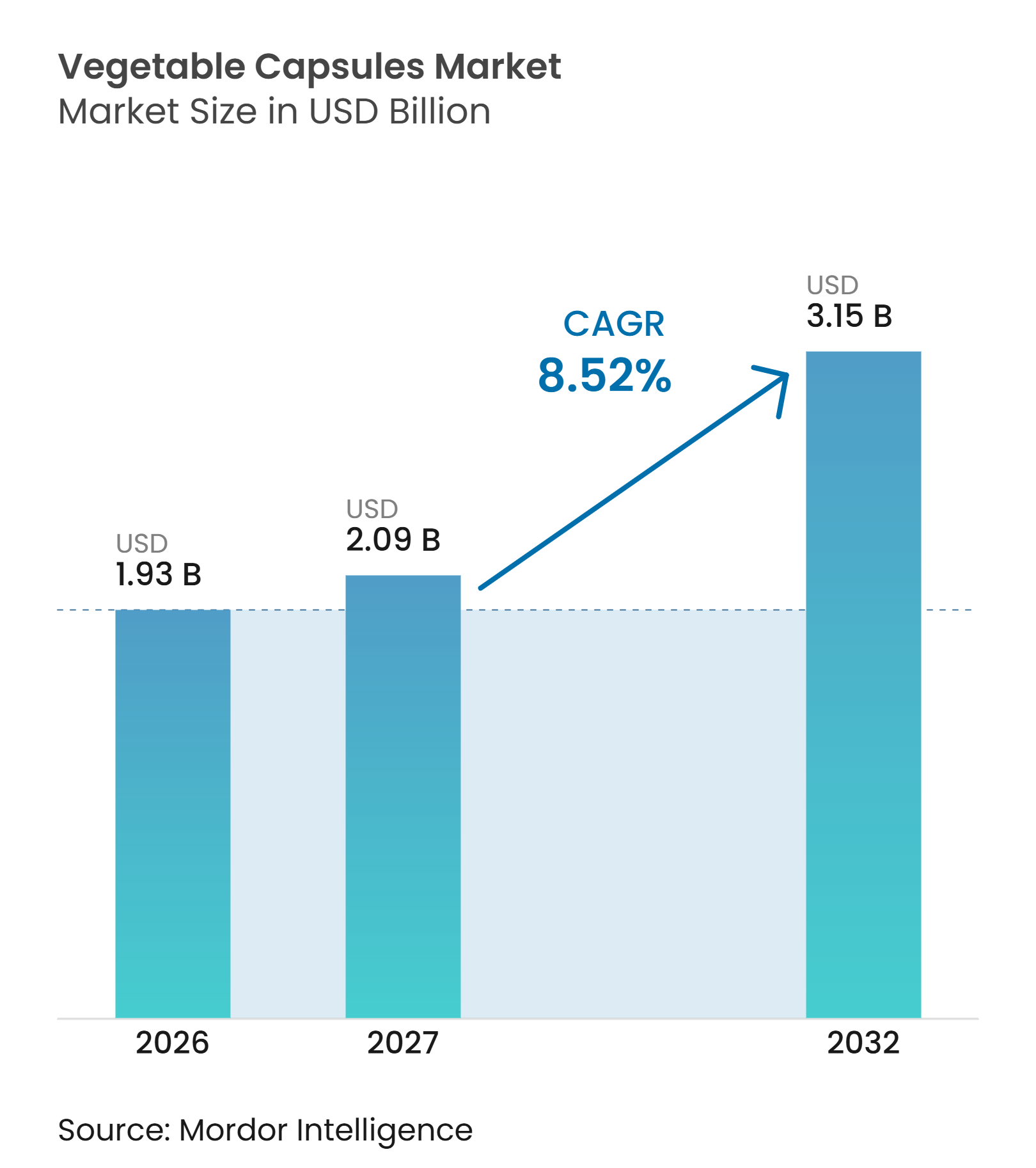
The vegetable capsules market size is expected to be valued at USD 1.93 billion in 2026. It is projected to grow from USD 2.09 billion in 2027 to USD 3.15 billion by 2032, registering a CAGR of 8.52% during the forecast period of 2027-2032. The vegetable capsules market is expanding as drug developers and supplement brands reduce reliance on gelatin-based supply chains. Vegetarian, vegan, halal, kosher, and clean-label requirements are making plant-derived shells more relevant to formulation and registration decisions. Moisture-sensitive products also support the shift because HPMC and pullulan can offer functional benefits for certain ingredients. Investment in local production is changing the competitive balance, especially where manufacturers seek shorter lead times and less exposure to import disruption. Cost premiums, volatile HPMC inputs, and lengthy supplier qualification cycles continue to limit adoption in price-sensitive applications.
Key Report Takeaways
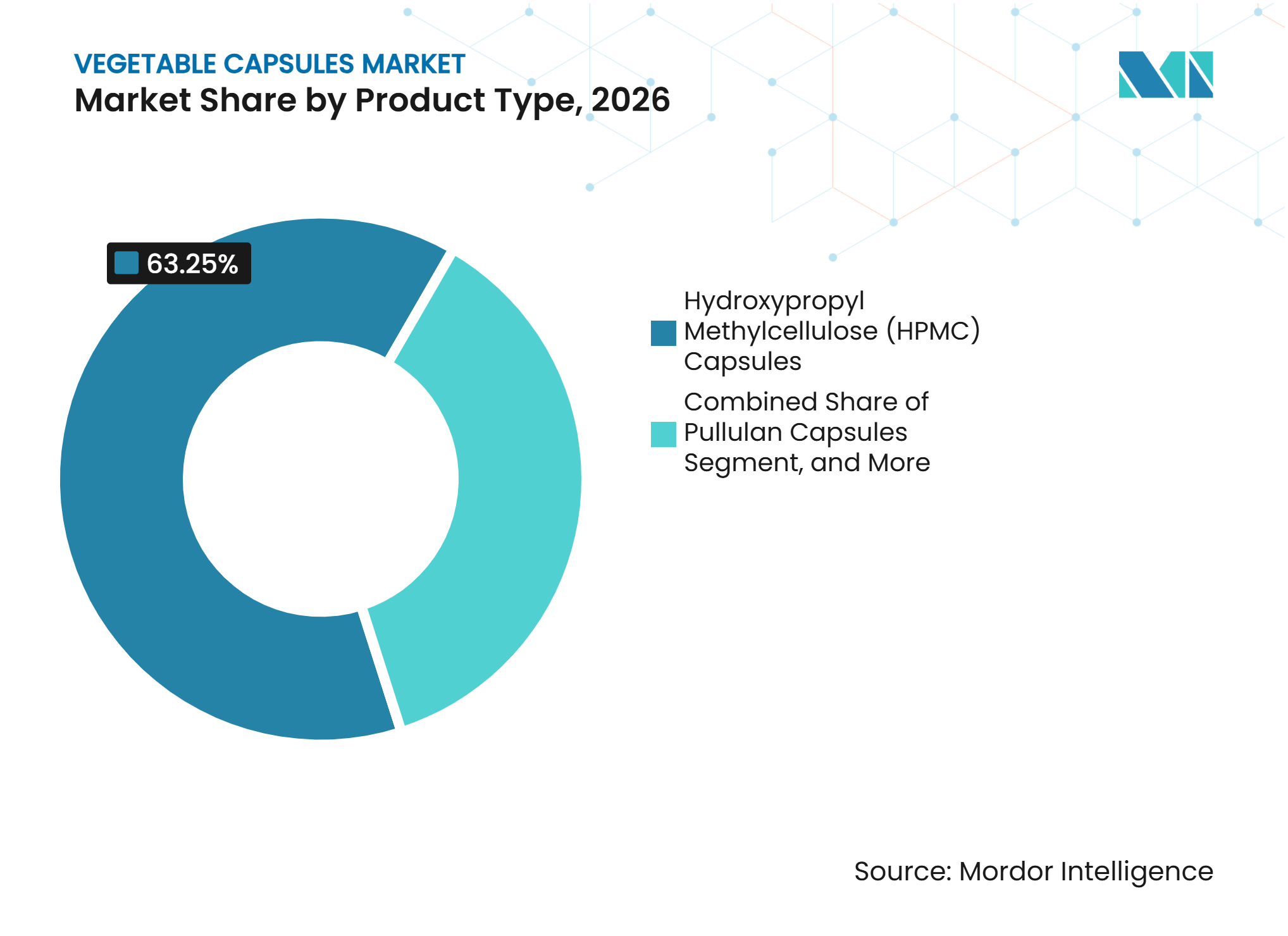
- By product type, HPMC capsules held 63.25% of the vegetable capsules market share in 2026, while pullulan capsules are projected to grow at an 8.82% CAGR through 2032.
- By source, cellulose-based capsules accounted for 65.47% of the vegetable capsules market share in 2026, while pullulan-based capsules are forecast to expand at a 9.33% CAGR through 2032.
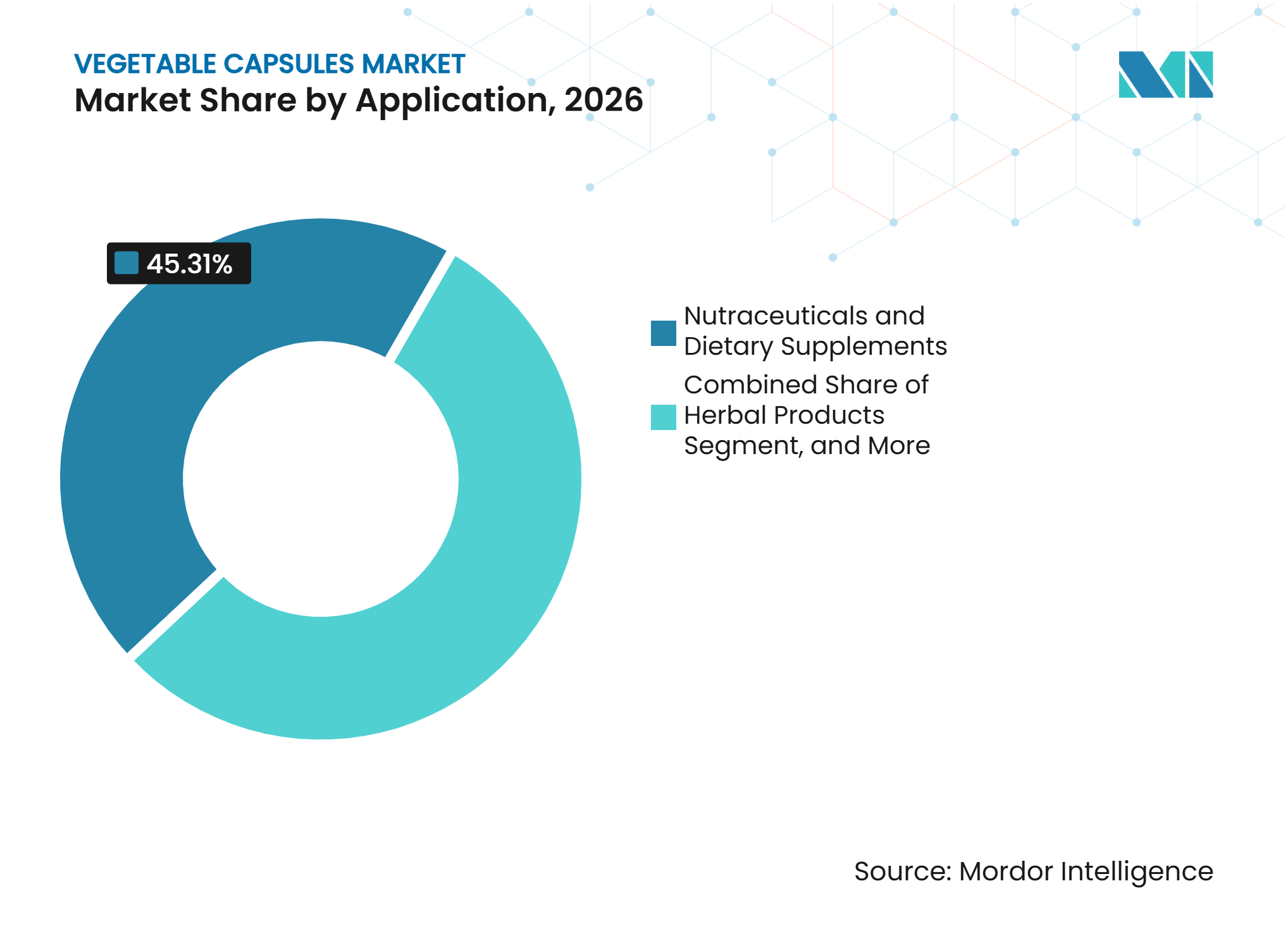
- By application, nutraceuticals and dietary supplements accounted for 45.31% of the vegetable capsules market size in 2026, while herbal products are forecast to grow at a 9.57% CAGR through 2032.
- By end user, nutraceutical companies held 43.78% of revenue in 2026, while CRO and CDMO companies are forecast to advance at a 9.84% CAGR through 2032.
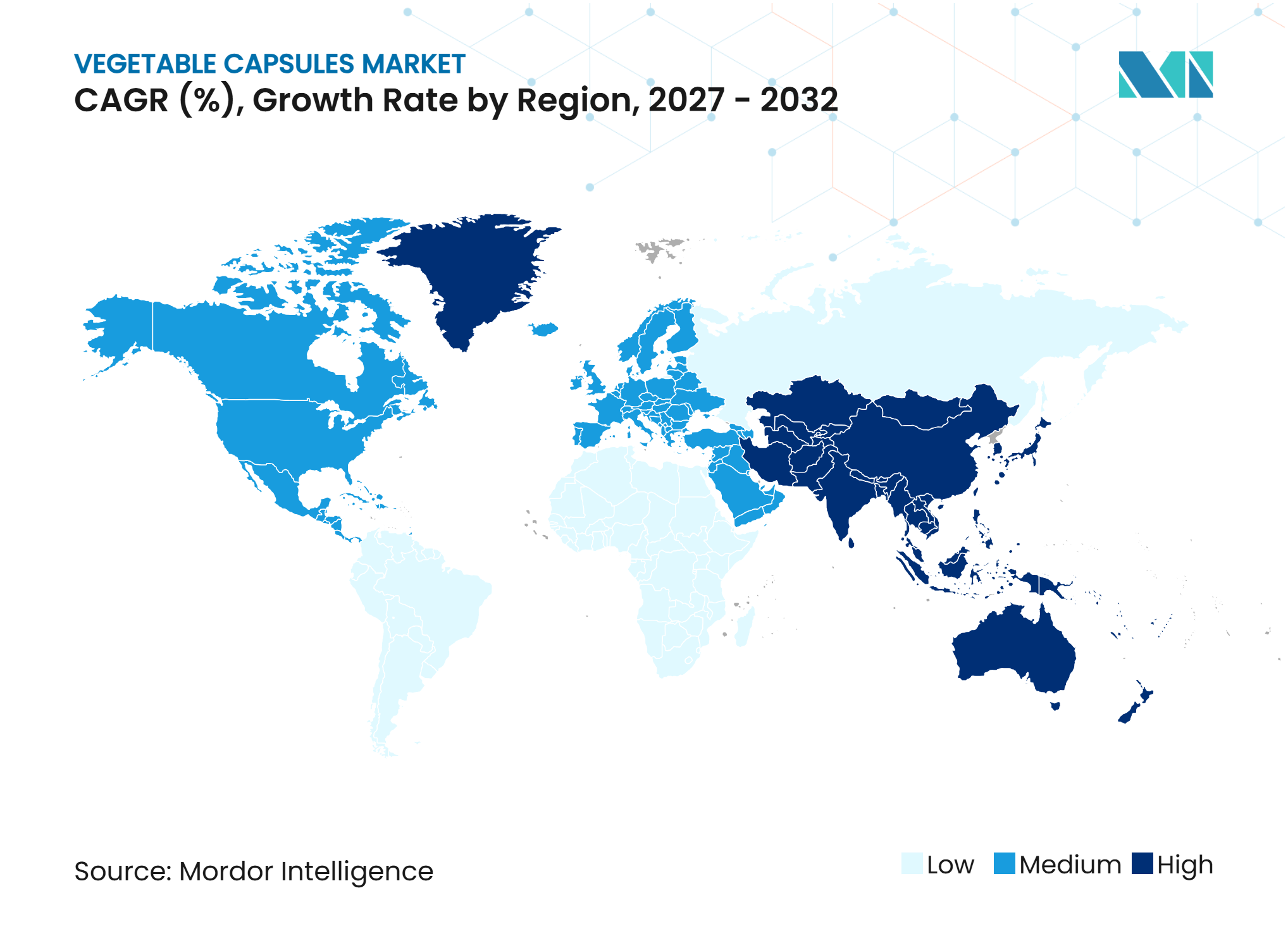
- By geography, North America held 36.94% of revenue in 2026, while Asia-Pacific is projected to grow at a 10.56% CAGR through 2032.
Note: Market numbers in this report are based on Mordor Intelligence's proprietary estimation framework, which combines nine months of actuals with Q4 projections for base year 2026.
Market Trends and Insights
Drivers Impact Analysis of Vegetable Capsules Market*
| Driver | (~) % Impact on CAGR Forecast | Geographic Relevance | Impact Timeline |
|---|---|---|---|
| Rising Demand for Vegetarian, Vegan, and Clean-Label Dosage Forms | +1.8% | Global, with premium intensity in North America and Europe | Medium term (2-4 years) |
| Expansion of Nutraceuticals, Functional Nutrition, and Preventive Healthcare | +1.6% | Global, strongest in Asia-Pacific and North America | Long term (≥ 4 years) |
| Increasing Pharmaceutical and Nutraceutical Manufacturing in Asia-Pacific | +1.3% | Asia-Pacific core, including India and China, with spillover to South Korea and Japan | Long term (≥ 4 years) |
| Growing Use of Plant-Based Capsules for Moisture-Sensitive Formulations | +1.0% | North America and Europe, with spillover to Asia-Pacific pharmaceutical exporters | Medium term (2-4 years) |
| TiO₂-Free and Natural-Color Reformulation of Capsule Shells | +0.8% | Europe-led, with global follow-through for export compliance | Short term (≤ 2 years) |
| Localized HPMC Capacity Reducing Lead Times and Import Exposure | +0.7% | North America, with follow-on impact in Europe | Short term (≤ 2 years) |
| Source: Mordor Intelligence | |||
Rising Demand for Vegetarian, Vegan, and Clean-Label Dosage Forms
Dietary ethics, religious certification, and clean-label positioning are expanding the addressable base of the vegetable capsules market. These criteria matter to supplement brands, but they also affect pharmaceutical products intended for halal and kosher markets. Lonza Capsugel stated that organic ingredients influenced 73% of North American consumers and 54% would pay more for organic-certified products. The company launched Organicaps in October 2025 as a USDA-organic-certified, plant-based pullulan capsule manufactured in North America. This product direction shows that organic certification can distinguish premium capsule offerings rather than function solely as a consumer-facing claim. The vegetable capsules market therefore benefits where brand owners need both formulation performance and documented certification.
Expansion of Nutraceuticals, Functional Nutrition, and Preventive Healthcare
Nutraceutical growth supports the vegetable capsules market because capsules remain a practical format for probiotics, enzymes, mushroom powders, and similar products. Product development is increasingly centered on formulas that pair active ingredients with stability requirements. HPMC capsules can support low-moisture formulations that need protection from humidity without refrigeration. More evidence-led formulations make shell performance relevant to the final product’s positioning. This relationship gives the vegetable capsules market exposure to preventive-health portfolios rather than only to lifestyle-led product launches. It also makes manufacturing consistency important for brands seeking repeat purchases and wider distribution.
Growing Use of Plant-Based Capsules for Moisture-Sensitive Formulations
The vegetable capsules market is supported by formulations that are sensitive to moisture or oxygen. The supplied material states that HPMC capsules typically contain 2% to 5% moisture, compared with 12% to 16% for gelatin. This difference supports use in probiotics, botanical extracts, mineral salts, and selected pharmaceutical products where humidity can affect stability. Pullulan has also been positioned for formulations where oxygen transmission can limit shelf life, including omega-3, CoQ10, and botanical antioxidant products. Specialty capsule formats can also include enteric and controlled-release options for products with defined release requirements. These uses broaden the value proposition beyond simple replacement of gelatin shells.
Increasing Pharmaceutical and Nutraceutical Manufacturing in Asia-Pacific
Asia-Pacific manufacturing strengthens the vegetable capsules market through both local demand and export-oriented pharmaceutical production. The supplied material reports that India’s pharmaceutical exports reached USD 28.29 billion in April through February of FY2026, an increase of 5.6% from the comparable earlier period. India’s revised Schedule M framework became fully applicable from January 2026, raising the importance of quality systems for manufacturers that serve regulated export markets. The regional production base gives formulators access to local capsule suppliers and supports pharmaceutical export activity. It also increases the value of multi-pharmacopoeial documentation for manufacturers serving several destinations. The vegetable capsules market is consequently supported by producers and formulators that require consistent quality systems for international supply.
Restraints Impact Analysis of Vegetable Capsules Market*
| Restraint | (~) % Impact on CAGR Forecast | Geographic Relevance | Impact Timeline |
|---|---|---|---|
| Higher Production Cost Compared with Gelatin Capsules | -1.0% | Global, most acute in price-sensitive Asia-Pacific and South America | Long term (≥ 4 years) |
| Volatility in HPMC, Cellulose Pulp, and Energy Input Costs | -0.8% | Global, with highest exposure in India- and China-dependent supply chains | Medium term (2-4 years) |
| Lengthy GMP Qualification and Multi-Pharmacopoeial Compliance | -0.6% | Global, with longest delays for new entrants in regulated European and U.S. markets | Long term (≥ 4 years) |
| Regional Variability in Moisture-Controlled Storage and Transport | -0.5% | Middle East and Africa, South America, and South and Southeast Asia | Medium term (2-4 years) |
| Source: Mordor Intelligence | |||
Higher Production Cost Compared with Gelatin Capsules
Vegetable capsule shells remain more expensive than gelatin at comparable order volumes, limiting the vegetable capsules market in price-led applications. The supplied pricing benchmarks place the HPMC premium at 30% to 80% over gelatin in FOB China export markets.[1] Higher HPMC raw-material costs, energy-intensive dip molding, and lower throughput contribute to this gap. ACG has argued that fill stability, reduced rework, and lower regulatory risk can narrow the total ownership cost difference.[2] These benefits do not remove the initial price barrier for high-volume commodity pharmaceutical products. The constraint is especially important in South America and Southeast Asia, where procurement often favors the least-cost qualified shell.
Volatility in HPMC, Cellulose Pulp, and Energy Input Costs
HPMC input volatility can place pressure on capsule margins and contract pricing. The supplied material indicates annual variability of 18% to 22% for capsule-grade HPMC, linked to a concentrated supply base, cellulose pulp cycles, and energy costs. Manufacturers without long-term supply agreements have less protection from these movements. This supply structure gives cellulose ether producers material influence over smaller capsule manufacturers. The constraint is more severe when energy costs rise in major chemical-processing locations. It favors capsule producers with vertical integration, larger purchasing scale, or established supplier contracts.
*Our forecasts treat driver/restraint impacts as directional, not additive. The impact forecasts reflect baseline growth, mix effects, and variable interactions.
Vegetable Capsules Market Segment Analysis
By Product Type:
HPMC Leads as Pullulan Commands a PremiumHPMC capsules held 63.25% of revenue in 2026. Their position reflects compatibility with high-speed encapsulation equipment and established acceptance across the USP, Ph. Eur., and JP pharmacopeias. Gelling-aid-free versions also support formulations seeking a simpler ingredient statement. The material’s FDA GRAS status and existing Drug Master File infrastructure strengthen its fit with pharmaceutical customers. These factors make HPMC the principal volume platform in the vegetable capsules industry.
Pullulan capsules are forecast to expand at an 8.82% CAGR from 2027 to 2032, the highest rate among product types. Their oxygen-barrier properties make them relevant to premium nutraceutical products with shelf-life requirements. Starch-based capsules retain a narrower role where pricing or formulation chemistry favors a plant-starch shell. Other products include specialty formats such as enteric and dry-powder inhalation HPMC grades. Product development in the vegetable capsules market is moving toward applications that can support a premium over conventional shells.



By Source:
Cellulose-Based Anchors Volume as Pullulan-Based Grows FastestCellulose-based materials accounted for 65.47% of the vegetable capsules market size in 2026. HPMC is derived from wood pulp through a cellulose ether synthesis route and has a long regulatory record. Major cellulose ether producers also support an established upstream supply chain for this segment. Existing formulation documentation and equipment compatibility reinforce the segment’s position. This supplier ecosystem makes cellulose-based products difficult to displace in regulated, high-volume uses. Its scale continues to anchor supply across pharmaceutical and supplement applications.
Pullulan-based products are forecast to grow at a 9.33% CAGR from 2027 to 2032. Lonza Capsugel’s October 2025 Organicaps launch showed a route for pullulan to serve brands that need both organic certification and a plant-based shell.[3] The material is attractive where oxygen protection and organic positioning justify a higher unit cost. Starch-based sources remain relevant in selected herbal and price-sensitive applications. Cellulose-based materials retain a structural advantage through documentation, supplier availability, and established production practice. The vegetable capsules market will therefore continue to combine high-volume cellulose demand with a smaller premium pullulan segment.
By Application:
Nutraceuticals Lead as Herbal Products Show Highest MomentumNutraceuticals and dietary supplements accounted for 45.31% of the vegetable capsules market size in 2026. The segment is driven by capsule material claims that are visible to consumers, including vegan, organic, halal, kosher, and allergen-free positioning. Supplement brands often select plant-based shells as part of the finished product’s label proposition. Product launches involving probiotics, enzymes, and botanical ingredients also create demand for low-moisture shell formats. This combination gives nutraceutical products a central role in the vegetable capsules market. It also makes certification and shelf-life performance relevant to purchasing decisions.
Herbal products are forecast to grow at a 9.57% CAGR from 2027 to 2032. Botanical extracts can present moisture and oxidation challenges that favor HPMC or pullulan over gelatin. This demand is based on formulation stability as well as ethical positioning. Pharmaceutical uses remain the second-largest application, although gelatin retains a wider role in the broader pharmaceutical capsule field. Export dossiers for halal and vegetarian markets support gradual conversion to plant-based shells in the Gulf Cooperation Council, Southeast Asia, and South Asia. Cosmetics, personal care, veterinary pharmaceuticals, and specialty food products add smaller sources of application diversity.

By End User:
Nutraceutical Firms Anchor Share as CRO and CDMOs Drive GrowthNutraceutical companies held 43.78% of revenue in 2026. These customers adopted vegetable shells early because vegan and halal claims can directly influence retail product positioning. Preventive-wellness portfolios are also increasing the number of capsule-based stock-keeping units used by these companies. Established supplement brands need reliable access to certified shell types across multiple products. Nutraceutical firms are therefore the leading end-user group in the vegetable capsules market.
CRO and CDMO companies are projected to grow at a 9.84% CAGR from 2027 to 2032. Virtual pharmaceutical companies and biotechnology firms increasingly depend on contract partners for oral solid dosage development and manufacturing. CDMOs with pre-qualified HPMC suppliers and multi-pharmacopoeial Drug Master Files can support simultaneous filings in the United States, Europe, and Japan. This documentation can improve their appeal to clients that need multi-market regulatory submissions. Pharmaceutical companies remain the second-largest end-user group. Their use of dossier-registered vegetable shells is smaller in volume but can generate higher value per capsule than nutraceutical-grade supply.
Geography Analysis
North America: Infrastructure and Compliance Intensity Drive Scale
North America held 36.94% of revenue in 2026. The region combines high supplement consumption with pharmaceutical manufacturing requirements that support demand for USP and NF-compliant plant-based shells. FDA good manufacturing practice requirements under 21 CFR Part 111 and traceability requirements under DSHEA support purchasing from suppliers with validated quality systems. ACG announced a phased USD 200 million investment in Atlanta in October 2025 for its first U.S. hard-shell capsule manufacturing operations, with early 2027 operations planned. SD Head USA also announced a USD 65 million North Carolina plant in November 2025 with capacity exceeding 20 billion HPMC capsules each year. These investments show that local capacity, regulatory responsiveness, and tariff resilience are becoming more important in the vegetable capsules market.
Asia-Pacific: Manufacturing Expansion Supports Demand
Asia-Pacific is projected to grow at a 10.56% CAGR from 2027 to 2032. India’s export-oriented pharmaceutical sector creates demand for capsules supported by established quality documentation. The revised Schedule M framework has been fully applicable since January 2026, raising compliance expectations for drug manufacturers. The region’s growing supplement activity gives the vegetable capsules market a separate demand base alongside contract manufacturing. China, South Korea, and Japan add substantial manufacturing capability and higher-value product demand. Sustainability preferences and consumer-health spending support interest in pullulan and specialty HPMC products across selected markets.
Europe, South America, and the Middle East and Africa: Regulatory and Certification Needs Shape Adoption
Europe’s TiO₂ food and supplement restrictions continue to influence reformulation of capsule shells. The supplied material states that TiO₂ remains permitted in medicines, while the food supplement ban remains in force. This distinction encourages suppliers to develop TiO₂-free alternatives for the supplement channel. Brazil and Argentina offer earlier-stage demand through nutraceutical manufacturing, although the cost gap with gelatin remains a constraint. Gulf Cooperation Council markets place importance on authenticated halal and kosher documentation for imports. South Africa and other Middle East and Africa pharmaceutical markets add incremental demand where certification and supply-chain compliance affect supplier choice.
Competitive Landscape
Market Concentration
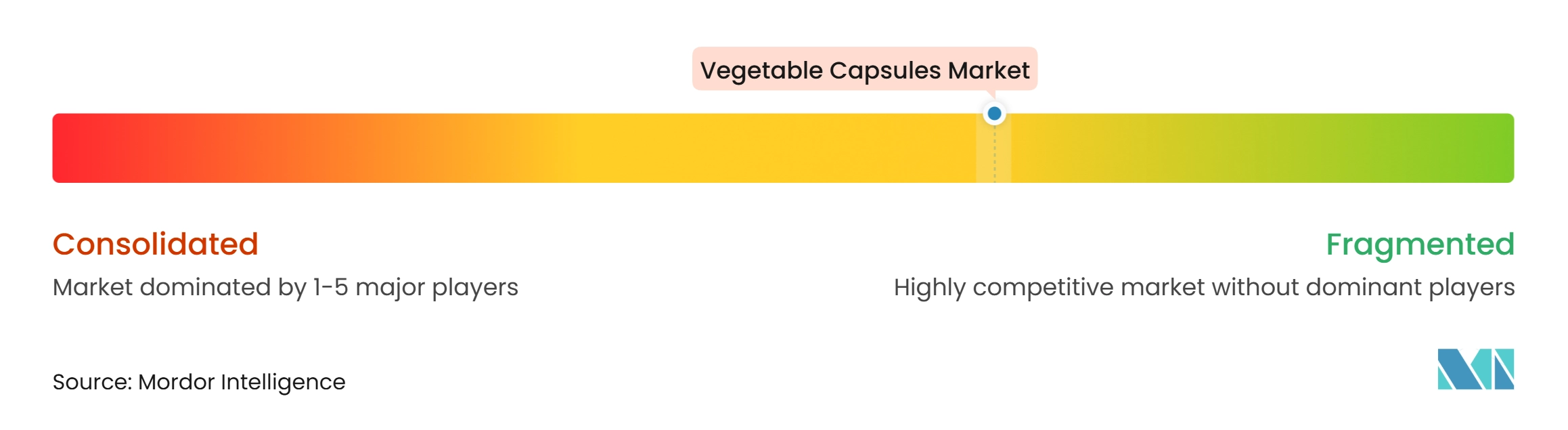
The vegetable capsules market is moderately concentrated, with globally integrated manufacturers holding significant pharmaceutical-grade volume and regional producers competing on price, capacity, and certification. Lonza agreed in March 2026 to divest its Capsules and Health Ingredients business to Lone Star Funds for an enterprise value of CHF 2.3 billion, equal to USD 3 billion in the supplied draft, while retaining a 40% stake. The transaction places the Vcaps, Plantcaps, and Organicaps product lines under a standalone ownership structure. Lonza’s change in ownership may increase commercial focus on the capsule platform. It also underscores the value assigned to established capsule portfolios with global regulatory credentials.
ACG is pursuing capacity expansion and product differentiation in the vegetable capsules market. Its Atlanta investment targets both gelatin and HPMC hard-shell capsules and is designed to create a U.S. production base. Lonza Capsugel’s Organicaps launch is another example of differentiation through organic-certified pullulan capsules. These strategies place greater emphasis on locally available capacity, specialized shell properties, and evidence supporting certification claims.
Chinese producers, including Shandong Head Group, Zhejiang Honghui, and Shanxi Guangsheng, compete through vertically integrated supply from HPMC powder to capsule shells. This structure can improve control over cost and raw-material availability. Certification investment also supports their effort to supply premium Western customers. Pharmaceutical customers continue to require Drug Master Files across USP, Ph. Eur., and JP, along with quality certifications such as ISO 9001 and ISO 14001. These documentation requirements remain a barrier for smaller producers seeking regulated pharmaceutical accounts.
Vegetable Capsules Industry Leaders
-
ACG Associated Capsules Private Limited
-
Farmacápsulas SA
-
Lonza Group AG
-
Nectar Lifesciences Ltd
-
Qingdao Yiqing Biotechnology Co. Ltd
- *Disclaimer: Major Players sorted in no particular order
Vegetable Capsules Market Companies Covered in this Report
- ACG Associated Capsules Private Limited
- Bright Pharma Caps
- CapsCanada Corporation
- Farmacápsulas SA
- HealthCaps India Ltd
- Lefancaps
- Lonza Group
- Natural Capsules Limited
- Nectar Lifesciences
- Procaps Group
- Qingdao Yiqing Biotechnology Co. Ltd
- Qualicaps Co. Ltd
- Roxlor International
- Shandong Head Group Co. Ltd
- Shanxi Guangsheng Medicinal Capsule Co. Ltd
- SIRIO Pharma Co. Ltd
- Suheung Co. Ltd
- Sunil Healthcare Limited
- Zhejiang Honghui Capsule Co. Ltd
- Zhejiang Huili Capsules Co. Ltd
Recent Industry Developments in Vegetable Capsules Market
- March 2026: Lonza signed a definitive agreement to divest its Capsules & Health Ingredients (CHI) business to Lone Star Funds for an enterprise value of CHF 2.3 billion (USD 3 billion), with Lonza retaining a 40% stake and receiving CHF 1.7 billion (USD 2.2 billion) in upfront cash. The transaction, expected to close in H2 2026 subject to regulatory approvals, repositions the Vcaps, Plantcaps, and Organicaps vegetable capsule lines under independent private equity ownership and is the final step in Lonza's transformation into a pure-play CDMO.
- January 2026: Yuexi Capsules (Zhejiang) commissioned a new HPMC capsule production line of plant origin as part of its long-term capacity expansion strategy, fully GMP- and ISO certified, targeting Europe and international supplement markets.
- November 2025: Shandong Head Group (SD Head USA) announced a USD 65 million investment to establish a manufacturing facility in Gaston County, North Carolina, producing Healsee brand vegetarian HPMC hard-shell capsules with capacity exceeding 20 billion capsules annually. The facility targets late 2026 operations and is designed to reduce tariff exposure and lead times for North American nutraceutical customers.
Global Vegetable Capsules Market Report Scope
As per the scope of the report, vegetable capsules are plant-based capsule shells used to encapsulate pharmaceutical drugs, dietary supplements, nutraceuticals, and herbal products. They are typically manufactured from hydroxypropyl methylcellulose (HPMC), pullulan, or other plant-derived materials, providing a vegetarian and vegan alternative to traditional gelatin capsules derived from animal sources.
The vegetable capsules market is segmented by product type, source, application, end user, and geography. By product type, the market is segmented into hydroxypropyl methylcellulose (HPMC) capsules, pullulan capsules, starch-based capsules, and others. By source, the market is segmented into cellulose-based, pullulan-based, and starch-based. By application, the market is segmented into pharmaceuticals, nutraceuticals & dietary supplements, cosmetics & personal care, herbal products, and others. By end user, the market is segmented into pharmaceutical companies, nutraceutical companies, CRO/CDMO companies, and others. By geography, the market is segmented into North America, Europe, Asia-Pacific, the Middle East and Africa, and South America. The market report also covers estimated market sizes and market trends for 17 countries across major regions worldwide. The report offers market value (in USD) for the above segments.
Segmentation Overview
| Hydroxypropyl Methylcellulose (HPMC) Capsules |
| Pullulan Capsules |
| Starch-Based Capsules |
| Others |
| Cellulose-Based |
| Pullulan-Based |
| Starch-Based |
| Pharmaceuticals |
| Nutraceuticals & Dietary Supplements |
| Cosmetics & Personal Care |
| Herbal Products |
| Others |
| Pharmaceutical Companies |
| Nutraceutical Companies |
| CRO/CDMO Companies |
| Others |
| North America | United States |
| Canada | |
| Mexico | |
| Europe | Germany |
| United Kingdom | |
| France | |
| Italy | |
| Spain | |
| Rest of Europe | |
| Asia-Pacific | China |
| India | |
| Japan | |
| Australia | |
| South Korea | |
| Rest of Asia-Pacific | |
| Middle East and Africa | GCC |
| South Africa | |
| Rest of Middle East and Africa | |
| South America | Brazil |
| Argentina | |
| Rest of South America |
| By Product Type | Hydroxypropyl Methylcellulose (HPMC) Capsules | |
| Pullulan Capsules | ||
| Starch-Based Capsules | ||
| Others | ||
| By Source | Cellulose-Based | |
| Pullulan-Based | ||
| Starch-Based | ||
| By Application | Pharmaceuticals | |
| Nutraceuticals & Dietary Supplements | ||
| Cosmetics & Personal Care | ||
| Herbal Products | ||
| Others | ||
| By End User | Pharmaceutical Companies | |
| Nutraceutical Companies | ||
| CRO/CDMO Companies | ||
| Others | ||
| By Geography | North America | United States |
| Canada | ||
| Mexico | ||
| Europe | Germany | |
| United Kingdom | ||
| France | ||
| Italy | ||
| Spain | ||
| Rest of Europe | ||
| Asia-Pacific | China | |
| India | ||
| Japan | ||
| Australia | ||
| South Korea | ||
| Rest of Asia-Pacific | ||
| Middle East and Africa | GCC | |
| South Africa | ||
| Rest of Middle East and Africa | ||
| South America | Brazil | |
| Argentina | ||
| Rest of South America | ||
Key Questions Answered in the Report
What is the forecast growth rate for vegetable capsules?
The vegetable capsules market is projected to grow at an 8.52% CAGR from 2027 to 2032 and reach USD 3.15 billion by 2032. Demand is supported by dietary certification needs, formulation performance, and supplement product development.
Which capsule material holds the leading share?
HPMC capsules lead with a 63.25% share in 2026. Equipment compatibility, established pharmacopoeial acceptance, Drug Master File infrastructure, and material familiarity support their use in high-volume pharmaceutical and nutraceutical applications.
Why are pullulan capsules growing faster than other capsule types?
Pullulan capsules are projected to grow at an 8.82% CAGR through 2032 because their oxygen-barrier properties support premium, oxidation-sensitive formulations. Organic certification can also give supplement brands another route to differentiate finished products.
Which application has the largest demand for vegetable capsules?
Nutraceuticals and dietary supplements hold the largest application share at 45.31% in 2026. Consumer-facing claims such as vegan, halal, kosher, organic, and allergen-free status influence shell material choice in this application.
Which region is expanding the fastest?
Asia-Pacific is forecast to grow at a 10.56% CAGR through 2032. The region combines pharmaceutical production, export-oriented quality requirements, contract manufacturing, and rising use of preventive-health supplements.
What are the key constraints on adoption of plant-based capsule shells?
Higher costs than gelatin, HPMC input volatility, lengthy supplier qualification, and storage conditions can slow adoption. These constraints are most relevant where customers prioritize cost or rely on long supply chains without robust handling controls.