
Vegan Pasta Market Size and Share
Market Overview
| Study Period | 2022 - 2032 |
|---|---|
| Market Size (2027) | USD 0.22 Billion |
| Market Size (2032) | USD 0.36 Billion |
| Growth Rate (2027 - 2032) | 9.64 % |
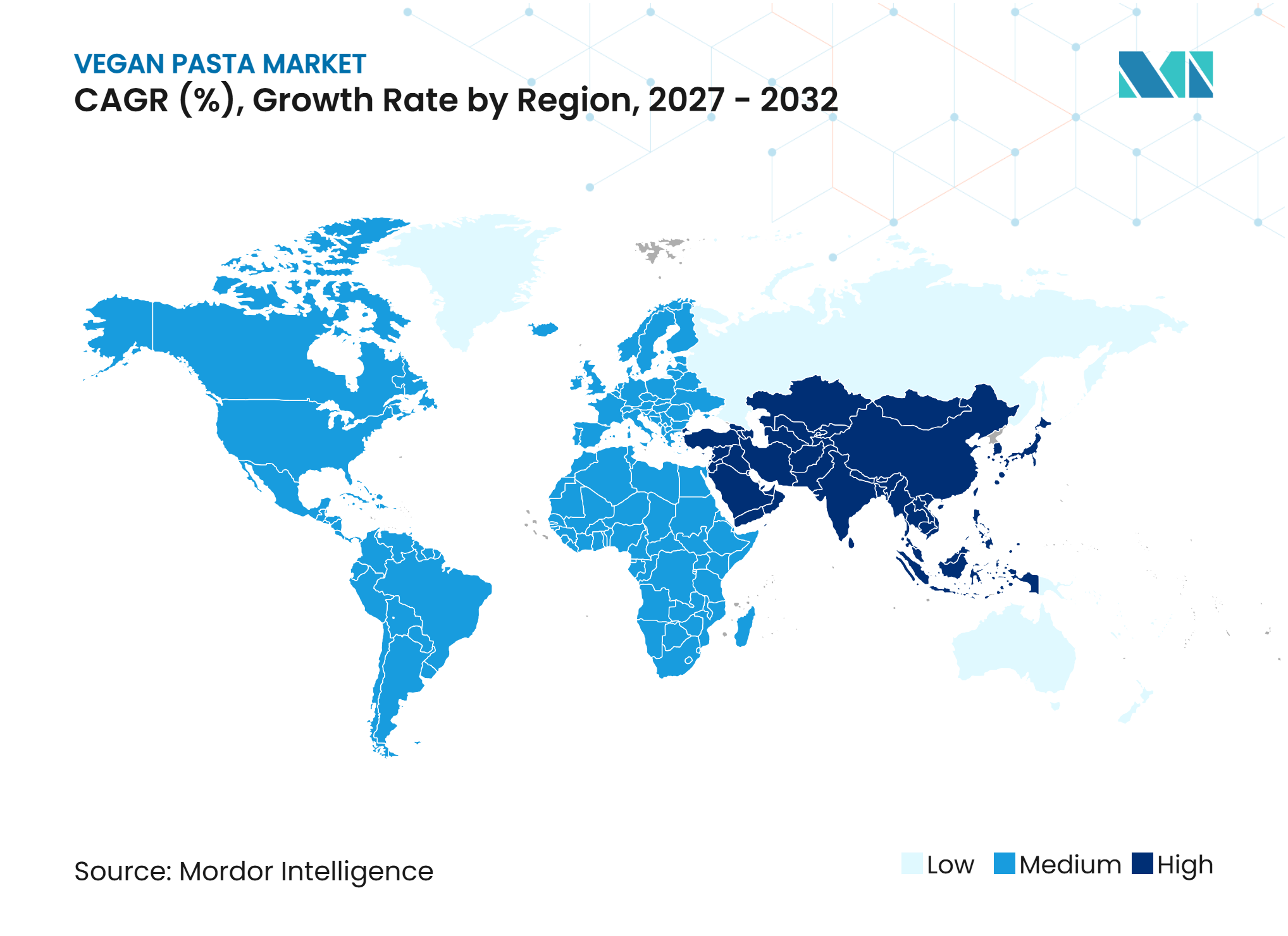
| Fastest Growing Market | Asia-Pacific |
| Largest Market | Europe |
| Market Concentration | Low |
Major Players *Disclaimer: Major Players sorted in no particular order Image © Mordor Intelligence. Reuse requires attribution under CC BY 4.0. | |
Vegan Pasta Market Analysis by Mordor Intelligence
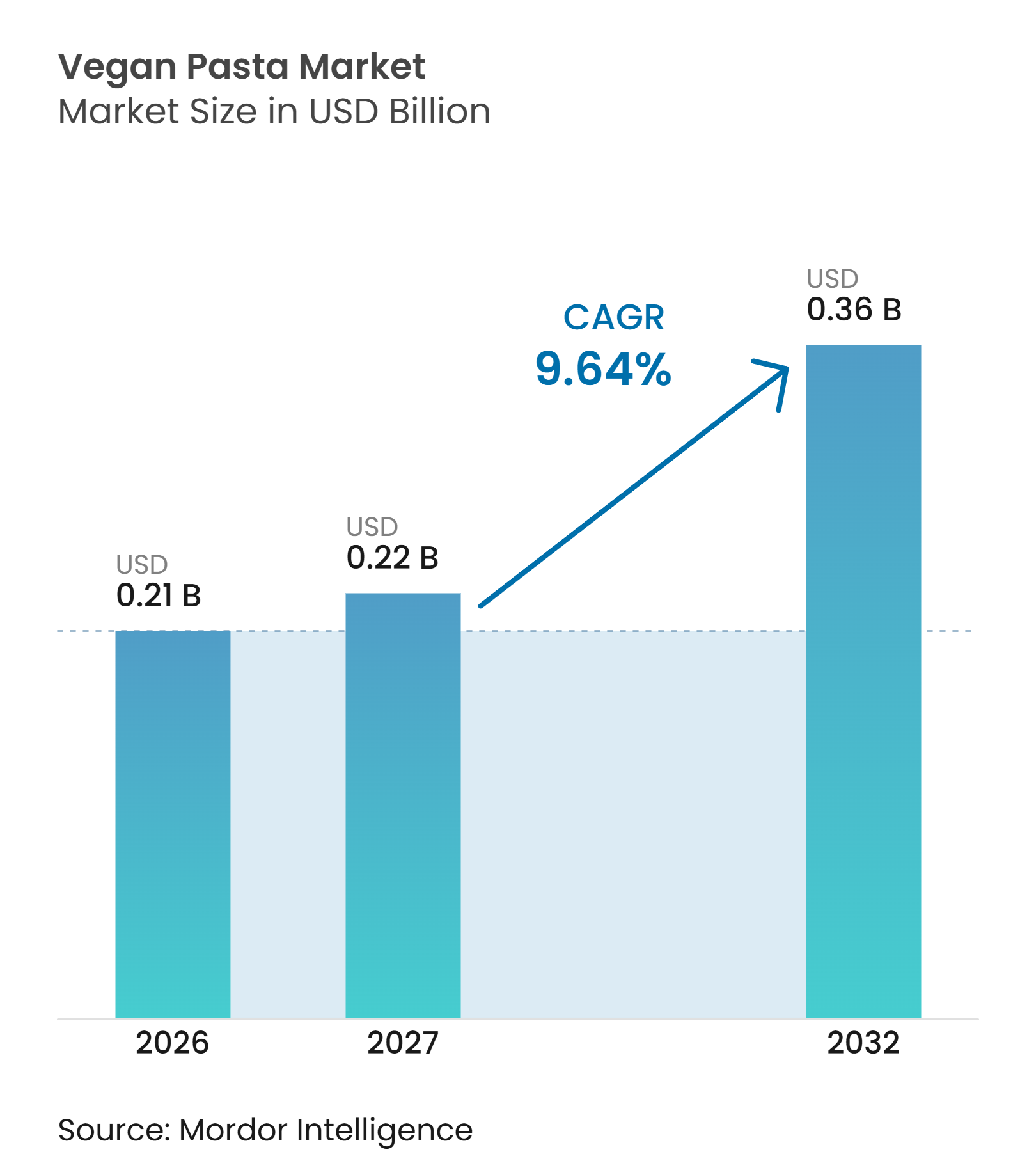
The vegan pasta market size is expected to grow from USD 0.21 billion in 2026 to USD 0.22 billion in 2027 and is forecast to reach USD 0.36 billion by 2032 at a 9.64% CAGR over 2027-2032. The vegan pasta market is supported by the growing adoption of flexitarian diets and increasing consumer interest in plant-based food options. The market offers considerable growth opportunities as manufacturers expand their reach among mainstream consumers and diversify product offerings. Product innovation is increasingly focused on enhancing taste, texture, protein content, and fiber levels to meet evolving consumer preferences and encourage repeat purchases. Manufacturers are also introducing diverse product formats and adapting packaging to cater to retail, foodservice, and ready-meal applications. Growing investments in product development, broader distribution networks, and improved raw material sourcing are further supporting market expansion.
Key Report Takeaways
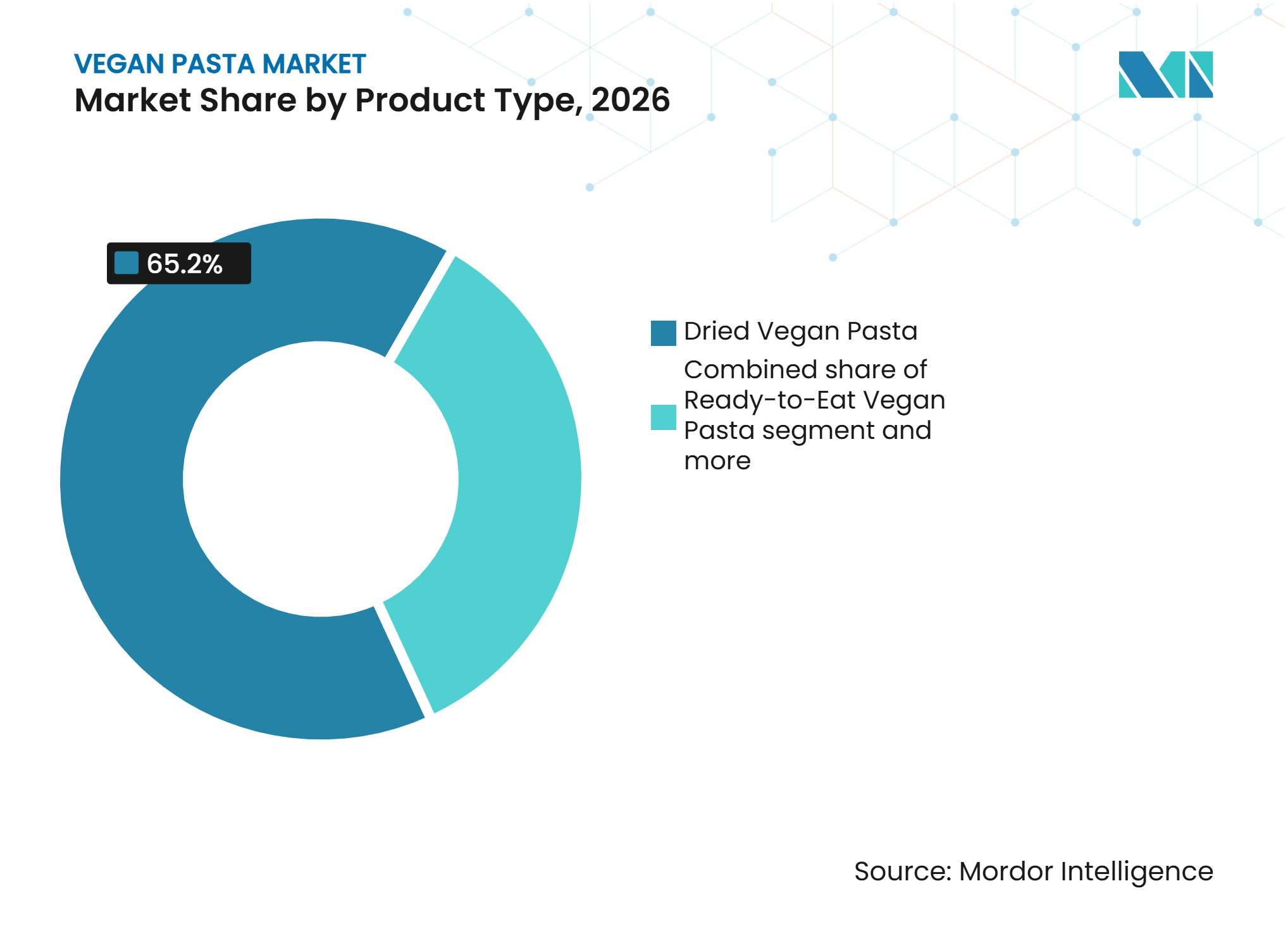
• By product type, dried vegan pasta held 65.23% of the vegan pasta market share in 2026, while ready-to-eat vegan pasta is forecast to expand at a CAGR of 11.21% through 2032.
• By source, chickpea-based vegan pasta held 42.12% of the vegan pasta market share in 2026, while lentil-based vegan pasta is forecast to expand at a CAGR of 11.45% through 2032.
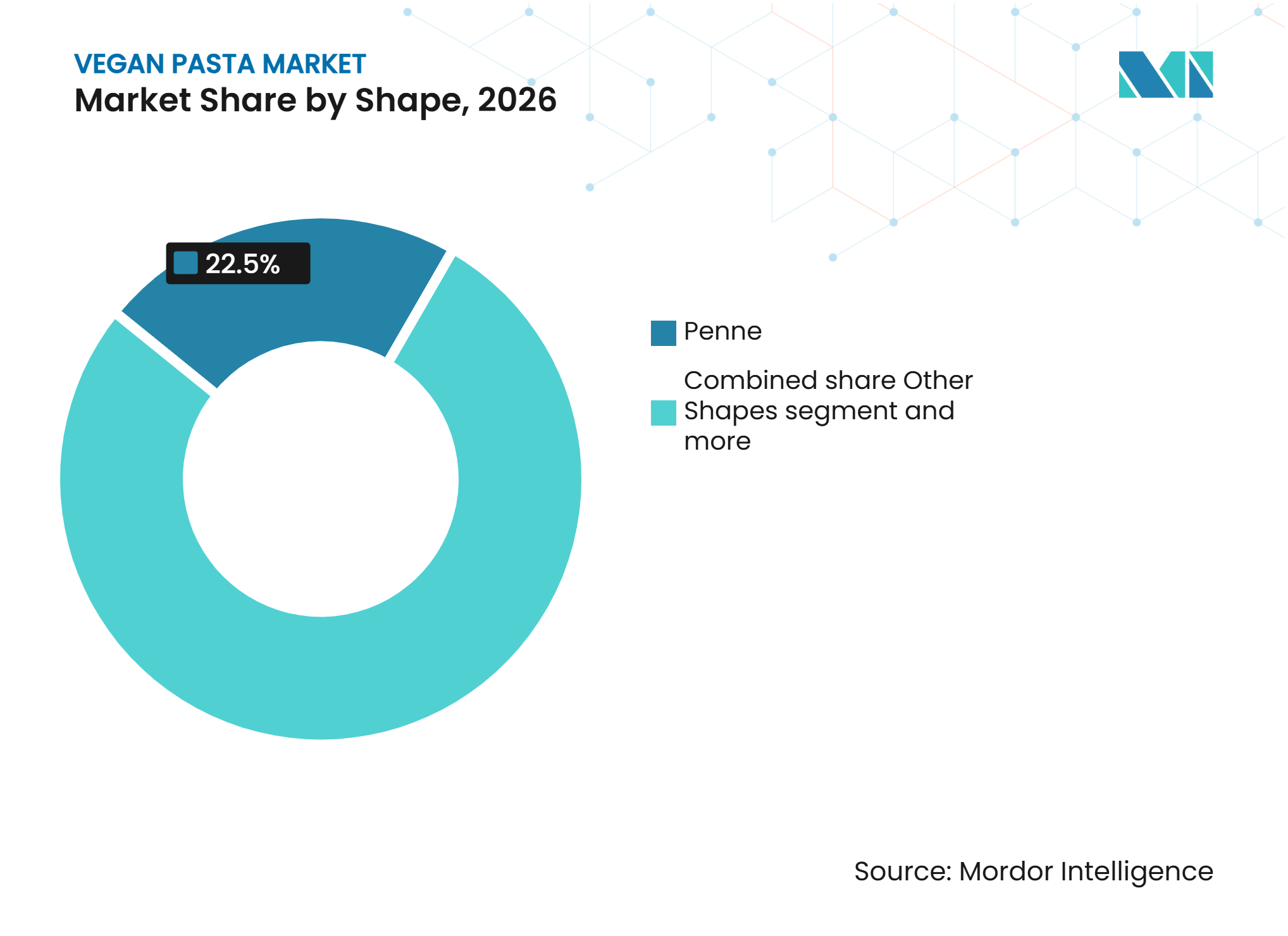
• By shape, penne held 22.56% of the vegan pasta market share in 2026, while other shapes are forecast to expand at a CAGR of 10.95% through 2032.
• By packaging type, boxes held 53.45% of the vegan pasta market share in 2026, while packets and pouches are forecast to expand at a CAGR of 10.85% through 2032.
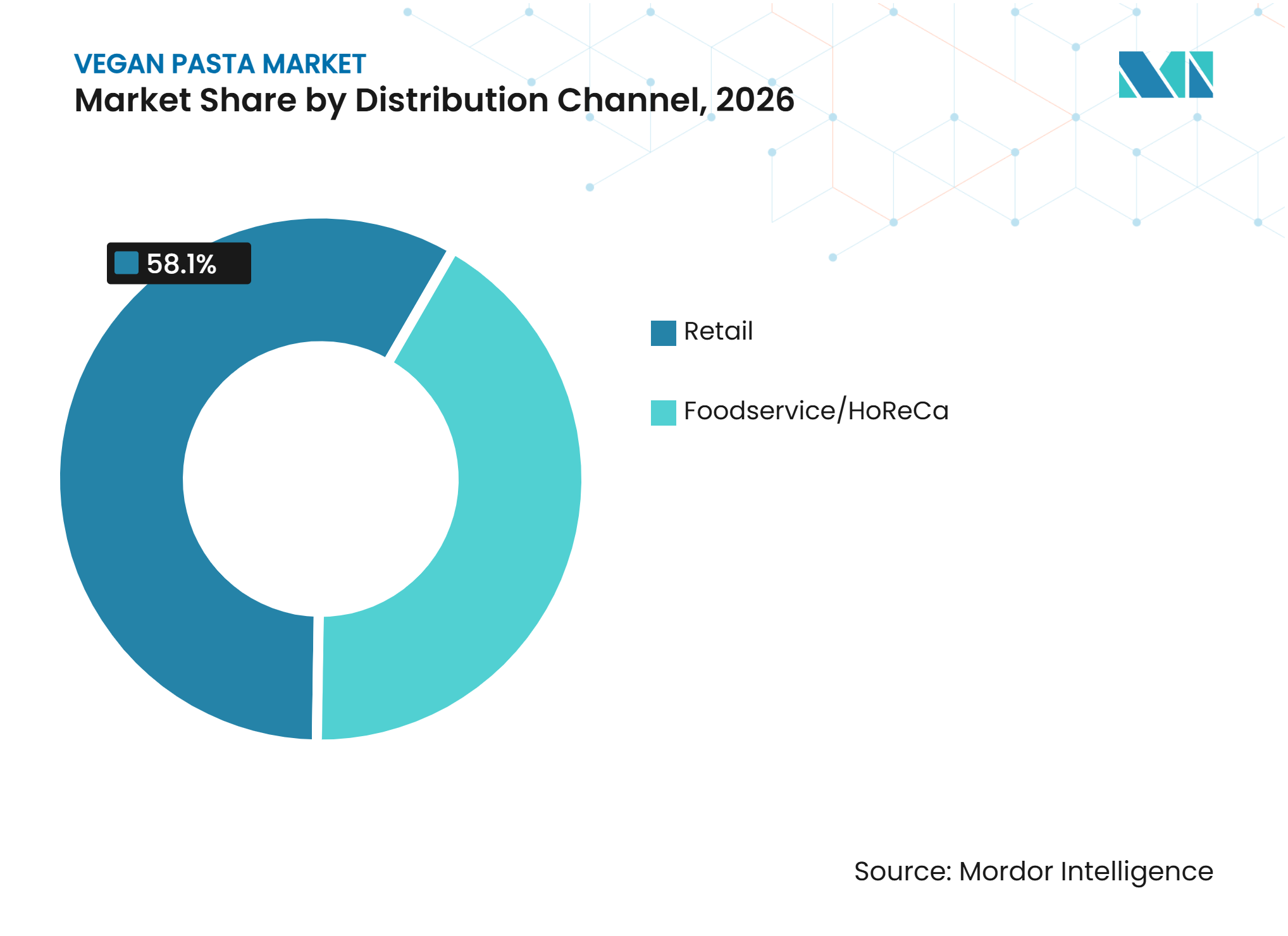
• By distribution channel, retail held 58.13% of the vegan pasta market share in 2026, while foodservice/HoReCa is forecast to expand at a CAGR of 11.65% through 2032.
• By geography, Europe held 33.65% of the vegan pasta market share in 2026, while Asia-Pacific is forecast to expand at a CAGR of 11.75% through 2032.
Note: Market numbers in this report are based on Mordor Intelligence's proprietary estimation framework, which combines nine months of actuals with Q4 projections for base year 2026.
Market Trends and Insights
Drivers Impact Analysis of Vegan Pasta Market*
| Driver | (~) % Impact on CAGR Forecast | Geographic Relevance | Impact Timeline |
|---|---|---|---|
| Expansion of vegan and flexitarian eating occasions | +2.1% | Global | Medium term (2-4 years) |
| Demand for high-protein and high-fiber meal bases | +1.9% | North America and EU, spill-over to APAC | Medium term (2-4 years) |
| Growing consumer preference for convenient and quick-preparation meals | +1.3% | Global | Short term (≤ 2 years) |
| Innovation improving the taste, texture, and cooking performance of vegan pasta | +1.7% | Global | Medium term (2-4 years) |
| Growing demand for premium, organic, and clean-label vegan pasta | +1.4% | Europe and North America | Long term (≥ 4 years) |
| Expansion of plant-based product portfolios by pasta manufacturers | +1.0% | Global | Short term (≤ 2 years) |
| Source: Mordor Intelligence | |||
Expansion of Vegan and Flexitarian Eating Occasions
The growing adoption of flexitarian diets is driving demand for vegan pasta beyond consumers who strictly follow vegan or vegetarian diets. For instance, according to research published by Good Food Institute Europe, 47% of German adults and 41% of United Kingdom adults reported actively reducing their meat consumption or following a meatless diet. Furthermore, in May 2025, 38% of adults across both countries intended to increase their consumption of plant-based foods [1]. These shifting dietary preferences are encouraging consumers to incorporate plant-based alternatives into their regular meals rather than limiting their use to specific occasions, creating opportunities for vegan pasta manufacturers to attract a wider consumer base through familiar flavors, appealing textures, nutritional benefits, and convenient product formats.
Demand for High-Protein and High-Fiber Meal Bases
Growing consumer interest in protein-rich and fiber-rich diets is creating opportunities for vegan pasta made from legumes, pulses, and other nutrient-dense plant ingredients. For instance, in July 2025, according to the International Food Information Council, 70% of Americans were trying to increase their protein intake, while 35% reported doing so over the previous year [2]. Reflecting this demand, Otelia launched its certified organic vegan protein pasta in April 2025, made from black beans, edamame, and soy chickpeas, offering 21g of protein and 9g of fiber per serving. These developments highlight opportunities for manufacturers to position vegan pasta as a nutritious everyday meal option while maintaining familiar flavors and convenient preparation.
Growing Consumer Preference for Convenient and Quick-Preparation Meals
The growing preference for convenient meal solutions is supporting demand for vegan pasta products that simplify everyday meal preparation. For instance, in February 2026, according to the American Frozen Food Institute (AFFI) report, 40% of shoppers consume frozen foods every few days or daily, while 77% purchase frozen foods with a specific meal or day in mind [3]. Additionally, 30% of consumers plan to increase their frozen food purchases, with ease of preparation ranking among the top three factors influencing purchasing decisions. White Rabbit offers frozen vegan pasta ready meals, including Sedanini Arrabbiata and Pennette Carbonara, featuring plant-based alternatives to meat ingredients. These ready-meal options expand the availability of plant-based pasta dishes and cater to consumers seeking quick and easy meal preparation.
Innovation Improving the Taste, Texture, and Cooking Performance of Vegan Pasta
Ongoing innovation in plant-based ingredients and food processing technologies is improving the taste, texture, and cooking performance of vegan pasta. Manufacturers are exploring alternative ingredients such as legumes, pulses, and vegetable-based flours to develop pasta with better firmness, elasticity, and mouthfeel. Improvements in formulation and processing techniques are also helping address common challenges such as mushiness, breakage, and undesirable aftertastes, making vegan pasta more comparable to conventional pasta. These developments are improving product quality, expanding consumer acceptance, and encouraging manufacturers to introduce more appealing and versatile vegan pasta options.
Restraints Impact Analysis of Vegan Pasta Market*
| Restraint | (~) % Impact on CAGR Forecast | Geographic Relevance | Impact Timeline |
|---|---|---|---|
| Price premiums of vegan pasta compared with conventional wheat pasta | -1.6% | Global, most acute in South America, MEA, and price-sensitive EU markets | Medium term (2-4 years) |
| Variability in the sensory characteristics and cooking performance of vegan pasta | -0.9% | Global | Short term (≤ 2 years) |
| Fluctuations in the supply and prices of legumes, pulses, and specialty grains | -0.7% | Global, APAC core, spill-over to MEA | Medium term (2-4 years) |
| Complexities associated with vegan certification, allergen cross-contact, and labeling requirements | -0.5% | EU and North America | Long term (≥ 4 years) |
| Source: Mordor Intelligence | |||
Price Premiums of Vegan Pasta Compared with Conventional Wheat Pasta
Vegan pasta typically carries a price premium over conventional wheat pasta due to the higher costs of alternative raw materials, specialized processing, and product formulation. Ingredients such as lentils, chickpeas, peas, and other plant-based proteins are generally more expensive than traditional wheat, increasing manufacturing costs. Specialized production requirements, smaller manufacturing volumes, and limited economies of scale further contribute to higher retail prices. These price differences may reduce accessibility for price-sensitive consumers, particularly in markets where conventional pasta is widely available at lower prices, potentially limiting broader adoption and repeat purchases.
Variability in the Sensory Characteristics and Cooking Performance of Vegan Pasta
Vegan pasta manufacturers face challenges in maintaining consistent taste, texture, and cooking performance across products made from different plant-based ingredients. Alternative flours derived from legumes, pulses, and vegetables vary in protein, fiber, and starch composition, which affects dough structure, firmness, elasticity, and cooking behavior. These differences can result in uneven texture, excessive softness, breakage, or changes in flavor after cooking. Meeting consumer expectations for taste and texture requires careful ingredient selection, formulation adjustments, and processing optimization, which increases product development complexity for manufacturers.
*Our forecasts treat driver/restraint impacts as directional, not additive. The impact forecasts reflect baseline growth, mix effects, and variable interactions.
Vegan Pasta Market Segment Analysis
By Product Type:
Dried Products Lead While Ready-to-Eat Formats Expand Meal OccasionsDried vegan pasta held 65.23% of the vegan pasta market share in 2026. Dried vegan pasta benefits from a longer shelf life, making it suitable for mainstream grocery distribution, foodservice procurement, and household pantry storage. Its compatibility with existing pasta manufacturing infrastructure and familiar cooking practices allows brands to enter the vegan pasta market through an established product format. Compared with fresh and frozen alternatives, dried pasta also requires less complex temperature-controlled logistics, supporting wider geographic distribution and more flexible inventory management. Its familiar preparation methods and suitability for placement alongside conventional pasta further reduce barriers to consumer adoption and retail operations.
Ready-to-eat vegan pasta is forecast to expand at a CAGR of 11.21% through 2032. Single-serve vegan pasta products cater to consumers seeking convenient, quick-to-prepare meals with portion flexibility. These products combine pre-cooked pasta, plant-based proteins, and prepared sauces to offer practical lunch and dinner solutions. Growing interest among retail and foodservice buyers in high-protein, single-serve plant-based ready meals is creating opportunities for manufacturers to expand their offerings. Innovations in packaging, shelf-life management, and food processing are helping maintain product quality, taste, and texture during storage and reheating. Familiar recipes, simple ingredient formulations, and clear nutritional positioning further enhance consumer appeal, allowing vegan pasta brands to address convenient meal occasions and reach a broader consumer base.



By Source:
Chickpea Holds the Largest Position While Lentil Gains MomentumChickpea-based vegan pasta held 42.12% of the vegan pasta market share in 2026. Chickpea-based vegan pasta benefits from strong consumer familiarity and its nutritional positioning, particularly as a source of plant-based protein and dietary fiber. Its established presence in the alternative pasta category makes it an accessible option for consumers exploring plant-based alternatives to conventional wheat pasta. Chickpea flour can be used across various pasta shapes and familiar meal applications, including salads, baked pasta dishes, and family meals, supporting wider product availability and everyday consumption. Its recognizable ingredient profile also helps manufacturers communicate product benefits and encourage consumer adoption.
Lentil-based vegan pasta is forecast to expand at a CAGR of 11.45% through 2032. Lentil-based vegan pasta offers manufacturers opportunities to develop nutritionally differentiated products while maintaining versatility across various pasta shapes and meal applications. Lentil flour offers useful water-absorption and binding properties, supporting pasta formulation and product development. Research on red lentil protein isolate has also highlighted improvements in amino acid profile, starch digestibility, and antioxidant phenolic content in pasta applications, creating opportunities for enhanced nutritional positioning. Multi-origin sourcing can support raw material availability, while improvements in flour consistency and processing techniques help manufacturers achieve desirable texture and reliable cooking performance.
By Shape:
Penne Remains Familiar While Specialty Shapes Build DifferentiationPenne accounted for 22.56% of the vegan pasta market in 2026. Penne holds a strong position in the vegan pasta market due to its familiar shape, ridged surface, and versatility across a range of meal applications. Its structure allows it to retain sauces effectively and work well in baked dishes, salads, and traditional pasta recipes. The familiar format also encourages consumers to explore vegan alternatives without changing their usual meal preferences. Penne's suitability for production using legume-based flours further supports its availability across plant-based product ranges. Meanwhile, spaghetti caters to traditional Italian meal occasions, elbows and macaroni serve comfort-food applications, and fusilli and rotini offer versatile options for sauce-based meals and prepared dishes.
Other shapes are forecast to expand at a CAGR of 10.95% through 2032. Regional and specialty pasta formats allow manufacturers to introduce greater culinary variety and differentiate their vegan pasta offerings through distinctive shapes and meal applications. These formats appeal to consumers seeking new dining experiences and provide chefs and foodservice operators with opportunities for creative food presentation. Advances in extrusion technology and specialized manufacturing capabilities are enabling producers to develop a wider range of shapes using alternative plant-based ingredients. Established manufacturers can further expand their portfolios by leveraging production scale and manufacturing partnerships. The introduction of diverse shapes also allows brands to target specific culinary preferences, complement different sauces, and cater to varied foodservice and retail applications.

By Packaging Type:
Boxes Provide Shelf Presence While Pouches Serve New ChannelsBoxes held 53.45% of the vegan pasta market share in 2026. Carton packaging remains a preferred format for vegan pasta due to its rigid structure, product protection, and effective presentation on retail shelves. It provides sufficient space for manufacturers to communicate important product attributes, including protein and fiber content, ingredient sources, organic status, and relevant certifications. The larger labeling area also supports the inclusion of preparation instructions, allergen information, and QR codes, thereby improving product transparency. Its compatibility with established dry-grocery shelf systems makes cartons suitable for mainstream retail distribution and standard household portions. Additionally, attractive packaging designs help manufacturers strengthen brand visibility and communicate premium product positioning while supporting informed consumer purchasing decisions.
Packets and pouches are forecast to grow at a 10.85% CAGR through 2032. Flexible packaging offers manufacturers a lightweight, space-efficient solution for vegan pasta products, particularly for single-serve formats, e-commerce distribution, and bulk foodservice supplies. Its compact design supports efficient storage, transportation, and handling, making it suitable for direct-to-consumer channels and commercial foodservice operations. Flexible packs also provide opportunities to develop packaging formats aligned with different portion sizes and consumption occasions. Improvements in packaging materials, sealing technologies, and closure designs help maintain product protection and quality throughout distribution and storage. With effective label design, manufacturers can communicate ingredient details, allergen information, nutritional attributes, and preparation instructions while catering to the requirements of retail and foodservice buyers.
By Distribution Channel:
Retail Provides Reach While HoReCa Adds Recurring DemandRetail held 58.13% of the vegan pasta market share in 2026. Retail channels play a key role in expanding the accessibility and visibility of vegan pasta by placing products alongside conventional pasta and other pantry staples. Supermarkets and hypermarkets provide broad consumer reach, while online retail offers greater product variety through assortment packs, subscriptions, and detailed product information. Convenience and grocery stores further improve accessibility among urban consumers seeking practical meal solutions. Retail platforms also provide opportunities for emerging brands to build awareness, communicate nutritional benefits, and introduce new product varieties. Clear labeling, reliable cooking performance, competitive pricing, and convenient pack sizes can strengthen consumer confidence and encourage repeat purchases.
Foodservice and HoReCa are forecast to expand at a CAGR of 11.65% through 2032. Foodservice and HoReCa channels provide opportunities for vegan pasta manufacturers to establish recurring demand through restaurants, hotels, catering services, and institutional dining facilities. Menu placements and catering contracts can introduce vegan pasta to a wider consumer base while supporting consistent procurement volumes. Growing adoption of plant-based meal options in institutional foodservice further creates opportunities for legume-based pasta products across cafeterias and commercial kitchens. Foodservice buyers value bulk-pack formats, dependable supply, cost efficiency, and consistent cooking performance across preparation and reheating. Manufacturers that develop suitable product specifications, packaging formats, and supply arrangements for commercial kitchens can strengthen their presence in this channel and expand the use of vegan pasta across professional foodservice applications.
Geography Analysis
Europe
Europe held 33.65% of the vegan pasta market share in 2026. Europe holds a strong position in the vegan pasta market, supported by high pasta consumption, established health-food retail networks, and growing consumer familiarity with plant-based foods. Increasing interest in nutritious alternatives, protein-rich ingredients, transparent product labeling, and premium dining experiences is driving market growth. The region's well-established retail infrastructure and strong pasta consumption habits provide manufacturers with opportunities to expand both premium and everyday product offerings. Established food safety, allergen, and organic certification frameworks further encourage product quality, transparency, and regulatory compliance across European markets.
Asia-Pacific
Asia-Pacific is forecast to expand at a CAGR of 11.75% through 2032. Asia-Pacific presents growing opportunities for the vegan pasta market, supported by increasing urbanization, expanding access to plant-based foods, and the development of premium retail, foodservice, and online distribution channels. Rising consumer interest in healthier food alternatives and greater product availability are encouraging manufacturers to expand their presence across the region. The growing popularity of pasta and increasing awareness of plant-based ingredients further support market development. The region also offers opportunities for manufacturers to introduce products suited to local dietary preferences, purchasing power, and consumption habits. Expanding digital retail platforms and improvements in distribution infrastructure can help emerging brands reach health-conscious consumers, while locally adapted product formulations and competitive pricing can strengthen market penetration.
North America and Emerging Regions
North America benefits from an established consumer base for plant-based pasta, supported by growing familiarity with alternative ingredients and interest in protein- and fibre-rich food products. Developed retail infrastructure and expanding foodservice applications provide manufacturers with opportunities to strengthen product availability across the region. South America offers growth potential through established pasta consumption habits, increasing urbanisation, and rising interest in functional food options. Meanwhile, the Middle East and Africa present opportunities through premium grocery retail, expanding foodservice operations, tourism, and changing urban consumption patterns. Differences in consumer preferences, purchasing power, and distribution infrastructure across these regions create opportunities for manufacturers to develop tailored product portfolios, pricing strategies, and distribution approaches to support wider vegan pasta adoption.
Competitive Landscape
Market Concentration
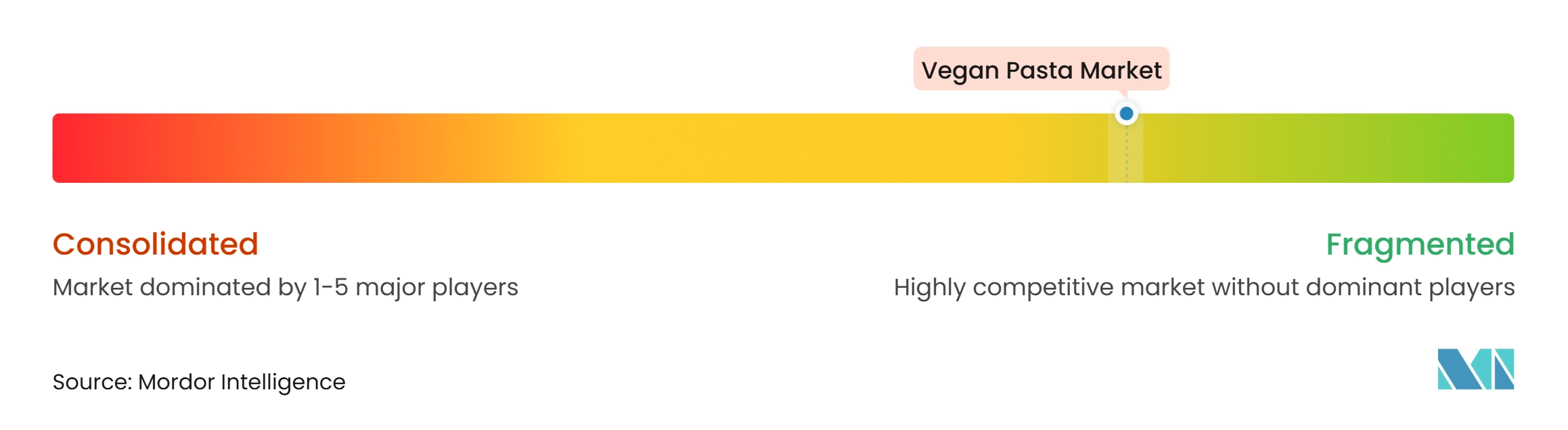
The vegan pasta market has a fragmented competitive structure. The competitive landscape includes established pasta manufacturers, specialized plant-based food producers, and regional manufacturers. Larger players leverage their production capabilities, brand recognition, distribution networks, and research and development infrastructure to expand their plant-based pasta portfolios. Their investments in innovation and product development support improvements in ingredient formulations, sensory characteristics, and manufacturing efficiency.
Specialist manufacturers differentiate themselves through alternative ingredients, organic positioning, product quality, ingredient traceability, and targeted retail strategies. Their specialized portfolios address consumer preferences for protein-rich, gluten-free, organic, and other alternative pasta products. Established manufacturers are also broadening their offerings to appeal to mainstream consumers by combining conventional grains with plant-based ingredients. Competitive positioning increasingly depends on product innovation, raw material sourcing, manufacturing expertise, and distribution capabilities.
Manufacturers are strengthening their sourcing strategies to ensure consistent ingredient availability and manage fluctuations in raw material supply. Improvements in processing technologies and formulation expertise help enhance product texture, cooking performance, and overall quality. Companies are adapting their offerings to meet the requirements of retail and foodservice customers, with an emphasis on consumer-friendly packaging, nutritional transparency, bulk supply, and consistent cooking performance. These strategies support market expansion and enable manufacturers to address evolving demand for vegan pasta products.
Vegan Pasta Industry Leaders
-
Banza LLC
-
Explore Cuisine
-
Fairfax Financial Holdings Limited (AGT Food and Ingredients Inc.)
-
Biovence (Lazzaretti)
-
ITineri S.r.l. (LEGÙ)
- *Disclaimer: Major Players sorted in no particular order
Vegan Pasta Market Companies Covered in this Report
- Banza LLC
- Explore Cuisine
- Fairfax Financial Holdings Limited (AGT Food and Ingredients Inc.)
- Biovence (Lazzaretti)
- ITineri S.r.l. (LEGÙ)
- Nature's Mills
- Sfoglini
- Durum Gıda Sanayi ve Ticaret A.Ş. (Pastavilla)
- Barilla Group (Catelli)
- Fundació Privada Ramon Noguera de Girona (Aliments Onyar)
- Rich'in Foodtech
- Anatomico
- Protaste B.V.
- Pianta LLC (Pianta Foods)
- Imsperium Foods AB (PurePasta)
- Melissa-Kikizas S.A.
- Protelle (Protelle Foods)
- The Kraft Heinz Company (KD NotCo)
- mossa GmbH (Pasta Nuova)
- Zanichelli & Govi S.r.l. (Govi Farm)
Recent Industry Developments in Vegan Pasta Market
- October 2026: Nepra Foods introduced PROPASTA in a new 16-ounce resealable pouch format through Amazon, expanding the brand from foodservice into the retail consumer market. The pasta is explicitly vegan and gluten-free, formulated with hemp and pea proteins, and provides plant-based protein and dietary fiber. The launch expanded access to the company's protein-rich pasta range for household consumption.
- June 2025: Nuttee Bean Co. launched vegan, gluten-free pasta made from fava beans. The product contained three ingredients and is positioned as a high-protein, high-fibre alternative to conventional pasta.
- April 2025: Otelia introduced organic vegan pasta made using beans and water, available in Black Bean, Edamame, and Soy Chickpea varieties. The products are also gluten-free and non-GMO.
Global Vegan Pasta Market Report Scope
The vegan pasta market includes pasta products made without animal-derived ingredients, using plant-based sources such as chickpeas, lentils, soybeans, and other ingredients. The market is segmented by Product Type, Source, Shape, Packaging Type, Distribution Channel, and Geography. Based on Product Type, it is segmented into Fresh, Dried, Frozen, and Ready-to-Eat Vegan Pasta. Based on Source, it includes Chickpea, Lentil, Soybean, and Other Sources. Based on Shape, it covers Penne, Spaghetti, Elbows, Macaroni, Fusilli, Rotini, and Other Shapes. Based on Packaging Type, it includes Boxes, Packets and Pouches, and Other Packaging Types. Based on Distribution Channel, it covers Foodservice/HoReCa and Retail. Geographically, the market is segmented into North America, Europe, Asia-Pacific, South America, and the Middle East and Africa. Market forecasts are provided in terms of value (USD).
Segmentation Overview
| Fresh Vegan Pasta |
| Dried Vegan Pasta |
| Frozen Vegan Pasta |
| Ready-to-Eat Vegan Pasta |
| Chickpea-Based Vegan Pasta |
| Lentil-Based Vegan Pasta |
| Soybean-Based Vegan Pasta |
| Other Sources |
| Penne |
| Spaghetti |
| Elbows and Macaroni |
| Fusilli and Rotini |
| Other Shapes |
| Boxes |
| Packets and Pouches |
| Other Packaging Types |
| Foodservice/HoReCa | |
| Retail | Supermarkets and Hypermarkets |
| Convenience/Grocery Stores | |
| Online Retail Stores | |
| Other Distribution Channels |
| North America | United States |
| Canada | |
| Mexico | |
| Rest of North America | |
| Europe | United Kingdom |
| Germany | |
| France | |
| Italy | |
| Spain | |
| Netherlands | |
| Poland | |
| Belgium | |
| Sweden | |
| Rest of Europe | |
| Asia-Pacific | China |
| Japan | |
| India | |
| Australia | |
| Indonesia | |
| South Korea | |
| Thailand | |
| Singapore | |
| Rest of Asia-Pacific | |
| South America | Brazil |
| Argentina | |
| Colombia | |
| Chile | |
| Peru | |
| Rest of South America | |
| Middle East and Africa | South Africa |
| Saudi Arabia | |
| United Arab Emirates | |
| Nigeria | |
| Egypt | |
| Morocco | |
| Turkey | |
| Rest of Middle East and Africa |
| By Product Type | Fresh Vegan Pasta | |
| Dried Vegan Pasta | ||
| Frozen Vegan Pasta | ||
| Ready-to-Eat Vegan Pasta | ||
| By Source | Chickpea-Based Vegan Pasta | |
| Lentil-Based Vegan Pasta | ||
| Soybean-Based Vegan Pasta | ||
| Other Sources | ||
| By Shape | Penne | |
| Spaghetti | ||
| Elbows and Macaroni | ||
| Fusilli and Rotini | ||
| Other Shapes | ||
| By Packaging Type | Boxes | |
| Packets and Pouches | ||
| Other Packaging Types | ||
| By Distribution Channel | Foodservice/HoReCa | |
| Retail | Supermarkets and Hypermarkets | |
| Convenience/Grocery Stores | ||
| Online Retail Stores | ||
| Other Distribution Channels | ||
| By Geography | North America | United States |
| Canada | ||
| Mexico | ||
| Rest of North America | ||
| Europe | United Kingdom | |
| Germany | ||
| France | ||
| Italy | ||
| Spain | ||
| Netherlands | ||
| Poland | ||
| Belgium | ||
| Sweden | ||
| Rest of Europe | ||
| Asia-Pacific | China | |
| Japan | ||
| India | ||
| Australia | ||
| Indonesia | ||
| South Korea | ||
| Thailand | ||
| Singapore | ||
| Rest of Asia-Pacific | ||
| South America | Brazil | |
| Argentina | ||
| Colombia | ||
| Chile | ||
| Peru | ||
| Rest of South America | ||
| Middle East and Africa | South Africa | |
| Saudi Arabia | ||
| United Arab Emirates | ||
| Nigeria | ||
| Egypt | ||
| Morocco | ||
| Turkey | ||
| Rest of Middle East and Africa | ||
Key Questions Answered in the Report
What is the market size for vegan pasta market?
The vegan pasta market is valued at USD 0.21 billion in 2026 and is projected to reach USD 0.36 billion by 2032, growing at a CAGR of 9.64% during 2027–2032.
Which vegan pasta product type has the largest share?
Dried vegan pasta lead with 65.23% share in 2026 as they offer shelf stability, familiar preparation, and broad distribution suitability.
Which ingredient source is growing fastest in vegan pasta?
Lentil-based vegan pasta is projected to expand at a CAGR of 11.45% through 2032, supported by useful binding properties and nutritional positioning.
Which region will grow fastest for vegan pasta?
Asia-Pacific is expected to expand at a CAGR of 11.75% through 2032, supported by urban demand, digital retail, and expanding foodservice access.