
Variable Speed Generator Market Size and Share
Market Overview
| Study Period | 2021 - 2031 |
|---|---|
| Market Size (2026) | USD 7.89 Billion |
| Market Size (2031) | USD 11.78 Billion |
| Growth Rate (2026 - 2031) | 8.34 % |
| Fastest Growing Market | Asia-Pacific |
| Largest Market | Asia-Pacific |
| Market Concentration | Medium |
Major Players *Disclaimer: Major Players sorted in no particular order Image © Mordor Intelligence. Reuse requires attribution under CC BY 4.0. | |
Variable Speed Generator Market Analysis by Mordor Intelligence
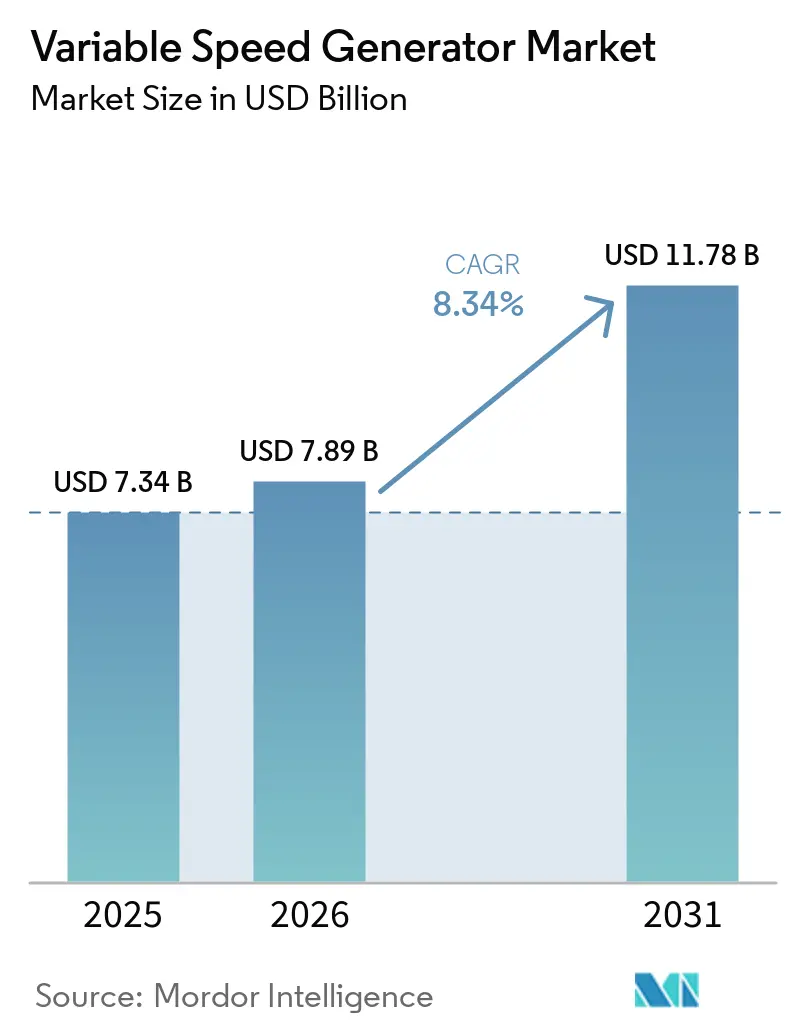
The Variable Speed Generator Market size is projected to be USD 7.34 billion in 2025, USD 7.89 billion in 2026, and reach USD 11.78 billion by 2031, at a CAGR of 8.34% from 2026 to 2031. Renewable additions increasingly require equipment that can respond to changing frequency and voltage conditions, which supports demand for variable-speed systems. Wind energy, pumped-storage hydropower, distributed power, and critical-power installations, therefore, remain central sources of demand. The Variable Speed Generator Market also benefits when operators prioritize fuel use, emissions performance, and flexible output over the lower purchase cost of fixed-speed equipment. Larger suppliers are responding by combining generators, converters, controls, and long-term service capabilities in integrated offers. High converter costs, maintenance requirements, heat exposure in semiconductor components, and integration with older grids continue to constrain adoption in some projects.
Key Report Takeaways
- By generator type, Doubly Fed Induction Generators held 36.3% of the Variable Speed Generator Market share in 2025, while Variable Speed Self-Excited Induction Generators are forecast to grow at a 9.2% CAGR through 2031.
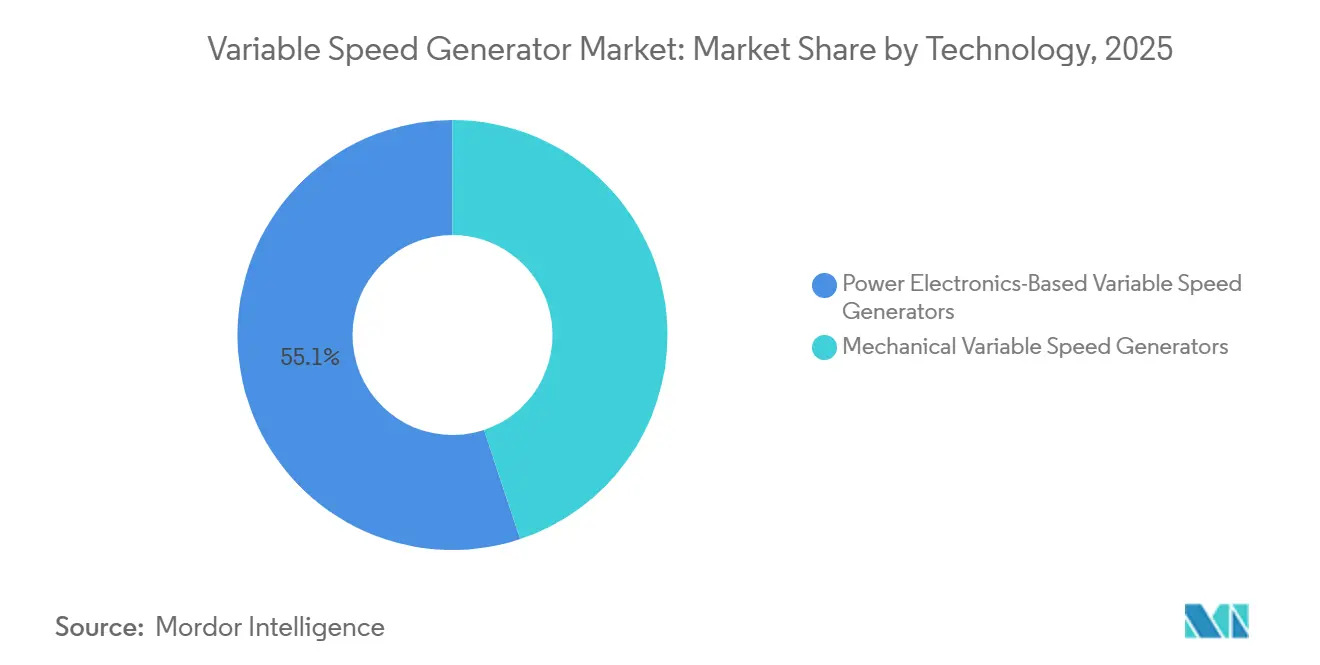
- By technology, power electronics-based variable-speed generators accounted for 55.1% of the Variable Speed Generator Market share in 2025 and are forecast to expand at a 9.5% CAGR through 2031.
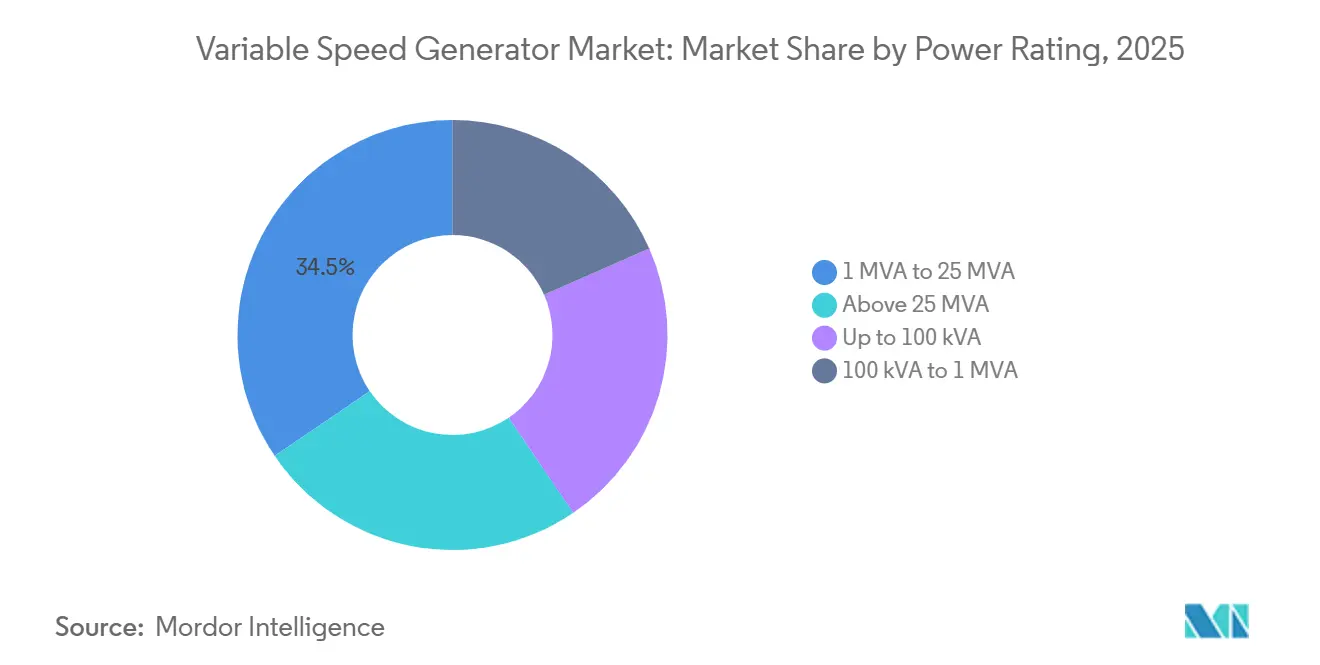
- By power rating, the 1 MVA to 25 MVA category held 34.5% of the Variable Speed Generator Market size in 2025 and is projected to grow at a 9.1% CAGR through 2031.
- By end user, renewable power generation held 31.4% of the Variable Speed Generator Market size in 2025 and is projected to grow at a 9.3% CAGR through 2031.
- By geography, Asia-Pacific accounted for 36.7% of revenue in 2025 and is forecast to expand at a 9.4% CAGR through 2031.
Note: Market size and forecast figures in this report are generated using Mordor Intelligence’s proprietary estimation framework, updated with the latest available data and insights as of January 2026.
Global Variable Speed Generator Market Trends and Insights
Drivers Impact Analysis*
| Driver | (~) % Impact on CAGR Forecast | Geographic Relevance | Impact Timeline |
|---|---|---|---|
| Renewable Energy Integration and Grid Flexibility | +2.50% | Global; concentrated in Asia-Pacific, EU, and North America | Long term (≥ 4 years) |
| Demand for Fuel-Efficient and Low-Emission Generation | +1.20% | Global; early gains in EU, North America, Japan | Medium term (2–4 years) |
| Expansion of Distributed Energy Resources and Microgrids | +1.00% | North America, EU, Australia, India | Medium term (2–4 years) |
| Growth of Off-Grid, Backup, and Critical-Power Applications | +0.70% | MEA, APAC (remote), North America | Short term (≤ 2 years) |
| Variable-Speed Pumped-Storage Hydropower Modernization | +0.60% | Asia-Pacific (Japan, India, China), Europe | Long term (≥ 4 years) |
| Hybrid Battery-Generator Load Following for Remote and Marine Operations | +0.50% | Global (marine corridors); Nordic, Southeast Asia | Medium term (2–4 years) |
| Source: Mordor Intelligence | |||
Renewable Energy Integration and Grid Flexibility
System operators are tightening requirements as inverter-based renewable generation reduces conventional grid inertia. Global wind installations increased 40% to 165 GW in 2025, with Asia-Pacific contributing 131 GW, or 80% of total additions[1]Global Wind Energy Council, “Global Wind Installations Rise a Record 40% as Industry Charts Way Out of Energy Crisis,” Global Wind Energy Council, gwec.net.. Variable-speed generators can provide active-power control and reactive support, allowing new renewable capacity to connect while maintaining frequency stability. The Variable Speed Generator Market is supported by grid rules that require fault-ride-through capability, rather than by capacity targets alone. DFIG systems can meet these requirements with lower converter requirements than full-scale converter architectures. GWEC expects 969 GW of new wind capacity to be added between 2026 and 2030, providing a sustained project pipeline for DFIG and PMSG equipment.
Demand for Fuel-Efficient and Low-Emission Generation
Marine, oil and gas, and distributed-power operators are seeking lower fuel use and lower emissions. Rolls-Royce Power Systems introduced its mtu Series 2000 variable-speed marine generator sets in August 2026 for applications from 650 kWe to 1,850 kWe[2]Rolls-Royce Power Systems, “More Flexible, More Efficient, Electric: Rolls-Royce Expands Its Portfolio of Variable-Speed Marine Generator Sets,” Rolls-Royce, rolls-royce.com.. The company states that matching engine speed to power demand can reduce fuel consumption and carbon dioxide emissions by up to 15% against fixed-speed sets. The range also reduces operating noise by 6 dB, which is relevant in ports and hybrid-vessel operations. Cummins validated natural-gas variable-speed technology for completions services in 2025, extending the use case beyond wind and hydropower. The Variable Speed Generator Market consequently has opportunities in heavy-duty operations where equipment has historically operated at a fixed speed.
Expansion of Distributed Energy Resources and Microgrids
Data-center developers, mining operators, and utilities facing interconnection constraints are commissioning behind-the-meter power systems. Wärtsilä received an order in 2026 for 412 MW of engine capacity for a hyperscale data-center project in Ohio[3]Wärtsilä Corporation, “Wartsila’s 34SG Engine Makes Its Data Center Debut with New 412 MW U.S. Project,” Wärtsilä, wartsila.com.. The order brought Wärtsilä’s engine capacity sold for U.S. data-center applications to more than 1.6 GW. Variable-speed prime-power systems can follow load without the fuel penalty associated with excess idle operation. This feature is particularly important where generators run continuously rather than only during outages. The Variable Speed Generator Market gains from this shift because flexible prime power is becoming an infrastructure option for users who cannot wait for grid expansion.
Variable-Speed Pumped-Storage Hydropower Modernization
Pumped-storage projects are increasing the demand for adjustable-speed generator-motor systems at the utility scale. GE Vernova commissioned India’s first variable-speed pumped-storage unit at the Tehri complex in June 2025, the first of 4 units rated at 250 MW each[4]GE Vernova Inc., “GE Vernova Commissions India’s First Variable Speed Pumped Storage Unit at the Country’s Largest Hydropower Complex,” GE Vernova, gevernova.com.. GE Vernova was selected in July 2026 to replace 2 units rated at 315 MW at the Dinorwig facility in Wales. ANDRITZ also received a July 2026 order to supply a 17 MW variable-speed pump turbine for the Vouglans and Saut-Mortier scheme in France. Toshiba secured a 200 MW adjustable-speed order for Kyogoku Unit 3 in July 2026, with commissioning planned for fiscal year 2031. These awards show that modernization decisions at aging hydropower assets are creating demand as renewable generation requires faster grid response.
Restraints Impact Analysis*
| Restraint | (~) % Impact on CAGR Forecast | Geographic Relevance | Impact Timeline |
|---|---|---|---|
| High Upfront Cost of Power-Electronics-Based Systems | -1.80% | Global; most acute in price-sensitive South & Southeast Asia, MEA | Short to Medium term (≤ 4 years) |
| Specialized Maintenance and Regulatory Compliance Requirements | -0.80% | Global; amplified in remote off-grid and tropical APAC locations | Long term (≥ 4 years) |
| Converter Semiconductor Thermal Stress and Technology Obsolescence | -0.60% | APAC tropics, MEA, equatorial South America | Medium term (2–4 years) |
| Interoperability Constraints in Legacy Generator and Grid Systems | -0.50% | South America, MEA, parts of South and Southeast Asia | Medium to Long term (2–5 years) |
| Source: Mordor Intelligence | |||
High Upfront Cost of Power-Electronics-Based Systems
Power electronics create the largest purchase-cost premium over a comparable fixed-speed machine. Full-converter PMSG and variable-speed SEIG configurations require converter equipment sized for the generator’s full output. A 2025 IEEE conference paper found that silicon-carbide MOSFET converters improved efficiency relative to IGBT equipment but carried higher initial semiconductor costs. The payback period can range from 1 to several years, depending on electricity prices and operating conditions. This cost is significant for mining projects in sub-Saharan Africa and distributed-power projects in South and Southeast Asia. A 2025 study found that a two-regime generator design could reduce converter ratings by up to 50% when variable-speed operation is used below 50% load.
Specialized Maintenance and Regulatory Compliance Requirements
Variable-speed equipment combines power electronics, digital controls, and, in DFIG systems, slip-ring assemblies. These components require specialist service capabilities that are not equally available in all regions. Remote mines, offshore installations, and off-grid projects can face high travel costs for maintenance teams and limited local access to converter modules. The result is a lifecycle cost that is higher than the initial equipment price alone suggests. IEC 61400-21 requirements for wind generators and IEC 60034 standards for rotating machines require testing of fault-ride-through, reactive support, and harmonic performance. Independent producers and smaller developers can face a greater burden where certification capacity remains limited.
*Our forecasts treat driver/restraint impacts as directional, not additive. The impact forecasts reflect baseline growth, mix effects, and variable interactions.
Segment Analysis
By Generator Type: DFIG Leads Installed Demand While SEIG Supports Distributed Applications
Doubly Fed Induction Generators held 36.3% of the Variable Speed Generator Market in 2025. Their partial-scale converter design limits converter requirements relative to full-converter systems and supports their cost position. DFIG equipment also benefits from established service networks created through more than 15 years of commercial deployment. The installed base supports replacement and repowering activity when new installations fluctuate. Variable Speed Self-Excited Induction Generators represent the fastest-growing generator type, with a projected 9.2% CAGR through 2031. Their ability to regulate voltage and frequency without an external grid reference makes them suitable for distributed and microgrid systems.
PMSG systems are gaining use in offshore wind projects above 12 MW, where eliminating the gearbox can reduce service intervals and maintenance spending. This design is relevant for deepwater and floating projects where crane access is difficult and expensive. WRIG systems remain used in legacy repowering projects and hydropower applications that need precise rotor-excitation control. Their position is under pressure as converter costs decline and direct-drive PMSG economics improve. Kawasaki Heavy Industries executed its first commercial license for iVSG virtual synchronous generator control technology in August 2026. The planned 2027 inverter introduction indicates that grid-forming control software is becoming a differentiator across generator types.
By Technology: Power Electronics-Based Systems Extend Their Lead
Power electronics-based systems accounted for 55.1% of the Variable Speed Generator Market share in 2025 and are expected to grow at a 9.5% CAGR through 2031. Their converter systems enable power-factor correction, rapid frequency response, and remote monitoring. These functions can improve grid support and operational oversight in renewable and distributed-power projects. A 2024 IEEE Access study reported that a silicon-carbide partial-scale converter for a 2 MW DFIG could reduce converter volume and improve efficiency compared with an IGBT solution. The technology, therefore, supports the operating requirements that increasingly shape equipment selection. The Variable Speed Generator Market continues to favor electronic control, where operators value flexibility and performance.
Mechanical variable-speed generators remain relevant where buyers prioritize simpler drivetrains and lower capital costs. Small run-of-river hydropower sites and legacy industrial upgrades are among the applications that can retain this preference. IEC 60034-30-1 efficiency classifications have influenced procurement requirements for rotating machines in European markets since 2024. Domestic Chinese IGBT manufacturers have also reached batch production of 3,300 V and 1,500 A modules, reducing the cost gap with imported components. These changes improve the economics of electronic systems without removing the role of mechanical alternatives. Power electronics-based systems are therefore positioned to retain their lead over the forecast period.


By Power Rating: The 1 MVA to 25 MVA Range Combines Scale and Growth
The 1 MVA to 25 MVA band accounted for 34.5% of the Variable Speed Generator Market size in 2025 and is forecast to grow at a 9.1% CAGR through 2031. This range aligns with much of the global onshore wind and mid-scale hydropower procurement base. Wind turbines rated from 3 MW to 8 MW are widely deployed in China, India, and Europe, and commonly use DFIG configurations. India added 6.05 GW of wind capacity in fiscal year 2025-26, a 46% increase from the prior year. Most of this deployment was in the 1 MW to 5 MW turbine class, supporting demand for assemblies in this rating range. The segment’s leadership reflects the concentration of procurement in medium-scale projects.
The up to 100 kVA category serves marine auxiliary power, remote telecommunications, and micro-hydropower applications. The 100 kVA to 1 MVA range addresses distributed generation, small wind, and off-grid mining demand. The above 25 MVA range supports large pumped-storage facilities and the largest offshore wind applications, although its unit volumes remain limited. Toshiba’s July 2026 Kyogoku order involves a 200 MW adjustable-speed system. GE Vernova’s Dinorwig modernization includes 2 replacement units rated at 315 MW. These projects demonstrate the high value associated with the largest rating category.
By End User: Renewable Power Generation Remains the Largest Demand Base
Renewable power generation held 31.4% of the Variable Speed Generator Market size in 2025 and is projected to expand at a 9.3% CAGR through 2031. Wind and solar capacity additions directly support demand for equipment that can manage variable output and provide grid support. This end-user segment offers the largest opportunity for manufacturers of DFIG and PMSG equipment. Its dependence on wind project activity also creates exposure to policy changes and auction outcomes in major markets. Manufacturers planning capacity around renewable demand must manage this variability. The scale of the renewable buildout continues to make this end-user group the leading source of demand.
Hydroelectric power generation provides a different demand profile through long infrastructure rehabilitation cycles. Pumped-storage modernization projects can proceed over multiyear schedules that are less dependent on annual wind procurement. Oil and gas applications are also adopting variable-speed technology where fuel savings matter in high-duty operations. Cummins’ 2025 validation of natural-gas variable-speed technology for completions services widened the application base in this segment. Mining sites in Western Australia, Chile, and Central Africa are using distributed power systems with variable-speed gensets and synchronous-condenser capabilities. Wärtsilä’s 120 MW order for Kalgoorlie Consolidated Gold Mines in December 2025 included synchronous-condenser capability for renewable integration.
Geography Analysis
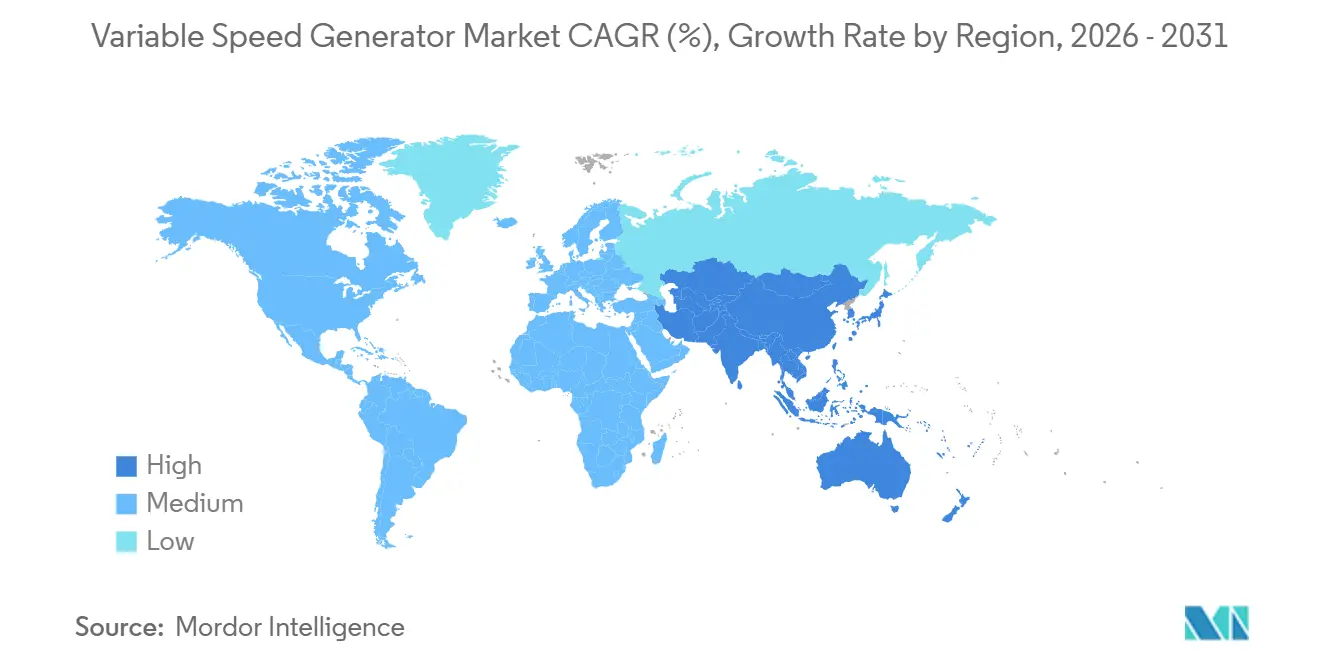
Asia-Pacific held 36.7% of the global Variable Speed Generator Market in 2025 and is forecast to record the fastest regional CAGR of 9.4% through 2031. China added 120.5 GW of wind capacity in 2025, supporting demand across wind generation and grid-balancing equipment. India added 6.05 GW of wind capacity in fiscal year 2025-26, while policy support for pumped-storage projects enlarged the addressable base for variable-speed generator-motor systems. Toshiba’s July 2026 Unit 3 contract shows continuing demand for adjustable-speed storage in Japan.
Europe and North America are the 2nd and 3rd largest regional markets, respectively. Europe is supported by offshore wind repowering, pumped-storage rehabilitation, and grid-code requirements. The Dinorwig contract in Wales and the Vouglans order in France, both awarded in 2026, show the role of modernization at older hydropower assets. North American demand is concentrated in wind OEM supply chains, data-center prime power, and natural-gas applications in oil-field services. Wärtsilä’s 412 MW Ohio project illustrates current data-center demand for flexible engine capacity.
South America, the Middle East, and Africa offer emerging opportunities through 2031. Wärtsilä signed 2 contracts in 2026 to supply 371 MW of balancing-engine capacity for projects in Brazil. Chile added 1.2 GW of wind capacity in 2025, while Saudi Arabia installed 1.5 GW of wind capacity during the same year. Legacy-grid integration can increase project costs in these regions. Fuel savings, emissions requirements, and the need for reliable distributed power nevertheless support continued adoption.

Competitive Landscape
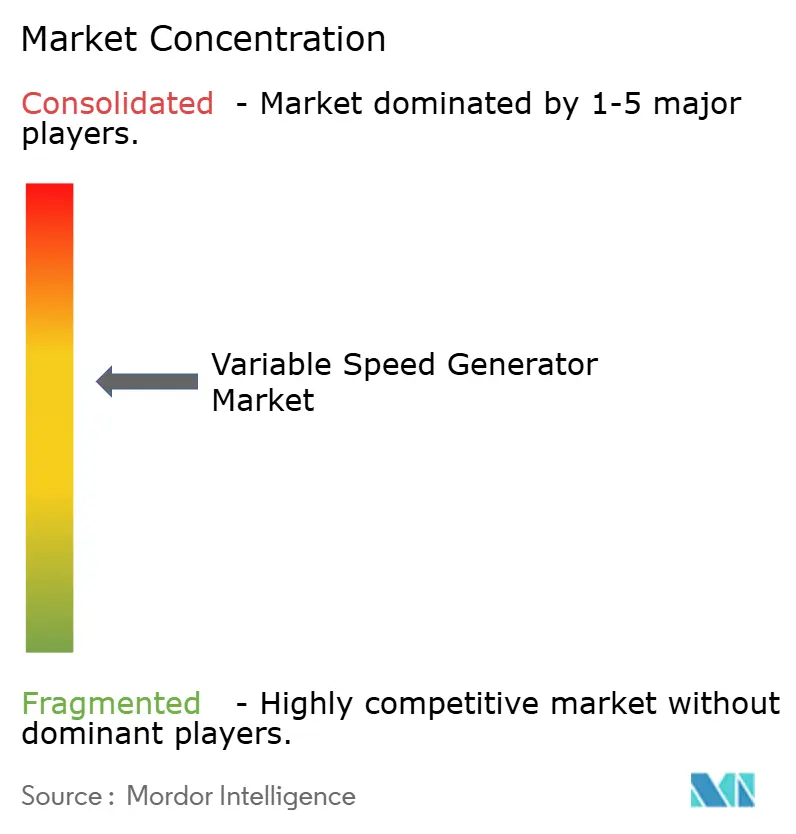
The Variable Speed Generator Market is moderately consolidated, with large OEMs holding leading individual revenue positions but no company holding a decisive share. Siemens Energy, GE Vernova, and ABB compete through portfolios that combine generators, converters, and digital controls. Longstanding service networks also strengthen their positions in large infrastructure applications. GE Vernova stated in July 2026 that it provides services for 74% of the U.K. pumped-storage capacity through its Dinorwig work. This installed-base position can support follow-on modernization and service contracts.
Competition is moving toward grid-forming controls, system integration, and long-term operations agreements. Kawasaki licensed its iVSG virtual synchronous generator control technology to inverter maker IKS in August 2026. The agreement targets an iVSG-equipped inverter product for market entry around 2027. Wärtsilä secured a January 2026 contract for a 123 MW Odessa, Texas, power plant under a 10-year operations-and-maintenance agreement. These moves show how service coverage and controls can differentiate suppliers alongside machine design.
Opportunities remain in compact variable-speed gensets below 500 kVA for hybrid-electric vessels. Rolls-Royce mtu, Fischer Panda, and WhisperPower are active in this part of the equipment range. Natural-gas variable-speed systems for oil-field services and data-center power are another area of competition for Cummins and Wärtsilä. Virtual synchronous generator software creates an opportunity for technology licensors and integration specialists, while vendors with established testing and certification capabilities are better placed to compete in projects subject to grid requirements.
Variable Speed Generator Industry Leaders
Siemens Energy AG
GE Vernova Inc.
ABB Ltd.
Cummins Inc.
Caterpillar Inc.
- *Disclaimer: Major Players sorted in no particular order

Recent Industry Developments
- July 2026: GE Vernova was selected by First Hydro Company to replace 2 × 315 MW pumped-storage units at the Dinorwig pumped-storage hydropower plant in North Wales, United Kingdom. The contract includes Variable Frequency Starting Equipment and a modernized station control system, extending plant life by at least 25 years and reinforcing GE Vernova's position as the service provider for 74% of U.K. pumped-storage capacity.
- July 2026: Toshiba received an order from Hokkaido Electric Power for a 200 MW adjustable-speed pumped-storage system for Kyogoku Power Plant Unit 3, with commercial operation targeted for fiscal year 2031.
- July 2026: ANDRITZ was awarded a contract by EDF to supply a 17 MW variable-speed pump turbine for the Vouglans and Saut-Mortier pumped-storage scheme in France. The project is intended to increase the site's energy storage capacity from 50 GWh to 250 GWh.
- June 2026: Wärtsilä received an order for 412 MW of power capacity for a hyperscale data-center project in Ohio, United States.


Global Variable Speed Generator Market Report Scope
A Variable Speed Generator (VSG) is an electrical generator designed to produce electricity across a range of rotational speeds, rather than at a fixed speed. It uses power-electronic converters and control systems to maintain a stable electrical output despite variations in the generator's mechanical speed. Variable speed generators are particularly useful in applications where the input speed fluctuates, such as wind turbines, hydroelectric systems, marine propulsion, gas engines, and hybrid renewable energy systems. By allowing the generator to operate at its optimum speed under varying load or resource conditions, VSGs can improve energy efficiency, power quality, and overall system performance.
The Variable Speed Generator Market is segmented by generator type, technology, power rating, end user, and geography. By generator type, the market is segmented into Variable Speed Self-Excited Induction Generators (SEIG), Doubly Fed Induction Generators (DFIG), Permanent Magnet Synchronous Generators (PMSG), and Wound Rotor Induction Generators (WRIG). By technology, the market is segmented into power electronics-based and mechanical technologies. By power rating, the market is segmented into up to 100 KVA, 100 KVA–1 MVA, and others. By end user, the market is segmented into renewable power, hydro, oil & gas, mining, marine, and industrial. The report also covers the market size and forecasts for the global variable speed generator market across 26 countries in key regions. For each segment, the market sizing and forecasts have been provided on the basis of value (USD).
| Variable Speed Self-Excited Induction Generator (SEIG) |
| Doubly Fed Induction Generator (DFIG) |
| Permanent Magnet Synchronous Generator (PMSG) |
| Wound Rotor Induction Generator (WRIG) |
| Power Electronics-Based Variable Speed Generators |
| Mechanical Variable Speed Generators |
| Up to 100 kVA |
| 100 kVA to 1 MVA |
| 1 MVA to 25 MVA |
| Above 25 MVA |
| Renewable Power Generation |
| Hydroelectric Power Generation |
| Oil and Gas |
| Mining |
| Marine and Shipbuilding |
| Industrial |
| Other End Users |
| North America | United States |
| Canada | |
| Mexico | |
| Europe | Germany |
| France | |
| Italy | |
| Spain | |
| United Kingdom | |
| Poland | |
| Russia | |
| Rest of Europe | |
| Asia-Pacific | China |
| India | |
| Japan | |
| South Korea | |
| Australia | |
| Indonesia | |
| Vietnam | |
| Thailand | |
| Rest of Asia-Pacific | |
| South America | Brazil |
| Argentina | |
| Chile | |
| Rest of South America | |
| Middle East and Africa | Saudi Arabia |
| United Arab Emirates | |
| Egypt | |
| South Africa | |
| Morocco | |
| Rest of Middle East and Africa |
| By Generator Type | Variable Speed Self-Excited Induction Generator (SEIG) | |
| Doubly Fed Induction Generator (DFIG) | ||
| Permanent Magnet Synchronous Generator (PMSG) | ||
| Wound Rotor Induction Generator (WRIG) | ||
| By Technology | Power Electronics-Based Variable Speed Generators | |
| Mechanical Variable Speed Generators | ||
| By Power Rating | Up to 100 kVA | |
| 100 kVA to 1 MVA | ||
| 1 MVA to 25 MVA | ||
| Above 25 MVA | ||
| By End User | Renewable Power Generation | |
| Hydroelectric Power Generation | ||
| Oil and Gas | ||
| Mining | ||
| Marine and Shipbuilding | ||
| Industrial | ||
| Other End Users | ||
| By Geography | North America | United States |
| Canada | ||
| Mexico | ||
| Europe | Germany | |
| France | ||
| Italy | ||
| Spain | ||
| United Kingdom | ||
| Poland | ||
| Russia | ||
| Rest of Europe | ||
| Asia-Pacific | China | |
| India | ||
| Japan | ||
| South Korea | ||
| Australia | ||
| Indonesia | ||
| Vietnam | ||
| Thailand | ||
| Rest of Asia-Pacific | ||
| South America | Brazil | |
| Argentina | ||
| Chile | ||
| Rest of South America | ||
| Middle East and Africa | Saudi Arabia | |
| United Arab Emirates | ||
| Egypt | ||
| South Africa | ||
| Morocco | ||
| Rest of Middle East and Africa | ||


Key Questions Answered in the Report
What is driving demand for variable-speed generators?
Renewable integration, grid flexibility, pumped-storage modernization, and flexible prime-power demand support adoption across wind, hydropower, marine, mining, and data-center applications.
How large is the Variable Speed Generator Market?
The sector is estimated at USD 7.89 billion in 2026 and is forecast to reach USD 11.78 billion by 2031, growing at an 8.34% CAGR.
Which generator type had the leading share in 2025?
DFIG systems held 36.3% of revenue in 2025, supported by partial-scale converter economics, fault-ride-through capability, and established service networks.
Which technology is growing fastest?
Power electronics-based systems are forecast to expand at a 9.5% CAGR through 2031 after holding 55.1% share in 2025, supported by grid-response and monitoring functions.
Which region is expected to grow fastest?
Asia-Pacific is forecast to grow at a 9.4% CAGR through 2031 after accounting for 36.7% of revenue in 2025, driven by wind additions and pumped-storage investments.
What is the main barrier to adoption?
Full power-electronics systems have higher upfront costs, while specialized maintenance, compliance testing, heat exposure, and legacy-grid integration can raise lifetime project costs.
Page last updated on:





