
Utility Scale Photovoltaic (PV) Inverter Market Size and Share
Market Overview
| Study Period | 2022 - 2032 |
|---|---|
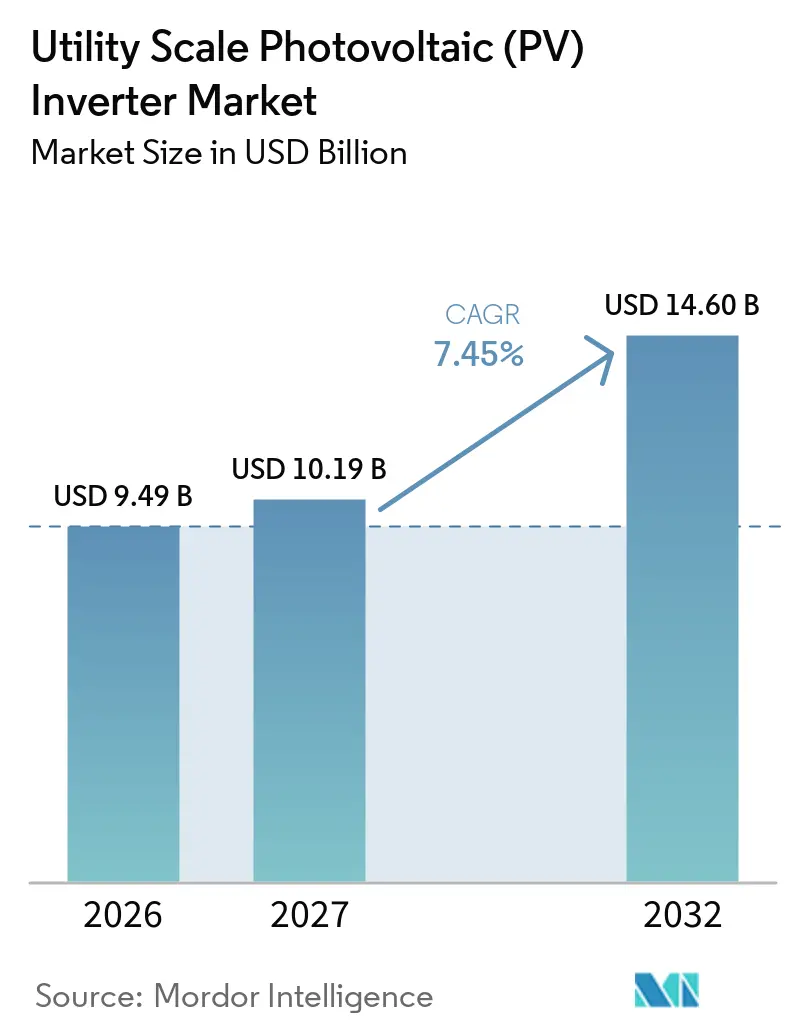
| Market Size (2027) | USD 10.19 Billion |
| Market Size (2032) | USD 14.60 Billion |
| Growth Rate (2027 - 2032) | 7.45 % |
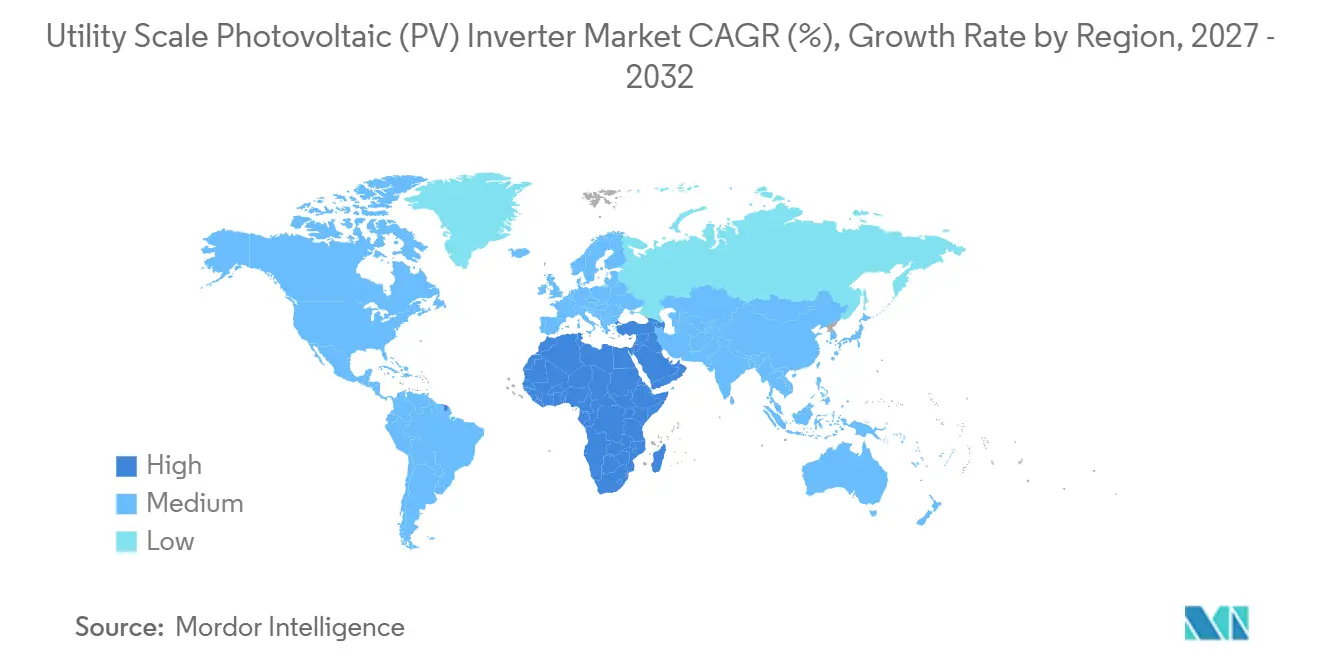
| Fastest Growing Market | Middle East and Africa |
| Largest Market | Asia-Pacific |
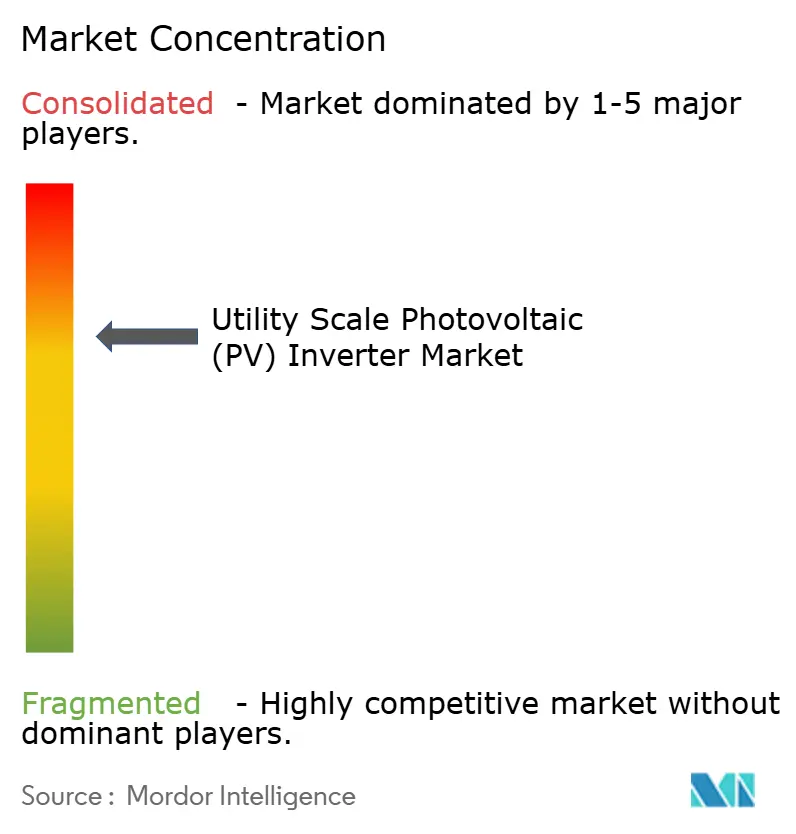
| Market Concentration | Medium |
Major Players *Disclaimer: Major Players sorted in no particular order Image © Mordor Intelligence. Reuse requires attribution under CC BY 4.0. | |
Utility Scale Photovoltaic (PV) Inverter Market Analysis by Mordor Intelligence
The Utility Scale Photovoltaic Inverter Market size is expected to grow from USD 9.49 billion in 2026 to USD 10.19 billion in 2027 and is forecast to reach USD 14.60 billion by 2032 at 7.45% CAGR over 2027-2032. The utility scale photovoltaic (PV) inverter market is moving beyond its former role as a supplier of equipment that converts direct current into alternating current for large solar plants. Buyers increasingly require assets that regulate voltage and frequency, support grid stability, work with battery systems, and communicate operating information to plant operators. Replacement demand also supports the utility scale photovoltaic (PV) inverter market, particularly where installations from the 2012 to 2017 feed-in tariff period are nearing the end of their design life. This creates a separate procurement stream alongside new solar capacity and can support demand even where annual additions vary. Competition therefore depends on technical compliance, service capability, equipment reliability, and the ability to integrate storage rather than on equipment price alone.
Key Report Takeaways
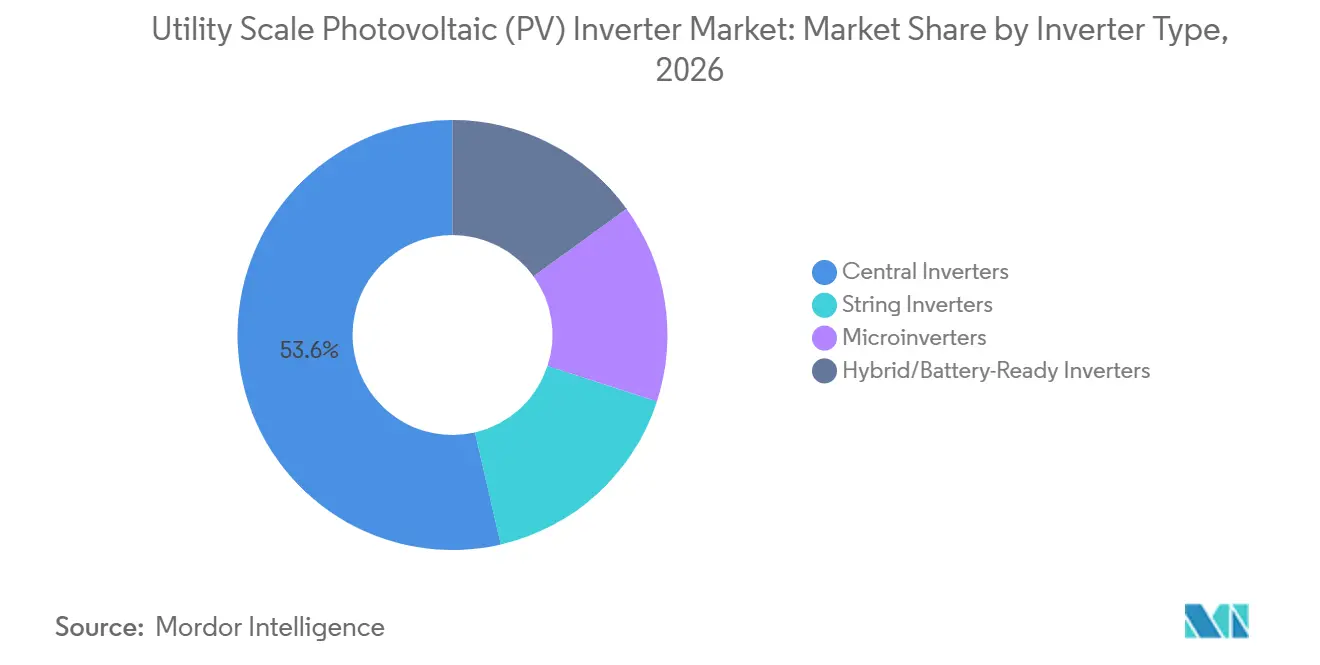
- By inverter type, central inverters held 53.6% of the utility scale photovoltaic (PV) inverter market share in 2026, while microinverters are forecast to expand at a 7.8% CAGR through 2032.
- By phase, three-phase inverters accounted for 72.4% of the utility scale photovoltaic (PV) inverter market share in 2026, while single-phase configurations are projected to grow at a 7.6% CAGR through 2032.
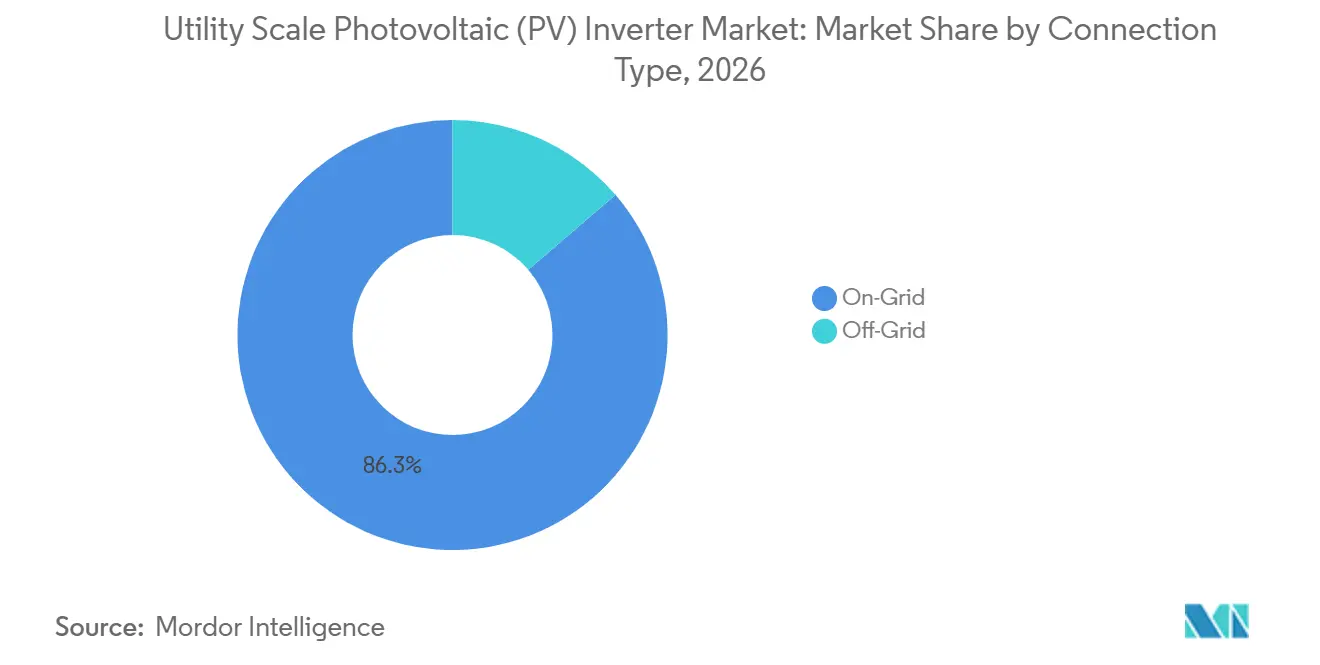
- By connection type, on-grid systems represented 86.3% of revenue in 2026, while off-grid configurations are forecast to advance at an 8.3% CAGR through 2032.
- By geography, Asia-Pacific held 53.8% of revenue in 2026, while Middle East and Africa is projected to record an 8.8% CAGR through 2032.
Note: Market numbers in this report are based on Mordor Intelligence's proprietary estimation framework, which combines nine months of actuals with Q4 projections for base year 2026.
Market Trends and Insights
Drivers Impact Analysis of Utility Scale Photovoltaic (PV) Inverter Market*
| Driver | (~) % Impact on CAGR Forecast | Geographic Relevance | Impact Timeline |
|---|---|---|---|
| Utility-Scale Solar Capacity Additions and Replacement Demand | +2.0% | Global | Short term (≤ 2 years) |
| 1500 V and 2000 V Architectures Lowering Balance-of-System Costs | +1.2% | North America, Europe, APAC core | Medium term (2-4 years) |
| Grid-Forming and Advanced Grid-Support Requirements | +1.0% | North America, Europe, Australia | Medium term (2-4 years) |
| Utility-Scale Solar-Plus-Storage Co-Location | +0.9% | APAC core, spill-over to MEA and North America | Medium term (2-4 years) |
| Weak-Grid Electrification and Emerging-Market Project Pipelines | +0.7% | MEA, Southeast Asia, South America | Long term (≥ 4 years) |
| Digital O&M, Predictive Maintenance and Remote Diagnostics | +0.5% | Global, early gains in China and Australia | Long term (≥ 4 years) |
| Source: Mordor Intelligence | |||
Utility-Scale Solar Capacity Additions and Replacement Demand
Annual utility-scale additions create demand for inverters in new projects and in replacement projects, which broadens the addressable base beyond annual capacity additions. In 2025, 666 million people lacked electricity access, and 85% of them lived in Sub-Saharan Africa.[1] This unmet need supports utility and mini-grid procurement beyond policy cycles in mature economies and creates a practical role for modular solar systems. Japan also has a replacement cycle from the 2012 to 2016 feed-in tariff period, when many utility installations were commissioned under earlier technical requirements. Updated grid codes favor replacement units that provide reactive-power support, remote diagnostics, and communication functions that older equipment cannot provide. The utility scale photovoltaic (PV) inverter market benefits because these requirements make simple replacement with older equipment less practical.
1500 V and 2000 V Architectures Lowering Balance-of-System Costs
The shift from 1500 V to 2000 V direct-current designs are changing the equipment mix in large solar plants and the way developers assess site-level balance-of-system requirements. Higher-voltage designs can reduce the number of inverter units and associated direct-current connections required at a site. GE Vernova brought a 2000 V DC FLEXINVERTER pilot into commercial operation in North America in early 2025. The company presents the platform as an option for projects that need more output within the same site footprint. Fewer but higher-capacity units change the economics of equipment selection, cable routing, maintenance planning, and access planning across large sites. This supports demand for equipment that can meet higher-voltage requirements as the utility scale photovoltaic (PV) inverter market becomes more standardized.
Grid-Forming and Advanced Grid-Support Requirements
Grid operators increasingly treat grid-forming capability as a project requirement rather than an optional feature included only in specialized projects. Technical frameworks such as IEEE Std. 2800-2022 and European Network of Transmission System Operators for Electricity (ENTSO-E) requirements give developers and manufacturers reference points for advanced grid support.[2] The requirements are not fully aligned across markets, so suppliers must demonstrate compliance with more than one grid code and qualification process. This raises the value of control systems, testing capacity, and practical working relationships with transmission system operators. It also separates basic equipment from systems that can provide voltage formation, frequency response, fault ride-through, and other grid services. The utility scale photovoltaic (PV) inverter market therefore gives an advantage to suppliers that can provide documented compliance and system-level support.
Utility-Scale Solar-Plus-Storage Co-Location
Co-located solar and battery projects require equipment that can manage photovoltaic output and battery charging or discharging within a coordinated operating system. Sungrow’s Cunderdin project in Western Australia entered operation in April 2025 with 128 MWdc of PV, 100 MWac of inverter capacity, and a 55 MW, 220 MWh battery system.[3] The project demonstrated how shared conversion infrastructure can support curtailment recovery, frequency regulation, and improved use of solar generation during constrained periods. The U.S. Department of Energy and National Renewable Energy Laboratory (NREL) reported that battery capacity paired with photovoltaics could account for 70% of new U.S. utility installations through 2027, compared with 49% in 2023. International Renewable Energy Agency (IRENA) also identified the use of PV and battery systems as firm-capacity resources in emerging economies where power supply reliability is important.[4] This gives developers a reason to select battery-ready inverters before storage is installed and before the project’s final operating configuration is set in the utility scale photovoltaic (PV) inverter market.
Restraints Impact Analysis of Utility Scale Photovoltaic (PV) Inverter Market*
| Restraint | (~) % Impact on CAGR Forecast | Geographic Relevance | Impact Timeline |
|---|---|---|---|
| Price Compression and Manufacturing Overcapacity | -2.1% | Global, most acute in China and Europe | Short term (≤ 2 years) |
| Power-Semiconductor and Transformer Supply Constraints | -1.0% | Global, with early pressure in North America and EU | Medium term (2-4 years) |
| Cybersecurity, Data Sovereignty and Remote-Access Restrictions | -0.6% | North America, EU, India | Medium term (2-4 years) |
| Grid Interconnection Delays and Curtailment Risk | -0.8% | North America, EU, spill-over to APAC | Long term (≥ 4 years) |
| Source: Mordor Intelligence | |||
Price Compression and Manufacturing Overcapacity
Excess manufacturing capacity puts sustained pressure on inverter prices and limits the scope for undifferentiated suppliers to protect margins. The International Energy Agency (IEA) reported that Chinese utility-scale inverters cost USD 13 per kW less than units manufactured in Europe. This price gap is difficult for European and North American producers to close with hardware alone, especially in tenders that prioritize capital cost. Equipment suppliers need revenue from software, storage integration, maintenance, or grid services to support margins over the project life in the utility scale photovoltaic (PV) inverter market. Lower equipment prices can improve project economics for developers, but they can weaken smaller suppliers with limited scale, narrower portfolios, or fewer service contracts. The utility scale photovoltaic (PV) inverter market is consequently dividing between high-volume equipment and differentiated systems with service revenue.
Cybersecurity, Data Sovereignty and Remote-Access Restrictions
Network-connected inverters have become a policy concern because they can be monitored or controlled remotely and may sit within critical electricity infrastructure. The International Energy Agency (IEA) has described inverter supply chains and cybersecurity as a power-system issue rather than a narrow procurement issue. European financing rules, U.S. procurement restrictions, and Indian data-hosting requirements raise the importance of equipment origin, remote-access controls, and data location. These rules can increase qualification costs, require additional documentation, and lengthen procurement schedules for developers and equipment suppliers. They also create an opening for suppliers that can document cybersecurity controls, local service capability, and compliant data management practices. Developers must account for different requirements by jurisdiction when they select equipment for multi-country portfolios in the utility scale photovoltaic (PV) inverter market.
*Our forecasts treat driver/restraint impacts as directional, not additive. The impact forecasts reflect baseline growth, mix effects, and variable interactions.
Utility Scale Photovoltaic (PV) Inverter Market Segment Analysis
By Inverter Type:
Central Inverters Lead Large Projects While Modular Formats Gain GroundCentral inverters captured a 53.6% revenue share in 2026. Their position reflects lower installed cost and centralized supervisory control in projects above 10 MWac. Large plants often favor a smaller number of high-capacity units because operators can supervise performance, maintenance, and grid interconnection from one control platform. The move toward 2000 V direct-current systems support this approach because each inverter can serve a larger photovoltaic array and fewer connections may be required across the site. Central equipment also fits projects with predictable layouts, limited shading variation, and a consistent operating profile over the site. Developers can use the format where equipment access, spare-parts planning, centralized diagnostics, and operating consistency are important considerations.
String inverters are more suitable where terrain, layout, or generation profiles vary across a project. Their distributed maximum power point tracking can limit losses from localized mismatch and make individual equipment failures easier to isolate without affecting every part of the plant. In China, procurement data for the first 8 months of 2025 showed that string inverters above 300 kW accounted for 65% of ordered capacity. This indicates that higher-power string units are narrowing the capacity gap with central systems in larger projects. Microinverters are expected to grow at a 7.8% CAGR through 2032, supported by module-level applications in Australia, Brazil, and rural electrification settings. Battery-ready equipment gives developers a route to add direct-current-coupled storage later without installing a separate conversion system. These choices allow developers to match architecture with the site, grid requirement, operating risk, and expected storage strategy in the utility scale photovoltaic (PV) inverter market.

By Phase:
Three-Phase Systems Support Transmission-Connected SolarThree-phase equipment accounted for 72.4% of revenue in 2026. It supports balanced loads at transmission and distribution interconnection points, which are essential for large solar plants connecting to utility networks. This configuration can deliver the power density needed for utility-scale sites without relying on multiple lower-capacity connections and additional connection equipment. It also aligns with the grid architecture used in large solar parks and co-located storage projects. Huawei launched FusionSolar9.0 in Europe in April 2026 with a kV-AC string configuration and up to 11 MW of photovoltaic array capacity. The launch illustrates continued demand for high-capacity three-phase equipment that combines output, control, grid-support functions, and practical integration with larger utility systems.
Three-phase systems are also relevant in Middle East and North Africa projects using large string units, bifacial modules, and single-axis trackers. Developers can combine distributed tracking benefits with fewer inverter units than earlier string designs required, which can simplify installation and routine servicing. Compliance with grid-support requirements further favors designs with sophisticated digital controls, monitoring, fault management, and reactive-power capability. Manufacturers are embedding these functions in standard utility products rather than treating them as specialized additions for selected projects. Single-phase equipment serves a different need in smaller and less developed grid systems where distribution networks are commonly configured that way. It is forecast to grow at 7.6% CAGR through 2032 as rural electrification, off-grid deployment, and replacement needs expand. The segment remains relevant where incremental solar capacity is being added close to local loads and where three-phase networks are not yet widely available in the utility scale photovoltaic (PV) inverter market.
By Connection Type:
On-Grid Procurement Remains Dominant While Off-Grid Projects ExpandOn-grid systems represented 86.3% of revenue in 2026 within the utility scale photovoltaic (PV) inverter market size. Long-term power purchase agreements, utility procurement processes, and large solar-farm development underpin this position across established solar markets. Developers select equipment that lowers cost per unit of capacity while meeting interconnection standards set by utilities and grid operators. The 2000 V transition has relevance in these projects because grid-connected plants seek higher equipment utilization and simpler site layouts. Institute of Electrical and Electronics Engineers (IEEE) 1547-2018 is a baseline interconnection standard in U.S. projects, which supports the use of digitally controlled utility-scale products. Advanced grid-support functions can narrow the field of qualified suppliers and make compliance records more significant in procurement decisions.
Off-grid configurations are forecast to grow at an 8.3% CAGR through 2032. They are used in mini-grids, island systems, and areas where extending the main network is costly or impractical because demand centers are dispersed. IEA Photovoltaic Power Systems Programme (IEA-PVPS) identified mini-grids as an alternative to expensive grid extension in Sub-Saharan Africa and Pacific Island markets. Off-grid systems must tolerate weak-grid conditions and work with batteries or backup generation to maintain reliable supply during variable solar production. This raises the value of hybrid equipment, black-start capability, and controls that stabilize local networks without continuous support from a wider grid. The segment’s growth is linked to electrification needs, solar imports, and the need for dependable power where conventional grid service is limited within the utility scale photovoltaic (PV) inverter market.
Geography Analysis
APAC Utility Scale Photovoltaic (PV) Inverter Market
Asia-Pacific held 53.8% of revenue in 2026. China is the region’s central manufacturing and procurement base, while India, Japan, and Southeast Asia add separate demand drivers with different project types and grid needs. India’s Pradhan Mantri Surya Ghar program targets 30 GW of rooftop installations by March 2027, which adds distributed demand alongside large ground-mounted tendering. Japan’s older feed-in tariff installations are entering a replacement period as operators assess equipment that meets current monitoring and grid-support requirements. Southeast Asian markets add a further opportunity as governments and utilities increase grid-connected solar tendering. The region therefore includes both large-volume new construction and equipment replacement demand in the utility scale photovoltaic (PV) inverter market.
APAC, Europe and North America Utility Scale Photovoltaic (PV) Inverter Market
Japan’s replacement projects favor units that meet current reactive-power and monitoring requirements and can remain compatible with revised grid codes. Southeast Asian markets are increasing grid-connected solar procurement as grid modernization becomes more important for system reliability. The Asian Development Bank stated in 2025 that Asia and the Pacific need grid upgrades to support the energy transition. Europe and North America form the next large demand bloc, although their procurement conditions are more affected by cybersecurity requirements and interconnection processes. In Europe, financing requirements can favor non-Chinese equipment in some utility projects and increase demand for verified technical documentation. Germany’s procurement of synthetic inertia and more demanding ENTSO-E rules raise the importance of grid-forming capability in the utility scale photovoltaic (PV) inverter market.
The Americas and MEA Utility Scale Photovoltaic (PV) Inverter Market
In North America, 773 GW of solar capacity was in active U.S. interconnection queues at the end of 2025. Queue reforms could convert part of this pipeline into multi-year inverter demand, although project timing will depend on transmission and permitting progress. Middle East and Africa is forecast to record an 8.8% CAGR through 2032 in the utility scale photovoltaic (PV) inverter market size. Sovereign-backed tenders in Saudi Arabia, the UAE, and Egypt support large solar projects, while off-grid electrification expands demand across Sub-Saharan Africa. Ember reported that 20 African countries set solar panel import records in the 12 months to June 2025. Brazil’s domestic manufacturing incentives and project pipelines in Colombia, Chile, and Argentina support South American demand across both centralized and distributed utility applications in the utility scale photovoltaic (PV) inverter market.
Competitive Landscape
The utility scale photovoltaic (PV) inverter market is concentrated among major suppliers, with Sungrow and Huawei together holding 49% of utility-scale shipments by volume in 2025. This position reflects manufacturing scale, factory output, broad product portfolios, established project references, ongoing project execution experience, global service coverage, and the ability to supply solar and storage systems through a single commercial relationship. The International Energy Agency (IEA) estimated that China holds 80% of global inverter manufacturing capacity. That concentration supports aggressive pricing from Chinese suppliers and gives leading manufacturers a scale advantage during competitive utility tenders. SMA competes through grid-forming central inverters, lifecycle service capability, and a stronger position in European projects where developers seek alternative qualified suppliers. Competition is therefore strongest where price, compliance, technical service, and storage integration are evaluated together rather than as separate procurement decisions in the utility scale photovoltaic (PV) inverter market.
Sungrow is extending its offering from standalone inverters into integrated solar and storage systems, which allows the company to address projects that require shared conversion equipment. Its Cunderdin project shows how a supplier can use shared conversion infrastructure for a co-located plant. The company also launched its 1+X 2.0 modular inverter in April 2025. The platform scales from 800 kW to 9.375 MW and includes diagnostic functions. Huawei has positioned FusionSolar9.0 around high-capacity string architecture and grid-forming capability for European projects. These moves show the importance of storage integration, high-power designs, documented grid support, and software functions that help operators identify faults and manage large plants.
ABB completed the acquisition of Gamesa Electric’s power electronics business in December 2025. The acquired portfolio includes utility-scale solar inverters, wind converters, and battery energy storage power conversion systems. The transaction gives ABB a wider power-electronics presence in Europe and other operating regions, while connecting solar equipment with a broader electrification portfolio. It also adds an installed base and manufacturing capability that can support service and equipment supply across more than one renewable technology. Market opportunities are strongest in 2000 V-capable central units, cybersecurity-qualified hardware, and systems designed for direct-current-coupled storage. Service, controls, and fault diagnostics are becoming more important in asset selection because they influence plant availability, operating visibility, and the timing of maintenance work over the project life in the utility scale photovoltaic (PV) inverter market.
Utility Scale Photovoltaic (PV) Inverter Industry Leaders
-
Sungrow Power Supply Co., Ltd.
-
Huawei Technologies Co., Ltd.
-
Sineng Electric Co., Ltd.
-
TBEA Sunoasis Co., Ltd.
-
Power Electronics S.L.
- *Disclaimer: Major Players sorted in no particular order
Utility Scale Photovoltaic (PV) Inverter Market Companies Covered in this Report
- ABB Ltd.
- CHINT Power Systems Co., Ltd.
- Delta Electronics, Inc.
- FIMER S.p.A.
- Ginlong Technologies Co., Ltd. (Solis)
- GoodWe Technologies Co., Ltd.
- Growatt New Energy Technology Co., Ltd.
- Huawei Technologies Co., Ltd.
- Ingeteam S.A.
- KSTAR New Energy Co., Ltd.
- Power Electronics S.L.
- Schneider Electric SE
- Siemens Energy AG
- Sineng Electric Co., Ltd.
- SMA Solar Technology AG
- Sungrow Power Supply Co., Ltd.
- TBEA Sunoasis Co., Ltd.
- TMEIC Corporation
- Yaskawa Solectria Solar
- Zhuzhou CRRC Times Electric Co., Ltd.
Recent Industry Developments in Utility Scale Photovoltaic (PV) Inverter Market
- April 2026: Huawei Digital Power launched its FusionSolar9.0 Smart PV Solution in Europe at a summit in Frankfurt, Germany. The solution features the industry’s first kV-AC string configuration, the first grid-forming smart string inverter, and a maximum 11 MW PV array capacity, responding to European utility developer demand for both higher yield and grid-stability compliance in the utility scale photovoltaic (PV) inverter market.
- December 2025: ABB completed its acquisition of Gamesa Electric’s power electronics business from Siemens Gamesa, incorporating utility-scale solar inverters, wind converters, and Battery energy storage system (BESS) power conversion systems. The acquired business reported EUR 145 million in annual revenues for the fiscal year ended September 2025, with manufacturing sites in Madrid and Valencia and 400 employees across India, China, the US, and Australia.
- April 2025: Sungrow’s Cunderdin 128 MWdc / 100 MWac PV plus 55 MW / 220 MWh BESS DC-coupled hybrid project in Western Australia reached full commercial operation, standing as Australia’s largest DC-coupled solar-plus-storage installation and demonstrating curtailment recapture and ancillary services delivery within the Southwest Interconnected System.
- April 2025: Sungrow unveiled the 1+X 2.0 Modular Inverter at the Global Renewable Energy Summit in Hefei, China. The platform scales from 800 kW to 9.375 MW, operates without derating at 52°C, and incorporates AI fault detection with greater than 96% diagnostic accuracy, targeting large-scale utility projects in high-temperature emerging markets.
Global Utility Scale Photovoltaic (PV) Inverter Market Report Scope
A utility-scale photovoltaic (PV) inverter is an industrial-grade power conversion device that transforms direct current (DC) electricity generated by large solar arrays into alternating current (AC) electricity compatible with transmission or sub-transmission electrical grids.
The global utility-scale photovoltaic (PV) inverter market is segmented by inverter type, phase, connection type, and geography. By inverter type, the market is segmented into central inverters, string inverters, microinverters, and hybrid/battery-ready inverters. By phase, the market is segmented into single-phase and three-phase inverters. By connection type, the market is segmented into on-grid and off-grid systems. The report also covers the market size and forecasts for the global utility-scale photovoltaic (PV) inverter market across 29 countries in key regions. For each segment, the market sizing and forecasts have been provided on the basis of value (USD).
Segmentation Overview
| Central Inverters |
| String Inverters |
| Microinverters |
| Hybrid/Battery-Ready Inverters |
| Single-Phase |
| Three-Phase |
| On-Grid |
| Off-Grid |
| North America | United States |
| Canada | |
| Mexico | |
| Europe | Germany |
| France | |
| Italy | |
| Spain | |
| United Kingdom | |
| Poland | |
| Netherlands | |
| Russia | |
| Rest of Europe | |
| Asia-Pacific | China |
| India | |
| Japan | |
| South Korea | |
| Australia | |
| Indonesia | |
| Malaysia | |
| Thailand | |
| Philippines | |
| Rest of Asia-Pacific | |
| South America | Brazil |
| Argentina | |
| Colombia | |
| Rest of South America | |
| Middle East and Africa | Saudi Arabia |
| United Arab Emirates | |
| South Africa | |
| Kenya | |
| Egypt | |
| Nigeria | |
| Rest of Middle East and Africa |
| By Inverter Type | Central Inverters | |
| String Inverters | ||
| Microinverters | ||
| Hybrid/Battery-Ready Inverters | ||
| By Phase | Single-Phase | |
| Three-Phase | ||
| By Connection Type | On-Grid | |
| Off-Grid | ||
| By Geography | North America | United States |
| Canada | ||
| Mexico | ||
| Europe | Germany | |
| France | ||
| Italy | ||
| Spain | ||
| United Kingdom | ||
| Poland | ||
| Netherlands | ||
| Russia | ||
| Rest of Europe | ||
| Asia-Pacific | China | |
| India | ||
| Japan | ||
| South Korea | ||
| Australia | ||
| Indonesia | ||
| Malaysia | ||
| Thailand | ||
| Philippines | ||
| Rest of Asia-Pacific | ||
| South America | Brazil | |
| Argentina | ||
| Colombia | ||
| Rest of South America | ||
| Middle East and Africa | Saudi Arabia | |
| United Arab Emirates | ||
| South Africa | ||
| Kenya | ||
| Egypt | ||
| Nigeria | ||
| Rest of Middle East and Africa | ||
Key Questions Answered in the Report
What is the projected value of the utility scale photovoltaic inverter sector by 2032?
It is projected to reach USD 14.6 billion by 2032, growing at a 7.45% CAGR from 2027.
Which inverter type leads utility-scale solar projects?
Central inverters lead, with 53.6% revenue share in 2026, because they suit large projects that need centralized control and low installed cost.
Why are grid-forming inverters becoming more important?
Grid operators increasingly require voltage, frequency, and stability support, which makes advanced controls a key procurement criterion.
Which connection type is growing fastest?
Off-grid systems are forecast to grow at an 8.3% CAGR through 2032, supported by mini-grid and rural electrification projects.
Which region is expected to grow fastest for utility-scale solar inverters?
Middle East and Africa is forecast to grow at an 8.8% CAGR through 2032, supported by large tenders and off-grid electrification.
How does solar-plus-storage affect inverter demand?
Co-located projects require systems that manage solar output and battery charging or discharging, which favors battery-ready and shared power-conversion platforms.