
Utility Boiler Market Size and Share
Market Overview
| Study Period | 2022 - 2032 |
|---|---|
| Market Size (2027) | USD 17.63 Billion |
| Market Size (2032) | USD 22.16 Billion |
| Growth Rate (2027 - 2032) | 4.68 % |
| Fastest Growing Market | Middle East and Africa |
| Largest Market | Asia-Pacific |
| Market Concentration | Medium |
Major Players *Disclaimer: Major Players sorted in no particular order Image © Mordor Intelligence. Reuse requires attribution under CC BY 4.0. | |
Utility Boiler Market Analysis by Mordor Intelligence
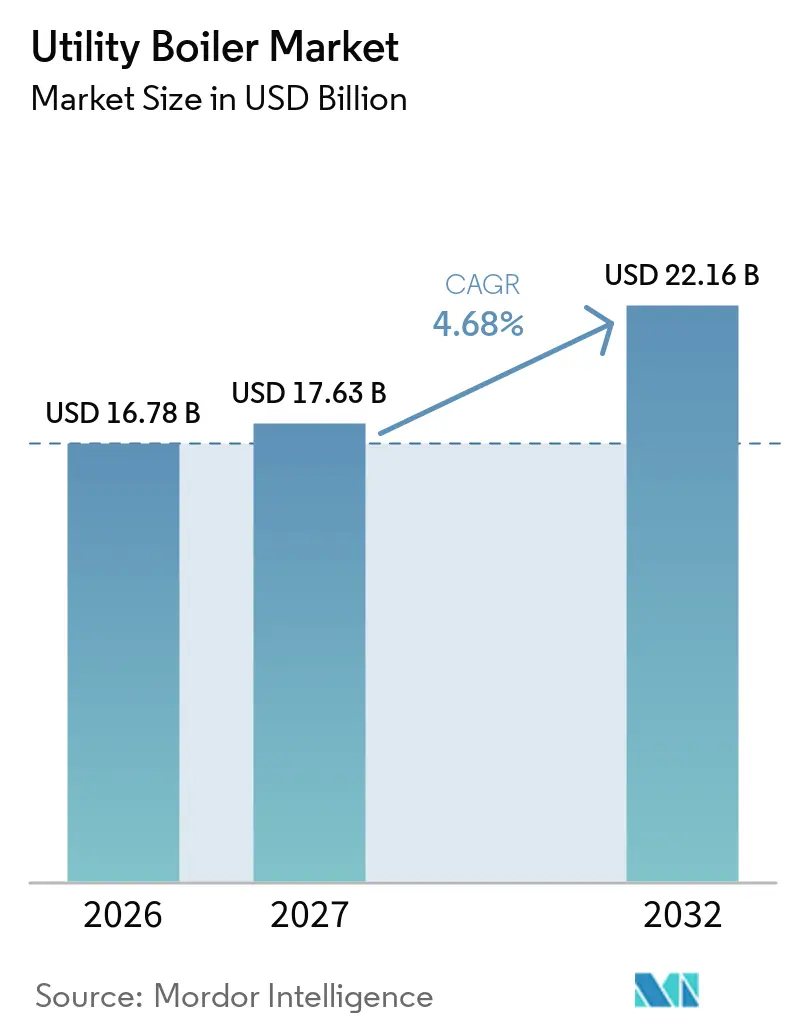
The Utility Boiler Market size was valued at USD 16.78 billion in 2026 and is estimated to reach USD 22.16 billion by 2032, at a CAGR of 4.68% during the forecast period from 2027 to 2032. The Utility Boiler Market is supported by rising electricity demand, the need for firm generation, and continued investment in thermal assets where renewable output cannot yet meet all grid requirements. Global electricity consumption rose 4.3% in 2024, compared with 2.5% in the prior year, which reinforced planning needs for reliable capacity across many power systems[1]. Procurement is shifting toward units that improve heat rates, lower fuel use, or support dual-fuel operation, rather than relying only on conventional replacement demand. The Utility Boiler Market also benefits from refurbishment work at aging plants, where operators can extend asset life through pressure-part replacement, fuel conversion, and emissions upgrades. Competitive opportunities are strongest where suppliers can shorten delivery schedules, meet code requirements, and offer service support after commissioning.
Key Report Takeaways
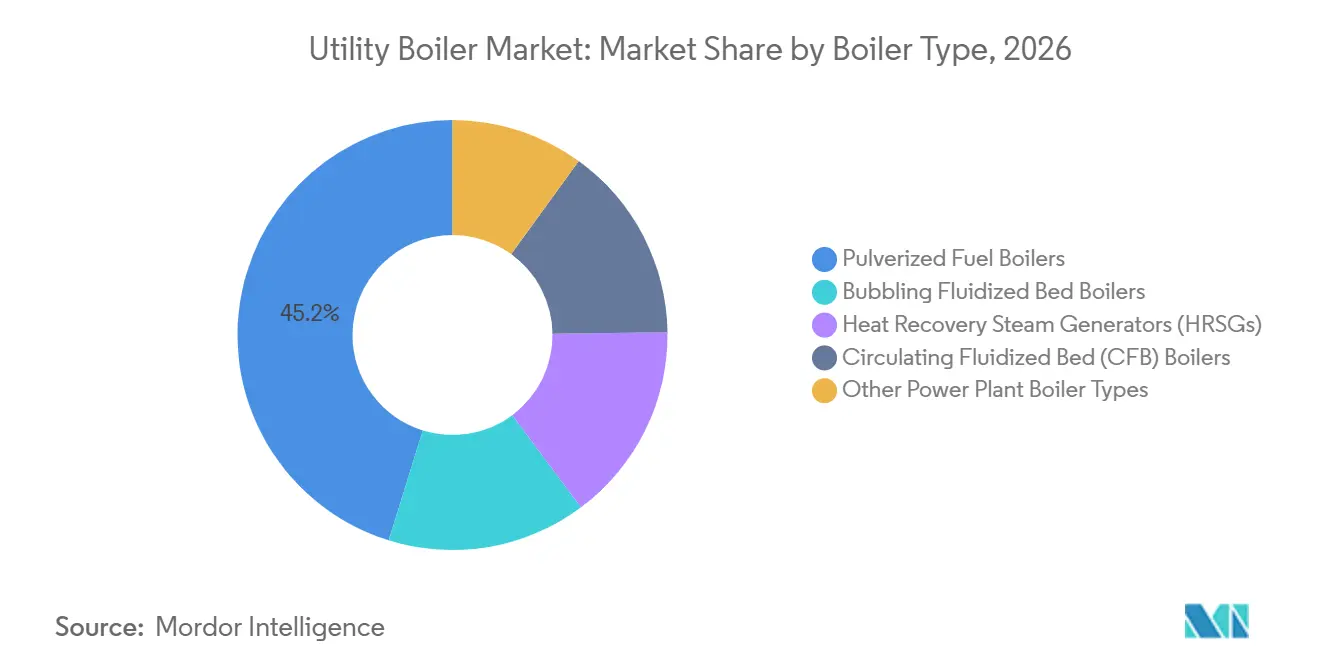
- By boiler type, pulverized fuel boilers held 45.2% of revenue in 2026, while Heat Recovery Steam Generators (HRSGs) are forecast to grow at a 5.1% CAGR through 2032.
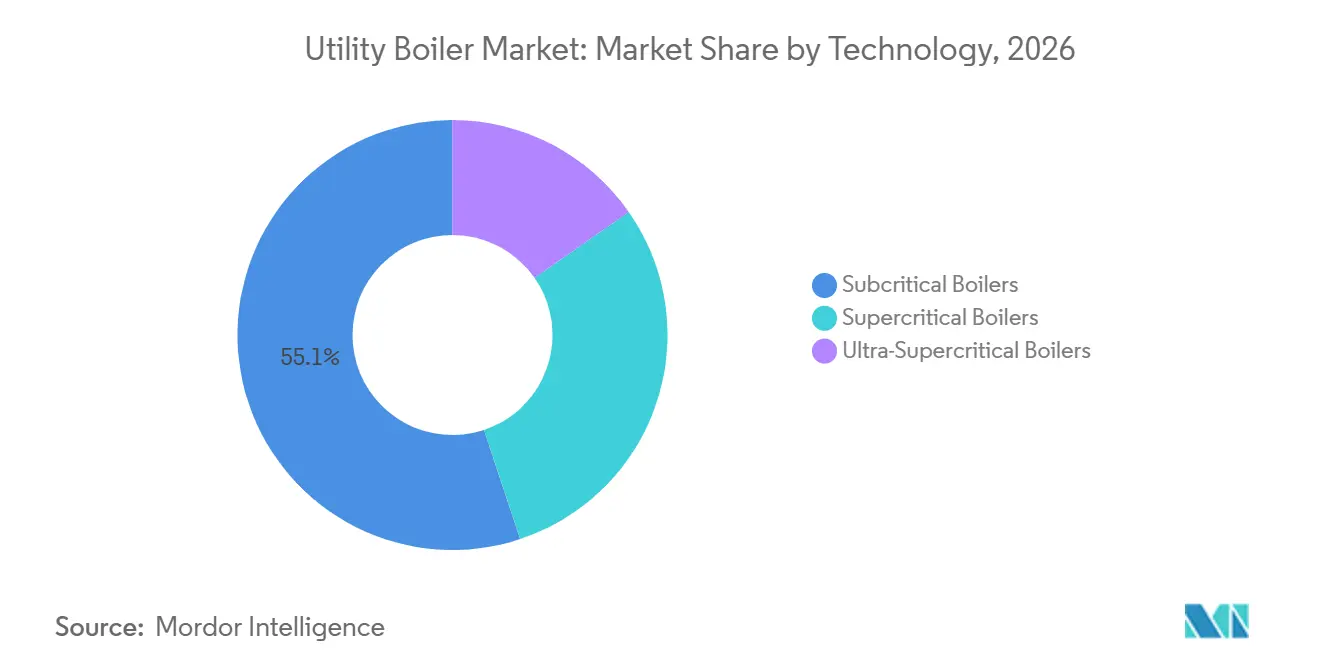
- By technology, subcritical boilers held 55.1% of revenue in 2026, while ultra-supercritical boilers are forecast to grow at a 5.7% CAGR through 2032.
- By capacity, the 30-100 MW range held 34.3% of revenue in 2026, while above-500 MW units are forecast to grow at a 5.6% CAGR through 2032.
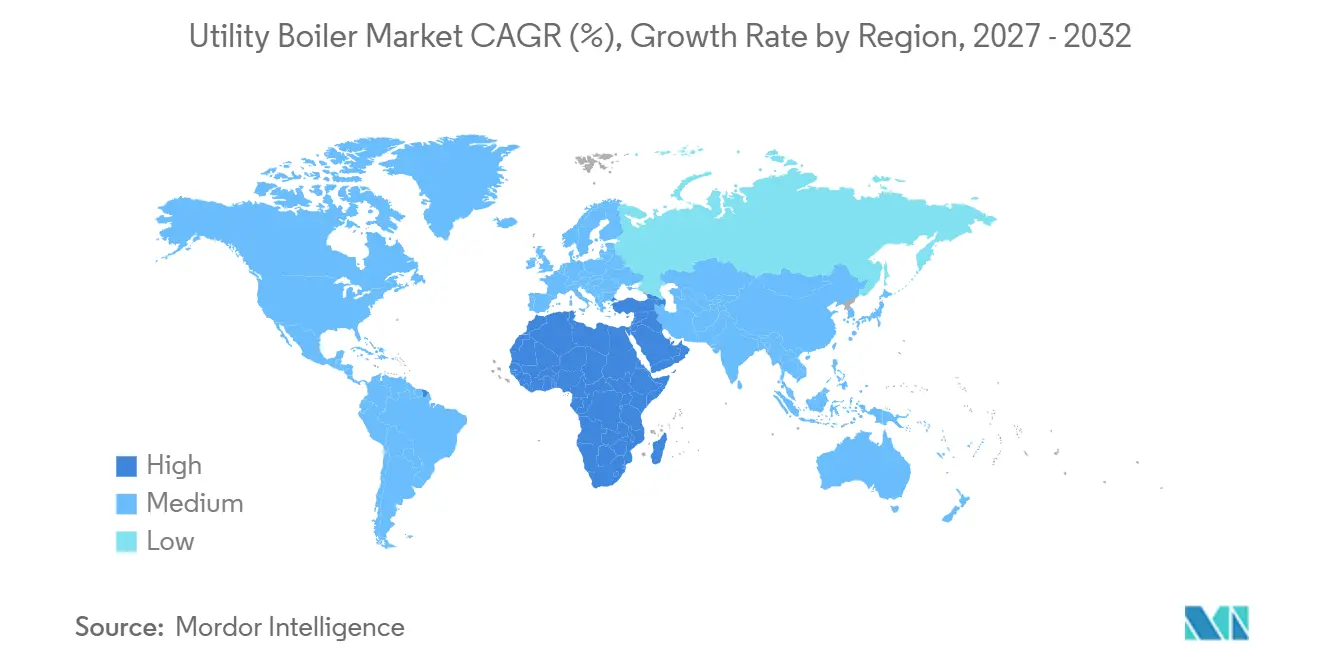
- By geography, Asia-Pacific held 67.7% of revenue in 2026, while the Middle East and Africa is forecast to grow at a 5.3% CAGR through 2032.
Note: Market numbers in this report are based on Mordor Intelligence's proprietary estimation framework, which combines nine months of actuals with Q4 projections for base year 2026.
Market Trends and Insights
Drivers Impact Analysis of Utility Boiler Market*
| Driver | (~) % Impact on CAGR Forecast | Geographic Relevance | Impact Timeline |
|---|---|---|---|
| Rising Electricity Demand and Thermal Capacity Expansion | +1.4% | Global, with emphasis on China, India, Southeast Asia, and the Middle East and Africa | Short term (≤ 2 years) |
| Stricter Emission Standards and High-Efficiency Boiler Adoption | +0.7% | Asia-Pacific, Europe, North America, and early-stage markets in Africa | Medium term (2-4 years) |
| Aging Thermal Fleet Modernization and Replacement | +0.8% | North America, Europe, Asia-Pacific, Japan, and South Korea | Medium term (2-4 years) |
| Industrial Steam Demand from Chemicals, Oil and Gas, and Manufacturing | +0.5% | Asia-Pacific, the Middle East and Africa, and South America | Medium term (2-4 years) |
| Data-Center-Led Gas Repowering and Firm Power Requirements | +0.4% | North America, Europe, and the Middle East and Africa | Short term (≤ 2 years) |
| Pressure-Part Replacements, Fuel Conversions, and Boiler Aftermarket Services | +0.3% | Global, concentrated in Asia-Pacific and North America | Long term (≥ 4 years) |
| Source: Mordor Intelligence | |||
Rising Electricity Demand and Thermal Capacity Expansion
The Utility Boiler Market is gaining support as electricity planners respond to stronger and less predictable demand growth. The International Energy Agency reported a 4.3% increase in global electricity consumption in 2024, a material increase from the prior year that added pressure on generation planning. China’s 2025-2027 coal power upgrade action plan directs upgrades of existing units and promotes higher-efficiency technology across provincial systems[2]. This approach creates demand for replacement equipment and for modifications that improve unit performance. Large utilities are also moving boiler orders earlier in the project sequence because supply availability can affect the construction schedule. The result is a wider set of opportunities covering both new capacity and existing fleet upgrades, allowing the Utility Boiler Market to serve utilities with distinct fuel, reliability, and operating priorities.
Data-Center-Led Gas Repowering and Firm Power Requirements
Data-center demand is opening a faster procurement channel for gas-fired boiler and steam turbine packages. In March 2026, Babcock & Wilcox received full notice to proceed on a USD 2.4 billion project to supply 1.2 GW through 4 natural gas-fired boilers for Base Electron to support Applied Digital AI Factory campuses. The project shows how customers are seeking dispatchable power where conventional interconnection and generation schedules are constrained. In August 2026, Babcock & Wilcox and Siemens Energy agreed to begin work on 20 steam turbine-generator sets totaling 1 GW for data-center power projects. Combined-cycle repowering is also relevant because it can add output at existing facilities without the civil works of a greenfield site. The R.D. Morrow Sr. station repower increased unit output from 204 MW to 572 MW using a Siemens gas turbine and a triple-pressure HRSG, showing how established sites can add capacity while using existing operating infrastructure.
Aging Thermal Fleet Modernization and Replacement
Aging thermal assets sustain demand for services and replacement equipment even when new-build activity varies by region. In September 2025, the U.S. Department of Energy announced USD 625 million in support for coal-related investment, including USD 350 million for recommissioning and retrofit work. This funding direction supports pressure-part replacement, combustion changes, efficiency projects, and dual-fuel modifications. The Utility Boiler Market can therefore capture work in stages as plant owners first extend operating life and later replace equipment that reaches technical limits. Existing sites also offer practical advantages because operators already have grid connections, water systems, and trained workforces. These conditions make refurbishment commercially relevant where replacement generation would take longer to develop, and they give the Utility Boiler Market a service opportunity that is less dependent on large greenfield awards.
Stricter Emission Standards and High-Efficiency Boiler Adoption
Emission standards are making efficiency and combustion performance more important in procurement decisions. The U.S. rule for hazardous air pollutants from coal- and oil-fired utility steam generating units set final requirements in February 2026, with important particulate matter and mercury provisions effective from April 2026[3]. Energy UK’s 2025 compliance protocol also addresses nitrogen oxide, sulfur dioxide, and particulate limits for boilers and gas turbines under the Industrial Emissions Directive[4]. Operators that keep thermal plants online may need upgrades to meet these operating conditions. Higher-efficiency boiler designs reduce fuel consumption and can support compliance planning at the same time. This demand is most durable where plant retirement is not a near-term option, which supports the Utility boiler market in systems with limited replacement options where power reliability remains a priority, particularly when operators must balance compliance, fuel costs, and system adequacy in the same investment decision.
Restraints Impact Analysis of Utility Boiler Market*
| Restraint | (~) % Impact on CAGR Forecast | Geographic Relevance | Impact Timeline |
|---|---|---|---|
| Renewable Generation and Gas-Fired Capacity Substitution Pressure | -1.0% | Europe, North America, and emerging pressure in Asia-Pacific | Medium term (2-4 years) |
| High Capital, Operating, and Emission-Control Costs | -0.6% | Global, with greater intensity in Sub-Saharan Africa and South America | Medium term (2-4 years) |
| Refractory, Alloy, and Specialized Component Supply Bottlenecks | -0.4% | Global, concentrated in project-dense Asia-Pacific and Middle East and Africa markets | Short term (≤ 2 years) |
| Complex Engineering, Procurement, and Construction (EPC), Commissioning, and Existing-Plant Integration Requirements | -0.3% | Asia-Pacific and the Middle East and Africa | Long term (≥ 4 years) |
| Source: Mordor Intelligence | |||
Renewable Generation and Gas-Fired Capacity Substitution Pressure
Renewable generation and gas-fired alternatives reduce the case for large new coal boiler projects in some markets. The restraint is most visible where grids have adequate flexibility, storage, transmission, and access to lower-carbon generation choices. New coal developments face greater uncertainty in Europe and parts of North America as electricity systems change their generation mix. The Utility Boiler Market remains less exposed in systems that require firm capacity and have limited grid integration options. South Asia, Southeast Asia, and parts of Africa still need dependable thermal generation to manage demand growth and variable renewable output. The outcome is a regional split rather than a uniform decline in boiler demand, with the Utility Boiler Market continuing to depend on the pace of grid investment and the availability of firm alternatives.
High Capital, Operating, and Emission-Control Costs
High equipment costs, financing requirements, and regulatory compliance expenses can delay project approvals and investment decisions. An 800 MW supercritical boiler-turbine-generator package typically costs between USD 250 million and USD 400 million, excluding civil works, EPC management, and balance-of-plant equipment and systems. A fully compliant large unit can require USD 1.2 billion to USD 1.6 billion when flue gas desulfurization, selective catalytic reduction, and electrostatic precipitator systems are included. Higher borrowing costs make these commitments harder to support in markets with limited credit capacity. Component availability can add pressure through longer lead times for alloys, refractories, and specialized equipment. These factors favor phased refurbishments, standardized configurations, and smaller projects where financing capacity is constrained, because these approaches can lower the immediate funding requirement and distribute technical work across a longer operating period.
*Our forecasts treat driver/restraint impacts as directional, not additive. The impact forecasts reflect baseline growth, mix effects, and variable interactions.
Utility Boiler Market Segment Analysis
By Boiler Type:
Gas Repowering and Ultra-Scale Circulating Fluidized Bed (CFB) Reshape the MixPulverized fuel boilers held 45.2% of the Utility Boiler Market share in 2026, supported by the large installed base in China, India, and Southeast Asia. Their continued role reflects established baseload systems and the use of coal-biomass or coal-gas co-firing options. These units also support recurring demand for tubes, burners, and auxiliary equipment, which gives established suppliers a continuing role after the original project is completed and the plant moves into its regular maintenance cycle. Circulating fluidized bed boilers are the second-largest type, with relevance in markets that use heterogeneous fuels, lignite, or waste-heat configurations. A 700 MW ultra-supercritical Circulating Fluidized Bed (CFB) unit connected to the grid in Yunnan in March 2025 and reached thermal efficiency of 46.34% at 29.3 MPa main steam pressure. POWERCHINA’s 700 MW unit at Guangdong Guoyue Shaoguan began commercial operation in July 2025, supporting the case for Circulating Fluidized Bed (CFB) deployment at a utility scale.
Heat Recovery Steam Generators (HRSGs) are the fastest-growing boiler type, with the Utility Boiler Market size for Heat Recovery Steam Generators (HRSGs) projected to expand at a 5.1% CAGR through 2032. Combined-cycle projects and gas repowering support this growth because they require steam generation equipment alongside gas turbines. GE Vernova is supplying Heat Recovery Steam Generators (HRSGs) for Oglethorpe Power’s Monroe County combined-cycle plant in Georgia, which is rated for more than 1,400 MW of total output. Bubbling fluidized bed boilers continue to serve biomass and distributed power applications. Other boiler types, including waste-heat and process steam units, follow investment in refining and chemical facilities, where the value proposition depends on recovering energy from a process stream and supplying dependable steam to production operations. Together, these categories create a portfolio in which conventional power demand and industrial steam demand require different supplier capabilities, from large integrated equipment packages to service support that helps customers manage routine operating needs.

By Technology:
Ultra-Supercritical Advances as Subcritical Base MaturesSubcritical boilers held 55.1% of the Utility Boiler Market share in 2026, reflecting installed-base economics in South and Southeast Asia. Vietnam, Indonesia, and the Philippines have substantial subcritical fleets that require maintenance and component replacements. Plant owners with limited capital budgets may favor servicing tubes, burners, and controls instead of retiring an operating unit. This work supports steady order flow even when large Engineering, Procurement, and Construction (EPC) awards are limited, giving the Utility Boiler Market a stable source of revenue from operating assets. Supercritical boilers provide a familiar specification for large projects that need higher efficiency without changing established engineering practices. The technology mix therefore combines a broad service base with new demand for higher-performance units, and it requires manufacturers to maintain expertise in both established operating fleets and more advanced specifications.
Ultra-supercritical boilers are forecast to grow at a 5.7% CAGR through 2032, making them the fastest-growing technology category. Dongfang Electric delivered key equipment in late 2025 for a 630°C ultra-supercritical double-reheat project in Yuncheng with 2 units of 1,000 MW, and commissioning is targeted for 2026. China’s 2025-2027 upgrade plan promotes advanced coal power technology and efficiency improvement across its provincial fleet. These projects increase demand for specialized materials, advanced controls, and suppliers that can meet high temperature and pressure requirements. The Utility boiler industry is therefore moving toward designs that reduce fuel use while supporting existing system reliability needs. This shift does not remove demand for subcritical maintenance, but it changes the technology profile of major new awards, as customers weigh operating efficiency, emissions obligations, material performance, and expected plant life before making a selection.
By Capacity:
Scale Economics Consolidate Procurement Toward Larger UnitsThe 30-100 MW range held 34.3% of revenue in 2026, reflecting the large installed base of industrial and smaller utility plants across Asia and South America. These units generate aftermarket demand for tube replacement, soot-blowing upgrades, and fuel conversion projects. The 100-250 MW and 250-500 MW ranges serve mid-tier utilities, independent power producers, and industrial systems. Buyers in these ranges may prefer standard configurations that reduce execution risk and financing complexity. Capacity choices are shaped by the local grid, fuel supply, and the size of the customer’s operating requirement, as well as the practical ability of the developer to fund construction, secure land, and manage the delivery of supporting infrastructure. As a result, smaller ranges remain important even as large central stations attract the highest-value projects, which broadens the Utility Boiler Market beyond major national tenders.
Above-500 MW units are forecast to grow at a 5.6% CAGR through 2032. Large boiler units can improve heat-rate performance per MWh and support the scale required by major national procurement programs, while concentrating a larger share of project value in a limited number of complex equipment packages that need closely coordinated engineering and site execution. This capacity band is associated with projects that require extensive engineering, long delivery schedules, and strong execution capability. It also raises the importance of financing, site readiness, and component supply. The Utility Boiler Market is likely to see suppliers compete on performance guarantees and delivery certainty as these units become more common. Smaller units will continue to serve local and industrial needs, creating a mixed demand base across the capacity spectrum and ensuring that the Utility boiler industry does not rely only on the relatively limited number of very large projects.
Geography Analysis
Asia-Pacific held 67.7% of revenue in 2026, making it the largest regional market. China’s 2025-2027 action plan supports power plant upgrades and higher-efficiency coal technology across provincial systems. India and Southeast Asia also sustain demand through new thermal capacity, replacements, and service work on existing fleets. The region has a broad mix of large utility projects, industrial steam applications, and aging units that need maintenance, supporting the Utility Boiler Market through several different purchasing channels. China’s high-capacity Circulating Fluidized Bed (CFB) projects show that advanced equipment can be deployed alongside large conventional fleets. Japan and South Korea contribute to the demand for fuel flexibility, pressure-part replacement, and upgrades at mature assets. The region’s scale and varied plant base make it central to both equipment sales and long-term service activity, because suppliers can address new construction, component replacement, fuel changes, and emission-related upgrades within the same broad regional market.
North America and Europe have a smaller new-build opportunity, but they remain important for retrofit, repowering, and digital modernization work. The U.S. Department of Energy’s USD 625 million announcement in September 2025 supported recommissioning and retrofit activity at coal-related facilities. North America also has an emerging behind-the-meter power segment for data centers, illustrated by Babcock & Wilcox’s USD 2.4 billion natural gas project for Base Electron. European projects are more likely to focus on compliance, plant-life extension, and gas repowering than on large new coal units, changing the Utility Boiler Market toward services and conversion work. Energy UK’s updated compliance protocol reinforces the role of emissions management in operating decisions. These regions reward suppliers that can upgrade existing infrastructure and meet demanding regulatory standards, while also providing field support that reduces outage time and improves the economics of continued plant operation.
The Middle East and Africa is forecast to grow at a 5.3% CAGR through 2032, making it the fastest-growing regional group. Saudi Electricity Company reported 23.4 GW of gas thermal projects under development in its fiscal year 2025 results, with carbon capture provisions, while its liquid displacement program covers 22.3 GW of oil-fired capacity conversion. This program supports Utility Boiler Market demand for modification and dual-fuel conversion in the Gulf, where the commercial objective is to change the operating fuel while retaining useful infrastructure and maintaining dependable supply for the power system. Thermax secured an INR 580 crore order, equivalent to USD 69 million at an average INR/USD rate of 84, from Dangote Industries in Nigeria in November 2025 for 4 high-pressure utility boilers. African demand is more varied across industrial, refinery, petrochemical, and power applications, giving the Utility Boiler Market exposure to a broad range of customer investment plans. South America remains a steady market for industrial steam, refining, mining, and agro-processing projects. The regional mix favors suppliers that can adapt designs to local fuels, financing limits, and operating conditions, including industrial users that need reliable steam supply but cannot support the scale or delivery profile of a central utility project.
Competitive Landscape
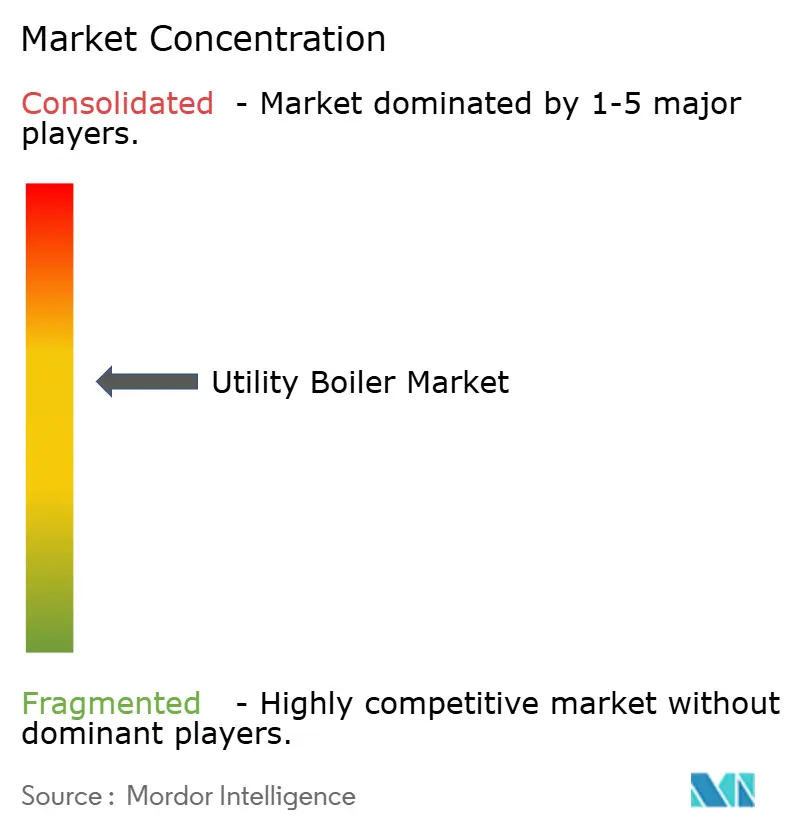
The Utility Boiler Market has a moderately consolidated OEM tier led by Babcock & Wilcox, Dongfang Electric, Mitsubishi Heavy Industries, GE Vernova, Bharat Heavy Electricals Limited (BHEL), and Shanghai Electric. Large suppliers compete for major projects through engineering depth, manufacturing capacity, performance guarantees, and the ability to meet national and international codes, which shapes how the Utility Boiler Market allocates high-value contracts. Chinese OEMs retain a strong position in domestic upgrades and seek international work in Africa and the Middle East. Western suppliers are directing more attention to gas-fired packages, repowering, and data-center projects. Smaller and regional specialists compete in aftermarket work, fuel conversion, and mid-scale systems, often relying on local field presence and familiarity with a customer’s installed equipment to provide a practical alternative to a major OEM. Code compliance remains a barrier for manufacturers that seek to enter large utility tenders without an established project record.
Babcock & Wilcox’s March 2026 notice to proceed for the USD 2.4 billion, 1.2 GW Base Electron project shows a focused move into data-center power infrastructure. Its August 2026 agreement with Siemens Energy for 20 steam turbine-generator sets totaling 1 GW extends this position across further data-center customers. GE Vernova’s HRSG supply for the Monroe County combined-cycle project demonstrates its role in the gas and combined-cycle equipment chain. Dongfang Electric’s equipment delivery for the 630°C Yuncheng project shows continued investment in ultra-supercritical capability. These strategic moves reflect competition across different demand pools rather than a single uniform procurement market. Companies that can combine equipment supply with service and retrofit capability have a broader range of revenue opportunities, since customers often need support through design, installation, commissioning, maintenance, and later efficiency or fuel-conversion work.
The Utility Boiler Market includes a large aftermarket opportunity because many units will remain in service even where new coal capacity slows. Thermax’s November 2025 order for 4 utility boilers for Dangote in Nigeria demonstrates the value of regional industrial projects outside the largest power markets. Suppliers also compete through turnaround time for pressure parts, field engineering, combustion changes, and fuel flexibility upgrades, which can be decisive when an operator needs to limit downtime at an asset that supports local power or industrial production. Advanced metallurgy and combustion-control know-how can become differentiators for ultra-supercritical work, because high-temperature service places greater demands on material selection, manufacturing quality, operating procedures, and the ability to maintain performance over time.
Utility Boiler Industry Leaders
-
Harbin Electric Company Limited
-
Dongfang Electric Corporation Limited
-
Shanghai Electric Group Company Limited
-
Bharat Heavy Electricals Limited
-
Babcock & Wilcox Enterprises, Inc.
- *Disclaimer: Major Players sorted in no particular order
Utility Boiler Market Companies Covered in this Report
- AC Boilers S.p.A.
- ANDRITZ AG
- Babcock & Wilcox Enterprises, Inc.
- Bharat Heavy Electricals Limited
- China National Erzhong Group Co., Ltd.
- Dongfang Electric Corporation
- Doosan Enerbility Co., Ltd.
- General Electric Company (GE)
- Harbin Electric Corporation
- IHI Corporation
- John Cockerill SA
- Larsen & Toubro Limited
- Mitsubishi Heavy Industries, Ltd.
- Rentech Boiler Systems, Inc.
- Shanghai Electric Group Company Limited
- Siemens Energy AG
- Sumitomo Heavy Industries, Ltd.
- Thermax Limited
- Valmet Oyj
- Walchandnagar Industries Limited
Recent Industry Developments in Utility Boiler Market
- August 2026: Babcock & Wilcox signed an agreement with Siemens Energy for 20 steam turbine-generator sets totaling 1 GW of capacity under its FastPower program for data center customers. The order is separate from the previously announced Applied Digital project and signals demand across multiple customers on accelerated delivery schedules.
- March 2026: Babcock & Wilcox received full notice to proceed on its USD 2.4 billion design-build agreement with Base Electron, backed by Applied Digital, to deliver 1.2 GW through 4300 MW natural gas-fired boilers. Siemens Energy was released to design and supply the steam turbine-generator sets, with engineering and manufacturing underway.
- January 2026: Babcock & Wilcox selected Siemens Energy to supply steam turbine-generator sets for the Applied Digital data-center power project under a limited notice to proceed that secured equipment for delivery by the end of 2028.
- December 2025: Dongfang Electric delivered the main boiler, steam turbine, and generator equipment for the 630°C ultra-supercritical double-reheat demonstration project in Yuncheng. The 21,000 MW units were targeted for commissioning in 2026.
Global Utility Boiler Market Report Scope
A utility boiler is a large-scale steam-generating system designed primarily for electricity production in utility-scale power plants. It converts thermal energy released by burning fuels, such as coal, natural gas, or biomass, into high-pressure steam that drives steam turbines to generate electricity. The market includes boiler systems and associated components supplied for new power plants, capacity expansions, and replacement or modernization projects.
The global utility boiler market is segmented by boiler type, technology, capacity, and geography. By boiler type, the market is segmented into pulverized fuel boilers, circulating fluidized bed (CFB) boilers, bubbling fluidized bed boilers, heat recovery steam generators (HRSGs), and other power plant boiler types. By technology, the market is segmented into subcritical, supercritical, and ultra-supercritical boilers. By capacity, the market is segmented into 30–100 MW, 100–250 MW, 250–500 MW, and above 500 MW. The report also covers the market size and forecasts for the global utility boiler market across 26 countries in key regions. For each segment, the market sizing and forecasts are provided on the basis of value (USD).
Segmentation Overview
| Pulverized Fuel Boilers |
| Circulating Fluidized Bed (CFB) Boilers |
| Bubbling Fluidized Bed Boilers |
| Heat Recovery Steam Generators (HRSGs) |
| Other Power Plant Boiler Types |
| Subcritical Boilers |
| Supercritical Boilers |
| Ultra-Supercritical Boilers |
| 30-100 MW |
| 100-250 MW |
| 250-500 MW |
| Above 500 MW |
| North America | United States |
| Canada | |
| Mexico | |
| Europe | Germany |
| France | |
| Italy | |
| Spain | |
| United Kingdom | |
| Poland | |
| Russia | |
| Rest of Europe | |
| Asia-Pacific | China |
| India | |
| Japan | |
| South Korea | |
| Australia | |
| Indonesia | |
| Vietnam | |
| Thailand | |
| Rest of Asia-Pacific | |
| South America | Brazil |
| Argentina | |
| Chile | |
| Rest of South America | |
| Middle East and Africa | Saudi Arabia |
| United Arab Emirates | |
| Egypt | |
| South Africa | |
| Morocco | |
| Rest of Middle East and Africa |
| By Boiler Type | Pulverized Fuel Boilers | |
| Circulating Fluidized Bed (CFB) Boilers | ||
| Bubbling Fluidized Bed Boilers | ||
| Heat Recovery Steam Generators (HRSGs) | ||
| Other Power Plant Boiler Types | ||
| By Technology | Subcritical Boilers | |
| Supercritical Boilers | ||
| Ultra-Supercritical Boilers | ||
| By Capacity | 30-100 MW | |
| 100-250 MW | ||
| 250-500 MW | ||
| Above 500 MW | ||
| By Geography | North America | United States |
| Canada | ||
| Mexico | ||
| Europe | Germany | |
| France | ||
| Italy | ||
| Spain | ||
| United Kingdom | ||
| Poland | ||
| Russia | ||
| Rest of Europe | ||
| Asia-Pacific | China | |
| India | ||
| Japan | ||
| South Korea | ||
| Australia | ||
| Indonesia | ||
| Vietnam | ||
| Thailand | ||
| Rest of Asia-Pacific | ||
| South America | Brazil | |
| Argentina | ||
| Chile | ||
| Rest of South America | ||
| Middle East and Africa | Saudi Arabia | |
| United Arab Emirates | ||
| Egypt | ||
| South Africa | ||
| Morocco | ||
| Rest of Middle East and Africa | ||
Key Questions Answered in the Report
What is the projected value of the Utility Boiler Market by 2032?
The Utility Boiler Market is projected to reach USD 22.16 billion by 2032, growing at a CAGR of 4.68% from 2027 to 2032.
Which boiler type leads utility boiler revenue?
Pulverized fuel boilers lead, with 45.2% revenue share in 2026.
Which technology is expected to grow the fastest?
Ultra-supercritical boilers are expected to grow at a 5.7% CAGR through 2032.
Which capacity range is expanding the fastest?
Above-500 MW units are forecast to grow at a 5.6% CAGR through 2032.
Which region has the largest utility boiler revenue share?
Asia-Pacific leads with 67.7% revenue share in 2026.
What is driving demand for utility boilers?
Demand is supported by electricity growth, thermal fleet modernization, emissions upgrades, gas repowering, and the need for reliable power.