
Urban Micro-Fulfillment Centers (MFC) and Dark Store Logistics Market Size and Share
Market Overview
| Study Period | 2021 - 2032 |
|---|---|
| Market Size (2027) | USD 14.26 Billion |
| Market Size (2032) | USD 41.84 Billion |
| Growth Rate (2027 - 2032) | 24.02 % |
| Fastest Growing Market | Asia-Pacific |
| Largest Market | Asia-Pacific |
| Market Concentration | Medium |
Major Players *Disclaimer: Major Players sorted in no particular order Image © Mordor Intelligence. Reuse requires attribution under CC BY 4.0. | |
Urban Micro-Fulfillment Centers (MFC) and Dark Store Logistics Market Analysis by Mordor Intelligence
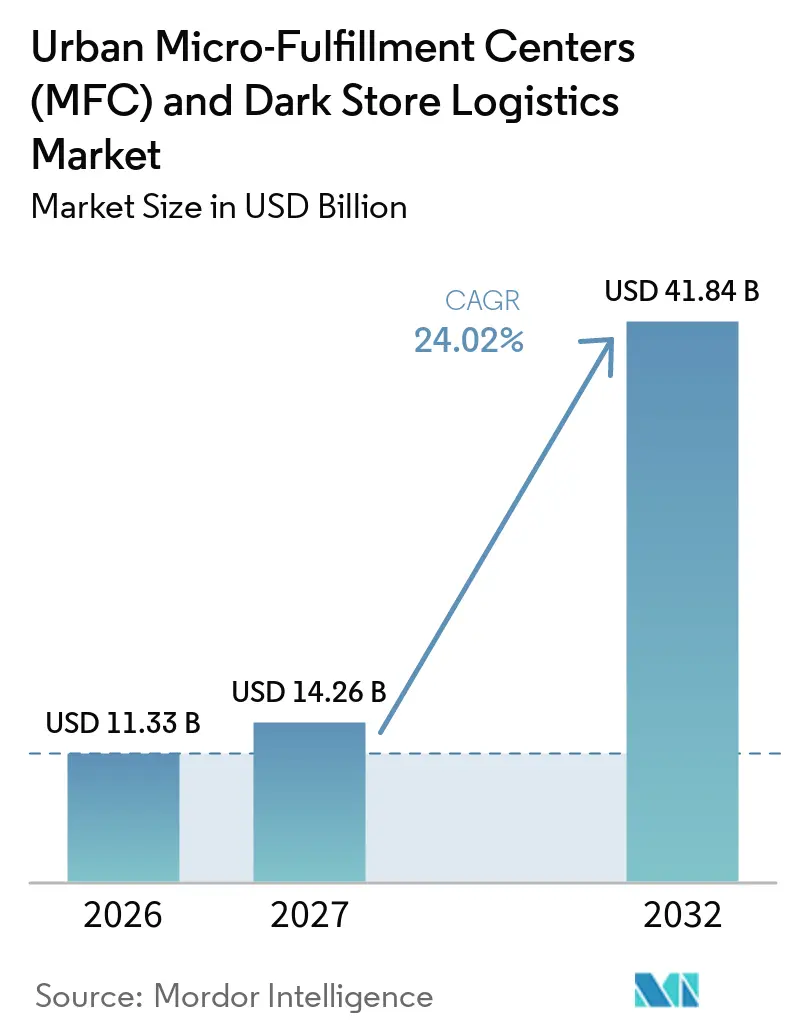
The urban micro-fulfillment centers (MFC) and dark store logistics market is valued at USD 11.33 billion in 2026 and is estimated to grow from USD 14.26 billion in 2027 to reach USD 41.84 billion by 2032, at a CAGR of 24.02% during the forecast period (2027-2032).
The urban micro-fulfillment centers (MFC) and dark store logistics market is moving fulfillment activity closer to dense demand areas, reducing reliance on distant regional warehouses for time-sensitive orders. Higher online retail spending, online grocery adoption, and delivery expectations are raising the value of local inventory positions. Operators are balancing dark-store deployment with store backroom conversions and shared facilities to improve coverage without matching the capital requirements of fully automated sites. The urban micro-fulfillment centers (MFC) and dark store logistics market also benefits from underused commercial sites and brownfield redevelopment, which can make urban locations more accessible. However, zoning rules, expensive conversions, limited small-bay space, cold-chain energy needs, and curbside constraints can delay new nodes even where customer demand is strong.
Key Report Takeaways
- By facility type, dark store-based fulfillment held 42.00% of the urban micro-fulfillment centers (MFC) and dark store logistics market size in 2026, while hybrid and shared urban fulfillment facilities are projected to register a 26.46% CAGR through 2032.
- By temperature type, non-temperature-controlled facilities held 64.00% of the urban micro-fulfillment centers (MFC) and dark store logistics market share in 2026, while temperature-controlled operations are projected to register a 25.68% CAGR through 2032.
- By organization size, large enterprises held 62.00% of revenue in 2026, while SMEs are projected to register a 24.51% CAGR through 2032.
- By end user, quick commerce and online grocery held 31.00% of revenue in 2026, while the same segment is projected to register a 25.33% CAGR through 2032.
- By geography, Asia-Pacific held 34.00% of revenue in 2026 and is projected to register a 25.75% CAGR through 2032.
Note: Market numbers in this report are based on Mordor Intelligence's proprietary estimation framework, which combines nine months of actuals with Q4 projections for base year 2026.
Market Trends and Insights
Drivers Impact Analysis of Urban Micro-Fulfillment Centers (MFC) and Dark Store Logistics Market*
| Driver | (~) % Impact on CAGR Forecast | Geographic Relevance | Impact Timeline |
|---|---|---|---|
| E-Commerce and Online Grocery Penetration | +6.5% | Global | Short term (≤ 2 years) |
| Consumer Expectations for Same-Day and Sub-Two-Hour Delivery | +5.8% | North America, Europe, APAC | Short term (≤ 2 years) |
| Rising Urban Order Density and Route Utilization | +4.2% | APAC core, spill-over to North America | Medium term (2-4 years) |
| Retailer Conversion of Existing Store and Backroom Space | +3.1% | North America, Europe | Medium term (2-4 years) |
| Labor Scarcity and Need for Automated Picking | +2.6% | North America, Europe, Japan | Long term (≥ 4 years) |
| Underused Urban Commercial Real Estate and Brownfield Conversion | +1.8% | Europe, North America | Medium term (2-4 years) |
| Source: Mordor Intelligence | |||
E-Commerce and Online Grocery Penetration
United States retail e-commerce sales reached USD 340.2 billion in the second quarter of 2026, representing 17.1% of total retail sales and 12.2% year-over-year growth.[1] Annual United States e-commerce sales totaled USD 1.23 trillion in 2025, and e-commerce represented 16.4% of retail sales. These volumes increase the number of orders that must be served within urban delivery areas and support demand for local fulfillment capacity. Online grocery adds a need for temperature-controlled inventory near consumers, which broadens the urban micro-fulfillment centers (MFC) and dark store logistics market beyond general merchandise. Blinkit ended fiscal year 2026 with 2,243 active dark stores and targeted 3,000 stores by March 2027. Amazon India committed USD 337 million to expand Amazon Now to more than 1,000 micro-fulfillment centers across 100 cities.
Consumer Expectations for Same-Day and Sub-Two-Hour Delivery
As per a recent study, on-time arrival was important to 73% of shoppers, while at least 40% valued same-day or next-day delivery choices. Half of consumers expect same-day delivery for food and perishable grocery orders. These delivery expectations favor neighborhood-based inventory because perishable orders have limited tolerance for longer travel times. The urban micro-fulfillment centers (MFC) and dark store logistics market, therefore, provides retailers with a way to make delivery speed part of customer retention instead of treating it only as a logistics cost. Larger dark stores can also support broader assortments while maintaining rapid delivery, with facilities sized from 3,500 to 4,500 ft² capable of holding up to 20,000 SKUs. Operators that cannot offer comparable delivery windows risk weaker trial conversion and repeat purchase behavior in categories where speed affects customer choice.
Rising Urban Order Density and Route Utilization
Higher order density improves the utilization of each urban node and reduces average delivery distance. In dense cities, a growing number of delivery corridors can become commercially viable as online purchasing increases. The urban micro-fulfillment centers (MFC) and dark store logistics market gains from this effect because more daily orders support better use of inventory, labor, vehicles, and automated systems. As networks add nodes, shorter routes can reduce per-order labor and fuel costs while increasing capacity during peak periods. The underlying economics favor coordinated networks rather than isolated facilities because the value of one site rises as nearby coverage improves. Southeast Asia's quick-commerce value reached USD 7.3 billion in gross merchandise value in 2025, with Singapore, Thailand, and Vietnam leading penetration and Indonesia remaining a large underpenetrated opportunity.
Retailer Conversion of Existing Store and Backroom Space
Retailers are converting underused backrooms and store space into local fulfillment areas, avoiding the land-acquisition cost of a separate site. Existing store networks can become distributed proximity assets when they are fitted with dedicated picking zones and automated equipment. More than 60% of one major United States retailer's stores receive freight from automated distribution centers, and more than 50% of its e-commerce fulfillment volume moves through automated systems. The urban micro-fulfillment centers (MFC) and dark store logistics market can use this model to expand closer to shoppers while retaining a retailer's existing real-estate footprint. Ocado Group has developed a store-based automation system designed for existing backrooms, signaling a focus on retail conversion rather than new standalone sites. Backroom conversion can also help established retailers respond to standalone dark-store competitors without duplicating every element of their physical network.
Restraints Impact Analysis of Urban Micro-Fulfillment Centers (MFC) and Dark Store Logistics Market*
| Restraint | (~) % Impact on CAGR Forecast | Geographic Relevance | Impact Timeline |
|---|---|---|---|
| Urban Real-Estate Costs and Zoning Friction | -2.8% | North America, Europe, APAC | Short term (≤ 2 years) |
| High Automation, Retrofit and Systems-Integration Capex | -2.1% | Global | Medium term (2-4 years) |
| Low-Throughput Micro-Market Unit Economics | -1.5% | North America, South America, MEA | Long term (≥ 4 years) |
| Curbside, Traffic, Energy and Cold-Chain Bottlenecks | -0.9% | APAC core, Europe | Medium term (2-4 years) |
| Source: Mordor Intelligence | |||
Urban Real-Estate Costs and Zoning Friction
Urban zoning rules do not always classify micro-fulfillment activity in a way that permits it near the areas with the highest consumer demand. New York City's zoning code permits micro-distribution facilities as of right in Use Group IX industrial designations and excludes them from commercial districts C1 through C4 without a variance.[2] California Assembly Bill 735, effective January 2026, added truck-route compliance and environmental review requirements for specified large logistics developments near sensitive receptors. Philadelphia also created a Multi-Modal Logistics Center Overlay District in September 2025. These requirements do not prevent the urban micro-fulfillment centers (MFC) and dark store logistics market from expanding, but they add time, compliance work, and cost that can disadvantage smaller operators. In practice, site selection has become as important as automation design because a technically suitable facility may still face local approval barriers.
High Automation, Retrofit and Systems-Integration Capex
Order picking can account for more than 50% of fulfillment operating costs, which creates a clear reason to automate but also raises the importance of upfront investment. The United States transportation, warehousing, and utilities sector had 353,000 job openings in August 2026, while warehousing and storage employment stood at 1,831,800 in September 2026.[3] This labor pressure makes automation attractive for the urban micro-fulfillment centers (MFC) and dark store logistics market, even when financing a retrofit is difficult.[4] Small-bay urban industrial vacancy stood at 6.4% in the United States in June 2026, limiting the supply of suitable space and increasing conversion premiums. Human-robot interface design and system integration can add engineering time to facilities that remain active during a phased conversion. These costs favor operators with established capital access, experienced integrators, and sufficient order volumes to support payback. The urban micro-fulfillment centers (MFC) and dark store logistics market consequently has a practical barrier to entry even where delivery demand is already visible. Operators need to sequence site selection, system design, and demand development so that expensive capacity is not installed ahead of viable order volumes.
*Our forecasts treat driver/restraint impacts as directional, not additive. The impact forecasts reflect baseline growth, mix effects, and variable interactions.
Urban Micro-Fulfillment Centers (MFC) and Dark Store Logistics Market Segment Analysis
By Facility Type:
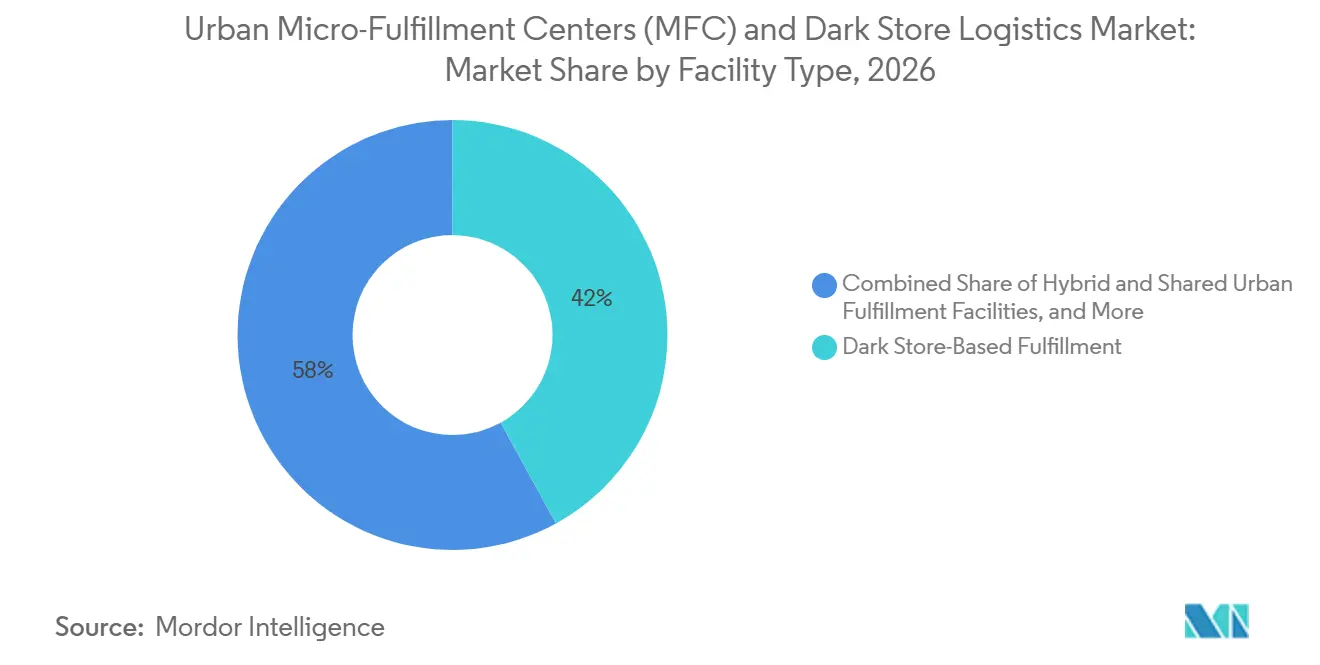
Dark Stores Lead While Hybrid Formats Define the Next Growth LayerDark store-based fulfillment held 42.00% of the urban micro-fulfillment centers (MFC) and dark store logistics market size in 2026, giving it the largest urban micro-fulfillment centers (MFC) and dark store logistics market share by facility type. This format offers a more capital-efficient way to build local coverage than a fully automated micro-fulfillment center. Blinkit reached 2,243 active stores by the end of fiscal year 2026 after adding 942 stores during the year. The scale of that rollout shows why dark stores remain useful where demand is established, but operators need rapid geographic coverage. MFC-based and retail store-based models remain relevant for large omnichannel operators that can use existing real estate and established logistics systems.
Hybrid and shared urban fulfillment facilities are projected to register a 26.46% CAGR through 2032, the highest rate within this segmentation. Their shared model spreads fixed automation and site costs across multiple tenants or product categories. Picnic's Oberhausen facility operated across 3 temperature zones from -18 °C to +20 °C and used 1,500 autonomous robots in 2025. The example illustrates how shared facilities can improve asset utilization while supporting fresh, frozen, and ambient products. This format provides an option for operators that want local capacity but cannot justify a dedicated automated node for one tenant or category.
By Temperature Type:
Ambient Dominates but Cold-Chain Closes the Economic GapNon-temperature-controlled facilities held 64.00% of the urban micro-fulfillment centers (MFC) and dark store logistics market share in 2026 because ambient goods make up a large share of e-commerce and general merchandise orders. These facilities require less specialized equipment than refrigerated or frozen operations. Many quick-commerce networks first establish local density with ambient assortments before expanding their fresh and chilled selection. This path has supported the current position of ambient operations within the urban micro-fulfillment centers (MFC) and dark store logistics market. Ambient goods also help keep inventory utilization stable across product categories and daily ordering patterns. The urban micro-fulfillment centers (MFC) and dark store logistics market can use this inventory mix to establish local operations before operators add the higher energy requirements of a cold-chain format. That sequence can limit early capital exposure while a customer base and delivery pattern are still developing.
Temperature-controlled operations are forecast to register a 25.68% CAGR through 2032 as grocery, pharmaceutical, and meal-kit demand expands. Chilled, frozen, and multi-temperature facilities require more energy and more specialized controls, but they support categories that cannot be handled through ambient networks. The urban micro-fulfillment centers (MFC) and dark store logistics market size for temperature-controlled operations is supported by the need to place cold-chain inventory nearer to urban customers. Multi-temperature sites can combine ambient, chilled, and frozen stock in one facility, improving format flexibility for retailers. Food safety and cold-chain integrity remain necessary operating considerations when these facilities handle perishable or regulated products.
By Organization Size:
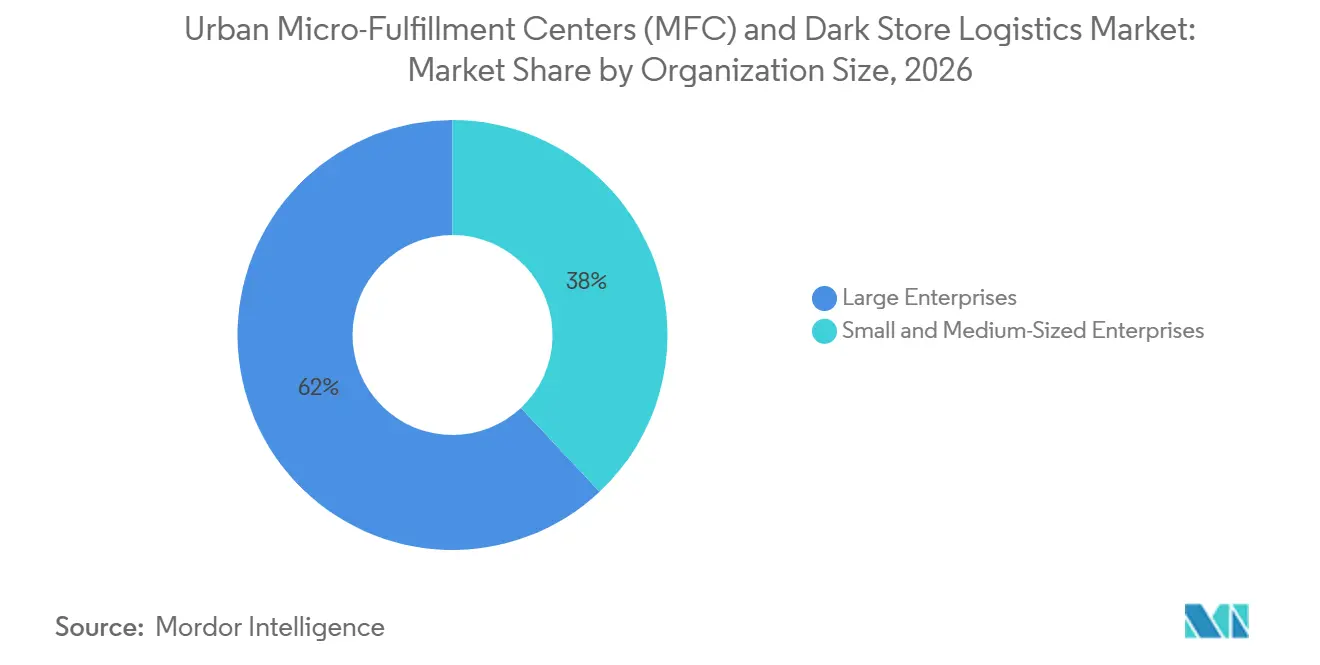
Large Enterprises Hold Scale Advantage, SMEs AccelerateLarge enterprises held 62.00% of 2026 revenue, reflecting their established investment in automation, site access, and logistics partnerships. Their existing systems can reduce per-unit costs as order volumes rise across a larger network. GXO Logistics reported USD 13.2 billion in revenue in 2025 and planned to scale GXO IQ across more than 50 sites in 2026, with nearly 20,000 robots expected to be in operation by year-end. This scale gives large organizations a cost and execution advantage when extending local fulfillment capacity in the urban micro-fulfillment centers industry. It also makes them better placed to absorb the capital and integration work required by automated urban operations.
SMEs are projected to register a 24.51% CAGR through 2032 as shared facilities, 3PL-managed systems, and robotics-as-a-service models reduce initial investment needs. These models allow smaller retailers to access local picking, packing, and delivery resources without developing a complete node network. DoorDash introduced DashMart Fulfillment Services in September 2025 for CVS Pharmacy, Party City, and Kroger. The service combines inventory management, picking, packing, and delivery through an existing dark-store network. Such models can widen participation in the urban micro-fulfillment centers (MFC) and dark store logistics market while leaving facility ownership concentrated among larger providers.
By End User:
Quick Commerce Commands Both Scale and Growth, Other Verticals Expand the BaseQuick commerce and online grocery held 31.00% of 2026 revenue and are projected to register a 25.33% CAGR through 2032. This segment holds the leading end-user position and has the fastest growth rate among end users. Dark-store expansion exposes more customers to rapid grocery delivery and can increase repeat orders, which supports further node investment. Swiggy Instamart operated 1,143 dark stores in 129 cities at the end of fiscal year 2026, with active dark-store area rising 95% year-over-year to 4.8 million ft². The delivery speed required for grocery and quick commerce makes proximity more central to the operating model than it is for many other retail categories.
E-commerce and general merchandise, grocery and food retail, and FMCG add demand that can use the same local fulfillment infrastructure with less urgent delivery requirements. Pharmaceutical and healthcare orders can require temperature control, chain-of-custody processes, and rapid delivery for urgent prescriptions. Consumer electronics, fashion, beauty, and personal care add ambient inventory that can smooth utilization across daily peaks. A broader product mix helps shared facilities use their local capacity through more hours of the day. This diversification allows the urban micro-fulfillment centers (MFC) and dark store logistics market to serve more than one order profile from the same urban site. It also gives a shared operator more ways to use labor, equipment, and urban space when demand for one category is lower at a particular time of day.
Geography Analysis
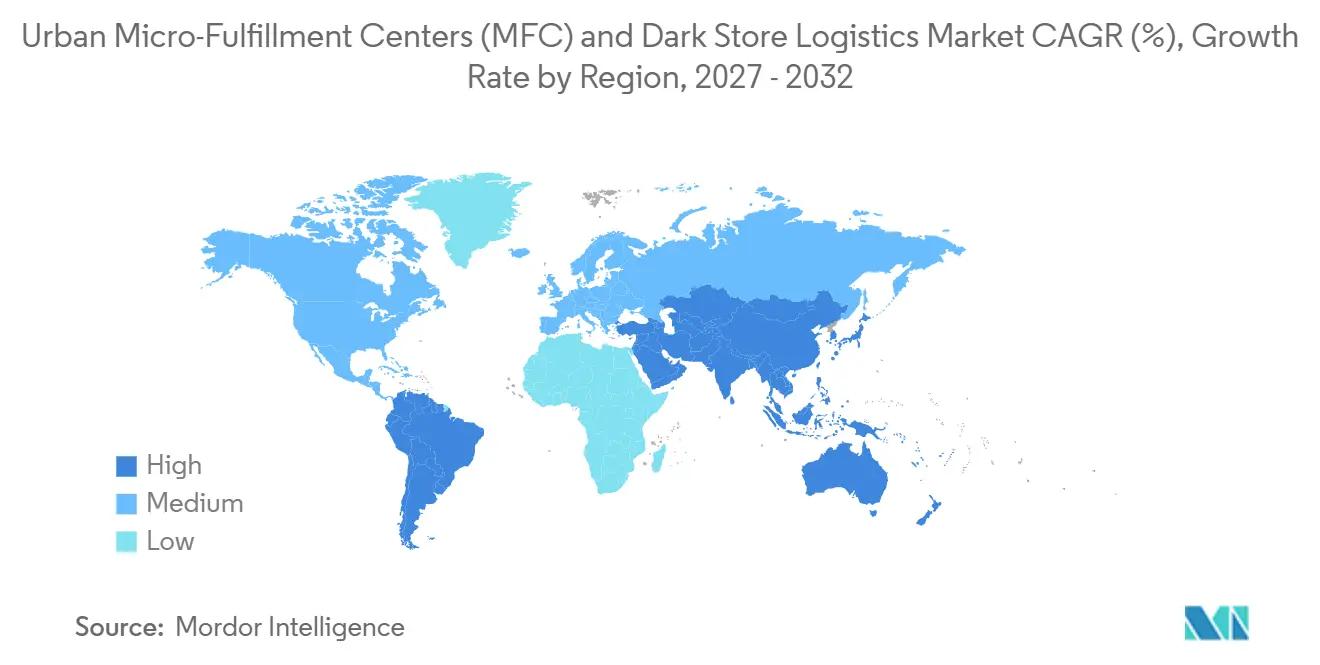
Asia-Pacific held 34.00% of 2026 revenue and is forecast to register a 25.75% CAGR through 2032. It has the largest urban micro-fulfillment centers (MFC) and dark store logistics market share because dense cities, established delivery ecosystems, and continued dark-store investment support localized fulfillment. Alibaba and JD.com each earmarked the equivalent of USD 1.4 billion in subsidies and competitive incentives in 2025 as quick-commerce competition increased in China. Flipkart Minutes crossed 1,000 micro-fulfillment centers in more than 130 cities by mid-2026, while Amazon India committed USD 337 million to expand Amazon Now across 100 cities. Japan and South Korea also support automation investment because aging workforces constrain the supply of manual fulfillment labor.
North America is the second-largest regional block, supported by United States e-commerce infrastructure and high demand for rapid delivery. United States e-commerce represented 17.1% of total retail in the second quarter of 2026. Small-bay industrial vacancy stood at 6.4% in June 2026, which showed the limited availability of suitable urban space. This shortage makes retailer backroom conversion an important alternative to leasing a standalone site.
Europe combines mature e-commerce demand with tight planning rules and a stronger shift toward brownfield development. Brownfield sites represented more than 52% of new logistics space developed in Germany during the first half of 2025. French rules classifying dark stores as warehouses have raised compliance demands for standalone operators. The urban micro-fulfillment centers (MFC) and dark store logistics market in Europe, therefore, favors operators that can reuse compliant sites or navigate local approvals effectively. Middle East and Africa and South America remain longer-horizon areas where urbanization and smartphone use are building the conditions for later network expansion.
Competitive Landscape
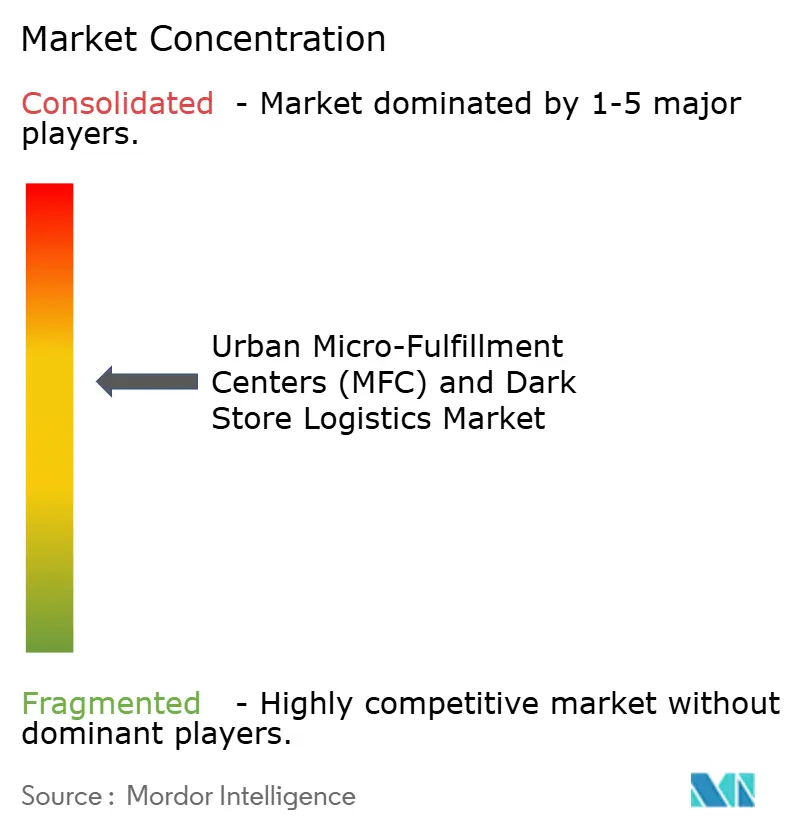
The urban micro-fulfillment centers (MFC) and dark store logistics market is moderately concentrated. Automation suppliers compete on storage density, throughput, retrofit compatibility, and software coordination within limited urban space. AutoStore, Exotec, KNAPP, Hai Robotics, Geekplus, and other providers offer different approaches to automated picking and goods movement. Exotec launched a 760,000 ft² automated fulfillment center with Komar Distribution Services in Savannah in March 2026. The installation targeted a 50% throughput increase and a 30% storage density improvement for direct-to-consumer demand.
Retailers and platform operators compete by adding nodes, widening assortments, and using existing real estate more effectively. Store backroom conversion can give established retailers a lower land-cost path than standalone dark-store entrants. DoorDash's DashMart Fulfillment Services provides retailers with inventory management, picking, packing, and last-mile delivery through its existing network. This approach lets retailers use urban capacity without building every operational component themselves. Walmart reported that more than 50% of its e-commerce fulfillment volume moved through automated systems in its November 2025 earnings release.
GXO plans to deploy its GXO IQ operating system across more than 50 sites in 2026, extending automated capabilities across its fulfillment network. Competition remains uneven because global technology providers and large retailers have greater capital resources than smaller operators. At the same time, shared facilities and managed fulfillment services leave room for smaller retailers to participate without owning infrastructure. White-space opportunities persist in second-tier cities in Asia, South America, and the Middle East and Africa where density can support local fulfillment but dedicated infrastructure remains limited.
Urban Micro-Fulfillment Centers (MFC) and Dark Store Logistics Industry Leaders
-
Amazon.com, Inc.
-
Walmart Inc.
-
Ocado Group plc
-
AutoStore Holdings Ltd.
-
Exotec SAS
- *Disclaimer: Major Players sorted in no particular order
Urban Micro-Fulfillment Centers (MFC) and Dark Store Logistics Market Companies Covered in this Report
- Amazon.com, Inc.
- Walmart Inc.
- Ocado Group plc
- AutoStore Holdings Ltd.
- Exotec SAS
- KION Group AG
- KUKA AG
- KNAPP AG
- Hai Robotics Co., Ltd.
- Fabric
- Geekplus Technology Co., Ltd.
- GreyOrange Pte. Ltd.
- Toyota Industries Corporation
- OPEX Corporation
- GXO Logistics, Inc.
- DHL Group
- DoorDash, Inc.
- Maplebear Inc.
- Eternal Limited
- Swiggy Limited
Recent Industry Developments in Urban Micro-Fulfillment Centers (MFC) and Dark Store Logistics Market
- August 2026: DP World agreed to acquire 6 GXO Logistics grocery contract logistics sites across the United Kingdom, adding 2 million ft² of warehouse capacity serving Asda, Sainsbury's, and the Co-op across ambient, chilled, frozen, and bonded storage.
- June 2026: Panattoni and Accolade commenced construction of Panattoni Business Park Prague I on the former Kovosrot brownfield in Prague's Dolni Mecholupy district. The first phase totals 44,800 m² across 3 buildings and targets BREEAM New Construction Outstanding certification.
- March 2026: Exotec and Komar Distribution Services launched a 760,000 ft² automated fulfillment center in Savannah, Georgia, equipped with the Skypod robotic system and targeting a 50% throughput increase and a 30% storage density improvement for direct-to-consumer demand.
- March 2026: Walmart Chile invested USD 200 million to automate its Lo Aguirre Distribution Center, deploying more than 1,400 autonomous robots in a 30,000 m² automated zone capable of processing more than 310,000 boxes daily.
Global Urban Micro-Fulfillment Centers (MFC) and Dark Store Logistics Market Report Scope
Segmentation Overview
| Dark Store-Based Fulfillment |
| Micro-Fulfillment Center-Based Fulfillment |
| Retail Store-Based Fulfillment |
| Hybrid and Shared Urban Fulfillment Facilities |
| Temperature-Controlled | Chilled |
| Frozen | |
| Multi-Temperature | |
| Non-Temperature-Controlled |
| Small and Medium-Sized Enterprises |
| Large Enterprises |
| Quick Commerce and Online Grocery |
| E-Commerce and General Merchandise |
| Grocery and Food Retail |
| Fast-Moving Consumer Goods (FMCG) |
| Pharmaceuticals and Healthcare |
| Consumer Electronics and Household Appliances |
| Fashion, Beauty and Personal Care |
| Other End Users |
| North America | United States |
| Canada | |
| Mexico | |
| South America | Brazil |
| Argentina | |
| Peru | |
| Chile | |
| Rest of South America | |
| Europe | Germany |
| United Kingdom | |
| France | |
| Italy | |
| Spain | |
| Russia | |
| Nordics (Denmark, Finland, Iceland, Norway, and Sweden) | |
| Rest of Europe | |
| Asia-Pacific | China |
| India | |
| Japan | |
| South Korea | |
| Australia | |
| Southeast Asia (ASEAN) | |
| Rest of Asia-Pacific | |
| Middle East and Africa | Saudi Arabia |
| United Arab Emirates | |
| Qatar | |
| South Africa | |
| Nigeria | |
| Egypt | |
| Rest of Middle East and Africa |
| By Facility Type | Dark Store-Based Fulfillment | |
| Micro-Fulfillment Center-Based Fulfillment | ||
| Retail Store-Based Fulfillment | ||
| Hybrid and Shared Urban Fulfillment Facilities | ||
| By Temperature Type | Temperature-Controlled | Chilled |
| Frozen | ||
| Multi-Temperature | ||
| Non-Temperature-Controlled | ||
| By Organization Size | Small and Medium-Sized Enterprises | |
| Large Enterprises | ||
| By End User | Quick Commerce and Online Grocery | |
| E-Commerce and General Merchandise | ||
| Grocery and Food Retail | ||
| Fast-Moving Consumer Goods (FMCG) | ||
| Pharmaceuticals and Healthcare | ||
| Consumer Electronics and Household Appliances | ||
| Fashion, Beauty and Personal Care | ||
| Other End Users | ||
| By Geography | North America | United States |
| Canada | ||
| Mexico | ||
| South America | Brazil | |
| Argentina | ||
| Peru | ||
| Chile | ||
| Rest of South America | ||
| Europe | Germany | |
| United Kingdom | ||
| France | ||
| Italy | ||
| Spain | ||
| Russia | ||
| Nordics (Denmark, Finland, Iceland, Norway, and Sweden) | ||
| Rest of Europe | ||
| Asia-Pacific | China | |
| India | ||
| Japan | ||
| South Korea | ||
| Australia | ||
| Southeast Asia (ASEAN) | ||
| Rest of Asia-Pacific | ||
| Middle East and Africa | Saudi Arabia | |
| United Arab Emirates | ||
| Qatar | ||
| South Africa | ||
| Nigeria | ||
| Egypt | ||
| Rest of Middle East and Africa | ||
Key Questions Answered in the Report
What is driving urban micro-fulfillment center adoption?
E-commerce and online grocery growth, rapid delivery expectations, dense order patterns, and retailer backroom conversions are supporting the urban micro-fulfillment centers (MFC) and dark store logistics market.
How large is the urban micro-fulfillment centers (MFC) and dark store logistics market?
The urban micro-fulfillment centers (MFC) and dark store logistics market size is projected to rise from USD 11.33 billion in 2026 to USD 41.84 billion by 2032, at a 24.02% CAGR (2027-2032).
Which facility format leads urban micro-fulfillment?
Dark store-based fulfillment leads with 42.00% of 2026 revenue, while hybrid and shared facilities have the highest projected 26.46% CAGR in the urban micro-fulfillment centers (MFC) and dark store logistics market.
Why are temperature-controlled facilities expanding?
Grocery, pharmaceuticals, and meal-kit demand require local chilled, frozen, and multi-temperature handling, supporting a 25.68% projected CAGR.
Which region is growing fastest for micro-fulfillment centers?
Asia-Pacific is projected to register a 25.75% CAGR through 2032 and held 34.00% of 2026 revenue.
What limits the rollout of urban fulfillment nodes?
Zoning restrictions, costly automation and retrofits, low-throughput economics, limited urban sites, and cold-chain or curbside constraints can delay urban micro-fulfillment centers (MFC) and dark store logistics market projects.