
Unmanned Aerial Systems Communication System Market Size and Share
Market Overview
| Study Period | 2020 - 2032 |
|---|---|
| Market Size (2027) | USD 3.09 Billion |
| Market Size (2032) | USD 5.24 Billion |
| Growth Rate (2027 - 2032) | 11.14 % |
| Fastest Growing Market | Asia-Pacific |
| Largest Market | North America |
| Market Concentration | Low |
Major Players *Disclaimer: Major Players sorted in no particular order Image © Mordor Intelligence. Reuse requires attribution under CC BY 4.0. | |
Unmanned Aerial Systems Communication System Market Analysis by Mordor Intelligence
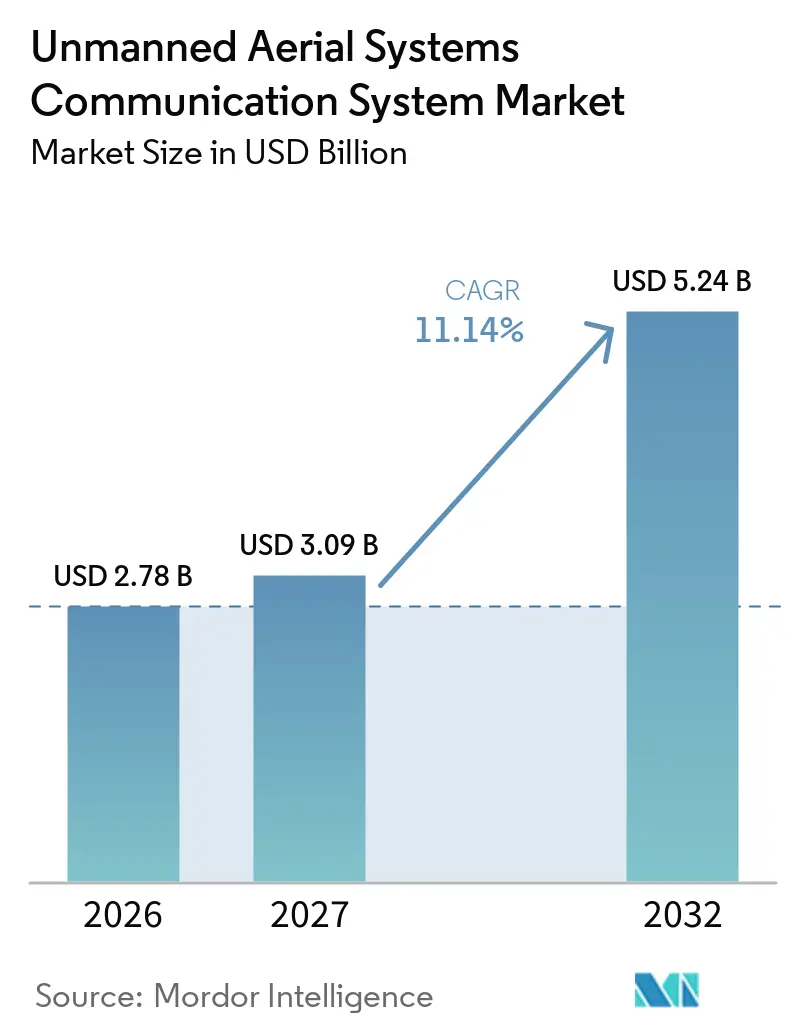
The unmanned aerial systems communication system market size was valued at USD 2.78 billion in 2026 and is forecast to grow from USD 3.09 billion in 2027 to reach USD 5.24 billion by 2032, at an 11.14% CAGR during the forecast period (2027-2032). Defense modernization is supporting demand for secure C2 links, radio hardware, antennas, modems, and management software. The US DoD is directing greater attention to unmanned systems and autonomy, which supports longer procurement cycles for resilient connectivity. BVLOS operations are also increasing the value of reliable communications, as operators must demonstrate link performance before scaling to commercial flights. Satellite, private wireless, and cellular networks are becoming complementary rather than separate options as operators seek consistent coverage. The unmanned aerial systems communication system market therefore favors suppliers that can combine secure hardware with software that manages multiple links.
Key Report Takeaways
- By component, transceivers held 31.89% of the unmanned aerial systems communication system market share in 2026, while antennas are forecast to grow at a 13.67% CAGR through 2032.
- By connectivity, terrestrial networks held 61.56% of the unmanned aerial systems communication system market share in 2026, while non-terrestrial networks are forecast to grow at a 14.52% CAGR through 2032.
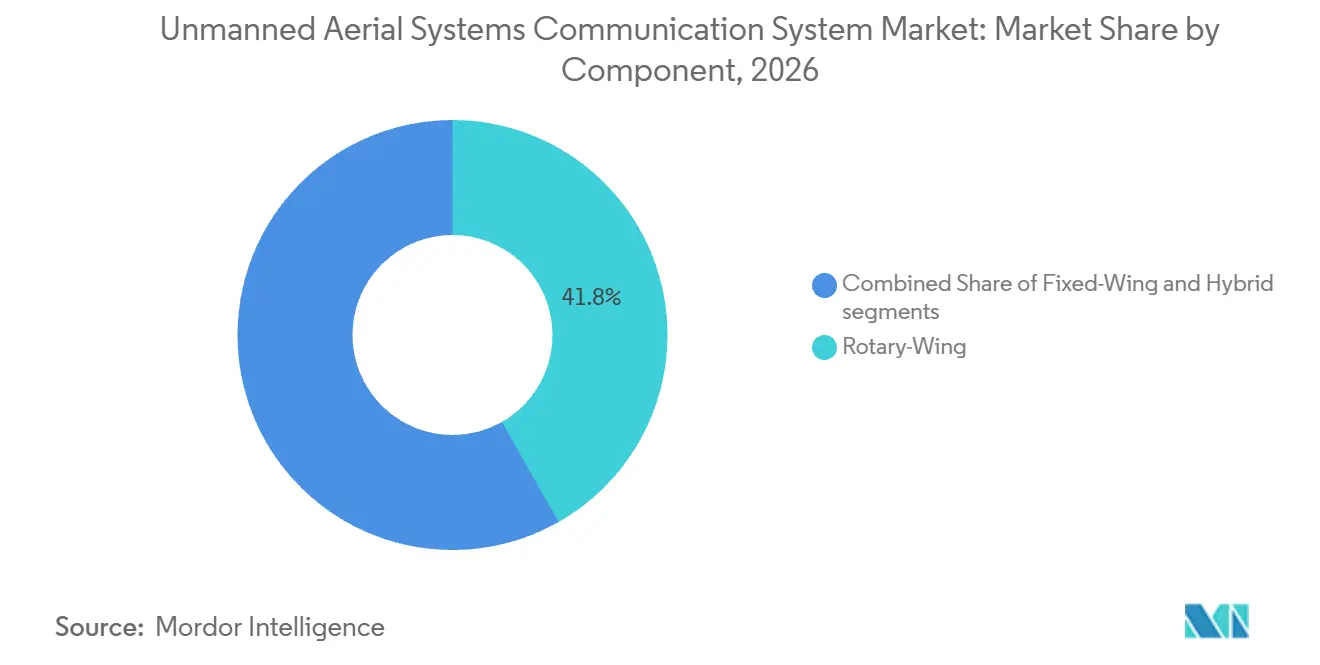
- By platform, rotary-wing systems held 41.78% of the unmanned aerial systems communication system market share in 2026, while hybrid platforms are forecast to grow at a 15.34% CAGR through 2032.
- By application, military systems held 43.67% of the unmanned aerial systems communication system market share in 2026, while government and law enforcement applications are forecast to grow at a 14.89% CAGR through 2032.
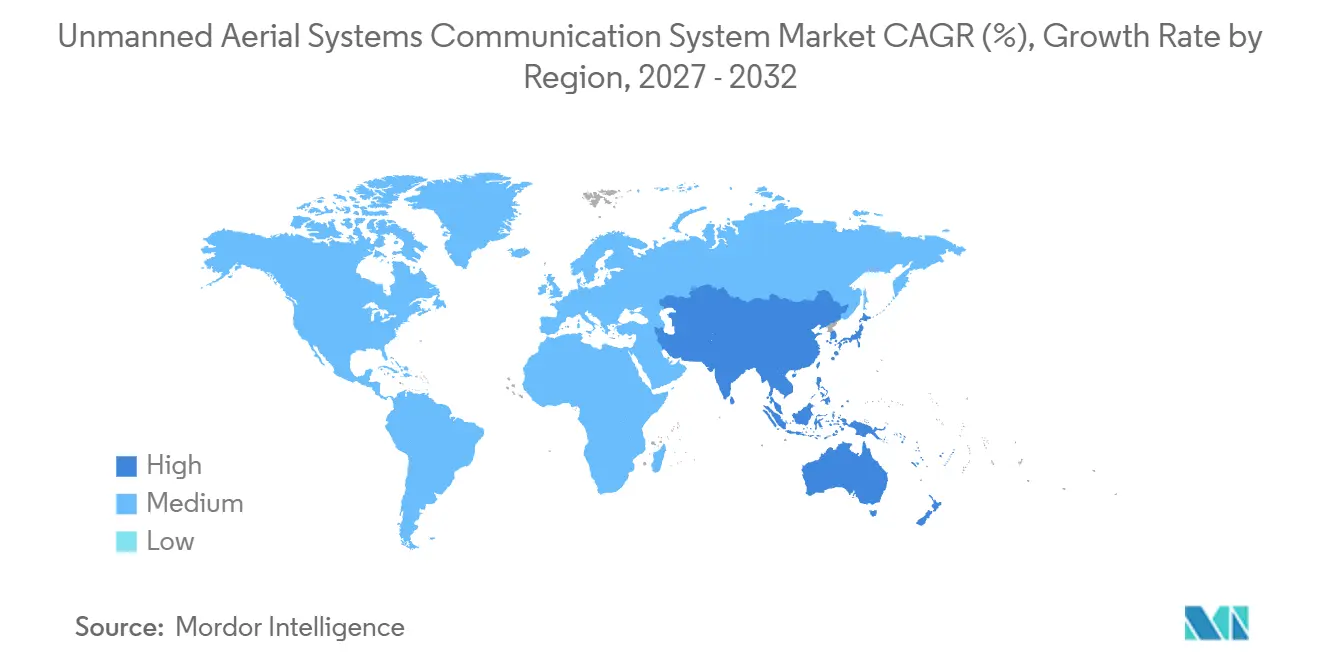
- By geography, North America held 35.95% of the unmanned aerial systems communication system market share in 2026, while Asia-Pacific is forecast to grow at a 15.01% CAGR through 2032.
Note: Market numbers in this report are based on Mordor Intelligence's proprietary estimation framework, which combines nine months of actuals with Q4 projections for base year 2026.
Market Trends and Insights
Drivers Impact Analysis of Unmanned Aerial Systems Communication System Market*
| Driver | (~) % Impact on CAGR Forecast | Geographic Relevance | Impact Timeline |
|---|---|---|---|
| Defense modernization and resilient C2 demand | +2.80% | Global, concentrated in North America, Europe, and Indo-Pacific | Short term (≤ 2 years) |
| BVLOS commercialization and airspace integration | +2.40% | North America and Europe, with spillover to Asia-Pacific | Medium term (2-4 years) |
| Higher payload data throughput and real-time edge analytics | +1.60% | Global | Medium term (2-4 years) |
| 5G, private wireless, LEO, and NTN network expansion | +1.80% | Asia-Pacific, with spillover to Middle East and Africa and South America | Long term (≥ 4 years) |
| Multi-link failover for swarms and fleet operations | +1.20% | North America and NATO Europe | Medium term (2-4 years) |
| Communication enabled UAS relays and emergency networks | +0.90% | Global, with early adoption in North America, Japan, and Germany | Medium term (2-4 years) |
| Source: Mordor Intelligence | |||
Defense Modernization and Resilient C2 Demand
Defense programs are raising requirements for encrypted, jam-resistant, and reliable C2 links in the unmanned aerial systems communication system market. US defense planning for unmanned systems and autonomy indicates a durable institutional demand for connectivity capable of operating in contested conditions. In April 2025, US Special Operations Command sought dynamic multi-domain communications for Group 2 and Group 3 UAV swarms, with an 18- to 30-month integration timeline. The requirement places communications readiness alongside airframe availability in acquisition decisions. The Marine Corps delivery of the SkyTower II relay pod for MQ-9 aircraft also shows how established platforms can be upgraded to extend network coverage rather than replaced.
BVLOS Commercialization and Airspace Integration
The FAA’s 2025 proposed BVLOS rule would introduce a performance-based framework that links operating authorization with dependable communication capability. This shifts attention from simple radio availability to documented C2 performance. FAA contract testing cited by uAvionix recorded 99.97% link availability across a 360-mile route over 4.3 hours of flight.[1] Such evidence makes reliable link management a practical procurement issue for operators pursuing larger commercial deployments. The communication stack must support transceivers, antennas, modems, and software that can maintain and record availability across a mission. Federal action to modernize spectrum access and support domestic UAS supply chains can also direct demand toward compliant domestic and allied communication equipment.
5G, Private Wireless, LEO, and NTN Network Expansion
5G, private wireless, LEO satellites, and NTNs are extending the connectivity choices available to UAS operators. Airbus and OQ Technology demonstrated a 5G NTN connection to a UAS in July 2025 using licensed S-band NB-IoT.[2] The test achieved 99.95% transmission continuity at 5 kbps during demanding maneuvers, supporting its relevance for C2 telemetry. Japan Radio Co. and its partners also demonstrated dynamic routing across GEO, LEO, and terrestrial 5G links in October 2025. ESA separately demonstrated conditional handover over LEO satellites, addressing signal continuity during rapid satellite passes.
Multi-Link Failover for Swarms and Fleet Operations
Swarm and fleet operations require several communications paths because a single radio-frequency link can become a mission-level failure point. Multi-link architectures combine C-Band, LTE, ISM, and satellite channels, then select a viable path as network conditions change. US defense requirements for communications in contested and denied conditions further support systems that relay data without extended interruption. Communication-enabled relay pods and emergency networks add another route to coverage by converting aircraft into nodes for dispersed personnel and autonomous assets.
Restraints Impact Analysis of Unmanned Aerial Systems Communication System Market*
| Restraint | (~) % Impact on CAGR Forecast | Geographic Relevance | Impact Timeline |
|---|---|---|---|
| Spectrum congestion and cross-border allocation fragmentation | -1.20% | Global, most acute in dense urban North American and European corridors | Short term (≤ 2 years) |
| Certification, cybersecurity, and BVLOS compliance costs | -0.90% | North America and Europe | Medium term (2-4 years) |
| SWaP constraints in small UAS and attritable platforms | -0.60% | Global | Long term (≥ 4 years) |
| Link degradation from multipath, doppler, rain, and electromagnetic attack | -0.50% | Global, with higher exposure in contested environments | Medium term (2-4 years) |
| Source: Mordor Intelligence | |||
Spectrum Congestion and Cross-Border Allocation Fragmentation
Civil UAS operations face limited dedicated spectrum as fleet volumes rise in dense areas. The FCC has recognized interference risks in the 2.4 GHz and 5.8 GHz ISM bands used by many civil systems. Dedicated spectrum under Part 88 provides a more protected path, but the available allocation remains narrow for high-density corridors. Equipment makers therefore need spectrum-efficient modulation, multi-band support, and adaptable antenna designs. National spectrum rules can differ across the US, Europe, and Japan, requiring firmware or hardware adjustments for the same platform. This raises certification and deployment costs for operators running fleets across borders and places pressure on modem and antenna suppliers.
Certification, Cybersecurity, and BVLOS Compliance Costs
Certification, cybersecurity, and BVLOS compliance can extend development schedules and increase the cost of UAS communication systems. The FAA’s proposed BVLOS framework includes design and production requirements that build on established airworthiness processes. Operators may also need to document link availability, verify suppliers, and meet cybersecurity obligations before entering larger deployments. The FCC’s action concerning foreign-produced UAS and components adds supply chain review requirements for some fleets. Research on UAS security in B5G networks identifies adversarial attacks, data poisoning, and model evasion as risks to the integrity of navigation and communications. Small operators may delay purchases while they absorb certification, audit, and supply chain costs, even when the long-term need for reliable connectivity remains.
*Our forecasts treat driver/restraint impacts as directional, not additive. The impact forecasts reflect baseline growth, mix effects, and variable interactions.
Unmanned Aerial Systems Communication System Market Segment Analysis
By Component:
Antennas Drive the Shift to Link DiversityTransceivers accounted for 31.89% of the unmanned aerial systems communication system market share by component in 2026 because every C-Band CNPC, LTE, 5G, L-band satellite, and mesh radio datalink requires a radio-frequency interface. BVLOS reliability requirements can increase the number of active radios on an airframe, while L3Harris’s October 2026 partnership with Skydio to integrate tactical radios and the Wraith waveform shows the need for uninterrupted C2 links in contested conditions.[3] Modems complement transceivers by processing baseband signals and managing LTE, 5G, and satellite protocols for these increasingly complex links. The other component group includes ground control radios, signal processors, and encryption modules that support the system around the airframe.
Antennas are projected to grow at a 13.67% CAGR through 2032, the fastest component rate in the unmanned aerial systems communication system market, as electronically steerable and phased-array designs support LEO connectivity within small aircraft SWaP limits. Viasat introduced government UAS connectivity terminals, starting at 440 g, in February 2026, which address the mass constraint faced by platforms that cannot carry large satellite equipment. Beam steering can also reduce Doppler and multipath disruption on fixed-wing and hybrid aircraft, where passive omnidirectional elements have practical limits. Research on NTNs identifies beamforming and beam-hopping as important techniques for LEO-to-UAS downlinks, supporting demand for advanced antenna designs.

By Connectivity:
Terrestrial Dominance Faces Structural Pressure from NTNTerrestrial networks held 61.56% of the unmanned aerial systems communication system market share in 2026 because established infrastructure supports many VLOS and short-range BVLOS operations, including urban inspection and public-safety deployments. Their coverage and cost profile continue to support routine missions where service quality is available. Open RAN 5G slicing has been shown to support BVLOS UAS operations within applicable 3GPP latency limits, which gives public cellular networks a credible C2 role. Private 5G offers an intermediate option between unlicensed ISM links and satellite service, allowing operators to match terrestrial designs with mission risk, bandwidth needs, and geography.
NTNs are forecast to grow at a 14.52% CAGR through 2032. The Airbus and OQ Technology flight test demonstrated that LEO connectivity can maintain telemetry during maneuvering. At the same time, Viasat’s protected tactical satellite work indicates continued demand for anti-jam government connectivity. Satellite links can serve commercial corridors as a backup to cellular coverage and support maritime and remote operations. Suppliers that make terrestrial-to-satellite handover reliable can compete for higher-value integrated connectivity programs.
By Platform:
Rotary-Wing Scale vs. Hybrid VTOL MomentumRotary-wing systems held 41.78% of the market share in 2026, reflecting their use in inspection, public safety, short-range delivery, and urban intelligence missions. Hovering operations require stable, low-latency video links and reliable command channels, and bandwidth needs can remain high even when aircraft movement is limited. The US DHS evaluated first-responder UAS in complex urban environments during 2025, reinforcing their role as communications nodes for police, fire, and search-and-rescue missions. Fixed-wing aircraft retain relevance for long-endurance intelligence, surveillance, agricultural, and wide-area missions where terrestrial coverage is less consistent.
Hybrid platforms are forecast to grow at a 15.34% CAGR through 2032, the highest platform rate in the market, because they combine vertical takeoff flexibility with fixed-wing endurance. These aircraft can transition from low-speed hover to high-speed cruise during a single mission, so link management systems must respond to varying Doppler, antenna, and frequency conditions. The resulting operating complexity creates demand for vendors that support dual-mode communications through integrated hardware and software. The platform model can also reduce dependence on conventional runway access for defense and logistics operations.
By Application:
Military Bedrock, Government and Law Enforcement AccelerationMilitary applications accounted for 43.67% of market share in 2026 because intelligence, surveillance, combat, and logistics missions each require high-assurance links. Intelligence missions rely on encrypted, jam-resistant transmission at standoff ranges, while combat missions impose strict command-latency requirements, and logistics missions operate in disrupted environments. Honeywell’s JetWave X was selected by the US Army in May 2025 for upgrades to airborne reconnaissance and EW aircraft, illustrating the replacement cycle for high-data-rate mission communications. Defense satellite investment can also support broader communications demand that flows into UAS procurement.
Government and law enforcement use is forecast to grow at a 14.89% CAGR through 2032 in the market, as border security, traffic management, and emergency response all depend on assured connectivity. The US DHS’s ACE-CASPER experiment is designed to assess resilient 5G session persistence and command handoff across the US-Canada border. Germany’s DLR has shown automated emergency UAS dispatch over a Vodafone 5G network with encrypted communications and live video. Commercial inspection, agriculture, and delivery add demand for weather-tolerant links, while public buyers increasingly emphasize interoperability, proof of performance, and secure links with existing safety networks.
Geography Analysis
North America: Defense Procurement and Regulatory Architecture Underpin Market Leadership
North America held 35.95% of the market share in 2026, supported by defense procurement, an established UAS supplier base, and a maturing regulatory structure. FCC Part 88 provides a licensed spectrum framework for non-networked C2 links, while the 2026 national drone policy calls for modernized spectrum access and a corridor network that can stimulate hardware demand. The US Army FY2026 budget materials include USD 378.60 million for tactical network communications and USD 149.90 million for satellite communications. Regulatory influence from the FCC and FAA provides operators with a clearer testing path, although compliance factors can still affect certification timing.
Asia-Pacific: Defense Modernization and Commercial Scale Drive Fastest Growth
Asia-Pacific is projected to grow at a 15.01% CAGR through 2032, driven by defense modernization in China, India, Japan, South Korea, and Australia, as well as broader commercial adoption, which can expand the regional supplier base. Japan Radio Co. and its partners demonstrated dynamic backhaul switching across GEO, LEO, and terrestrial 5G networks in 2025, placing multi-orbit routing on a practical path for disaster response and wider UAS operations. Suppliers that meet local security, radio, and procurement requirements can participate in both public and defense programs.
Europe, Middle East and Africa, and South America: Different Paths to Adoption
Europe benefits from EASA’s common UAS rules, which support hardware standardization across participating countries. Germany’s 5G-enabled emergency dispatch work provides a public-safety model, while the UK has tested multi-datalink BVLOS designs that combine protected C-Band, cellular, and LEO satellite connectivity. In the Middle East, UAS corridors in the UAE and Saudi Arabia connect communications investment with smart-city and digital infrastructure programs. African demand centers on inspection and agricultural missions over locations with limited terrestrial coverage, and South American demand is supported by Brazilian precision agriculture. These needs favor systems that combine terrestrial, satellite, and mission-specific radio capability.
Competitive Landscape
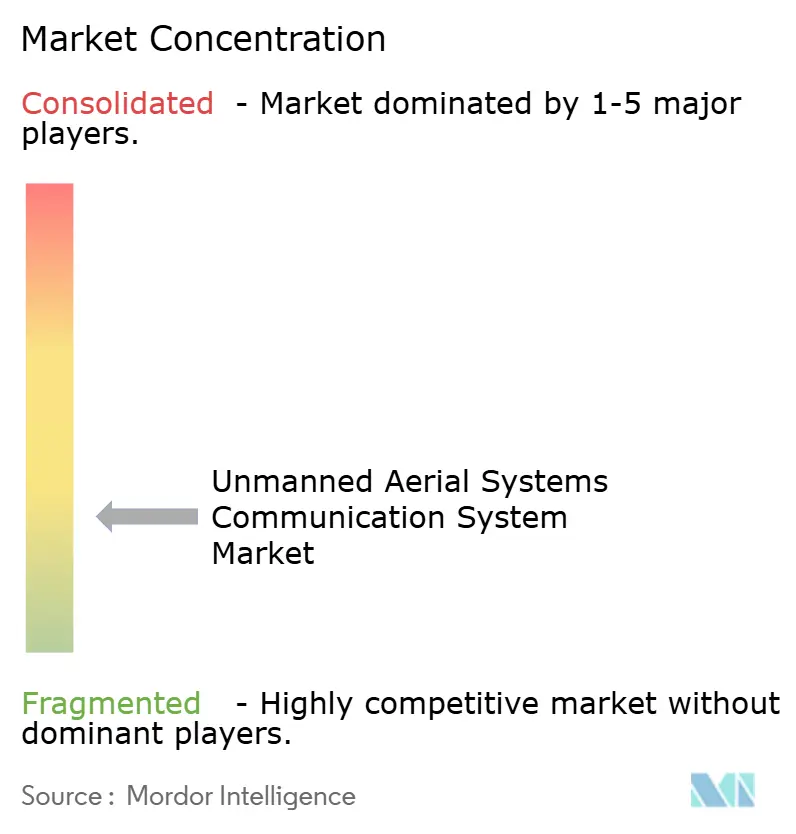
The market has a fragmented competitive landscape, comprising established aerospace and defense companies, UAS manufacturers, and specialized radio and connectivity providers. SZ DJI Technology Co., Ltd., L3Harris Technologies, Inc., RTX Corporation, Israel Aerospace Industries Ltd., and Skydio, Inc., compete for integrated military and government programs, while Silvus Technologies, Inc. (Motorola Solutions), Doodle Labs LLC, Elsight Ltd., Commtact Ltd., and Microhard Systems Inc. serve specialized needs with compact radios, mesh networking, and link aggregation. L3Harris and Skydio announced a partnership in October 2026 to integrate tactical radios and the Wraith waveform into Skydio’s autonomous UAS platform. The move shows how communication suppliers can secure design positions before larger fleet purchases.
Viasat, Inc., launched its VuaLe portfolio in February 2026, featuring L-band connectivity terminals for government UAV operations, starting at 440 g. It also received a protected tactical satellite communications contract in October 2025, strengthening its position in resilient government connectivity. These moves show that large suppliers are addressing the same SWaP requirements that have helped smaller radio specialists compete. Multi-orbit ground stations that manage GEO and LEO services, and link-layer software that uses live signal data rather than preset failover rules, remain important opportunities.
Software-defined radios (SDRs) tailored for Group 1 and Group 2 aircraft are becoming increasingly important as legacy equipment can exceed available weight and power budgets. FCC security actions affecting foreign-produced UAS components can create substitution demand for compliant transceivers and flight-control communications equipment. Compliance with FCC Part 88, RTCA/DO-377A CNPC standards, and EASA UAS requirements remains a barrier to entry for suppliers without certification resources. These requirements can protect established vendors and encourage partnerships or acquisitions as a route to approved capability.
Unmanned Aerial Systems Communication System Industry Leaders
-
SZ DJI Technology Co., Ltd.
-
L3Harris Technologies, Inc.
-
RTX Corporation
-
Israel Aerospace Industries Ltd.
-
Skydio, Inc.
- *Disclaimer: Major Players sorted in no particular order
Unmanned Aerial Systems Communication System Market Companies Covered in this Report
- SZ DJI Technology Co., Ltd.
- Thales Group
- Honeywell Aerospace Inc.
- Gilat Satellite Networks Ltd.
- L3Harris Technologies, Inc.
- Israel Aerospace Industries Ltd.
- Skydio, Inc.
- RTX Corporation
- Northrop Grumman Corporation
- General Atomics Aeronautical Systems, Inc.
- Elbit Systems Ltd.
- BAE Systems plc
- Doodle Labs LLC
- Elsight Ltd.
- Microhard Systems Inc.
- UAV Navigation S.L.U.
- Silvus Technologies, Inc. (Motorola Solutions, Inc.)
- Sky-Drones Technologies Ltd.
- Botlink, LLC
- SKYTRAC Systems Ltd.
- Orbit Communications Systems Ltd.
- Hughes Network Systems, LLC
- Commtact Ltd.
- UAVOS Inc.
Recent Industry Developments in Unmanned Aerial Systems Communication System Market
- October 2026: L3Harris Technologies, Inc., and Skydio Inc. announce a partnership to integrate L3Harris's tactical radios and Wraith waveform into Skydio's autonomous UAS platform, creating a connected battlefield capability combining autonomous flight with resilient, encrypted C2 communications for military warfighters. The collaboration is aimed at delivering integrated autonomous sensor and communications solutions to the US military and allied forces.
- October 2026: AeroVironment, Inc. and Elsight Ltd. announced a partnership to integrate Elsight's Halo connectivity technology into AeroVironment's Mayhem 10 launched effects system, enhancing communications resilience in complex and contested environments. The integration will enable the Mayhem 10 to manage multiple communications networks through a single connectivity layer, including satellite, private and public cellular, and point-to-point radio.
- January 2026: Elsight Ltd. received a USD 460,000 purchase order from a US public safety sector customer for its Halo connectivity platform, which creates a single bonded tunnel using available multi-links from LTE, 5G, SatCom, and RF links to provide continuous uptime and connectivity between a UAS and ground control stations.
Global Unmanned Aerial Systems Communication System Market Report Scope
The unmanned aerial systems communication system market comprises communication equipment and integrated technologies that enable reliable data transmission, command and control, telemetry, and real-time information exchange among unmanned aerial vehicles (UAVs), ground control stations, and other connected platforms. The scope includes communication systems supplied for new UAS production, system integration, modernization, and retrofit programs across military, commercial, government, and law enforcement applications, including intelligence, surveillance, and reconnaissance (ISR), combat operations, logistics, infrastructure inspection, agriculture, border security, traffic management, and emergency response.
The unmanned aerial systems communication system market is segmented by component, connectivity, platform, application, and geography. By component, the market is segmented into transceivers, antennas, modems, and others. By connectivity, the market is segmented into terrestrial networks and non-terrestrial networks. By platform, the market is segmented into fixed-wing, rotary-wing, and hybrid. By application, the market is segmented into military, commercial, and government and law enforcement. The report also covers the market sizes and forecasts for the unmanned aerial systems communication system market in major countries across different regions. For each segment, the market size is provided in terms of value (USD).
Segmentation Overview
| Transceivers |
| Antennas |
| Modems |
| Others |
| Terrestrial Networks |
| Non-Terrestrial Networks |
| Fixed-Wing |
| Rotary-Wing |
| Hybrid |
| Military | Intelligence, Surveillance, and Reconnaissance (ISR) |
| Combat | |
| Logistics | |
| Commercial | Infrastructure Inspection |
| Agriculture | |
| Delivery and Logistics | |
| Others | |
| Government and Law Enforcement | Border Security and Surveillance |
| Traffic Management | |
| Emergency Response and Disaster Management | |
| Others |
| North America | United States | |
| Canada | ||
| Mexico | ||
| Europe | United Kingdom | |
| France | ||
| Germany | ||
| Italy | ||
| Spain | ||
| Russia | ||
| Rest of Europe | ||
| Asia-Pacific | China | |
| India | ||
| Japan | ||
| South Korea | ||
| Australia | ||
| Rest of Asia-Pacific | ||
| South America | Brazil | |
| Rest of South America | ||
| Middle East and Africa | Middle East | United Arab Emirates |
| Saudi Arabia | ||
| Rest of Middle East | ||
| Africa | South Africa | |
| Rest of Africa | ||
| By Component | Transceivers | ||
| Antennas | |||
| Modems | |||
| Others | |||
| By Connectivity | Terrestrial Networks | ||
| Non-Terrestrial Networks | |||
| By Platform | Fixed-Wing | ||
| Rotary-Wing | |||
| Hybrid | |||
| By Application | Military | Intelligence, Surveillance, and Reconnaissance (ISR) | |
| Combat | |||
| Logistics | |||
| Commercial | Infrastructure Inspection | ||
| Agriculture | |||
| Delivery and Logistics | |||
| Others | |||
| Government and Law Enforcement | Border Security and Surveillance | ||
| Traffic Management | |||
| Emergency Response and Disaster Management | |||
| Others | |||
| By Geography | North America | United States | |
| Canada | |||
| Mexico | |||
| Europe | United Kingdom | ||
| France | |||
| Germany | |||
| Italy | |||
| Spain | |||
| Russia | |||
| Rest of Europe | |||
| Asia-Pacific | China | ||
| India | |||
| Japan | |||
| South Korea | |||
| Australia | |||
| Rest of Asia-Pacific | |||
| South America | Brazil | ||
| Rest of South America | |||
| Middle East and Africa | Middle East | United Arab Emirates | |
| Saudi Arabia | |||
| Rest of Middle East | |||
| Africa | South Africa | ||
| Rest of Africa | |||
Key Questions Answered in the Report
What is driving demand for unmanned aerial systems communication systems?
Defense modernization, BVLOS operations, and the need for secure links across cellular, satellite, and radio networks are supporting demand.
How large is the unmanned aerial systems communication system market?
The unmanned aerial systems communication system market is projected to increase from USD 3.09 billion in 2027 to USD 5.24 billion by 2032, at an 11.14% CAGR.
Which UAS communication component is growing fastest?
Antennas are projected to expand at a 13.67% CAGR through 2032 as operators adopt compact and electronically steerable designs.
Why are NTNs important for UAS communications?
They are projected to grow at a 14.52% CAGR because satellite links can extend coverage and provide redundancy for BVLOS operations.
Which platform has the strongest growth outlook?
Hybrid platforms are forecast to grow at a 15.34% CAGR through 2032, combining vertical takeoff with fixed-wing endurance.
Which region will grow fastest for UAS communications?
Asia-Pacific is forecast to grow at a 15.01% CAGR through 2032, supported by defense modernization and commercial adoption.