
United States Tokenized Deposit Market Size and Share
Market Overview
| Study Period | 2021 - 2032 |
|---|---|
| Forecast Data Period | 2027 - 2032 |
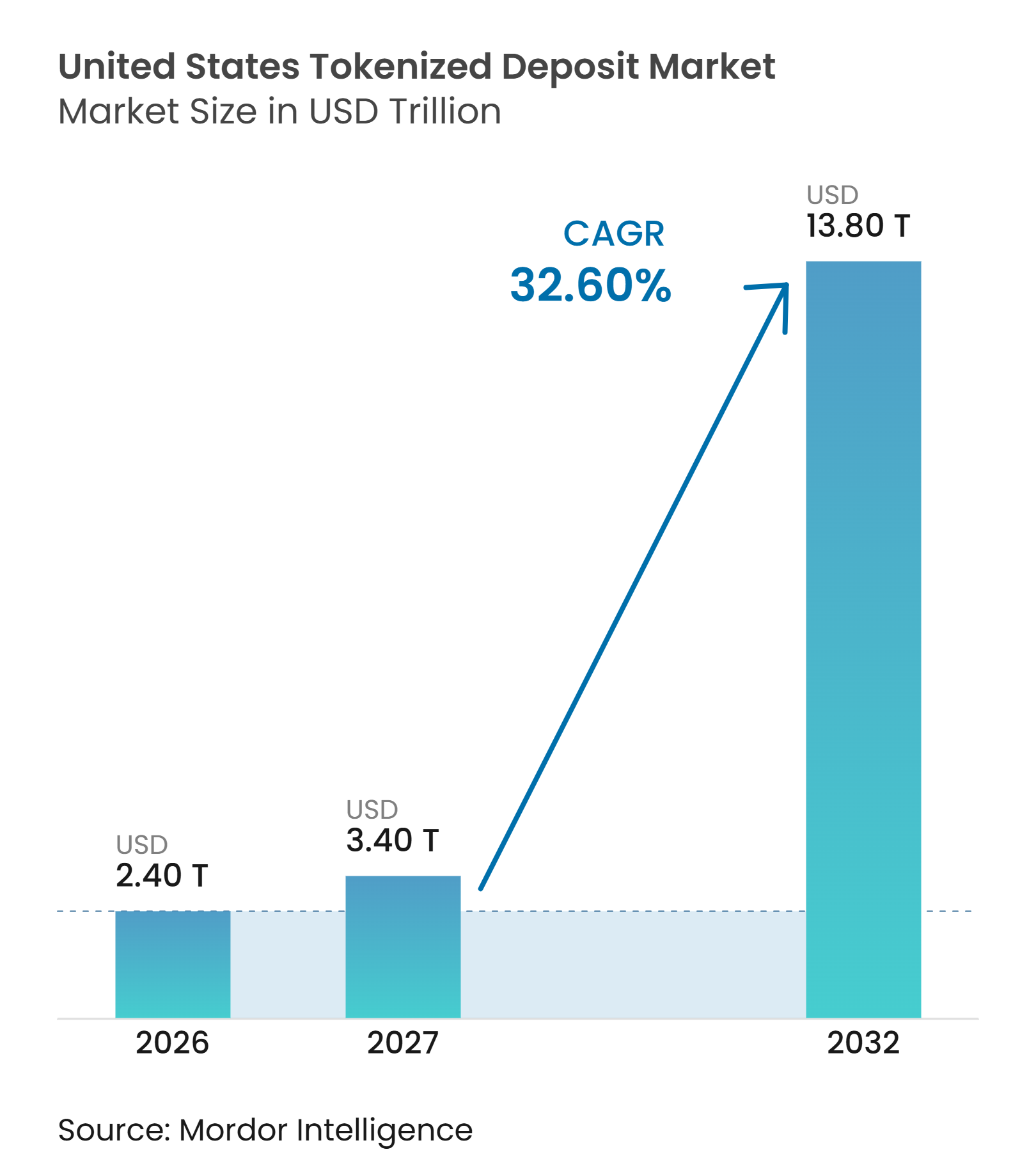
| Base Year Market Size (2026) | USD 2.40 Trillion |
| Market Size (2027) | USD 3.40 Trillion |
| Market Size (2032) | USD 13.80 Trillion |
| Growth Rate (2027 - 2032) | 32.60 % |
| Market Concentration | Low |
Major Players *Disclaimer: Major Players sorted in no particular order Image © Mordor Intelligence. Reuse requires attribution under CC BY 4.0. | |
United States Tokenized Deposit Market Analysis by Mordor Intelligence
The United States Tokenized Deposit Market size is expected to grow from USD 2.40 trillion in 2026 to USD 3.40 trillion in 2027 and is forecast to reach USD 13.80 trillion by 2032 at 32.60% CAGR over 2027-2032.
Tokenized deposits are on-chain claims against a licensed bank’s balance sheet, so they retain deposit insurance eligibility and bank regulation while enabling programmable transfers and continuous settlement. The GENIUS Act clarified the legal position of deposits recorded with distributed ledger technology, separating them from payment stablecoins and reducing a major regulatory barrier for banks. The United States tokenized deposit market is moving first through controlled bank networks, where institutions can preserve established account records and risk controls. This approach gives banks a practical route to modernize treasury and settlement processes while meeting prudential requirements. Competition is therefore centered on connecting private bank systems to broader networks without weakening compliance, customer safeguards, or liquidity management.
Key Report Takeaways
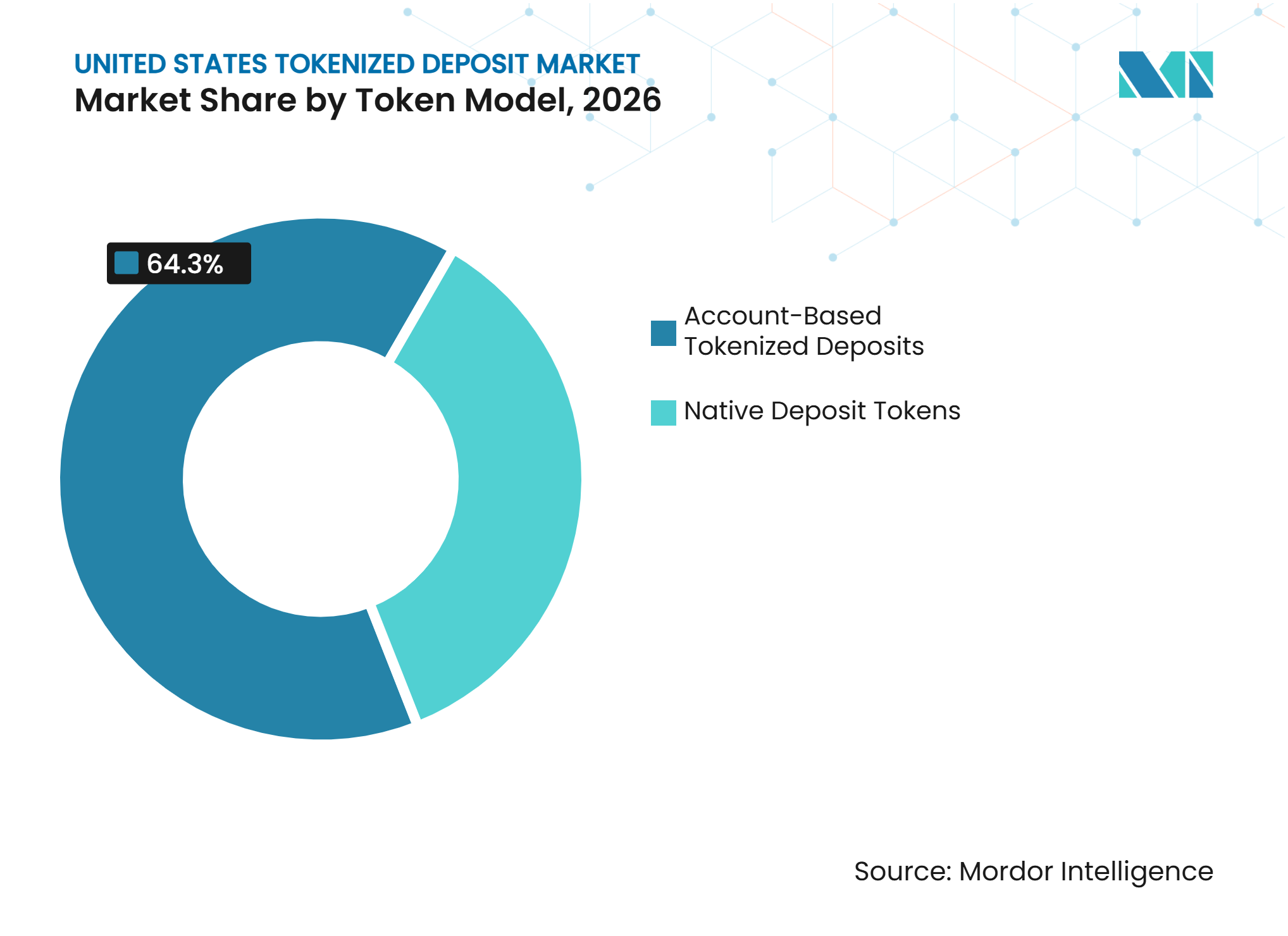
- By token model, account-based tokenized deposits captured 64.3% of the United States tokenized deposit market share in 2026, while native deposit tokens are projected to grow at a 45.4% CAGR through 2032.
- By network model, single-bank networks held 55.4% of the United States tokenized deposit market share in 2026, while interbank shared multi-bank networks are projected to grow at a 50.2% CAGR through 2032.
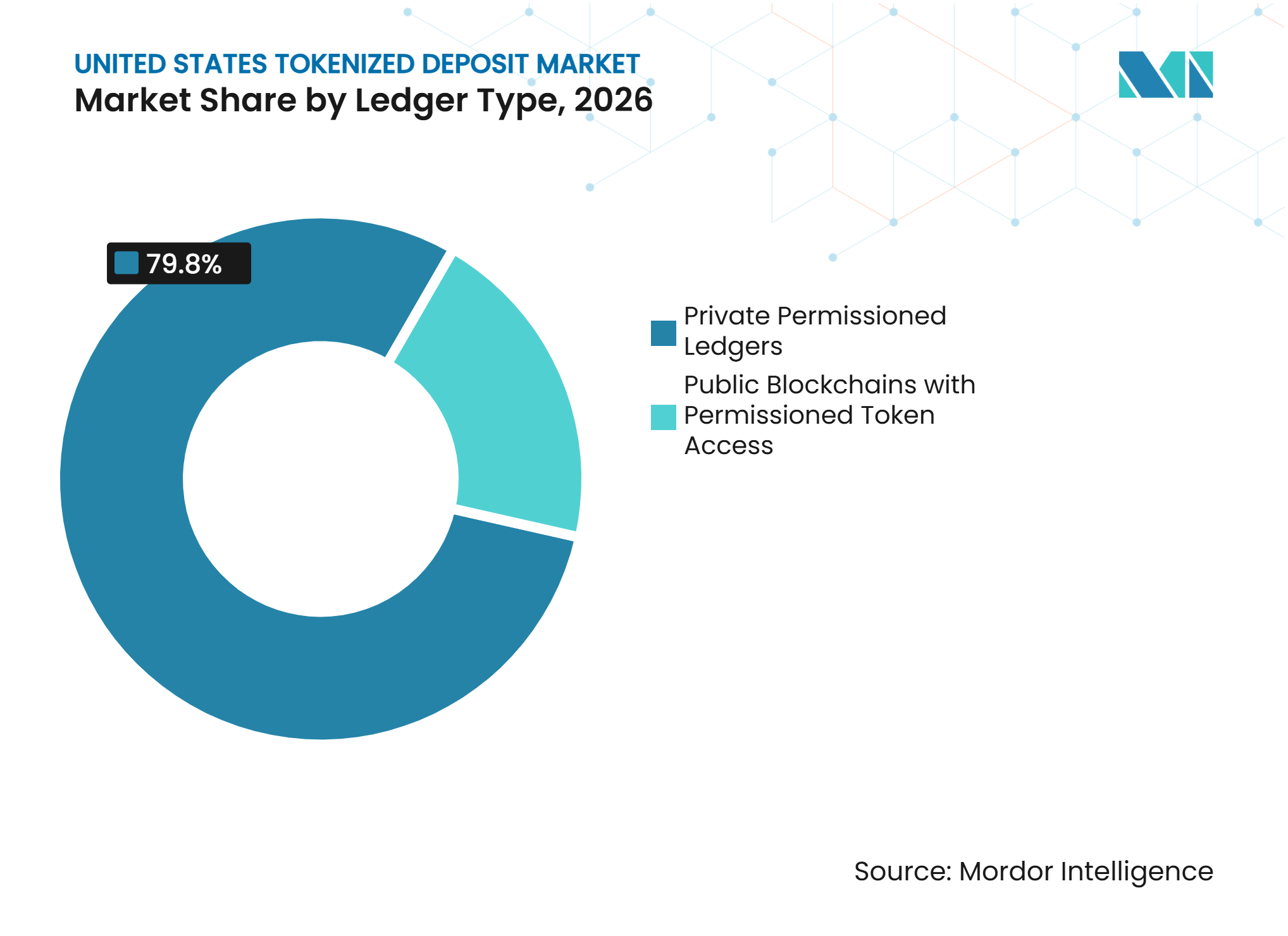
- By ledger type, private permissioned ledgers captured 79.8% of the United States tokenized deposit market share in 2026, while public blockchains with permissioned token access are projected to grow at a 54.8% CAGR through 2032.
- By use case, intra-group treasury and liquidity management accounted for 29.5% of the United States tokenized deposit market share in 2026, while foreign exchange and payment-versus-payment settlement are projected to grow at a 48.3% CAGR through 2032.
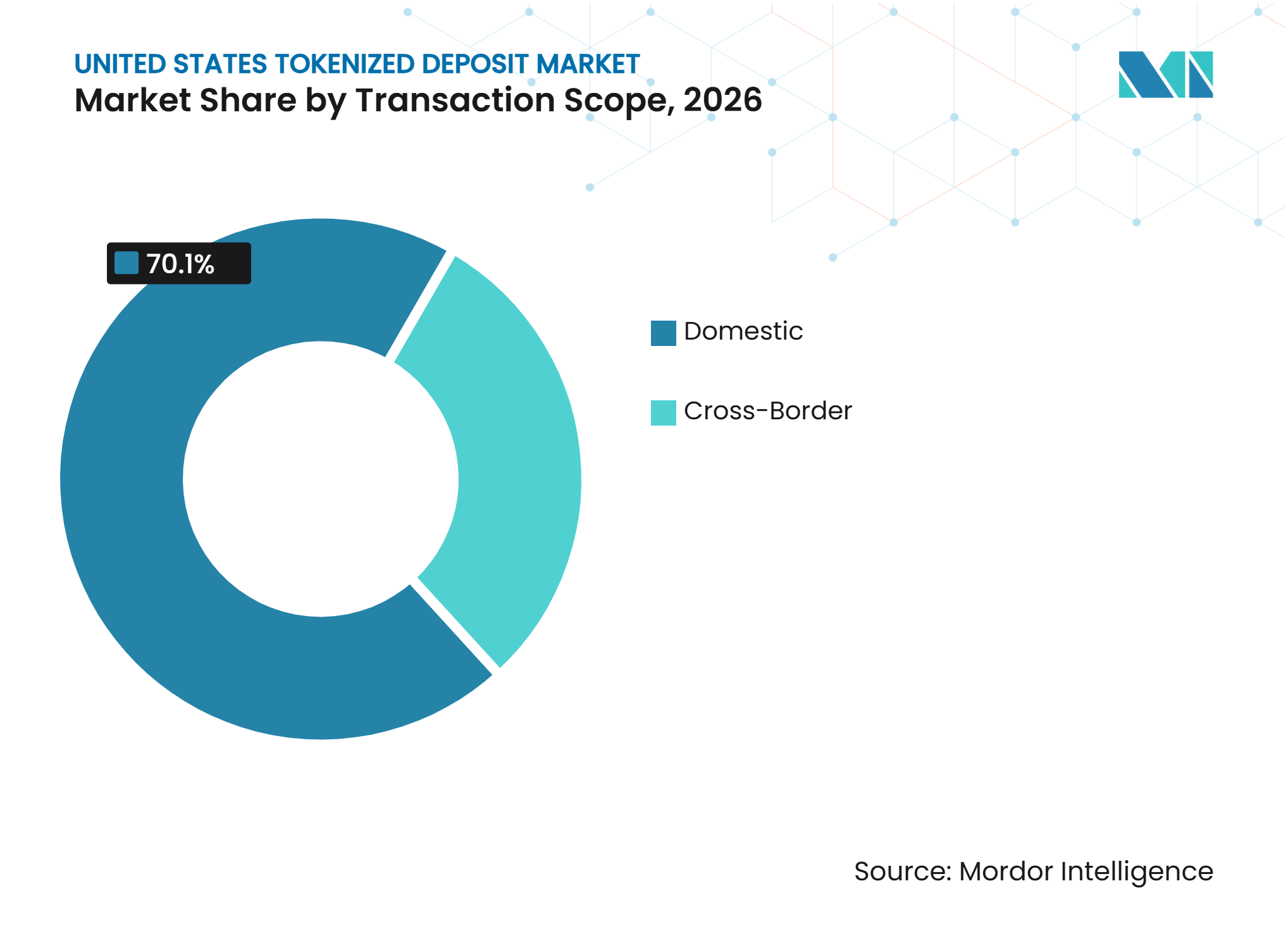
- By transaction scope, domestic transactions captured 70.1% of the United States tokenized deposit market share in 2026, while cross-border transactions are projected to grow at a 45.6% CAGR through 2032.
- By end user, banks and other deposit-taking institutions captured 45.4% of the United States tokenized deposit market share in 2026, while payments, fintech, and digital-asset firms are projected to grow at a 49.7% CAGR through 2032.
Note: Market numbers in this report are based on Mordor Intelligence's proprietary estimation framework, which combines nine months of actuals with Q4 projections for base year 2026.
Market Trends and Insights
Drivers Impact Analysis of United States Tokenized Deposit Market*
| Driver | (~) % Impact on CAGR Forecast | Geographic Relevance | Impact Timeline |
|---|---|---|---|
| Demand for 24/7 Institutional Settlement | +7.5% | National, concentrated in major financial centers including New York and Chicago | Short term (≤ 2 years) |
| Corporate Treasury and Intraday Liquidity Optimization | +6% | National, with early adoption among large multinationals headquartered in New York and California | Short term (≤ 2 years) |
| Programmable Payments and Automated Conditional Transfers | +5% | National, with infrastructure development centered on New York and Silicon Valley | Medium term (2-4 years) |
| Cross-Border Payments and Multi-Jurisdictional Treasury Modernization | +5% | National, with spillover into United States correspondent banking relationships in Europe and Asia-Pacific | Medium term (2-4 years) |
| Integration With Tokenized Securities and Collateral | +4% | National, concentrated in New York’s capital-markets ecosystem | Medium term (2-4 years) |
| Bank Demand for Blockchain Payment Infrastructure and Differentiation | +3.5% | National, led by major United States financial institutions responding to stablecoin competition | Long term (≥ 4 years) |
| Source: Mordor Intelligence | |||
Demand for 24/7 Institutional Settlement
The gap between banking cutoffs and global financial activity is creating immediate demand for continuous institutional settlement. Institutions that manage positions across time zones cannot always defer margin calls, liquidity transfers, or supplier payments until the next business day[1]. Continuous availability also lets treasury teams keep cash in interest-bearing accounts until settlement is due, which can reduce the need for idle prefunding balances. The operational change is significant because corporate teams must adjust controls, staffing, and liquidity policies for a financial environment that no longer pauses overnight. For the United States tokenized deposit market, these requirements create an opportunity to support institutional clients seeking faster fund availability and more flexible settlement. Wells Fargo announced tokenized deposit capabilities for corporate and commercial clients in August 2026, designed to enable funds to move, be programmed, and settle around the clock within the regulated banking system.
Corporate Treasury and Intraday Liquidity Optimization
Large multinationals often maintain cash across regional accounts to protect against cutoff times and payment delays. Tokenized deposits can support just-in-time funding, which reduces the need to leave money unused in separate accounts. Payoneer used Citi Token Services in August 2025 for continuous intracompany transfers among its United States, United Kingdom, and Singapore entities[2]. This arrangement demonstrates how a bank-controlled token can support internal transfers across legal entities while retaining familiar banking controls. Programmable instructions can also connect payment release to operational events such as receipt of goods or a margin call. The United States tokenized deposit market therefore has a strong early application in treasury functions where balances, approvals, and timing are tightly managed.
Programmable Payments and Automated Conditional Transfers
Programmable payments allow a tokenized deposit to carry rules that determine when and how funds can move. The Clearing House built its On-Chain Money Initiative around functions such as escrow, delivery-versus-payment, and spending restrictions. These features can make corporate payment flows more automated without removing bank oversight from the process. BNY introduced tokenized deposit capabilities in January 2026 for collateral and margin workflows, where predefined conditions can reduce settlement failures[3]. Project Agorá tested programmable wholesale cross-border payments and reported an average settlement time of 80 seconds across its real-value testing scenarios. The United States tokenized deposit market may therefore gain value from payment rules that improve settlement discipline rather than from speed alone.
Cross-Border Payments and Multi-Jurisdictional Treasury Modernization
Correspondent banking involves sequential checks, cutoff periods, and prefunded Nostro balances, which can delay cross-border corporate payments. Wells Fargo announced an initial USD-to-GBP tokenized deposit offering for corporate clients in August 2026, with wider currency and country coverage planned for 2027. These developments show that the United States tokenized deposit market is progressing from domestic pilots toward multi-jurisdictional treasury activity.
Restraints Impact Analysis of United States Tokenized Deposit Market*
| Restraint | (~) % Impact on CAGR Forecast | Geographic Relevance | Impact Timeline |
|---|---|---|---|
| Fragmented Bank Networks and Limited Interoperability | -3.5% | National, affecting financial institutions without cross-bank settlement connectivity | Short term (≤ 2 years) |
| Legacy Banking Integration Costs and Operational Complexity | -2.5% | National, with a greater effect on regional and community banks with older core systems | Medium term (2-4 years) |
| Smart-Contract, Cybersecurity, and Third-Party Technology Risks | -2% | National, with concentration in technology-intensive financial centers | Medium term (2-4 years) |
| Intraday Liquidity and Deposit-Flow Management Challenges | -1.5% | National, influenced by Federal Reserve liquidity coverage ratio requirements and bank stress-testing frameworks | Long term (≥ 4 years) |
| Source: Mordor Intelligence | |||
Fragmented Bank Networks and Limited Interoperability
A client using one bank’s tokenized deposit cannot necessarily send value directly to a client of another bank. This limits the universal usability that makes conventional commercial bank money valuable to corporate customers. The Clearing House is addressing this issue through an interoperability layer that connects bank platforms instead of issuing one shared token. Its network transactions are targeted for the second quarter of 2027, which makes common messaging and settlement rules central to near-term adoption. The Conference of State Bank Supervisors has stated that state-chartered banks seek joint regulatory guidance before making large investments in tokenized deposit networks. Until common protocols and governance arrangements are established, the United States tokenized deposit market will remain divided across separate bank ecosystems.
Legacy Banking Integration Costs and Operational Complexity
A tokenized deposit service must remain aligned with core banking records, accounting controls, liquidity monitoring, legal agreements, and regulatory reporting. This requirement is more difficult for regional and community banks that do not have the technology resources of the largest institutions. BNY maintained parallel on-chain and traditional records when it launched its service in January 2026 to preserve regulatory and reporting integrity. Parallel systems can make an initial launch safer, but they also create a transitional cost for the institution. The Clearing House selected Quant to provide interoperability and a tokenized-deposits-as-a-service option for smaller financial institutions, which may lower each bank’s integration burden. The United States tokenized deposit market will depend on shared services and repeatable controls if smaller banks are to participate at meaningful scale.
*Our forecasts treat driver/restraint impacts as directional, not additive. The impact forecasts reflect baseline growth, mix effects, and variable interactions.
United States Tokenized Deposit Market Segment Analysis
By Token Model:
Account-Based Deposits Lead While Native Tokens ExpandAccount-based tokenized deposits captured a 64.3% share in 2026. Banks have favored this model because it can mirror existing deposit accounts on-chain without changing the underlying liability structure. The model reduces legal uncertainty and systems-migration risk during the early phase of adoption. JPMorgan’s Kinexys offered blockchain deposit accounts to institutional clients before introducing the JPMD token. That sequence reflects the preference of incumbent banks to build from familiar account structures rather than replace them immediately.
Native deposit tokens are projected to grow at a 45.4% CAGR through 2032. They are designed for use directly on blockchain networks and can meet demand from institutional users seeking regulated on-chain cash. JPMD became available on Base in November 2025 following a proof-of-concept, providing a model for permissioned bank tokens on public infrastructure. The GENIUS Act distinguishes tokenized deposits from payment stablecoins, which preserves the ability of bank deposits to offer interest under the applicable bank framework. The two models are likely to coexist as institutions balance public-network access with the controls of established deposit systems.



By Network Model:
Single-Bank Networks Lead While Shared Networks BuildSingle-bank networks held a 55.4% share of the United States tokenized deposit market size in 2026. They give a bank the ability to prove internal use cases before resolving the governance and legal issues of interbank settlement. Citi Token Services has operated across several markets and supports intra-group and third-party transfers. This scale shows that single-bank models can support substantial client activity before a shared infrastructure is available. Banks can also keep direct control over onboarding, data access, and operational procedures in this structure.
Interbank shared multi-bank networks are forecast to grow at a 50.2% CAGR through 2032. The Clearing House initiative includes 17 United States banks and is intended to connect on-chain settlement to existing CHIPS and RTP systems. The participants include JPMorgan, Bank of America, Citigroup, Wells Fargo, BNY, HSBC, BMO, PNC, and Santander. Bilateral arrangements can offer a way to build connectivity before a common network is active. A mixed model of proprietary networks, bilateral links, and shared rails is likely to shape the United States tokenized deposit market during the transition period.
By Ledger Type:
Private Ledgers Anchor Activity as Public Access GrowsPrivate permissioned ledgers captured a 79.8% share in 2026. Banks use these networks to control participant access, data visibility, and smart-contract deployment. BNY used a private permissioned blockchain at launch and retained records in its traditional systems. This model fits existing risk, compliance, and control frameworks, particularly for institutional cash and collateral processes. It also lets a bank define the operating rules before it permits a wider set of counterparties to participate.
Public blockchains with permissioned token access are projected to grow at a 54.8% CAGR through 2032. These networks can give regulated deposit tokens access to established digital-asset liquidity and applications. JPMorgan introduced JPMD on Base, illustrating the pull of public infrastructure. The OCC clarified that national banks may engage in certain cryptocurrency activities in March 2025, removing a key supervisory obstacle for bank participation. Public-network activity will still require restricted transfers and firm operational controls to meet bank compliance expectations.

By Use Case:
Treasury Leads While Foreign Exchange Settlement AcceleratesIntra-group treasury and liquidity management accounted for 29.5% of the United States tokenized deposit market size in 2026. Large corporations can use programmed cash sweeps to move funds across legal entities when payment or funding conditions are met. The strongest benefit comes from reducing cash that would otherwise be held in advance across multiple accounts. The model is particularly relevant to multinational companies that manage high daily transfer values. It offers a clear early return case because reductions in idle balances can be measured against integration and control costs.
Foreign exchange and payment-versus-payment settlement are projected to grow at a 48.3% CAGR through 2032. OSTTRA, Baton, and Partior added tokenized commercial bank funds as a settlement option for atomic foreign exchange transactions in USD, EUR, and SGD in June 2025. Project Agorá also tested payment-versus-payment activity in its cross-currency scenarios. These applications aim to reduce the settlement timing and counterparty risks associated with conventional correspondent banking arrangements. Securities and digital-asset settlement, collateral management, commercial payments, and retail payments remain additional use cases, although retail activity is still at an early pilot stage.
By Transaction Scope:
Domestic Transactions Provide the Base as Cross-Border Activity RisesDomestic transactions captured 70.1% share in 2026. Same-country transfers give banks a lower-complexity setting to test settlement processes, client controls, and operating resilience. The first phase of the Clearing House initiative focuses on a domestic United States interbank network. It will connect tokenized deposit clearing to the RTP and CHIPS infrastructure, which together handle more than USD 2 trillion in daily clearing and settlement. Domestic activity therefore provides both immediate transaction use cases and a foundation for later cross-border services.
Cross-border transactions are projected to grow at a 45.6% CAGR through 2032. The value case is stronger when a service can reduce correspondent-bank steps, pre-funded Nostro balances, and time-zone delays. Wells Fargo’s initial service is structured around USD-to-GBP corporate payments, showing how banks may move from domestic readiness to high-value international corridors. Citi’s 24/7 United States dollar clearing capability also supports near-real-time liquidity management across its own and non-Citi accounts. Cross-border deployment will require coordination across legal jurisdictions, currencies, compliance systems, and bank networks, which makes interoperability a central issue rather than a secondary feature.
By End User:
Banks Lead Activity While Digital-Asset Firms Grow FastestBanks and other deposit-taking institutions accounted for 45.4% of activity in 2026. They are both issuers and early users of tokenized deposits for internal liquidity management, collateral optimization, and intraday credit positioning. This early internal use reduces dependency on external client adoption during a network’s initial development. Bank treasury operations can move funding among branches, clearing desks, and correspondent accounts within controlled systems. The United States tokenized deposit industry thus begins with issuer-led demand before broader corporate and consumer use develops.
Payments, fintech, and digital-asset firms are projected to grow at a 49.7% CAGR through 2032. These firms need regulated cash tools that fit blockchain-based workflows and provide access to institutional liquidity. B2C2, Coinbase, and Mastercard participated in JPMD testing and live transactions, showing how tokenized deposits can support digital-asset settlement. Capital-markets firms are also working with BNY on collateral and margin processes, while corporates and public-sector entities remain earlier in adoption. Individuals are a future-stage user group because consumer services will require different product design, safeguards, and distribution models.
Geography Analysis
New York: Commercial and Infrastructure Center
New York is the commercial and infrastructure center of the United States tokenized deposit market. JPMorgan Chase, Citigroup, BNY, Goldman Sachs, and The Clearing House have headquarters or major treasury and market operations in the city. The Clearing House operates RTP and CHIPS, which clear and settle more than USD 2 trillion daily and provide the incumbent rails that the On-Chain Money Initiative is designed to extend. Kinexys operates JPMD from New York and provides a bank-led blockchain model for institutional clients. The city’s prime brokerage, repo, derivatives, and clearing operations also make collateral mobility and margin automation practical early uses. BNY’s work with ICE on tokenized deposit integration across clearinghouses supports a potential path toward continuous securities or derivatives settlement. Regulatory influence from the Federal Reserve, FDIC, and OCC remains important because New York institutions must align operating models with national supervisory expectations.
California: Technology Partnerships and Public Blockchain Access
California supports public blockchain access within the United States tokenized deposit market through its concentration of technology and digital-asset firms. Coinbase’s Base network hosted JPMD after JPMorgan’s November 2025 launch for institutional clients. The choice of Base reflected the network’s transaction performance and its existing institutional digital-asset activity. The San Francisco Bay Area also includes firms that are relevant to the fastest-growing payments, fintech, and digital-asset end-user category. Alchemy provided smart-wallet and enterprise infrastructure for JPMorgan’s JPMD proof-of-concept in June 2025. This illustrates how California technology suppliers can support production services for banks headquartered in New York. The region’s engineering and investment base can also support integration layers, application programming interfaces, and programmable treasury tools that banks may not build internally.
Regional Hubs: Wider Banking Coverage and National Policy Influence
The United States tokenized deposit market is extending beyond New York and California through banks in Chicago, Charlotte, Pittsburgh, Cleveland, and other regional financial centers. BMO’s United States operations, Truist, PNC, and KeyBank are among the institutions that broaden the operating footprint of the Clearing House consortium. Wells Fargo announced its tokenized deposit service from San Francisco, but its corporate and commercial client relationships give the offering national reach. Washington, District of Columbia shapes adoption through the FDIC, OCC, and Federal Reserve, whose 2025 actions removed prior administrative barriers to some bank crypto-related activities. The Dallas Federal Reserve also examined how tokenized deposits could affect bank liquidity and maturity transformation in August 2026. Its work stated that a 10% reduction in deposit weighted average life could reduce aggregate bank maturity-transformation capacity by USD 580 billion in 10-year equivalents. This national mix of bank networks, regional policy research, and large corporate client bases will influence whether adoption becomes concentrated in major centers or spreads across the wider banking system.
Competitive Landscape
Market Concentration
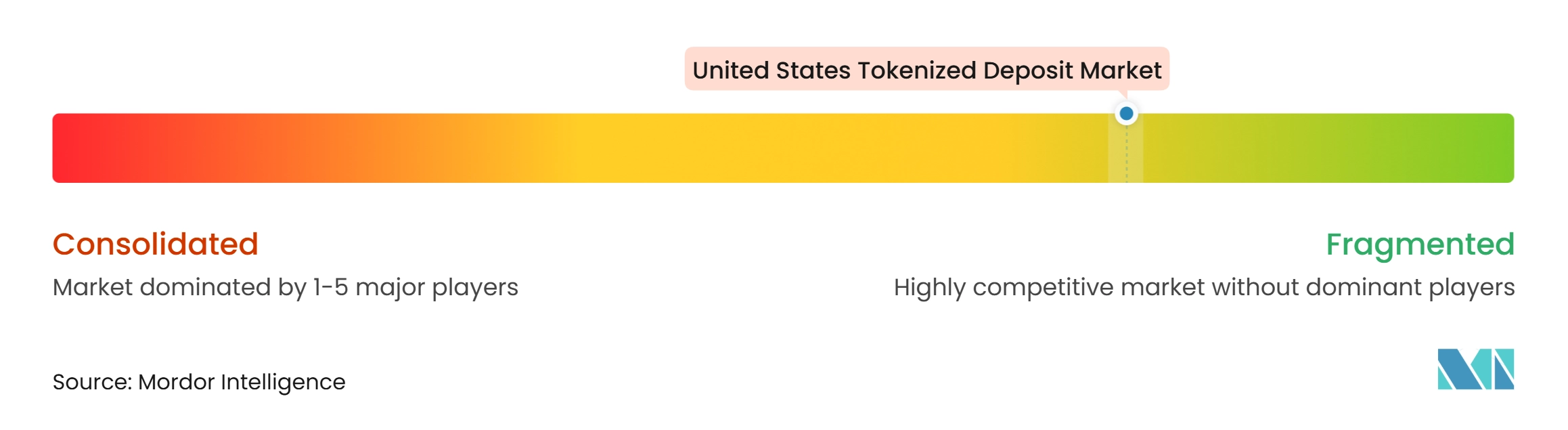
The United States tokenized deposit market is fragmented, with competition spread across large commercial banks, payment infrastructure providers, custodians, and technology firms developing interoperability solutions. JPMorgan, Citigroup, BNY, and Wells Fargo are pursuing distinct institutional use cases, but their offerings differ in blockchain access, payment capabilities, custody integration, and target customers. JPMorgan has developed tokenized deposit capabilities through its Kinexys platform, while Citi Token Services focuses on institutional cash management and cross-border payments. BNY combines custody, collateral management, and payment capabilities, supported by its reported USD 55.8 trillion in assets under custody and administration and USD 2.5 trillion in daily payment throughput. Wells Fargo has also announced tokenized deposit services for corporate and commercial clients. These different operating models indicate that the market is developing across several competing platforms rather than being controlled by a single provider.
The infrastructure layer further supports a fragmented market structure. The Clearing House’s On-Chain Money Initiative brings together 17 banks to explore connections between tokenized settlement and established payment networks, including CHIPS and RTP. Its partnership with Quant on interoperability, transaction orchestration, and tokenized-deposit infrastructure could help participating institutions connect without independently building every component. Meanwhile, providers are differentiating their services around specific applications: JPMorgan has introduced JPMD on Base for institutional users, Wells Fargo has targeted corporate cross-border payments, and BNY has developed digital cash capabilities for collateral and margin workflows. These approaches create opportunities for regional banks and infrastructure providers to compete through interoperability, integration, and specialized settlement services.
Regulatory readiness, client trust, operational resilience, and integration with existing banking systems will remain important competitive factors. The Federal Reserve, Federal Deposit Insurance Corporation, and Office of the Comptroller of the Currency influence how banks manage the risks associated with digital assets and distributed-ledger technology. Intellectual property related to conditional foreign-exchange settlement, automated collateral substitution, and programmable escrow may also help differentiate individual providers, although patent ownership alone does not establish market leadership.
United States Tokenized Deposit Industry Leaders
-
JPMorgan Chase & Co.
-
Citigroup Inc.
-
The Bank of New York Mellon Corporation
-
Wells Fargo and Company
-
Bank of America Corporation
- *Disclaimer: Major Players sorted in no particular order
United States Tokenized Deposit Market Companies Covered in this Report
- JPMorgan Chase & Co.
- Citigroup Inc.
- The Bank of New York Mellon Corporation (BNY)
- Wells Fargo & Company
- Bank of America Corporation
- BMO Financial Group
- Citizens Financial Group, Inc.
- Fifth Third Bancorp
- HSBC Holdings plc
- Huntington Bancshares Incorporated
- KeyCorp
- PNC Financial Services Group, Inc.
- Regions Financial Corporation
- Santander Holdings USA, Inc.
- TD Bank, N.A.
- Truist Financial Corporation
- U.S. Bancorp
- First Horizon Corporation
- M&T Bank Corporation
- Old National Bancorp
Recent Industry Developments in United States Tokenized Deposit Market
- September 2026: The Clearing House selected Quant to power its On-Chain Money Initiative. Quant’s Overledger platform provided the interoperability, orchestration, and transaction-management layer for the 17-bank United States tokenized deposit settlement network. The service included a tokenized-deposits-as-a-service option for smaller financial institutions, and network transactions were targeted for the second quarter of 2027.
- August 2026: Wells Fargo announced tokenized deposits for corporate and commercial clients. The program launched in fall 2026 for selected clients using USD-to-GBP cross-border transactions on Wells Fargo’s proprietary blockchain. It expanded to more clients, currencies, and countries during 2027 and included smart-contract conditional payment functionality.
- June 2026: Seventeen United States banks committed to The Clearing House On-Chain Money Initiative. JPMorgan, Citigroup, Bank of America, Wells Fargo, BNY, BMO, HSBC, PNC, Santander, TD Bank, Truist, U.S. Bank, Citizens Financial Group, Fifth Third, KeyBank, Regions Financial, and Huntington National Bank announced a shared settlement network. The network linked on-chain clearing to existing CHIPS and RTP rails with continuous availability.
- May 2026: BIS Project Agorá completed real-value testing of cross-border tokenized deposit settlement. Twenty-eight private-sector institutions and central banks completed transactions totaling CHF 800,000 (USD 1.01 million) across 17 cross-currency scenarios. The program included payment-versus-payment transactions and intra-group bank transfers, with an average settlement time of 80 seconds.
United States Tokenized Deposit Market Report Scope
Segmentation Overview
| Account-Based Tokenized Deposits |
| Native Deposit Tokens |
| Single-Bank (Intra-Bank) Networks |
| Interbank – Shared Multi-Bank Networks |
| Interbank – Bilateral and Cross-Network Links |
| Private Permissioned Ledgers |
| Public Blockchains with Permissioned Token Access |
| Securities and Digital-Asset Settlement and Collateral Management |
| FX and PvP Settlement |
| Intra-Group Treasury and Liquidity Management |
| Third-Party Commercial and Institutional Payments |
| Retail and Other Payments |
| Domestic |
| Cross-Border |
| Banks and Other Deposit-Taking Institutions | |
| Capital-Markets and Investment Firms | |
| Payments, Fintech and Digital-Asset Firms | |
| Nonfinancial Corporates | Large Corporates and Multinationals |
| SMEs | |
| Public Sector and Government Entities | |
| Individuals |
| By Token Model | Account-Based Tokenized Deposits | |
| Native Deposit Tokens | ||
| By Network Model | Single-Bank (Intra-Bank) Networks | |
| Interbank – Shared Multi-Bank Networks | ||
| Interbank – Bilateral and Cross-Network Links | ||
| By Ledger Type | Private Permissioned Ledgers | |
| Public Blockchains with Permissioned Token Access | ||
| By Use Case | Securities and Digital-Asset Settlement and Collateral Management | |
| FX and PvP Settlement | ||
| Intra-Group Treasury and Liquidity Management | ||
| Third-Party Commercial and Institutional Payments | ||
| Retail and Other Payments | ||
| By Transaction Scope | Domestic | |
| Cross-Border | ||
| By End User | Banks and Other Deposit-Taking Institutions | |
| Capital-Markets and Investment Firms | ||
| Payments, Fintech and Digital-Asset Firms | ||
| Nonfinancial Corporates | Large Corporates and Multinationals | |
| SMEs | ||
| Public Sector and Government Entities | ||
| Individuals | ||
Key Questions Answered in the Report
What is the forecast growth rate for tokenized deposits in the United States?
The United States tokenized deposit market is projected to grow at a 32.6% CAGR from 2027 to 2032, rising from USD 3.4 trillion in 2027 to USD 13.8 trillion by 2032.
Which token model leads tokenized deposits in the United States?
Account-based tokenized deposits lead with 64.3% share in 2026 because they can mirror existing bank account records while reducing migration and regulatory risk.
Why are banks using tokenized deposits for corporate treasury?
Continuous settlement and programmable transfers can reduce idle cash balances, support just-in-time funding, and improve intraday liquidity management.
What is the fastest-growing tokenized deposit use case?
Foreign exchange and payment-versus-payment settlement is projected to grow at a 48.3% CAGR through 2032 as institutions seek to reduce timing, liquidity, and settlement risks.
How are public blockchains used for bank deposit tokens?
Public blockchains with permissioned token access are projected to grow at a 54.8% CAGR through 2032 because they can connect regulated bank money with established digital-asset ecosystems.
What limits broader tokenized deposit adoption?
Fragmented networks, legacy integration costs, cybersecurity concerns, and intraday deposit-flow management remain constraints for banks and their corporate clients.