
United States STATCOM Market Size and Share
Market Overview
| Study Period | 2021 - 2032 |
|---|---|
| Forecast Data Period | 2027 - 2032 |
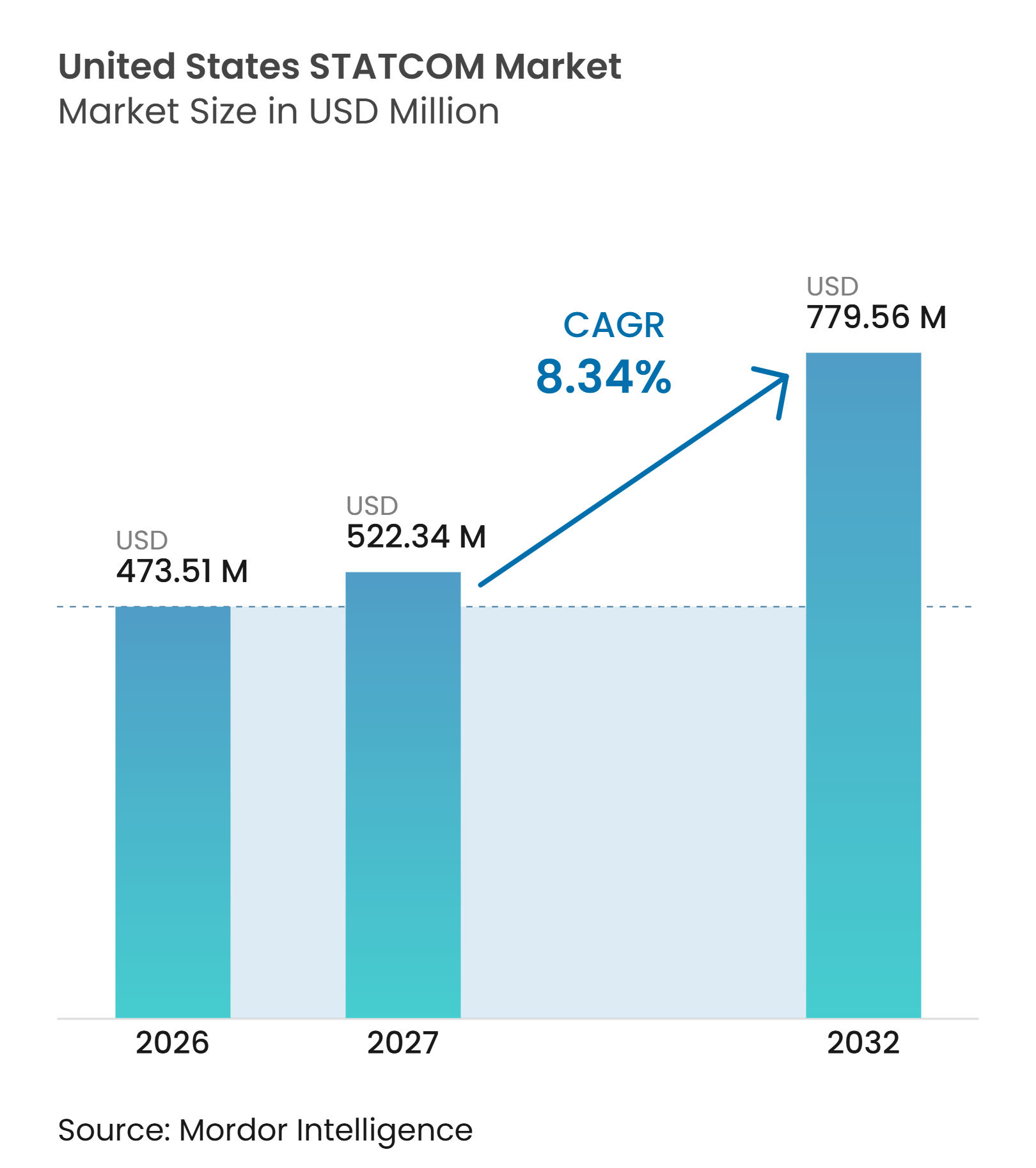
| Base Year Market Size (2026) | USD 473.51 Million |
| Market Size (2027) | USD 522.34 Million |
| Market Size (2032) | USD 779.56 Million |
| Growth Rate (2027 - 2032) | 8.34 % |
| Market Concentration | Medium |
Major Players *Disclaimer: Major Players sorted in no particular order Image © Mordor Intelligence. Reuse requires attribution under CC BY 4.0. | |
United States STATCOM Market Analysis by Mordor Intelligence
The United States STATCOM market size is expected to increase from USD 473.51 million in 2026 to USD 512.99 million in 2027 and reach USD 779.56 million by 2032, growing at a CAGR of 8.34% over 2027-2032. The United States STATCOM market is gaining support from grid upgrades that increase transfer capacity within existing transmission corridors. Federal programs are creating clearer procurement routes for advanced transmission equipment and related grid support systems. Renewable generation and large data center loads are raising the value of fast voltage control at stressed connection points. Suppliers are responding with grid-forming controls, active power support, and bundled project delivery. Long equipment lead times, procurement processes, and control validation requirements continue to shape project timing in the United States STATCOM market.
Key Report Takeaways
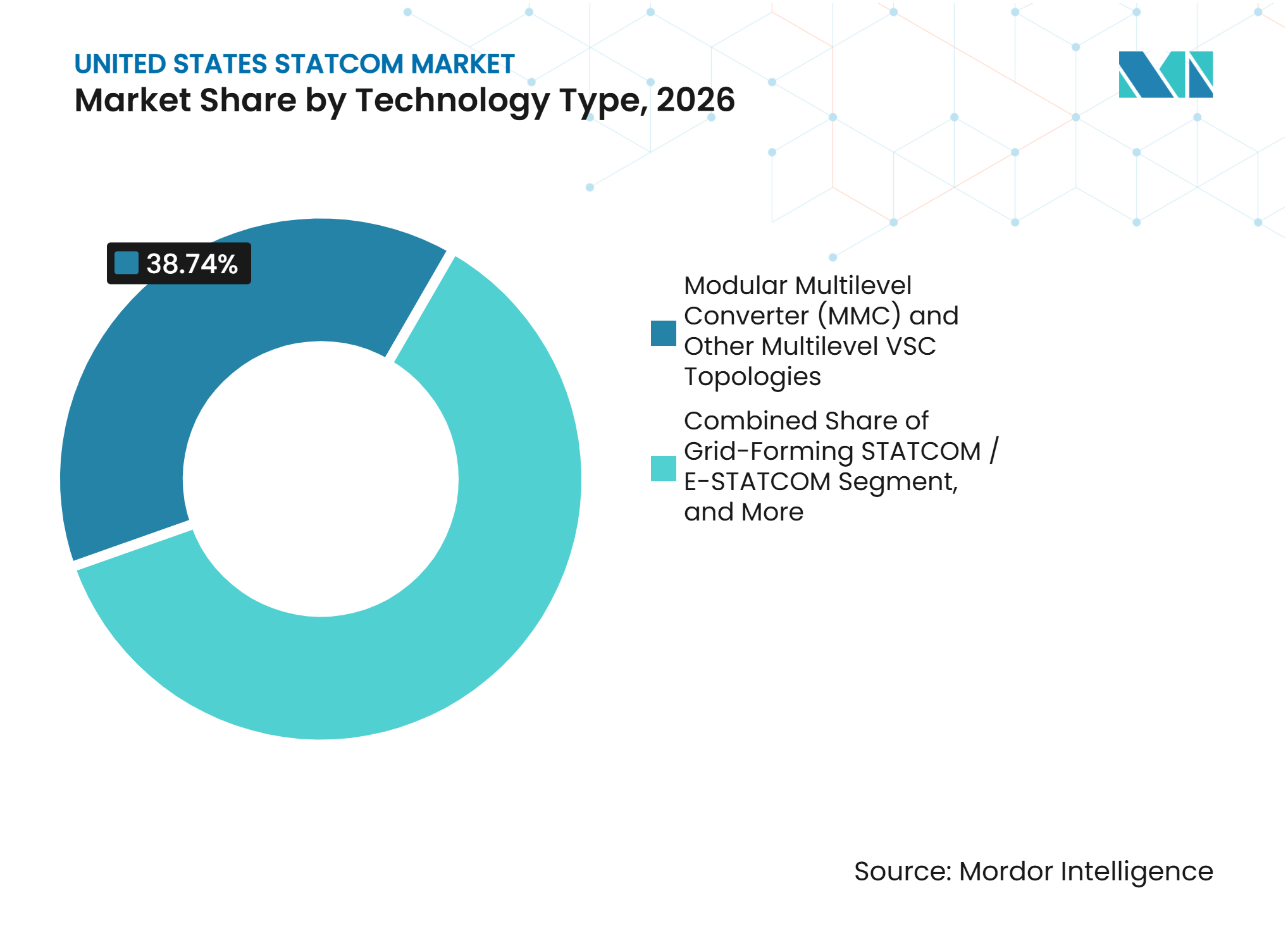
- By technology type, Modular Multilevel Converter and Other Multilevel VSC Topologies held 38.74% of the United States STATCOM market share in 2026, while Grid-Forming STATCOM and E-STATCOM are projected to expand at a 9.27% CAGR through 2032.
- By reactive power rating, Large-Scale Transmission STATCOM held 47.83% revenue share in 2026, while Small-Scale Distribution and Industrial STATCOM is projected to expand at a 9.16% CAGR through 2032.
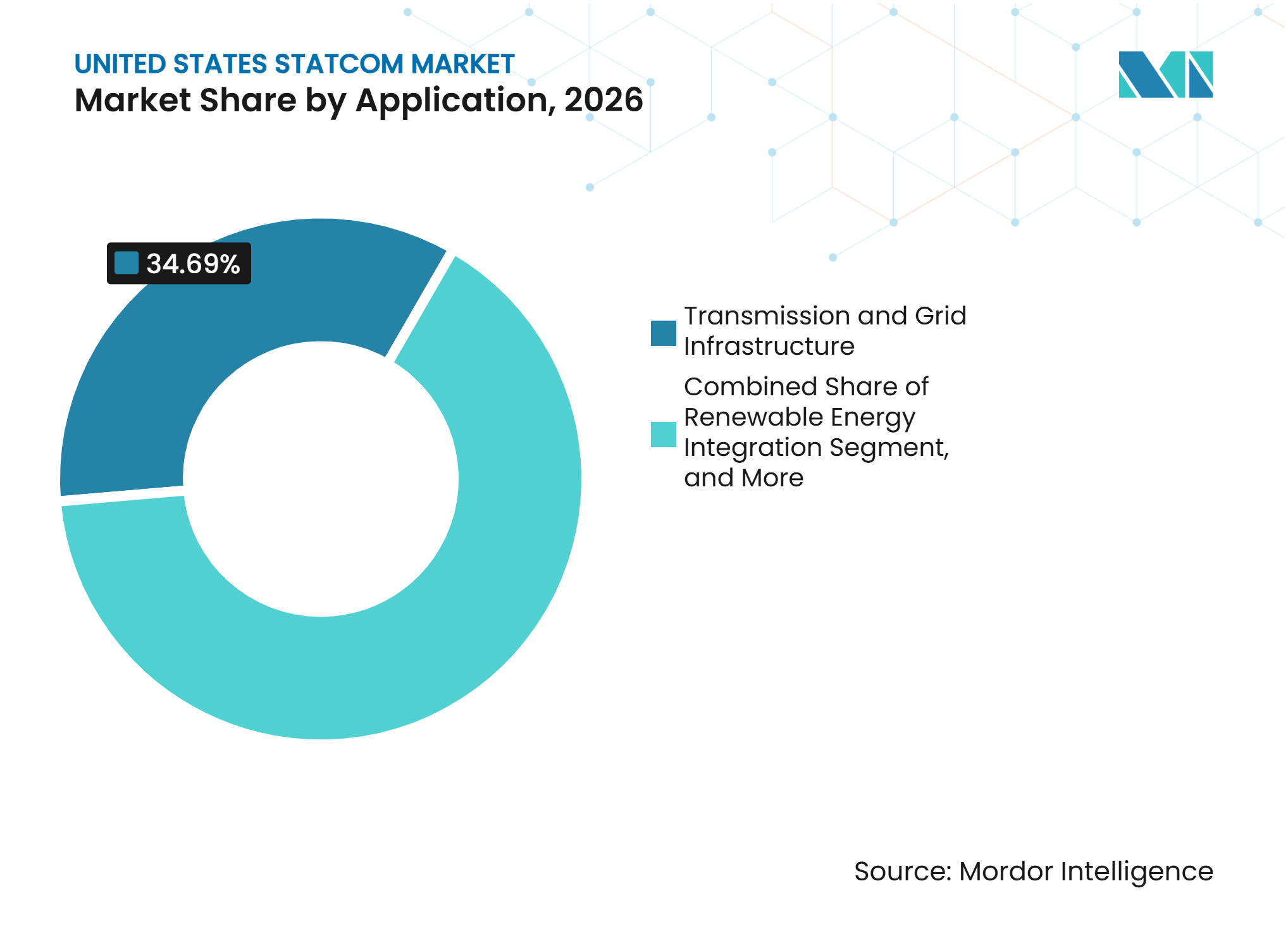
- By application, Transmission and Grid Infrastructure held 34.69% revenue share in 2026, while Data Centers and Commercial Infrastructure is projected to expand at a 9.32% CAGR through 2032.
- By component, Power Electronic Converter Valves held a 37.92% revenue share in 2026, while Control, Protection, and Monitoring Systems are projected to expand at a 9.19% CAGR through 2032.
Note: Market numbers in this report are based on Mordor Intelligence's proprietary estimation framework, which combines nine months of actuals with Q4 projections for base year 2026.
Market Trends and Insights
Drivers Impact Analysis of United States STATCOM Market*
| Driver | (~) % Impact on CAGR Forecast | Geographic Relevance | Impact Timeline |
|---|---|---|---|
| Federal and State Grid Modernization Investment | +2.1% | National, with concentrated project awards in WECC, ERCOT, MISO, and PJM | Short term (≤ 2 years) |
| Renewable Interconnection and Ride-Through Compliance | +1.8% | WECC, including California and the Southwest, ERCOT, and Midwest ISO | Medium term (2-4 years) |
| Transmission Congestion Relief Without New Rights-of-Way | +1.4% | National, with early gains in PJM, MISO, and ERCOT constrained corridors | Medium term (2-4 years) |
| AI Data Center Load Volatility and Weak-Grid Support | +1.2% | ERCOT, PJM, and the Southeast | Short term (≤ 2 years) |
| Low-Inertia Grid Formation Requirements | +0.9% | WECC, ERCOT, and upper MISO | Long term (≥ 4 years) |
| Voltage Stability Needs in Long-Distance Transmission Corridors | +0.7% | WECC interregional corridors, the Southeast, and the Mountain West | Long term (≥ 4 years) |
| Source: Mordor Intelligence | |||
Federal and State Grid Modernization Investment
The Department of Energy launched Speed to Power in September 2025 to connect grid investment with reliability, affordability, and national competitiveness. The department announced USD 1.9 billion in SPARK funding in March 2026 for advanced transmission upgrades within existing rights-of-way. SPARK supports projects that pair reconductoring with advanced technologies, providing utilities with a path to incorporate dynamic voltage support into broader upgrade packages. The United States STATCOM market benefits when utilities can consider reactive compensation alongside conductor work rather than as a separate capital request. The Grid Resilience and Innovation Partnerships program expands the federal funding base for projects that improve grid reliability and resilience. Formula grant funding for state and tribal grid resilience programs also broadens the set of public entities that can advance grid-support investments.
Renewable Interconnection and Ride-Through Compliance
FERC Order No. 2023 changes how transmission providers process requests to connect new generating facilities. The order includes requirements to support more comprehensive technical studies and greater consistency in interconnection reviews. Wind and solar projects need dependable voltage performance at their points of interconnection. Dynamic reactive power equipment can help projects meet ride-through expectations where inverter controls alone are insufficient. The United States STATCOM market therefore has a role in connection designs for renewable projects located on weaker parts of the transmission system. Grid-forming control approaches also address the reduced system strength that can follow the retirement of synchronous generation.
Transmission Congestion Relief Without New Rights-of-Way
Transmission owners face long development periods when a new line requires permitting, land access, and community approval. Advanced transmission technologies can improve system use within existing corridors and reduce the need for some new rights-of-way. STATCOM systems support this objective by managing voltage and reactive power at constrained substations and along stressed lines. The United States STATCOM market gains from projects that combine power-flow improvements with reconductoring or other network upgrades. DOE's SPARK program specifically targets investments that can expand capacity through existing rights-of-way. This approach can shorten the gap between identifying a constraint and making a practical grid improvement.
AI Data Center Load Volatility and Weak-Grid Support
Large AI data centers can create sharp and variable electricity demand at a single grid connection point. A 2026 peer-reviewed study found that a modeled 1,000-MW AI data center load reduced voltage stability margins under both normal and severe contingency conditions. This operating profile increases the need for responsive voltage support near host substations. Siemens Energy introduced its E-STATCOM product for data centers in April 2025 with reactive and active power capability supported by supercapacitor storage. The United States STATCOM market can benefit where utilities and campus operators need to reduce voltage swings and improve power quality. Speed to Power also identifies rising electricity demand linked to advanced computing as a reason to speed grid investment.
Restraints Impact Analysis of United States STATCOM Market*
| Restraint | (~) % Impact on CAGR Forecast | Geographic Relevance | Impact Timeline |
|---|---|---|---|
| High Project-Level Engineering and Installation Cost | -1.5% | National, most acute for small and mid-tier utilities in MISO and the Southeast | Short term (≤ 2 years) |
| Lengthy Utility Procurement, Interconnection, and Siting Cycles | -1.2% | National, most severe in jurisdictions without streamlined interconnection tariffs | Medium term (2-4 years) |
| Limited Domestic Supply of High-Voltage Power-Electronics Components | -0.8% | National, compounded by bulk-power equipment sourcing restrictions | Short term (≤ 2 years) |
| Interoperability, Cybersecurity, and Control-Model Validation Risk | -0.6% | National, particularly for grid-forming projects in WECC and ERCOT | Long term (≥ 4 years) |
| Source: Mordor Intelligence | |||
High Project-Level Engineering and Installation Cost
A utility-scale STATCOM project requires engineering studies, protection integration, civil works, testing, and commissioning in addition to converter hardware. These activities make the installed cost materially higher than that of a simpler capacitor-bank alternative. The United States STATCOM market must therefore compete for capital against lower-cost static solutions, even when those solutions offer less suitable response capability. CPS Energy identified two 300 MVAR STATCOM projects for the San Antonio network with a combined estimated project cost of USD 116.5 million.[1] Smaller utilities may have more difficulty recovering these project costs through regulated rates. Equipment costs can also increase when transformers, reactors, valves, and controls must be sourced within narrow delivery windows.
Lengthy Utility Procurement, Interconnection, and Siting Cycles
Utilities often need several years to move from identifying a reactive power issue to placing a system in service. FERC continues to oversee transmission-provider actions required to implement Order No. 2023, including changes to tariffs and interconnection processes. Supply chain risk standards add vendor review and documentation obligations for network-connected grid equipment. These processes are necessary for reliability, but they can delay procurement of integrated control and monitoring systems. CPS Energy's 2025 filing identified a 2027 need date for one San Antonio unit and a 2029 date for another, while the projects remained in the cost estimation phase. The United States STATCOM market can have a substantial announced pipeline while actual installations progress more slowly.
*Our forecasts treat driver/restraint impacts as directional, not additive. The impact forecasts reflect baseline growth, mix effects, and variable interactions.
United States STATCOM Market Segment Analysis
By Technology Type:
Grid-Forming Controls Expand System SupportModular Multilevel Converter and Other Multilevel VSC Topologies held 38.74% of the United States STATCOM market share in 2026. Their scale, lower harmonic performance, and operating flexibility suit high-value transmission projects. Modular designs can simplify transport, factory assembly, field installation, and maintenance for high-capacity systems. The delta-connected MMC configuration is increasingly relevant for projects that require substantial reactive output. Conventional VSC-based STATCOM systems remain relevant for established installations, replacement work, and buyers seeking familiar operating designs.
Grid-Forming STATCOM and E-STATCOM are projected to grow at a 9.27% CAGR through 2032. This technology supports grids with high levels of inverter-based generation and lower synchronous strength. E-STATCOM designs can combine reactive support, active power response, and storage-enabled load smoothing. IEEE research published in 2025 identified MMC configurations that can integrate supercapacitor storage on the DC side. CIGRE documented an owner's perspective on grid-forming controls for VSC HVDC and STATCOM projects in 2026.



By Reactive Power Rating:
Large Projects Lead Revenue While Smaller Units Gain Use CasesLarge-Scale Transmission STATCOM held 47.83% of the United States STATCOM market share in 2026. High-voltage projects carry large contract values because they require considerable equipment capacity and detailed network integration. Their procurement is commonly linked to bulk-system reliability assessments and formal transmission planning processes. ERCOT's July 2025 filing for CPS Energy described two planned 300 MVAR units for the San Antonio transmission network. Medium-scale units serve regional substations, industrial corridors, municipal utility systems, and locations with targeted voltage needs.
Small-Scale Distribution and Industrial STATCOM is projected to grow at a 9.16% CAGR through 2032. AI campuses and distributed renewable projects are creating demand for responsive local voltage support. These buyers often need combined packages with transformers, capacitor banks, shunt reactors, protection, and controls. AMSC announced a USD 25 million turnkey contract in July 2026 for an integrated power-quality solution at a large mining development. Such delivery models can increase each project's value compared with sales of standalone equipment.
By Application:
Data Centers Add a New Demand SourceTransmission and Grid Infrastructure accounted for 34.69% of the United States STATCOM market in 2026. The segment is supported by reliability needs at transmission substations and changing power flows on major networks. These projects can remain active through commodity cycles because they address planned operating and reliability requirements. DOE funding for advanced transmission upgrades can support utility interest in dynamic grid equipment. Renewable energy integration and industrial modernization provide additional applications for fast voltage-control systems.
Data Centers and Commercial Infrastructure are projected to grow at a 9.32% CAGR through 2032. Growth reflects rising AI computing loads and power-quality risks associated with rapid load changes. The IET study on large AI data center loads showed a sharp reduction in modeled voltage stability margins during severe conditions. Siemens Energy's 2025 E-STATCOM offering combines reactive support with active power capability for data center settings.[2] Railway electrification introduces a further use case in which traction loads require rapid voltage management.

By Component:
Controls Gain Importance Alongside Converter HardwarePower Electronic Converter Valves accounted for 37.92% of the United States STATCOM market in 2026. IGBT-based valve assemblies remain central to the conversion process and account for a large portion of the equipment's value. Converter transformers and reactors connect the transmission system to the converter stage and can affect construction schedules. Hitachi announced more than USD 1 billion in U.S. grid manufacturing investments in September 2025, including capacity for transformers and high-voltage components. Harmonic filters and capacitors manage switching effects and meet project-specific power-quality requirements.
Control, Protection, and Monitoring Systems is projected to grow at a 9.19% CAGR through 2032. Grid-forming systems require advanced modeling, validation, protection coordination, and reliable monitoring compared with conventional reactive devices. FERC directed NERC to develop supply chain risk management standards for certain grid-connected equipment during 2025. This regulatory influence increases the importance of secure controls, vendor review, and documented cybersecurity practices. Hitachi Energy announced a USD 10 million Power Electronics Center of Competence in North Carolina in April 2026.
Geography Analysis
California and the Western Interconnection
California and the Western Interconnection have a strong need for dynamic voltage support as renewable resources change power flows across long transmission paths. The United States STATCOM market is supported in this area by planning needs at high-voltage substations and remote renewable connection points. Federal funding for advanced technologies within existing rights-of-way can support projects in constrained Western corridors. Grid-forming controls are becoming more relevant where inverter-based resources reduce conventional system strength. CIGRE's 2026 work on grid-forming VSC HVDC and STATCOM projects reflects this operational focus.
Texas and the ERCOT Footprint
Texas has clear demand for reactive power equipment because it combines renewable resources, rapid load growth, and an electrically isolated grid. CPS Energy identified two 300 MVAR STATCOM units for its San Antonio transmission network in a July 2025 ERCOT planning filing.[3] The projects were intended to address reliability needs with target dates in 2027 and 2029. Large data center connections add voltage and power-quality pressure for the Texas grid. ERCOT selected GE Vernova for a proof of concept of a distribution awareness platform in October 2025.
Eastern Markets and Other U.S. Regions
PJM and MISO face increasing voltage management needs as industrial loads and renewable resources connect across broad transmission systems. Northern MISO areas may require grid-forming capability as wind resources and generator retirements reduce system strength. The Southeast has a growing need for reactive support as plans for renewable and offshore generation increase coastal connection requirements. Versant Power commissioned a ±150 MVAR STATCOM at Maine's Tunk Lake Substation in May 2025 to support clean-energy connections and improve voltage performance.
Competitive Landscape
Market Concentration
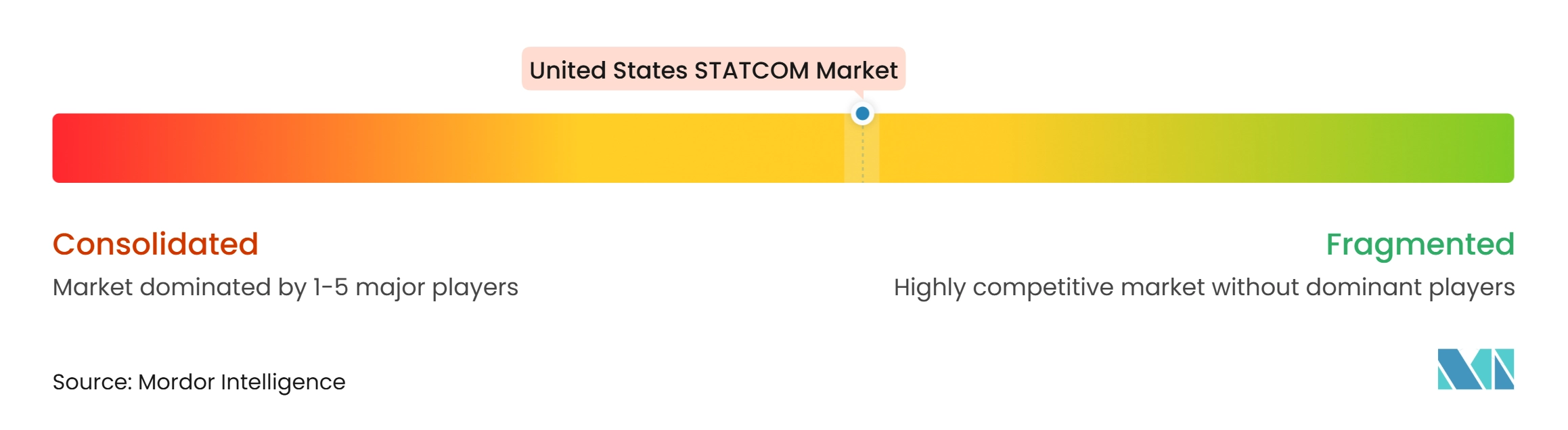
The United States STATCOM market is moderately concentrated in utility transmission projects because a limited group of suppliers can meet the complex engineering, testing, and delivery requirements. Siemens Energy, Hitachi Energy, and GE Vernova have strong positions in large project awards and related grid technologies. Hitachi Energy announced a USD 10 million investment in a North Carolina Power Electronics Center of Competence in April 2026. The facility expands local engineering, testing, and system integration for reactive-power and HVDC solutions in the United States STATCOM market. Its manufacturing expansion supports a strategy based on component availability and closer delivery support.
Technology differentiation is becoming more important as buyers seek support for weak grids and large variable loads. GE Vernova offers a STATCOM solution to strengthen grids and support the expansion of renewable energy.[4] Siemens Energy developed the E-STATCOM for data center use, combining reactive support and active power response in a single system. GE Vernova and Smart Wires signed a memorandum in June 2025 to explore deploying paired FACTS and modular series compensation. These moves show suppliers expanding from equipment sales toward broader grid-support packages.
American Superconductor is pursuing turnkey delivery for industrial and utility applications. The company announced a USD 25 million integrated power-quality contract for a large mining development in July 2026. The scope included modular STATCOM technology, capacitors, reactors, a transformer, switchgear, and protection and control equipment. Supply chain standards can favor suppliers with established engineering, manufacturing, and cybersecurity processes.
United States STATCOM Industry Leaders
-
American Superconductor Corporation
-
Siemens Energy AG
-
GE Vernova Inc.
-
Eaton Corporation plc
-
Toshiba Energy Systems and Solutions Corporation
- *Disclaimer: Major Players sorted in no particular order
United States STATCOM Market Companies Covered in this Report
- American Superconductor Corporation
- Siemens Energy AG
- GE Vernova Inc.
- Eaton Corporation plc
- Toshiba Energy Systems and Solutions Corporation
- Hyosung Heavy Industries Corporation
- Hitachi Energy Ltd.
- Ingeteam Power Technology, S.A.
- JEMA Energy, S.A.
- Nidec Conversion
- S&C Electric Company
- Merus Power Plc
- Comsys AB
- CG Power and Industrial Solutions Limited
- Mitsubishi Electric Corporation
Recent Industry Developments in United States STATCOM Market
- September 2026: Hitachi announced plans for a USD 528 million transformer manufacturing facility in Gallman, Mississippi, described as the cornerstone of its approximately USD 1.5 billion US manufacturing expansion program. The facility will more than double Hitachi Energy's US transformer production capacity and is scheduled to begin production in 2029, reducing domestic component lead times for STATCOM and HVDC projects requiring matched converter transformers as part of their bill of materials.
- July 2026: American Superconductor Corporation secured a USD 25 million turnkey contract from a North American utility to deliver an integrated power quality solution for a large-scale mining development. The scope combines modular STATCOM technology, metal-enclosed capacitor banks, shunt reactors, a 138 kV power transformer, switchgear, and protection and control equipment under a single engineering, procurement, and commissioning contract, representing the company's largest individual mining development order and a demonstration of the integrated solutions model's revenue leverage over standalone equipment supply.
- April 2026: Hitachi Energy announced a USD 10 million Power Electronics Center of Competence in Cary, North Carolina, scheduled for inauguration in fall 2026, creating 150 new jobs and expanding local engineering, testing, and system integration capabilities for reactive compensation and HVDC systems. The 32,000-square-foot facility serves as Hitachi Energy's primary US hub for STATCOM and reactive power product delivery, directly supporting domestic content requirements emerging from FERC CIP and Executive Order frameworks.
- March 2026: The U.S. Department of Energy's Office of Electricity announced approximately USD 1.9 billion in competitive funding under the SPARK program for advanced transmission technology upgrades within existing rights-of-way. The program prioritizes projects deploying reconductoring alongside advanced transmission technologies, including STATCOMs, with concept papers due April 2026 and project selections anticipated in August 2026, establishing a defined near-term procurement pipeline for reactive compensation assets across 26 states.
United States STATCOM Market Report Scope
The United States STATCOM market comprises the sale and deployment of static synchronous compensators (STATCOMs), which are power electronic devices used to regulate voltage, improve power quality, and enhance grid stability. Utilities and industrial facilities use STATCOM systems to provide reactive power compensation, support the integration of renewable energy, and maintain reliable electricity transmission and distribution networks.
The United States STATCOM Market Report is Segmented by Technology Type (Modular Multilevel Converter (MMC) and Other Multilevel VSC Topologies, Conventional Voltage Source Converter (VSC)-Based STATCOM, Grid-Forming STATCOM / E-STATCOM, and Medium-Voltage and Distribution STATCOM), Reactive Power Rating (Large-Scale Transmission STATCOM, Medium-Scale STATCOM, and Small-Scale Distribution and Industrial STATCOM), Application (Transmission and Grid Infrastructure, Renewable Energy Integration, Industrial and Manufacturing, Data Centers and Commercial Infrastructure, and Railway Electrification and Other Applications), and Component (Power Electronic Converter Valves, Converter Transformers and Reactors, Capacitors and Harmonic Filters, Control, Protection, and Monitoring Systems, and Cooling Systems and Auxiliary Components). The Market Forecasts are Provided in Terms of Value (USD).
Segmentation Overview
| Modular Multilevel Converter (MMC) and Other Multilevel VSC Topologies |
| Conventional Voltage Source Converter (VSC)-Based STATCOM |
| Grid-Forming STATCOM / E-STATCOM |
| Medium-Voltage and Distribution STATCOM |
| Large-Scale Transmission STATCOM |
| Medium-Scale STATCOM |
| Small-Scale Distribution and Industrial STATCOM |
| Transmission and Grid Infrastructure |
| Renewable Energy Integration |
| Industrial and Manufacturing |
| Data Centers and Commercial Infrastructure |
| Railway Electrification and Other Applications |
| Power Electronic Converter Valves |
| Converter Transformers and Reactors |
| Capacitors and Harmonic Filters |
| Control, Protection, and Monitoring Systems |
| Cooling Systems and Auxiliary Components |
| By Technology Type | Modular Multilevel Converter (MMC) and Other Multilevel VSC Topologies |
| Conventional Voltage Source Converter (VSC)-Based STATCOM | |
| Grid-Forming STATCOM / E-STATCOM | |
| Medium-Voltage and Distribution STATCOM | |
| By Reactive Power Rating | Large-Scale Transmission STATCOM |
| Medium-Scale STATCOM | |
| Small-Scale Distribution and Industrial STATCOM | |
| By Application | Transmission and Grid Infrastructure |
| Renewable Energy Integration | |
| Industrial and Manufacturing | |
| Data Centers and Commercial Infrastructure | |
| Railway Electrification and Other Applications | |
| By Component | Power Electronic Converter Valves |
| Converter Transformers and Reactors | |
| Capacitors and Harmonic Filters | |
| Control, Protection, and Monitoring Systems | |
| Cooling Systems and Auxiliary Components |
Key Questions Answered in the Report
What is the United States STATCOM market size?
The United States STATCOM market is expected to increase from USD 473.51 million in 2026 to USD 512.99 million in 2027 and USD 779.56 million by 2032.
What is the projected growth rate for STATCOM systems in the United States?
The forecast CAGR is 8.34% from 2027 to 2032. Grid modernization, renewable connections, and large-load support are the main growth factors.
Which STATCOM technology is growing fastest?
Grid-Forming STATCOM and E-STATCOM is projected to record the highest technology CAGR of 9.27% through 2032.
Why are data centers adopting dynamic voltage support?
Large AI data centers can create rapid load changes that reduce voltage stability margins, increasing demand for local reactive and active power support.
Which application has the strongest forecast growth?
Data Centers and Commercial Infrastructure is projected to grow at a 9.32% CAGR through 2032.
What limits STATCOM project deployment?
High project costs, long utility procurement cycles, component availability, and control validation requirements can delay installation.