
United States Smart Faucets Market Size and Share
Market Overview
| Study Period | 2021 - 2032 |
|---|---|
| Forecast Data Period | 2027 - 2032 |
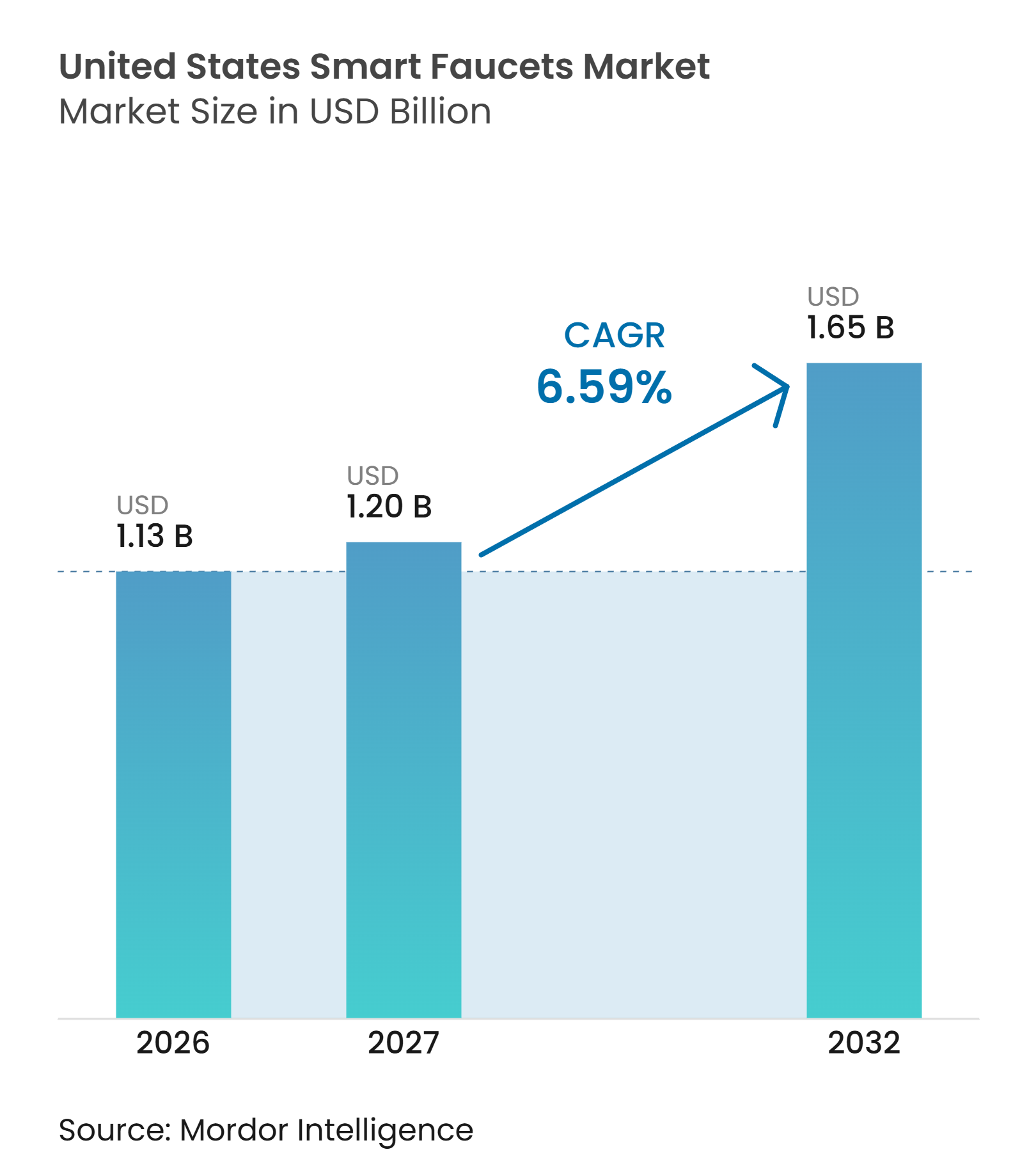
| Base Year Market Size (2026) | USD 1.13 Billion |
| Market Size (2027) | USD 1.20 Billion |
| Market Size (2032) | USD 1.65 Billion |
| Growth Rate (2027 - 2032) | 6.59 % |
| Market Concentration | Medium |
Major Players *Disclaimer: Major Players sorted in no particular order Image © Mordor Intelligence. Reuse requires attribution under CC BY 4.0. | |
United States Smart Faucets Market Analysis by Mordor Intelligence
Key Report Takeaways
-
By material, brass accounted for 43.8% of the United States smart faucets market share in 2026, while engineering plastics and polymer composites are forecast to grow at a 7.0% CAGR during 2027–2032.
-
By installation type, deck-mount faucets accounted for a 62.8% share in 2026, while other installations are forecast to grow at a 6.8% CAGR during 2027–2032.
-
By application, bathroom sink faucets accounted for 60.8% of the United States smart faucets market share in 2026, while kitchen sink faucets are forecast to grow at a 6.8% CAGR during 2027–2032.
-
By construction or project type, replacement, renovation, and retrofit accounted for a 65.6% share in 2026, and it is also projected to grow at a faster CAGR.
-
By end user, residential buyers accounted for the largest share in 2026, while commercial demand is forecast to grow at a 7.1% CAGR during 2027–2032.
-
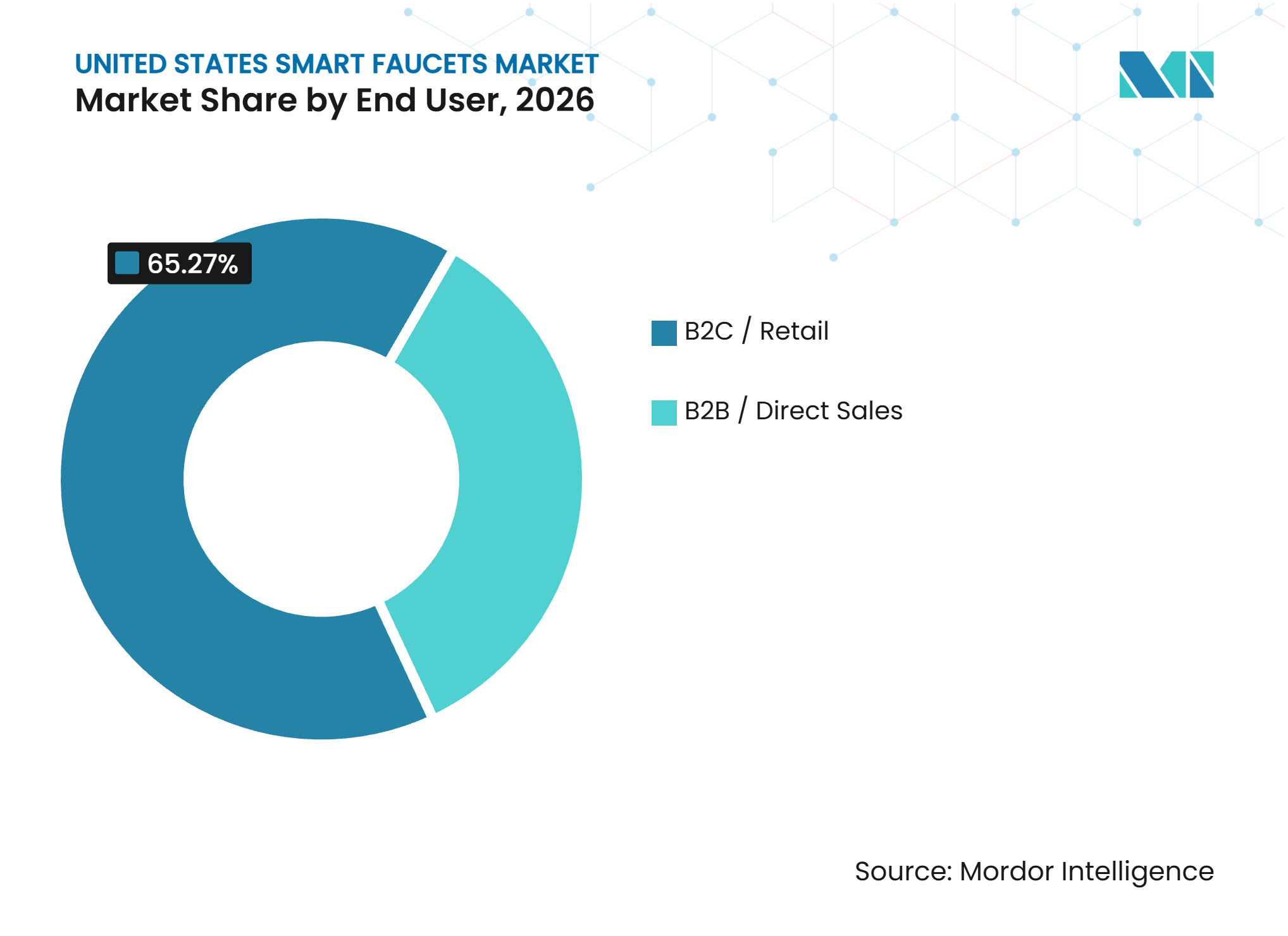
By distribution channel, B2C and retail accounted for a 65.3% share in 2026, while B2B and direct sales are forecast to grow at a 6.9% CAGR during 2027–2032.
-
By geography, the Southeast accounted for a 31.1% share in 2026, while the Southwest is forecast to grow at a 6.9% CAGR during 2027–2032.
Note: Market numbers in this report are based on Mordor Intelligence's proprietary estimation framework, which combines nine months of actuals with Q4 projections for base year 2026.
Market Trends and Insights
Drivers Impact Analysis of United States Smart Faucets Market*
| Driver | (~) % Impact on CAGR Forecast | Geographic Relevance | Impact Timeline |
|---|---|---|---|
| WaterSense and State-Level Water-Efficiency Requirements | +1.2% | National, with compliance hotspots in California, New York, Oregon, and Washington | Medium term (2-4 years) |
| Touchless Retrofits in Healthcare, Education, Airports, and Offices | +1.5% | National, with strongest demand in Northeast and Southeast urban centers | Medium term (2-4 years) |
| Connected-Home Adoption and Voice-Controlled Water Dispensing | +1.0% | National, with early gains in West Coast technology-focused markets | Medium term (2-4 years) |
| Aging Housing Stock and Remodel-Led Replacement | +1.3% | National, with the greatest effect in pre-1980 housing clusters in the Northeast and Midwest | Medium term (2-4 years) |
| Insurer-Led Leak Detection and Automatic Shut-Off Incentives | +0.6% | National, with early gains in high-claim states such as Texas and Florida | Short term (≤ 2 years) |
| Turbine-Powered, Battery-Light, and Low-Flow Commercial Fixtures | +0.5% | National, with LEED-focused projects concentrated in the West and Southeast | Long term (≥ 4 years) |
| Source: Mordor Intelligence | |||
WaterSense and State-Level Water-Efficiency Requirements
The United States smart faucets market faces a policy setting where federal and state rules do not always move in the same direction. On 16 May 2025, the Department of Energy proposed rescinding its amended faucet standards, which would raise the federal maximum from 2.2 gpm to the statutory 2.5 gpm. California, New York, and Washington continue to apply more demanding lavatory faucet requirements of 1.2 gallons per minute. National manufacturers have limited incentive to maintain separate designs for every state so that stricter state rules can influence the broader product portfolio. Digital flow settings and monitored use can help suppliers meet different compliance needs without redesigning the basic fixture. This gives connected and touchless products an advantage where facility owners need documented water performance.
Touchless Retrofits in Healthcare, Education, Airports, and Offices
Commercial buyers increasingly treat touchless fixtures as part of a building operating plan rather than as a cosmetic restroom upgrade. ASHRAE 188 and Guideline 12-2023 address water-management programs and identify faucets as relevant control points. Sensor faucets can support scheduled flushing and usage records, which can help facilities manage water systems more consistently. Sloan introduced a 0.35 gallons-per-minute BASYS sensor faucet extension in January 2025 that qualifies for LEED v4 water-efficiency credits and meets CALGreen requirements[3]. Those attributes allow a single product line to address multiple project requirements in healthcare, education, airports, and offices. Facility managers benefit when they combine hygiene, water use, and maintenance objectives in one procurement decision.
Connected-Home Adoption and Voice-Controlled Water Dispensing
Connected-home demand is expanding smart faucet functionality beyond touchless activation. Voice control, app-based settings, measured dispensing, and water-use monitoring can integrate kitchen and bathroom fixtures into broader home systems. Major platforms support select voice assistants but do not support Matter, creating a practical interoperability gap. This gap may make buyers cautious, particularly when they expect connected devices to remain compatible with future home platforms. It also creates opportunities for suppliers that can simplify setup and improve cross-platform control. The United States smart faucets market will depend on delivering practical daily-use functions beyond voice control, as users continue to expect reliable manual or touch activation when connected services are unavailable.
Aging Housing Stock and Remodel-Led Replacement
Aging housing stock gives the United States smart faucets market a replacement base that is less dependent on new housing construction. NAHB reported in 2025 that nearly half of owner-occupied homes were built before 1980, which points to a large number of properties with older plumbing fixtures. Harvard Joint Center for Housing Studies projected USD 509 billion in homeowner improvement and repair spending for 2025[4]. Remodeling projects create a natural point to replace faucets because labor, cabinetry, countertops, and water lines may already be under review. Sensor and connected fixtures can be presented as an incremental upgrade during a broader project rather than as a stand-alone purchase. The replacement cycle also gives manufacturers a channel to reach homes where a full smart-home system has not yet been installed.
Restraints Impact Analysis of United States Smart Faucets Market*
| Restraint | (~) % Impact on CAGR Forecast | Geographic Relevance | Impact Timeline |
|---|---|---|---|
| Higher Upfront Cost Than Manual Faucets | -1.5% | National, with the strongest effect in price-sensitive Midwest and rural locations | Short term (≤ 2 years) |
| Installer Shortages and Retrofit Complexity | -1.2% | National, with the most acute effect in high-growth Sun Belt metropolitan areas | Medium term (2-4 years) |
| Sensor Performance in Variable Lighting, Humidity, and Water Conditions | -0.6% | National, with residential applications more affected than commercial applications | Medium term (2-4 years) |
| Patchwork Codes, Certification, and Low-Flow Compliance Costs | -0.8% | National, with multi-state compliance burdens concentrated in California, Texas, and New York | Medium term (2-4 years) |
| Source: Mordor Intelligence | |||
Higher Upfront Cost Than Manual Faucets
Price remains the clearest barrier to residential adoption in the United States smart faucets market. Smart faucets can cost 3 to 5 times more than comparable manual fixtures. Entry-level residential touchless models start at USD 340 to USD 460, while premium voice-integrated models can exceed USD 1,100. This difference can keep smart features in the discretionary part of a renovation budget. Commercial buyers can spread costs across broader facility projects, but homeowners often evaluate one faucet against a lower-cost manual replacement. Wider insurer incentives, simpler products, and clearer savings evidence would be needed to reduce this gap.
Installer Shortages and Retrofit Complexity
Limited skilled labor can slow installations even when building owners are ready to buy. Plumbing Manufacturers International reported in 2025 that a projected shortage of 550,000 workers could affect the plumbing sector. Hardwired sensor products may require coordination between a plumber and an electrician, unlike a simple manual faucet swap. This raises scheduling risk and can increase total installation expense. Retrofit work is particularly exposed because older buildings can present uncertain wiring, wall access, or supply-line conditions. Products that simplify power requirements and installation steps can therefore expand access to the United States smart faucets market.
*Our forecasts treat driver/restraint impacts as directional, not additive. The impact forecasts reflect baseline growth, mix effects, and variable interactions.
United States Smart Faucets Market Segment Analysis
By Material:
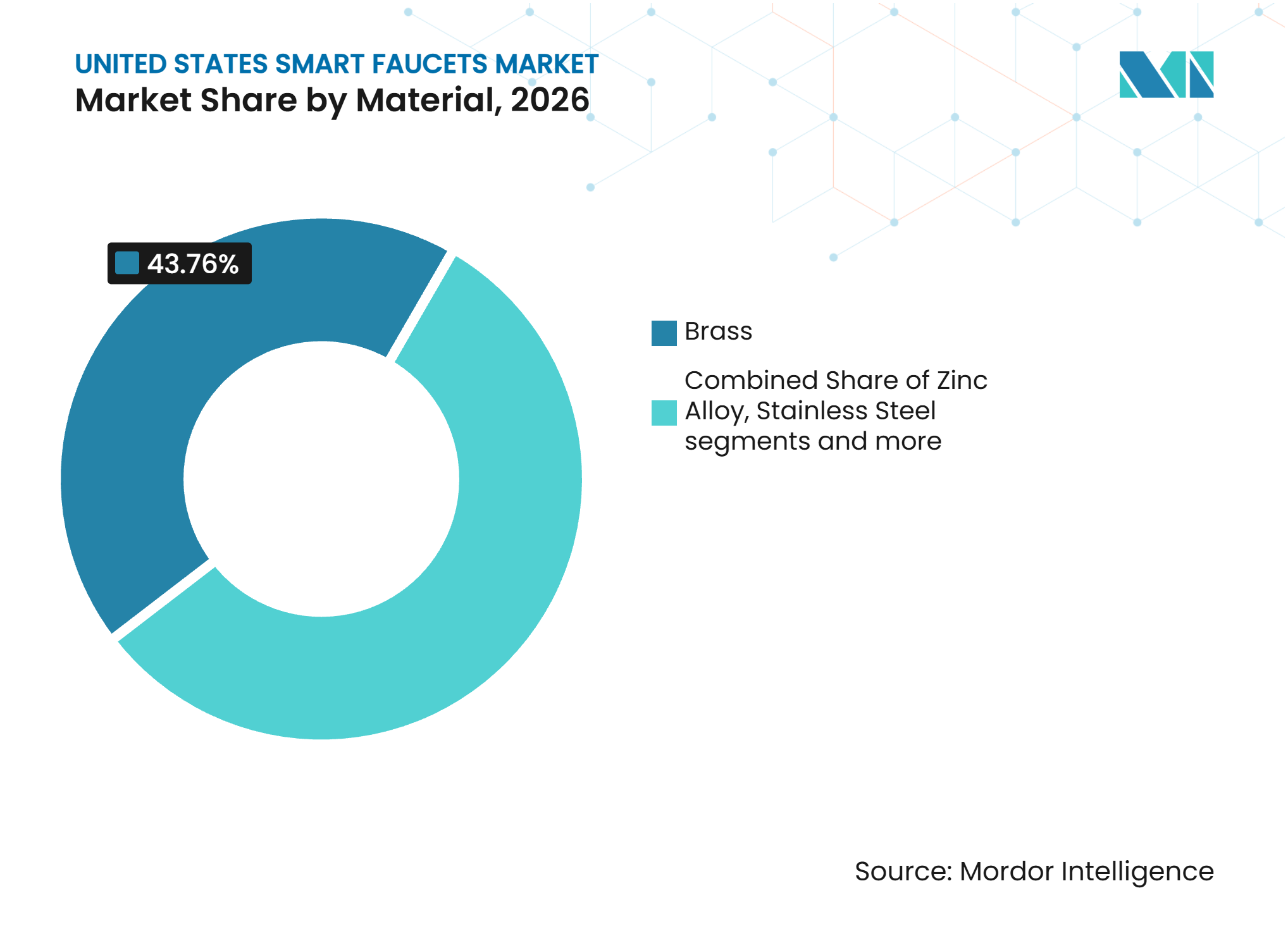
Polymer Composites Accelerate as Brass Retains Legacy LeadBrass held a 43.8% share in 2026 because installers and specifiers know its pressure tolerance, machinability, and use across plumbing applications. Brass remains familiar in home renovation and commercial purchasing, while lead-free requirements are encouraging manufacturers to examine materials that can meet water-contact needs without alloy changes. Stainless steel serves applications that value durability and a premium appearance, while zinc alloy remains relevant where lower purchase cost is important. The material choice affects valve construction, finish durability, weight, and the way a product is positioned to contractors. These tradeoffs keep brass central to current specifications, even as alternatives expand.
Engineering plastics and polymer composites are projected to grow at a 7.0% CAGR through 2032, the fastest material rate. Envalior states that its EcoPaXX PA4.10 has been tested for more than 1 million operating cycles without water leakage in faucet mixing-valve applications. This supports the use of engineered polymers where weight, corrosion resistance, and lead-free design are important. Syensqo reported that AvaSpire PAEK compounds are used in plumbing tubes for faucet connection applications. These examples show that polymer-metal designs have moved into commercial use, while performance evidence continues to shape material selection alongside installer preference.


By Installation Type:
Deck-Mount Leads as Niche Formats Build Specification MomentumDeck-mount faucets held a 62.8% share in 2026. Their lead reflects broad compatibility with existing countertop openings in residential renovation projects and standard use on commercial restroom counters. A deck-mount sensor faucet can often use the location of an existing manual fixture, which can reduce project disruption. That practical fit matters for owners trying to control installation labor and renovation time. Wall-mount products serve specialized design applications but may require greater wall access and plumbing coordination.
Other installations are forecast to grow at a 6.8% CAGR during 2027-2032, supported by behind-glass sensors, integrated vanity units, and prefabricated commercial configurations. These formats fit large projects where restroom design, cleaning access, and repeatable installation are planned together. Sports venues, transport hubs, and corporate campuses can favor modular systems because they need many fixtures installed under consistent specifications. Zurn Elkay described Zurn One Systems as integrated fixtures and plumbing components for commercial settings in its 2025 filing. Prefabricated approaches can reduce coordination across product categories and support a more consistent maintenance approach after installation.
By Application:
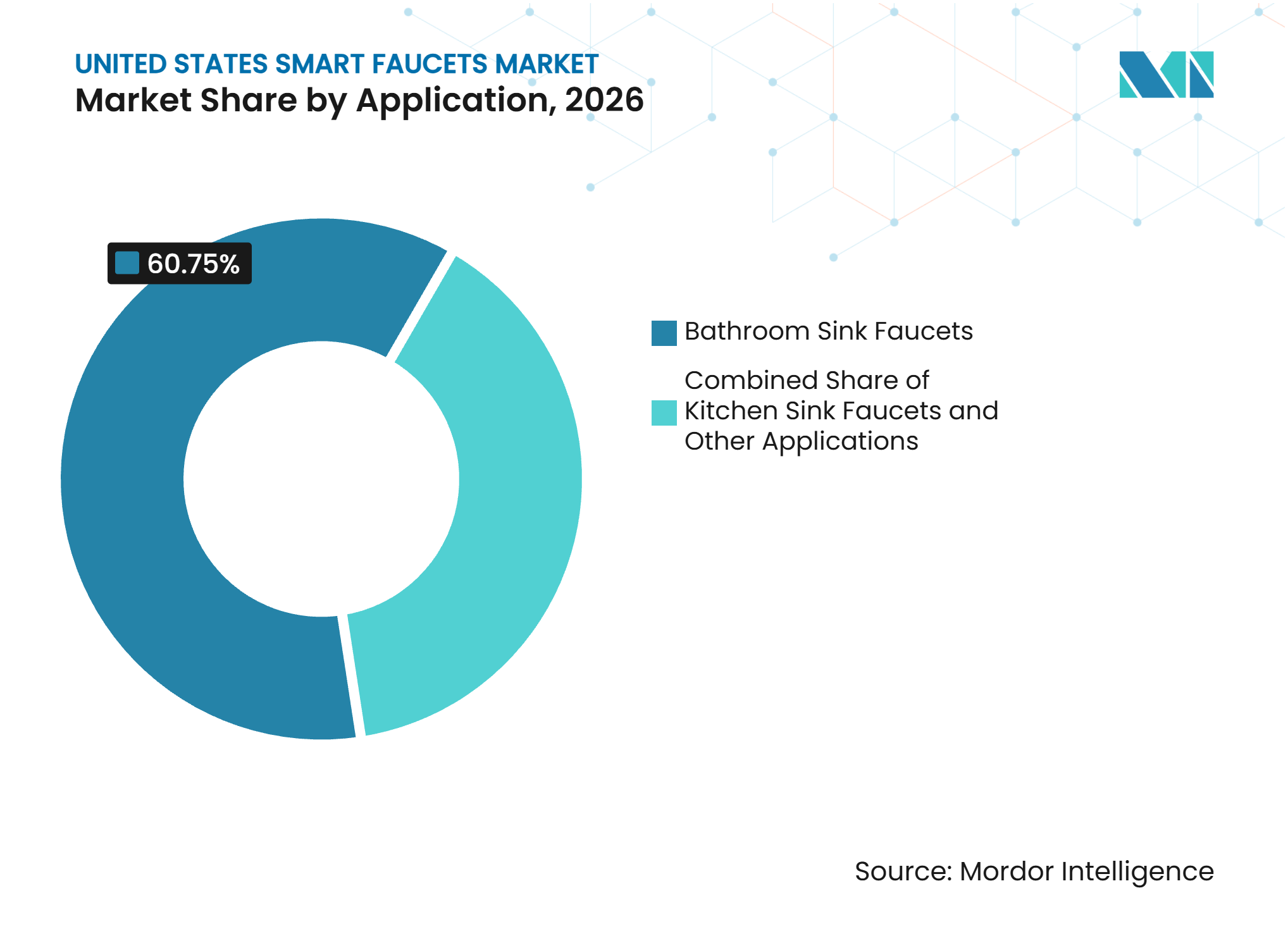
Bathroom Faucets Lead as Kitchen Installs Narrow the GapBathroom sink faucets accounted for 60.8% of the United States smart faucets market size in 2026. Bathrooms often have more faucets per property than kitchens, which creates a larger unit base. Touchless lavatory use fits hygiene expectations in airports, schools, healthcare settings, and offices. Commercial buyers can standardize bathroom fixtures across many restrooms in one project, creating volumes that kitchen installations cannot match. Bathroom products also benefit from the need for low-flow performance in institutional settings.
Kitchen sink faucets are forecast to grow at a 6.8% CAGR during 2027-2032. Their appeal depends on measured dispensing, voice commands, touch activation, and water-use monitoring that support food preparation. Delta VoiceIQ and Kohler Konnect are examples of this feature direction. Kitchen users may place greater value on convenience and precise water delivery than bathroom users. The Environmental Protection Agency has not established a dedicated WaterSense specification for kitchen faucets, leaving brands room for proprietary efficiency claims and buyers with less standardized guidance.

By Construction or Project Type:
Retrofit Cycle Anchors Both Volume and GrowthReplacement, renovation, and retrofit held a 65.6% share in 2026. This category is the leading growth area in the research, focusing on current demand and future opportunities in the same project type. Older homes, offices, schools, and hospitality properties often replace faucets during wider plumbing, bathroom, or kitchen work. Harvard projected USD 509 billion in homeowner improvement and repair spending in 2025. A touchless or connected model can be considered when labor and related building work are already budgeted, especially when water monitoring or low-flow performance addresses an owner’s concern.
New construction and first installation represent the remaining demand base, but they grow more slowly. Builders can include touchless products in planned packages, especially in large communities and commercial developments. New projects are exposed to broader building cycles, financing conditions, and permit activity. NAHB reported in 2025 that the remodeling share of residential construction is rising. This setting favors suppliers with strong replacement distribution, common plumbing compatibility, contractor training, and retail availability.
By End User:
Residential Volume Leads, Commercial Momentum OutpacesResidential buyers held the largest share of the United States smart faucets market in 2026. Single-family and multifamily homes provide a larger number of potential replacement points than any institutional customer group. Homeowners can be drawn to smart-home compatibility, touchless use, voice settings, and finishes that distinguish a renovated room. The price barrier remains meaningful because each household must weigh smart features against a manual fixture alternative. Retail choice, installation simplicity, and insurer-linked water monitoring can improve the financial case where incentives are available.
Commercial demand is forecast to grow at a 7.1% CAGR during 2027-2032. Hospitals, airports, schools, offices, and public venues can purchase fixtures as part of planned capital programs. These buyers can link touchless products to hygiene, water management, maintenance, and compliance requirements. Sloan’s 2025 low-flow BASYS extension illustrates the type of product designed for these institutional criteria. Larger projects support consistent specifications and give suppliers an opportunity to build long-term relationships through service, parts, and connected monitoring.
By Distribution Channel:
B2C Retail Dominates, B2B Direct Sales AccelerateB2C and retail channels held a 65.3% share in 2026. This includes home-improvement stores, kitchen and bath showrooms, online sellers, and local hardware outlets. Retail gives homeowners access to a broad range of finishes, control types, and price points. Online listings have made product comparisons and price transparency more common, which can pressure mid-tier brands to explain features clearly. Store displays, installer referrals, and product reviews affect whether a buyer chooses a touchless model.
B2B and direct sales are forecast to grow at a 6.9% CAGR through 2032. Manufacturers use direct relationships with property managers, hotel groups, healthcare operators, and other facility owners to support project-based purchasing. These buyers often value consistent supply, product documentation, service support, and specification assistance for large retrofits. The model is well suited to products that must meet several compliance or maintenance requirements at once. It gives the United States smart faucets industry a path to build recurring customer relationships beyond a one-time retail transaction.
Geography Analysis
Southeast: Commercial Depth and Rebuilding Support Demand
The Southeast held a 31.1% share in 2026. The region combines a large hospitality base, dense commercial property, and substantial plumbing replacement activity. The 2024 storm rebuilding in Florida and the Carolinas is a factor supporting replacement demand, because owners can select efficient fixtures when damaged systems are renewed. Georgia’s building activity also supports turnover in housing-related plumbing demand. Commercial buyers can use low-flow sensor products to meet water-use and maintenance goals, which makes the region relevant to retail and institutional specification strategies.
Southwest: Water Constraints Support the Fastest Growth
The Southwest is forecast to grow at a 6.9% CAGR through 2032, making it the fastest-growing regional part of the United States smart faucets market. Water scarcity gives efficiency features a direct operational value in this region. The Environmental and Energy Study Institute published a 2025 review of water pressures in the Colorado River Basin. The Water Infrastructure Modernization Act of 2025 proposed a funding path for smart water technologies. Manufacturers can combine lower-flow hardware, monitoring, and practical retrofit designs for public and private buildings seeking to manage water use.
Northeast, Midwest, and West: Distinct Replacement and Specification Patterns
The Northeast has older housing stock and a large base of healthcare and university facilities, which supports steady replacement demand. New York’s lavatory faucet rules steer replacement choices toward lower-flow products, while Midwest price sensitivity can limit premium residential adoption despite institutional project demand. The West outside the Southwest benefits from California’s CALGreen framework, strong technology-oriented consumer demand in major metropolitan areas, and Sloan's compliance-ready sensor product range. Suppliers need distinct propositions, with renovation support in the Northeast, value and service in the Midwest, and connected compliance products in the West.
Competitive Landscape
Market Concentration
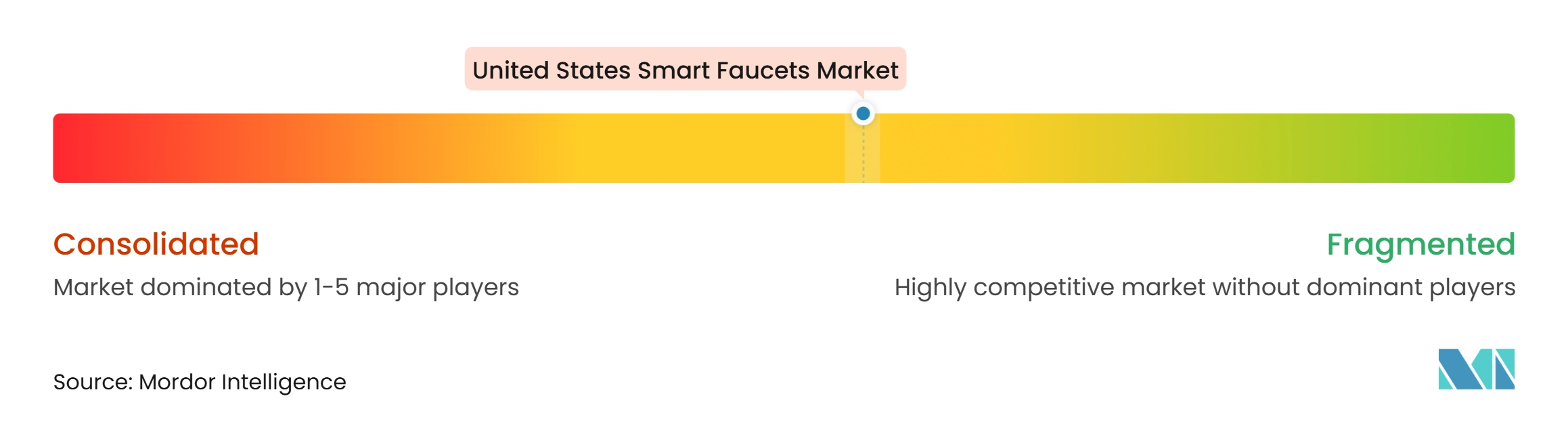
The United States smart faucets market has a moderately concentrated structure, with large plumbing brands carrying substantial influence in their core channels. Kohler, Moen through Fortune Brands Innovations, and Delta Faucet through Masco serve premium residential and mixed-use commercial demand. Sloan Valve and Zurn Elkay have strong positions in institutional projects such as airports, hospitals, and public facilities. This creates a practical division between consumer-focused competition and specification-led commercial competition. Zurn Elkay reported in its 2025 filing that its connected plumbSMART platform supports real-time usage monitoring and automated flushing functions, extending the fixture role into wider water management.
Competition depends on sensor reliability, connected-system compatibility, and the breadth of certifications suppliers offer. Delta’s H2Optics infrared technology and TOTO’s EcoPower hydropower generation represent distinct approaches to performance and maintenance. Sloan’s LEED v4 eligibility and CALGreen compliance support its relevance in institutional specifications. Kohler’s Apple Home integration illustrates how premium brands use broader smart-home ecosystems to differentiate their products. The lack of Matter support among major platforms may raise buyer concerns about ecosystem lock-in, creating an advantage for companies that simplify installation, compatibility, and ongoing service.
DIY-friendly sensor retrofit kit for mass residential replacement. Major brands have not addressed this opportunity at scale. Products in this segment require simple installation, reliable sensor performance, demonstrable water-efficiency benefits, and retail support. Larger companies can defend their established positions through distribution networks, warranty coverage, contractor relationships, and compliance capabilities.
United States Smart Faucets Industry Leaders
-
Kohler Co.
-
Moen Incorporated
-
Delta Faucet Company
-
LIXIL Corporation
-
Sloan Valve Company
- *Disclaimer: Major Players sorted in no particular order
United States Smart Faucets Market Companies Covered in this Report
- Kohler Co.
- Moen Incorporated
- Delta Faucet Company
- LIXIL Corporation
- Fortune Brands Innovations
- Masco Corporation
- TOTO Ltd.
- Sloan Valve Company
- Zurn Elkay Water Solutions
- Pfister
- Hansgrohe USA
- Chicago Faucets
- Bradley Corporation
- Speakman
- Symmons
- Kraus USA
- T&S Brass and Bronze Works
- Stern Engineering Ltd.
- FontanaShowers
- Watts Water Technologies
Recent Industry Developments in United States Smart Faucets Market
- October 2026: Delta Faucet has launched the Noreau kitchen collection: Touch2O touchless, VoiceIQ (Alexa/Google) metered dispensing, a TempSense LED temperature indicator, a 5-year electronics warranty, and five finishes.
- July 2026: Harbour Group acquired Symmons Industries and Symmons Connected (Braintree, MA), which offer faucets and the Evolution AI-First smart water management platform for commercial buildings.
- February 2026: Delta Faucet has unveiled the Cordova kitchen collection, with select models offering Touch2O touchless technology (tap or hands-free motion), and the Altado collection with ProClean spray.
United States Smart Faucets Market Report Scope
Segmentation Overview
| Zinc Alloy |
| Stainless Steel |
| Brass |
| Engineering Plastics / Polymer Composites |
| Other Materials |
| Deck-Mount |
| Wall-Mount |
| Other Installations |
| Kitchen Sink Faucets |
| Bathroom Sink Faucets |
| Other Applications |
| New Construction / First Installation |
| Replacement / Renovation / Retrofit |
| Residential |
| Commercial |
| B2C / Retail | Multi-Brand Stores/Home-Improvement Retailers |
| Specialist Plumbing and Kitchen/Bath Showrooms (including Exclusive Brand Outlets (EBOs)) | |
| Online / E-Commerce | |
| Local Hardware Stores / Unorganized Retail | |
| B2B / Direct Sales |
| Northeast |
| Southeast |
| Midwest |
| Southwest |
| West |
| By Material | Zinc Alloy | |
| Stainless Steel | ||
| Brass | ||
| Engineering Plastics / Polymer Composites | ||
| Other Materials | ||
| By Installation Type | Deck-Mount | |
| Wall-Mount | ||
| Other Installations | ||
| By Application | Kitchen Sink Faucets | |
| Bathroom Sink Faucets | ||
| Other Applications | ||
| By Construction/Project Type | New Construction / First Installation | |
| Replacement / Renovation / Retrofit | ||
| By End-User | Residential | |
| Commercial | ||
| By Distribution Channel | B2C / Retail | Multi-Brand Stores/Home-Improvement Retailers |
| Specialist Plumbing and Kitchen/Bath Showrooms (including Exclusive Brand Outlets (EBOs)) | ||
| Online / E-Commerce | ||
| Local Hardware Stores / Unorganized Retail | ||
| B2B / Direct Sales | ||
| By Geography | Northeast | |
| Southeast | ||
| Midwest | ||
| Southwest | ||
| West | ||
Key Questions Answered in the Report
What is the forecast for United States smart faucets through 2032?
The United States smart faucets market is projected to reach USD 1.65 billion by 2032, growing at a 6.6% CAGR from 2027.
Which material leads demand for smart faucets in the United States?
Brass leads with 43.8% share in 2026, while engineering plastics and polymer composites have the fastest forecast growth at 7.0% CAGR through 2032.
Why are commercial buyers adopting touchless faucets?
Commercial buyers use touchless fixtures to support hygiene, water management, facility maintenance, and compliance needs in high-traffic buildings.
Which United States region has the fastest smart faucet growth?
The Southwest is forecast to grow at a 6.9% CAGR through 2032, supported by water-efficiency needs and conservation efforts.
What limits residential adoption of connected faucets?
Higher upfront prices, installation complexity, and concerns about sensor reliability can limit adoption by homeowners.