
United States Small Hydropower Market Size and Share
Market Overview
| Study Period | 2022 - 2032 |
|---|---|
| Forecast Data Period | 2027 - 2032 |
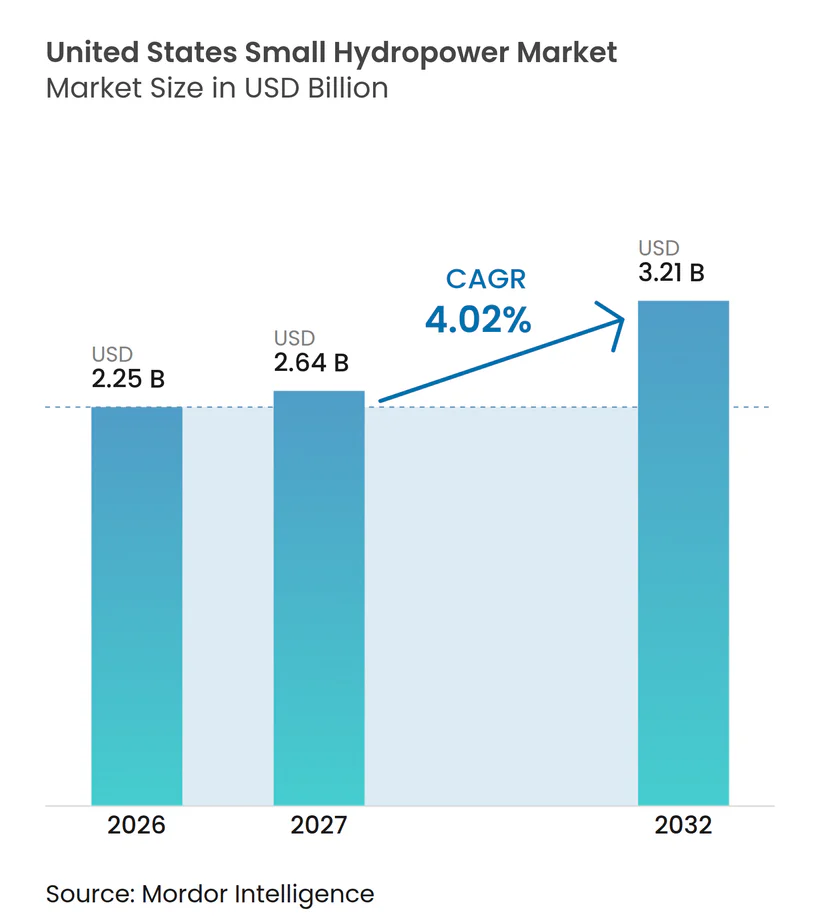
| Base Year Market Size (2026) | USD 2.25 Billion |
| Market Size (2027) | USD 2.64 Billion |
| Market Size (2032) | USD 3.21 Billion |
| Growth Rate (2027 - 2032) | 4.02 % |
| Market Concentration | Medium |
Major Players *Disclaimer: Major Players sorted in no particular order Image © Mordor Intelligence. Reuse requires attribution under CC BY 4.0. | |
United States Small Hydropower Market Analysis by Mordor Intelligence
The United States small hydropower market size was valued at USD 2.25 billion in 2026 and is estimated to grow from USD 2.64 billion in 2027 to reach USD 3.21 billion by 2032, at a CAGR of 4.02% during the forecast period (2027-2032). The market is supported by demand for dispatchable generation that can operate when solar and wind output varies. Federal funding has shifted project activity toward upgrades at existing facilities, non-powered dams, and water conduits. This reduces civil construction exposure and makes refurbishment more practical than greenfield development in many locations. Long-term power purchase agreements are creating a clearer path to project financing for hydro assets. Licensing delays and lower solar costs continue to limit new run-of-river projects where existing water infrastructure is unavailable.
Key Report Takeaways
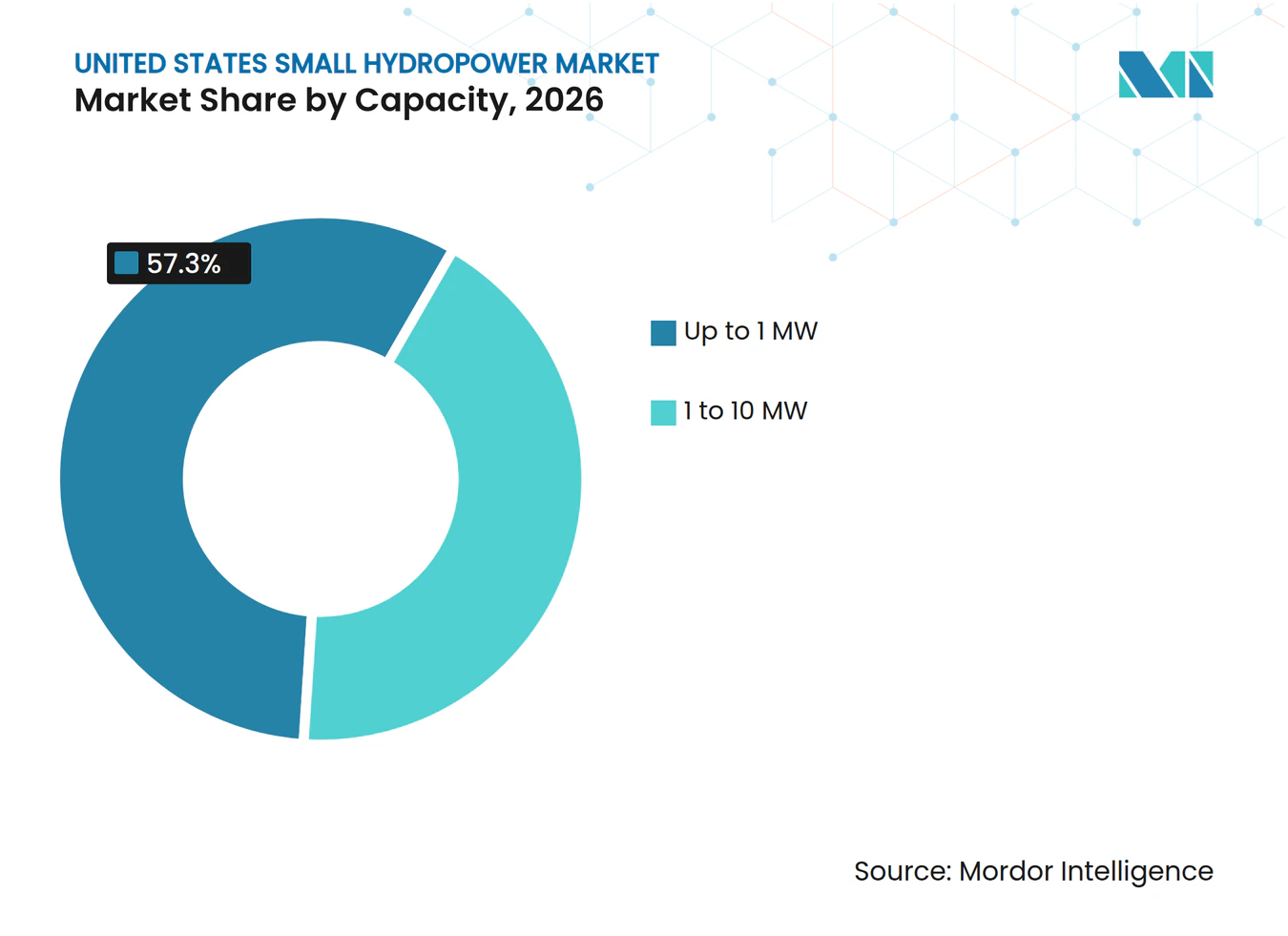
- By capacity, the up to 1 MW segment held 57.3% of the United States small hydropower market share in 2026 and is forecast to expand at a CAGR of 4.6% through 2032.
- By technology, run-of-river held 48.6% of revenue in 2026, while in-stream and micro-conduit is forecast to grow at a CAGR of 4.8% through 2032.
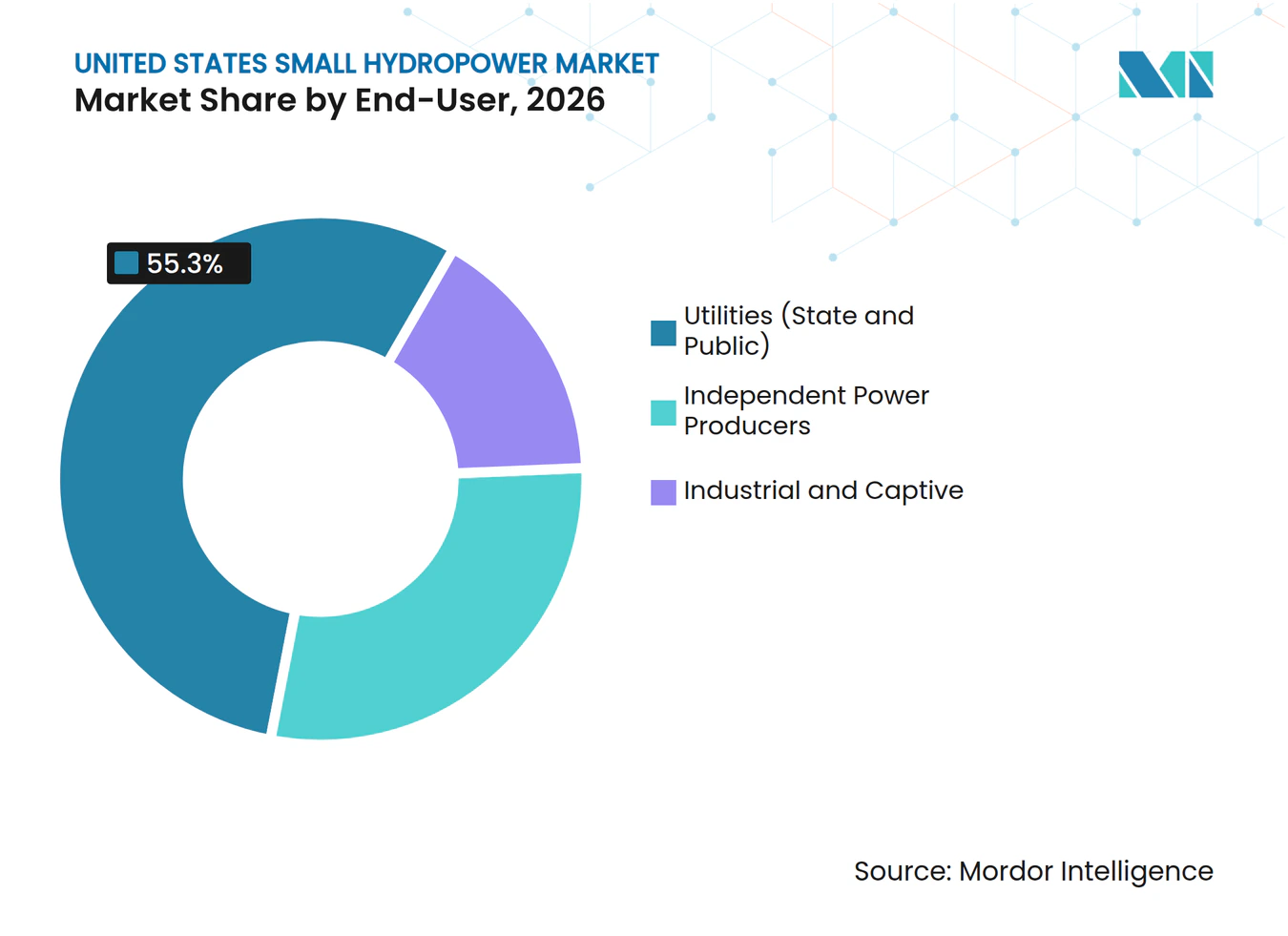
- By end user, utilities, state and public, held 55.3% of revenue in 2026, while independent power producers are forecast to grow at a CAGR of 4.2% through 2032.
Note: Market numbers in this report are based on Mordor Intelligence's proprietary estimation framework, which combines nine months of actuals with Q4 projections for base year 2026.
Market Trends and Insights
Drivers Impact Analysis of United States Small Hydropower Market*
| Driver | (~) % Impact on CAGR Forecast | Geographic Relevance | Impact Timeline |
|---|---|---|---|
| Rising Demand for Dispatchable Clean Electricity | +1.0% | National, with concentration in PJM, WECC, and SERC grid regions | Medium term (2-4 years) |
| Federal Funding for Non-Powered Dam Retrofits and Fleet Modernization | +0.8% | National, with early gains in the West, Southeast, and New England | Short term (≤ 2 years) |
| Corporate and Utility Demand for Firm Renewable Supply | +0.6% | National, with concentration in PJM and MISO electricity markets | Medium term (2-4 years) |
| Decentralized Power Demand in Remote and Resilience-Critical Communities | +0.5% | Alaska, Pacific Northwest, and Appalachian corridor | Medium term (2-4 years) |
| Fish-Safe Turbines Expanding the Addressable Retrofit Base | +0.4% | Eastern United States and Pacific Northwest, with potential in the Mountain West | Long term (≥ 4 years) |
| Modular Conduit and Low-Head Systems Reducing Site-Development Friction | +0.3% | National, with early gains in Western states and New England | Short term (≤ 2 years) |
| Source: Mordor Intelligence | |||
Rising Demand for Dispatchable Clean Electricity
Grid demand is rising in PJM, WECC, and SERC as data centers and industrial loads add pressure to regional systems. PJM projected nearly 40 GW of peak-demand growth over the next decade, increasing the value of generation that operates independently of weather conditions. Small hydropower facilities typically operate at capacity factors of 30% to 55%, compared with 20% to 25% for utility-scale solar projects. This operating profile can support capacity needs alongside variable renewable generation. The United States small hydropower market also benefits when corporate buyers seek generation attributes linked to hourly clean-power delivery rather than unbundled renewable certificates. Hydropower had a global weighted average levelized cost of electricity of USD 62/MWh in 2025, compared with USD 44/MWh for solar photovoltaic power, making reliability an important factor in the hydro value proposition.
Federal Funding for Non-Powered Dam Retrofits and Fleet Modernization
The Infrastructure Investment and Jobs Act allocated more than USD 750 million to hydroelectric incentive payments through three Department of Energy programs. In September 2024, the Department of Energy selected 293 capital-improvement projects across 33 states for negotiations totaling more than USD 430 million, and resumed negotiations with selectees in April 2026.[1] At the end of 2024, 78 non-powered dams and 23 conduit projects were in the federal development pipeline, representing 1.12 GW of proposed capacity. Non-powered dams accounted for 72% of that proposed capacity, while 95% of proposed new United States hydropower capacity involved additions at existing structures. The United States small hydropower market therefore draws much of its opportunity from existing civil assets rather than new dam construction. Projects below 10 MW were eligible for up to 25% of small-project funding allocations, improving access to capital for smaller developers.
Corporate and Utility Demand for Firm Renewable Supply
Long-term power purchase agreements give hydro projects more predictable cash flows and can support debt financing. In July 2025, Brookfield Asset Management and Google LLC announced a framework agreement for up to 3,000 MW of United States hydroelectric capacity under 20-year power purchase agreements in PJM and MISO.[2] Tennessee Valley Authority also signed a 10-year agreement with Argo Infrastructure Partners and Brookfield Asset Management in November 2024 for the Smoky Mountain Hydroelectric facilities, with delivery beginning in 2025. These transactions provide contractual models that smaller independent power producers can adapt for portfolios of sub-10 MW assets. The United States small hydropower market may benefit as investors apply established diligence and contracting practices to aggregated smaller facilities.
Decentralized Power Demand in Remote and Resilience-Critical Communities
Remote Alaskan communities often depend on diesel generation, and residential electricity rates can exceed USD 0.50/kWh. This cost structure makes small hydropower a viable alternative where water resources are available. In July 2025, Ameresco Inc. announced a USD 240 million partnership with Juneau Hydropower Inc. to develop a 19.8 MW Sweetheart Lake facility expected to generate 116,000 MWh per year. In June 2025, the Department of Energy selected 14 community microgrid assistance partnership awardees, including 12 Alaska-based recipients, for hybrid renewable and diesel microgrids. Local resilience needs also shape project decisions when extreme weather disrupts fuel delivery or grid service. The United States small hydropower market has a specific role in remote systems, as it can provide steady local supply rather than only intermittent output.
Restraints Impact Analysis of United States Small Hydropower Market*
| Restraint | (~) % Impact on CAGR Forecast | Geographic Relevance | Impact Timeline |
|---|---|---|---|
| Long, Uncertain Licensing and Water-Quality Review Cycles | -0.8% | National, with elevated impact in the Pacific Northwest and New England | Long term (≥ 4 years) |
| Solar-Plus-Storage Cost Competition for New Distributed Projects | -0.7% | Southwest United States, California, and increasingly national | Short term (≤ 2 years) |
| Revenue Stacking and Ancillary-Service Monetization Uncertainty | -0.3% | PJM, MISO, and WECC electricity market regions | Medium term (2-4 years) |
| Climate-Driven Hydrologic Volatility and Insurance Repricing | -0.2% | Western states, Gulf Coast, and Pacific Northwest | Long term (≥ 4 years) |
| Source: Mordor Intelligence | |||
Long, Uncertain Licensing and Water-Quality Review Cycles
Federal licensing remains a major constraint for smaller projects. The average hydropower licensing duration was 4.2 years in 2024, which can weaken returns for assets below 5 MW.[3] Clean Water Act Section 401 certifications, fish and wildlife conditions, and multiagency environmental reviews add time and uncertainty. The Federal Energy Regulatory Commission adopted two categorical exclusions, effective August 4, 2025, for routine post-licensing hydropower activities. This change reduces review requirements for eligible activities but does not shorten the initial review for a new license. Qualifying conduit facilities can use a 45-day determination pathway under Federal Power Act Section 30. This distinction directs developers in the United States small hydropower market toward conduit and micro-conduit opportunities.
Solar-Plus-Storage Cost Competition for New Distributed Projects
Solar photovoltaic power and battery storage compete directly with greenfield run-of-river projects in sunnier regions. The weighted average cost for solar photovoltaic power in 2025 was USD 44/MWh, which was 41% below the USD 62/MWh hydropower average reported by the International Renewable Energy Agency. This cost difference has the greatest effect on new projects in the 100 kW to 1 MW range that lack existing water infrastructure. Non-powered dam and conduit retrofits avoid much of the cost of new civil construction and can remain competitive. United States hydraulic turbine imports reached USD 61 million in 2024, up 27% from 2023, while exports fell to USD 21 million, down 57%. This pattern is consistent with demand for domestic modernization work in the United States small hydropower market.
*Our forecasts treat driver/restraint impacts as directional, not additive. The impact forecasts reflect baseline growth, mix effects, and variable interactions.
United States Small Hydropower Market Segment Analysis
By Capacity:
Micro-Scale Assets Anchor Revenue, Conduit Deployments AccelerateThe Up to 1 MW segment held 57.3% of the United States small hydropower market share in 2026 and is forecast to grow at a 4.6% CAGR through 2032. Its position is tied to the scale of municipal, agricultural, and industrial water systems. The Conduit Hydropower Engineering, Evaluation, and Technology Acceleration project identified more than 1,400 MW of in-conduit potential across the United States. Compact modular turbines, often below 500 kW, fit much of this resource base. Projects below 10 MW account for more than 75% of the national hydropower fleet. The Department of Energy funding design supports smaller projects through preferential cost-sharing provisions.
The 1 to 10 MW segment accounted for the remaining 42.7% of revenue in 2026. This segment contains much of the generator rewinding, runner replacement, and refurbishment activity at existing licensed sites. FERC relicensed 10 small projects in the 0.1 to 10 MW range during 2024, reflecting continued activity at existing facilities. Qualifying conduit status can shorten the development process for eligible assets. Rancho California Water District filed for a 105 kW conduit facility in California in July 2025. Cibola Renewables filed for an 84 kW in-canal project in New Mexico in July 2026.[4] These filings illustrate why the smallest sites remain important to the United States small hydropower market.



By Technology:
Run-of-River Scale Yields to In-Stream InnovationRun-of-River held 48.6% of technology revenue in 2026 in the United States small hydropower market. It has a large installed base along regulated eastern and northwestern river corridors. Predictable generation can complement wind and solar output in these locations. Reservoir-based systems ranked second and are commonly located at multipurpose dams where water management and flood control remain primary functions. Pumped-storage has a limited role within the small-hydro definition, as many projects operate above 10 MW. Broad relicensing activity can increase demand for engineering services and equipment in related supply chains.
In-Stream and Micro-conduit is the fastest-growing technology segment, with a projected 4.8% CAGR through 2032. The segment is supported by the qualifying conduit pathway and prefabricated turbine systems. Voith's M-Line platform provides preassembled water-to-wire units for low-head run-of-river and conduit sites. Emrgy's hydrokinetic turbines were referenced in the 2026 Cibola Renewables filing for a canal facility. These systems can operate within existing water conveyance infrastructure, avoiding some of the civil work required for traditional river projects. This supports a larger set of low-impact opportunities across the United States small hydropower market.
By Component:
Turbine Modernization Leads, Digital Controls Gain ShareTurbines were the main value driver within equipment spending in 2026. Runner replacements and hydraulic efficiency upgrades were particularly important at older licensed facilities. Natel Energy's FishSafe turbine achieved 98.6% to 100% rainbow trout survival in a 2025 study, supporting its use where fish passage is a permitting requirement. The March 2026 sturgeon research expanded this evidence base to species significant in eastern rivers. Natel Energy scheduled an installation of a FishSafe runner at Garvins Falls Unit 4 for fall 2026. Turbine modernization in the United States small hydropower market is therefore becoming more closely linked to environmental compliance.
Generators were the second-largest component revenue category. Excitation-system replacement, stator rewinding, and protective-relay upgrades are common needs at plants approaching relicensing. In February 2026, ANDRITZ received a USD 33.9 million Bureau of Reclamation contract for excitation, governor, and relay upgrades at Grand Coulee's John W. Keys III plant. Control and automation is gaining importance as operators add digital supervisory control and real-time grid-response capability. Balance-of-plant costs remain high in greenfield developments, as they include intakes, penstocks, and civil structures. Those costs are lower at non-powered dam and conduit retrofits. This cost difference reinforces refurbishment as the primary operating model across the United States small hydropower market.
By End-User:
Utilities Sustain Scale, IPPs Command GrowthUtilities, state and public, held 55.3% of end-user revenue in 2026. Public power entities operate many small facilities within municipal utility and public authority portfolios. These owners can access Section 247 payments with 30% cost sharing and annual support of up to USD 5 million per facility. The 2024 selections covered the West, Southeast, New England, Midwest, Mid-Atlantic, and California. This distribution reflects the geographic reach of public hydro ownership and provides a stable installed base for the United States small hydropower market.
Independent power producers are forecast to grow at a 4.2% CAGR through 2032. Portfolio aggregation is becoming more feasible as corporate power purchase agreements provide longer revenue commitments. The Brookfield Asset Management-Google and Tennessee Valley Authority agreements show how hydro assets can be structured around creditworthy off-takers. This structure can be adapted to groups of smaller assets in New England and the Mid-Atlantic. Industrial and captive users remain a smaller opportunity set. The Oak Ridge National Laboratory industrial conduit assessment noted that these projects can be efficient and cost-effective, as they are commonly eligible for on-site net metering. Facilities with adjacent water systems may therefore generate additional demand for the United States small hydropower market.

Geography Analysis
The West received USD 99.5 million across 38 Section 247 projects, the largest regional allocation in the supplied data. Alaska, Idaho, Oregon, Utah, and Washington accounted for this regional group. The funding reflects the density of hydro resources and resilience needs in isolated communities. Pacific Northwest run-of-river facilities operate in regulated river systems managed by federal water agencies. Fish passage requirements for salmon and steelhead can constrain upgrades while supporting adoption of fish-safe equipment. California received USD 68.6 million for 39 projects, with spending directed mainly toward grid-resilience upgrades. These projects can help existing facilities provide voltage support as solar penetration rises.
New England received USD 65.5 million across 80 Section 247 selections, the highest regional project count in the supplied data. The region is a key location for fish-passage turbine retrofits due to requirements affecting Atlantic salmon, American eel, and river herring. The planned Garvins Falls Unit 4 installation illustrates this focus. The Southeast received USD 83 million, the second-largest allocation by value. TVA-managed assets and Appalachian run-of-river sites support the regional base. The Smoky Mountain facilities began delivering power under their 10-year agreement in 2025. This mix of public ownership and contracted generation supports the United States small hydropower market across the eastern corridors.
Alaska is distinct because diesel displacement is more important than grid integration. Residential rates in remote communities can exceed USD 0.50/kWh, creating a strong use case for hydro where suitable resources exist. Twelve of the 14 Community Microgrid Assistance Partnership awardees were located in Alaska. The USD 240 million Sweetheart Lake project near Juneau is expected to add 19.8 MW and generate 116,000 MWh annually. The Midwest received USD 63.5 million, while the Mid-Atlantic received USD 50 million. Activity in both regions centers on dam safety and grid-resilience upgrades. Regulated river systems provide fewer new-generation opportunities than retrofit work. Geographic demand therefore remains driven by upgrading assets that already serve local power systems.
Competitive Landscape
Market Concentration
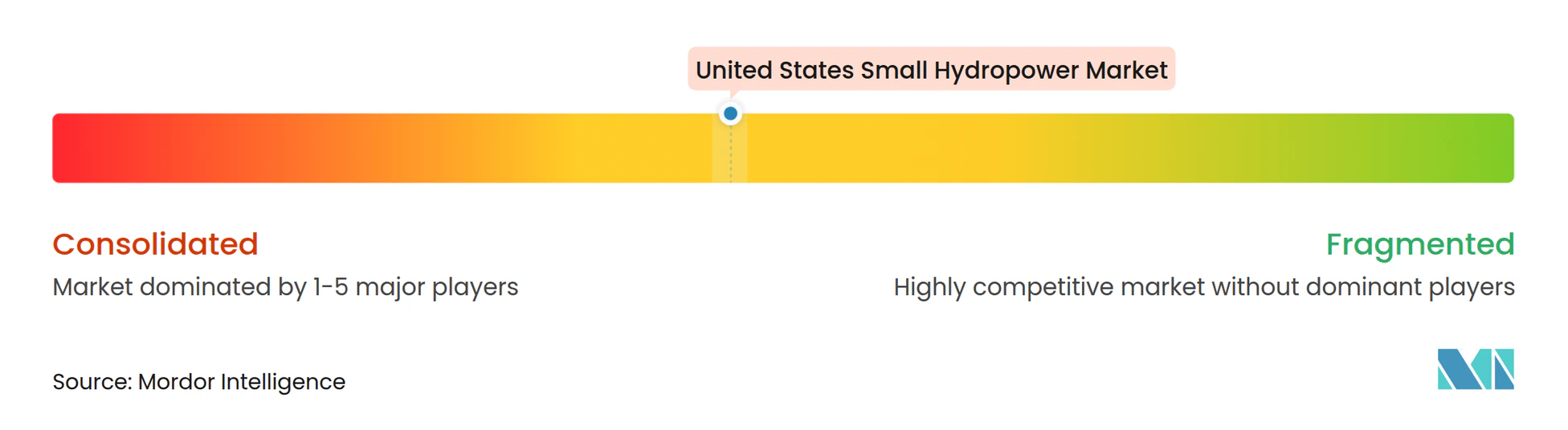
The United States small hydropower market is moderately concentrated in electromechanical equipment and fragmented in project development. ANDRITZ, Voith Hydro, and GE Vernova are established suppliers of turbines, generators, excitation systems, and controls. Voith Hydro's York, Pennsylvania facility is the only dedicated hydropower turbine plant in the United States with an in-house hydraulic laboratory. This capability supports specialized design and testing for domestic projects. ANDRITZ supplied five generator stators rated at 215 MVA each for the Robert Moses Power Plant in April 2026. Its Grand Coulee modernization contract also demonstrates the continuing demand for equipment upgrades at large legacy assets.
Canyon Hydro, Gilbert Gilkes and Gordon, Mavel, and Global Hydro Energy serve mid-market projects in the 100 kW to 5 MW range. Turbulent and Emrgy focus on low-head and conduit applications that use more standardized equipment. Fish-safe turbines are becoming an important source of differentiation during relicensing. Natel Energy's FishSafe platform can reduce the need for exclusion screens and improve generation where flow restrictions apply, according to the supplied study results. The planned Garvins Falls installation is a practical example of a technology-led retrofit strategy. The United States small hydropower market also presents an opening in sub-1 MW conduits, where large original equipment manufacturers do not necessarily have a cost advantage.
Competitive conditions favor companies that combine engineering capability with regulatory knowledge and access to project capital. The Federal Energy Regulatory Commission's conduit facility process can create an advantage for developers that identify eligible sites early. Companies with fish-passage technology may have stronger positions in eastern and Pacific Northwest relicensing projects. ANDRITZ has pursued modernization work at Niagara and Grand Coulee, while Voith Hydro commissioned its StreamDiver-based installation at Lock 14 on the Kentucky River in May 2025. Natel Energy has focused on technology validation and planned commercial deployment of its FishSafe turbine. Project development remains dispersed among municipal utilities, rural cooperatives, independent power producers, and site-specific developers. These structures support moderate competitive intensity across the United States small hydropower market.
United States Small Hydropower Industry Leaders
-
ANDRITZ AG
-
Voith GmbH & Co. KGaA
-
GE Vernova Inc.
-
Siemens Energy AG
-
Canyon Hydro
- *Disclaimer: Major Players sorted in no particular order
United States Small Hydropower Market Companies Covered in this Report
- American Hydro Corporation
- ANDRITZ AG
- AtkinsRéalis Group Inc.
- Bharat Heavy Electricals Limited
- Blueline Manufacturing Company
- Canyon Hydro
- CKD Blansko Holding, a.s.
- FLOVEL Energy Pvt Ltd.
- GE Vernova Inc.
- Gilbert Gilkes & Gordon Ltd.
- Global Hydro Energy GmbH
- Litostroj Power Group
- Mavel a.s.
- Natel Energy, Inc.
- Siemens Energy AG
- Statkraft AS
- Toshiba Energy Systems & Solutions Corporation
- Turbulent NV
- Voith GmbH & Co. KGaA
- Wärtsilä Corporation
Recent Industry Developments in United States Small Hydropower Market
- July 2026: Cibola Renewables, LLC filed a notice with FERC for an 84 kW qualifying conduit hydropower facility on the Rio Grande Socorro Main Canal in New Mexico. The project utilizes Emrgy's modular hydrokinetic turbine technology for small-scale conduit hydropower systems within existing water infrastructure.
- March 2026: Natel Energy published a peer-reviewed study in the Journal of Ecohydrology demonstrating safe passage of Atlantic sturgeon and shortnose sturgeon through its FishSafe Restoration Hydro Turbine (RHT). The findings support deployment of environmentally compatible small hydropower systems, a key consideration in expanding low-impact hydro development in the United States.
- July 2025: Ameresco and Juneau Hydropower, Inc. announced development of the Sweetheart Lake Hydropower Project in Alaska. The 19.8 MW facility is expected to generate approximately 116,000 MWh annually, improving regional energy resilience and expanding renewable generation capacity in the state.
- May 2025: Voith Hydro commissioned its StreamDiver-based small hydropower installation at Lock 14 on the Kentucky River. The StreamDiver technology is designed for low-head hydropower applications and reflects ongoing modernization and deployment of distributed small hydropower assets in the United States.
United States Small Hydropower Market Report Scope
Small Hydropower (SHP) refers to electricity generation by harnessing the natural flow of water, typically producing between 1 to 30 megawatts (MW) of power. Unlike large-scale hydropower projects, SHP facilities generally operate as run-of-river systems, meaning they do not require large dams or reservoirs and cause minimal disruption to local ecosystems. They are widely used to provide clean, reliable, and cost-effective electricity to remote or rural communities that are not connected to the main grid.
The United States small hydropower market is segmented by capacity into up to 1 MW and 1 to 10 MW. By technology, the market is segmented into reservoir-based, run-of-river, pumped-storage, and in-stream and micro-conduit systems. By component, the market is segmented into turbines, generators, control and automation, and balance-of-plant. By end-user, the market is segmented into utilities (state and public), independent power producers, and industrial and captive users. Market forecasts are provided in value terms (USD).
Segmentation Overview
| Up to 1 MW |
| 1 to 10 MW |
| Reservoir-Based |
| Run-of-River |
| Pumped-Storage |
| In-Stream and Micro-conduit |
| Turbines |
| Generators |
| Control and Automation |
| Balance-of-Plant |
| Utilities (State & Public) |
| Independent Power Producers |
| Industrial and Captive |
| By Capacity | Up to 1 MW |
| 1 to 10 MW | |
| By Technology | Reservoir-Based |
| Run-of-River | |
| Pumped-Storage | |
| In-Stream and Micro-conduit | |
| By Component (Qualitative Analysis only) | Turbines |
| Generators | |
| Control and Automation | |
| Balance-of-Plant | |
| By End-User | Utilities (State & Public) |
| Independent Power Producers | |
| Industrial and Captive |
Key Questions Answered in the Report
What is the projected value of the United States small hydropower market by 2032?
The United States small hydropower market is forecast to reach USD 3.21 billion by 2032, growing at a CAGR of 4.02% from 2027.
Which capacity range leads United States small hydropower revenue?
The up to 1 MW capacity range led with 57.3% of revenue in 2026 and is forecast to grow at a CAGR of 4.6% through 2032.
What is driving demand for small hydropower projects in the United States?
Key drivers include demand for dispatchable electricity, federal retrofit funding, long-term power purchase agreements, and remote community resilience needs.
Which technology is growing fastest in the United States small hydropower market?
In-stream and micro-conduit technology is forecast to grow at a CAGR of 4.8% through 2032, driven by its ability to utilize existing water conveyance systems.
What limits new small hydropower development in the United States?
Long licensing timelines and the lower cost of solar photovoltaic power can limit greenfield projects, particularly where existing water infrastructure is unavailable.
Which end-user segment is expanding fastest?
Independent power producers are forecast to grow at a CAGR of 4.2% through 2032, as they aggregate smaller facilities and utilize long-term power purchase agreements.