
United States Semiconductor Demand In Data Center Market Size and Share
Market Overview
| Study Period | 2021 - 2032 |
|---|---|
| Forecast Data Period | 2027 - 2032 |
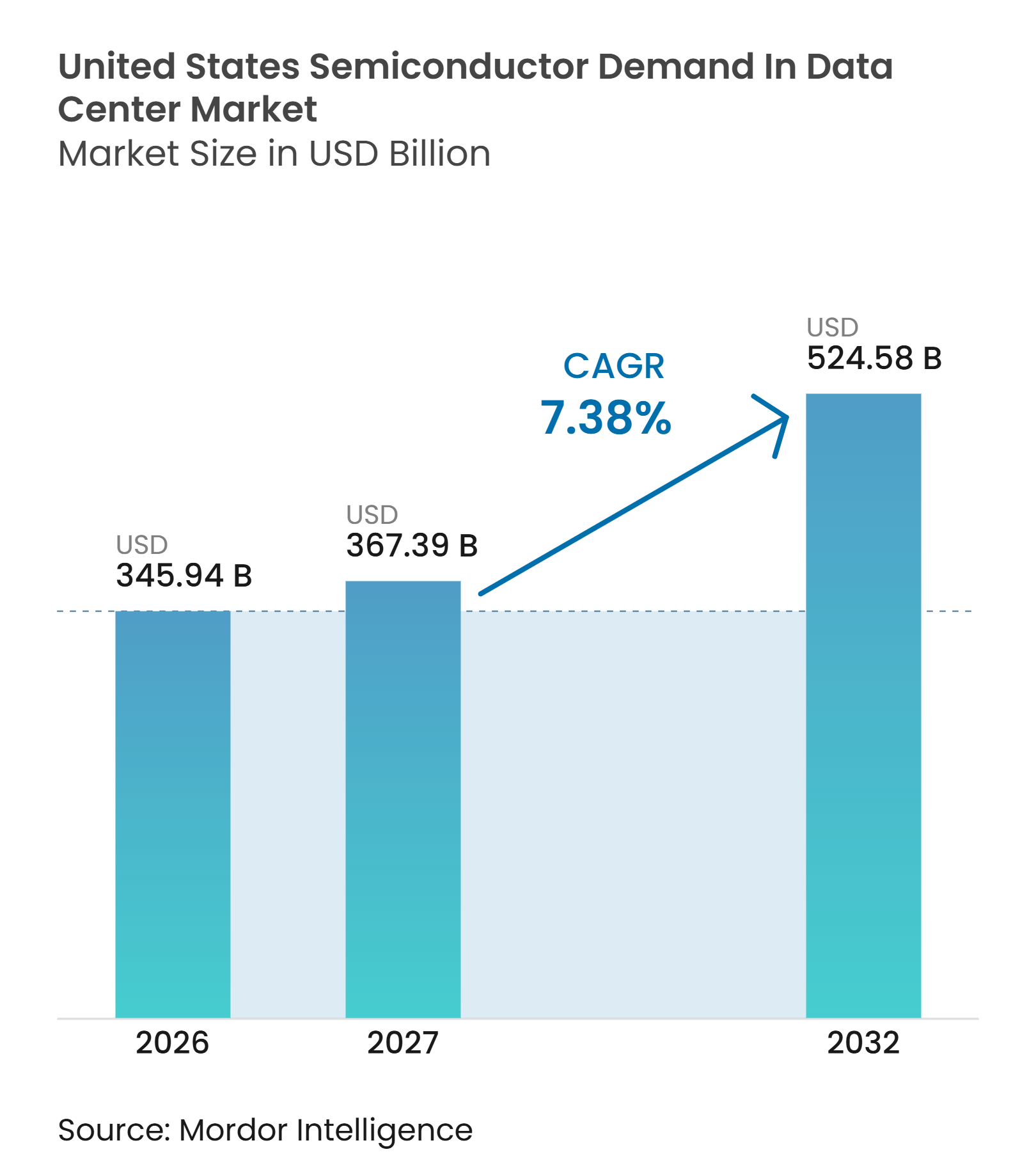
| Base Year Market Size (2026) | USD 345.94 Billion |
| Market Size (2027) | USD 367.39 Billion |
| Market Size (2032) | USD 524.58 Billion |
| Growth Rate (2027 - 2032) | 7.38 % |
| Market Concentration | Medium |
Major Players *Disclaimer: Major Players sorted in no particular order Image © Mordor Intelligence. Reuse requires attribution under CC BY 4.0. | |
United States Semiconductor Demand In Data Center Market Analysis by Mordor Intelligence
The United States semiconductor demand in data center market size is projected to expand from USD 345.94 billion in 2026 and USD 371.47 billion in 2027 to USD 524.58 billion by 2032, registering a CAGR of 7.38% from 2027 to 2032. Demand is centered on the chips required to operate AI-capable servers, including processors, memory, networking devices, power components, analog devices, optoelectronics, and sensors. The United States semiconductor demand in data center market is benefiting from sustained AI training and inference deployments, which raise the amount of compute and memory installed in each rack. Hyperscalers are also diversifying their procurement through custom ASIC programs, creating demand for advanced memory, networking, packaging, and power devices alongside merchant accelerators. Power access is likely to shape the location and timing of new capacity more than chip availability in several established data center hubs. This places a premium on regions with available power, faster interconnection processes, and facilities designed for high-density racks.
Key Report Takeaways
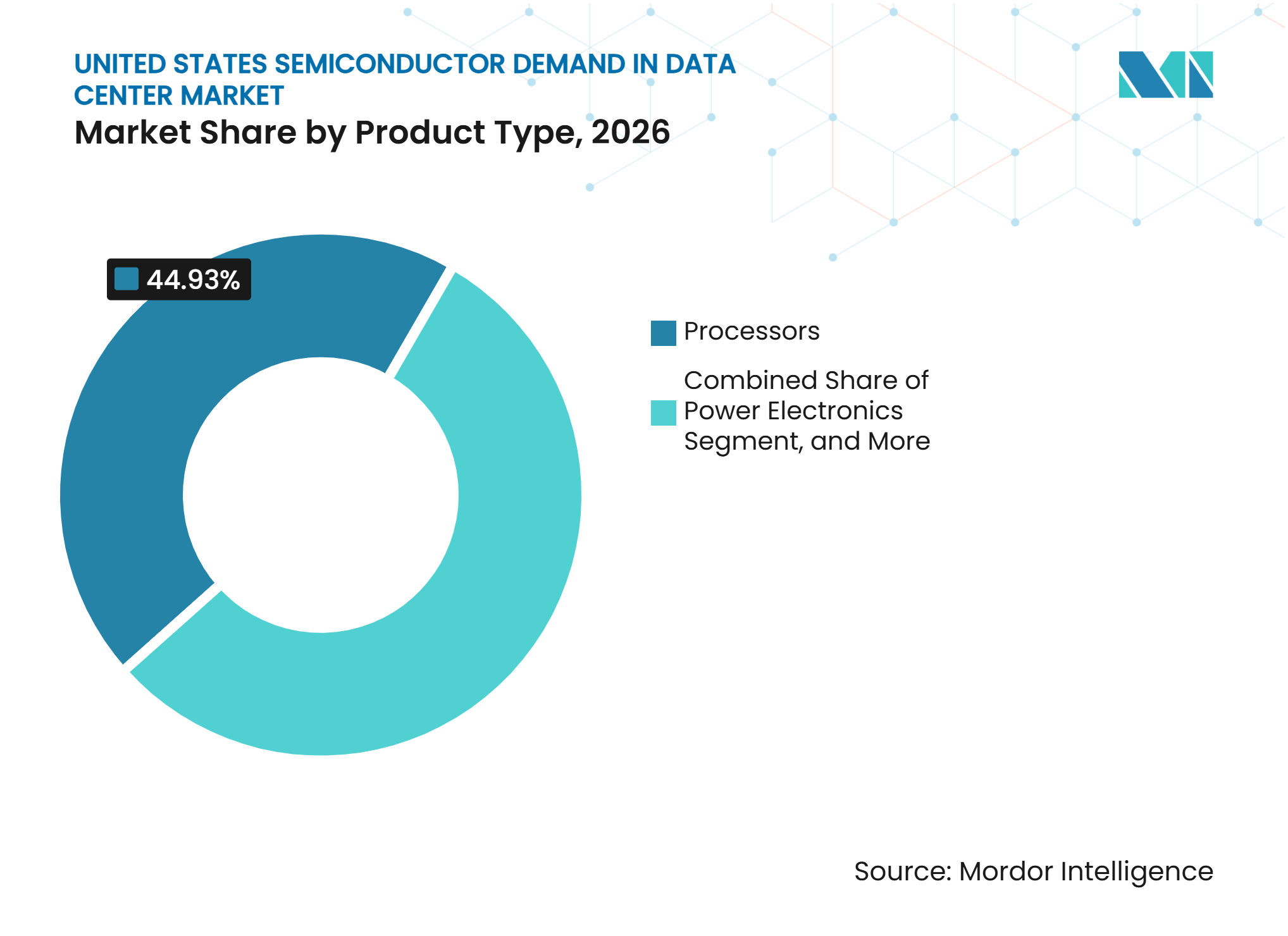
- By product type, processors held 44.93% of the United States semiconductor demand in data center market share in 2026, while memory type is projected to expand at an 8.16% CAGR through 2032.
- By application, IT equipment accounted for 75.68% of the United States semiconductor demand in data center market size in 2026, while server and rack power systems are expected to expand at an 8.22% CAGR through 2032.
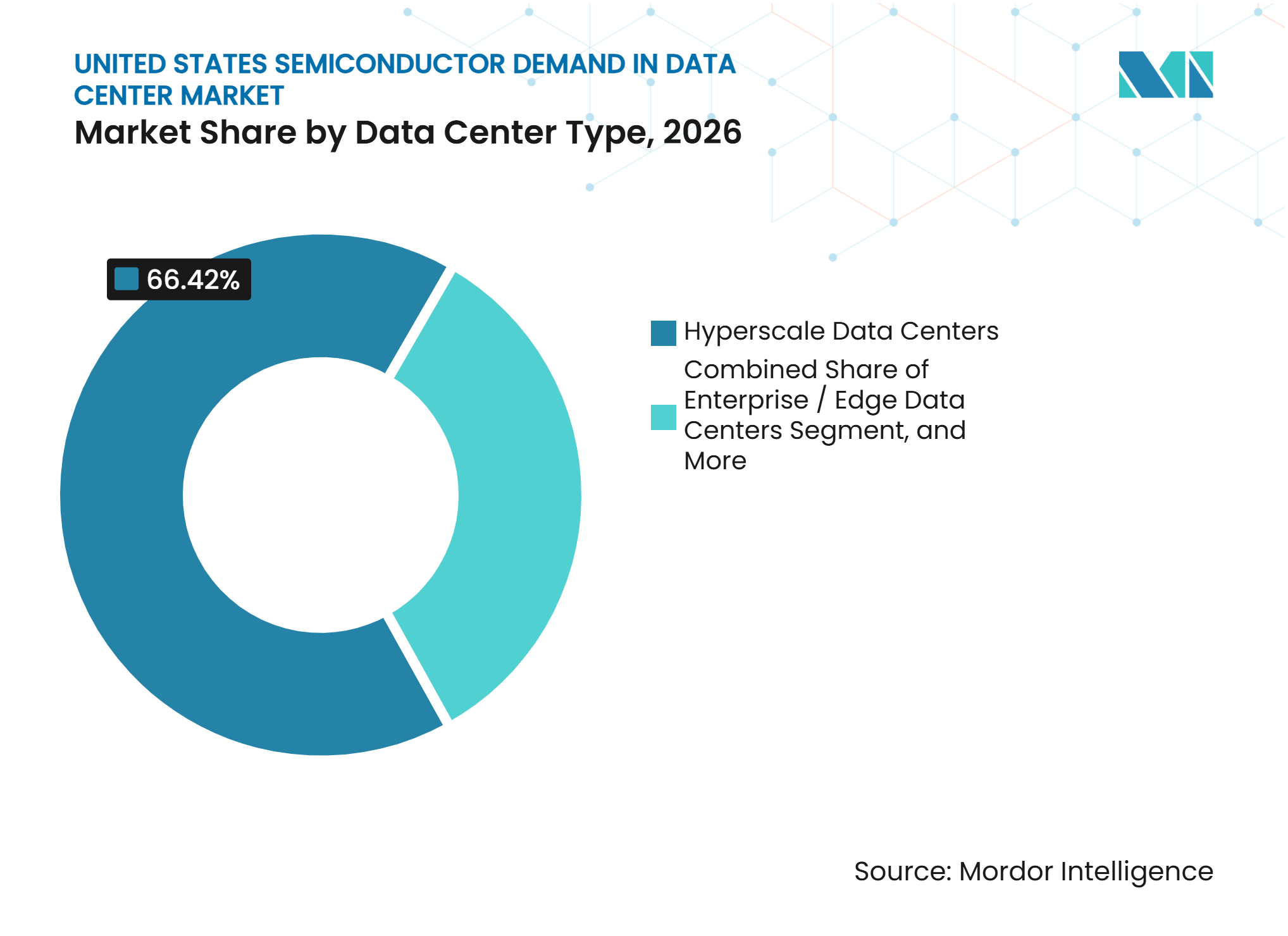
- By data center type, hyperscale facilities held 66.42% share in 2026, while colocation facilities are projected to grow at an 8.27% CAGR through 2032.
Note: Market numbers in this report are based on Mordor Intelligence's proprietary estimation framework, which combines nine months of actuals with Q4 projections for base year 2026.
Market Trends and Insights
Drivers Impact Analysis of United States Semiconductor Demand In Data Center Market*
| Driver | (~) % Impact on CAGR Forecast | Geographic Relevance | Impact Timeline |
|---|---|---|---|
| Generative AI Training and Inference Expansion | +2.1% | National, concentrated in Northern Virginia, West Texas, and Phoenix AI factory corridors | Medium term (2-4 years) |
| Hyperscale Cloud Infrastructure Investment | +1.6% | National, with early gains in Northern Virginia, West Texas, Georgia, and Chicago | Medium term (2-4 years) |
| Rising Demand for High-Bandwidth Memory and Accelerated Computing | +1.3% | National, driven by U.S.-based hyperscaler GPU procurement cycles | Short term (≤ 2 years) |
| Data Movement Bottlenecks Driving Networking Semiconductor Adoption | +0.8% | National, heaviest in hyperscale and neocloud AI factory deployments | Medium term (2-4 years) |
| Rack-Scale Power Density Increasing Semiconductor Content per Server | +0.6% | National, accelerating fastest in hyperscale campuses adopting 400V-800V DC architectures | Long term (≥ 4 years) |
| Hyperscaler Custom Silicon Increasing Semiconductor Design Activity | +0.4% | National, with design activity concentrated in Silicon Valley and Seattle engineering centers | Long term (≥ 4 years) |
| Source: Mordor Intelligence | |||
Generative AI Training and Inference Expansion
AI inference is becoming a larger and more persistent source of semiconductor demand than single training runs. Every deployed inference service uses compute, memory, networking, and power resources as customer usage expands. Google reported that it processed 480 trillion tokens during April 2025, which was 50 times the prior-year monthly volume.[1] Each generated response creates recurring demand for the supporting hardware. The United States semiconductor demand in data center market therefore benefits from recurring procurement across a growing installed base. The Semiconductor Industry Association expects annual revenue from semiconductors used in AI data centers to exceed USD 1.2 trillion by 2028.
Hyperscale Cloud Infrastructure Investment
Hyperscaler spending is supporting larger and more continuous infrastructure construction programs. Project Stargate began in January 2025 with a commitment of up to USD 500 billion for United States data centers and energy infrastructure over 4 years. J.P. Morgan originated USD 9.6 billion in construction loans for the Abilene, Texas campus. New AI facilities require frequent server upgrades because performance gains increasingly depend on newer accelerators, memory, and interconnects. This replacement cycle supports demand after the original facility buildout has been completed. The United States semiconductor demand in the data center market also benefits when hyperscalers procure custom silicon, because those programs require parallel sourcing of memory, power, and networking devices.
Rising Demand for High-Bandwidth Memory and Accelerated Computing
High-bandwidth memory has become a critical component of accelerated computing systems. The Center for Strategic and International Studies reported that data centers are on track to consume 70% of global memory-device production in 2026. This demand pattern reflects the large memory requirements of AI accelerators and the need to keep compute units supplied with data. SK Hynix indicated that HBM demand could exceed supply for several years. Micron stated that HBM4 for NVIDIA's Vera Rubin platform delivers more than 2.8 TB/s of bandwidth and over 20% better power efficiency. The resulting mix favors advanced memory procurement within the United States semiconductor demand in data center market.
Data Movement Bottlenecks Drive Networking Semiconductor Adoption
Large AI clusters require rapid data movement among accelerators, storage, and control systems. This increases the need for DPUs, SmartNICs, Ethernet switch ASICs, optical interconnects, and related connectivity components. NVIDIA integrated BlueField-4 DPUs into its Vera Rubin architecture for AI factory infrastructure. Broadcom introduced its 102.4 Tbps Tomahawk 6 switching platform for large AI fabric deployments in 2026. Larger clusters require additional switches, DPUs, and optical transceivers rather than merely more GPUs. This creates a broader networking opportunity as United States semiconductor demand in the data center market shifts toward increasingly dense accelerator clusters.
Restraints Impact Analysis of United States Semiconductor Demand In Data Center Market*
| Restraint | (~) % Impact on CAGR Forecast | Geographic Relevance | Impact Timeline |
|---|---|---|---|
| Limited Power Availability and Data Center Interconnection Delays | -1.5% | National, most acute in Northern Virginia through PJM, and emerging in California through CAISO and the Pacific Northwest | Long term (≥ 4 years) |
| Advanced Packaging, HBM, and Accelerator Supply Constraints | -1.1% | National, with production constraints concentrated in Taiwan and South Korean HBM fabs | Short term (≤ 2 years) |
| Extended Qualification Cycles for Custom Data Center Silicon | -0.7% | National, most acute among hyperscaler custom ASIC programs at Google, AWS, and Microsoft | Medium term (2-4 years) |
| Rapid Accelerator Obsolescence and Uncertain AI Return on Investment | -0.5% | National, relevant to enterprise and colocation segments making long-cycle procurement decisions | Long term (≥ 4 years) |
| Source: Mordor Intelligence | |||
Limited Power Availability and Data Center Interconnection Delays
Power availability can delay the commissioning of semiconductor-intensive data centers even after hardware has been secured. A scientific study reported that United States interconnection queues had reached 2,600 GW and that median waits for projects to complete interconnection in 2023 were nearly 5 years. Delayed commissioning shifts the timing of server, memory, and networking procurement. It can also extend use of installed hardware while operators pursue efficiency gains in existing facilities. The Department of Energy advanced its Speed to Power effort in September 2025, alongside the Grid Resilience and Innovation Partnerships program, to accelerate transmission and grid connections. These policies will influence the geographic distribution of the United States semiconductor demand in data center market through 2030.
Advanced Packaging, HBM, and Accelerator Supply Constraints
Advanced packaging capacity and HBM yields can constrain accelerator availability even when wafer capacity is available. The manufacturing process for HBM requires substantially more cleanroom capacity per gigabyte than standard DRAM. Capacity shifted toward HBM can therefore limit output available for other memory products. NVIDIA announced in June 2026 that its substrate partners planned a 2.5-fold capacity increase over 3 years, while Amkor planned to increase advanced packaging capacity by more than 300% by 2028. Custom data center chips also require extensive qualification before deployment at scale. These production and validation requirements can postpone shipment schedules in the United States semiconductor demand in data center market.
*Our forecasts treat driver/restraint impacts as directional, not additive. The impact forecasts reflect baseline growth, mix effects, and variable interactions.
United States Semiconductor Demand In Data Center Market Segment Analysis
By Product Type:
Processors Anchor Rack Value, Memory AcceleratesProcessors held 44.93% of the United States semiconductor demand in data center market share in 2026, reflecting the high value of GPUs and CPUs within AI server racks. GPUs are the main compute engines for training and high-volume inference workloads. NVIDIA reported data center revenue of USD 193.7 billion in fiscal 2026, demonstrating the scale of accelerator demand. AMD reported USD 8.55 billion in data center revenue in Q3 2026, a 97% year-over-year increase driven by EPYC processors and Instinct GPUs.[2] The Semiconductor Industry Association and Deloitte found that the AI accelerator tray accounted for 74% of the value of standard AI server rack content. CPUs accounted for 8% of the value, while DPUs accounted for 2%. DSPs and MCUs serve smaller but necessary functions in control, monitoring, and automation systems. Their contribution is less visible than accelerator spend but remains tied to growth in rack installations.
Memory type is projected to expand at an 8.16% CAGR through 2032, making it the fastest-growing product category. HBM supports accelerated computing by supplying high-speed data access close to the processor. DRAM and NAND flash continue to serve server memory and storage requirements. Logic ICs include FPGAs, DPUs, SmartNICs, controller ICs, and network switch devices. These products become increasingly important as AI clusters add nodes and require more complex fabric management. Power electronics support the transition from 48V systems toward 400V-800V DC rack architectures. Analog ICs, optoelectronics, and sensors support signal conditioning, optical transmission, thermal control, and environmental monitoring. Together, these categories broaden the United States semiconductor demand in data center industry beyond the accelerator itself. The product mix makes the United States semiconductor demand in data center market dependent on a coordinated supply chain rather than any single chip category.



By Application:
IT Equipment Dominates, Power Systems Lead GrowthIT equipment accounted for 75.68% of United States semiconductor demand in data center market size in 2026. AI accelerator modules and high-bandwidth memory are the primary cost lines in this application. The Semiconductor Industry Association and Deloitte estimated the compute-tray value at USD 1.5 million to USD 3.5 million for a standard AI rack, compared with a total rack value of USD 1.5 million to USD 4 million. Network and management trays add USD 17,000 to USD 25,000 per rack. Accelerator interconnect trays add USD 10,000 to USD 50,000 per rack. Federal cloud workloads also require security-capable equipment aligned with FedRAMP and NIST SP 800-53 controls.
Server and rack power systems are projected to expand at an 8.22% CAGR through 2032. Rack designs are moving toward much higher power density as accelerator counts increase. NVIDIA's Kyber system roadmap targets 600 kW per rack by 2027, with a 1 MW architecture in the longer term. Texas Instruments introduced an 800V DC architecture with NVIDIA in March 2026 that uses 2 conversion stages from 800V to processor power. Battery backup and energy storage systems also need power semiconductors as onsite power options expand. Cooling, facility power, automation, and safety systems need more controllers and sensors as racks become denser. These applications increase the importance of the United States semiconductor demand in data center industry in power conversion and environmental control.
By Data Center Type:
Hyperscale Leads, Colocation Accelerates FastestHyperscale data centers held 66.42% of market revenue in 2026. The category benefits from concentrated investment by Google, Amazon, Microsoft, Meta, and Oracle. These operators procure large quantities of GPUs, CPUs, memory, networking devices, and power chips. They also develop custom silicon programs that reduce dependence on individual merchant accelerator suppliers. Google TPU, AWS Trainium, and Microsoft Maia programs still require advanced memory, power management, and fabric connectivity. Google stated that its TPU v7 Ironwood provides 4,614 FP8 TFLOPS, 192 GB of HBM3E, and 7.37 TB/s of bandwidth. AWS stated that Trainium3 is its first 3 nm chip and provides 2.517 PFLOPS of FP8 compute. This makes hyperscale facilities the main demand center for advanced compute and memory in the United States semiconductor demand in data center market.
Colocation data centers are projected to grow at an 8.27% CAGR through 2032. The segment gains business when hyperscalers need capacity without carrying all interconnection and construction risk. Colocation providers are introducing AI-ready facilities with liquid cooling and high-voltage bus architectures. These designs contain more power and thermal-control semiconductors than legacy enterprise facilities. Enterprise and edge data centers are expected to grow more gradually because their budgets and deployment schedules are more dispersed. However, inference workloads can move closer to applications when latency, security, or data residency requirements matter. This supports ongoing demand for CPUs, embedded accelerators, networking silicon, and storage devices outside hyperscale campuses. Colocation growth widens the customer base for the United States semiconductor demand in data center market. It also gives equipment suppliers another route to sell high-density infrastructure beyond direct hyperscaler procurement.

Geography Analysis
Northern Virginia: Dense Cloud Capacity and Tight Power Conditions
Northern Virginia reached 4,182 MW of inventory in Q1 2026 and recorded a 0.3% vacancy rate. CBRE reported that 96% of scheduled 2026 supply was already committed, indicating exceptionally limited spare capacity.[3] The region has dense fiber networks and close connections to federal agencies and enterprise users. Its workloads have a substantial cloud and networking component, not only AI training. This supports demand for CPUs, connectivity devices, and secure infrastructure components. Dominion Energy's power-delivery batching process has extended timelines for new supply. PJM interconnection conditions therefore remain a central regulatory influence on expansion. The United States semiconductor demand in data center market size in this region is shaped by phased delivery schedules and continued upgrades to installed capacity.
Texas: Expanding AI Training Capacity
Texas is emerging as a major location for AI training infrastructure because of its available land and a different grid-connection model. ERCOT revised its 2030 data center growth forecast from 29 GW to 77 GW in 2026. West Texas had 2.9 GW under construction in H2 2025. The Abilene Stargate campus received USD 9.6 billion in construction financing, which supports a large AI-focused deployment. Such facilities require GPU clusters, HBM-stacked accelerators, and high-radix networking fabrics. Dallas-Fort Worth supports a more mixed profile, including enterprise and hyperscale inference workloads. That mix raises demand for CPUs, NVMe storage, and analytics-oriented accelerators. Texas is extending the United States semiconductor demand in data center market into locations designed for larger and more power-intensive campuses.
Emerging Markets: Broader Procurement Across New Hubs
Georgia, Illinois, Arizona, and other Sun Belt locations are gaining attention as new data center development centers. Atlanta commissioned 298 MW in Q4 2025, while Austin added 1,909 MW in Q1 2026 and reached 2,558 MW of inventory. Chicago recorded more than 300 MW of positive net absorption in Q4 2025. Phoenix supports AI-ready deployments and related semiconductor manufacturing activity. JLL reported that 77% of new North American data center capacity is being built in frontier markets beyond established hubs. This dispersion expands the United States semiconductor demand in data center market across a larger footprint. It also increases coordination needs for accelerator shipments, memory allocation, and service support. Local power rules, water considerations, and permitting processes will influence which emerging locations sustain the fastest growth.
Competitive Landscape
Market Concentration
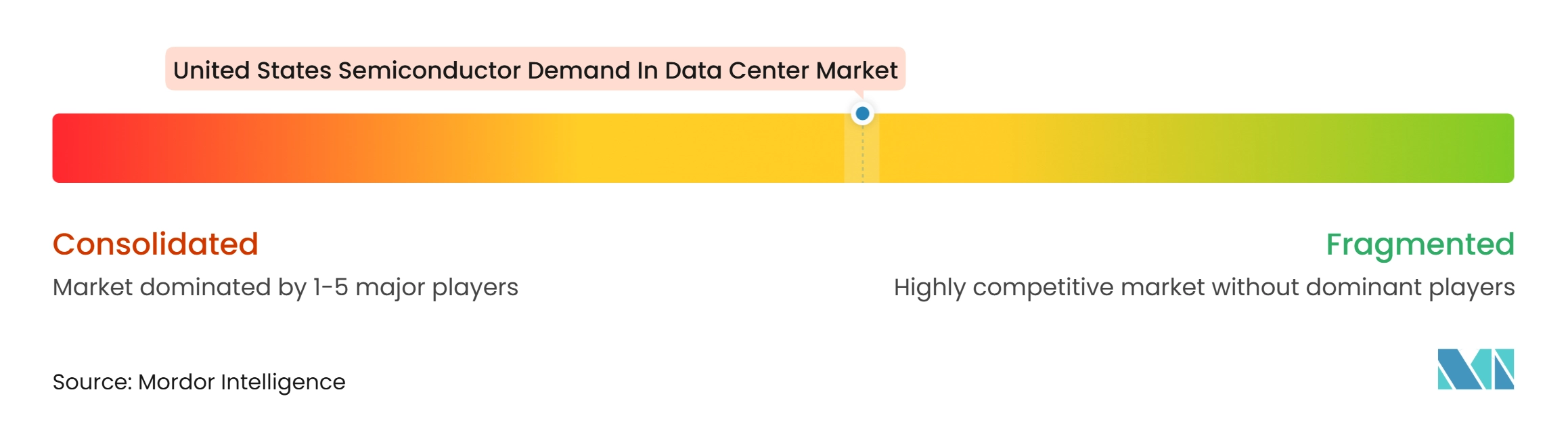
NVIDIA leads the AI accelerator tier, while AMD is strengthening its position in CPU and GPU across data center infrastructure. NVIDIA's approximate 70% share of the AI chip market indicates substantial concentration in the accelerator layer. AMD's Q3 2026 data center revenue grew 97% year over year, supported by EPYC and Instinct products. Intel remains active in CPU infrastructure and custom processing units. Hyperscalers also act as both buyers and designers through their own ASIC programs. This means the competitive structure differs across accelerators, memory, networking, and power devices. The United States semiconductor demand in the data center market has concentrated positions in some layers and wider supplier participation in others.
Memory suppliers compete within a smaller group because HBM manufacturing requires specialized process capability. SK Hynix, Samsung, and Micron are key suppliers of advanced memory for AI platforms. Micron's HBM4 deployment for Vera Rubin illustrates the importance of bandwidth and energy efficiency in this competition. Networking remains more contested among NVIDIA, Broadcom, Marvell, and Cisco. Broadcom's Tomahawk 6 platform is designed for large Ethernet fabrics in AI clusters. Marvell and NVIDIA expanded their NVLink Fusion partnership in May 2025, allowing custom XPUs to connect with NVIDIA rack-scale infrastructure.[4] These moves support both open and semi-custom approaches, as well as vertically integrated networking systems.
Power delivery and thermal control are important areas of competition among suppliers as rack density rises. Texas Instruments introduced an 800V DC solution with NVIDIA in March 2026. Analog Devices announced support for 800V DC data center architectures in August 2025. NVIDIA expanded substrate and advanced packaging capacity through agreements with suppliers in June 2026. Procurement requirements for FedRAMP, NIST cybersecurity controls, and domestic-content incentives can differentiate suppliers in federal AI deployments. Suppliers with reliable packaging, secure components, and high-voltage power designs are positioned to benefit. The United States semiconductor demand in data center market is thus shaped by ecosystem partnerships as well as direct chip performance.
United States Semiconductor Demand In Data Center Industry Leaders
-
NVIDIA Corporation
-
Advanced Micro Devices, Inc.
-
Intel Corporation
-
Broadcom Inc.
-
Marvell Technology, Inc.
- *Disclaimer: Major Players sorted in no particular order
United States Semiconductor Demand In Data Center Market Companies Covered in this Report
- NVIDIA Corporation
- Advanced Micro Devices, Inc.
- Intel Corporation
- Broadcom Inc.
- Marvell Technology, Inc.
- Micron Technology, Inc.
- Samsung Electronics Co., Ltd.
- SK hynix Inc.
- Kioxia Holdings Corporation
- Taiwan Semiconductor Manufacturing Company Limited
- GlobalFoundries Inc.
- United Microelectronics Corporation
- Texas Instruments Incorporated
- Analog Devices, Inc.
- Monolithic Power Systems, Inc.
Recent Industry Developments in United States Semiconductor Demand In Data Center Market
- October 2026: AMD reported Q3 2026 data center segment revenue of USD 8.55 billion, up 97% year over year, driven by record EPYC server processor sales and the initial launch of its Instinct MI450 GPU Series. AMD guided Q4 2026 revenue to USD 17 billion, implying full-year data center segment revenue more than doubling from 2025.
- June 2026: NVIDIA disclosed supply chain expansion agreements with substrate manufacturers IBIDEN, Samsung Electro-Mechanics, and Unimicron, targeting a combined 2.5x increase in capacity over 3 years. Amkor committed to increasing advanced packaging capacity by more than 300% by the end of 2028. KYEC will build new United States facilities supported by a USD 1.1 billion capacity reservation advance from NVIDIA.
- May 2026: NVIDIA invested USD 2 billion in Marvell Technology and expanded the NVLink Fusion partnership. The partnership enables hyperscalers to integrate custom XPUs with NVIDIA's rack-scale networking infrastructure at up to 1.8 TB/s of bidirectional bandwidth per chiplet.
- March 2026: Texas Instruments unveiled a complete 800V DC power architecture solution for next-generation AI data centers in collaboration with NVIDIA. The solution requires 2 conversion stages from 800V to processor power and supports rack power densities exceeding 1 MW. The same month, Micron disclosed that it had commenced mass production of HBM4 36GB 12-high memory for NVIDIA's Vera Rubin platform, delivering 2.8 TB/s bandwidth at over 20% improved power efficiency.
United States Semiconductor Demand In Data Center Market Report Scope
The United States data center semiconductor demand market refers to the demand for semiconductors used in data center infrastructure, including processors, memory chips, storage devices, networking components, and accelerators. These semiconductors support data processing, storage, cloud computing, artificial intelligence (AI), and high-performance computing applications across enterprise and hyperscale data centers.
The United States Semiconductor Demand in Data Center Market Report is Segmented by Product Type (Processors [Central Processing Units (CPUs), Graphics Processing Units (GPUs), Microcontrollers (MCUs), and Digital Signal Processors (DSPs)], Logic ICs [Field Programmable Gate Arrays (FPGAs), DPUs/IPUs/SmartNICs, Network Switches and Server Rack Connectivity, Controller ICs, and Other Logic ICs], Memory Type [DRAM, High-Bandwidth Memory (HBM), NAND Flash, NOR Flash, and Other Memory Types], Power Electronics [Discrete Components {Rectifiers, Bipolar Transistors, MOSFETs, IGBTs, and Other Discrete Components}, Power Modules {Thyristor Modules, IGBT Modules, MOSFET Modules, and Intelligent Power Modules (IPMs)}, and Power ICs {PMICs (Multichannel), Switching Regulators (AC/DC and DC/DC, Isolated/Non-Isolated), Linear Regulators, Battery Management ICs, Gate Driver ICs, and Other Power ICs}], Analog ICs [Interface and Signal-Conditioning ICs, Signal-Conversion ICs, Application-Specific Analog ICs], Optoelectronics [Laser Transmitters, Photodetectors and Photodiodes, Optocouplers and Optical Isolators, Optical Switches, and Infrared Emitters and Detectors], and Sensors [Temperature Sensors, Pressure Sensors, Magnetic-Field and Hall-Effect Sensors, Current Sensors, Humidity Sensors, and Gas and Smoke Sensors]), Application (IT Equipment, Server and Rack Power Systems, Battery Backup and Energy Storage Systems, Facility Power Infrastructure, Cooling and Thermal Management Infrastructure, Data Center Monitoring and Automation, and Safety and Security Infrastructure), and Data Center Type (Hyperscale Data Centers, Colocation Data Centers, and Enterprise/Edge Data Centers). The Market Forecasts are Provided in Terms of Value (USD).
Segmentation Overview
| Processors | Central Processing Units (CPUs) | |
| Graphics Processing Units (GPUs) | ||
| Microcontrollers (MCUs) | ||
| Digital Signal Processors (DSPs) | ||
| Logic ICs | Field Programmable Gate Arrays (FPGAs) | |
| DPUs / IPUs / SmartNICs | ||
| Network Switches and Server Rack Connectivity | ||
| Controller ICs | ||
| Other Logic ICs | ||
| Memory Type | DRAM | |
| High-Bandwidth Memory (HBM) | ||
| NAND Flash | ||
| NOR Flash | ||
| Other Memory Types | ||
| Power Electronics | Discrete Components | Rectifiers |
| Bipolar Transistors | ||
| MOSFETs | ||
| IGBTs | ||
| Other Discrete Components | ||
| Power Modules | Thyristor Modules | |
| IGBT Modules | ||
| MOSFET Modules | ||
| Intelligent Power Modules (IPMs) | ||
| Power ICs | PMICs (Multichannel) | |
| Switching Regulators (AC/DC, DC/DC, Isolated/Non-Isolated) | ||
| Linear Regulators | ||
| Battery Management ICs | ||
| Gate Driver ICs | ||
| Other Power ICs | ||
| Analog ICs | Interface and Signal-Conditioning ICs | |
| Signal-Conversion ICs | ||
| Application-Specific Analog ICs | ||
| Optoelectronics | Laser Transmitters | |
| Photodetectors and Photodiodes | ||
| Optocouplers and Optical Isolators | ||
| Optical Switches | ||
| Infrared Emitters and Detectors | ||
| Sensors | Temperature Sensors | |
| Pressure Sensors | ||
| Magnetic-Field and Hall-Effect Sensors | ||
| Current Sensors | ||
| Humidity Sensors | ||
| Gas and Smoke Sensors | ||
| IT Equipment |
| Server and Rack Power Systems |
| Battery Backup and Energy Storage Systems |
| Facility Power Infrastructure |
| Cooling and Thermal Management Infrastructure |
| Data Center Monitoring and Automation |
| Safety and Security Infrastructure |
| Hyperscale Data Centers |
| Colocation Data Centers |
| Enterprise / Edge Data Centers |
| By Product Type | Processors | Central Processing Units (CPUs) | |
| Graphics Processing Units (GPUs) | |||
| Microcontrollers (MCUs) | |||
| Digital Signal Processors (DSPs) | |||
| Logic ICs | Field Programmable Gate Arrays (FPGAs) | ||
| DPUs / IPUs / SmartNICs | |||
| Network Switches and Server Rack Connectivity | |||
| Controller ICs | |||
| Other Logic ICs | |||
| Memory Type | DRAM | ||
| High-Bandwidth Memory (HBM) | |||
| NAND Flash | |||
| NOR Flash | |||
| Other Memory Types | |||
| Power Electronics | Discrete Components | Rectifiers | |
| Bipolar Transistors | |||
| MOSFETs | |||
| IGBTs | |||
| Other Discrete Components | |||
| Power Modules | Thyristor Modules | ||
| IGBT Modules | |||
| MOSFET Modules | |||
| Intelligent Power Modules (IPMs) | |||
| Power ICs | PMICs (Multichannel) | ||
| Switching Regulators (AC/DC, DC/DC, Isolated/Non-Isolated) | |||
| Linear Regulators | |||
| Battery Management ICs | |||
| Gate Driver ICs | |||
| Other Power ICs | |||
| Analog ICs | Interface and Signal-Conditioning ICs | ||
| Signal-Conversion ICs | |||
| Application-Specific Analog ICs | |||
| Optoelectronics | Laser Transmitters | ||
| Photodetectors and Photodiodes | |||
| Optocouplers and Optical Isolators | |||
| Optical Switches | |||
| Infrared Emitters and Detectors | |||
| Sensors | Temperature Sensors | ||
| Pressure Sensors | |||
| Magnetic-Field and Hall-Effect Sensors | |||
| Current Sensors | |||
| Humidity Sensors | |||
| Gas and Smoke Sensors | |||
| By Application | IT Equipment | ||
| Server and Rack Power Systems | |||
| Battery Backup and Energy Storage Systems | |||
| Facility Power Infrastructure | |||
| Cooling and Thermal Management Infrastructure | |||
| Data Center Monitoring and Automation | |||
| Safety and Security Infrastructure | |||
| By Data Center Type | Hyperscale Data Centers | ||
| Colocation Data Centers | |||
| Enterprise / Edge Data Centers | |||
Key Questions Answered in the Report
What is the size of the United States semiconductor demand in data center market?
The market is projected at USD 345.94 billion in 2026 and USD 371.47 billion in 2027. It is forecast to reach USD 524.58 billion by 2032, supported by AI-ready infrastructure investment and rising semiconductor content per rack.
What is driving semiconductor demand in United States data centers?
AI training and inference deployments increase demand for accelerators, HBM, networking devices, and power components. Hyperscale construction, custom silicon programs, and frequent hardware refresh cycles add further demand across new and existing facilities.
Which product category holds the largest share in data center semiconductor demand?
Processors held 44.93% share in 2026. GPUs and CPUs are the highest-value compute components in AI server racks, while memory is the fastest-growing product category because accelerated systems require much more bandwidth.
Which application is expected to grow fastest through 2032?
Server and rack power systems are projected to expand at an 8.22% CAGR through 2032. Higher rack power density is increasing demand for power conversion, intelligent control, battery backup, and management devices that support high-voltage designs.
Which type of data center is growing fastest?
Colocation data centers are projected to grow at an 8.27% CAGR through 2032. The segment benefits from demand for AI-ready capacity and can limit direct construction and interconnection risk for hyperscalers seeking near-term deployment options.