
United States Pet Insurance Market Size and Share
Market Overview
| Study Period | 2021 - 2032 |
|---|---|
| Forecast Data Period | 2027 - 2032 |
| Base Year Market Size (2026) | USD 6.60 Billion |
| Market Size (2027) | USD 7.30 Billion |
| Market Size (2032) | USD 13.10 Billion |
| Growth Rate (2027 - 2032) | 12.40 % |
| Market Concentration | High |
Major Players *Disclaimer: Major Players sorted in no particular order Image © Mordor Intelligence. Reuse requires attribution under CC BY 4.0. | |
United States Pet Insurance Market Analysis by Mordor Intelligence
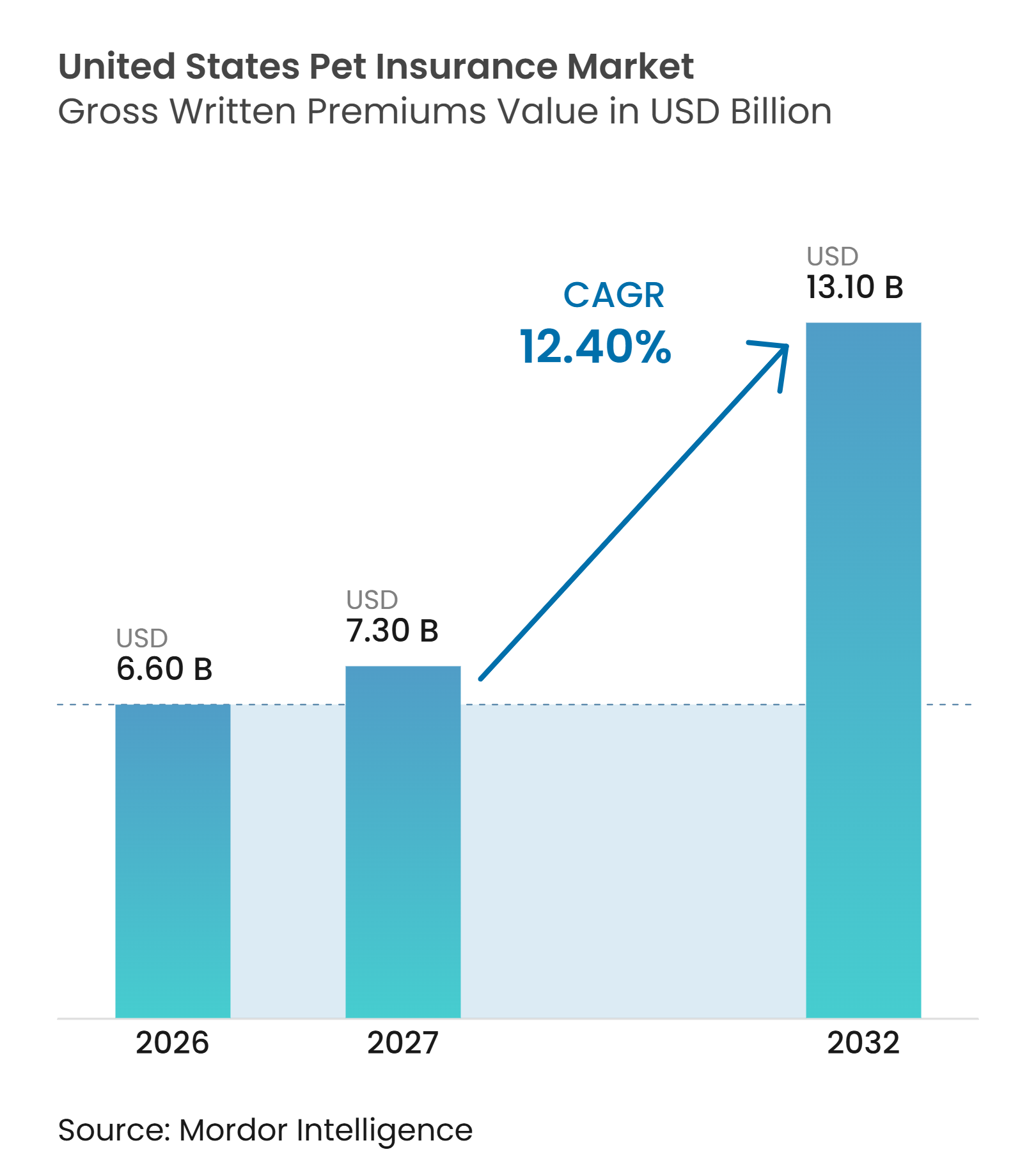
The United States Pet Insurance Market size in terms of gross written premiums value is expected to grow from USD 6.60 billion in 2026 to USD 7.30 billion in 2027 and is forecast to reach USD 13.10 billion by 2032 at 12.40% CAGR over 2027-2032.
Coverage remained limited to 4.27% of the United States dog and cat population at the end of 2025, leaving more than 155 million pets without financial protection. This penetration gap gives the United States pet insurance market a long runway for new enrollment, rather than relying only on premium increases among existing policyholders. The United Kingdom has household pet insurance penetration of 28%, while Sweden has penetration of 67%, providing a useful comparison for the headroom still available in the United States. Higher specialty-care costs, broader coverage expectations, and easier enrollment are changing how households assess protection for veterinary expenses. Employers, insurers, and veterinary partners are also expanding channels that place coverage closer to the point where consumers make pet-care decisions.
Key Report Takeaways
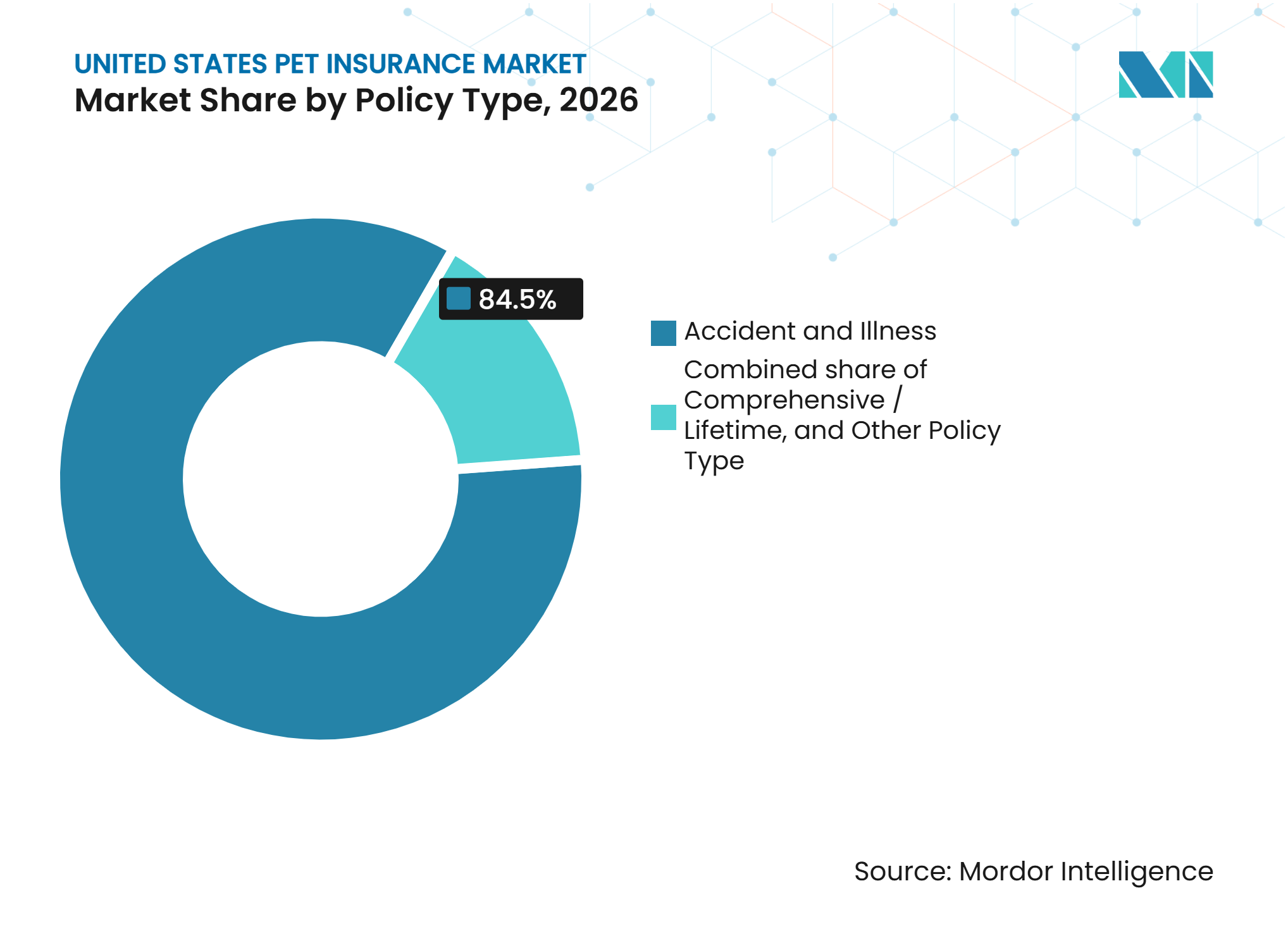
- By policy type, accident and illness captured 84.5% of the United States pet insurance market share in 2026, while comprehensive/lifetime is projected to grow at a 14.5% CAGR through 2032.
- By coverage architecture, mid-tier plans captured 45.4% of the United States pet insurance market share in 2026, while comprehensive caps are projected to grow at a 14.8% CAGR through 2032.
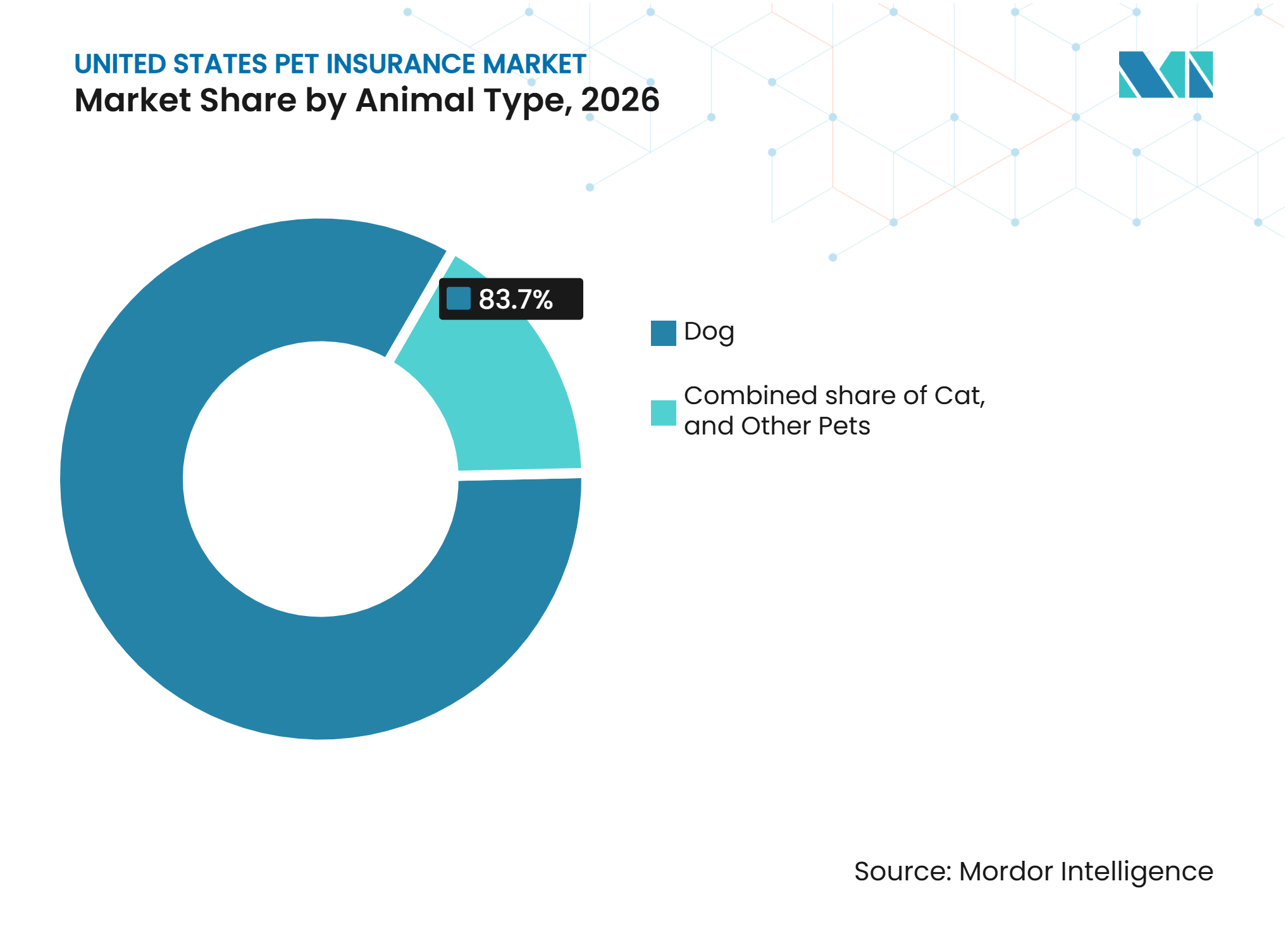
- By animal type, dogs captured 83.7% of the United States pet insurance market share in 2026, while cats are projected to grow at a 15.1% CAGR through 2032.
- By distribution channel, direct digital captured 35.4% of the United States pet insurance market share in 2026, while other channels are projected to grow at a 16.4% CAGR through 2032.
- By geography, the South captured 42.8% of the United States pet insurance market share in 2026, while the Midwest is projected to grow at a 13.5% CAGR through 2032.
Note: Market numbers in this report are based on Mordor Intelligence's proprietary estimation framework, which combines nine months of actuals with Q4 projections for base year 2026.
Market Trends and Insights
Drivers Impact Analysis of United States Pet Insurance Market*
| Driver | (~) % Impact on CAGR Forecast | Geographic Relevance | Impact Timeline |
|---|---|---|---|
| Rising Veterinary Treatment and Specialty-Care Costs | +3.2% | National, amplified in high-cost metropolitan areas of the Northeast and Pacific Coast | Short term (≤ 2 years) |
| Pet Humanization and Demand for Comprehensive Coverage | +2.0% | National, strongest in urban and suburban markets in the West and Northeast | Medium term (2-4 years) |
| Employer Benefits and Embedded Insurance Distribution | +1.8% | National, with early momentum in Chicago, New York, and Dallas | Medium term (2-4 years) |
| Low Pet Insurance Penetration and Untapped Demand | +1.6% | Midwest and South, with penetration below 4%, and the Deep South below 2% | Long term (≥ 4 years) |
| Digital Enrollment and Simplified Claims Processing | +1.4% | National, with greater relevance in markets with strong smartphone and broadband access | Short term (≤ 2 years) |
| Flexible Coverage Plans and Cat-Specific Products | +1.2% | National, with greater relevance in the South and Midwest | Medium term (2-4 years) |
| Source: Mordor Intelligence | |||
Rising Veterinary Treatment and Specialty-Care Costs
Veterinary costs are making pet insurance more relevant for households facing expensive treatment decisions. The American Veterinary Medical Association reported that 81% of veterinarians surveyed in 2025 saw increased client sensitivity to costs[1]. Trupanion’s analysis of more than 5.7 million claims identified oncology and cardiology as important specialty-care exposures. These care categories expose policyholders to expenses that are difficult to plan for through household savings alone. Insurers that designed products around primary-care costs must now manage greater specialty-care claims exposure. The resulting demand for broader protection supports movement from basic Accident & Illness plans toward more comprehensive policies in the United States pet insurance market.
Pet Humanization and Demand for Comprehensive Coverage
The American Pet Products Association identified 95 million pet-owning households in the United States in 2025. This base has already committed to pet ownership and represents the main population that insurers seek to convert into policyholders. MetLife Pet reported average health-related spending of USD 1,135 per pet parent in 2025, while spending on insurance rose 36% to USD 472[2]. Cat premium volume increased 33.1% in 2025, compared with 17.6% for dogs, as cat owners increasingly apply the same healthcare expectations to cats. Broader interest in coverage for chronic, hereditary, and preventive needs is changing the product mix across the United States pet insurance market. It also gives carriers a wider policyholder base and reduces dependence on canine risks alone.
Employer Benefits and Embedded Insurance Distribution
Employer benefits are becoming a more important enrollment route in the United States pet insurance market. ADP found that 5% of United States employers offered pet insurance, while 35% of respondents viewed it as extremely or very important for attracting talent[3]. The gap indicates room for growth in worksite benefits, particularly among employers that already manage voluntary benefits through digital platforms. Payroll deduction can reduce the friction of recurring payment decisions and may support policy retention. The Standard and OnePack Plan by PetPartners introduced a program in August 2025 that enabled employer clients to offer group-rate pet insurance through payroll deduction. Embedded distribution can also lower customer acquisition costs when insurers use established human resources systems rather than consumer advertising alone.
Low Pet Insurance Penetration and Untapped Demand
Low enrollment remains one of the clearest growth conditions for the United States pet insurance market. NAPHIA recorded coverage for 4.27% of the country’s 163.6 million dogs and cats at the end of 2025[4]. Dog penetration stood at 5.99%, while cat penetration was 2.29%, leaving a large difference between species. The disparity is important because cat ownership is widespread, but many owners still view cats as lower-cost animals to maintain. The Midwest and South combine lower insurance penetration with large pet-owning populations. Insurers that develop simpler products and practical distribution partnerships can address these less developed areas without depending on higher premiums.
Restraints Impact Analysis of United States Pet Insurance Market*
| Restraint | (~) % Impact on CAGR Forecast | Geographic Relevance | Impact Timeline |
|---|---|---|---|
| Premium Inflation and Affordability Constraints | -1.8% | National, most acute in lower-income markets in the South and Midwest | Short term (≤ 2 years) |
| Pre-Existing Condition Exclusions and Waiting Periods | -1.2% | National, with greater impact in the 27 states without Model Act adoption | Medium term (2-4 years) |
| Rising Claim Severity and Renewal Premium Increases | -1.0% | National, particularly on the Pacific Coast and in the Northeast | Short term (≤ 2 years) |
| Claim Denials and Limited Direct Veterinary Payments | -0.8% | National, concentrated among carriers without direct-payment infrastructure | Long term (≥ 4 years) |
| Source: Mordor Intelligence | |||
Premium Inflation and Affordability Constraints
Affordability limits enrollment among households most likely to benefit from protection against unexpected veterinary costs. Spot Pet Insurance found that 21% of surveyed United States pet owners identified USD 500 as the point at which an unplanned veterinary bill becomes financially unmanageable. The survey also found that 27% of respondents experienced financial stress for months after a large veterinary bill. Higher renewal premiums can weaken the value proposition for consumers who initially selected insurance because of a low monthly payment. Nationwide non-renewed 100,000 policies through 2025 as loss-cost inflation made certain product tiers unsustainable. The United States pet insurance market must therefore balance adequate pricing with products that remain affordable for new and existing policyholders.
Pre-Existing Condition Exclusions and Waiting Periods
Pre-existing condition clauses and waiting periods remain a source of consumer frustration. The National Association of Insurance Commissioners states that 27 states and the District of Columbia have no pet insurance-specific statute as of October 2026. The National Association of Insurance Commissioners Pet Insurance Model Act establishes standards covering waiting-period disclosures, hereditary disorders, and wellness plan rules. Seventeen jurisdictions, including Rhode Island and Ohio, have adopted the act, while it takes effect in New Jersey on January 1, 2027. Different state rules can make it harder for consumers to understand what a policy will cover before they enroll. Larger insurers may find compliance easier because they have established legal and operational resources, while smaller providers may face more complexity.
*Our forecasts treat driver/restraint impacts as directional, not additive. The impact forecasts reflect baseline growth, mix effects, and variable interactions.
United States Pet Insurance Market Segment Analysis
By Policy Type:
Broad Coverage Demand Reshapes the Product MixAccident & illness plans held 84.5% of the United States pet insurance market size in 2026. First-time buyers often choose these policies because they offer protection from sudden, high-cost events. This concentration also shows that many consumers enter the category with a narrow definition of the risks they want to insure. Accident-only and standalone wellness products can provide lower-cost starting points for households in the South and Midwest. Pumpkin introduced its standalone wellness program in August 2026, with monthly pricing starting at USD 15.95 for cats and USD 20.95 for dogs. These options can help insurers serve consumers who are not ready to purchase a full policy.
Comprehensive/lifetime coverage is forecast to expand at 14.5% CAGR through 2032. Growth reflects the needs of policyholders who discover limits in their coverage after experiencing chronic, hereditary, oncology, or cardiology claims. As pets age, consumers may place more value on plans that cover a wider range of treatment needs. The United States pet insurance industry is therefore moving toward a more varied product ladder, where carriers retain entry-level plans while developing clear routes to broader coverage. Policy wording and benefit design will remain important because upgrade decisions depend on whether policyholders understand what their existing plan excludes. Carriers that communicate these differences plainly can support both retention and movement into higher-value policies.


By Coverage Architecture:
Mid-Tier Maturity Sets the Stage for UpsellMid-tier plans captured 45.4% of total premium value in 2026. These products formed the central enrollment cohort during the recent direct-digital expansion, when price accessibility strongly influenced consumer choice. They continue to offer a balance between monthly premium costs and benefit limits. Basic and entry tiers remain important for lower-income households and first-time cat owners. These plans can serve as an acquisition route for insurers that want to establish relationships before policyholders need extensive care. The segment also reflects the importance of product choice, since a single benefit structure does not fit every household.
Comprehensive caps are projected to expand at a 14.8% CAGR through 2032. This demand is linked to policyholders whose pets were enrolled when young and later required more expensive care. Trupanion has filed for approval of a lower-cost product in Rhode Island, Virginia, and Nevada in 2026, offering annual limits from USD 2,500 to unlimited and group discounts of up to 25%. The filing shows that even providers associated with premium plans are addressing the space between basic policies and high-limit coverage. Clear differentiation in deductible, reimbursement, and annual-limit options will be essential as buyers compare price with protection. The United States pet insurance market can expand more steadily when policyholders have practical paths to change coverage as their financial needs change.
By Animal Type:
Dog Foundation Anchors the Market, Cat Momentum BuildsDogs accounted for 83.7% of insured pets in 2026. Their average monthly Accident & Illness premium was USD 62, compared with USD 32 for cats, which contributed to their larger share of premium value. Dog owners are also more familiar with insurance as a way to manage veterinary bills. This foundation gives insurers a large established customer base. It also means carriers must continue to manage breed-specific risk and the higher expected cost of canine treatment. Dogs will remain the main source of current premium value within the United States pet insurance market.
Cats are forecast to grow at a 15.1% CAGR through 2032. The United States had 76.3 million cats in 2025, while cat insurance penetration was only 2.29%, compared with 5.99% for dogs. This gap suggests that cat coverage has room to grow as consumers reconsider historic assumptions about feline healthcare costs. Lower entry prices, preventive-care bundles, and shorter waiting periods can help insurers address the category. Other pets, including birds, exotic animals, and horses, remain a higher-premium niche with fewer participating carriers. Specialized underwriters may find opportunities in these categories, although regulatory requirements and product design are more complex.

By Distribution Channel:
Digital Scale Confronts Embedded AccelerationDirect digital channels held a 35.4% share in 2026. Frictionless enrollment and fast policy issuance helped establish this channel during the recent acquisition expansion. Digital carriers can use automated claims handling and digital communication to control service costs and maintain customer engagement. Lemonade reported that its pet in-force premium exceeded USD 500 million in the first quarter of 2026. Digital scale will remain important, but it does not remove the need for strong underwriting and retention. The channel will continue to compete with partners that reach consumers in more targeted settings.
Other channels are projected to grow at a 16.4% CAGR through 2032. This category includes employer and worksite programs, affinity groups, point-of-adoption programs, and veterinary-referred enrollment. MetLife Pet partnered with Petstablished in December 2025 to embed personalized insurance quotes into the adoption and registration process at more than 1,000 animal welfare organizations that facilitate more than 160,000 annual adoptions. Such partnerships reach owners when their pet has no known prior medical history and when insurance is easier to consider. Broker and managing general agent arrangements also support employer programs, while bank and composite-insurer channels can use existing personal-lines relationships. These routes provide a way for the United States pet insurance industry to reduce reliance on broad consumer advertising.
Geography Analysis
The South held 42.8% of the United States pet insurance market share in 2026. Its pet-owning population provides scale, but insurance access remains limited beyond larger urban centers. Atlanta, Dallas, and Orlando recorded combined pet insurance and veterinary spending below the United States average in early 2026. This suggests that high ownership does not automatically create broad insurance adoption. The region’s lower average premiums could support enrollment if insurers improve access through employers, adoption partners, and digital programs.
The Northeast has the highest average monthly premiums for dogs. New York averaged USD 54 per month, and Massachusetts averaged USD 52 per month, compared with a national average of USD 42. Penetration in New York, New Jersey, Massachusetts, and Connecticut approaches 4% to 6% of pet-owning households. The region is therefore more mature than the South or Midwest. Growth is more likely to come from higher-value coverage and stronger retention than from broad first-time enrollment.
The West is another established regional base for the United States pet insurance market. California represented 18.1% of insured pets and 19.9% of gross written premium in 2025. Seattle metropolitan pet-related spending was 23% above the United States average from January through April 2026. Higher veterinary costs help explain the region’s premium level. The Midwest remains the most important lower-penetration growth area because pet ownership exceeds 70% of households in several states while insurance coverage remains between 2% and 4%. Ohio’s adoption of the NAIC Model Act in 2025 also provides a clearer consumer-protection framework that may support enrollment confidence.
Competitive Landscape
Market Concentration
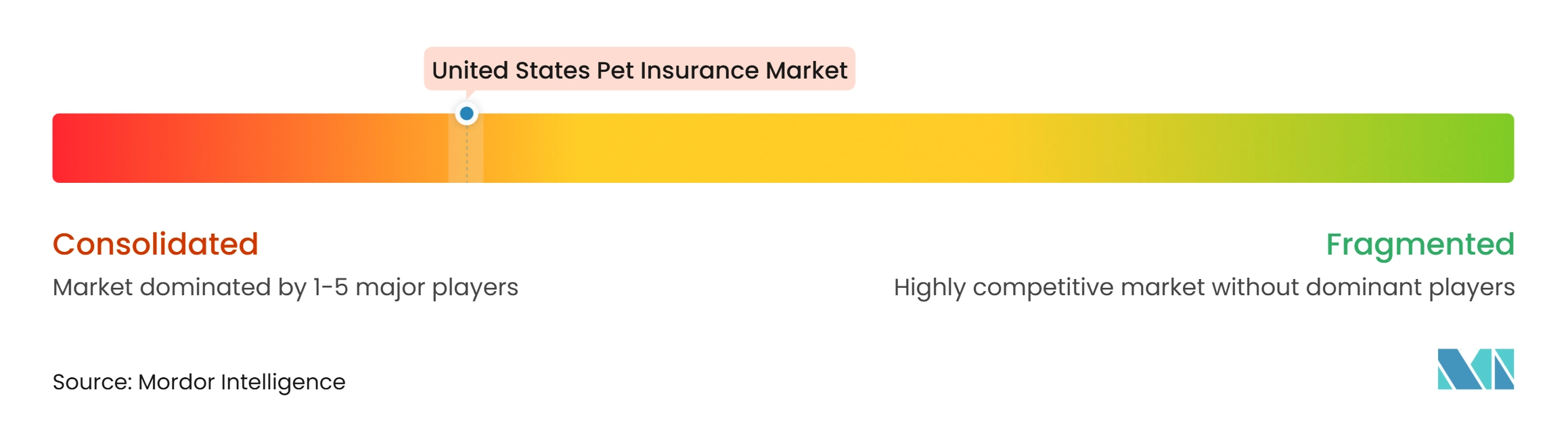
The United States pet insurance market is consolidated, with leading insurance groups holding significant positions through established brands, broad distribution networks, and substantial premium volumes. Trupanion Insurance Group reported USD 1.22 billion in direct premiums written in 2025, while Independence Pet Insurance Group reported USD 884.1 million following strong annual growth. Nationwide remained a major competitor despite a decline in its 2025 premiums. Competition among established providers and specialist insurers continues to focus on pricing, claims experience, customer service, and digital distribution. Leading companies benefit from operational scale and established veterinary relationships, creating barriers for smaller competitors seeking to expand their presence.
Lemonade reported that its pet in-force premium exceeded USD 500 million in the first quarter of 2026. The company’s digital claims model is built around automated first notices of loss and lower claims handling costs. Trupanion instead uses its VetDirectPay network to make eligible payments at participating veterinary hospitals. Chubb’s acquisition of Healthy Paws brought a large property and casualty insurer into direct participation in the category. Trupanion also indicated in its 2025 annual filing that it plans to launch a digital-first mid-tier product as part of its 2026 to 2028 strategy. These moves show how providers are responding to demand for both lower-cost access and simpler service.
Doubtless launched in June 2026 as the parent organization bringing together Independence Pet Holdings and Pinnacle Pet Group. The organization insures more than 6 million pets across 10 countries and retains consumer-facing brands including Pets Best, Embrace, Pumpkin, Figo, ASPCA Pet Health Insurance, and Spot. Its scale gives the group shared reinsurance capacity and broader actuarial information across its portfolio. Smaller providers can still pursue opportunities in adoption partnerships, small-employer benefits, and direct veterinary payment systems. Regulatory rules in the 17 jurisdictions that adopted the National Association of Insurance Commissioners Model Act raise the operating requirements for all carriers. This favors organizations with established compliance capacity, while product innovation and distribution partnerships remain important ways for other providers to compete.
United States Pet Insurance Industry Leaders
-
Trupanion Insurance Group
-
Nationwide P&C Group
-
Independence Pet Insurance Group
-
Lemonade, Inc.
-
Healthy Paws (Chubb Company)
- *Disclaimer: Major Players sorted in no particular order
United States Pet Insurance Market Companies Covered in this Report
- Trupanion, Inc.
- Nationwide Mutual Insurance Company
- Independence Pet Holdings, Inc.
- Lemonade, Inc.
- Healthy Paws (Chubb Company)
- MetLife, Inc.
- Fetch Pet Insurance
- Odie Pet Insurance
- Prudent Pet Insurance
- Liberty Mutual Insurance
- Physicians Mutual Pet Insurance
- CarePlus by Chewy
- Progressive Insurance
- Crum & Forster Pet Insurance Group
- American Modern Insurance Group
- Kanguro Insurance
- Rainwalk Pet Insurance
- ManyPets
- Wishbone Pet Insurance
- FurSure Pet Health Insurance
Recent Industry Developments in United States Pet Insurance Market
- September 2026: Fetch Pet Insurance launched Fetch Online Vet, powered by Vetster, embedding 4 annual video veterinary consultations plus unlimited chat directly in the Fetch member app at no additional cost or claim-filing requirement.
- September 2026: Lemonade expanded pet insurance to Kentucky, reaching 44 states plus Washington, D.C. The company’s pet book exceeded USD 500 million in in-force premium in the first quarter of 2026.
- August 2026: Pumpkin launched the standalone Pumpkin Wellness Club starting at USD 15.95 per month for cats and USD 20.95 per month for dogs, separate from any insurance requirement.
- June 2026: Doubtless launched as the unified global brand combining Independence Pet Holdings and Pinnacle Pet Group, insuring more than 6 million pets across 10 markets while retaining separate consumer-facing insurance brands.
United States Pet Insurance Market Report Scope
Segmentation Overview
| Accident & Illness |
| Comprehensive / Lifetime |
| Other Policy Type |
| Basic / entry tiers |
| Mid tiers |
| Comprehensive caps |
| Dog |
| Cat |
| Other Pets (Birds, Exotics, Equine, etc.) |
| Direct digital |
| Broker / MGA-carrier |
| Bancassurance / composite cross-sell |
| Other channels |
| Northeast |
| Midwest |
| South |
| West |
| By Policy Type | Accident & Illness |
| Comprehensive / Lifetime | |
| Other Policy Type | |
| By Coverage Architecture | Basic / entry tiers |
| Mid tiers | |
| Comprehensive caps | |
| By Animal Type | Dog |
| Cat | |
| Other Pets (Birds, Exotics, Equine, etc.) | |
| By Distribution Channel | Direct digital |
| Broker / MGA-carrier | |
| Bancassurance / composite cross-sell | |
| Other channels | |
| By Region | Northeast |
| Midwest | |
| South | |
| West |
Key Questions Answered in the Report
What is driving demand for pet insurance in the United States?
Rising specialty-care costs, broader coverage expectations, and low insurance penetration are supporting demand. Only 4.27% of United States dogs and cats had coverage at the end of 2025.
How large is the United States pet insurance sector?
The sector is valued at USD 6.6 billion in 2026 and is forecast to reach USD 13.1 billion by 2032, growing at a 12.4% CAGR.
Which pet type has the strongest growth potential?
Cats are projected to grow at 15.1% CAGR through 2032. Their 2.29% insurance penetration is substantially below the 5.99% rate for dogs.
Which sales channel is growing fastest for pet insurance?
Other channels, including worksite, affinity, point-of-adoption, and veterinary-referred enrollment, are projected to grow at 16.4% CAGR through 2032.
Why are employer pet benefits becoming more relevant?
ADP found that only 5% of United States employers offer pet insurance, while 35% view it as extremely or very important for attracting talent
Which region offers the strongest future opportunity?
The Midwest is forecast to grow at 13.5% CAGR through 2032 because insurance penetration remains low despite high pet ownership.