
United States Optical Ground Wire (OPGW) Market Size and Share
Market Overview
| Study Period | 2022 - 2032 |
|---|---|
| Forecast Data Period | 2027 - 2032 |
| Base Year Market Size (2026) | USD 133.15 Million |
| Market Size (2027) | USD 138.38 Million |
| Market Size (2032) | USD 205.26 Million |
| Growth Rate (2027 - 2032) | 8.21 % |
| Market Concentration | Medium |
Major Players *Disclaimer: Major Players sorted in no particular order Image © Mordor Intelligence. Reuse requires attribution under CC BY 4.0. | |
United States Optical Ground Wire (OPGW) Market Analysis by Mordor Intelligence
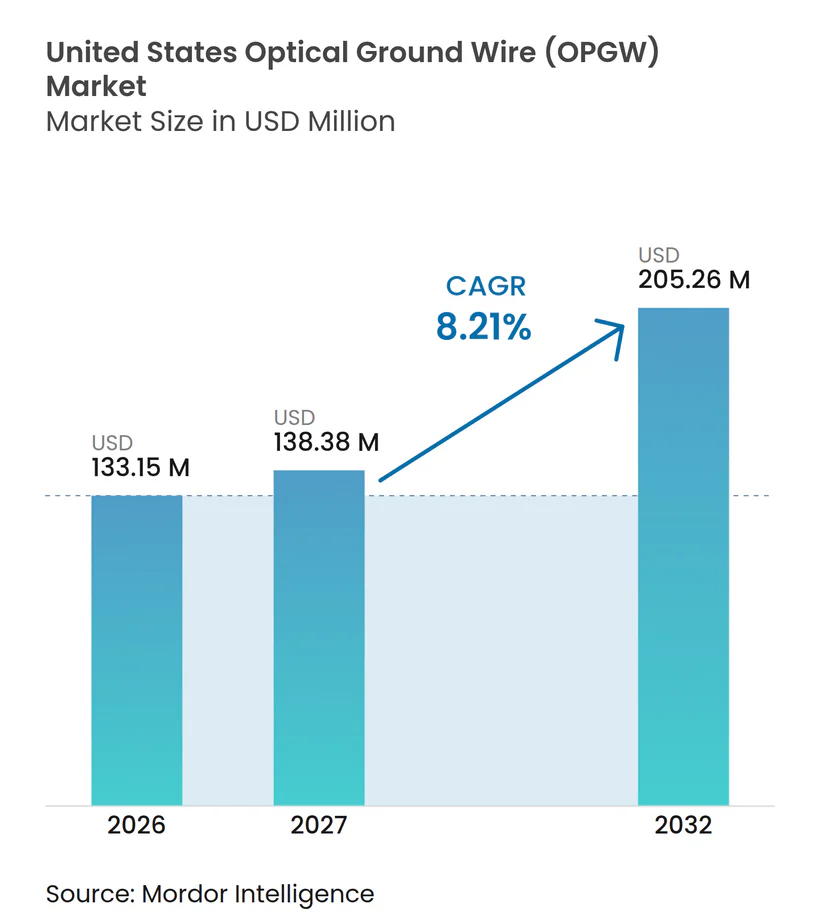
The United States Optical Ground Wire Market size was valued at USD 133.15 million in 2026 and is estimated to grow from USD 138.38 million in 2027 to reach USD 205.26 million by 2032, at a CAGR of 8.21% during the forecast period (2027-2032). Grid investment is moving toward projects that combine physical resilience with higher-capacity communications, which supports demand for optical ground wire on new and rebuilt transmission corridors. Rising electricity demand from data centers is adding pressure to build transmission capacity and improve communication links between substations. The United States Optical Ground Wire (OPGW) market also benefits when utilities upgrade aging overhead ground wire because replacement projects can increase fiber capacity without adding a new right-of-way, avoiding the additional permissions that a separate communications route may require, reducing disruption to existing communities, and preserving project scheduling flexibility for utility capital programs. Domestic manufacturing requirements shape procurement because federally supported projects must meet Buy America, Build America requirements, and these rules can influence the supplier pool before technical proposals are evaluated. Suppliers with domestic capacity, established utility qualifications, and engineering support are positioned to compete for projects where long-term performance and delivery timing matter as much as the initial cable specification.
Key Report Takeaways
- By fiber count, 48F held 39.1% revenue share in 2026, while 96F is forecast to grow at an 11.2% CAGR through 2032.
- By cable design type, Design A held 37.4% revenue share in 2026, while Design B is forecast to grow at a 9.2% CAGR through 2032.
- By end-use industry, power utilities held 72.7% revenue share in 2026 and are forecast to grow at a 9.1% CAGR through 2032.
Note: Market numbers in this report are based on Mordor Intelligence's proprietary estimation framework, which combines nine months of actuals with Q4 projections for base year 2026.
Market Trends and Insights
Drivers Impact Analysis of United States Optical Ground Wire (OPGW) Market*
| Driver | (~) % Impact on CAGR Forecast | Geographic Relevance | Impact Timeline |
|---|---|---|---|
| Grid Modernization for AI and Data Center Load Growth | +3.2% | National, with concentrated early impact in Texas, Virginia, Georgia, and North Carolina data center corridors | Long term (≥ 4 years) |
| Transmission Resilience Spending for Wildfire and Extreme Weather Risk | +1.8% | Western United States core, including California, Oregon, Washington, and Colorado, with spillover to Southwest and mountain states | Medium term (2-4 years) |
| Smart Grid Communications and Protection Automation | +1.2% | National, with highest density in MISO, PJM, and ISO-NE footprints | Long term (≥ 4 years) |
| Federal and Utility Preference for Domestic, BABA-Compliant Supply | +0.9% | National, particularly for Department of Energy and NTIA-funded corridors across 26+ states | Medium term (2-4 years) |
| Right-of-Way Reuse and Dual Grounding-Communications Function | +0.7% | National, with highest impact in densely permitted Northeast and Midwest corridors | Long term (≥ 4 years) |
| Fiber Capacity Upgrades on Existing High-Voltage Corridors | +0.6% | National, with near-term activity in ISO-NE and PJM aging-asset zones | Short term (≤ 2 years) |
| Source: Mordor Intelligence | |||
Grid Modernization for AI and Data Center Load Growth
The United States Optical Ground Wire (OPGW) market is supported by a growing need to connect large new loads while preserving reliable grid operations. The Federal Energy Regulatory Commission (FERC) reported that more than 1,900 transmission projects entered service in 2025, adding more than 7,000 miles of transmission lines nationally.[1] FERC also issued show-cause orders to the six major regional transmission organizations and independent system operators in June 2026 regarding large-load and co-located load interconnection rules. Each new or rebuilt high-voltage corridor requires protection and supervisory communications, increasing the value of fiber integrated within the shield wire. The Department of Energy identifies data center demand as a major planning consideration in its National Transmission Needs Study.[2] This creates a longer project pipeline for the United States Optical Ground Wire (OPGW) market because line expansion and communications upgrades are typically specified together.
Transmission Resilience Spending for Wildfire and Extreme Weather Risk
The United States Optical Ground Wire (OPGW) market gains from utility spending that improves detection, protection coordination, and monitoring in fire-prone areas. Pacific Gas and Electric Company’s 2026 to 2028 Wildfire Mitigation Plan identifies overhead system hardening as a central program and describes both completed and planned undergrounding work.[3] Optical ground wire can provide shielding and communications through one overhead installation, which is relevant where full undergrounding is not feasible. The fiber link supports fault detection and relay coordination without requiring a separate communications route along the same line. Western utilities therefore have a reason to include higher-capacity optical ground wire during targeted transmission hardening. The opportunity extends beyond immediate replacement work because monitoring requirements continue after a hardened line enters service.
Smart Grid Communications and Protection Automation
Digital protection systems are increasing the importance of reliable low-latency communications across transmission networks. GE Vernova describes its Multilin L90 line current differential protection platform as an optical communications-based solution for transmission line protection.[4] This technical requirement favors fiber links integrated with the overhead ground wire on high-voltage structures. Utilities using IEC 61850-based systems and synchro phasor networks require dependable connections between substations and remote line equipment. Optical ground wire also provides a route for sensing applications that can help utilities observe line conditions. These needs raise the role of the United States Optical Ground Wire (OPGW) market from a cable replacement category to part of a broader grid-control investment program.
Federal and Utility Preference for Domestic, Build America, Buy America Act (BABA)-Compliant Supply
Federal procurement rules are strengthening the role of domestic manufacturing in the United States Optical Ground Wire (OPGW) market. The Federal Highway Administration ended the general applicability waiver for manufactured products in January 2025, broadening the practical relevance of Buy America requirements for federally funded infrastructure. The Department of Energy committed USD 5.3 billion to 31 grid reconductoring projects under the SPARK program in August 2026. Rebuilding existing lines creates an opportunity to replace or upgrade overhead ground wire at the same time as conductors. AFL, Corning, Lightera, and Prysmian have communicated Build America, Buy America Act (BABA)-Compliant Supply commitments for qualifying fiber and cable programs. Compliance is therefore a purchasing condition that favors suppliers with qualifying US production and established utility relationships.
Restraints Impact Analysis of United States Optical Ground Wire (OPGW) Market*
| Restraint | (~) % Impact on CAGR Forecast | Geographic Relevance | Impact Timeline |
|---|---|---|---|
| High Installation Skill and Live-Line Execution Requirements | -0.9% | National, most acute in rural Western United States where helicopter access and specialized crew availability are most constrained | Medium term (2-4 years) |
| Aluminum, Stainless Steel, and Fiber Input-Cost Volatility | -0.7% | National, amplified by Section 232 import tariff effects on aluminum and global stainless steel supply-chain pressures | Short term (≤ 2 years) |
| Utility Qualification Cycles and Project-Specific Design Requirements | -0.4% | National, particularly constraining for new entrants across PJM and MISO qualification frameworks | Medium term (2-4 years) |
| OPGW Fiber Damage Risk During Stringing and Splicing | -0.3% | National, with the highest risk in long-span mountain or high-wind corridor installations in Western and Mountain states | Short term (≤ 2 years) |
| Source: Mordor Intelligence | |||
High Installation Skill and Live-Line Execution Requirements
Live-line installation requires specialist crews, carefully controlled pulling methods, and precision splicing. An American Electric Power project completed in 2025 used anti-rotation equipment during installation of OPGW on a 345 kV line. The case shows why cable handling is central to project delivery because twist or fiber damage can require replacement rather than a simple localized repair. Utilities may need to secure specialized crews well before construction begins, which can delay conversion of approved capital budgets into installed cable. The constraint is most visible on remote, mountainous, or high-wind routes that require difficult access and complex stringing. It may slow near-term installations even where the United States Optical Ground Wire (OPGW) market has strong underlying demand.
Aluminum, Stainless Steel, and Fiber Input-Cost Volatility
Optical ground wire combines aluminum alloy wires, stainless steel tubes, and optical fiber, leaving manufacturers exposed to changes in several input categories. The input materials affect the economics of both standard and high-fiber-count designs. Section 232 aluminum tariff measures remain relevant to the cost environment for imported material and components. Higher material costs can pressure supplier margins when utility contracts are awarded before procurement costs are fully known. The effect is more immediate on projects that depend on specialized tube or strand configurations. It also makes procurement timing and domestic supply arrangements more important for participants in the United States Optical Ground Wire (OPGW) market.
*Our forecasts treat driver/restraint impacts as directional, not additive. The impact forecasts reflect baseline growth, mix effects, and variable interactions.
United States Optical Ground Wire (OPGW) Market Segment Analysis
By Fiber Count:
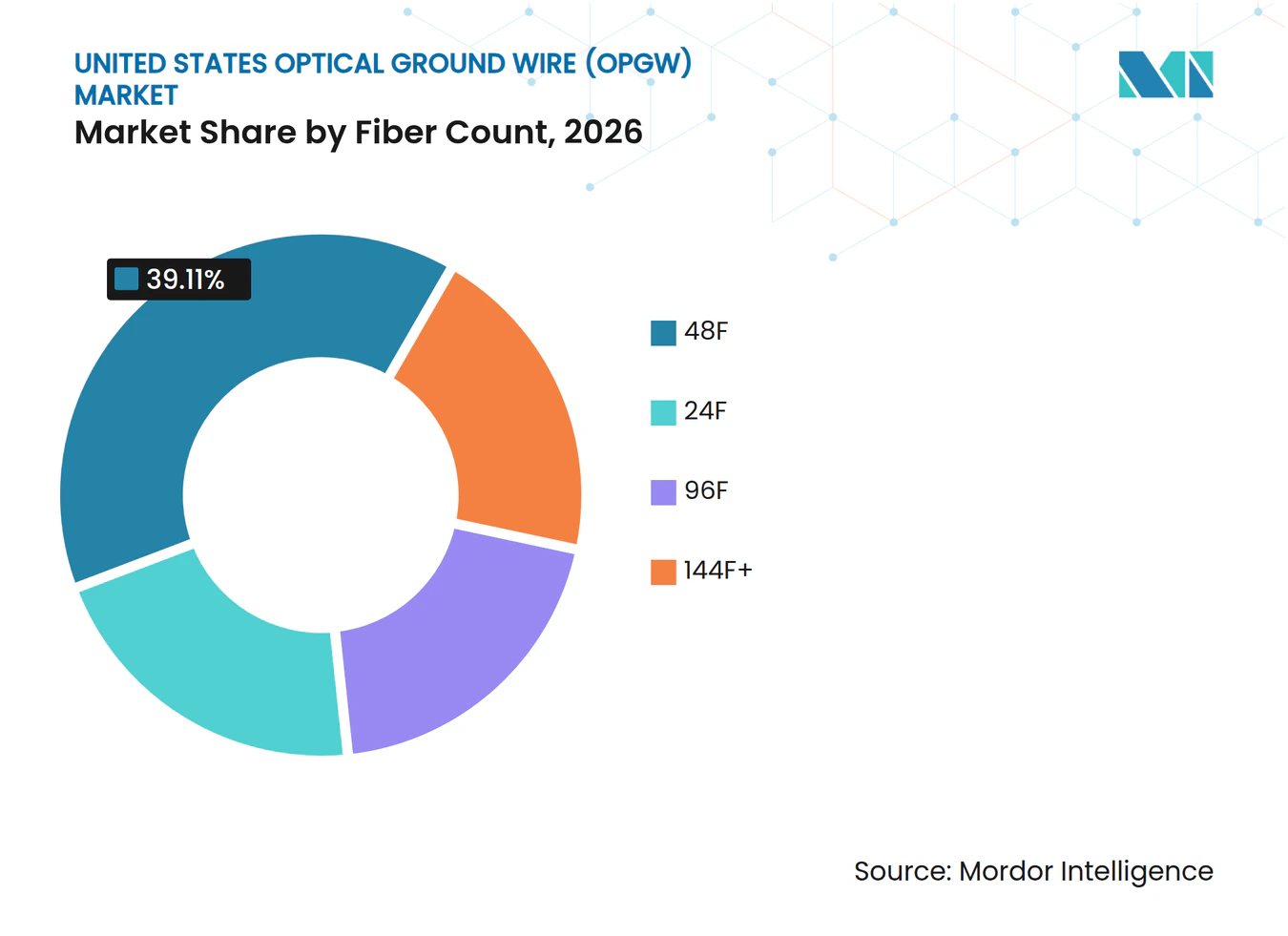
High-Capacity Cables Are Reshaping the Installed BaseThe 48F configuration held 39.1% of the United States Optical Ground Wire (OPGW) market share in 2026. It remains common on 115 kV to 345 kV corridors where utilities are replacing legacy 12F and 24F cable. This configuration offers more capacity without necessarily changing tower attachment hardware, which can simplify a renewal project. Eversource Energy’s Line 191 replacement work shows how utilities are addressing deteriorated legacy OPGW through planned renewal projects. The fiber count supports protection redundancy and space for future communications, helping 48F retain a leading role in the United States Optical Ground Wire (OPGW) market.
The 96F segment is projected to record an 11.2% CAGR through 2032, the strongest growth rate in this segmentation. Utilities are adopting higher counts where digital substations, line monitoring, and wider-area communications require greater capacity. The design can support utility communications while leaving fibers available for future network uses and service requirements. The 24F category remains suitable for lower-capacity routes, while 144F+ is gaining relevance on 500 kV and 765 kV projects where capacity per tower attachment is important. Sterlite Electric’s 2025 OPGW catalog includes a 144F dual-layer stranded stainless steel tube design for high-capacity applications.



By Cable Design Type:
Central Tube Leads While Stranded Designs Gain GroundDesign A held 37.4% of the United States Optical Ground Wire (OPGW) market share in 2026. The central aluminum tube construction balances mechanical strength, thermal performance, and fiber protection for common utility line classes. Its established installation practices reduce uncertainty for utility specification teams and support consistent contractor handling. AFL’s AlumaCore family represents this central aluminum tube architecture in the domestic product range. Compatibility with existing hardware and procurement specifications makes Design A a practical choice across a large portion of the United States Optical Ground Wire (OPGW) market.
Design B is forecast to expand at a 9.2% CAGR through 2032, the highest rate among cable design types. The stranded aluminum tube construction provides greater flexibility for longer spans and can accommodate higher fiber counts within a consistent outside diameter. Its design distributes bending stress across the cable structure, which is useful in areas exposed to vibration. Central and stranded stainless steel tube variants serve high short-circuit-current applications, while hybrid and multi-tube designs support very high fiber counts with standard sag and tension characteristics. IEEE Standard 1138 remains a core reference for mechanical, electrical, and optical performance testing across these design approaches.
By End-Use Industry:
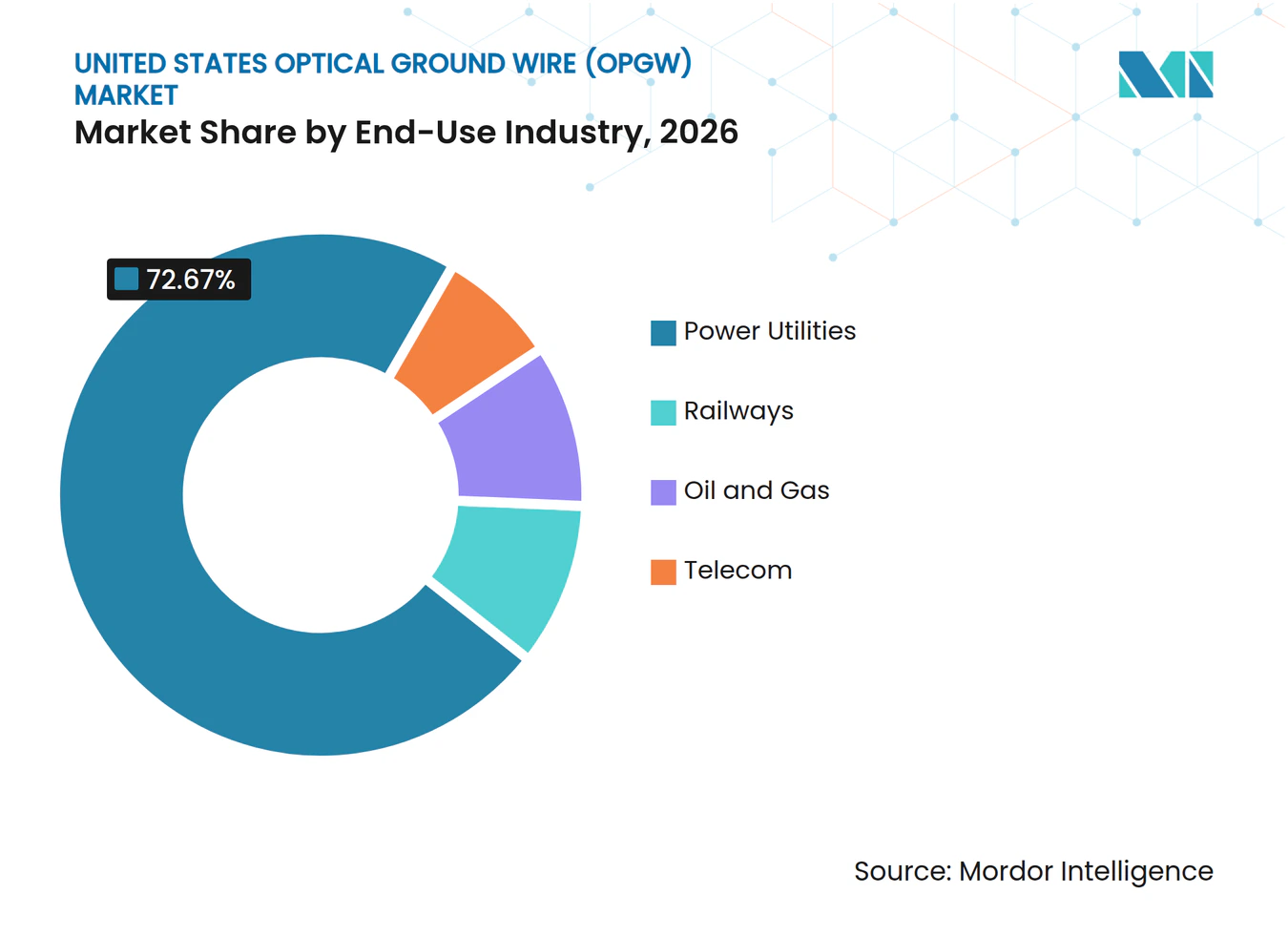
Power Utilities Anchor DemandPower utilities accounted for 72.7% of the United States Optical Ground Wire (OPGW) market size in 2026 and are projected to grow at a 9.1% CAGR through 2032. Utilities use OPGW to combine lightning shielding with communications for protection, supervisory control, and monitoring. Federal Energy Regulatory Commission (FERC) reported that Midcontinent Independent System Operator (MISO) approved 432 transmission expansion projects totaling USD 12.3 billion and that the Southwest Power Pool (SPP) approved 50 projects totaling USD 8.6 billion in the 2025 planning cycle. These project pipelines support recurring procurement needs across regional systems and keep demand tied to multiyear capital plans. Grid hardening and network digitalization make utilities both the core customer group and the principal source of expansion.
Telecom operators are generally capacity lessees on utility-owned fiber rather than direct purchasers of OPGW. Some rural broadband programs may support installations where transmission or distribution structures can host fiber. Railways form a smaller demand area because electrified freight lines and positive train control systems need reliable communications along existing rights-of-way. Oil and gas applications are limited and are mainly associated with supervisory control communications on high-pressure pipeline corridors. These users provide incremental demand where a shared overhead route reduces permitting requirements and strengthens operational communications.

Geography Analysis
The Western United States has a strong need for optical ground wire where wildfire mitigation programs require more monitoring and protection capabilities. Pacific Gas and Electric’s 2026 to 2028 plan reports approximately 924 circuit miles undergrounded since 2019 and approximately 1,067 additional circuit miles planned through 2028. Optical ground wire provides a complementary option on overhead lines that cannot be placed underground and supports condition monitoring and coordinated protection. Southern California Edison also identifies overhead system and transmission actions within its wildfire mitigation planning. These requirements make western projects an important source of specialized replacement and hardening work in the United States Optical Ground Wire (OPGW) market.
Texas and the MISO footprint represent a high-volume area for near-term transmission investment. Texas utilities have committed USD 33 billion to construct the state’s first 765 kV transmission backbone. High-voltage backbone projects require robust cable designs and substantial fiber capacity for protection and supervisory control systems. MISO’s 2025 transmission plan approved 432 projects valued at USD 12.3 billion, including upgrades around growing load centers. The Speed to Power through Accelerated Reconductoring and other Key Advanced Transmission Technology Upgrades (SPARK) Program directs funding toward reconductoring work across 26 states, supporting simultaneous upgrades to conductors and shield wire, and making the central United States a meaningful corridor for the United States Optical Ground Wire (OPGW) market.
The Southeast is seeing rapid interconnection activity around data center clusters in Virginia, North Carolina, and Georgia. Prysmian announced a USD 1.3 billion investment across facilities in North Carolina, Tennessee, and South Carolina in August 2026. The Northeast has a different demand pattern because legacy OPGW is approaching replacement age, and Eversource projects have identified fiber deterioration, splice issues, and insufficient slack on older installations. This creates a predictable renewal path that favors upgrades from 24F to 48F or higher counts, giving the United States Optical Ground Wire (OPGW) market both growth-led construction demand and replacement-led procurement demand.
Competitive Landscape
Market Concentration
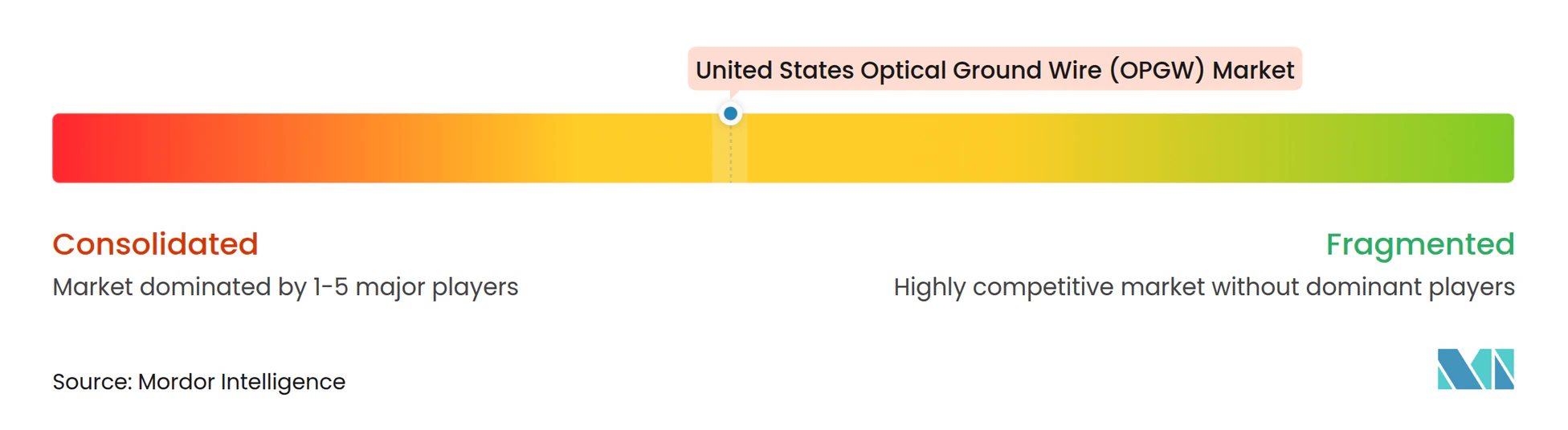
The United States Optical Ground Wire (OPGW) market has a moderately concentrated supplier base that includes integrated cable manufacturers and smaller regional specialists. Large suppliers benefit when they control optical fiber inputs, metal strand production, finished cable design, and utility qualification support. BABA requirements narrow the effective supply base for federally funded work because qualifying domestic production is a procurement requirement. AFL has supplied OPGW in the United States since 1985 and offers AlumaCore, HexaCore, and CentraCore product families. New suppliers face utility qualification cycles and project-specific requirements before they can compete for established accounts.
Prysmian announced a USD 1.3 billion investment across 3 US manufacturing facilities in August 2026. The program includes expansion at Claremont, North Carolina, Jackson, Tennessee, and Lexington, South Carolina, and is intended to increase domestic fiber and cable capacity. The company also released OPGWatch in 2025, a system that uses a dedicated fiber in installed OPGW to monitor events along a line. This approach links cable supply with monitoring capabilities and gives utilities a reason to consider a broader solution rather than only cable price. Corning’s 2026 agreement of up to USD 6 billion with Meta signals investment in domestic fiber capacity, a key input for OPGW manufacturing.
Lightera launched as Furukawa Electric’s unified global optical fiber cable brand in April 2025, bringing OFS Fitel and other cable operations under one identity. Its participation in Build America, Buy America Act (BABA)-Compliant Supply commitments places it among manufacturers aligned with qualifying US fiber and cable programs. Competition is increasingly shaped by domestic capacity, product qualification, engineering support, installation risk, and supply reliability.
United States Optical Ground Wire (OPGW) Industry Leaders
-
AFL Telecommunications LLC
-
Prysmian S.p.A.
-
Fujikura Ltd.
-
Furukawa Electric Co., Ltd.
-
Sterlite Electric Limited
- *Disclaimer: Major Players sorted in no particular order
United States Optical Ground Wire (OPGW) Market Companies Covered in this Report
- AFL Telecommunications LLC
- APAR Industries Limited
- Corning Incorporated
- Elsewedy Electric S.A.E.
- Fujikura Ltd.
- Furukawa Electric Co., Ltd.
- General Cable Industries, Inc.
- Hengtong Group Co., Ltd.
- Jiangsu Zhongtian Technology Co., Ltd.
- LS Cable & System Ltd.
- Nexans S.A.
- NKT A/S
- NV Bekaert SA
- OFS Fitel, LLC
- Prysmian S.p.A.
- Southwire Company, LLC
- Sterlite Electric Limited
- Sumitomo Electric Industries, Ltd.
- Taihan Cable & Solution Co., Ltd.
- Tratos Cavi S.p.A.
- Tratos Group
- Yangtze Optical Fibre and Cable Joint Stock Limited Company
- ZTT International Limited
Recent Industry Developments in United States Optical Ground Wire (OPGW) Market
- September 2026: The US Department of Energy committed USD 5.25 billion, including USD 1.9 billion in federal funding and USD 3.35 billion in recipient cost-share, to 31 grid reconductoring projects under the SPARK program.
- August 2026: Prysmian announced a USD 1.25 billion investment across three US manufacturing facilities: USD 1.07 billion at Claremont, NC, USD 100 million at Jackson, TN, and USD 80 million at Lexington, SC, creating 600 US manufacturing jobs by 2030.
- July 2026: Prysmian signed a EUR 5.5 billion long-term agreement with Molex to supply optical cables for US and global data centers over up to 10 years.
- June 2026: FERC issued show-cause orders to PJM INTERCONNECTION (PJM), MISO, SPP, CAISO, ISO-NE, and NYISO regarding tariff provisions for large-load and co-located load interconnection.
United States Optical Ground Wire (OPGW) Market Report Scope
An optical ground wire (OPGW) is a hybrid overhead cable installed at the top of high-voltage power transmission towers. It combines electrical grounding protection with fiber optic telecommunications.
The United States optical ground wire (OPGW) market is segmented by fiber count, cable design type, and end-use industry. By fiber count, the market is segmented into 24F, 48F, 96F, and 144F and above. By cable design type, the market is segmented into Design A, Design B, Design C, Design D, Design E, and Design F. By end-use industry, the market is segmented into power utilities, telecommunications, railways, and oil and gas. For each segment, the market sizing and forecasts are provided on the basis of value (USD).
Segmentation Overview
| 24F |
| 48F |
| 96F |
| 144F+ |
| Design A |
| Design B |
| Design C |
| Design D |
| Design E |
| Design F |
| Power Utilities |
| Telecom |
| Railways |
| Oil & Gas |
| By Fiber Count | 24F |
| 48F | |
| 96F | |
| 144F+ | |
| By Cable Design Type | Design A |
| Design B | |
| Design C | |
| Design D | |
| Design E | |
| Design F | |
| By End-Use Industry | Power Utilities |
| Telecom | |
| Railways | |
| Oil & Gas |
Key Questions Answered in the Report
What is driving demand for optical ground wire in the United States?
Transmission expansion, grid hardening, data center load growth, and digital protection systems are driving demand. The United States OPGW market is forecast to grow at an 8.21% CAGR through 2032.
Which fiber count is growing fastest?
The 96F configuration is projected to grow at an 11.2% CAGR through 2032 as utilities seek greater capacity for protection and monitoring applications.
Which customer group buys the most OPGW?
Power utilities held 72.7% of demand in 2026 and are projected to grow at a 9.1% CAGR through 2032.
Why do domestic manufacturing rules matter for OPGW suppliers?
Federal Buy America requirements influence eligibility for federally funded grid projects. Suppliers with qualifying U.S. capacity are better positioned for these procurement programs.
What role does OPGW play in wildfire mitigation?
It combines overhead shielding with communications that can support fault detection, monitoring, and protection coordination on lines that remain overhead.
What limits installation growth?
Specialized live-line installation crews, complex stringing work, and changes in material costs can extend project schedules and affect supplier margins.