
United States Music CD Market Size and Share
Market Overview
| Study Period | 2020 - 2031 |
|---|---|
| Forecast Data Period | 2026 - 2031 |
| Base Year Market Size (2025) | USD 312.38 Million |
| Market Size (2026) | USD 412.90 Million |
| Market Size (2031) | USD 480.40 Million |
| Growth Rate (2026 - 2031) | 3.07 % |
| Market Concentration | Medium |
Major Players *Disclaimer: Major Players sorted in no particular order Image © Mordor Intelligence. Reuse requires attribution under CC BY 4.0. | |
United States Music CD Market Analysis by Mordor Intelligence
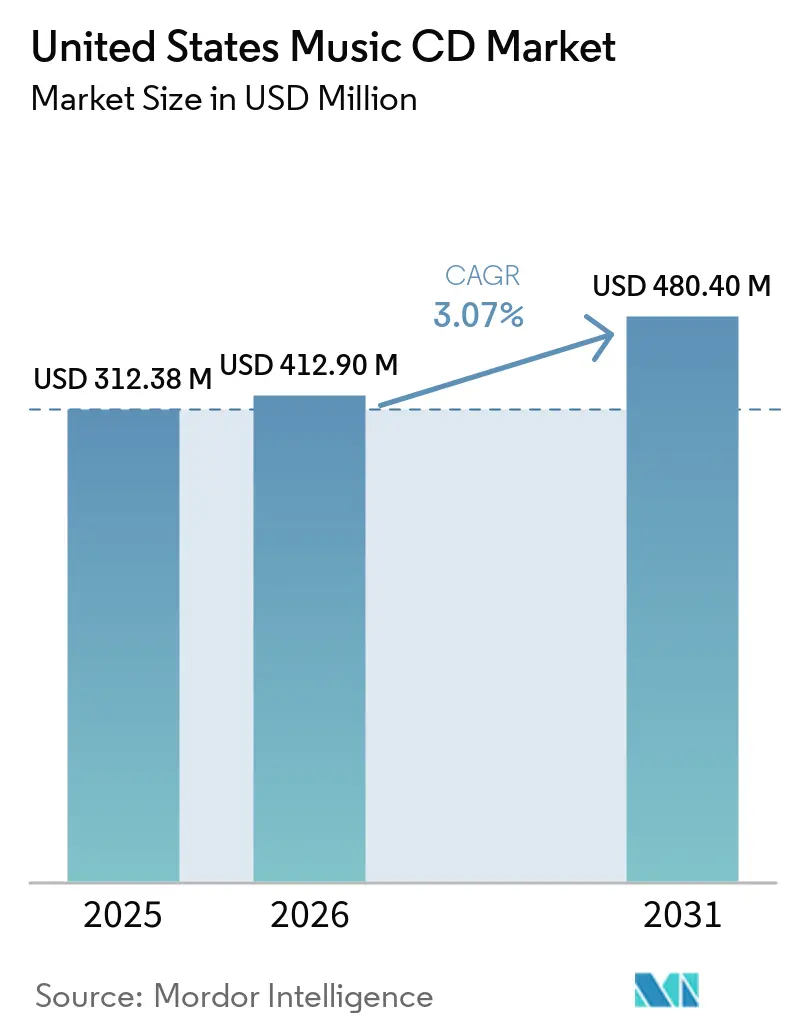
The United States Music CD Market size was valued at USD 312.38 million in 2025 and is estimated to expand from USD 412.90 million in 2026 to reach USD 480.40 million by 2031, at a CAGR of 3.07% during the forecast period (2026-2031). Volume was 29.50 million units in 2025, is estimated at 37.84 million units in 2026, and is forecast to reach 38.66 million units by 2031, at a CAGR of 0.43% from 2026 to 2031. Value is advancing much faster than unit shipments because CDs are increasingly bought as collectibles, artist merchandise, and premium releases rather than as a primary listening format. The 2026 recovery in physical sales has been led by K-pop releases, which have restored visibility for CDs at major retailers and expanded shelf space for other artists. Direct sales, bundled merchandise, and short production runs also make the format more practical for independent artists. At the same time, streaming remains the primary listening channel, while reduced disc manufacturing capacity and narrower retail assortments could limit supply and choice in the United States Music CD Market.
Key Report Takeaways
- By product type, Standard Audio CDs led with 48.17% of the United States Music CD Market share in 2025, while Special-Edition and Box-Set CDs are projected to expand at a 4.23% CAGR through 2031.
- By distribution channel, e-commerce held 61.92% of the United States Music CD Market share in 2025 and is projected to expand at a 5.18% CAGR through 2031.
Note: Market size and forecast figures in this report are generated using Mordor Intelligence’s proprietary estimation framework, updated with the latest available data and insights as of January 2026.
United States Music CD Market Trends and Insights
Drivers Impact Analysis*
| Driver | (~) % Impact on CAGR Forecast | Geographic Relevance | Impact Timeline |
|---|---|---|---|
| K-pop and Collector-Edition Release Multiplication | +1.2% | National, concentrated in Los Angeles, New York, Chicago, and Seattle | Short term (≤ 2 years) |
| Tangible-Fandom Demand for Ownership and Collectibility | +0.7% | National | Medium term (2-4 years) |
| Artist-to-Fan Direct Sales and Merch Bundling | +0.5% | National, with accelerated gains in online and touring channels | Medium term (2-4 years) |
| Late-Year Blockbuster Release Concentration | +0.3% | National, concentrated in Q4 holiday retail | Short term (≤ 2 years) |
| Mainstreaming of Independent-Artist Physical Releases | +0.2% | National, with early gains in Nashville, Los Angeles, and Austin touring circuits | Long term (≥ 4 years) |
| Premium Audiophile and Remastered Catalog Editions | +0.1% | National, concentrated in Northeast and Pacific Coast audiophile communities | Long term (≥ 4 years) |
| Source: Mordor Intelligence | |||
K-pop and Collector-Edition Release Multiplication
K-pop labels have changed how physical releases are planned and sold in the United States Music CD Market. Luminate reported sales of 16.3 million CDs in the first half of 2026, up 16% from the prior year, with K-pop accounting for 10% of that volume. Sales excluding K-pop still rose 6.7%, showing that the release activity also supported purchases across other genres. Multiple versions with photocards and exclusive inserts encourage fans to buy more than 1 copy of the same title. Target and Walmart increased their share of physical album sales from 23.3% in the first half of 2025 to 28.7% in the first half of 2026 as those releases moved into mass retail. This broader retail presence gives labels selling other genres greater access to physical music shelf space in the United States Music CD Market.
Tangible-Fandom Demand for Ownership and Collectibility
CD demand increasingly reflects participation in a fan community rather than a need for a playback device. A Luminate survey reported that 50% of Gen Z and Millennial CD buyers in the United States did not own a CD player. Physical albums can still hold value for fans because they include photographs, inserts, limited packaging, and trading items. Luminate survey data cited by a Korean trade publication showed that 27% of U.S. K-pop fans bought at least 1 CD in 2025, compared with 19% of general music listeners. This behavior places limited-edition merchandise and artist support closer to the purchase decision than sound quality or routine playback. MusicWatch estimated that 69 million Americans listened to CDs at least once in 2025, so a traditional listening base continues alongside collectible buying in the United States Music CD Market.[1]
Artist-to-Fan Direct Sales and Merch Bundling
Independent artists use CDs as part of broader merchandise offers that can include apparel, signed items, and downloads. Bandcamp has facilitated more than USD 1.7 billion in cumulative payments to artists and takes a 10% revenue share on physical merchandise, compared with up to 15% on digital items. That structure gives artists a clear reason to sell physical releases directly to fans. In November 2025, Disc Makers and Spinney Media announced 6 months of free warehousing and listings across Amazon, Walmart, eBay, and artist Spotify pages with each CD or vinyl order. Disc Makers stated in May 2026 that short CD manufacturing could begin at USD 2 per disc, which can support limited runs of 50 units for artists using pre-orders. A sold-out small release can help an artist judge demand before ordering a larger run, strengthening the direct-sales model in the United States Music CD Market.[2]
Late-Year Blockbuster Release Concentration
Holiday releases concentrate a large share of CD revenue into the final quarter of the year. Luminate reported 8.3 million U.S. CD sales in Q3 2025, up 12.3% from Q2, followed by 11.4 million in Q4, up 15.8% from Q3. Premium catalog releases are often timed for gifting, which favors box sets and collectible packages.[3] The Beatles released their 2025 Edition Anthology Collection as an 8CD box set for USD 121.99 on November 21, 2025. John Lennon and Yoko Ono’s Power to the People 9CD plus 3 Blu-ray set was released at USD 229.99 on October 10, 2025. This release pattern raises demand for reserved manufacturing slots late in the year and supports premium product planning in the United States Music CD Market.[4]
Restraints Impact Analysis*
| Restraint | (~) % Impact on CAGR Forecast | Geographic Relevance | Impact Timeline |
|---|---|---|---|
| Streaming Substitution and Listening-Time Migration | -1.8% | National | Long term (≥ 4 years) |
| Shrinking Retail Shelf Space and Store Closures | -0.8% | National, with acute effects in suburban and small-market areas | Medium term (2-4 years) |
| High Minimum-Efficient Pressing Runs | -0.3% | National, with disproportionate effects on emerging independent artists | Long term (≥ 4 years) |
| Polycarbonate, Packaging, and Freight Cost Volatility | -0.2% | National, with upstream cost pressure from Asian feedstock and benzene markets | Short term (≤ 2 years) |
| Source: Mordor Intelligence | |||
Streaming Substitution and Listening-Time Migration
Streaming remains the dominant channel for recorded music consumption, limiting the number of listeners who need a physical format for daily access. The RIAA reported that streaming accounted for 82% of recorded-music revenue in the first half of 2026, totaling USD 4.9 billion. The paid subscription base reached 106.5 million U.S. accounts in 2025 and generated USD 6.4 billion in annual revenue. Streaming platforms also control much of music discovery, but they do not provide an automatic route from listening to physical purchases. Artists with established fan groups, touring audiences, or catalog followers can sell CDs outside that discovery system. Artists without those relationships may find it harder to convert streaming activity into physical sales in the United States Music CD Market.
Shrinking Retail Shelf Space and Store Closures
Store closures and narrower music assortments reduce the places where consumers encounter CDs. Best Buy ended DVD and Blu-ray disc sales in early 2024 and announced 10 to 15 additional store closures in fiscal 2025, following the closure of 24 stores in 2023. The effect is larger for mid-tier artists and independent labels that cannot secure a limited number of retail slots. Surviving mass retailers focus on high-velocity K-pop releases, while independent record stores focus on collectors and audiophile customers. This leaves direct websites, concert venues, and specialist stores as the main routes for many artists. The United States Music CD Industry, therefore, depends on a narrower retail base, even while leading releases generate strong demand.
*Our forecasts treat driver/restraint impacts as directional, not additive. The impact forecasts reflect baseline growth, mix effects, and variable interactions.
Segment Analysis
By Product Type: Collectible and Premium Formats Elevate Revenue per Unit
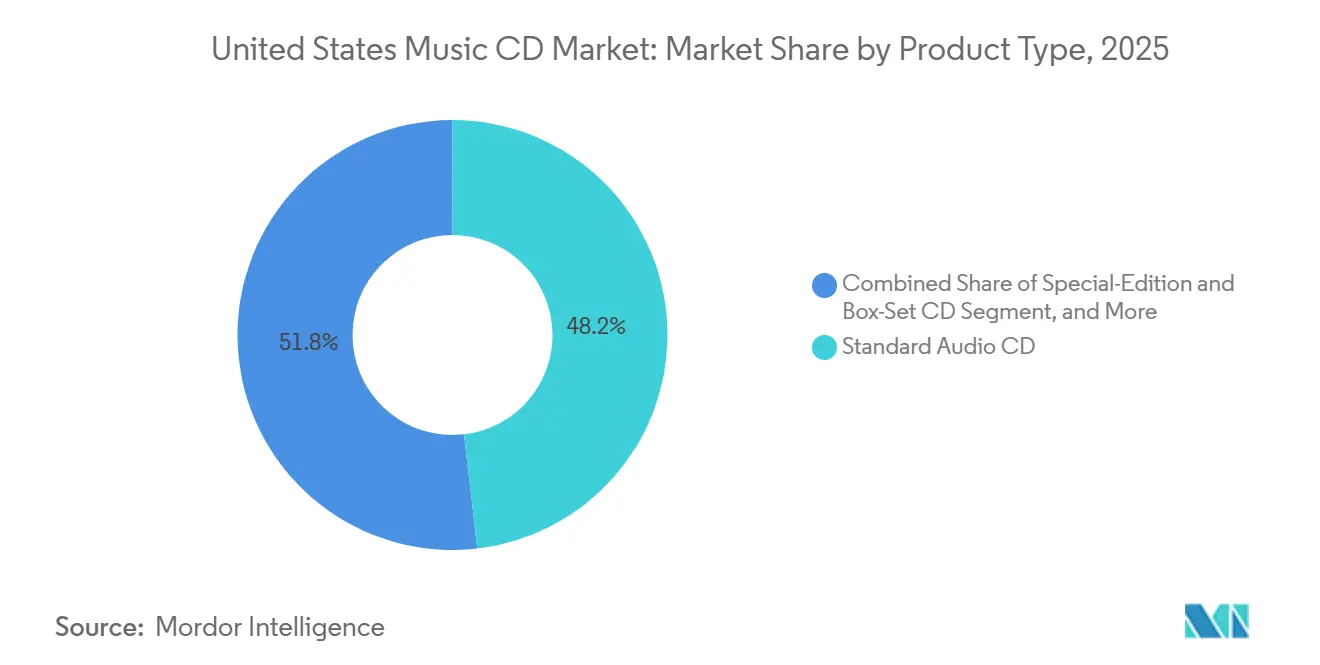
Standard Audio CDs held 48.17% of the United States Music CD Market Size in 2025. The segment remains the basic format for mainstream pop, country, and K-pop campaigns. Its broad role comes from lower production costs and wider retail acceptance than premium formats. K-pop labels also use standard discs in multi-version album campaigns, which can produce multiple purchases from a single fan. Standard CDs remain important for new releases because they are accessible to a broad group of consumers and retailers.
Special-Edition and Box-Set CDs are projected to expand at a 4.23% CAGR from 2026 to 2031. These releases use larger packages, editorial material, and exclusive content to support a higher selling price. The Beatles’ Anthology Collection 2025 Edition contained 191 tracks remastered by Giles Martin, including Anthology 4 and limited numbered photo art cards. Rhino Records also released Foreigner’s Super Deluxe 4CD plus Blu-ray package for the album’s 45th anniversary in 2026. Premium and Audiophile CDs, including SACD hybrid and high-resolution formats, serve a smaller audience that values sound quality and presentation. Mobile Fidelity Sound Lab and Impex Records offered numbered catalog SACD releases in 2025 and 2026 at USD 30 to USD 35 per disc. Other products, such as CD singles and direct-market promotional formats, remain smaller contributors with limited forecast visibility in the United States Music CD Market.

By Distribution Channel: E-Commerce Anchors Volume and Reshapes Artist Economics
E-commerce held 61.92% of the United States Music CD Market Size in 2025 and is projected to expand at a 5.18% CAGR through 2031. Amazon’s CDs and Vinyl store, Bandcamp, and label-operated stores give collectors access to titles that are not stocked locally. These channels also help independent artists reach buyers without relying on a national retail listing. The Disc Makers and Spinney Media agreement added warehousing and marketplace support to CD orders in November 2025. E-commerce can therefore support both high-volume collector releases and small artist-led campaigns in the United States Music CD Market.
In-store and retail channels maintained a significant position in 2025, but their role has become more specialized. Independent record stores can serve collectors through release events and Record Store Day Black Friday exclusives. Target and Walmart lifted their share of total U.S. physical album sales from 23.3% in the first half of 2025 to 28.7% in the first half of 2026 through K-pop placements. These placements attract repeat purchasers looking for exclusive versions and photocards. The model depends heavily on the continued popularity of K-pop releases. If that demand weakens, retailers may have less reason to maintain broad CD sections, which would affect titles outside the high-velocity release cycle.
Geography Analysis
The United States Music CD Market is a single-country market and the largest physical music economy in North America. It became the largest global importer of Korean physical music albums in the first half of 2026, with USD 74.12 million in imports. Demand is not evenly distributed across the country. K-pop fandom, collectibility, audiophile interest, and touring activity are strongest in different regional settings. Los Angeles, New York, Seattle, and Chicago have high specialty-store density and active K-pop fan networks. These coastal metropolitan areas also have Korean-American communities that support repeat purchasing tied to artists such as BTS, Enhypen, and Ateez. The import results have encouraged Korean labels to pay more attention to U.S. retail placement and direct distribution.
The Midwest and Sun Belt provide a different source of demand for the United States Music CD Market. Target and Walmart locations in these regions helped push mass retailers to 28.7% of U.S. physical album sales in the first half of 2026. K-pop exclusives have helped restore physical music sections in hypermarkets. Those sections also create space for catalog and new-release titles by Western artists. MusicWatch estimated that more than 40 million Americans listened to CDs in the car in 2025, including 23 million who identified CDs as their most-used in-car format. Suburban and rural areas can retain more older vehicles without streaming-native audio systems. This playback base supports continued demand for Standard Audio CDs outside major coastal cities.
The Southeast and Southwest have a different connection to the United States Music CD Market through touring activity. Country, Christian contemporary, and independent Americana artists use concert venues to sell CDs directly to fans. These releases were priced between USD 10 and USD 15 per unit in the examples provided. Disc Makers reported in 2026 that concert CDs can deliver margins above 80% for mid-level touring artists. This sales route is less dependent on chart rankings or streaming recommendations. It gives artists in touring circuits a practical outlet for short runs and merchandise bundles. Regional differences, therefore, shape demand through retail access, vehicle use, touring networks, and fan communities.
Competitive Landscape
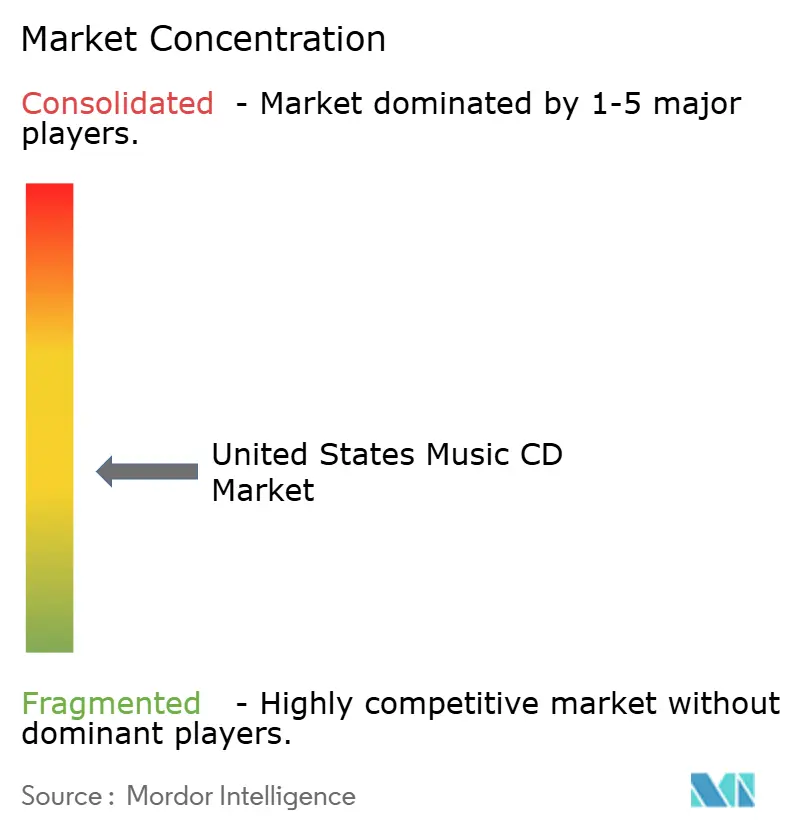
The United States Music CD Market remains moderately fragmented at the manufacturing level, with no company holding a dominant position across pressing, packaging, and retail distribution. Disc Makers has a strong position in manufacturing for independent artists. The company operates directly with artists and handles mastering, replication, injection molding, G7-certified HP Indigo printing, and packaging in-house. This integrated model supports faster turnaround times for smaller orders. Disc Makers reported delivery in 6 to 8 days in a 2026 secret-shopper comparison. The company’s focus on smaller orders creates an opening for suppliers capable of handling replicated runs below the usual 300-500-unit range. That opening is relevant to micro-labels, limited editions, and artists testing demand before larger production runs.
Sony DADC remained an important supplier for larger catalog and major-label runs in 2026, but its planned capacity changes introduce uncertainty for optical-disc supply. Sony Interactive Entertainment announced in July 2026 that it would discontinue physical media for PlayStation consoles from January 2028. Sony DADC’s Thalgau facility produced 600,000 discs daily, with around half allocated to PlayStation, and began planning to reduce its disc volume to 10% of its current level by 2028 while retraining 300 employees for optical microlens production. The removal of a large gaming disc workload could change the cost base for music disc production. It could also make planning more important for labels that need high-volume manufacturing. Sony DADC’s Terre Haute, Indiana, facility remained active in 2026, but the broader shift has raised concerns about long-term production capacity in the United States Music CD Market.
Packaging quality has become an important competitive factor for premium catalog and box-set work. G7-certified color accuracy and SACD-grade quality can matter when labels want collectible releases rather than basic discs. NFC tags and QR code fan portals can connect a physical CD to digital content and artist services. Some independent manufacturers are testing those features, but they are not yet a standard offering. The Audio Home Recording Act of 1992 applies royalty levies to digital music recording devices and media through the Copyright Office. The compliance framework can arise in licensing discussions, but does not materially restrict CD economics. The United States Music CD Industry has room for suppliers that combine quick small-batch service, premium packaging, and digital fan access.
United States Music CD Industry Leaders
-
Sony DADC US Inc.
-
Disc Makers, Inc.
-
A to Z Media, Inc.
-
Duplication.com, Inc.
-
Precise Media Services, Inc.
- *Disclaimer: Major Players sorted in no particular order
Recent Industry Developments
- September 2026: The RIAA released its 2026 Mid-Year Recorded Music Revenue Report, confirming that US CD wholesale revenue surged 58.6% to USD 171.1 million in the first half of 2026, with unit volume up 45.7% to 17.5 million CDs. Total US physical music revenue grew 25.9% to USD 731.5 million in the same period, marking the sharpest half-year growth rate for physical formats since the early streaming era.
- August 2026: Disc Makers announced investment in a second lacquer cutting lathe at its facility, requiring a dedicated concrete slab isolation system for vibration-free cutting precision. The expansion responds to simultaneous acceleration in vinyl and CD demand encountered in 2026 and positions the company to scale in-house manufacturing capacity without outsourcing.
- July 2026: Luminate's 2026 mid-year report confirmed BTS's "Arirang" as the top-selling CD in the United States in the first half of 2026 at 567,000 copies sold, followed by Enhypen's "THE SIN: VANISH" at 286,000 units and Ateez's "Golden Hour: Part 4" at 263,000 units. Seven of the top 10 best-selling US CDs in the period were K-pop releases, and total US CD sales grew 16% year over year to 16.3 million units.
- May 2026: Disc Makers released data showing CD revenue up 9% year-to-date for 2026, with April 2026 recording 18% growth year over year. Company CEO Tony van Veen attributed the acceleration to Gen Z consumers treating the compact disc as an affordable collectible, noting that CDs are often a newly discovered format for this generation rather than a nostalgic one.
United States Music CD Market Report Scope
The United States Music CD Market encompasses the sales and distribution of physical compact discs, including standard audio releases, premium audiophile editions, and special collector box sets, catering to enthusiasts who value tangible media, superior sound quality, and exclusive packaging through various retail and online channels.
The United States Music CD Market Report is Segmented by Product Type (Standard Audio CD, Premium and Audiophile CD, Special-Edition and Box-Set CD, and Other Products), Distribution Channel (E-commerce and In-store/Retail including Record and Music Shops, Mass Market Retailers, and Other Retail Channels). The Market Forecasts are Provided in Terms of Value (USD).
| LP and EP Vinyl Records |
| Single Vinyl Records |
| Box Sets and Multi-Disc Collections |
| Other Products |
| E-commerce | |
| In-store/Retail | Record and Music Shops |
| Mass Market Retailers | |
| Other Retail Channels |
| By Product Type | LP and EP Vinyl Records | |
| Single Vinyl Records | ||
| Box Sets and Multi-Disc Collections | ||
| Other Products | ||
| By Distribution Channel | E-commerce | |
| In-store/Retail | Record and Music Shops | |
| Mass Market Retailers | ||
| Other Retail Channels | ||
Key Questions Answered in the Report
What is the size of the United States Music Vinyl Market?
The United States Music Vinyl Market was valued at USD 1.04 billion in 2025, is estimated at USD 1.18 billion in 2026, and is forecast to reach USD 1.58 billion by 2031 at a 6.01% CAGR.
What is driving demand for vinyl records in the United States?
Gen Z and millennial collecting, premium editions, direct artist releases, and independent retail events support demand. Streaming discovery also leads fans to purchase physical releases.
Which product type leads U.S. vinyl sales?
LP and EP vinyl records led with 78.43% share in 2025 because they serve new releases, reissues, and collectible formats.
Which distribution channel is expanding fastest for vinyl?
Record and music shops within in-store retail are projected to expand at an 8.64% CAGR through 2031, supported by events, curated inventory, and local music communities.
What is limiting U.S. vinyl production?
High input costs, price inflation, limited pressing capacity, and 6-to-9-month lead times at larger facilities can constrain supply, especially for independent labels.
Where is U.S. vinyl manufacturing concentrated?
Tennessee is the main manufacturing hub, with facilities in Nashville and Memphis. Oregon added capacity in 2026 through the Object Permanence plant in Salem.