
United States IC Design Services Market Size and Share
Market Overview
| Study Period | 2021 - 2032 |
|---|---|
| Forecast Data Period | 2027 - 2032 |
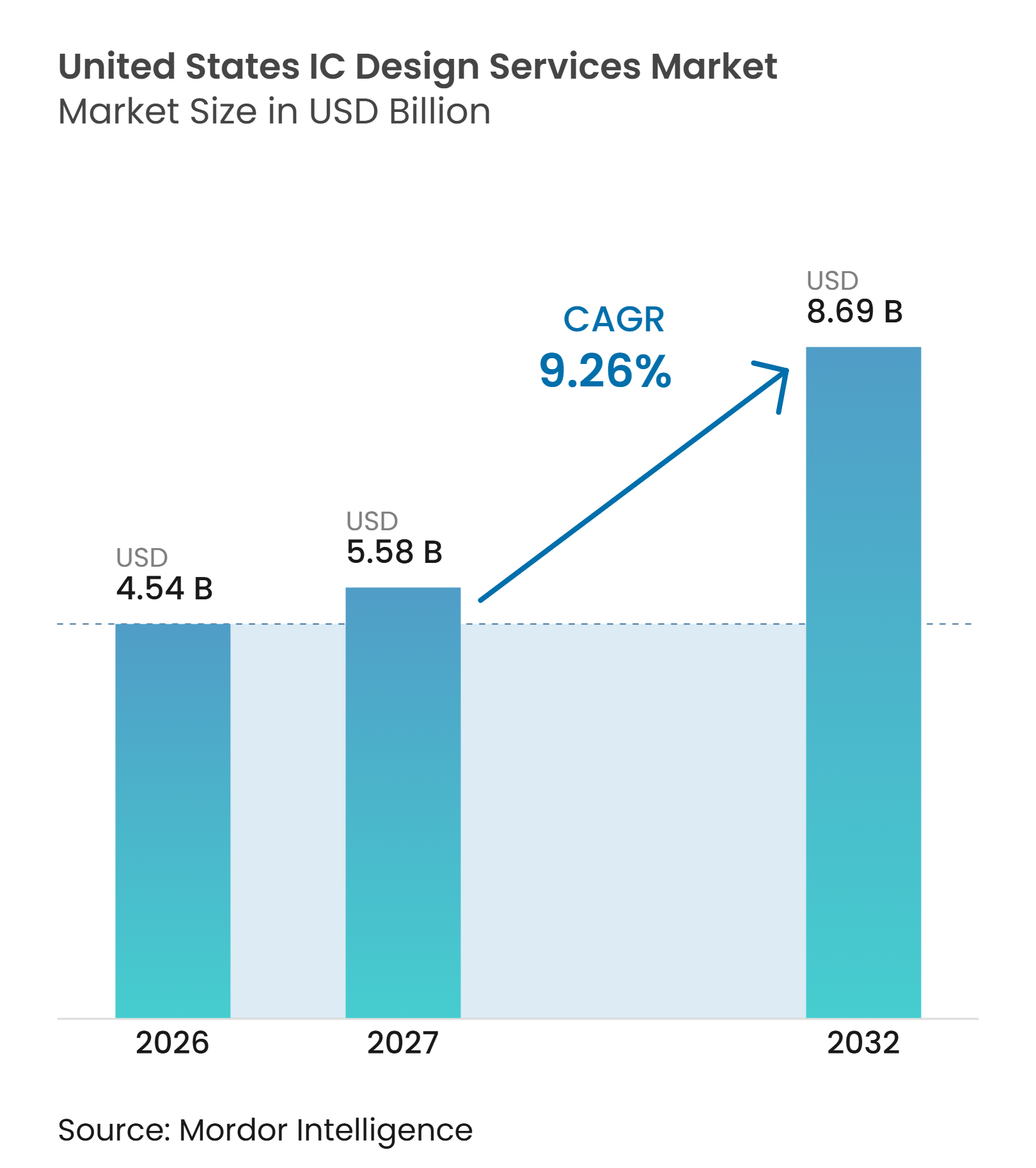
| Base Year Market Size (2026) | USD 4.54 Billion |
| Market Size (2027) | USD 5.58 Billion |
| Market Size (2032) | USD 8.69 Billion |
| Growth Rate (2027 - 2032) | 9.26 % |
| Market Concentration | Medium |
Major Players *Disclaimer: Major Players sorted in no particular order Image © Mordor Intelligence. Reuse requires attribution under CC BY 4.0. | |
United States IC Design Services Market Analysis by Mordor Intelligence
The United States IC Design Services market size is projected to expand from USD 4.54 billion in 2026 to USD 5.58 billion in 2027, and to USD 8.69 billion by 2032, registering a CAGR of 9.26% between 2027 and 2032. Demand is rising as semiconductor companies use specialist partners to add engineering capacity without building every capability internally or carrying the full cost of specialized teams across each program phase. The United States IC Design Services market is benefiting from custom silicon programs for artificial intelligence, high-performance computing, and data centers, which sustain demand for design, verification, implementation, and system-level coordination. Federal research programs also lower barriers to experimental chip development and can bring university, startup, and research projects into commercial design-service workflows. In the United States IC Design Services market, advanced process nodes, chiplets, and 3D integration are broadening the scope of work across architecture, verification, packaging, and tape-out. Competition increasingly depends on advanced-node credentials, access to qualified global engineering teams, reusable IP, and the ability to deliver work across the silicon development cycle. The United States IC Design Services market gives providers with these capabilities opportunities to move from discrete engineering assignments toward longer customer engagements.
Key Report Takeaways
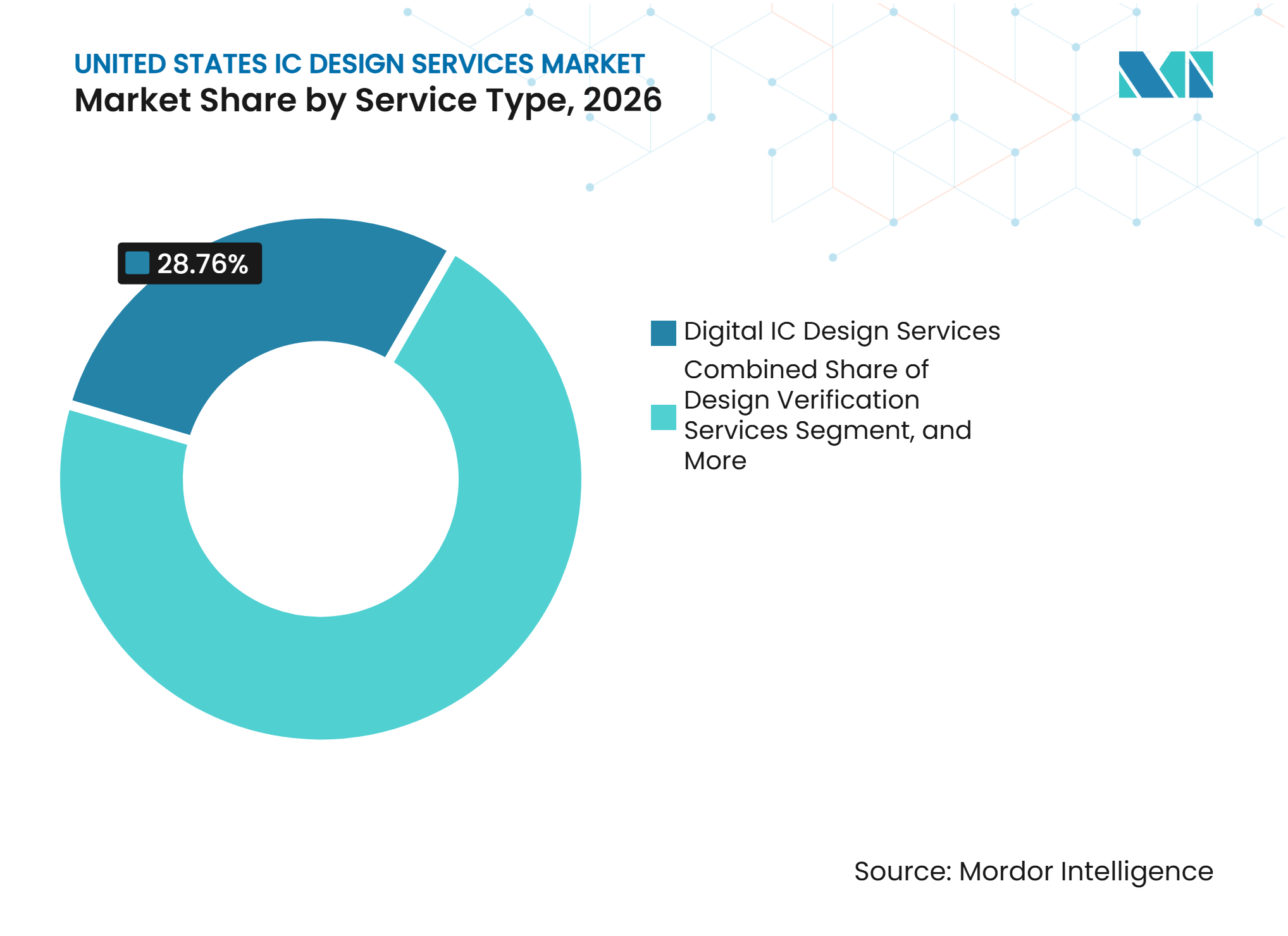
By service type, Digital IC Design Services held 28.76% of the United States IC Design Services market share in 2026, while Design Verification Services is projected to expand at a 10.66% CAGR through 2032.
By end-user application, AI, HPC and Data Centers accounted for 33.09% of the United States IC Design Services market size in 2026 and is expected to expand at a 10.71% CAGR through 2032.
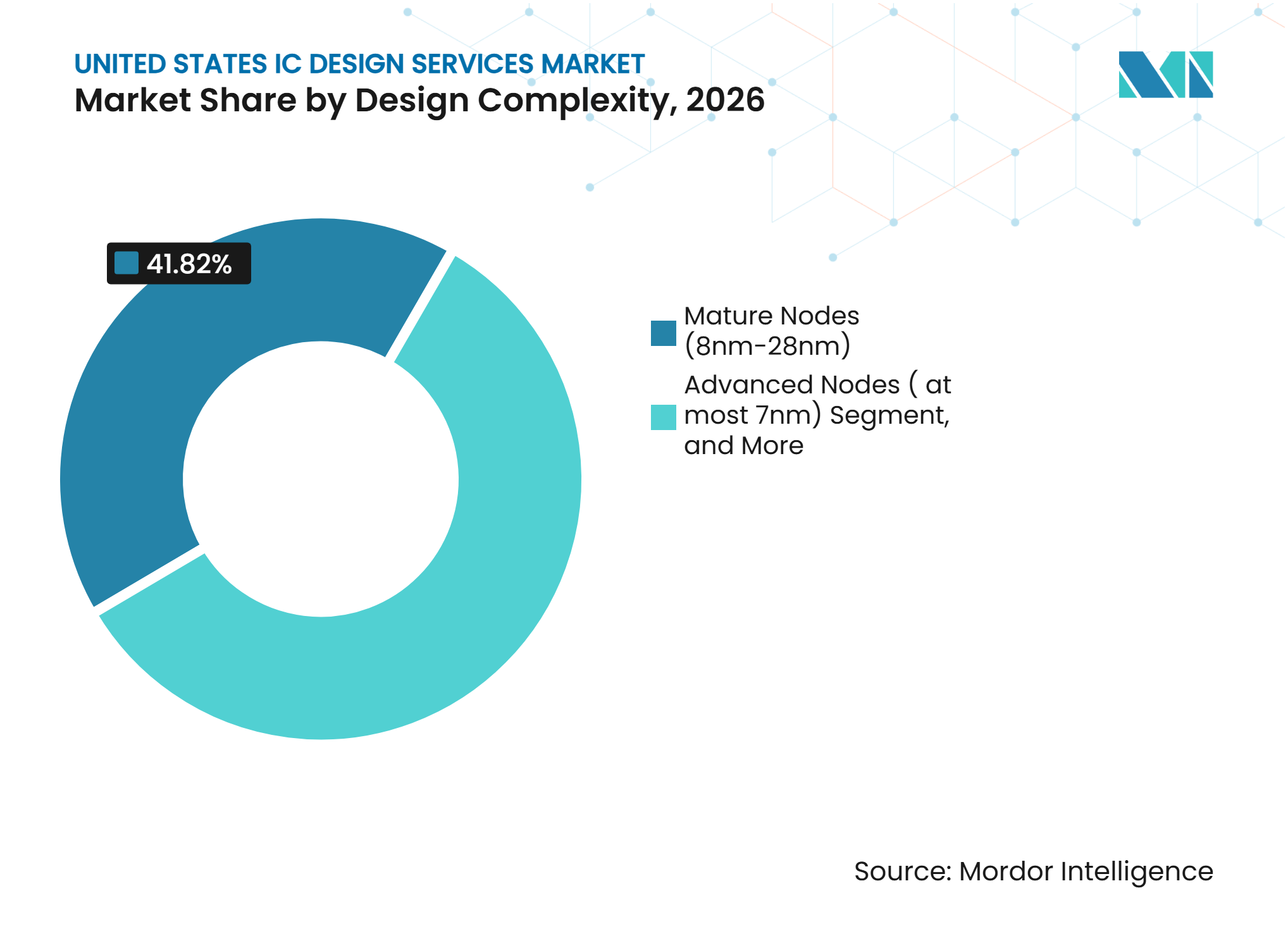
By design complexity, Mature Nodes, 8nm-28nm, held 41.82% of revenue in 2026, while Advanced Nodes, ≤7nm, is projected to advance at a 9.89% CAGR through 2032.
Note: Market numbers in this report are based on Mordor Intelligence's proprietary estimation framework, which combines nine months of actuals with Q4 projections for base year 2026.
Market Trends and Insights
Drivers Impact Analysis of United States IC Design Services Market*
| Driver | (~) % Impact on CAGR Forecast | Geographic Relevance | Impact Timeline |
|---|---|---|---|
| Outsourcing Of Complex IC Design Engineering Activities | +3.1% | National, with US-serving delivery from Taiwan, South Korea, India, and Europe | Short term (≤ 2 years) |
| Government-Backed Semiconductor R&D And Domestic Design Initiatives | +1.5% | National, with key hubs in California, Texas, Arizona, New York, Ohio, and Oregon | Medium term (2-4 years) |
| Advanced Node Design Complexity | +1.2% | National, with global supply chain implications | Medium term (2-4 years) |
| Chiplet Architectures And Advanced Packaging Adoption | +1.0% | Global, with US-led design specification and cross-border execution | Medium term (2-4 years) |
| Rising Semiconductor Content In Automotive, Industrial, And Connected Devices | +0.7% | National, with North America as a primary automotive demand center | Medium term (2-4 years) |
| Secure Semiconductor Design Demand In Defense And Aerospace | +0.5% | National, with US defense programs and Trusted Foundry supply chains | Long term (≥ 4 years) |
| Source: Mordor Intelligence | |||
Outsourcing Of Complex IC Design Engineering Activities
The United States IC Design Services market is supported by outsourcing of front-end and back-end engineering work. Fabless companies and hyperscalers retain architecture, product definition, and ownership within their own teams. They assign RTL design, physical implementation, design-for-test, and verification activities to specialist providers. This model lets companies add capacity while avoiding equivalent increases in domestic engineering headcount. Alchip derived 78% of its 2025 revenue from North American customers, showing the scale of external design capacity used by customers in the region. This United States IC Design Services market pattern separates domestic chip specification from globally distributed physical design and packaging work.
Government-Backed Semiconductor R&D And Domestic Design Initiatives
Federal semiconductor research funding is expanding the pool of organizations eligible to pursue advanced chip programs. The Department of Commerce Office of Inspector General reported that the CHIPS Research and Development Office had awarded USD 8.3 billion in semiconductor R&D funding by January 2025. The CHIPS R&D Office launched the NSTC Investment Fund in April 2026 for companies commercializing semiconductor research and development.[1] The National Semiconductor Technology Center Design Collaboration Facility was intended to expand access to EDA software and reduce the cost of experimental chip design. The White House strategy identifies design enablement as a national microelectronics priority alongside manufacturing. University, startup, and research programs can therefore require commercial support as they move designs toward tape-out.
Advanced Node Design Complexity
Advanced nodes increase the specialist work required to complete a chip design. Higher transistor counts raise the need for reusable processor, memory, and connectivity IP. The Semiconductor Industry Association stated that IP licensing accounts for more than 50% of total design costs at sub-7nm nodes. Companies must balance custom development against licensed IP when developing leading-edge products. Verification and qualification cycles extend the engineering effort needed before tape-out. In the United States IC Design Services market, these conditions favor service providers with proven methodologies, process knowledge, and reusable design assets.
Chiplet Architectures And Advanced Packaging Adoption
Chiplet adoption is changing the scope of work performed by IC design service providers. Modular designs require die-to-die interface design, interposer layout, and coordination of 2.5D and 3D structures. TCS launched chiplet-based system engineering services in September 2025, covering UCIe and HBM interfaces, verification, and interposer design. GUC announced 2nm 16 Gbps HBM4E IP in September 2026, extending its high-bandwidth memory interface portfolio. The IEEE Heterogeneous Integration Roadmap describes heterogeneous integration as a critical aerospace and defense capability. Providers that combine knowledge of digital, analog, signal integrity, power delivery, and packaging are better positioned to support these programs.
Restraints Impact Analysis of United States IC Design Services Market*
| Restraint | (~) % Impact on CAGR Forecast | Geographic Relevance | Impact Timeline |
|---|---|---|---|
| High Engineering Labor Costs And Talent Competition | -2.1% | National, with Silicon Valley, Austin, and Seattle as primary markets | Short term (≤ 2 years) |
| Advanced Node Complexity And High EDA Licensing Costs | -1.6% | National, with global implications for US-serving design houses | Medium term (2-4 years) |
| Shortage Of Specialized IC Design Engineers | -1.2% | National, with California, Texas, Oregon, and Arizona as primary hubs | Medium term (2-4 years) |
| Export Controls And Cross-Border Technology Restrictions | -0.8% | International operations of US-based companies and their design partners | Medium term (2-4 years) |
| Source: Mordor Intelligence | |||
High Engineering Labor Costs And Talent Competition
High engineering compensation limits domestic teams' ability to scale at the pace of chip programs. It also makes external engineering delivery more attractive for companies that need additional capacity. A University of Southern California Information Sciences Institute study found that semiconductor demand in Southern California for engineers was 3 times that for technicians. The Semiconductor Industry Association reported that only 3% of graduates entering engineering jobs each year join the semiconductor sector. The supply constraint places particular pressure on analog, mixed-signal, physical design, and verification roles. Companies therefore use global delivery teams while keeping product architecture and customer decisions close to their domestic operations.
Advanced Node Complexity And High EDA Licensing Costs
Advanced-node design requires a larger set of EDA tools, IP blocks, compute resources, and specialist skills. These requirements raise the cost of participating in leading-edge programs. Global IC Physical Design and Verification revenue increased 16.6% year over year in the second quarter of 2026, reflecting demand for complex implementation and verification work. Cadence offers multi-die 3D-IC design tools for analysis and sign-off across integrated die and package workflows. The cost burden can narrow the number of providers able to support advanced projects. It also encourages design houses to reuse IP and automation across more engagements.
*Our forecasts treat driver/restraint impacts as directional, not additive. The impact forecasts reflect baseline growth, mix effects, and variable interactions.
United States IC Design Services Market Segment Analysis
By Service Type:
Digital Services Lead, Verification Drives Future DemandDigital IC Design Services held 28.76% of the United States IC Design Services market share in 2026. The segment benefits from continued demand for RTL development and system-on-chip integration. Hyperscalers and fabless companies require digital implementation capacity for custom ASIC programs. Global electronic design services revenue increased 25.1% year over year in the second quarter of 2026. The result indicates sustained demand for external engineering services that support digital implementation. Digital work remains central because it connects system architecture with implementation, integration, and eventual verification.
Design Verification Services is projected to expand at a 10.66% CAGR from 2027 to 2032. Multi-billion-transistor designs require functional verification, formal sign-off, and silicon bring-up activities that can exceed internal team capacity. Verification providers need staff who can use modern simulation and test-generation workflows. Analog IC Design Services and Analog Mixed-Signal IC Design Services retain importance in automotive power management, medical devices, and industrial sensor interfaces. Physical Design and Layout Services are also becoming more relevant as chiplets add interposer layout and die-to-die routing requirements. IP Development and Design Support Services benefit as customers reuse proven blocks across several chip programs.



By End-User Application:
AI, HPC And Data Centers Combine Scale And MomentumAI, HPC, and Data Centers accounted for 33.09% of revenue in 2026 and are projected to expand at a 10.71% CAGR through 2032. Hyperscalers are advancing proprietary ASIC programs to optimize workload performance and reduce reliance on merchant silicon. These programs require substantial support for digital design, verification, physical implementation, and packaging. SEMIFIVE secured a USD 52 million AI accelerator contract with a US fabless company during 2026. The engagement showed how a single accelerator program can materially affect demand for a design services provider. It also reflected customers' preference for providers that can support development through production.
Automotive applications offer an additional source of demand as connected vehicles, electrification, and driver-assistance systems require more semiconductors. Consumer Electronics and Industrial programs provide a steadier base for providers with analog, mixed-signal, and mature-node skills. Defense and Aerospace work requires radiation-hardened designs and longer program cycles. Healthcare designs require low-power and miniaturized analog topologies for implantable and wearable products. Telecom and Networking applications need high-speed SerDes, coherent DSP, and RF front-end design capabilities. These end uses broaden the United States IC Design Services industry beyond the investment cycles of AI infrastructure customers.
By Design Complexity:
Mature Nodes Support Revenue, Advanced Nodes AccelerateMature Nodes, 8nm-28nm, accounted for 41.82% of the United States IC Design Services market size in 2026. Automotive, industrial, defense, and medical applications favor established processes because they offer stability, extended product lifecycles, and suitable cost structures. Analog, mixed-signal, and power-management designs also commonly use mature and legacy processes. These nodes provide multiple foundry options and established manufacturing flows. Mature-node work consequently provides consistent opportunities for providers with design, layout, and validation expertise. The segment remains important even as leading-edge demand receives more industry attention.
Advanced Nodes (≤7nm) are projected to grow at a 9.89% CAGR through 2032. AI accelerators, networking ASICs, and advanced processors use smaller geometries to meet compute density and power efficiency requirements. Programs at sub-7nm nodes require longer verification and qualification cycles than designs at established nodes. They also require closer coordination among IP suppliers, EDA vendors, foundries, and packaging partners. Legacy Nodes (Above 28nm) continue to serve microcontrollers, power devices, and mixed-signal devices in cost-sensitive applications. Providers that build verification automation and reusable IP can improve delivery predictability across these design programs.

Geography Analysis
California
California remains the primary United States IC Design Services market demand center because it is home to dense clusters of fabless companies, AI chip startups, and hyperscaler architecture teams. NVIDIA, Apple, Qualcomm, Broadcom, and AMD maintain major design and architecture operations in the San Francisco Bay Area. Synopsys and Cadence also operate from the region, which supports close interaction between EDA providers and chip development teams. The University of Southern California's Information Sciences Institute identified a 20% shortfall in the local semiconductor workforce.[2] This shortage is directing more design and verification work to service teams in Taiwan, South Korea, and India. Startup activity also creates a pipeline of companies that may need external tape-out support before they can build large internal teams.
Texas
Texas is emerging as a major semiconductor design and manufacturing hub in the United States IC Design Services market. The state has substantial cumulative semiconductor workforce requirements through 2030, according to the National Network for Microelectronics Education. Texas Instruments, NXP Semiconductors' US operations, and AMD's Austin design center anchor enterprise design activity. Manufacturing expansion creates demand for process-aware physical design and design-for-test work. The Dallas-Fort Worth and Austin corridors also connect automotive semiconductor programs with a broad engineering base. Lower engineering costs than the San Francisco Bay Area can support the expansion of design centers outside California. The state's talent supply and manufacturing activity provide providers with a practical setting for deeper customer engagement.
Pacific Northwest, Northeast, Southwest, And Midwest
The Pacific Northwest, Northeast, Southwest, and Midwest are adding specialized demand within the United States IC Design Services market. In Oregon and Washington, Intel's Hillsboro campus and Amazon Web Services custom silicon programs support physical design and verification requirements. Arizona State University Research Park hosts the NSTC prototyping and advanced packaging piloting facility, where preliminary activities began in 2026. This facility complements TSMC's planned five-fab campus and supports process-specific design work. New York and New England draw on defense-related IC design and analog mixed-signal expertise. The NSF-supported ACE-3D Chip Design Hub at the University of Chicago is developing capabilities for vertically stacked 3D architectures. These hubs show that federal programs, advanced packaging, and local research strengths are extending the national design ecosystem.
Competitive Landscape
Market Concentration
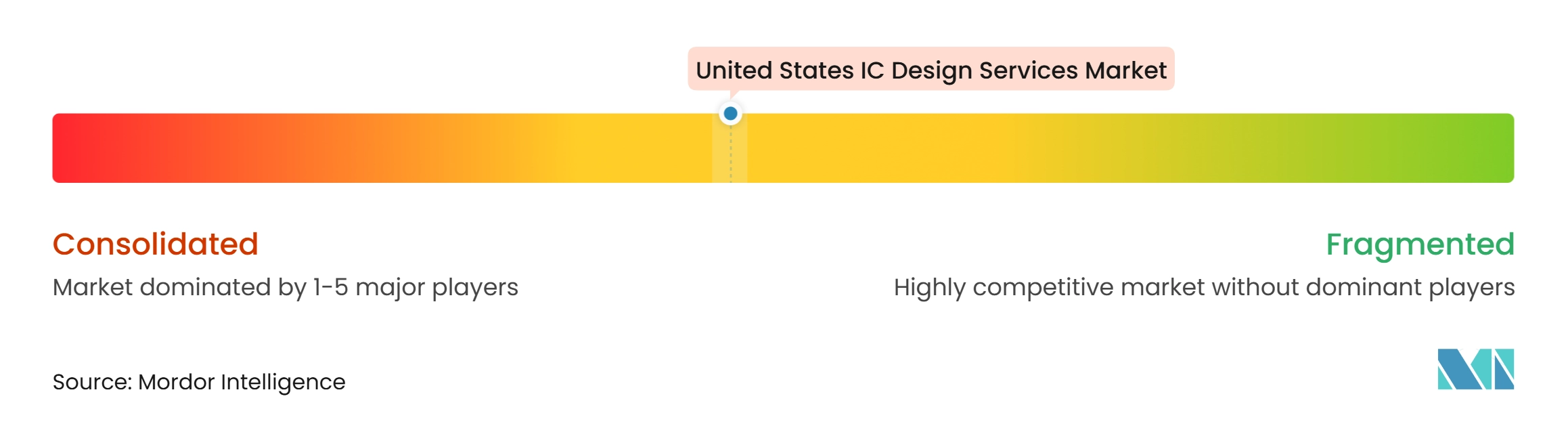
The United States IC Design Services market has moderate concentration in advanced-node work and greater fragmentation in mature-node engineering services. GUC and Alchip hold strong positions in AI ASIC design through their proximity to TSMC's advanced process technologies. Alchip's North American customers provided 78% of its 2025 revenue. India-based providers are expanding US customer mandates in front-end design and verification. Their competitiveness rests on global delivery capacity and cost-effective engineering coverage. Advanced-node providers compete through process experience, IP portfolios, and foundry relationships.
Customers increasingly seek partners that can extend from RTL implementation into packaging, testing, and production support. SEMIFIVE's USD 52 million AI accelerator engagement with a US fabless company was structured as an end-to-end ASIC program. TCS introduced chiplet system engineering services in 2025, covering interfaces, verification, and 2.5D and 3D interposer design.[3] GUC strengthened its position in advanced memory interfaces by announcing its 2nm 16 Gbps HBM4E IP. These moves show that providers are investing in broader technical scope rather than relying on point design services. Design verification automation, chiplet-aware physical design, and secure aerospace designs remain areas with fewer qualified suppliers.
Regulatory compliance is becoming part of the competitive assessment for advanced computing programs. BIS due diligence rules and the Authorized IC Designer framework shape access to certain advanced computing IC transactions. Providers that meet these requirements can offer customers greater confidence in restricted supply-chain work. MosChip reported FY2026 revenue of INR 585.15 crore (USD 70.2 million), up 25.34% from the prior year. Its expansion in Japan and South Korea was accompanied by continued activity in North America. The market concentration score is 4 of 10, as a few providers lead advanced-node AI ASIC engagements while the wider front-end, verification, and mature-node service base remains fragmented.
United States IC Design Services Industry Leaders
-
HCL Technologies Limited Pre footer link
-
Wipro Limited
-
Capgemini SE
-
L&T Technology Services Limited
-
eInfochips (An Arrow Company)
- *Disclaimer: Major Players sorted in no particular order
United States IC Design Services Market Companies Covered in this Report
- Global Unichip Corporation
- Alchip Technologies Limited
- Faraday Technology Corporation
- VeriSilicon Microelectronics (Shanghai) Co., Ltd.
- SEMIFIVE Co., Ltd.
- CoAsia SEMI Co., Ltd.
- Sondrel Limited
- EnSilica plc
- Racyics GmbH
- ICsense NV
- E-Infochips Private Limited
- HCL Technologies Limited
- L&T Technology Services Limited
- MosChip Technologies Limited
- Tessolve Semiconductor Private Limited
Recent Industry Developments in United States IC Design Services Market
- September 2026: SEMIFIVE commenced mass production of HyperAccel's LLM AI inference accelerator on Samsung Foundry's 4nm advanced process node, a Big Die chip exceeding 500 mm², delivering a complete turnkey solution from front-end design through packaging, testing, and volume manufacturing supply. The company secured KRW 42.3 billion (USD 30.7 million) in new mass-production orders in H1 2026, nearly double its full-year 2025 order intake, with overseas orders accounting for 45% of Q2 2026 bookings.
- September 2026: Global Unichip Corp. announced its 2nm 16 Gbps HBM4E IP, extending its advanced packaging IP portfolio at the leading edge of high-bandwidth memory interface standards and reinforcing its competitive positioning for next-generation AI accelerator programs targeting the most advanced process nodes.
- May 2026: SEMIFIVE secured a USD 52 million AI accelerator contract with a US fabless company, its first North American spec hand-off project and the company's largest single contract to date, validating its end-to-end ASIC model with a customer segment that represents the most dynamic demand pool in the global IC design services market.
- April 2026: The CHIPS Research and Development Office launched the Investment Fund for the National Semiconductor Technology Center, creating a new investment pathway for companies commercializing semiconductor R&D innovations, with applications processed through the existing Broad Agency Announcement framework and project budgets required to be at least USD 10 million.
United States IC Design Services Market Report Scope
The United States IC Design Services Market encompasses revenue generated by companies that provide outsourced and specialized integrated circuit (IC) design, development, verification, and engineering support services to semiconductor manufacturers, fabless semiconductor companies, integrated device manufacturers (IDMs), OEMs, and system developers.
The United States IC Design Services Market Report is Segmented by Service Type (Analog IC Design Services, Digital IC Design Services, Analog Mixed-Signal (AMS) IC Design Services, Physical Design and Layout Services, Design Verification Services, IP Development and Design Support Services, and Other Service Types), End-User Application (Automotive, AI, HPC, and Data Centers, Consumer Electronics, Industrial, Defense and Aerospace, Medical and Healthcare, Telecom and Networking, and Other End-User Applications), Design Complexity (Advanced Nodes (≤7nm), Mature Nodes (8nm-28nm), and Legacy Nodes (Above 28nm)). The Market Forecasts are Provided in Terms of Value (USD).
Segmentation Overview
| Analog IC Design Services |
| Digital IC Design Services |
| Analog Mixed-Signal (AMS) IC Design Services |
| Physical Design and Layout Services |
| Design Verification Services |
| IP Development and Design Support Services |
| Other Service types |
| Automotive |
| AI, HPC, and Data Centers |
| Consumer Electronics |
| Industrial |
| Defense and Aerospace |
| Medical and Healthcare |
| Telecom and Networking |
| Other End-User Applications |
| Advanced Nodes (≤7nm) |
| Mature Nodes (8nm-28nm) |
| Legacy Nodes (Above 28nm) |
| By Service Type | Analog IC Design Services |
| Digital IC Design Services | |
| Analog Mixed-Signal (AMS) IC Design Services | |
| Physical Design and Layout Services | |
| Design Verification Services | |
| IP Development and Design Support Services | |
| Other Service types | |
| By End-User Application | Automotive |
| AI, HPC, and Data Centers | |
| Consumer Electronics | |
| Industrial | |
| Defense and Aerospace | |
| Medical and Healthcare | |
| Telecom and Networking | |
| Other End-User Applications | |
| By Design Complexity | Advanced Nodes (≤7nm) |
| Mature Nodes (8nm-28nm) | |
| Legacy Nodes (Above 28nm) |
Key Questions Answered in the Report
What is the United States IC Design Services market size?
It is projected to increase from USD 5.58 billion in 2027 to USD 8.69 billion by 2032, at a 9.26% CAGR.
What is driving demand for IC design services in the United States?
Custom ASIC programs for AI, HPC, and data centers, plus outsourcing of complex verification and physical design work, are supporting demand.
Which service type leads the United States IC Design Services sector?
Digital IC Design Services led with 28.76% share in 2026, while Design Verification Services is projected to record the fastest service-type expansion at a 10.66% CAGR.
Which end-user application has the strongest demand?
AI, HPC and Data Centers held 33.09% of revenue in 2026 and is expected to advance at a 10.71% CAGR through 2032.
Why are advanced-node programs important to design service providers?
Advanced-node programs need specialized verification, IP integration, process knowledge, and closer coordination with foundry and packaging partners.
Which US states are key IC design services hubs?
California leads in fabless, AI, and EDA activity, while Texas, Arizona, Oregon, Washington, and New York add manufacturing, research, and specialized design demand.