
United States Heat Exchangers Market Size and Share
Market Overview
| Study Period | 2022 - 2032 |
|---|---|
| Forecast Data Period | 2027 - 2032 |
| Base Year Market Size (2026) | USD 3.24 Billion |
| Market Size (2027) | USD 3.80 Billion |
| Market Size (2032) | USD 4.90 Billion |
| Growth Rate (2027 - 2032) | 5.25 % |
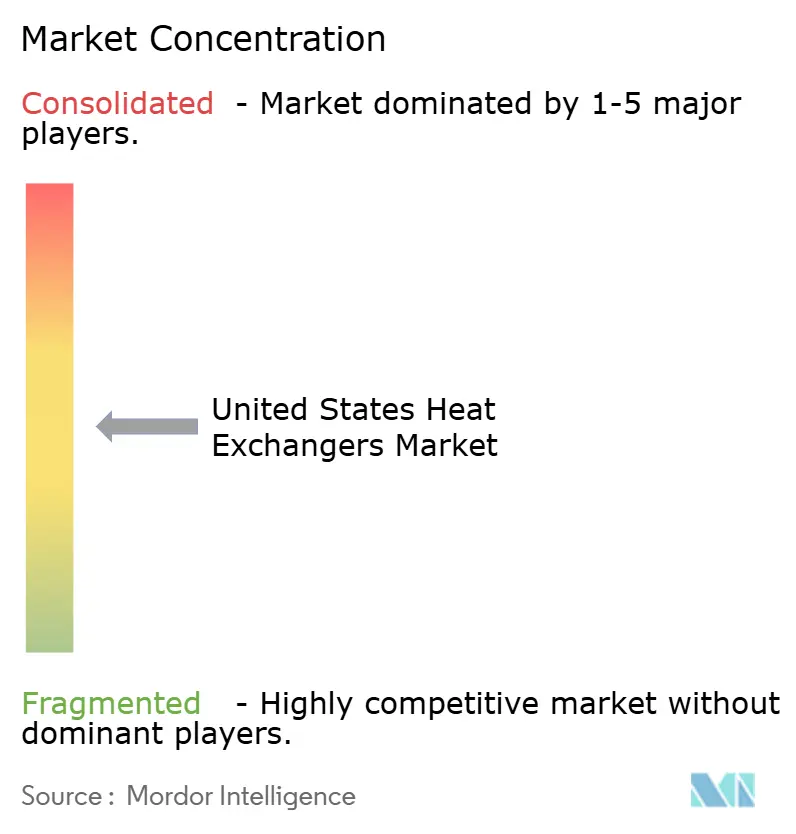
| Market Concentration | Medium |
Major Players *Disclaimer: Major Players sorted in no particular order Image © Mordor Intelligence. Reuse requires attribution under CC BY 4.0. | |
United States Heat Exchangers Market Analysis by Mordor Intelligence
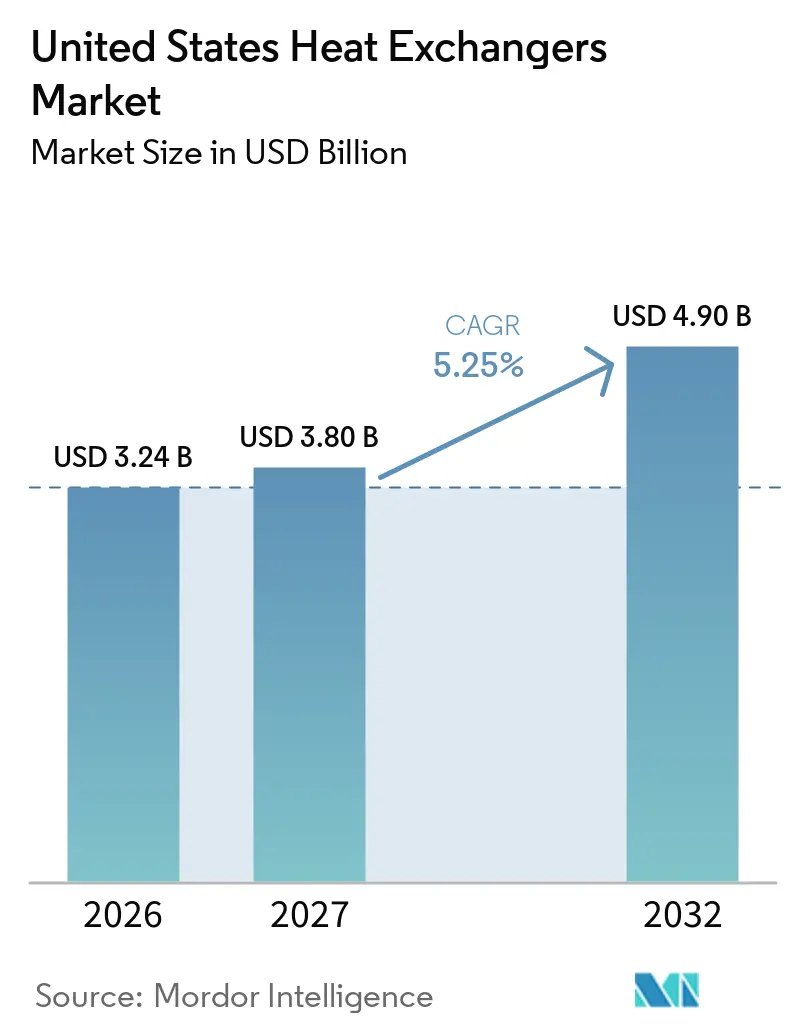
The United States heat exchangers market size was valued at USD 3.24 billion in 2026 and is estimated to grow from USD 3.80 billion in 2027 to reach USD 4.90 billion by 2032, at a CAGR of 5.25% during the forecast period (2027-2032). Demand is shifting toward compact equipment for liquid-cooled data centers, heat-pump HVAC systems, and industrial waste-heat recovery. Traditional refinery replacement activity remains significant, but it is no longer the sole driver of equipment demand. Manufacturing incentives and computing infrastructure investment are directing capital toward efficient thermal equipment. Suppliers are responding by adding production capacity, developing new products, and targeting more specialized applications. The United States heat exchangers market depends on both large industrial projects and newer cooling and electrification requirements.
Key Report Takeaways
- By type, shell-and-tube held 34.2% of the United States heat exchangers market share in 2026, while plate and frame is forecast to grow at a 6.2% CAGR through 2032.
- By material of construction, stainless steel held 37.8% share in 2026 and is forecast to grow at a 6.8% CAGR through 2032.
- By flow arrangement, counter-current held 63.6% of the United States heat exchangers market share in 2026, while cross-flow is forecast to grow at a 6.7% CAGR through 2032.
- By end-use industry, chemical and petrochemical processing held 26.3% of revenue in 2026, while other industries are forecast to grow at a 7.1% CAGR through 2032.
Note: Market numbers in this report are based on Mordor Intelligence's proprietary estimation framework, which combines nine months of actuals with Q4 projections for base year 2026.
Market Trends and Insights
Drivers Impact Analysis of United States Heat Exchangers Market*
| Driver | (~) % Impact on CAGR Forecast | Geographic Relevance | Impact Timeline |
|---|---|---|---|
| Industrial Modernization and Process-Efficiency Investment | +1.1% | Gulf Coast, Texas and Louisiana, and the Midwest, Ohio, Michigan, and Illinois | Medium term (2-4 years) |
| HVAC, Refrigeration, and Heat-Pump Electrification | +1.2% | National, with early gains in the Sun Belt and Mid-Atlantic | Short term (≤ 2 years) |
| Data-Center Liquid Cooling and Thermal-Network Development | +1.3% | Virginia and Texas hyperscale corridor, expanding to the Pacific Northwest | Short term (≤ 2 years) |
| Industrial Decarbonization and Waste-Heat Recovery Programs | +0.9% | Heavy-industry states, including Texas, Indiana, Pennsylvania, and Ohio | Medium term (2-4 years) |
| Domestic Manufacturing, Refining, and Infrastructure Incentives | +0.7% | Gulf Coast, Appalachian Basin, and Midwest | Medium term (2-4 years) |
| Digital Monitoring, Predictive Maintenance, and Connected Thermal Systems | +0.5% | National, with early adoption in Texas and Midwest industrial hubs | Long term (≥ 4 years) |
| Source: Mordor Intelligence | |||
Data-Center Liquid Cooling and Thermal-Network Development
Hyperscale data center construction has become a major source of demand in the United States heat exchangers market. AI-oriented computing systems require significantly higher heat removal than conventional racks. The U.S. Department of Energy projected that U.S. data center electricity use could reach 325 to 580 TWh by 2028. This requirement increases demand for liquid-side heat rejection equipment across cooling distribution units and facility cooling loops. Brazed plate and microchannel equipment are used where compact layouts and close thermal control are required. In February 2026, Danfoss A/S launched its B3-260C brazed plate heat exchanger for data center cooling, with a capacity of up to 1 MW and design optimization for low temperature differences.
HVAC, Refrigeration, and Heat-Pump Electrification
Heat pump electrification supports another important demand stream for the United States heat exchangers market. Heat pumps shipped 3.6 million units in 2025, exceeding gas furnace shipments by 12%.[1] These systems use heat exchange components in refrigerant circuits and hydronic applications. The transition to A2L refrigerants for new residential and light-commercial equipment after January 1, 2025, has increased the need for equipment redesigns. Compact geometries can support these redesigned systems where installation space is limited. Commercial building retrofits also create demand for plate heat exchanger-based heat interface units.
Industrial Decarbonization and Waste-Heat Recovery Programs
Industrial decarbonization is expanding thermal equipment demand in high-temperature applications. These applications include steam generation from process heat, electrolyzer thermal management, and direct air capture systems. Federal advanced manufacturing support and heat recovery programs improve project economics for some industrial facilities. Fouling in crude preheat trains was estimated to cost U.S. refiners USD 1 billion to USD 1.2 billion annually. Fouling also increases energy use and maintenance requirements, driving interest in low-fouling designs and planned cleaning schedules. Compact welded plate units can reduce both equipment footprint and energy use in suitable process applications.
Domestic Manufacturing, Refining, and Infrastructure Incentives
Federal industrial policy supports the United States heat exchangers market through manufacturing investment and infrastructure demand. The Section 48C Advanced Manufacturing Tax Credit is one relevant mechanism for eligible manufacturing investments.[2] Gulf Coast liquefied natural gas (LNG) projects require custom equipment for feed-gas conditioning and liquefaction service. Clean hydrogen facilities also require thermal management equipment for electrolyzer systems. These projects add demand beyond historical refinery replacement cycles. Input cost volatility for stainless steel and copper can favor domestic fabrication while creating margin pressure for import-dependent suppliers.
Restraints Impact Analysis of United States Heat Exchangers Market*
| Restraint | (~) % Impact on CAGR Forecast | Geographic Relevance | Impact Timeline |
|---|---|---|---|
| High Upfront Cost and Extended Capital Approval Cycles | -0.7% | National, with greater exposure in midstream and power generation pipelines | Medium term (2-4 years) |
| Fouling, Corrosion, and Lifecycle Maintenance Complexity | -0.6% | Gulf Coast refining and Midwest chemical plants | Long term (≥ 4 years) |
| Skilled Thermal-Systems Labor Shortages | -0.4% | National, with acute shortages in Gulf Coast and Midwest industrial hubs | Medium term (2-4 years) |
| Retrofit-Space, Water-Availability, and System-Integration Constraints | -0.3% | Southwest industrial corridors with water constraints | Medium term (2-4 years) |
| Source: Mordor Intelligence | |||
High Upfront Cost and Extended Capital Approval Cycles
Large custom shell-and-tube units can exceed USD 2 million when engineering costs are included. Oil and gas and power projects can also require multiyear permitting and financing processes, which can delay equipment upgrades in the United States heat exchangers market. Internal hurdle rates above 15% can make premium equipment difficult to justify against continued maintenance of existing assets. Capital approval timelines for certain exchanger upgrades above USD 5 million lengthened by 4 to 6 months between 2024 and 2026. Modular and skid-mounted packages can shorten installation timelines, although they may carry higher unit costs.
Fouling, Corrosion, and Lifecycle Maintenance Complexity
Fouling raises operating costs and reduces effective service life across refining, chemical, and power applications. Fouling in U.S. crude preheat trains is estimated to generate USD 1 billion to USD 1.2 billion in annual costs. Corrosion also increases material selection costs in demanding applications. Operators may specify exotic alloys or polymer composite equipment to reduce cleaning frequency and unplanned downtime. These requirements increase upfront costs, even when they reduce longer-term operating risk, and also support demand for connected monitoring systems and premium low-fouling materials.
*Our forecasts treat driver/restraint impacts as directional, not additive. The impact forecasts reflect baseline growth, mix effects, and variable interactions.
United States Heat Exchangers Market Segment Analysis
By Type:
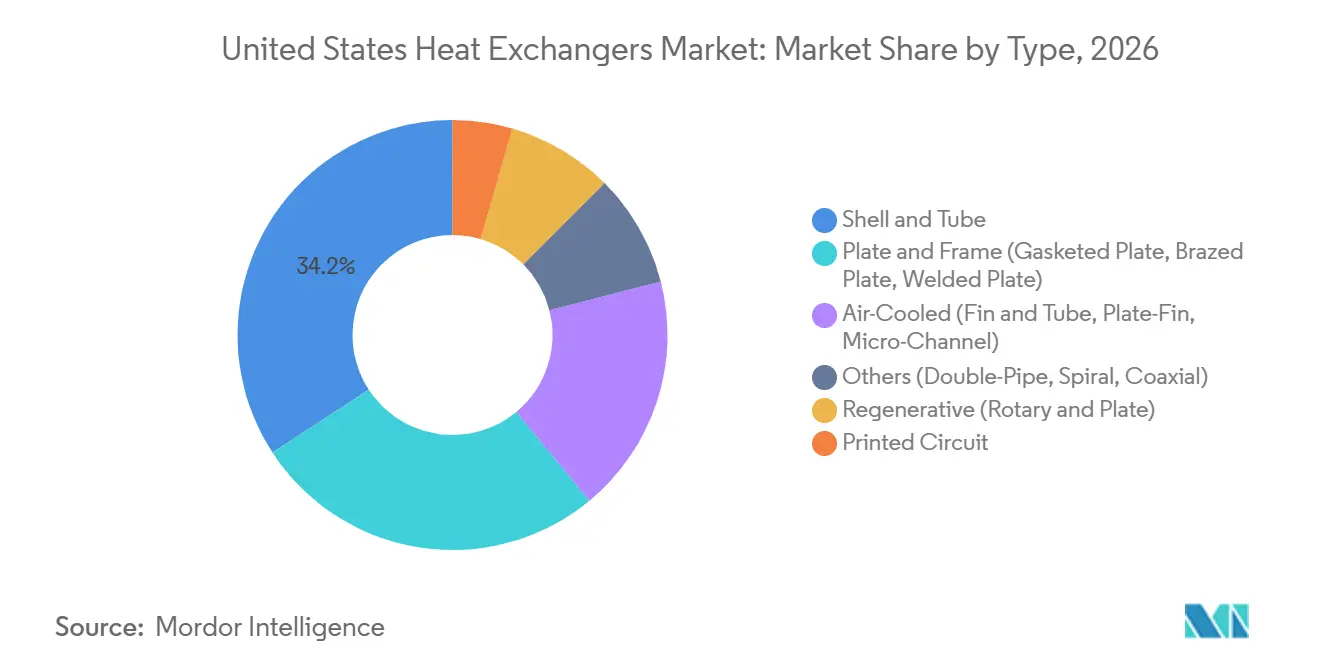
Shell-and-Tube Leads While Compact Equipment Gains GroundShell-and-tube equipment held 34.2% of the United States heat exchangers market in 2026, making it the largest type segment. Its installed base is supported by refinery preheat trains, steam condensers, and reactor coolers. American Society of Mechanical Engineers (ASME)-certified designs and replaceable tube bundles support continued use in established industrial sites. Gulf Coast operators processing heavy crude continue to value the format's fouling tolerance. Plate and frame equipment is forecast to grow at a 6.2% CAGR through 2032, reflecting demand from cooling distribution units and heat-pump hydronic circuits.
Compact equipment can provide a smaller footprint and high thermal efficiency in suitable applications, though gasketed plate designs can have pressure and temperature limitations. Alfa Laval launched the TS45 semi-welded plate heat exchanger in August 2026 for high-capacity and high-pressure applications.[3] Air-cooled units retain demand where cooling water is constrained. Regenerative designs support industrial drying and HVAC energy recovery. Printed circuit exchangers also attract development interest for advanced nuclear applications, where Department of Energy (DOE)-backed research reported 34% to 35% Brayton-cycle efficiency in heat-pipe microreactor work.

By Material of Construction:
Stainless Steel Holds a Broad Demand BaseStainless steel was the dominant material in 2026 and is forecast to grow at a 6.8% CAGR through 2032. This reflects demand from food processing, chemical processing, and hydrogen-related applications. More than 57% of U.S. food processing facilities operated stainless steel plate heat exchangers in 2025. Stainless steel supports sanitary processing and corrosion resistance. Carbon steel remains important for lower-corrosion duties in oil and gas, HVAC, and power generation, though its addressable use narrows when operators prioritize lifecycle performance in corrosive service.
Copper and aluminum remain relevant in HVAC and residential heat-pump systems. Aluminum is widely used in microchannel and fin-and-tube equipment due to its brazing properties. Exotic alloys, including titanium, nickel, and Hastelloy, command premium pricing for severe chemical, desalination, and pharmaceutical duties. The United States heat exchangers market also includes polymer-based options for applications requiring chemical resistance. Alfa Laval began integrating EcoACX low-emission stainless steel into gasketed plate heat exchangers in June 2026. This reflects interest in lowering embodied carbon while maintaining heat-transfer performance.
By Flow Arrangement:
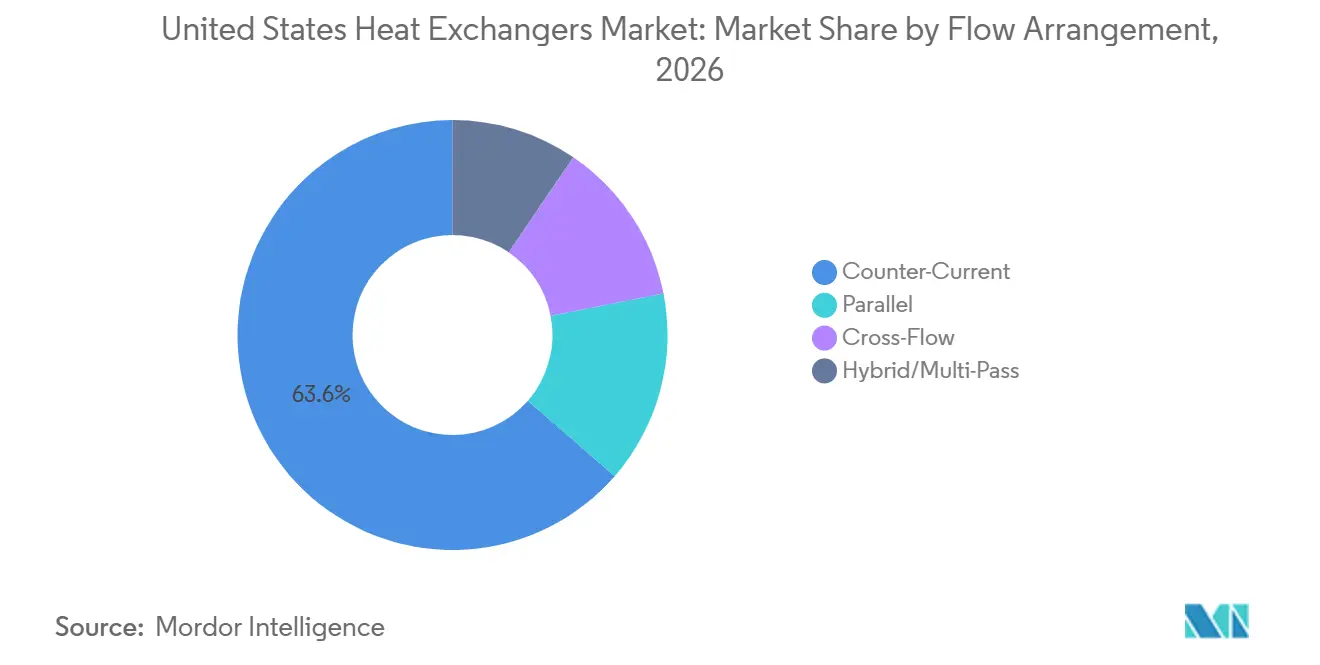
Counter-Current Retains Its Efficiency AdvantageCounter-current flow held 63.6% of U.S. heat exchanger demand in 2026. The configuration provides a high mean temperature difference for specified inlet and outlet conditions, which can reduce the required heat-transfer surface area and equipment cost. Its performance supports use in crude preheat trains, steam condensers, and absorption refrigeration systems. Cross-flow is forecast to grow at a 6.7% CAGR through 2032, supported by data center free-cooling systems and HVAC air-handling units where air is one fluid stream.
Parallel flow can be used where maximum wall temperature must be limited, which is relevant for heat-sensitive food or biochemical streams. Hybrid and multipass arrangements are common in shell-and-tube systems with limited installation space and can accommodate several process streams in refinery service. Kelvion participated in a 2025 project developing 3D-printed prototypes for supercritical carbon dioxide (CO2) systems.[4] This indicates that additive manufacturing can enable more customized flow geometry. The United States heat exchangers industry continues to use established flow arrangements while developing specialized designs.
By End-Use Industry:
Chemical and Petrochemical Processing Leads DemandChemical and petrochemical processing held 26.3% of the United States heat exchangers market in 2026. The sector uses equipment for distillation, reaction cooling, heat integration, and waste-heat recovery, with Texas and Louisiana concentrating a large share of this activity. Operators are upgrading equipment to improve energy integration and meet industrial emissions requirements. Oil and gas demand also comes from liquefied natural gas (LNG) and midstream infrastructure, where projects often require large custom units with extended lead times.
Power generation supports demand through feedwater heaters, steam condensers, and heat recovery steam generators, with nuclear facilities forming part of this stable volume base. Other industries are forecast to grow at a 7.1% CAGR through 2032, a group that includes automotive, metallurgy, mining, HVACR, pharmaceutical, and biotechnology applications. Data center cooling and bioprocessing expansion support this group's growth. Food and beverage demand is supported by sanitary equipment requirements, while water and wastewater facilities are adopting more advanced thermal processes.
Geography Analysis
The Gulf Coast held the largest geographic presence within the United States heat exchangers market in 2025. Texas and Louisiana concentrate refinery, LNG export, and petrochemical capacity. This industrial base drives demand for custom shell-and-tube equipment, exotic alloys for acid-gas service, and air-cooled units where water availability is limited. Refiners are expanding heat-recovery systems for cracking and steam-reforming operations. Metalforms maintains a fabrication presence in Beaumont, Texas, following the 2024 acquisition of Koch Heat Transfer's North American business.
The Mid-Atlantic and Southeast represent the fastest-growing regional demand area for liquid-cooling equipment. The Virginia, North Carolina, and Georgia corridor is a key area for data center development, supporting demand for brazed plate and microchannel equipment for cooling distribution units (CDUs) and facility-side loops. Alfa Laval announced a phased doubling of its Richmond, Virginia capacity in February 2026, with completion planned for mid-2028. Johnson Controls invested in Accelsius in October 2025 and introduced its Silent-Aire CDU platform, supporting demand for qualified cooling assemblies.
The Midwest generates demand from automotive, specialty chemical, food and beverage, and metallurgical applications that follow long refresh cycles. California and the West Coast contribute demand through semiconductor fabrication and renewable-energy projects. Geothermal and concentrated solar projects require brine-handling and thermal-storage configurations. California's cap-and-trade program supports waste-heat recovery investment, while water availability, plant space, and industrial investment levels influence the overall United States heat exchangers market size.
Competitive Landscape
The United States heat exchangers market is moderately consolidated at the premium end. Alfa Laval, Danfoss, Modine Manufacturing, Chart Industries, and Johnson Controls hold positions through manufacturing scale, proprietary designs, and customer qualification processes. Proven performance, supply reliability, and compliance with American Society of Mechanical Engineers (ASME) Section VIII and Air-Conditioning, Heating, and Refrigeration Institute (AHRI) requirements create meaningful barriers in many applications. Alfa Laval announced plans in February 2026 to double its Richmond production capacity by mid-2028, addressing industrial and data center demand.
Modine Manufacturing announced a USD 4 billion agreement in May 2026 for Airedale data center cooling solutions through 2029, with USD 165 million in upfront customer funding. Danfoss began brazed plate heat exchanger production in Monterrey, Mexico in February 2026, with the investment intended to shorten North American supply chains. These developments reflect competition based on capacity, product suitability, and delivery responsiveness, with the United States heat exchangers market attracting investment in data center cooling and energy-transition equipment.
Opportunities remain in printed circuit equipment for advanced nuclear and hydrogen applications, as well as digital fouling management and predictive maintenance. Aftermarket services provide recurring revenue, and TransTech Group expanded access to Koch Heat Transfer brands through its acquisition. Mid-sized specialists can compete through custom shell-and-tube and brazed-plate configurations. Complex service requirements mean the United States heat exchangers market is not defined solely by large OEMs.
United States Heat Exchangers Industry Leaders
-
Alfa Laval AB
-
Danfoss A/S
-
Xylem Inc.
-
Kelvion Holding GmbH
-
SPX FLOW, Inc.
- *Disclaimer: Major Players sorted in no particular order
United States Heat Exchangers Market Companies Covered in this Report
- Alfa Laval AB
- API Heat Transfer Inc.
- Barriquand Technologies Thermiques SAS
- Chart Industries, Inc.
- Danfoss A/S
- FUNKE Wärmeaustauscher Apparatebau GmbH
- HRS Heat Exchangers Ltd.
- Johnson Controls International plc
- Kelvion Holding GmbH
- Koch Heat Transfer Company
- Mersen SA
- Modine Manufacturing Company
- Southern Heat Exchanger Corporation
- SPX FLOW, Inc.
- SWEP International AB
- Taco Comfort Solutions
- Thermax Limited
- Tranter, Inc.
- Wessels Company
- Xylem Inc.
Recent Industry Developments in United States Heat Exchangers Market
- September 2026: Johnson Controls introduces the Sabroe HitemHP industrial heat pump range, designed to deliver high-temperature process heat with up to three times the energy efficiency of electric boilers and up to 82% reductions in on-site CO2 emissions in validated applications. The launch expands the company's thermal management portfolio and increases demand for advanced industrial heat exchanger systems used in heat pump applications.
- August 2026: Alfa Laval launched the TS45 semi-welded plate heat exchanger, the largest semi-welded model in its portfolio. The unit is designed for high-capacity and high-pressure duties in industrial processing, carbon capture, energy transition projects, and industrial heat pumps.
- June 2026: Alfa Laval, in collaboration with Acerinox, began incorporating EcoACX low-emission stainless steel into its gasketed plate heat exchanger manufacturing, reducing embodied carbon in heat exchanger production and supporting sustainability requirements across food processing, energy, HVAC, and data center cooling applications.
- February 2026: Danfoss launched the B3-260C brazed plate heat exchanger, designed specifically for high-density data center cooling applications. The product supports cooling distribution units (CDUs) with capacities up to 1 MW, addressing rapidly growing demand from AI and hyperscale data centers.
United States Heat Exchangers Market Report Scope
A heat exchanger is a device designed to transfer heat from one fluid to another without the fluids mixing or coming into direct contact. It controls system temperatures by either heating or cooling a target fluid stream. These devices are widely used in everyday systems such as refrigerators, air conditioners, and car radiators. They are also essential in large-scale industrial operations, including chemical processing, power generation, and petroleum refining, where energy efficiency is a key requirement.
The United States heat exchangers market is segmented by type into shell and tube, plate and frame, air-cooled, regenerative, printed circuit, and other heat exchangers. By material of construction, the market is segmented into stainless steel, carbon steel, non-ferrous materials, exotic alloys, and polymers and composites. By flow arrangement, the market is segmented into counter-current, parallel, cross-flow, and hybrid/multi-pass configurations. By end-use industry, the market is segmented into oil and gas, chemical and petrochemical, power generation, food and beverage, pulp and paper, water and wastewater treatment, and other industries including automotive and transportation, metallurgy, mining, HVACR, and pharmaceutical and biotechnology. Market forecasts are provided in value terms (USD).
Segmentation Overview
| Shell and Tube |
| Plate and Frame (Gasketed Plate, Brazed Plate, Welded Plate) |
| Air-Cooled (Fin and Tube, Plate-Fin, Micro-Channel) |
| Regenerative (Rotary and Plate) |
| Printed Circuit |
| Others (Double-Pipe, Spiral, Coaxial) |
| Stainless Steel |
| Carbon Steel |
| Non-Ferrous (Copper, Aluminium) |
| Exotic Alloys (Titanium, Nickel, Hastelloy) |
| Polymers and Composites (PTFE, Graphite, Ceramic) |
| Counter-Current |
| Parallel |
| Cross-Flow |
| Hybrid/Multi-Pass |
| Oil and Gas |
| Chemical and Petrochemical |
| Power Generation (incl. Nuclear) |
| Food and Beverage |
| Pulp and Paper |
| Water and Waste-water Treatment |
| Other Industries (Automotive and Transportation, Metallurgy, Mining, HVACR, Pharmaceutical and Biotechnology) |
| By Type | Shell and Tube |
| Plate and Frame (Gasketed Plate, Brazed Plate, Welded Plate) | |
| Air-Cooled (Fin and Tube, Plate-Fin, Micro-Channel) | |
| Regenerative (Rotary and Plate) | |
| Printed Circuit | |
| Others (Double-Pipe, Spiral, Coaxial) | |
| By Material of Construction | Stainless Steel |
| Carbon Steel | |
| Non-Ferrous (Copper, Aluminium) | |
| Exotic Alloys (Titanium, Nickel, Hastelloy) | |
| Polymers and Composites (PTFE, Graphite, Ceramic) | |
| By Flow Arrangement | Counter-Current |
| Parallel | |
| Cross-Flow | |
| Hybrid/Multi-Pass | |
| By End-Use Industry | Oil and Gas |
| Chemical and Petrochemical | |
| Power Generation (incl. Nuclear) | |
| Food and Beverage | |
| Pulp and Paper | |
| Water and Waste-water Treatment | |
| Other Industries (Automotive and Transportation, Metallurgy, Mining, HVACR, Pharmaceutical and Biotechnology) |
Key Questions Answered in the Report
What is the projected value of the United States heat exchangers market by 2032?
The United States heat exchangers market is projected to reach USD 4.90 billion by 2032, from USD 3.80 billion in 2027.
What is driving demand for heat exchangers in the United States?
Key demand drivers include data center liquid cooling, heat pump electrification, industrial waste heat recovery, LNG infrastructure, and process efficiency investment.
Which heat exchanger type is growing the fastest in the United States?
Plate and frame equipment is forecast to grow at a CAGR of 6.2% from 2027 through 2032.
Which material is expected to grow fastest in heat exchanger applications?
Stainless steel is forecast to grow at a CAGR of 6.8% through 2032, driven by demand from food processing, chemicals, and hydrogen-related applications.
Which end-use sector leads heat exchanger demand in the United States?
Chemical and petrochemical processing accounted for 26.3% of market value in 2026, supported by the Gulf Coast industrial base.
How do suppliers compete in the United States heat exchangers market?
Suppliers compete on the basis of qualified product designs, production capacity, delivery responsiveness, specialized applications, and aftermarket service.