
United States Energy Retrofit Tools Market Size and Share
Market Overview
| Study Period | 2022 - 2032 |
|---|---|
| Forecast Data Period | 2027 - 2032 |
| Base Year Market Size (2026) | USD 2.83 Billion |
| Market Size (2027) | USD 3.32 Billion |
| Market Size (2032) | USD 5.18 Billion |
| Growth Rate (2027 - 2032) | 9.33 % |
| Market Concentration | Medium |
Major Players *Disclaimer: Major Players sorted in no particular order Image © Mordor Intelligence. Reuse requires attribution under CC BY 4.0. | |
United States Energy Retrofit Tools Market Analysis by Mordor Intelligence
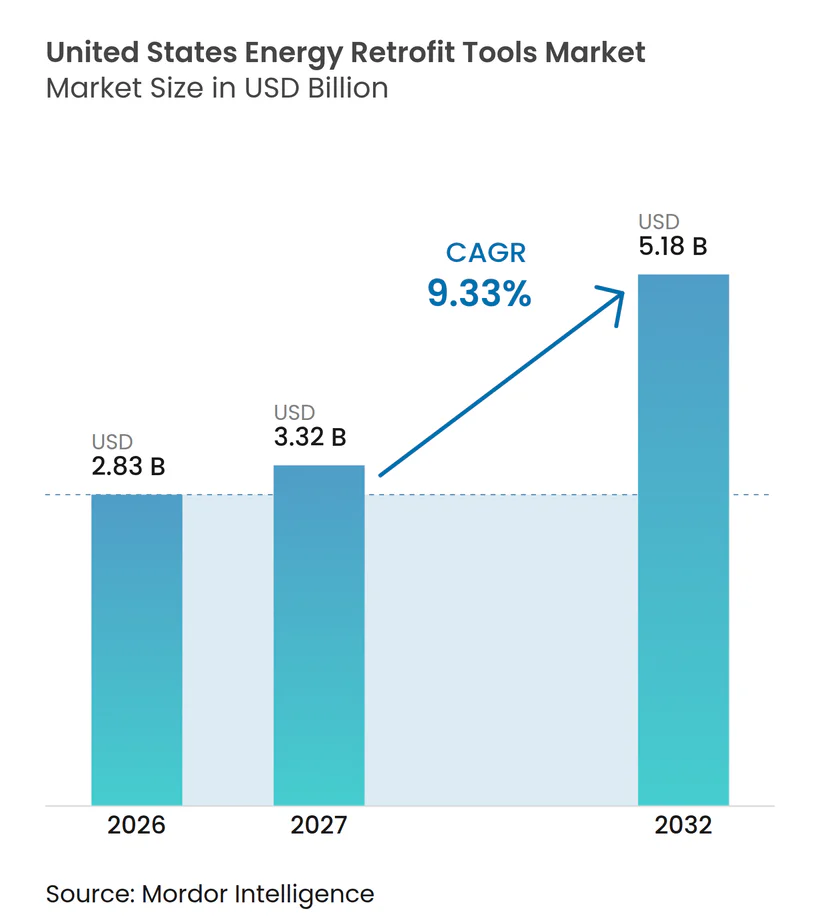
The United States energy retrofit tools market size was valued at USD 2.83 billion in 2026 and is estimated to grow from USD 3.32 billion in 2027 to reach USD 5.18 billion by 2032, at a CAGR of 9.33% during the forecast period (2027-2032). The market is being shaped by building owners who need reliable methods to plan upgrades, document energy use, and assess compliance options before committing capital. Federal incentives under Section 179D reward qualifying commercial building improvements that reduce energy use intensity, increasing the value of credible assessment and verification tools. Building performance requirements in leading jurisdictions are also moving energy modeling, audit platforms, HVAC diagnostics, and envelope inspection from occasional purchases into routine components of retrofit planning. Larger providers are expanding their software, automation, and maintenance capabilities through acquisitions, while specialist vendors are addressing specific use cases such as remote audits and thermal inspection. The strongest opportunity in the market is among small and midsize commercial and institutional buildings, where faster data capture and more automated modeling could reduce the effort that has historically limited adoption.
Key Report Takeaways
- By tool type, building energy modeling software held 22.1% of revenue in 2026, while renewable energy tools recorded the highest projected CAGR at 13.5% through 2032.
- By application, HVAC retrofit accounted for 29.6% of revenue in 2026, while renewable energy integration is projected to expand at an 11.7% CAGR through 2032.
- By building type, commercial buildings held 38.3% of revenue in 2026, while industrial buildings recorded the highest projected CAGR at 10.5% through 2032.
Note: Market numbers in this report are based on Mordor Intelligence's proprietary estimation framework, which combines nine months of actuals with Q4 projections for base year 2026.
United States Energy Retrofit Tools Market Trends and Insights
Drivers Impact Analysis*
| Driver | (~) % Impact on CAGR Forecast | Geographic Relevance | Impact Timeline |
|---|---|---|---|
| Building-Code Compliance and Performance-Based Incentives | +2.5% | Northeast US, Mid-Atlantic, and Pacific Coast, with early spillover to Mountain West | Short term (≤ 2 years) |
| Portfolio-Scale Benchmarking and Mandatory Disclosure | +1.8% | National, with concentration in New York City, Boston, Washington, DC, and Chicago | Short term (≤ 2 years) |
| AI-Enabled Fault Detection and Predictive Maintenance | +2.0% | National, led by high-value office and data-center clusters | Medium term (2-4 years) |
| Retrofit ROI Validation and Performance-Contracting Requirements | +1.2% | National, with highest intensity in federal and institutional markets | Medium term (2-4 years) |
| Cloud Interoperability Across Legacy Building Systems | +0.8% | National | Medium term (2-4 years) |
| Automated Data Capture for Small-Building Retrofit Decisions | +0.6% | National, with early gains in high-density urban markets | Long term (≥ 4 years) |
| Source: Mordor Intelligence | |||
Building-Code Compliance and Performance-Based Incentives
The US energy retrofit tools market benefits when owners need to measure a building's energy position before selecting a compliance pathway. Section 179D allows deductions for qualifying energy-efficient commercial building property, with deductions tied to reductions in energy and power costs compared with reference buildings.[1] This framework makes credible modeling, documentation, and verification useful at the start of a retrofit rather than only after equipment is installed. New York City's Local Law 97 creates financial exposure for covered buildings that exceed their emissions limits, giving owners a direct reason to evaluate several upgrade options before committing funds. The resulting procurement cycle favors tools that can compare heating, ventilation, and air conditioning (HVAC), envelope, electrification, and operational measures using the same building baseline. Compliance deadlines also make purchases less dependent on ordinary software budget cycles because owners must resolve potential exposure within a defined timetable.
Growth of Portfolio-Scale Benchmarking and Mandatory Disclosure
Benchmarking requirements are expanding the role of the US energy retrofit tools market from individual asset assessment to portfolio management. The Institute for Market Transformation tracks city, county, and state policies that require or support benchmarking and transparency for existing buildings.[2] Portfolio managers need systems that collect, normalize, and review energy data across many properties, rather than maintaining a separate audit record for each site. This need supports tools that align their data structures with ENERGY STAR Portfolio Manager and other established reporting workflows. Public or lender-facing energy information can also influence how owners prioritize capital plans, as performance data becomes part of a building's broader operating record. Providers that link energy-use data with retrofit plans, asset records, and reporting submissions are better positioned to serve owners with large and diverse portfolios.
AI-Enabled Fault Detection and Predictive Maintenance
AI-enabled fault detection is expanding the US energy retrofit tools market by connecting retrofit planning with daily operating decisions. Johnson Controls International expanded its OpenBlue Energy and Comfort Intelligence offering in August 2026 with capabilities that autonomously execute dynamic airside control actions from building data. The company reported nearly 10% lower airside energy use at a pilot site, demonstrating why owners value more granular control over fixed schedules. Continuous diagnostics can identify deterioration before a major failure and allow earlier commissioning or maintenance work. Over time, operating data can improve models for a particular building, making the service more useful as its history grows. That accumulated context can raise switching costs, particularly where an owner wants a single provider to connect controls, analytics, and maintenance.
Retrofit ROI Validation and Performance-Contracting Requirements
Performance contracting supports the US energy retrofit tools market because retrofit savings must be documented throughout the life of a project. Energy savings performance contracts require measurement and verification, which creates demand for metering, dashboards, audit records, and periodic reporting rather than a single preliminary assessment. The federal government continues to use this approach for facility upgrades, and its project structures typically require tools to remain in use after the construction stage. This shifts demand toward products that can maintain a reliable baseline, track changes, and explain results to building owners and contract partners. The effect is especially relevant in federal, university, hospital, and other institutional portfolios with long planning horizons. It also gives providers an opportunity to build recurring service relationships around reporting and operating performance, rather than relying solely on initial model creation.
Restraints Impact Analysis*
| Restraint | (~) % Impact on CAGR Forecast | Geographic Relevance | Impact Timeline |
|---|---|---|---|
| Fragmented Building Data and Inconsistent Asset Documentation | -1.2% | National, most acute in older urban cores and secondary markets | Long term (≥ 4 years) |
| High Modeling, Integration, and Implementation Costs | -1.5% | National, disproportionately affecting smaller markets and properties | Short term (≤ 2 years) |
| Cybersecurity, Privacy, and Operational-Technology Risk | -0.8% | National | Medium term (2-4 years) |
| Shortage of Qualified Modelers, Auditors, and Commissioning Specialists | -0.9% | National, most acute in secondary cities and rural markets | Long term (≥ 4 years) |
| Source: Mordor Intelligence | |||
Fragmented Building Data and Inconsistent Asset Documentation
Fragmented data limits the US energy retrofit tools market because many older commercial and industrial properties lack complete digital records for heating, ventilation, and air conditioning (HVAC) equipment, envelope details, and historical energy use. Modelers may need to reconstruct baseline conditions from paper drawings, field visits, and incomplete records before evaluating upgrade scenarios. This problem is often more pronounced in buildings completed before building information modeling became common practice. It can increase the initial cost of analysis and weaken the business case for smaller owners with limited engineering resources. AI-supported document parsing, drone thermal imaging, and mobile scanning can reduce the manual burden, but deployment is uneven across building sizes. The data challenge will remain a practical constraint until lower-cost collection methods are widely available beyond the large-building segment.
High Modeling, Integration, and Implementation Costs
High delivery costs can delay adoption in the US energy retrofit tools market, particularly among midsize owners without in-house technical teams. Large commercial building energy modeling assignments can require 40 to 200 hours of skilled engineering work, placing comprehensive studies beyond many smaller budgets. Integration is also difficult when legacy building systems use proprietary or limited interfaces and require custom connections to modern analytics products. Claroty reported in 2025 that 75% of surveyed organizations had building management systems affected by known exploitable vulnerabilities, while 51% had systems that were both KEV-affected and internet-exposed.[3] The National Institute of Standards and Technology identifies weak authentication and unmanaged third-party remote access as key risks in building automation and control systems.[4] Owners may therefore need to address security gaps before connecting a new platform, adding cost and extending the implementation schedule.
*Our forecasts treat driver/restraint impacts as directional, not additive. The impact forecasts reflect baseline growth, mix effects, and variable interactions.
Segment Analysis
By Tool Type: Building Energy Modeling (BEM) Software Leads Volume as Renewable Tools Accelerate
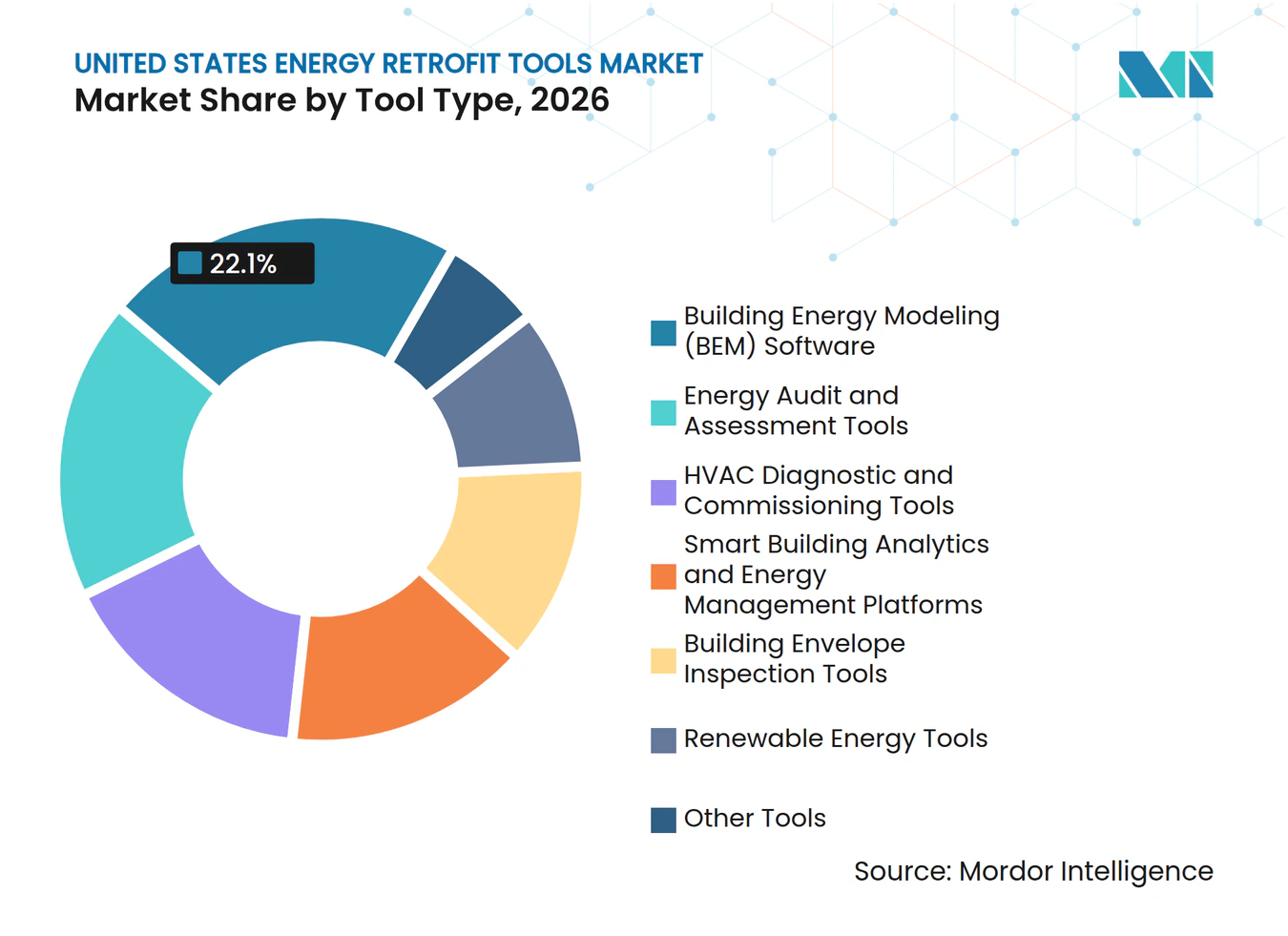
Building energy modeling (BEM) software held 22.1% of the US energy retrofit tools market share in 2026, reflecting its central role in compliance documentation, incentive qualification, and capital planning. The category is commonly used to compare retrofit options before owners select equipment or construction packages. Its position is reinforced by integration with design workflows and simulation engines used during assessment and early project planning. These connections keep a modeling platform embedded in a project after an initial study is completed. Energy audit and assessment products form the next major group, as building owners need structured data collection and reporting to support upgrade decisions. HVAC diagnostic and commissioning tools also benefit from a large base of aging commercial systems that require tuning, replacement, or deeper analysis. Together, these categories support work from the first site review through post-installation verification. Demand for these core tools remains tied to the volume of planned building improvements and the availability of usable asset data.
Renewable energy tools are projected to grow at a 13.5% CAGR from 2027 to 2032, the fastest rate among tool types. Owners are using these tools to examine combinations of onsite solar, heat pumps, and battery storage within a building-level energy plan. The National Renewable Energy Laboratory expanded its REopt web tool in 2026 to include air-source heat pump analysis alongside geothermal and battery options. This broader capability illustrates why renewable planning is becoming more closely connected to retrofit assessment rather than being treated as a separate decision. Smart building analytics and energy management platforms are also gaining relevance as owners seek ongoing visibility after an upgrade is completed. Building envelope inspection tools, including thermal imaging and data-driven infrared analysis, are expected to serve projects where envelope upgrades are a primary route to improved energy performance. The US energy retrofit tools market therefore has room for products that combine design-stage assumptions with operational data from completed buildings.



By Application: HVAC Retrofit Anchors Demand as Renewable Integration Gains Momentum
HVAC retrofit accounted for 29.6% of application revenue in 2026, making it the largest application by value. HVAC systems often represent one of the largest controllable energy uses in commercial properties, giving owners a clear starting point for compliance and cost-reduction plans. Retrofit projects require diagnostic tools to identify performance gaps, commissioning platforms to confirm proper operation, and measurement tools to monitor results. The work at 55 Water Street in New York City illustrates the scale of this need. Trane Technologies installed 2 centrifugal chillers, 27 modular chillers, and a heat recovery system at the property, cutting steam use by nearly 70% and overall energy intensity by nearly 20%.[5] The project also secured USD 5.5 million in utility rebates and USD 9 million in Inflation Reduction Act tax credits, while avoiding USD 1.2 million in annual Local Law 97 fines. This type of project supports tool demand across diagnosis, design, installation, and ongoing verification.
Renewable energy integration is projected to record an 11.7% CAGR through 2032, making it the fastest-growing application in the US energy retrofit tools market. Building owners are increasingly considering solar, electrified heating, storage, and controls as connected parts of the same capital plan. Whole-building modeling helps them assess interactions among load reduction, electrification, renewable generation, and energy storage. Lighting, building envelope, and electrical applications are more mature, and their tool sets have become less differentiated in many retrofit settings. Water heating and service hot water work is gaining attention as heat pump water heaters become a practical option for mixed-use buildings. Providers that can incorporate these separate measures into a common building model can help owners understand sequencing, operating effects, and funding options. This need supports continued demand for tools that go beyond calculating isolated equipment savings.
By Building Type: Commercial Buildings Drive Revenue as Industrial Segment Gains Pace
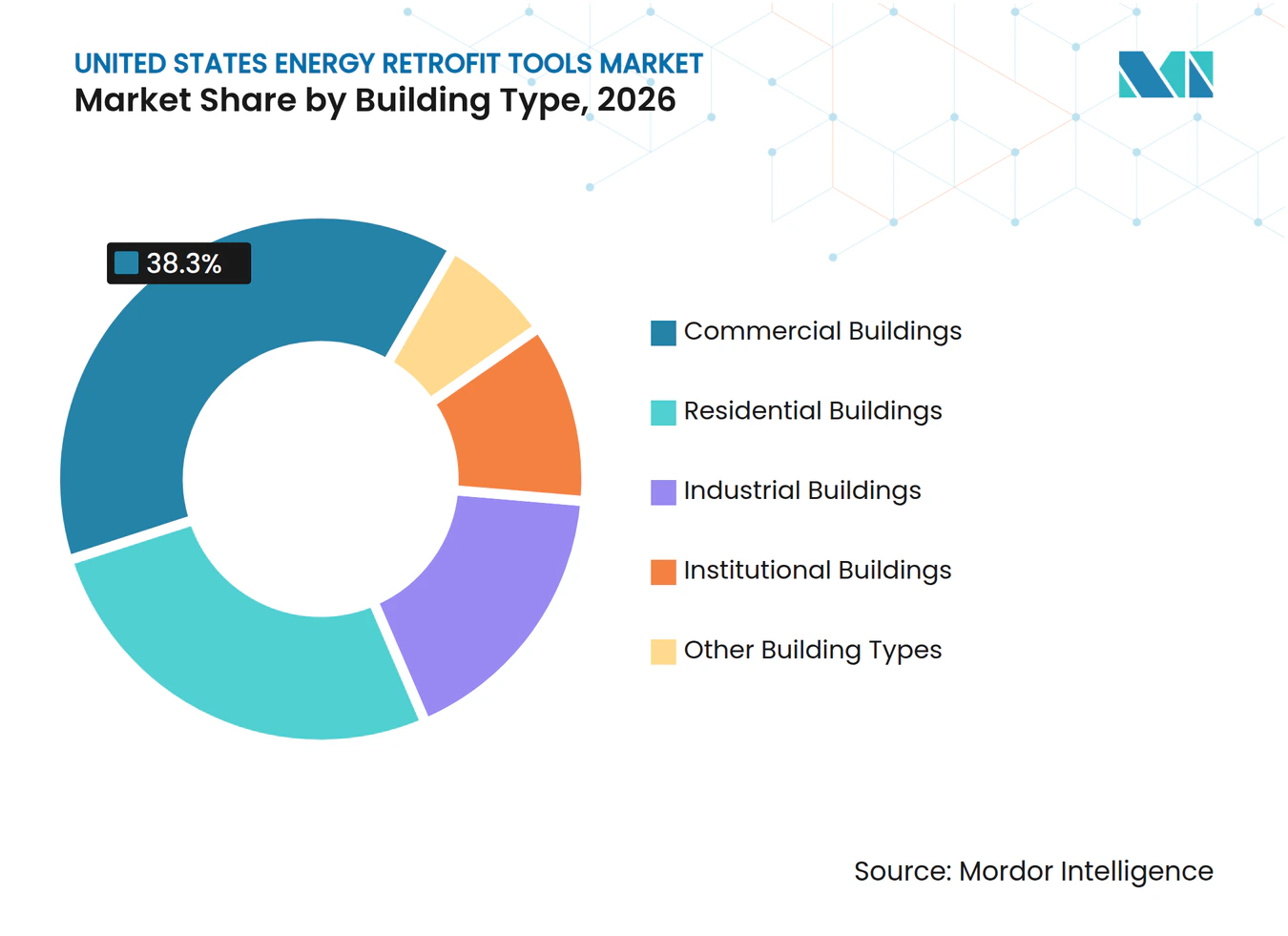
Commercial buildings held 38.3% of 2026 revenue, supported by large office, retail, and mixed-use assets in major metropolitan areas. These properties often face the most immediate pressure to document performance and prepare capital plans for energy-related requirements. Their demand tends to follow regulatory deadlines, as owners must evaluate potential penalties and upgrade pathways regardless of broader property conditions. Large portfolios also create a need for consistent reporting across multiple building types and locations. Institutional properties, including universities, hospitals, and government facilities, remain an important adoption group because they often pursue multiyear performance, resilience, and sustainability programs. These organizations can use energy service agreements and internal capital plans to maintain tool engagement across multiple facilities. The commercial segment therefore remains the revenue anchor for providers offering modeling, audit, analytics, and verification capabilities.
Industrial buildings are forecast to grow at a 10.5% CAGR from 2027 to 2032, the fastest rate among building types. Manufacturers face a growing need to document energy use and evaluate changes to process-related equipment and facility systems. A 2025 peer-reviewed study validated a semi-automatic Building Information Modeling-to-Building Energy Modeling (BIM-to-BEM) framework for industrial facilities using interoperable Green Building XML (gbXML) workflows for retrofit scenario comparison. Such workflows can make structured energy modeling more accessible where facilities have complex equipment and building characteristics. Industrial users also need tools that support the information required for energy management practices and internal investment reviews. This creates an opportunity for platforms that translate detailed technical data into usable comparison cases for operational and financial teams. The US energy retrofit tools market is consequently expanding beyond conventional commercial building workflows into more specialized industrial assessment needs.

Geography Analysis
The Northeast is the leading demand center in the US energy retrofit tools market because of its concentration of large properties and established building performance requirements. New York City’s Local Law 97 covers buildings over 25,000 square feet and makes emissions management a significant planning issue for affected owners. This setting supports steady demand for building energy modeling, audit platforms, HVAC diagnostics, and envelope inspection tools. Boston's Building Emissions Reduction and Disclosure Ordinance (BERDO) 2.0 and Washington, DC, building performance rules add to the region’s regulatory density. The close concentration of major markets allows providers to serve owners that manage similar requirements across more than one city. It also strengthens the local ecosystem of energy consultants, contractors, software specialists, and commissioning professionals. Maryland and Pennsylvania add to the regional opportunity as benchmarking requirements broaden the group of properties that need energy data and reporting support.
California has a mature energy modeling environment, and its policy framework sustains demand for the US energy retrofit tools market. Title 24 has made simulation-based performance modeling a familiar part of commercial permitting for many years. California’s AB 802 requires annual benchmarking for commercial buildings above 50,000 square feet, reinforcing the need for portfolio analytics and ENERGY STAR reporting interfaces. San Francisco’s existing-building requirements encourage owners to connect energy audit results with long-range electrification and capital plans. Washington State’s Clean Buildings Act applied its first compliance deadline to buildings above 220,000 square feet in June 2026, with later deadlines for smaller buildings. These policies support tools that combine modeling, reporting, capital planning, and operating data. The region’s early adoption also gives suppliers a testing ground for new digital workflows before they are used more widely.
The Sun Belt and Midwest are important growth areas, although their demand profile differs from the Northeast and Pacific Coast. Texas, Florida, and Georgia have significant HVAC retrofit activity because cooling loads and operating costs create a clear economic case for diagnostics and commissioning. These markets include many midsize properties that are outside strict building performance frameworks, which increases the value of simpler and lower-cost assessment tools. The Midwest also benefits from a professional energy services base built around public, institutional, and commercial facilities. Chicago’s long-running benchmarking rules and St. Louis requirements for larger buildings support continuing energy services activity. The US energy retrofit tools market size in these regions depends more on operating economics, equipment replacement, and federal or institutional programs than on a single compliance deadline. This creates space for suppliers that can show immediate maintenance and energy value alongside longer-term reporting benefits.
Competitive Landscape
Market Concentration
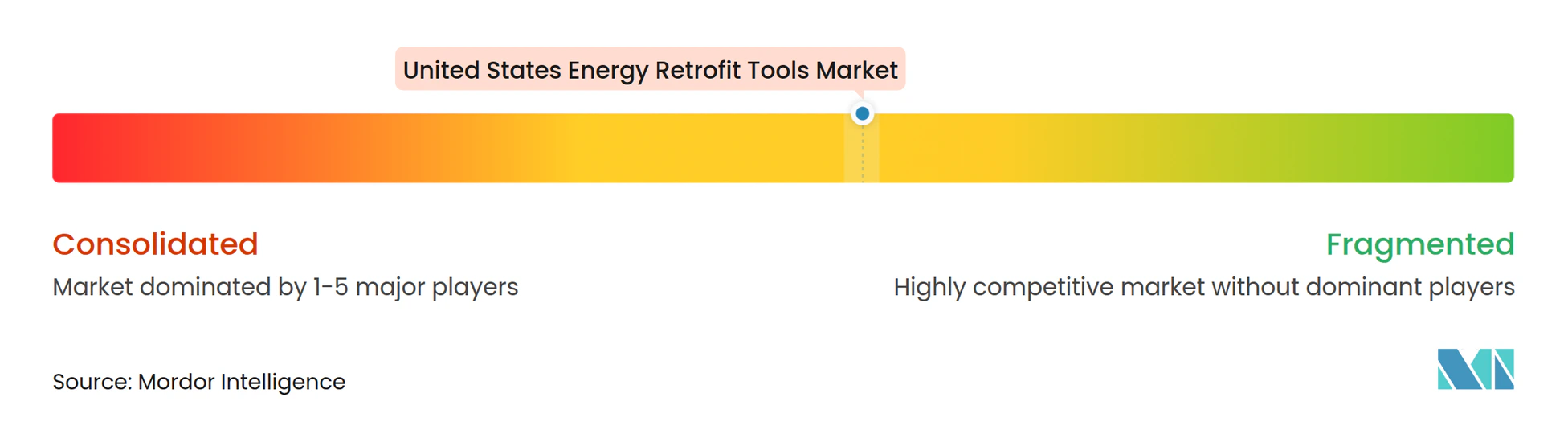
The United States energy retrofit tools market is moderately concentrated among large building technology providers, while remaining fragmented across specialist software and inspection categories. Johnson Controls, Schneider Electric, Siemens, Honeywell, and Trane Technologies hold broad portfolios that connect controls, building systems, data management, and service capabilities. Their strategy is increasingly platform-led, as building owners want data to move across design, operations, maintenance, and reporting workflows. Johnson Controls launched Metasys 16.0 in June 2026 with native redundancy, energy management capabilities, automated workflows, and International Electrotechnical Commission (IEC) 62443-4-2 SL2 cybersecurity compliance. Security features are becoming a standard competitive requirement as analytics tools connect to operating technology. The market favors providers that can reduce integration friction without creating new cyber risks.
A key competitive opportunity lies in automated assessment for small and midsize buildings, where traditional studies can require more expertise than owners can afford. AI-assisted remote audits, drone-based envelope inspection, and document parsing are being developed to reduce field effort and speed model preparation. A 2025 study described a large-language-model-based multi-agent framework that produced calibrated building energy models in 48 minutes, compared with a conventional 8 to 32 hours. Lower preparation time could make energy assessment more practical for buildings between 20,000 and 50,000 square feet. Siemens acquired energy modeling technology from Setmetrics to enhance Brightly Software's scenario modeling capability, stating that the technology can reduce model development effort by up to 80%. This move indicates that large providers are seeking lighter-weight tools alongside enterprise platforms. Specialist providers can still compete where they offer faster deployment, focused workflows, or a better fit for a specific building class.
Acquisitions are helping companies close gaps in operations, automation, and performance contracting. Autodesk announced a definitive agreement in May 2026 to acquire MaintainX for USD 3.6 billion, extending its approach across design, construction, and operations workflows. Carrier acquired AI-enabled building automation provider 75F in July 2026 to strengthen its offering for light commercial properties and its broader digital platform. Opterra Energy Services acquired NORESCO in August 2026, combining performance contracting, renewable energy, and energy management capabilities within a larger integrated provider. These transactions indicate that software, service delivery, and building operations are becoming more closely linked in the United States energy retrofit tools market. Smaller vendors remain relevant where they can serve narrow needs that large platforms do not address efficiently.
United States Energy Retrofit Tools Industry Leaders
-
Johnson Controls International plc
-
Schneider Electric SE
-
Siemens AG
-
Honeywell International Inc.
-
Autodesk, Inc.
- *Disclaimer: Major Players sorted in no particular order
Recent Industry Developments
- August 2026: Johnson Controls introduced new AI capabilities within its OpenBlue platform, including Energy and Comfort Intelligence powered by Nantum AI and the OBI agentic AI assistant. The platform can reduce onboarding and implementation time by up to 95% and helps optimize HVAC airside systems, supporting energy retrofit projects focused on operational efficiency improvements.
- June 2026: Johnson Controls launched Metasys 16.0, featuring native redundancy, an integrated Energy Management Suite, automated workflows, and advanced cybersecurity. The release includes EPBD-ready energy reporting and fault detection capabilities that support building energy upgrades, retro-commissioning, and ongoing performance optimization.
- May 2026: Autodesk signed a definitive agreement to acquire MaintainX for approximately USD 3.6 billion. MaintainX provides maintenance, asset management, inspection, and operations software that supports building performance improvements and long-term retrofit asset management, strengthening Autodesk's building lifecycle and operations platform.
- November 2025: Schneider Electric SE unveiled EcoStruxure Foresight Operation, an AI-powered platform that integrates building systems, energy systems, and electrical infrastructure into a single operational interface. The platform is designed to improve building performance, predictive maintenance, and energy efficiency, supporting retrofit and modernization projects.
United States Energy Retrofit Tools Market Report Scope
Energy retrofit tools include software solutions, diagnostic instruments, inspection equipment, and analytics platforms used to assess, optimize, and improve the energy performance of existing buildings and facilities. These tools help identify energy inefficiencies, evaluate retrofit opportunities, monitor energy consumption, and support the implementation of energy-saving measures. Common applications include HVAC upgrades, lighting retrofits, building envelope improvements, renewable energy integration, and smart building management.
The United States energy retrofit tools market is segmented by tool type into building energy modeling (BEM) software, energy audit and assessment tools, HVAC diagnostic and commissioning tools, building envelope inspection tools, smart building analytics and energy management platforms, renewable energy tools, and other tools. By application, the market is segmented into HVAC retrofit, lighting retrofit, building envelope retrofit, heating and cooling systems, water heating and service hot water, electrical systems and equipment, renewable energy integration, and other applications. By building type, the market is segmented into residential buildings, commercial buildings, industrial buildings, institutional buildings, and other building types. Market forecasts are provided in value terms (USD).
| Building Energy Modeling (BEM) Software |
| Energy Audit and Assessment Tools |
| HVAC Diagnostic and Commissioning Tools |
| Building Envelope Inspection Tools |
| Smart Building Analytics and Energy Management Platforms |
| Renewable Energy Tools |
| Other Tools |
| HVAC Retrofit |
| Lighting Retrofit |
| Building Envelope Retrofit |
| Heating and Cooling Systems |
| Water Heating and Service Hot Water |
| Electrical Systems and Equipment |
| Renewable Energy Integration |
| Other Applications |
| Residential Buildings |
| Commercial Buildings |
| Industrial Buildings |
| Institutional Buildings |
| Other Building Types |
| By Tool Type | Building Energy Modeling (BEM) Software |
| Energy Audit and Assessment Tools | |
| HVAC Diagnostic and Commissioning Tools | |
| Building Envelope Inspection Tools | |
| Smart Building Analytics and Energy Management Platforms | |
| Renewable Energy Tools | |
| Other Tools | |
| By Application | HVAC Retrofit |
| Lighting Retrofit | |
| Building Envelope Retrofit | |
| Heating and Cooling Systems | |
| Water Heating and Service Hot Water | |
| Electrical Systems and Equipment | |
| Renewable Energy Integration | |
| Other Applications | |
| By Building Type | Residential Buildings |
| Commercial Buildings | |
| Industrial Buildings | |
| Institutional Buildings | |
| Other Building Types |
Key Questions Answered in the Report
What is driving demand for energy retrofit tools in the United States?
Compliance planning, federal incentives, benchmarking requirements, and the need to document performance are supporting demand for modeling, audit, diagnostics, and verification tools.
Which tool category is growing fastest through 2032?
Renewable energy tools are forecast to grow at a 13.5% CAGR from 2027 to 2032, supported by planning needs for solar, heat pumps, and battery storage.
Why do HVAC retrofits account for the largest application share?
HVAC retrofits held a 29.6% share in 2026 because HVAC systems represent a major controllable energy use and require tools across diagnosis, commissioning, and verification.
Which building type has the highest forecast growth?
Industrial buildings are forecast to expand at a 10.5% CAGR through 2032 as facilities require more structured energy-use assessment and retrofit planning.
How do building performance standards affect procurement decisions?
Building performance requirements encourage owners to use modeling and audit tools early to compare upgrade options, document compliance pathways, and plan capital spending.
What is the main barrier for smaller building owners?
Modeling effort, legacy system integration, incomplete asset records, and cybersecurity preparation can make advanced tools harder to adopt for smaller properties.
What is the current market size of United States energy retrofit tools market?
The United States energy retrofit tools market size was valued at USD 2.83 billion in 2026 and is estimated to grow from USD 3.32 billion in 2027 to reach USD 5.18 billion by 2032, at a CAGR of 9.33% during the forecast period (2027-2032).