
United States Energy Retrofit Market Size and Share
Market Overview
| Study Period | 2022 - 2032 |
|---|---|
| Forecast Data Period | 2027 - 2032 |
| Base Year Market Size (2026) | USD 109.72 Billion |
| Market Size (2027) | USD 128.76 Billion |
| Market Size (2032) | USD 177.51 Billion |
| Growth Rate (2027 - 2032) | 6.63 % |
| Market Concentration | Medium |
Major Players *Disclaimer: Major Players sorted in no particular order Image © Mordor Intelligence. Reuse requires attribution under CC BY 4.0. | |
United States Energy Retrofit Market Analysis by Mordor Intelligence
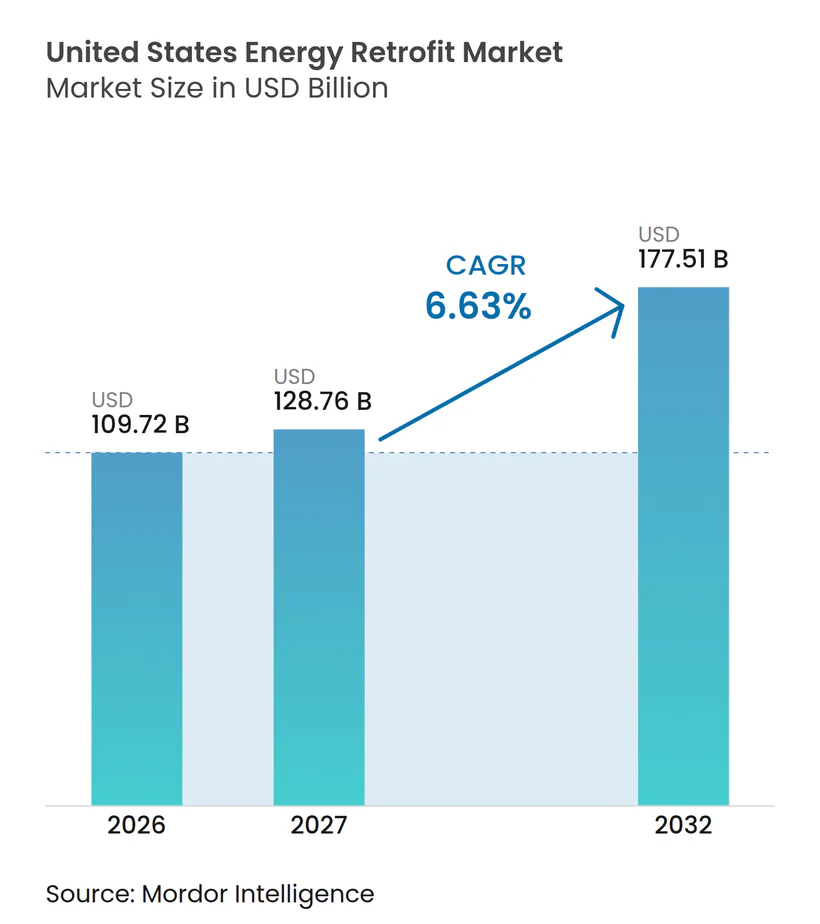
The United States energy retrofit market size is expected to increase from USD 109.72 billion in 2026 to USD 128.76 billion in 2027 and reach USD 177.51 billion by 2032, at a CAGR of 6.63% over 2027-2032. The market is supported by an aging commercial building base, replacement needs in Heating, Ventilation, and Air Conditioning (HVAC) equipment, and public policies that make energy performance a capital planning issue. Building owners increasingly combine equipment replacement with controls, electrical upgrades, and renewable generation, as these measures can be designed as a single project. The market also benefits from performance-contract structures that allow public and institutional owners to repay projects through verified savings. Labor availability remains a material constraint, as retrofit work requires electricians, HVAC technicians, controls specialists, and commissioning staff. Larger providers can use integrated auditing, design, financing, and measurement services to compete for complex projects, while regional contractors continue to serve much of the smaller upgrade work.
Key Report Takeaways
- By retrofit depth, shallow and light projects held 61.6% of the United States energy retrofit market share in 2026, while deep retrofits are forecast to grow at a 7.4% CAGR through 2032.
- By technology, HVAC systems held 36.3% of segment revenue in 2026, while renewable integration is forecast to expand at an 8.2% CAGR through 2032.
- By application, commercial buildings accounted for 46.9% of segment revenue in 2026, while public and institutional buildings are forecast to advance at a 7.2% CAGR through 2032.
Note: Market numbers in this report are based on Mordor Intelligence's proprietary estimation framework, which combines nine months of actuals with Q4 projections for base year 2026.
United States Energy Retrofit Market Trends and Insights
Drivers Impact Analysis*
| Driver | (~) % Impact on CAGR Forecast | Geographic Relevance | Impact Timeline |
|---|---|---|---|
| Federal And State Retrofit Incentives And Tax Credits | +1.9% | National, with faster uptake in California, New York, and Massachusetts | Short term (≤ 2 years) |
| Rising Cost Pressure From Aging Building Stock And Inefficient HVAC Assets | +1.5% | National, with greater exposure in the Midwest and Northeast | Medium term (2-4 years) |
| Electrification And Heat Pump Conversion In Existing Buildings | +1.3% | Northeast, Mid-Atlantic, and Pacific Coast, with growing activity in the Mountain West | Medium term (2-4 years) |
| Commercial ESG Disclosure And Building Performance Standards | +1.1% | Urban cores including New York, Washington, D.C., Boston, Denver, and Seattle | Short term (≤ 2 years) |
| Utility Interval Data And Submetering For Retrofit Prioritization | +0.6% | National, with higher use in deregulated electricity markets | Medium term (2-4 years) |
| Embedded Carbon And Refrigerant Leakage Reduction | +0.4% | National, especially refrigerant-intensive commercial HVAC portfolios | Short term (≤ 2 years) |
| Source: Mordor Intelligence | |||
Federal And State Retrofit Incentives and Tax Credits
Section 179D offers a commercial building efficiency deduction of up to USD 5.90 per square foot in 2026 when prevailing-wage conditions are met. Section 48E provides a 30% base credit for eligible commercial solar and heat pump installations, with additions that can raise the effective credit to 50% to 70% of eligible costs.[1] These provisions broaden the set of projects that can meet an owner's return requirements. Direct-pay and transfer mechanisms also allow tax-exempt schools, municipalities, and hospitals to benefit from qualifying incentives through project structures arranged by energy service companies. This wider access benefits the United States energy retrofit market because institutional owners can apply incentives to projects that were previously difficult to finance. When federal support is paired with utility rebates and Property Assessed Clean Energy (PACE) financing, qualifying commercial projects can move from 10- to 15-year payback periods to 4- to 7-year periods.
Aging Buildings, HVAC Replacement, and Refrigerant Compliance
Annual United States building energy expenditure stood at USD 374 billion, while legacy heating, ventilation, and air conditioning (HVAC) equipment remains common in commercial properties. Packaged rooftop units heat 37% of commercial buildings and serve 50% of commercial floor space, while natural gas boilers account for 73% of commercial space-heating energy. Aging assets create a replacement cycle that extends beyond a like-for-like equipment purchase. The United States Environmental Protection Agency's refrigerant requirements, which took effect in January 2026 for systems with charge sizes of 15 pounds or more, require leak repair, monitoring, and reclamation practices that can alter the timing and scope of HVAC investment. The United States energy retrofit market benefits when end-of-life replacement leads owners to add controls, electrical work, and related system improvements. Buildings with a median age above 35 years can face several replacement and compliance decisions within the same planning period.
Electrification, Heat Pumps, and Energy Data
A peer-reviewed 2024 study found that air-source heat pumps could be economically attractive for up to 38% of United States households under Inflation Reduction Act provisions.[2] Commercial conversions can have wider project scopes because heat pump equipment may require upgrades to electrical panels, service capacity, ventilation, and controls. National Renewable Energy Laboratory modeling found that replacing gas-fired rooftop units with heat pump rooftop units, demand-control ventilation, energy recovery, and economizers could reduce total site energy use by 19.8% across the modeled commercial building stock. Utility interval data and submetering help owners identify buildings and systems with the clearest savings case before committing capital. The United States energy retrofit market therefore extends beyond HVAC suppliers to electrical, mechanical, and controls contractors. State heat pump programs and targets in California, New York, Massachusetts, and Minnesota further support demand where simple energy-cost payback would not be sufficient.
Building Performance Standards and Portfolio Planning
Building performance requirements are moving energy work from a voluntary operating decision toward a compliance-driven capital decision in many city markets. The United States Environmental Protection Agency's Portfolio Manager platform tracks more than 600,000 buildings and 25 billion square feet, giving owners a common tool for benchmarking and investment planning. Buildings that use regular benchmarking have reduced energy consumption by an average of 7% over three years before mandated retrofit activity begins. Large owners are increasingly evaluating projects across portfolios instead of approving measures one building at a time. This approach strengthens the United States energy retrofit market because standardized audits, controls platforms, and measurement practices can be applied across multiple assets. Requirements related to carbon reporting and asset-level emissions also encourage owners to consider envelope, refrigerant, and energy-system measures together.
Restraints Impact Analysis*
| Restraint | (~) % Impact on CAGR Forecast | Geographic Relevance | Impact Timeline |
|---|---|---|---|
| High Upfront Capital Requirement And Long Payback Cycles | -1.4% | National, particularly smaller and mid-market commercial properties | Long term (≥ 4 years) |
| Skilled Labor Shortages And Contractor Capacity Constraints | -0.9% | National, with added pressure in the Southeast, Mountain West, and suburban markets | Medium term (2-4 years) |
| Tenant Disruption And Phased Execution In Occupied Buildings | -0.5% | Urban, high-density commercial and multifamily properties | Medium term (2-4 years) |
| Interconnection, Permitting, And Code Compliance Delays | -0.4% | High-density urban areas with multi-agency approvals | Long term (≥ 4 years) |
| Source: Mordor Intelligence | |||
High Upfront Capital Requirements and Long Payback Cycles
Deep commercial energy retrofits can require USD 40 to USD 150 per square foot, depending on project scope and location. Simple payback periods can range from 8 to 15 years before incentives and from 5 to 8 years when rebates and federal credits are fully utilized in high-cost energy markets. This profile can conflict with commercial lease terms of 5 to 10 years, as owners fund the project while tenants receive a large share of the operating savings. A 2025 commercial building decision-maker study found that asset managers often apply a 5-year payback benchmark linked to hurdle rates near 20% annually.[3] Energy performance contracts and Property Assessed Clean Energy (PACE) financing can reduce this gap, but neither has reached enough independent owners to eliminate it as a constraint. Smaller properties also face higher transaction costs because financing, technical review, and compliance planning cannot always be distributed across a large portfolio.
Workforce, Occupancy, and Approval Constraints
The construction sector must attract 349,000 net new workers in 2026 and 456,000 in 2027, while one in five electricians is older than 55. Energy-efficiency workforce research identifies limited career awareness, misaligned curricula, licensing differences, insufficient professional development, and weak employer-training coordination as barriers to expanding labor supply. The United States energy retrofit market can face delays when the same electricians, HVAC technicians, and commissioning agents are required across multiple project types simultaneously. Occupied properties present an additional challenge, as building owners must phase construction around tenants, safety requirements, and operating hours. Interconnection, permitting, and code reviews can further delay projects that combine HVAC, solar, electrical, and envelope measures. These conditions tend to favor large energy service companies with established trade networks and experience managing complex approvals.
*Our forecasts treat driver/restraint impacts as directional, not additive. The impact forecasts reflect baseline growth, mix effects, and variable interactions.
Segment Analysis
By Retrofit Depth: Shallow Upgrades Lead Current Spending While Deep Projects Grow Faster
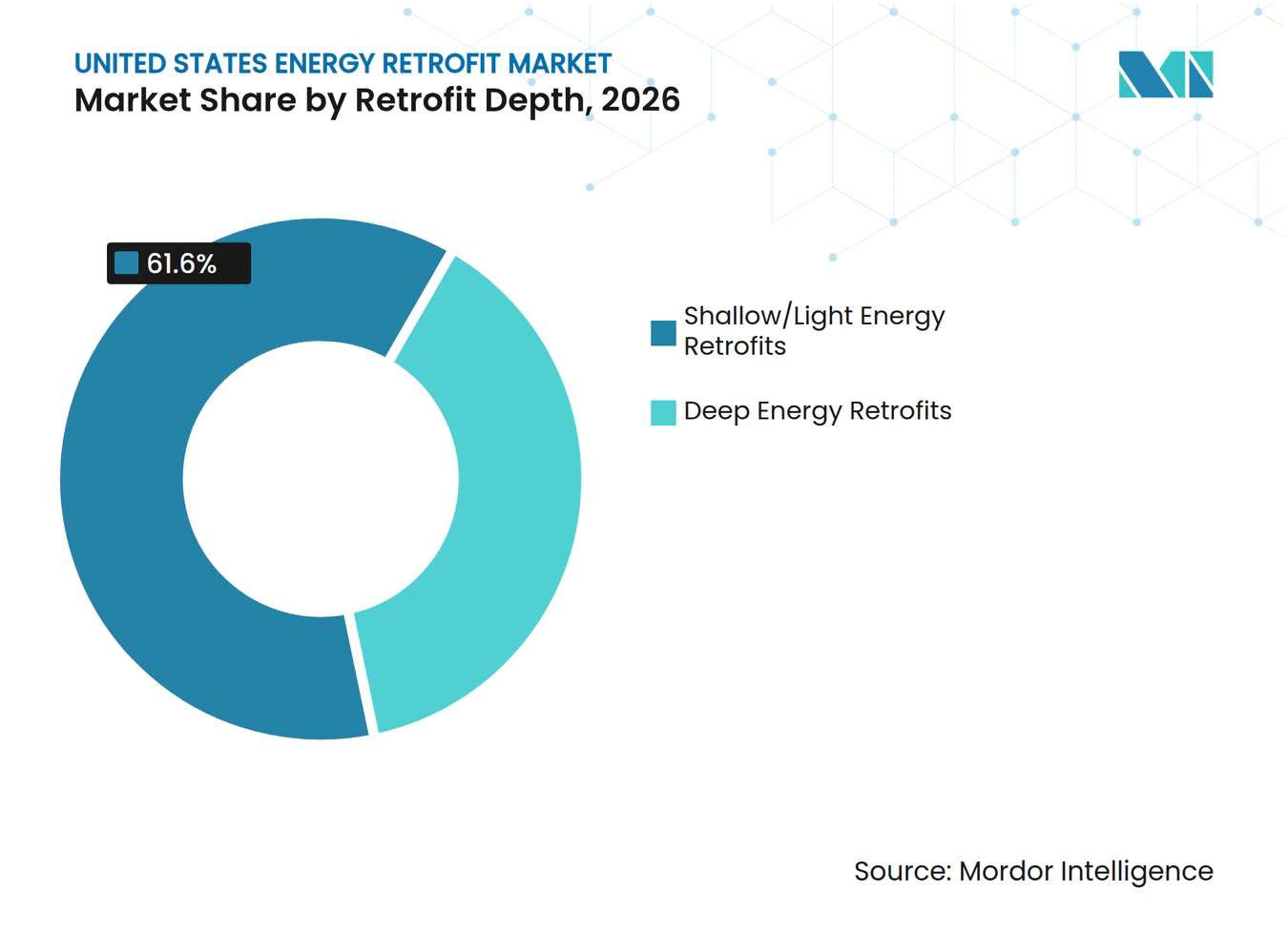
Shallow and light upgrades held 61.6% of the United States energy retrofit market share in 2026. This work includes lighting replacements, controls upgrades, and heating, ventilation, and air conditioning (HVAC) tune-ups that are easier to implement in occupied buildings. Lighting and shallow HVAC measures have median payback periods of 3 to 4 years, compared with 11 to 12 years for building fabric measures. Their lower cost, shorter schedule, and limited disruption make them accessible to a broad range of building owners. These measures also suit contractors working with standardized scopes and utility rebate programs.
Deep retrofits are forecast to grow at a 7.4% CAGR from 2027 to 2032. The United States energy retrofit market size for deep retrofit work is supported by buildings that have already completed basic lighting and controls projects. Owners in that position must consider higher-impact measures when additional efficiency improvements are required to meet energy or emissions targets. Such projects often require careful sequencing around occupants, structural conditions, and multiple building systems. Performance contracts are particularly relevant in institutional settings because verified savings can support longer repayment periods.



By Technology: HVAC Is the Largest Category While Renewable Integration Grows Fastest
HVAC systems accounted for 36.3% of technology-segment revenue in 2026. Packaged rooftop units serve 50% of U.S. commercial floor space, and natural gas boilers account for 73% of commercial space-heating energy, making HVAC replacement a steady part of the energy retrofit market. Equipment replacement often becomes a broader engineering project when owners need to address refrigerant rules, controls, ventilation, or electrical capacity at the same time. The EPA's refrigerant transition requirements also increase the importance of planning replacement schedules before equipment failure creates an urgent project.
Renewable integration is forecast to grow at an 8.2% CAGR between 2027 and 2032. Commercial owners can pair solar projects with HVAC electrification to utilize the Section 48E Clean Electricity Investment Tax Credit. Commercial solar installed costs ranged from USD 1.6 to USD 1.8 per watt DC before incentives in 2026. Smart controls and internet of things (IoT) energy-management systems also provide a less capital-intensive option for existing properties. In August 2026, Johnson Controls International stated that its expanded OpenBlue capabilities could reduce integration implementation times by up to 95% across complex multi-building facilities. Lighting remains important in K-12 schools, municipal buildings, and retail sites where the economics and rebate structures are well understood.
By Application: Commercial Buildings Hold the Largest Base and Public Institutions Lead Growth
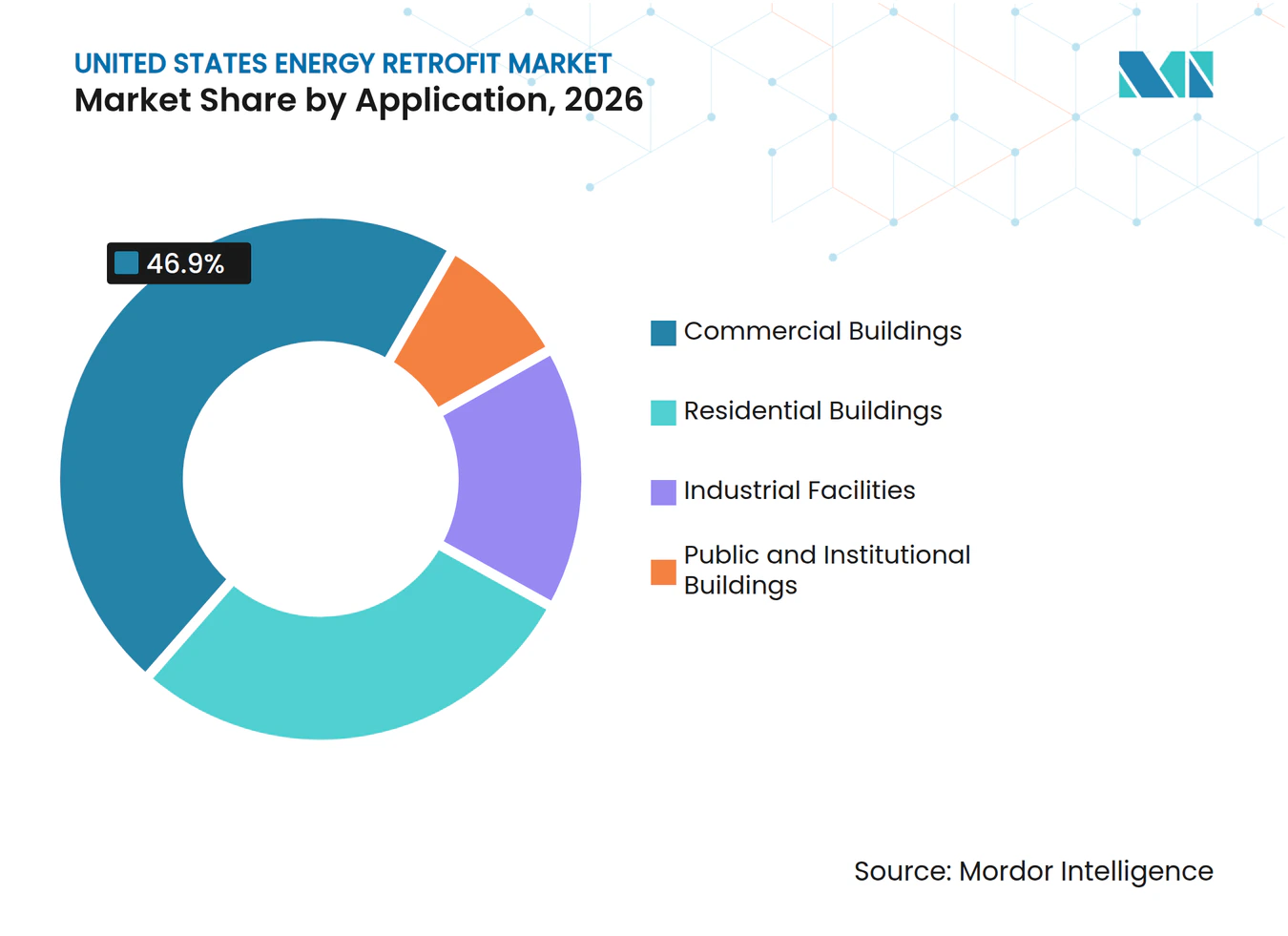
Commercial buildings represented 46.9% of application-segment revenue in 2026. The commercial segment reflects demand from offices, retail centers, health care facilities, and multifamily buildings. These owners often face energy costs, investor expectations, and local performance requirements simultaneously. Residential work has a high unit count but typically involves smaller projects and a larger pool of local contractors. Industrial facilities may prioritize process-energy investments over building-envelope improvements, although facility-level energy management is gaining importance in capital plans.
Public and institutional buildings are forecast to grow at a 7.2% CAGR from 2027 to 2032. Federal energy savings performance contracts, state mandates for schools and municipal assets, and contract terms of 20 to 25 years help these owners address longer-payback measures. In October 2025, Ameresco Inc. secured a USD 197 million energy savings performance contract for the U.S. Naval Research Laboratory that covered steam generation, chilled-water systems, and supervisory control and data acquisition (SCADA) deployment. Public procurement can mobilize capital without placing the full cost on an agency balance sheet. The United States energy retrofit market is therefore supported by public owners that can use verified-savings structures for more complex work.

Geography Analysis
The Northeast remains a highly active area for the United States energy retrofit market because it has older commercial properties, dense city building stock, and strong state incentive programs. New York, Massachusetts, Connecticut, and New Jersey have significant demand for HVAC upgrades, controls, and building-envelope work. Massachusetts utility-administered energy-efficiency programs receive more than USD 1 billion in annual funding, supporting local supply chains for retrofit services and equipment. California’s 2025 Building Energy Efficiency Standards became effective in January 2026 and require updated HVAC and envelope benchmarks during nonresidential alteration work. This makes many renovation permits a point at which owners must assess broader efficiency measures.
The South and Midwest provide a different mix of demand drivers. Texas, Florida, and other southeastern markets have strong HVAC upgrade demand because cooling loads can make efficiency investments financially attractive. Federal and military buildings in Indiana, Illinois, Minnesota, Wisconsin, Georgia, Kansas, and Virginia use performance-contract structures for energy and building automation upgrades. The United States energy retrofit market size in these regions is supported by federal work even where local building-performance policy is less comprehensive. Regional contractors must still navigate varied permitting practices, labor conditions, and utility program requirements.
The Mountain West is developing as a retrofit corridor as comparatively newer commercial buildings approach their first major equipment-upgrade cycle. Denver’s program sets carbon-intensity targets for buildings larger than 25,000 square feet and uses compliance milestones through 2030. Mesa County, Colorado, began a USD 11.5 million energy performance contract with Schneider Electric in July 2024, using state financing, utility rebates, and federal incentives without direct county capital outlay. Phoenix, Salt Lake City, and Raleigh are also incorporating energy benchmarking into building administration, broadening the geographic base beyond the largest coastal metropolitan areas.
Competitive Landscape
Market Concentration
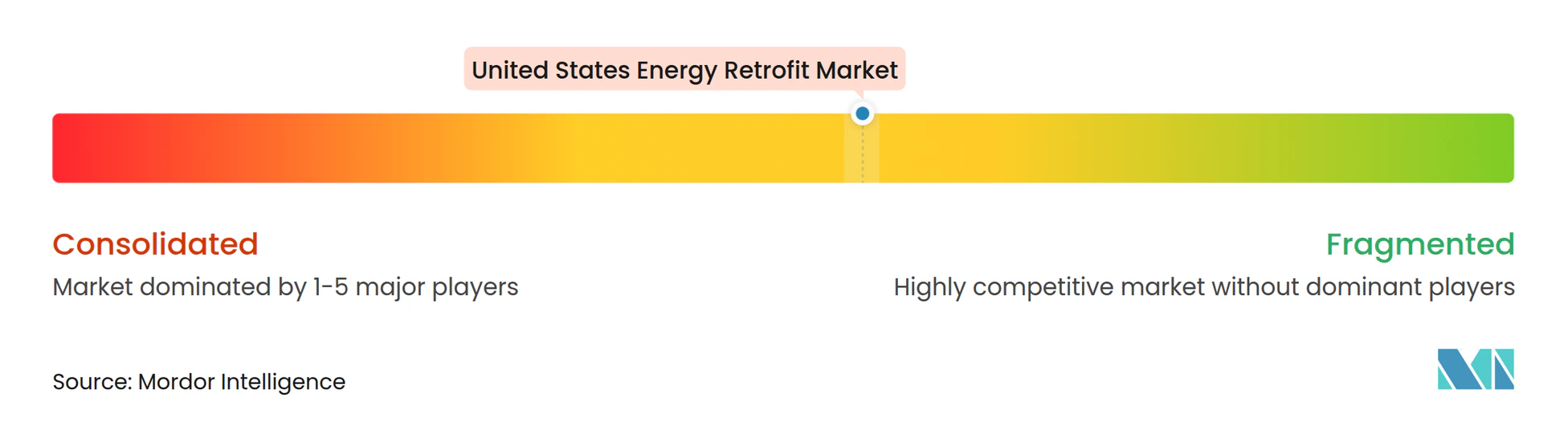
The United States energy retrofit market is moderately consolidated among large providers of integrated energy services. Ameresco, Honeywell, Johnson Controls, Trane Technologies, Siemens, and Schneider Electric compete for large energy savings performance contracts and energy performance contracts. Their offerings combine audits, design, financing, equipment integration, and measurement and verification. These capabilities matter for public and institutional clients that need one contractor to manage several systems. Regional mechanical, electrical, and plumbing contractors still perform much of the shallow upgrade work.
Digital building platforms are becoming a central competitive tool. In June 2026, Johnson Controls launched Metasys 16.0 with American Society of Heating, Refrigerating and Air-Conditioning Engineers (ASHRAE) Guideline 36-aligned sequences, cybersecurity features, expanded IP-device capacity, and workflows intended to reduce engineering and deployment time. The company stated that the platform could support energy savings of up to 30% in suitable applications. In August 2026, Johnson Controls expanded OpenBlue with Energy and Comfort Intelligence and an agentic AI assistant for cross-equipment data connectivity.
Honeywell was selected in January 2026 to modernize building automation systems at Fort Benning, Georgia, across nearly 300 buildings and more than 3 million square feet.[4] Ameresco began a USD 10 million or larger energy infrastructure project at Mount Sinai School District in May 2026, combining LED lighting, direct digital controls, solar PV, transformer replacements, and a fuel oil-to-natural-gas conversion. Smaller firms such as Willdan Energy Solutions, Orion Energy Systems, Energy Systems Group, and Entegrity Energy Partners focus on utility, government, lighting, and controls programs with repeatable scopes. The competitive gap is most visible in commercial properties below 50,000 square feet, where owners need financing support, compliance guidance, and low-disruption delivery. The United States energy retrofit market offers room for providers that can make those services easier for smaller owners to buy.
United States Energy Retrofit Industry Leaders
-
Trane Technologies plc
-
Johnson Controls International plc
-
Siemens AG
-
Schneider Electric SE
-
Ameresco, Inc.
- *Disclaimer: Major Players sorted in no particular order
Recent Industry Developments
- May 2026: Ameresco began an energy infrastructure modernization project for the Mount Sinai School District in New York. The project includes LED lighting upgrades, energy management system modernization with direct digital controls, rooftop solar PV installations, high-efficiency transformer replacements, and conversion from fuel oil to natural gas under an Energy Savings Performance Contract (ESPC).
- March 2026: Ameresco partnered with Saginaw Public Schools in Michigan to implement a district-wide LED lighting retrofit under an ESPC framework. Installation commenced in April 2026, with completion targeted for August 2026, supporting energy savings and operational cost reductions across school facilities.
- January 2026: The U.S. Army selected Honeywell International to modernize building automation systems across nearly 300 buildings at Fort Benning, Georgia. The project covers more than 3 million square feet using the Niagara platform and is expected to generate annual savings of approximately USD 4.5 million.
- September 2025: Ameresco and the City of Olympia broke ground on a nearly USD 17 million retrofit project at the Olympia Armory. The project includes building envelope improvements, accessibility upgrades, and solar PV installation delivered through an ESPC structure.
United States Energy Retrofit Market Report Scope
Energy retrofit refers to the process of upgrading existing buildings, facilities, or infrastructure with energy-efficient technologies and systems to reduce energy consumption and improve overall performance. Typical improvements include HVAC upgrades, lighting replacements, building envelope enhancements, smart energy controls, and renewable energy integration. Energy retrofits help lower operating costs, enhance occupant comfort, reduce greenhouse gas emissions, and extend the useful life of buildings.
The United States energy retrofit market is segmented by retrofit depth into deep energy retrofits and shallow/light energy retrofits. By technology, the market is segmented into HVAC systems, lighting systems, building envelope (insulation and glazing), renewable integration (solar PV and solar thermal), smart building controls and IoT, and water heating and plumbing. By application, the market is segmented into residential buildings, commercial buildings, industrial facilities, and public and institutional buildings. Market forecasts are provided in value terms (USD).
| Deep Energy Retrofits |
| Shallow/Light Energy Retrofits |
| HVAC Systems |
| Lighting Systems |
| Building Envelope (Insulation and Glazing) |
| Renewable Integration (Solar PV, Solar Thermal) |
| Smart Building Controls and IoT |
| Water Heating and Plumbing |
| Residential Buildings |
| Commercial Buildings |
| Industrial Facilities |
| Public and Institutional Buildings |
| By Retrofit Depth | Deep Energy Retrofits |
| Shallow/Light Energy Retrofits | |
| By Technology | HVAC Systems |
| Lighting Systems | |
| Building Envelope (Insulation and Glazing) | |
| Renewable Integration (Solar PV, Solar Thermal) | |
| Smart Building Controls and IoT | |
| Water Heating and Plumbing | |
| By Application | Residential Buildings |
| Commercial Buildings | |
| Industrial Facilities | |
| Public and Institutional Buildings |
Key Questions Answered in the Report
What is the 2026 value of the United States energy retrofit market?
The United States energy retrofit market was estimated at USD 128.76 billion in 2027 and is forecast to reach USD 177.51 billion by 2032.
What is driving demand for energy retrofit projects in the United States?
Aging HVAC systems, heat pump adoption, incentive programs, refrigerant requirements, and building performance planning are supporting project activity.
Which retrofit type holds the largest share of spending?
Shallow and light upgrades held 61.6% of 2026 spending due to shorter payback periods and limited disruption.
Which technology is growing the fastest in building upgrades?
Renewable integration is forecast to grow at an 8.2% CAGR through 2032, as owners pair solar investments with HVAC electrification.
Which building application is forecast to grow fastest?
Public and institutional buildings are forecast to grow at a 7.2% CAGR through 2032, supported by long-term performance contracts.