
United States Data Center Logistics Market Size and Share
Market Overview
| Study Period | 2021 - 2032 |
|---|---|
| Forecast Data Period | 2027 - 2032 |
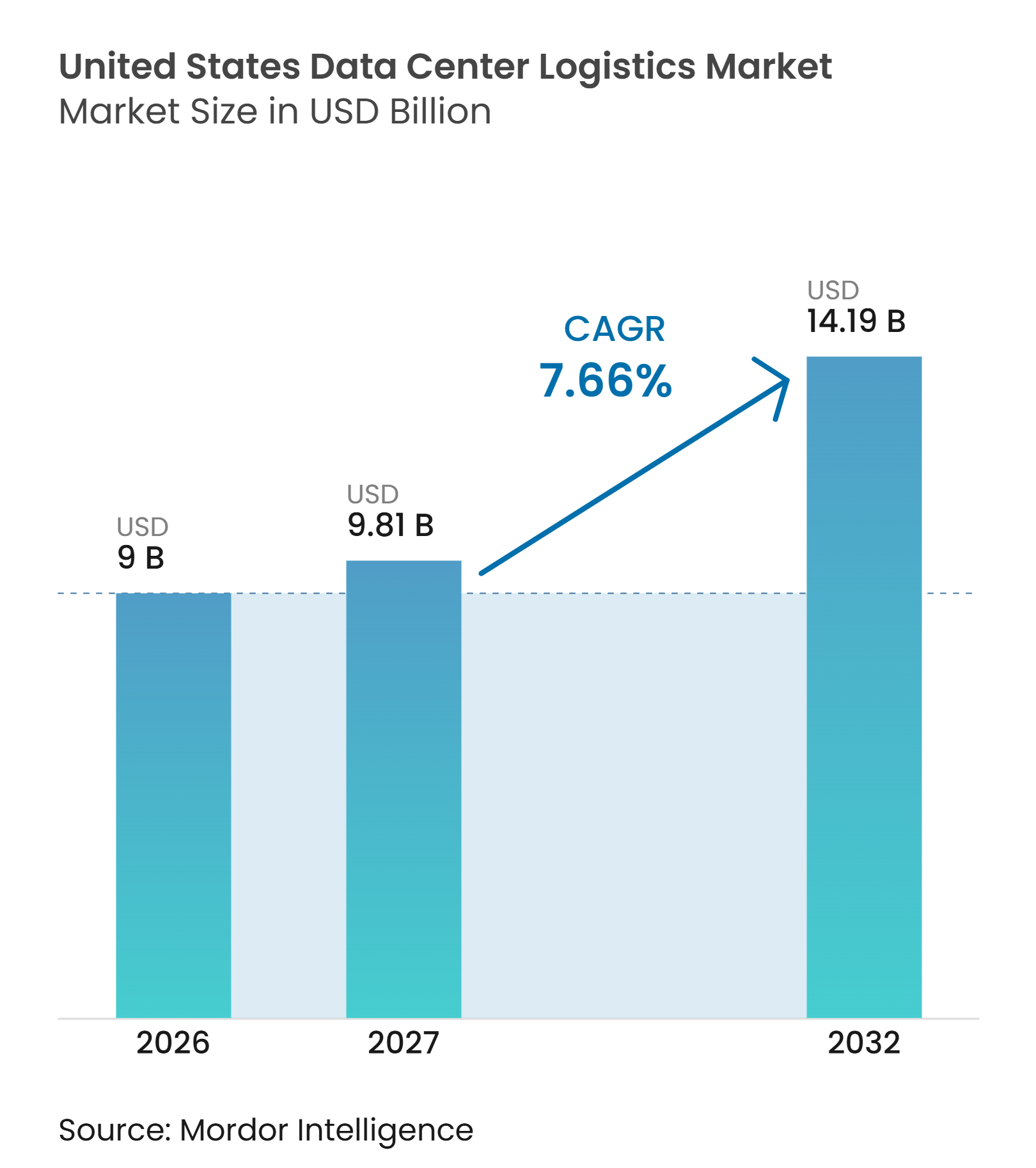
| Base Year Market Size (2026) | USD 9 Billion |
| Market Size (2027) | USD 9.81 Billion |
| Market Size (2032) | USD 14.19 Billion |
| Growth Rate (2027 - 2032) | 7.66 % |
| Market Concentration | Medium |
Major Players *Disclaimer: Major Players sorted in no particular order Image © Mordor Intelligence. Reuse requires attribution under CC BY 4.0. | |
United States Data Center Logistics Market Analysis by Mordor Intelligence
The United States data center logistics market size is valued at USD 9 billion in 2026. It is estimated to grow from USD 9.81 billion in 2027 to reach USD 14.19 billion by 2032, at a CAGR of 7.66% during the forecast period 2027 to 2032.
The United States data center logistics market is supported by a large pipeline of AI and cloud infrastructure, which increases demand for delivery, staging, configuration, and controlled storage. Data center supply in primary North American markets reached 10,903 MW in the first half of 2026, while vacancy fell to 1.4%, showing that new capacity continued to be absorbed quickly. The United States data center logistics market also benefits from shorter equipment refresh cycles, because active facilities need ongoing deliveries of servers, power systems, and cooling equipment. Logistics providers are responding by expanding specialized warehouses and moving more technical work away from construction floors. DHL announced 10 dedicated North American sites with more than 7 million ft² of capacity for rack configuration, pre-testing, and specialized transport, reflecting the momentum of the United States data center logistics service model.
Key Report Takeaways
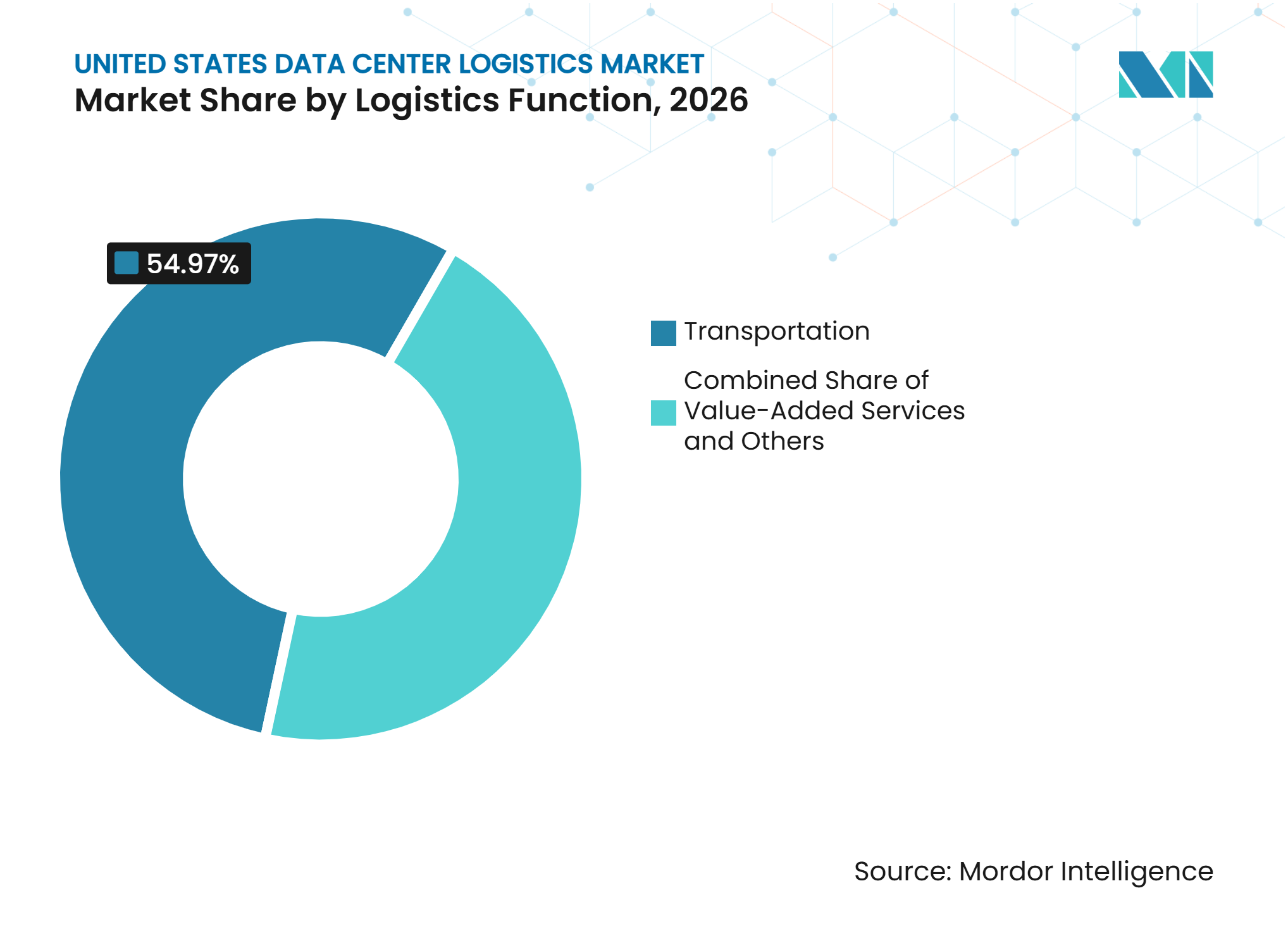
- By logistics function, transportation accounts for 54.97% of the United States data center logistics market share in 2026, while value-added services are forecast to expand at a 9.60% CAGR through 2032.
- By transportation mode, road accounts for 58.80% of the United States data center logistics market size in 2026, while air is forecast to expand at a 9.95% CAGR through 2032.
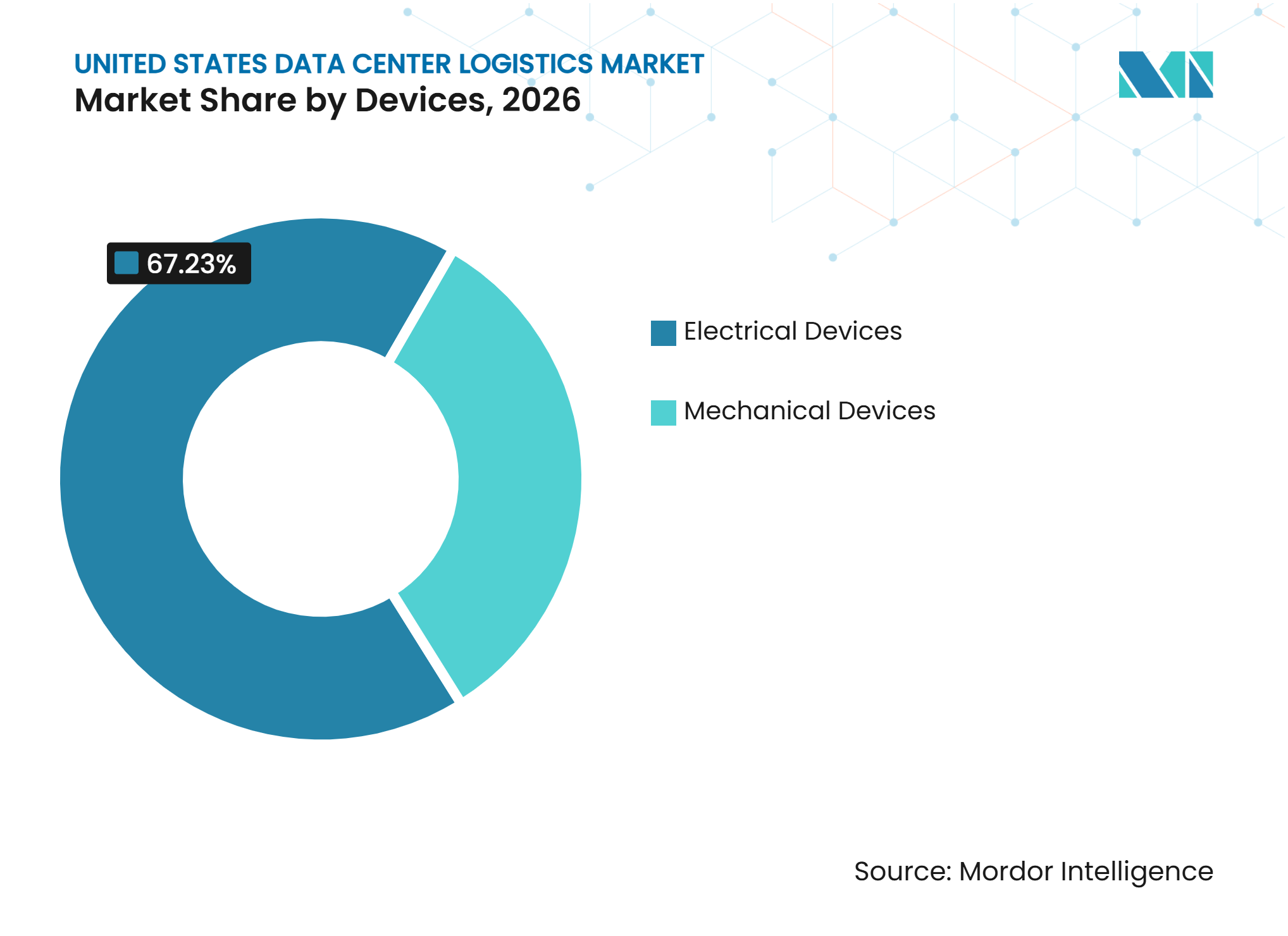
- By devices, electrical devices account for 67.23% of the United States data center logistics market share in 2026, while mechanical devices are forecast to expand at a 9.53% CAGR through 2032.
- By data center size, large-scale data centers account for 65.54% of the United States data center logistics market size in 2026, while small and medium-scale data centers are forecast to expand at a 9.47% CAGR through 2032.
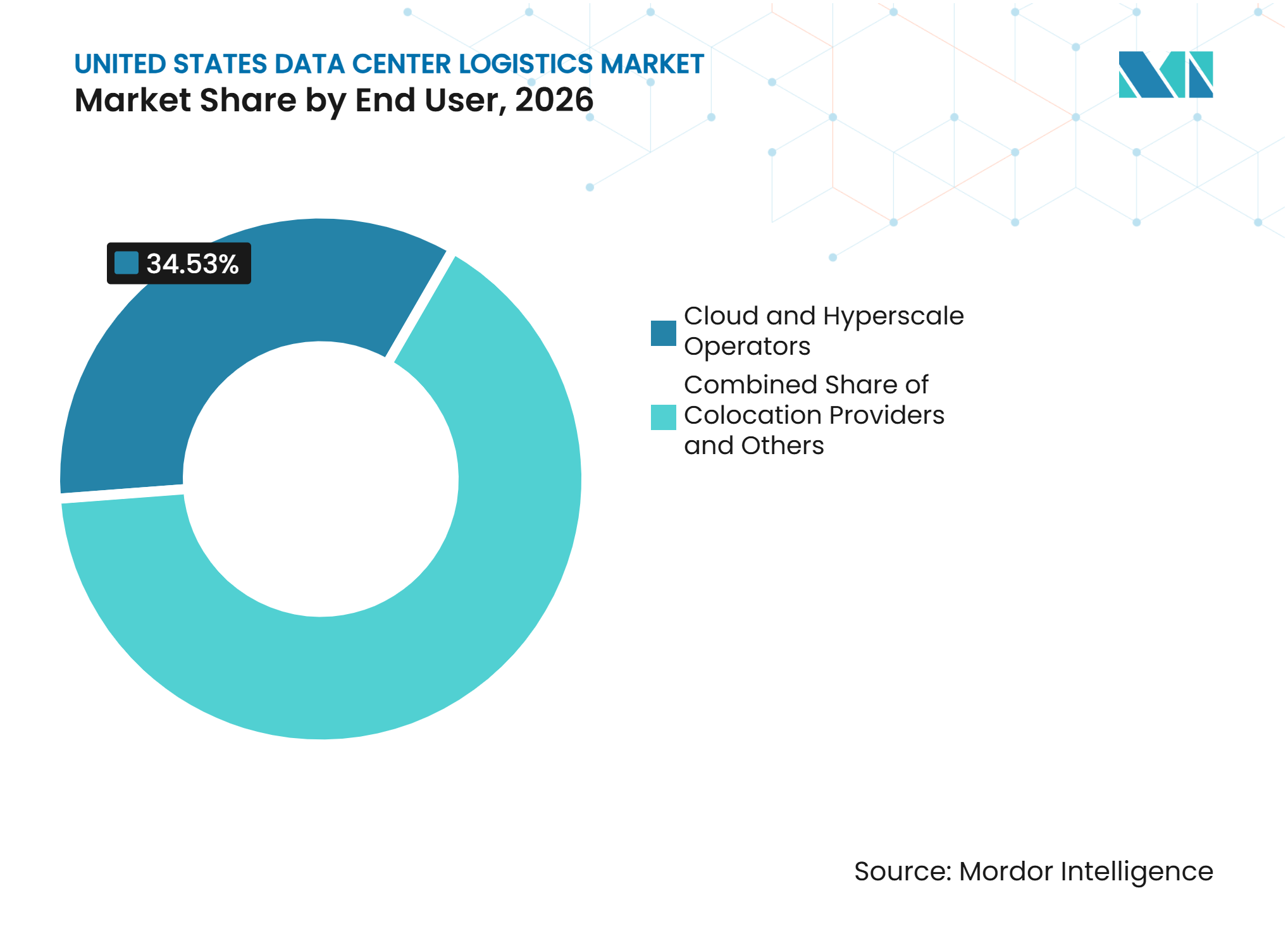
- By end user, cloud and hyperscale operators account for 34.53% of the United States data center logistics market share in 2026 and are forecast to expand at a 10.61% CAGR through 2032.
- By geography, the Southeast accounts for 29.12% of the United States data center logistics market share in 2026, while the Southwest is forecast to expand at a 10.22% CAGR through 2032.
Note: Market numbers in this report are based on Mordor Intelligence's proprietary estimation framework, which combines nine months of actuals with Q4 projections for base year 2026.
Market Trends and Insights
Drivers Impact Analysis of United States Data Center Logistics Market*
| Driver | (~) % Impact on CAGR Forecast | Geographic Relevance | Impact Timeline |
|---|---|---|---|
| Hyperscale and AI Capacity Expansion | +2.5% | National, concentrated in Southeast and Southwest | Long term (≥ 4 years) |
| High-Density Power and Cooling Deployments | +1.4% | National, with early gains in Northern Virginia, Phoenix, and Atlanta | Medium term (2-4 years) |
| Compressed Construction and Commissioning Schedules | +1.0% | National, with growing activity in Midwest and Southwest secondary markets | Medium term (2-4 years) |
| White-Glove and Chain-of-Custody Logistics | +0.8% | National | Short term (≤ 2 years) |
| Modular and Prefabricated Components | +0.6% | National, with early gains in Texas, Ohio, and Arizona | Medium term (2-4 years) |
| Near-Site Staging and Sequenced Delivery | +0.5% | National, with Southeast and Southwest campuses leading adoption | Short term (≤ 2 years) |
| Source: Mordor Intelligence | |||
Hyperscale and AI Data Center Capacity Expansion
United States data center capacity is expected to rise from 24 GW in 2026 to 110 GW by 2030, increasing the flow of equipment and construction materials that specialized providers need to coordinate. Primary North American market supply increased 33.7% year-over-year to 10,903 MW in the first half of 2026, while vacancy fell to 1.4%[1]. The demand pattern extends beyond a one-time build phase because cloud facilities continue to receive new computing and power equipment after commissioning. Providers that can connect freight, warehouse operations, technical handling, and site delivery are positioned to serve that continuing requirement.
High-Density Power, Cooling, and Modular Equipment Deployments
AI-oriented facilities use higher rack densities than traditional installations, increasing the weight, value, and handling requirements for power and cooling equipment. The IEA 4E program states that liquid cooling can reduce facility energy use by 30% to 40%, which supports its adoption in high-density environments. The Open Compute Project recommends controlled transport temperatures of 5 °C to 60 °C for liquid-cooled racks and longer-term storage between 20 °C and 25 °C. These requirements increase demand for trained handling teams, monitoring, specialized packaging, and suitable warehouse conditions in the United States data center logistics market. Modular cooling and power assemblies further shift work from construction sites into factories, then require delivery in a tightly planned installation sequence. This operating model makes coordination between manufacturers, project managers, carriers, and site teams more important than conventional shipment planning.
Compressed Construction, Staging, and Sequenced Delivery
Construction teams are seeking faster facility delivery, so logistics activities affect whether a site can stay on schedule. DHL created dedicated warehouses for rack configuration, pre-testing, and warehouse-to-site transport, which allows technical work to happen before equipment reaches a live site. DHL also introduced a North American forward-stocking service that uses more than 150 locations in the United States and Canada to support delivery of critical parts within 4 hours. Near-site warehouses allow providers to hold equipment close to a campus and release it in the order required for installation. This helps construction teams manage several buildings at once without overloading site storage areas. The United States data center logistics market, therefore, places greater value on inventory visibility, appointment control, and reliable handoffs among contractors.
White-Glove Handling and Secure Chain of Custody
Server racks, power units, and liquid-cooled systems require protection from shock, vibration, environmental exposure, and unauthorized access. The Open Compute Project identifies storage and transport practices for liquid-cooled racks because coolant systems can face leakage and handling risks. Kuehne+Nagel’s Secure Cloud Deployment service uses tracking for shock, tilt, temperature, humidity, and light exposure during transport. IATA reported that air cargo carried more than two-thirds of global AI-related goods by value in 2025, and AI-related consignments increased 20% year-over-year[2]. High-value equipment strengthens the business case for specialized vehicles, monitored transport, trained installation teams, and documented custody. NIST security guidance also supports formal controls for systems serving government workloads, which can make traceability a practical requirement for providers working on those deployments.
Restraints Impact Analysis of United States Data Center Logistics Market*
| Restraint | (~) % Impact on CAGR Forecast | Geographic Relevance | Impact Timeline |
|---|---|---|---|
| Limited Heavy-Haul Routes, Grid Interconnection, and Site Access | -1.3% | National, most acute in rural Southwest and Midwest greenfield sites | Long term (≥ 4 years) |
| Risk of Shock, Vibration, ESD, and Environmental Damage | -0.9% | National | Short term (≤ 2 years) |
| Shortage of Mission-Critical Logistics Labor and Specialized Equipment | -1.1% | National, particularly in secondary markets | Medium term (2-4 years) |
| Long Lead Times for Transformers, Switchgear, and Cooling Equipment | -1.0% | National, especially where pre-staged inventory is limited | Long term (≥ 4 years) |
| Source: Mordor Intelligence | |||
Heavy-Haul Access, Grid Constraints, and Equipment Lead Times
Large transformers, switchgear, cooling equipment, and prefabricated modules need to move through routes that may have weight, clearance, and permit limits. The United States Department of Transportation provides the framework for oversize and overweight vehicle operations, while individual states manage many route-specific permitting decisions. This adds planning time to projects in rural or newly developed locations. Lengthy lead times for power transformers and generator step-up transformers can require controlled storage before a site is ready. Extended storage can increase costs and create demand for secure facilities, but it also ties up working capacity in the United States data center logistics market. Delays in grid interconnection, site infrastructure, or delivery permits can cause equipment to arrive long before commissioning dates.
Equipment Damage Risk and Specialized Labor Constraints
Vibration, electrostatic discharge, incorrect temperatures, or poor handling can damage sensitive computing equipment. The Open Compute Project describes transport and storage controls for liquid-cooled hardware, including conditions that protect coolant systems and related components. The Federal Motor Carrier Safety Administration sets safety rules for commercial vehicles and drivers, which form an important compliance baseline for heavy and specialized movements. Providers need drivers, riggers, warehouse technicians, and field teams who understand both freight safety and equipment sensitivity. This requirement is harder to meet in secondary markets with smaller pools of specialized labor and limited access to air-ride vehicles or clean handling equipment. The constraint can limit service availability even when equipment demand remains strong.
*Our forecasts treat driver/restraint impacts as directional, not additive. The impact forecasts reflect baseline growth, mix effects, and variable interactions.
United States Data Center Logistics Market Segment Analysis
By Logistics Function:
Value-Added Services Expands Beyond Core FreightTransportation accounts for 54.97% of the United States data center logistics market share in 2026, reflecting the volume of servers, power systems, cooling equipment, and construction materials moving to active sites. Road and project-cargo movements remain essential because many facilities require large equipment to reach campuses outside major urban centers. Warehousing and storage support projects where transformers, switchgear, and cooling systems need to be held before site conditions allow installation. DHL has opened dedicated facilities that combine storage with rack configuration, pre-testing, and specialized dispatch, showing how warehouse functions are becoming more technical. The United States data center logistics market continues to need these transport and storage services even as operators add more specialized activities.
Value-added services have the fastest projected growth at 9.60% CAGR through 2032, supported by configuration, staging, testing, firmware work, installation support, and chain-of-custody documentation. Kuehne+Nagel describes a service model that includes monitored transport, rack handling, component installation, and packaging removal at data center locations. The service category requires stronger technical procedures than standard freight, which can make capabilities and training more important than transport pricing alone. NIST controls for government-related workloads add further importance to documented physical access and custody practices.



By Transportation Mode:
Road Leads While Air Serves Urgent Equipment NeedsRoad transport accounts for 58.80% of the United States data center logistics market size in 2026 because it can move bulk materials, heavy mechanical systems, racks, and power equipment from ports, factories, and warehouses to sites. Road carriers also support final-mile delivery, installation appointments, and returns from active facilities. Heavy and oversized loads require route review and permits under state and federal operating rules. Rail, sea, and inland waterways can support selected project-cargo movements where the origin, destination, and equipment profile permit their use. The United States data center logistics market needs multimodal planning because construction schedules and equipment characteristics differ from one shipment to another.
Air has the highest projected growth at 9.95% CAGR through 2032 because some processors, servers, and other components are too time-sensitive for ocean freight. Air cargo carried more than two-thirds of AI-related goods by value in 2025, while these consignments increased 20% over the prior year, according to IATA. Kuehne+Nagel reported continued focus on cloud and data center services, supported by air freight, sea freight, and specialized ground solutions. Air shipments usually carry higher transport costs, so they are most suitable for critical equipment or projects facing narrow commissioning windows. The result is a clear division between bulk movements and urgent high-value movements within the United States data center logistics market.
By Devices:
Electrical Systems Lead While Cooling Equipment Gains PaceElectrical devices account for 67.23% of the United States data center logistics market share in 2026, led by servers, storage systems, UPS equipment, transformers, and other power infrastructure. These systems account for a large share of facility investment and require carefully coordinated shipping and receiving. Higher equipment values raise the importance of tracked transport, secure storage, and trained final-mile teams. Data center growth is reshaping demand for electrical equipment in the United States. Electrical Devices may remain central to the United States data center logistics market because every new facility needs computing and power systems before operations can begin.
Mechanical devices are forecast to register a 9.53% CAGR through 2032, driven by liquid cooling systems, racks, dry coolers, cooling towers, and related equipment. The IEA 4E program estimates that liquid cooling can lower facility energy use by 30% to 40%, strengthening its role in dense computing deployments[3]. The Open Compute Project has published handling guidance for liquid-cooled racks, including temperature ranges and storage conditions. These specifications make mechanical equipment logistics more specialized and increase the need for suitable packaging, warehouse environments, and installation planning. Factory-built cooling modules can also reduce site assembly work while concentrating handling risk in fewer, heavier shipments.

By Data Center Size:
Large Campuses Dominate and Edge Sites Broaden DemandLarge-scale data centers account for 65.54% of the United States data center logistics market size in 2026 because hyperscale and colocation campuses account for major equipment purchases and multi-year construction programs. Large campuses need advance delivery plans that align multiple vendors, security rules, site access controls, and installation teams. Their scale supports dedicated staging facilities and contracted transport networks. The United States data center logistics market size for this segment remains anchored by the continuous buildout of large cloud infrastructure sites.
Small and medium-scale data centers are forecast to register a 9.47% CAGR through 2032 as edge deployments and enterprise upgrades extend activity beyond established hubs. Distributed facilities often have less on-site space for receiving, staging, and material handling than large campuses. This can create demand for scheduled deliveries, temporary storage, and skilled final-mile teams. Smaller projects may also need customized delivery plans when their sites have restricted access or limited loading infrastructure. The expanding base of locations gives specialized providers opportunities outside the largest hyperscaler accounts in the United States data center logistics market.
By End User:
Cloud and Hyperscale Operators Concentrate DemandCloud and hyperscale operators account for 34.53% of the United States data center logistics market share in 2026 and are forecast to grow at a 10.61% CAGR through 2032. Their investment programs require repeated movements of computing hardware, electrical infrastructure, cooling systems, and replacement parts. 80.4% of capacity under construction in the primary North American market was pre-leased in the first half of 2026. This visibility can help logistics providers plan warehouse capacity and fleet activity over longer periods. Kuehne+Nagel has stated that customers provided equipment requirement visibility through 2027 to 2029, showing the extended planning horizons involved in these relationships.
Colocation providers also create demand because they serve enterprises that do not operate their own large facilities. IT and telecommunications companies need physical infrastructure for network expansion and edge computing, while financial services, government, healthcare, and media users often require more formal controls over equipment movement. NIST guidance is particularly relevant where regulated or government workloads require documented security controls. Each customer type can require different receiving procedures, access controls, and equipment handling methods. This diversity limits the usefulness of a single standardized service model and supports specialized service development across the United States data center logistics industry.
Geography Analysis
The Southeast accounts for 29.12% of the United States data center logistics market share in 2026, supported by Northern Virginia and Atlanta. Northern Virginia added 1,102 MW of net absorption in 2025 and reached 4,039.6 MW of inventory[4]. The regional buildout supports demand for recurring inbound deliveries, local staging, and controlled transport between warehouse sites and campuses. Very low availability in established locations makes predictable logistics capacity important because site teams have little room to hold excess inventory. Providers in this geography are likely to benefit from dedicated warehouse networks, technical configuration capability, and close coordination with contractors.
The Southwest is forecast to expand at a 10.22% CAGR through 2032, making it the fastest-growing regional part of the United States data center logistics market. Prime Data Centers began construction on 3 buildings at a 240 MW Phoenix campus in May 2026 as part of a USD 3 billion investment. Development across Arizona and Nevada increases movement of power, cooling, server, and modular systems into a region with long distances between manufacturing, ports, warehouses, and final sites. The Southwest benefits from expanding power infrastructure and from a shift away from some capacity-constrained markets. The United States Department of Transportation’s oversize and overweight operating framework remains relevant for equipment deliveries that require route and permit planning. Providers that secure staging capacity and heavy-haul expertise in Phoenix and nearby corridors can better manage equipment sequencing for new campuses.
The Midwest is gaining projects in Ohio, Indiana, and Wisconsin as operators seek capacity outside established coastal hubs. These locations can require new local staging and heavy-haul capability because specialist networks are less mature than in Northern Virginia or Phoenix. The Northeast continues to serve financial services and enterprise requirements that place value on proximity, resilience, and controlled equipment handling. NIST-related security practices and other customer controls can shape custody requirements for sensitive equipment in this geography. The West retains a large installed base, but power constraints can direct some new build activity toward Arizona and Nevada. Across these mixed regions, the United States data center logistics market relies on flexible warehousing, route planning, and technical delivery services that can adapt to diverse site conditions.
Competitive Landscape
Market Concentration
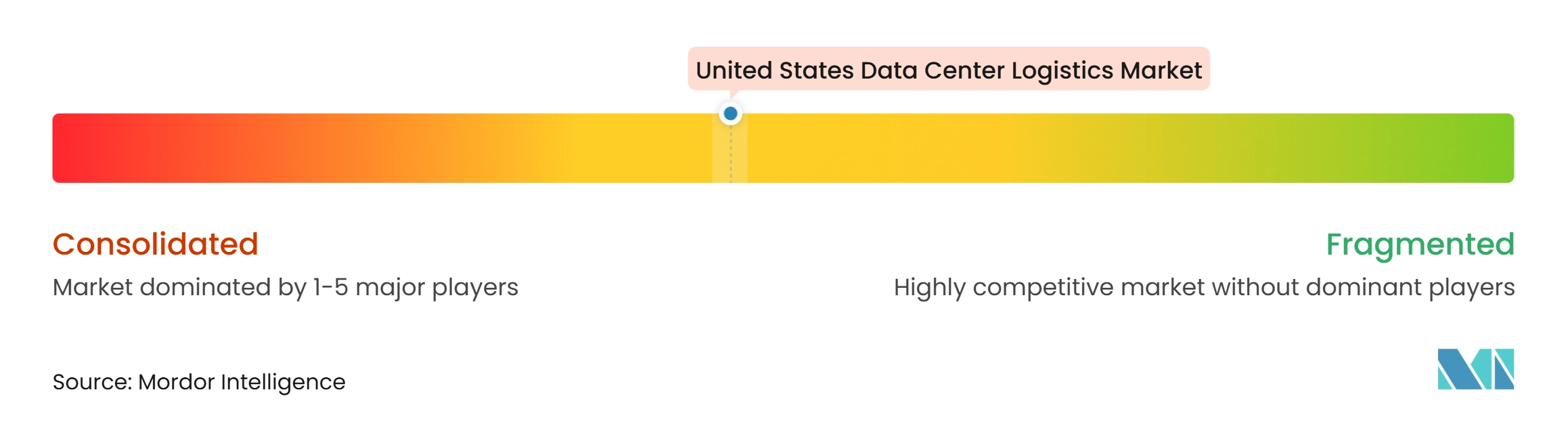
The United States data center logistics market is consolidated among global providers that combine freight forwarding, warehouse operations, technical services, and final-mile delivery. DHL Group, GXO Logistics, Kuehne+Nagel, and DP World compete with project-cargo specialists, IT relocation providers, and regional staging operators. DHL’s 10 dedicated North American data center logistics sites provide rack configuration, pre-testing, and specialized warehouse-to-site transport. This approach combines services that customers could otherwise source from several providers.
DP World expanded its specialized United States network in October 2026, supporting nearly 50 data center sites with transportation, inventory management, cleanroom-enabled configuration, and final deployment. The company stated that it could configure up to 75 custom racks weekly and managed more than USD 2 billion in assets through its platform. Kuehne+Nagel uses monitored transport and air-ride delivery for cloud infrastructure customers, which reflects the rising importance of equipment protection and traceability. ISO 9001-based quality systems and NIST-aligned custody practices can support provider credibility with customers that need consistent handling and documented controls. These capabilities can make it difficult for conventional freight providers to compete for the most sensitive work.
GXO Logistics reported 5 new data center contracts in the fourth quarter of 2025 and claimed work across multiple regions with a leading hyperscaler. Arvato entered the United States data center services segment in January 2025 through ATC, offering warehousing, white-glove final-mile delivery, cabling, staging, and high-precision handling. GEODIS and CEVA Logistics have also established specialized service offerings that combine transport, secure warehousing, tracking, final-mile delivery, and circular services. Competition is, therefore, active in both integrated national networks and narrower technical niches.
United States Data Center Logistics Industry Leaders
-
DHL Group
-
DSV
-
Kuehne+Nagel
-
DP World
-
GXO Logistics
- *Disclaimer: Major Players sorted in no particular order
United States Data Center Logistics Market Companies Covered in this Report
- DHL Group
- Logistics Plus Inc.
- MG Moving Services LLC
- JK Moving Services
- GXO Logistics, Inc.
- Expeditors International of Washington, Inc.
- DP World Limited
- Kuehne + Nagel International AG
- Ceva Logistics
- FedEx
- TransPak Inc.
- GEODIS
- UPS
- DSV
- Nippon Express
- Arvato
- AIT Worldwide Logistics
- Rhenus Logistics
- Nationwide Transport Services
- Yusen Logistics
Recent Industry Developments in United States Data Center Logistics Market
- October 2026: DP World expanded its specialized United States data center logistics network, with operations now supporting nearly 50 United States data center sites serving leading hyperscale activities. The platform integrates transportation, inventory management, server configuration in cleanroom-enabled environments, processing up to 75 custom racks weekly, and final deployment, covering more than USD 2 billion in managed assets.
- August 2026: DHL Supply Chain launched a national forward-stocking solution for data center infrastructure parts, operating from more than 150 locations across the United States and Canada and enabling delivery of mission-critical installation and replacement parts within 4 hours of customer requests.
- June 2026: DHL Group expanded its Asia Pacific data center logistics capabilities, adding more than 30,000 m² of dedicated warehouse capacity with a further 130,000 m² of committed expansion in Malaysia and Thailand, extending global supply corridors that support North American data center construction logistics.
- March 2026: DHL Supply Chain announced 10 dedicated data center logistics warehouse sites in North America, totaling more than 7 million ft² of capacity, designed to serve hyperscale and colocation operators with white-glove handling, rack configuration, pre-testing, and specialized warehouse-to-site transport.
United States Data Center Logistics Market Report Scope
Segmentation Overview
| Transportation | Road |
| Rail | |
| Sea and Inland Waterways | |
| Air | |
| Warehousing and Storage | |
| Value-Added Services |
| Electrical Devices | UPS Systems |
| Servers and Storage Devices | |
| Other Electrical Infrastructure | |
| Mechanical Devices | Cooling Systems |
| Racks | |
| Other Mechanical Infrastructure |
| Small and Medium-Scale Data Centers |
| Large-Scale Data Centers |
| Cloud and Hyperscale Operators |
| Colocation Providers |
| IT and Telecommunications Companies |
| Banking, Financial Services and Insurance (BFSI) |
| Government and Defense |
| Healthcare |
| Content, Media and Digital Services |
| Other End Users |
| Midwest |
| Northeast |
| Southeast |
| Southwest |
| West |
| By Logistics Function | Transportation | Road |
| Rail | ||
| Sea and Inland Waterways | ||
| Air | ||
| Warehousing and Storage | ||
| Value-Added Services | ||
| By Devices | Electrical Devices | UPS Systems |
| Servers and Storage Devices | ||
| Other Electrical Infrastructure | ||
| Mechanical Devices | Cooling Systems | |
| Racks | ||
| Other Mechanical Infrastructure | ||
| By Data Center Size | Small and Medium-Scale Data Centers | |
| Large-Scale Data Centers | ||
| By End User | Cloud and Hyperscale Operators | |
| Colocation Providers | ||
| IT and Telecommunications Companies | ||
| Banking, Financial Services and Insurance (BFSI) | ||
| Government and Defense | ||
| Healthcare | ||
| Content, Media and Digital Services | ||
| Other End Users | ||
| By Geography | Midwest | |
| Northeast | ||
| Southeast | ||
| Southwest | ||
| West | ||
Key Questions Answered in the Report
What is the forecast for United States data center logistics through 2032?
The sector is projected to increase from USD 9.81 billion in 2027 to USD 14.19 billion by 2032, at a 7.66% CAGR.
Which logistics function is growing fastest for United States data centers?
Value-added services are forecast to register at a 9.60% CAGR through 2032, supported by staging, configuration, testing, and chain-of-custody work.
Why is air freight becoming more important for data center deployments?
Air is forecast to register a 9.95% CAGR through 2032 because operators use it for urgent, high-value computing equipment. IATA reported that air cargo carried more than two-thirds of AI-related goods by value in 2025.
Which equipment category drives the most logistics spending?
Electrical devices account for a 67.23% share in 2026 because servers, power systems, storage equipment, and transformers form the core of facility investment.
Which United States region is expanding fastest for data center logistics?
The Southwest is forecast to register a 10.22% CAGR through 2032, supported by construction activity in Arizona, Nevada, and surrounding markets.
What capabilities do providers need to serve cloud and hyperscale operators?
Providers need secure warehousing, controlled transport, equipment tracking, configuration capability, skilled handling teams, and reliable final-mile delivery.