
United States Cargo Insurance Market Size and Share
Market Overview
| Study Period | 2021 - 2032 |
|---|---|
| Forecast Data Period | 2027 - 2032 |
| Base Year Market Size (2026) | USD 1.7 Billion |
| Market Size (2027) | USD 1.8 Billion |
| Market Size (2032) | USD 2.10 Billion |
| Growth Rate (2027 - 2032) | 3.10 % |
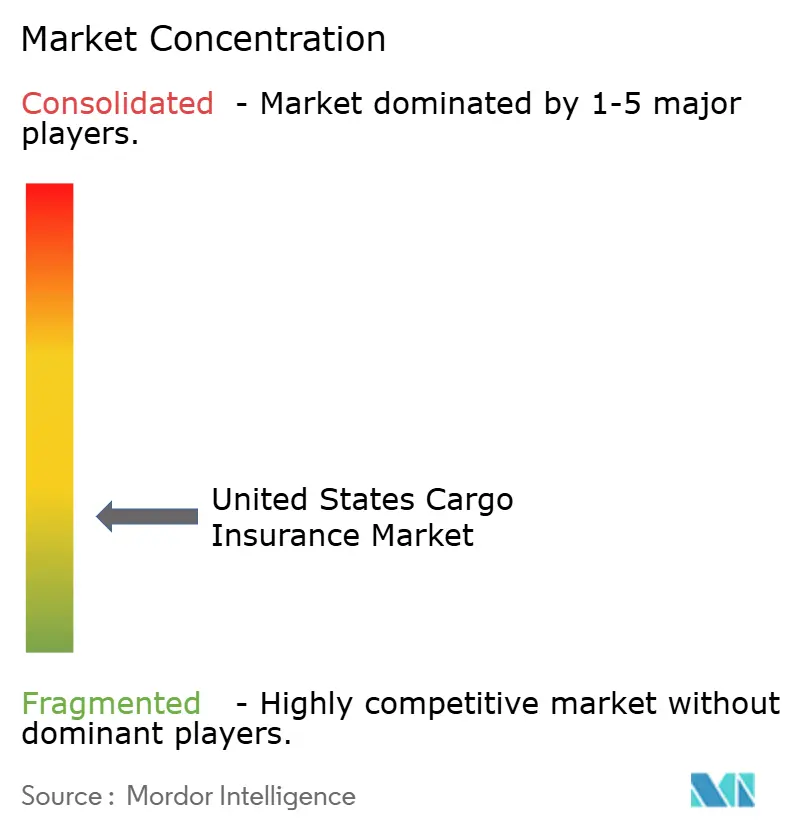
| Market Concentration | Low |
Major Players *Disclaimer: Major Players sorted in no particular order Image © Mordor Intelligence. Reuse requires attribution under CC BY 4.0. | |
United States Cargo Insurance Market Analysis by Mordor Intelligence
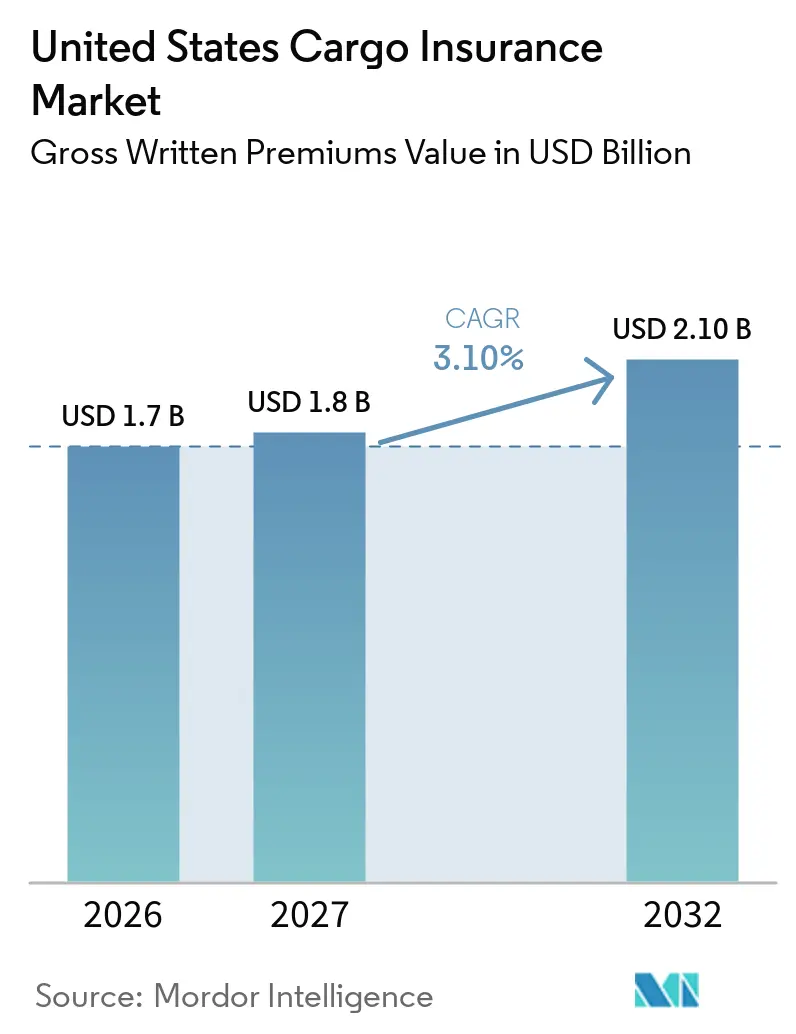
The United States Cargo Insurance Market size in terms of gross written premiums value is projected to expand from USD 1.7 billion in 2026 and USD 1.8 billion in 2027 to USD 2.10 billion by 2032, registering a CAGR of 3.10% between 2027 and 2032.
The United States cargo insurance market is expanding because insured shipment values are rising, cargo risks are changing, and distribution is becoming more digital. IUMI reported that the United States cargo loss ratio fell to 40% in 2025 from 75% in 2024, which has attracted underwriting capacity and increased competition in commodity cargo. Tariff-related costs are influencing cargo insurance exposures by increasing shipment values and creating additional risks associated with cargo accumulation and demurrage. Cargo theft also remains a significant concern, with estimated losses across the United States and Canada reaching nearly USD 725 million in 2025, an increase of 60% year over year. According to the United States Bureau of Economic Analysis, United States goods imports totaled USD 3,438.4 billion in 2025, highlighting the substantial volume of trade activity potentially requiring cargo insurance.
Key Report Takeaways
- By mode of transport, sea freight captured 47.8% of the United States cargo insurance market share in 2026, while air cargo is projected to grow at a 6.5% CAGR through 2032.
- By cargo profile, containerized cargo held a 42.4% share of the United States cargo insurance market in 2026, while project, heavy-lift, and out-of-gauge cargo is forecast to grow at a 5.8% CAGR through 2032.
- By trade scope, cross-border cargo accounted for 68.1% of the United States cargo insurance market in 2026, while domestic inland transit is projected to grow at a 4.7% CAGR through 2032.
- By distribution channel, brokers and agents captured 65.3% of the United States cargo insurance market share in 2026, while online and digital platforms are forecast to grow at a 9.2% CAGR through 2032.
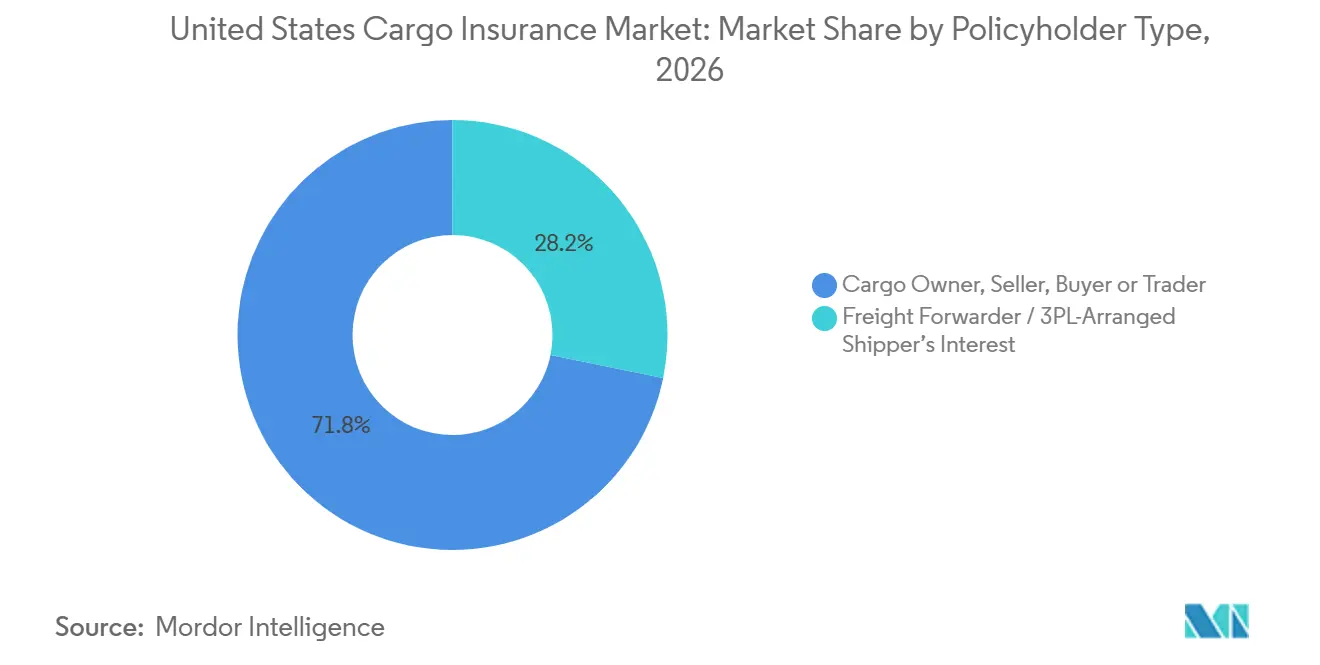
- By policyholder type, cargo owners accounted for 71.8% of the United States cargo insurance market in 2026, while freight forwarder and 3PL-arranged shippers’ interest is projected to grow at a 6.5% CAGR through 2032.
- By end-user industry, retail, consumer goods, and e-commerce held 22.4% of the United States cargo insurance market in 2026, while electronics and high-value manufactured goods are forecast to grow at a 6.7% CAGR through 2032.
Note: Market numbers in this report are based on Mordor Intelligence's proprietary estimation framework, which combines nine months of actuals with Q4 projections for base year 2026.
Market Trends and Insights
Drivers Impact Analysis of United States Cargo Insurance Market*
| Driver | (~) % Impact on CAGR Forecast | Geographic Relevance | Impact Timeline |
|---|---|---|---|
| Tariff Volatility, Trade-Route Diversification, and Rising Insured Shipment Values | +0.7% | National, concentrated at West Coast, Gulf Coast, and Northeast gateway ports | Short term (≤ 2 years) |
| Rising Cargo Theft, Strategic Freight Fraud, and High-Value Shipment Exposure | +0.5% | United States-wide, with hotspots in California, Texas, New Jersey, and Florida | Medium term (2-4 years) |
| Growth in E-Commerce Fulfillment and High-Frequency Parcel Shipments | +0.5% | National, with early gains in major urban fulfillment corridors | Medium term (2-4 years) |
| Expansion of High-Value, Temperature-Controlled, and Specialized Cargo Movements | +0.6% | Global trade lanes inbound to the United States and domestic cold-chain corridors | Medium term (2-4 years) |
| Digital Freight Platforms and Embedded Shipment-Level Insurance Distribution | +0.7% | National, with adoption concentrated in transport management system-heavy mid-market logistics ecosystems | Medium term (2-4 years) |
| Growing Need for Cargo Accumulation and Extreme-Weather Risk Management | +0.4% | Gulf Coast, Southeast, and Pacific Northwest, with periodic national exposure events | Long term (≥ 4 years) |
| Source: Mordor Intelligence | |||
Tariff Volatility, Trade-Route Diversification, and Rising Insured Shipment Values
Executive Order 14257, signed on April 2, 2025, introduced reciprocal tariffs on imports into the United States, with subsequent executive actions modifying tariff rates and scope. These changes increase uncertainty around landed costs, declared cargo values, and international shipping routes. Higher duties, taxes, and fees can increase the insured value required for imported goods, creating underinsurance risks when policy limits are not updated. Munich Re illustrated this exposure with an example in which a shipment insured for USD 5 million could require USD 6.5 million in coverage following tariff-related cost increases[1]. Importers consolidating orders to manage higher costs may also increase cargo accumulation at ports, warehouses, and distribution centers. The International Union of Marine Insurance has warned that tariffs could increase insured cargo values by as much as 50%, particularly in North America, while trade-route changes may introduce new transit and storage risks.
Rising Cargo Theft, Strategic Freight Fraud, and High-Value Shipment Exposure
The United States cargo insurance market faces increasing exposure to organized cargo theft and high-value freight crime. Verisk CargoNet estimated cargo theft losses across the United States and Canada at nearly USD 725 million in 2025, an increase of 60% from 2024[2]. Confirmed cargo theft incidents rose 18% to 2,646, while the average value per theft increased 36% to USD 273,990. Criminals increasingly target valuable electronics, metals, and other high-value goods, while freight fraud and deceptive collection arrangements create additional risks during transportation. These developments increase the importance of shipment verification, secure carrier selection, real-time tracking, and risk-based underwriting. Insurers and brokers can respond through coverage tailored to high-value shipments and stronger controls against theft and fraudulent diversion.
Growth in E-Commerce Fulfillment and High-Frequency Parcel Shipments
The United States cargo insurance market is adapting to the continued expansion of parcel shipments and increasingly distributed e-commerce fulfillment networks. The United States parcel market recorded 23.1 billion shipments in 2025, representing 3.3% year-on-year growth, according to Pitney Bowes[3]. Higher shipment frequency and the movement of goods through multiple fulfillment centers, sorting hubs, and last-mile delivery networks create demand for flexible cargo protection. Traditional annual cargo policies may not adequately serve smaller sellers that require simple coverage for individual shipments or frequent cross-border orders. International e-commerce also supports demand for air cargo insurance, particularly for high-value and time-sensitive products. Insurers can expand distribution through simplified policy issuance, shipment-level pricing, and coverage options that complement carrier liability.
Digital Freight Platforms and Embedded Shipment-Level Insurance Distribution
Digital freight platforms are creating new distribution opportunities in the United States cargo insurance market by integrating insurance into shipment booking and logistics workflows. In August 2025, Aon and Redkik announced a multi-year collaboration to embed shippers’ interest and cargo insurance into logistics platforms across North America and other regions. The arrangement supports API-driven integration and on-demand coverage at the point of sale. In June 2025, Hiscox launched a Cargo API through broker partners to automate underwriting for small cargo and stock throughput risks[4]. These developments can simplify policy issuance, improve access to shipment-level protection, and help insurers capture data on cargo movements and claims. Insurers and brokers that integrate digital distribution and automated underwriting may be better positioned to serve freight forwarders, logistics providers, and smaller businesses seeking faster access to cargo coverage.
Restraints Impact Analysis of United States Cargo Insurance Market*
| Restraint | (~) % Impact on CAGR Forecast | Geographic Relevance | Impact Timeline |
|---|---|---|---|
| Premium Sensitivity and Limited Insurance Penetration Among Small and Medium-Sized Shippers | -0.4% | National, with acute gaps in domestic LTL, last-mile, and small and medium-sized enterprise cross-border freight | Medium term (2-4 years) |
| Coverage Gaps, Valuation Disputes, and Confusion Between Cargo Insurance and Carrier Liability | -0.3% | United States-wide | Short term (≤ 2 years) |
| Claims Complexity Across Multimodal Shipments and Multiple Contracting Parties | -0.3% | National, with greater effects on cross-border and ocean-road intermodal routes | Medium term (2-4 years) |
| Catastrophe Accumulation, Concentrated Port and Warehouse Exposure, and Loss Volatility | -0.2% | Gulf Coast, East Coast, and Southern California gateway concentrations | Long term (≥ 4 years) |
| Incomplete Shipment Data and Underinsurance from Outdated Cargo Valuations | -0.3% | United States-wide | Short term (≤ 2 years) |
| Source: Mordor Intelligence | |||
Premium Sensitivity and Limited Insurance Penetration Among Small and Medium-Sized Shippers
Many domestic shipments in the United States move without standalone cargo insurance, leaving shippers reliant on the carrier’s contractual or statutory liability. Under the Carmack Amendment, motor carriers’ liability for cargo loss or damage is generally governed by federal law, although applicable limitations may depend on the shipment contract, declared value, and other legal requirements. A USD 200,000 electronics shipment could therefore face a substantial recovery shortfall if the carrier’s liability is limited. Small and medium-sized shippers may be reluctant to purchase standalone cargo coverage because of premium costs, limited awareness, or the perceived low probability of a major loss. Federal regulations generally do not require ordinary property freight carriers to maintain cargo insurance as a condition of federal operating authority, although separate requirements apply to household-goods carriers and other regulated categories. Consequently, growth in this segment of the United States cargo insurance market depends on affordable premiums, accessible distribution, and greater awareness of the financial exposure associated with uninsured shipments.
Coverage Gaps, Valuation Disputes, and Confusion Between Cargo Insurance and Carrier Liability
Gaps in carrier liability coverage for the commercial or replacement value of lost or damaged goods drive demand for standalone cargo insurance in the United States. The Carmack Amendment generally governs domestic motor freight and establishes carrier liability, subject to applicable statutory and contractual provisions. International ocean shipments may fall under the Carriage of Goods by Sea Act, which typically limits carrier liability to USD 500 per package or customary freight unit unless the shipper declares a higher value or another applicable arrangement applies. Differences among carrier liability, declared cargo value, and insured value can expose shippers to substantial financial losses. Disputes may also arise over valuation methods, policy exclusions, inadequate packaging, temperature excursions, and damage occurring across multiple transport modes. Insurers can mitigate these risks through clear policy language, accurate shipment valuations, and explicit coverage terms for transit, handling, storage, and temperature-sensitive goods.
*Our forecasts treat driver/restraint impacts as directional, not additive. The impact forecasts reflect baseline growth, mix effects, and variable interactions.
United States Cargo Insurance Market Segment Analysis
By Mode of Transport:
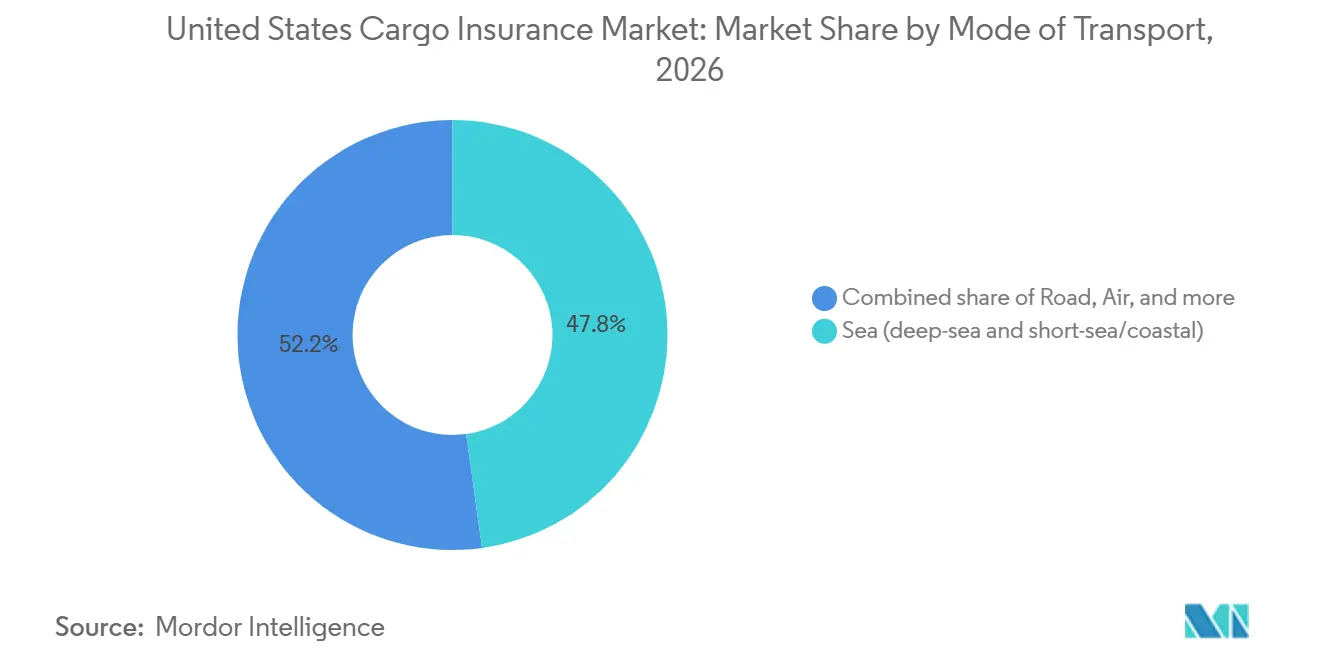
Ocean Freight Leads the Premium Base While Air Cargo ExpandsSea freight held a 47.8% share in 2026, supported by the role of ocean routes in United States goods trade. United States imports of capital goods and computers and accessories increased substantially in 2025, reflecting demand for industrial equipment and technology products. A significant share of international merchandise trade moves by sea, while road and rail support overland corridors, including trade with Mexico, which remained the largest United States goods import partner in 2025. Inland waterways also carry bulk commodities through the Mississippi River and Gulf Coast systems.
Air cargo is forecast to grow at a 6.5% CAGR through 2032 in the United States cargo insurance market. Demand for air freight is supported by high-value electronics, semiconductors, and time-sensitive technology shipments moving between Asia and the United States. The expansion of artificial intelligence infrastructure and data-center investment increases the importance of transporting servers and related components quickly. High-value airfreight shipments require appropriate insured-value declarations and coverage for physical damage, theft, and handling-related losses. Temperature-sensitive and fragile goods may also require specialized policy terms and risk controls.
By Cargo Profile:
Containerized Freight Holds the Largest Position While Project Cargo GrowsContainerized cargo accounted for 42.4% of the United States cargo insurance market size in 2026. Containerization supports standardized handling, intermodal transportation, and established cargo documentation practices across international supply chains. Dry bulk and liquid bulk serve energy, agricultural, and chemical supply chains. Break-bulk and roll-on/roll-off cargo support automotive, machinery, and capital equipment movements. Containerized electronics and other high-value manufactured goods can require substantial insured limits, depending on shipment value and accumulation exposure.
Project, heavy-lift, and out-of-gauge cargo is forecast to grow at a 5.8% CAGR through 2032. Infrastructure development, data-center construction, energy projects, and industrial investment support demand for specialized transportation of oversized equipment. The Port of Virginia handles a range of breakbulk and project cargo, including machinery and industrial materials, although the previously stated 157% year-over-year increase in September 2026 breakbulk tonnage could not be verified against an official port release. These shipments can require agreed-value policies, specialist surveys, and coverage tailored to loading, lifting, storage, and transit conditions. The complexity and replacement cost of project cargo create opportunities for specialist underwriters and marine insurance providers.
By Trade Scope:
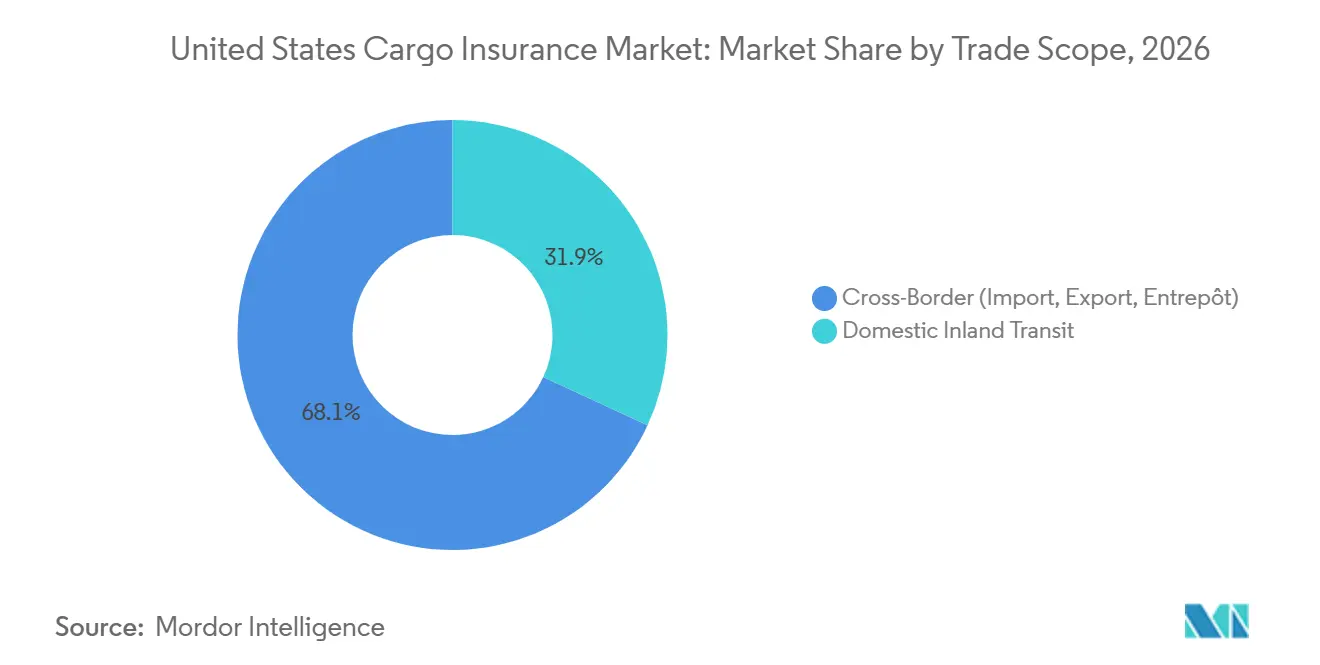
Cross-Border Trade Holds the Largest Position While Domestic Transit ExpandsCross-border cargo accounted for 68.1% of the United States cargo insurance market in 2026. International shipments can involve different contractual responsibilities, customs procedures, and liability regimes across transport modes and jurisdictions. The United States recorded goods trade deficits of USD 202.1 billion with China and USD 178.2 billion with Vietnam in 2025, highlighting the importance of transpacific and Southeast Asian supply chains. Cross-border cargo policies must reflect the agreed allocation of risk under applicable Incoterms, declared shipment values, and the transportation arrangements involved. Multimodal shipments may also require clear provisions for storage, transshipment, and inland movement.
Domestic inland transit is projected to grow at a 4.7% CAGR through 2032 in the United States cargo insurance market. Domestic distribution networks, e-commerce fulfillment, and movements between ports, warehouses, and retail locations create recurring cargo exposures. The United States parcel sector recorded 23.1 billion shipments in 2025, according to Pitney Bowes, demonstrating the scale of domestic parcel activity. Carrier liability may not fully compensate shippers for the value of lost or damaged goods, creating a potential role for standalone cargo coverage. Digital distribution and simplified shipment-level policies can help insurers serve businesses with frequent, lower-value shipments.
By Distribution Channel:
Brokers Lead While Digital Platforms Have the Highest Growth RateBrokers and agents held 65.3% of the United States cargo insurance market size in 2026. Brokers provide access to multiple insurers, assist with policy structuring, and support clients through complex claims and risk-management requirements. They remain important for multinational stock throughput programs, project cargo, and pharmaceutical cold-chain risks. These accounts can require tailored policy wording, valuation reviews, and management of accumulated exposures across warehouses and transport networks. Direct insurers also serve businesses seeking standardized coverage and established insurance relationships.
Online and digital platforms are projected to grow at a 9.2% CAGR through 2032. In May 2026, Distinguished Programs announced the launch of a marine cargo program backed by Allianz, covering physical loss or damage during transit and storage, including domestic and international inland transit. Hiscox's Cargo API also supports automated binding through broker partners for eligible cargo and stock throughput risks, with limits of up to USD 5 million. Digital distribution can integrate insurance into freight booking and logistics workflows, simplifying placement for eligible shipments. Brokers remain important for complex and high-value risks, making a combination of digital and relationship-based distribution relevant to the United States cargo insurance market.
By Policyholder Type:
Cargo Owners Retain the Largest Share While Forwarder Arrangements AdvanceCargo owners accounted for 71.8% of the United States cargo insurance market in 2026. This group includes sellers, buyers, and traders that have an insurable interest in goods during transportation. Large importers and manufacturers may use open cargo policies, stock throughput coverage, or voyage-specific insurance, depending on their shipment patterns and risk-management requirements. Changes in purchase prices, freight charges, and other insured-value components can create valuation gaps if policy declarations are not updated. Regular valuation reviews and appropriate policy limits can help cargo owners maintain adequate protection.
Freight forwarder and 3PL-arranged shipper’s interest insurance is forecast to grow at a 6.5% CAGR through 2032. Logistics intermediaries can make cargo protection more accessible by incorporating insurance options into freight booking and transportation services. In July 2025, Great American Insurance Group announced a collaboration with Breeze to expand digital and embedded marine cargo insurance solutions for freight forwarders. Such arrangements can simplify policy placement while helping shippers distinguish their own cargo protection from a logistics provider's contractual liability. Their effectiveness depends on clear disclosure of the insured party, coverage limits, exclusions, and the party responsible for purchasing the policy.
By End-User Industry:
Retail and E-Commerce Lead While Electronics Record the Fastest GrowthRetail, consumer goods, and e-commerce held 22.4% of the United States cargo insurance market in 2026. Imports of finished goods and domestic fulfillment operations generate recurring transportation exposures across ports, distribution centers, and last-mile delivery networks. Food, beverage, and agricultural products require coverage appropriate to spoilage, temperature fluctuations, and handling risks. Energy and bulk commodity shipments create additional demand associated with industrial materials and international trade. These industries require policy terms suited to their cargo values, transportation conditions, and loss exposures.
Electronics and high-value manufactured goods are projected to grow at a 6.7% CAGR through 2032. Investment in artificial intelligence infrastructure and data centers supports demand for servers, semiconductor components, networking equipment, and other technology products. The United States recorded USD 201.4 billion in imports from Taiwan in 2025, while imports from Vietnam reached USD 193.8 billion, reflecting the importance of Asian manufacturing supply chains. High-value electronics can require tailored coverage for theft, accidental damage, handling incidents, and accumulation at logistics facilities. Pharmaceutical and chemical shipments may require temperature-control provisions, while automotive cargo policies must account for damage during loading, transit, and unloading.
Geography Analysis
North America accounted for 7.2% of global marine premium income in 2025, according to the International Union of Marine Insurance (IUMI), based on its 2026 market review. The United States cargo insurance market is concentrated around major coastal gateways and inland logistics corridors. Los Angeles and Long Beach remain key West Coast gateways for transpacific trade, including shipments from China, Taiwan, and Vietnam. In 2025, United States goods imports from China reached USD 308.4 billion, while imports from Taiwan and Vietnam reached USD 201.4 billion and USD 193.8 billion, respectively. The Port of Los Angeles handled a record 1.04 million twenty-foot equivalent units in September 2026, supported by holiday merchandise, changing shipping routes, and demand for technology-related imports. The corridor remains exposed to seismic events, port congestion, and labor disruptions, which can affect cargo accumulation and transit risk.
The East Coast corridor includes the ports of New York and New Jersey, Savannah, and Baltimore. These gateways handle consumer goods, machinery, pharmaceuticals, and other imported products moving through domestic distribution networks. Verisk CargoNet recorded 59 cargo theft incidents in New Jersey during the first quarter of 2026, compared with 27 in the same period of 2025, an increase of 119%. This rise highlights the importance of theft prevention, secure storage, shipment verification, and specialized cargo coverage in the region. Gulf Coast ports also remain important for energy, petrochemical, agricultural, and other bulk cargo movements.
The United States cargo insurance market is also influenced by inland manufacturing and logistics centers as goods move from coastal gateways to domestic distribution networks. Semiconductor manufacturing, electric vehicle supply chains, data-center investment, and industrial automation support cargo movements through inland freight corridors. Memphis, Chicago, and Dallas-Fort Worth serve as important air freight, rail, trucking, and distribution hubs. These locations generate demand for coverage spanning domestic transit, intermediate storage, and transfers between transportation modes. Imports arriving through West Coast, East Coast, and Gulf Coast ports feed these inland networks, creating interconnected exposure across the United States cargo insurance market.
Competitive Landscape
The United States cargo insurance market is fragmented, with competition among global specialty insurers, regional carriers, managing general agents, Lloyd’s syndicates, coverholders, and technology-enabled insurance providers. AIG, Allianz Commercial, AXA XL, Berkshire Hathaway Specialty Insurance, and Travelers participate in complex, high-value, and multinational cargo programs, while other providers compete across specialized risks and customer segments. The diversity of underwriting providers and distribution models limits the dominance of any single participant across the overall market. Additional underwriting capacity and softer pricing conditions in standard marine cargo lines have intensified competition, placing pressure on premiums and margins for insurers without strong risk selection and differentiated offerings.
Competition increasingly depends on specialized coverage, underwriting expertise, and digital distribution. Insurers and intermediaries are developing solutions for climate-related exposures, high-value electronics, strategic cargo theft, and shipment-level protection. Loadsure and Breeze use digital platforms to streamline cargo insurance placement, while Great American Insurance Group's collaboration with Breeze supports automated shipper's interest coverage for freight forwarders. These models enable providers to target specific customer segments and integrate coverage into logistics workflows.
Specialist underwriting arrangements and embedded insurance distribution further contribute to the fragmented competitive structure. Providers can differentiate themselves through higher shipment limits, real-time tracking, fraud prevention, and tailored coverage for complex transportation risks. Small and medium-sized shippers also represent an opportunity because carrier liability may not provide adequate protection for the full value of their goods.
United States Cargo Insurance Industry Leaders
-
American International Group, Inc.
-
Allianz SE
-
Chubb Limited
-
Zurich Insurance Group Ltd.
-
AXA XL
- *Disclaimer: Major Players sorted in no particular order
United States Cargo Insurance Market Companies Covered in this Report
- American International Group, Inc.
- Allianz SE
- Chubb Limited
- Zurich Insurance Group Ltd.
- AXA XL
- Berkshire Hathaway Specialty Insurance
- CNA Financial Corporation
- Great American Insurance Group
- Liberty Mutual Insurance
- Markel Group Inc.
- Munich Re Specialty North America
- QBE Insurance Group Limited
- Starr Insurance Companies
- The Travelers Companies, Inc.
- Tokio Marine Group
- Sompo International
- The Hartford Financial Services Group, Inc.
- UPS Capital Corporation
- Loadsure
- U.S. Marine Insurance Group
Recent Industry Developments in United States Cargo Insurance Market
- October 2026: Chaucer Group and Indemni launched a specialist United States cargo insurance proposition targeting strategic theft. Coverage includes single-trip transit, annual contingent cargo, and standalone strategic theft protection, with limits of up to USD 15 million per shipment. Risk controls include driver verification, shipment tracking, and improved visibility across the logistics chain.
- June 2026: Overhaul and Navium launched the Helix Consortium, described as a purpose-built insurance solution for artificial intelligence infrastructure cargo. Backed by Lloyd’s of London underwriting capacity, it offers transit limits of up to USD 75 million under a single agreement and combines specialist underwriting with Overhaul’s real-time cargo risk-management technology.
- February 2026: AXA XL and U.S. Marine Insurance Group announced a partnership to distribute Shipper’s Interest insurance. U.S. Marine Insurance Group acts as program manager, combining specialized underwriting with coverage options for transportation, logistics, and construction clients. The companies’ relationship began in 2024 and expanded with this announcement.
- August 2025: Aon and Redkik announced a multi-year collaboration to embed Shipper’s Interest and cargo insurance into global supply chains, initially spanning Europe, the Middle East and Africa, Asia-Pacific, and North America. The collaboration supports API-driven integration, on-demand shipment-level coverage, and dynamic pricing informed by weather data, theft trends, and claims history, with predictive analytics and artificial intelligence-powered risk insights.
United States Cargo Insurance Market Report Scope
Segmentation Overview
| Sea (Deep-Sea and Short-Sea / Coastal) |
| Inland Waterway |
| Road |
| Rail |
| Air |
| Containerized Cargo |
| Dry Bulk Cargo |
| Liquid Bulk Cargo |
| Break-Bulk and General Cargo |
| Project, Heavy-Lift and Out-of-Gauge |
| Rolling Cargo / Ro-Ro |
| Cross-Border (Import, Export, Entrepôt) |
| Domestic Inland Transit |
| Brokers and Agents |
| Direct Insurers |
| Online and Digital Platforms |
| Cargo Owner, Seller, Buyer or Trader |
| Freight Forwarder / 3PL-Arranged Shipper’s Interest |
| Food, Beverage, and Agri-Commodities |
| Energy and Bulk Commodities |
| Chemicals and Pharmaceuticals |
| Automotive and Industrial Equipment |
| Electronics and High-Value Manufactured Goods |
| Retail, Consumer Goods, and E-Commerce |
| Construction and Infrastructure Project Owners |
| Others |
| By Mode of Transport | Sea (Deep-Sea and Short-Sea / Coastal) |
| Inland Waterway | |
| Road | |
| Rail | |
| Air | |
| By Cargo Profile | Containerized Cargo |
| Dry Bulk Cargo | |
| Liquid Bulk Cargo | |
| Break-Bulk and General Cargo | |
| Project, Heavy-Lift and Out-of-Gauge | |
| Rolling Cargo / Ro-Ro | |
| By Trade Scope | Cross-Border (Import, Export, Entrepôt) |
| Domestic Inland Transit | |
| By Distribution Channel | Brokers and Agents |
| Direct Insurers | |
| Online and Digital Platforms | |
| By Policyholder Type | Cargo Owner, Seller, Buyer or Trader |
| Freight Forwarder / 3PL-Arranged Shipper’s Interest | |
| By End-User Industry | Food, Beverage, and Agri-Commodities |
| Energy and Bulk Commodities | |
| Chemicals and Pharmaceuticals | |
| Automotive and Industrial Equipment | |
| Electronics and High-Value Manufactured Goods | |
| Retail, Consumer Goods, and E-Commerce | |
| Construction and Infrastructure Project Owners | |
| Others |
Key Questions Answered in the Report
What is the projected size of the United States cargo insurance sector?
The sector is projected to increase from USD 1.7 billion in 2026 to USD 2.1 billion by 2032, at a 3.1% CAGR from 2027 to 2032.
Which transport mode has the largest share of cargo insurance premiums?
Sea freight held 47.8% share in 2026, supported by the role of ocean routes in United States import trade.
Which cargo insurance segment is growing the fastest?
Online and digital platforms are forecast to grow at a 9.2% CAGR through 2032, the highest rate among the stated segments.
Why is air cargo insurance demand growing?
Air cargo is projected to grow at a 6.5% CAGR through 2032 as technology, semiconductor, and artificial intelligence server shipments require specialized protection.
How does cargo theft affect shipper coverage needs?
Cargo theft losses across the United States and Canada reached USD 725 million in 2025, increasing demand for coverage that addresses theft and strategic fraud.
What role do brokers have in United States cargo insurance?
Brokers and agents held 65.3% share in 2026 because they support complex placements, access to insurers, and claims advocacy.