
United States Battery Energy Storage System Market Size and Share
Market Overview
| Study Period | 2022 - 2032 |
|---|---|
| Forecast Data Period | 2027 - 2032 |
| Base Year Market Size (2026) | USD 10.72 Billion |
| Market Size (2027) | USD 12.58 Billion |
| Market Size (2032) | USD 30.46 Billion |
| Growth Rate (2027 - 2032) | 19.35 % |
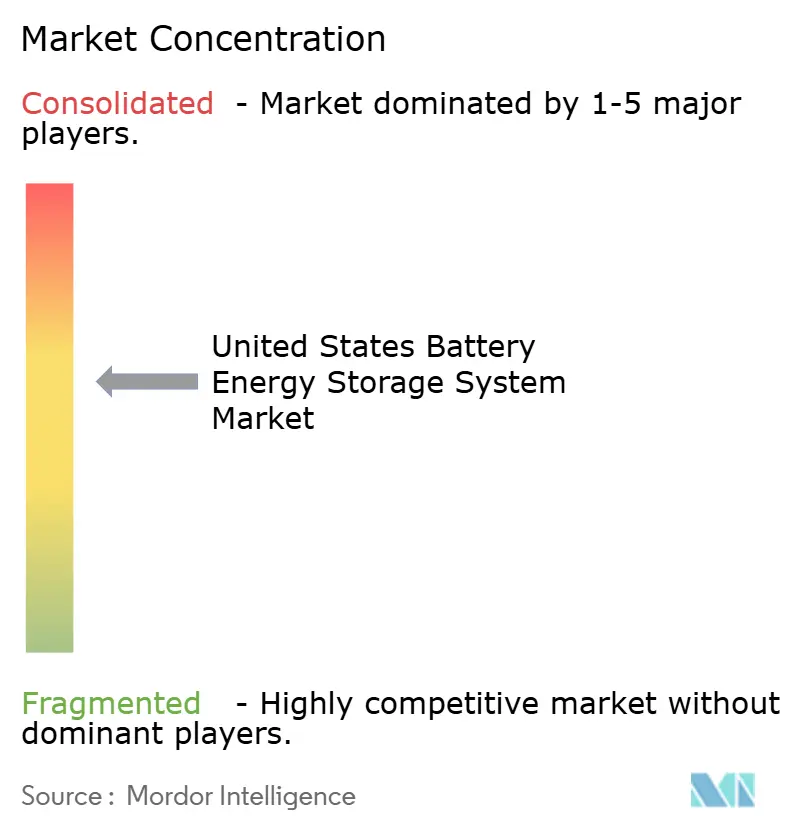
| Market Concentration | Medium |
Major Players *Disclaimer: Major Players sorted in no particular order Image © Mordor Intelligence. Reuse requires attribution under CC BY 4.0. | |
United States Battery Energy Storage System Market Analysis by Mordor Intelligence
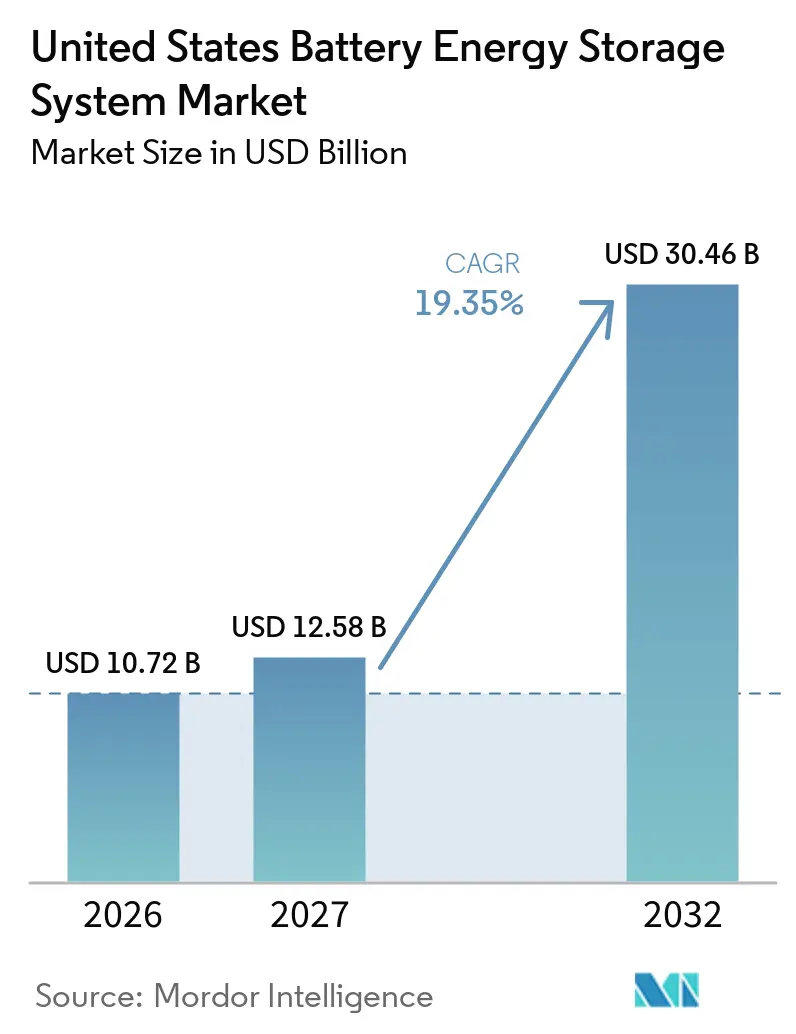
The United States battery energy storage system market size is projected to be USD 10.72 billion in 2026, USD 12.58 billion in 2027, and reach USD 30.46 billion by 2032, at a CAGR of 19.35% from 2027 to 2032. Growth is driven by the need for dispatchable capacity as renewable generation expands, solar output varies by hour, and system operators apply resource adequacy rules that value reliable delivery. Utility procurement remains the primary demand base, while large electricity loads are broadening the need for flexible capacity across several regions and making project timing more critical for local grids. Federal tax incentives and domestic manufacturing support influence project economics, although eligibility rules make sourcing decisions, contract terms, and project schedules more complex. The market is moving beyond frequency regulation toward energy arbitrage, capacity contracts, renewable firming, and co-located solar configurations as leading regions add more storage. Congestion in interconnection queues, higher transmission upgrade requirements, siting requirements, and supply chain compliance remain significant constraints on development.
Key Report Takeaways
- By battery type, lithium-ion held 91.4% of the United States Battery Energy Storage System Market share in 2026, while flow batteries are projected to grow at a 23.6% CAGR through 2032.
- By connection type, on-grid systems held 88.5% of revenue in 2026, while off-grid and microgrid systems are forecast to grow at a 22.4% CAGR through 2032.
- By component, battery packs and racks held 60.2% of revenue in 2026, while energy management software is forecast to grow at a 20.3% CAGR through 2032.
- By energy capacity range, the 101 to 500 MWh category held 40.7% of revenue in 2026, while projects above 500 MWh are forecast to grow at a 20.8% CAGR through 2032.
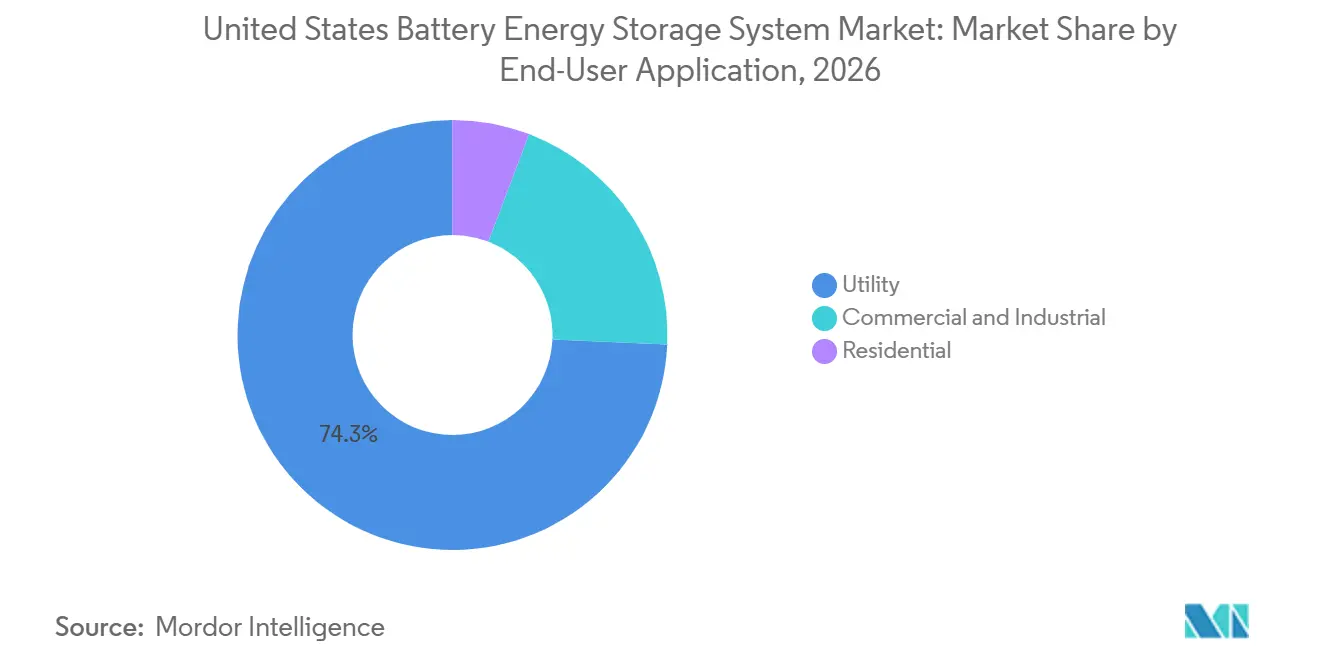
- By end-user application, utilities held 74.3% of revenue in 2026, while commercial and industrial applications are forecast to grow at a 21.3% CAGR through 2032.
Note: Market numbers in this report are based on Mordor Intelligence's proprietary estimation framework, which combines nine months of actuals with Q4 projections for base year 2026.
Market Trends and Insights
Drivers Impact Analysis of United States Battery Energy Storage System Market*
| Driver | (~) % Impact on CAGR Forecast | Geographic Relevance | Impact Timeline |
|---|---|---|---|
| Renewable Firming and Capacity Accreditation | +3.8% | CAISO, ERCOT, MISO, SPP, and national spillover | Long term (≥ 4 years) |
| Federal Tax Credits and Domestic Content Incentives | +3.2% | National, with early gains in Texas, California, and Arizona | Medium term (2-4 years) |
| Data Center and AI Load Growth | +2.7% | Virginia, Texas, Arizona, Georgia, and Illinois | Medium term (2-4 years) |
| Falling Lithium-Ion Costs and Improving LCOS | +2.9% | Global supply chain, with demand concentrated in ERCOT and CAISO | Short term (≤ 2 years) |
| State Reliability Targets and Retail Rate Volatility | +2.1% | California, New York, Texas, Illinois, and Maryland | Medium term (2-4 years) |
| Co-Located Storage and Curtailment Reduction | +1.5% | CAISO, ERCOT, WECC, PJM, and MISO | Long term (≥ 4 years) |
| Source: Mordor Intelligence | |||
Utility-Scale Renewable Firming and Capacity Accreditation Needs
Renewable firming is a central procurement driver for the United States Battery Energy Storage System Market because storage can shift output from periods of surplus generation to periods when power is needed. The California Independent System Operator applies a 4-hour dispatch standard in its resource adequacy framework, making duration an important project design requirement rather than a secondary equipment choice. Storage projects are increasingly paired with solar capacity, which helps reduce curtailment, supports dispatch when solar generation falls, and may reduce exposure to separate interconnection upgrades. The Solar Energy Industries Association reported that 48% of U.S. utility-scale storage was co-located with solar, and project duration increased during 2026. Capacity accreditation processes in the Midcontinent Independent System Operator and PJM Interconnection also place more value on dependable storage output and extend the relevance of these systems beyond the established western markets. The shift toward longer-duration procurement supports larger projects and can favor the above-500 MWh range where site, transmission, and construction conditions allow development.
Federal Storage Tax Credits and Domestic Content Incentives
Federal incentives continue to shape the economics of the United States Battery Energy Storage System Market by changing the relative cost of projects that meet applicable requirements. Section 48E provides a base investment tax credit for qualifying clean electricity investment, including energy storage. Domestic content rules can improve credit value for projects that meet sourcing conditions, so developers now consider documentation and equipment origin at an earlier stage. Manufacturing credits also support domestic cell and module production, which may change the relative cost of locally assembled systems and reduce reliance on a limited group of import routes. Domestic manufacturing capacity is also becoming part of supplier evaluation for projects that require clear compliance documentation. Developers must still align procurement plans with the applicable tax credit and foreign entity requirements before committing project capital, since late changes could affect both project cost and eligibility.
Data Center and AI Load Growth
Data center load growth creates an additional demand channel for the United States Battery Energy Storage System Market because facilities require both large volumes of electricity and dependable operations. The International Energy Agency reported that data center electricity consumption rose 17% in 2025.[1] The U.S. Department of Energy and Lawrence Berkeley National Laboratory projected that data center consumption would increase 29% from 2025 to 2026 in the reference case.[2] These loads can require resilient power and flexible operations where grid capacity is constrained, especially when facility growth is faster than local network expansion. Grid-connected systems can support local network needs, while on-site storage can help manage fast changes in facility demand, support backup arrangements, and reduce exposure to delayed grid upgrades. This is particularly relevant in regions with concentrated data center development and lengthy interconnection timelines, where electricity access can influence the timing of new construction.
Falling Lithium-Ion System Costs and Improving LCOS
Falling battery costs have improved the project case for the United States Battery Energy Storage System Market and have widened the range of applications that developers can consider. Lithium iron phosphate systems are widely used in utility-scale applications because they combine cost, cycle life, and safety characteristics that fit standardized large deployments. Lower system costs can make storage more competitive with gas peaking resources in wholesale power markets, particularly when systems can capture several value streams over their operating life. Longer cycle life also supports a more stable cost profile as an asset age and completes repeated charging and discharging cycles. These conditions favor standardized utility deployments and paired solar-storage projects, while also placing more importance on system availability and actual operating performance. They raise competitive pressure on suppliers whose systems cannot offer similar performance, supply chain certainty, or a clear route to compliant procurement.
Restraints Impact Analysis of United States Battery Energy Storage System Market*
| Restraint | (~) % Impact on CAGR Forecast | Geographic Relevance | Impact Timeline |
|---|---|---|---|
| Interconnection Queues and Transmission Upgrade Costs | -2.8% | National, most severe in MISO, SPP, and PJM, and ongoing in CAISO | Long term (≥ 4 years) |
| FEOC, Domestic Content, Tariff, and Traceability Uncertainty | -2.5% | National, with acute effects on import-reliant developers in ERCOT and CAISO | Medium term (2-4 years) |
| Fire Safety, Siting, Insurance, and Authority Requirements | -1.5% | National, with added complexity in dense urban and wildfire-prone regions | Medium term (2-4 years) |
| Cybersecurity, Firmware Control, and Warranty Risk | -0.9% | National, including FERC-jurisdictional markets and utility-contracted assets | Long term (≥ 4 years) |
| Source: Mordor Intelligence | |||
Interconnection Queues and Transmission Upgrade Costs
Interconnection delays are a major constraint on the United States Battery Energy Storage System Market because a project cannot operate until it secures a viable connection to the electricity network. Lawrence Berkeley National Laboratory reported that 2,061 GW of generation and storage capacity was seeking grid interconnection at the end of 2025, including 749 GW of storage projects.[3] The time from an interconnection request to commercial operation had risen to more than 4 years for projects built during 2018-2024. Cluster-study reform can improve process management, but it does not remove the need for transmission upgrades, local engineering review, or cost allocation decisions. Developers face higher risk when required network upgrade costs are not known before major procurement commitments, as those costs can affect a project's financing needs and expected returns. Queue congestion is especially significant in regions where storage would otherwise support renewable growth, reliability, and new large-load development.
FEOC, Domestic Content, Tariff, and Traceability Uncertainty
Foreign-entity rules and domestic-content requirements add procurement complexity to the United States Battery Energy Storage System Market, particularly for projects seeking available tax incentives. H.R. 1 introduced Material Assistance Cost Ratio thresholds that affect tax-credit eligibility for projects using products associated with prohibited foreign entities. Developers need clear traceability across cells, modules, and other manufactured products when planning eligible projects, and they need that information early enough to shape contracts and project design. This requirement can slow contract and concentrate demand among suppliers with documented domestic or non-restricted supply chains, especially when delivery schedules are tight. The rules can also affect the cost comparison between imported products and compliant alternatives, as credit eligibility can have a material effect on overall project economics. As updated guidance is issued, procurement structures for projects planned for 2027 and 2028 will remain sensitive to compliance interpretation and the availability of qualifying equipment.
*Our forecasts treat driver/restraint impacts as directional, not additive. The impact forecasts reflect baseline growth, mix effects, and variable interactions.
United States Battery Energy Storage System Market Segment Analysis
By Battery Type:
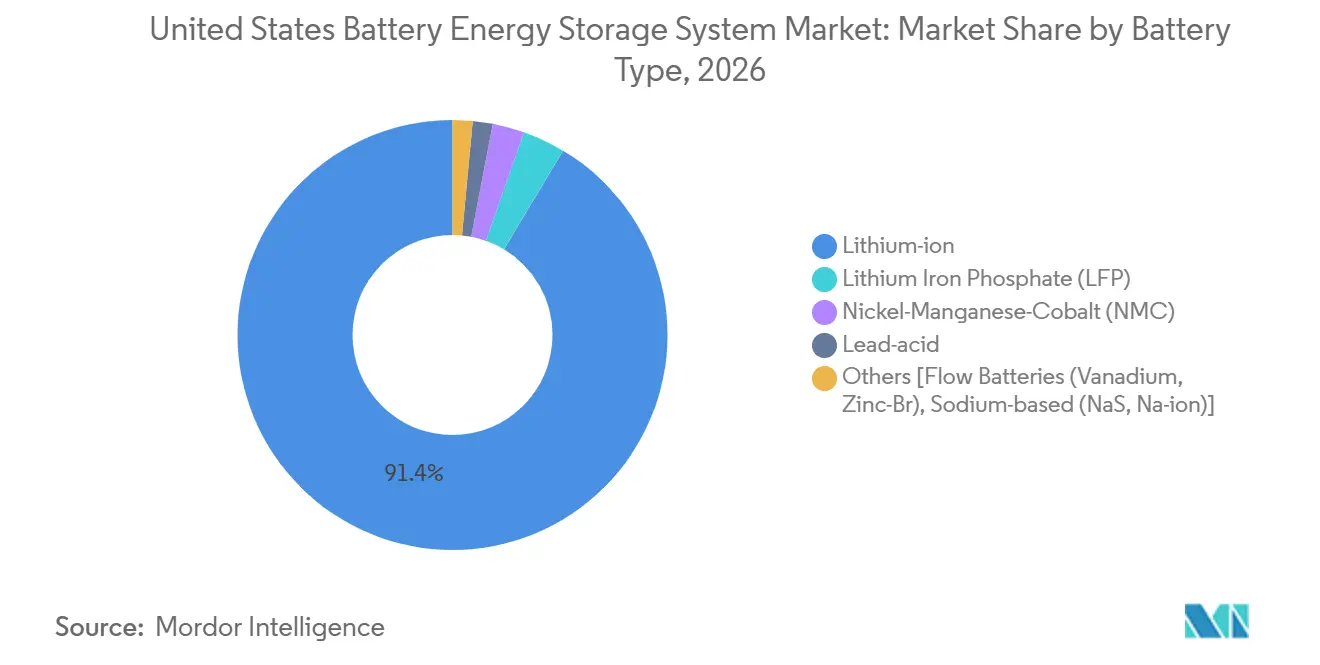
Lithium-Ion Retains a Strong LeadLithium-ion technology held 91.4% of 2026 revenue in the United States Battery Energy Storage System Market. Lithium iron phosphate has become the dominant utility chemistry due to its cost, scalability, and operating life. Nickel manganese cobalt chemistry serves a narrower role where high energy density and site constraints are priorities, while lead-acid batteries remain concentrated in legacy off-grid replacement applications. Flow batteries are the fastest-growing category, with a projected CAGR of 23.6% through 2032, supported by long-duration procurement needs. Vanadium flow batteries represented more than 70% of installed US flow battery capacity. Dairyland Power Cooperative ordered 43 MWh of Invinity vanadium flow batteries in August 2026 for Upper Midwest sites, supported by the US Department of Energy REVIVE program.
This order reflects commercial utility interest in longer-duration applications. Sodium-based and zinc-bromine systems remained in pre-commercial or early-commercial stages but may gain relevance where domestic sourcing and multi-hour duration matter more than short-term lithium-ion cost advantages. The flow battery segment remains smaller than lithium-ion in terms of market size, although it has a stronger growth profile in specialized applications. Battery selection will continue to depend on site conditions, dispatch duration, cost, and supply chain eligibility, leaving each chemistry suited to different operating requirements rather than a single uniform project model.

By Connection Type:
Grid-Connected Systems LeadOn-grid systems accounted for 88.5% of 2026 revenue in the United States Battery Energy Storage System Market, serving energy arbitrage, capacity, and renewable integration needs. Record deployment in 2025 reflected utility procurement and the continued role of grid-scale storage. ERCOT and CAISO operate large storage fleets, although saturation in frequency regulation has redirected assets toward capacity products and energy arbitrage.
Off-grid and microgrid systems are projected to grow at a 22.4% CAGR through 2032. Data center operators may consider them when grid connection studies and upgrades delay new service, while rural and island-grid modernization provides additional use cases. Microgrids offer a self-contained option for sub-utility loads facing long development timelines. Their economics are shaped by local generation costs, interconnection requirements, reliability needs, and the value of avoided outages. Although utility-connected projects remain the larger demand base, the market is extending beyond central-grid applications. Project developers must weigh resilience benefits against the added cost of local generation and controls.
By Component:
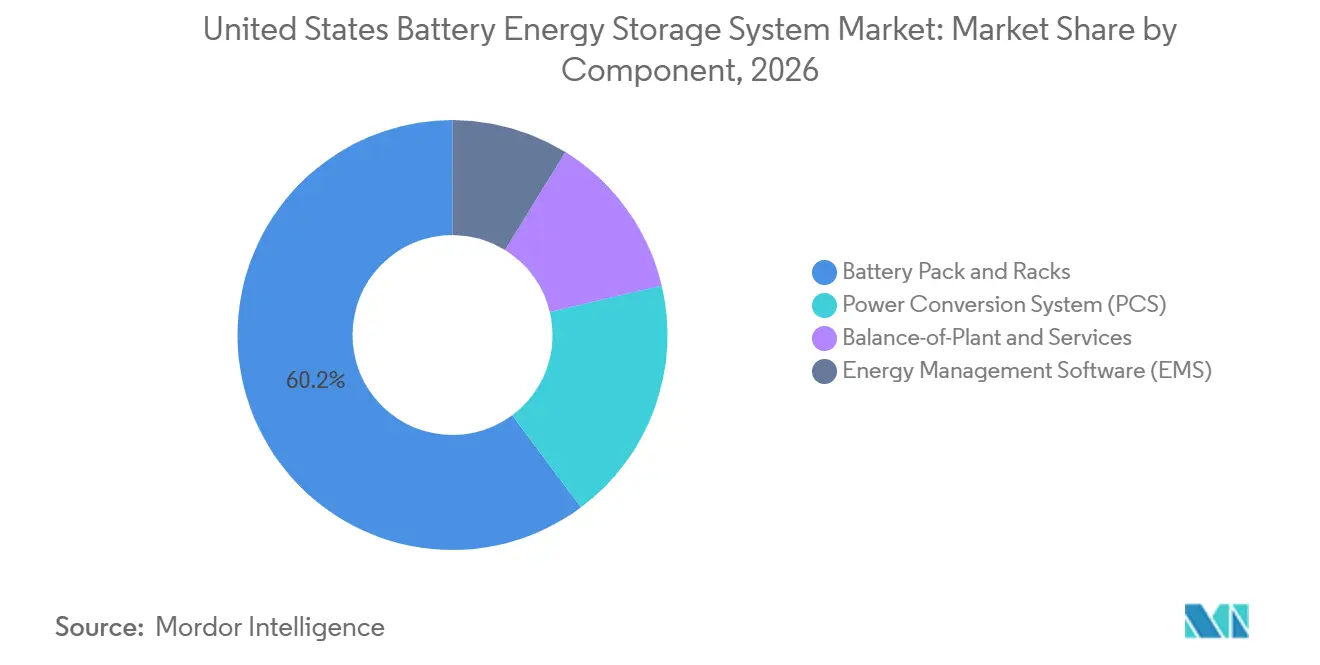
Hardware Provides Scale While Software Supports OperationsBattery packs and racks held 60.2% of 2026 component revenue in the United States Battery Energy Storage System Market, reflecting the capital-intensive nature of large deployments. Power conversion systems control the interface between batteries and the electricity network, while balance-of-plant equipment and services remain necessary for project delivery. Energy management software is the fastest-growing component, with a projected CAGR of 20.3% through 2032, supporting decisions across energy arbitrage, frequency response, and demand-charge management.
Fluence Energy launched its Smartstack 10 MWh platform in June 2026, stating that it delivered site-level energy density of 680 MWh per acre.[4] This illustrates the link between hardware design and software-supported operations. As hardware prices decline, asset owners may place greater weight on dispatch quality and lifecycle management. Domestic module incentives can also change the component mix by encouraging local assembly. The market continues to require both physical equipment and controls capable of managing changing grid conditions. Suppliers must demonstrate that their systems can deliver reliable operation over the full asset life.
By Energy Capacity Range:
Mid-Scale Projects Hold the Largest PositionThe 101 to 500 MWh range held 40.7% of 2026 revenue in the United States Battery Energy Storage System Market and suits many standalone storage and solar-plus-storage configurations. Projects below 100 MWh include commercial and industrial, distribution-connected, and residential behind-the-meter applications, and can face pricing pressure as hardware becomes standardized. The above-500 MWh category is projected to grow at a 20.8% CAGR through 2032, supported by multi-hour capacity needs, large solar developments, and high-load facilities. Very large projects can distribute some interconnection costs across a greater amount of installed energy.
Development of very large projects remains constrained by transmission studies, land availability, permitting, and local acceptance. The market size for projects above 500 MWh will depend on whether developers can secure interconnection and complete construction within required timelines. Mid-scale assets remain relevant because they can match a wider range of grid and solar project configurations. Project size will continue to be determined by local infrastructure as well as technology and project economics. Large projects also require careful coordination among developers, equipment providers, utilities, and permitting authorities.
By End-User Application:
Utilities Remain the Core Customer GroupUtilities held 74.3% of 2026 revenue in the United States Battery Energy Storage System Market, supported by resource adequacy, renewable integration, and the need to shift energy across hours of the day. Utility-scale installations were the main contributor to storage deployment during 2026. The residential segment contracted by 2% in 2026 after the Section 25D investment tax credit expired. Utility projects remain dependent on market rules, transmission access, and long-term contracting.
Commercial and industrial applications are projected to grow at a 21.3% CAGR through 2032, supported by clean-energy commitments, demand-charge management, and new ancillary-service opportunities. Large electricity users may use storage to manage operational risk and improve power resilience. Meta Platforms and NextEra Energy Resources signed 11 power purchase agreements and 2 energy storage agreements totaling 2.5 GW in late 2025, illustrating the closer relationship between commercial buyers and utility-scale supply. Although utilities retain the larger revenue base, the market will continue to draw demand from both groups. Demand from large commercial customers can also influence project location and desired operating profiles.
Geography Analysis
ERCOT and CAISO remain the primary operating regions of the United States Battery Energy Storage System Market, making Texas and California the most prominent locations for utility-scale deployment. The Energy Information Administration reported that U.S. operating battery storage capacity reached 43.6 GW at the end of 2025 and was approaching 52 GW by mid-2026. California's resource adequacy framework places value on storage capable of delivering power for several hours. Arizona recorded 6.2 GWh of utility-scale storage deployments in the second quarter of 2026, supported by solar pairing economics and Western transmission access. The market share held by these western and Texas operating regions remains significant, although increasing market saturation is influencing how projects are dispatched and financed.
PJM and MISO represent important areas for the next phase of project development, as storage activity moves beyond its early concentration in California and Texas. Interconnection timing and transmission upgrade requirements can significantly affect whether proposed projects reach commercial operation, making queue position, cost certainty, and project duration central considerations for regional development. The United States Battery Energy Storage System Market is expected to expand unevenly in regions where local power-market rules and grid conditions do not offer comparable revenue opportunities.
New York, ISO-NE, Nevada, Illinois, Michigan, and Georgia are also emerging locations for storage development. New York's storage target and New England's clean-peak framework illustrate the role of state and regional policy in shaping project interest, while Nevada's solar-plus-storage activity demonstrates how resource availability can support deployment. Geographic expansion will depend on interconnection access, viable revenue arrangements, and the ability of developers to advance projects from planning to commercial operation.
Competitive Landscape
The United States Battery Energy Storage System Market has moderately concentrated competition in large utility projects. Fluence Energy, Tesla, AES Corporation, and Sungrow Power Supply are active in system supply and project delivery, while Contemporary Amperex Technology, LG Energy Solution, Samsung SDI, and BYD remain important cell suppliers. Supply chain architecture has become a central competitive factor in 2026. Developers with documented domestic or non-restricted cell supply hold advantages in financing and tax-credit eligibility. Suppliers compete on system scale, equipment availability, project execution, and the ability to support customer requirements across the project lifecycle. Fluence Energy launched Smartstack in June 2026 for high-density applications where project footprint is a constraint.
Software is also an important point of differentiation. Fluence Energy's Mosaic platform and Tesla's Autobidder platform support dispatch across multiple revenue streams, and recurring software revenue can reduce exposure to hardware margin pressure. Smaller integrators must compete on project execution, controls, customer relationships, and supply certainty. Wartsila and Mitsubishi Power Americas participate in hybrid gas-storage systems where dispatchability requirements exceed the standard duration of lithium iron phosphate (LiFePO4) batteries. NERC CIP compliance requirements for grid-connected systems under FERC oversight can add costs, particularly for smaller providers.
Long-duration storage, commercial and industrial systems in eastern markets, and residential virtual power plants remain areas of opportunity. Invinity Energy Systems' 43 MWh sale to Dairyland Power Cooperative reflects utility demand for flow-battery applications in the Upper Midwest. Sungrow Power Supply and Delta Capacity signed a 1 GWh framework agreement for PowerTitan 2.0 deployments in February 2026. Fluence Energy also announced a domestic-content Smartstack system for the 800 MWh Rexford 2 project in California. Competition will depend on compliance capability, bankable technology, software performance, and the ability to deliver large systems on schedule. The largest suppliers are positioned to benefit where customers prioritize proven execution and compliant supply chains.
United States Battery Energy Storage System Industry Leaders
-
Sungrow Power Supply Co., Ltd.
-
Tesla, Inc.
-
Fluence Energy, Inc.
-
NextEra Energy Resources, LLC
-
FlexGen
- *Disclaimer: Major Players sorted in no particular order
United States Battery Energy Storage System Market Companies Covered in this Report
- AES Corporation
- BYD Company Limited
- Canadian Solar Inc.
- Contemporary Amperex Technology Co., Limited (CATL)
- Eaton Corporation plc
- Energy Vault Holdings, Inc.
- Enphase Energy, Inc.
- esVolta, LP
- FlexGen Power Systems, Inc.
- Fluence Energy, Inc.
- GE Vernova Inc.
- Hitachi Energy Ltd.
- Invenergy LLC
- Jupiter Power LLC
- LG Energy Solution Ltd.
- Mitsubishi Power Americas, Inc.
- NextEra Energy Resources, LLC
- Powin, LLC
- Saft Groupe S.A.
- Samsung SDI Co., Ltd.
- Schneider Electric SE
- Siemens Energy AG
- Sungrow Power Supply Co., Ltd.
- Tesla, Inc.
- Wärtsilä Corporation
Recent Industry Developments in United States Battery Energy Storage System Market
- August 2026: Dairyland Power Cooperative placed an order with Invinity Energy Systems for 43 MWh of Endurium vanadium flow batteries across multiple Upper Midwest locations under the U.S. Department of Energy's REVIVE Program. The project represents one of the largest utility-scale vanadium flow battery procurements in the United States and highlights growing interest in long-duration energy storage technologies beyond lithium-ion.
- July 2026: Fluence Energy agreed to supply a 200 MW / 800 MWh Smartstack battery energy storage system for Avantus's Rexford 2 project in Tulare County, California. The project will utilize domestically sourced battery cells manufactured in Utah, South Carolina, and Texas, supporting U.S. supply chain localization. Construction is expected to begin in 2027, with commercial operation targeted for late 2028.
- July 2026: Fluence Energy launched its Smartstack 10 MWh energy storage platform, designed to achieve energy densities of up to 680 MWh per acre. The system targets utility-scale solar-plus-storage projects in land-constrained and grid-congested regions across the United States, enabling higher storage capacity within a smaller project footprint.
- January 2026: Redwood Materials completed a USD 425 million Series E financing round, valuing the company at more than USD 6 billion and supporting the expansion of battery recycling and battery material production capabilities in the United States.
United States Battery Energy Storage System Market Report Scope
A battery energy storage system (BESS) is an integrated technology setup that stores electrical energy in rechargeable batteries and discharges it as required. It captures excess electricity from renewable sources such as solar and wind, or from the power grid during periods of low demand. Built-in power conversion systems and controllers manage the flow of electricity, converting it between storage and grid use. By balancing supply and demand in real time, a BESS stabilizes the electrical network, prevents shortages, and provides reliable backup power.
The United States battery energy storage system market is segmented by battery type into lithium-ion, lithium iron phosphate (LFP), nickel-manganese-cobalt (NMC), lead-acid, and other batteries including flow batteries (vanadium and zinc-bromine) and sodium-based batteries (NaS and sodium-ion). By connection type, the market is segmented into on-grid (utility interconnected) and off-grid (micro-grid and hybrid) systems. By component, the market is segmented into battery pack and racks, power conversion systems (PCS), energy management software (EMS), and balance-of-plant and services. By energy capacity range, the market is segmented into below 100 MWh, 101 to 500 MWh, and above 500 MWh. By end-user application, the market is segmented into residential, commercial and industrial, and utility. For each segment, the market sizing and forecasts are provided on the basis of value (USD).
Segmentation Overview
| Lithium-ion |
| Lithium Iron Phosphate (LFP) |
| Nickel-Manganese-Cobalt (NMC) |
| Lead-acid |
| Others [Flow Batteries (Vanadium, Zinc-Br), Sodium-based (NaS, Na-ion)] |
| On-Grid (Utility Interconnected) |
| Off-Grid (Micro-Grid, Hybrid) |
| Battery Pack and Racks |
| Power Conversion System (PCS) |
| Energy Management Software (EMS) |
| Balance-of-Plant and Services |
| Below 100 MWh |
| 101 to 500 MWh |
| Above 500 MWh |
| Residential |
| Commercial and Industrial |
| Utility |
| By Battery Type | Lithium-ion |
| Lithium Iron Phosphate (LFP) | |
| Nickel-Manganese-Cobalt (NMC) | |
| Lead-acid | |
| Others [Flow Batteries (Vanadium, Zinc-Br), Sodium-based (NaS, Na-ion)] | |
| By Connection Type | On-Grid (Utility Interconnected) |
| Off-Grid (Micro-Grid, Hybrid) | |
| By Component | Battery Pack and Racks |
| Power Conversion System (PCS) | |
| Energy Management Software (EMS) | |
| Balance-of-Plant and Services | |
| By Energy Capacity Range | Below 100 MWh |
| 101 to 500 MWh | |
| Above 500 MWh | |
| By End-user Application | Residential |
| Commercial and Industrial | |
| Utility |
Key Questions Answered in the Report
What is the projected value of the United States battery energy storage system market by 2032?
The United States battery energy storage system market is forecast to reach USD 30.46 billion by 2032, growing at a CAGR of 19.35% from 2027. This estimate reflects continued utility procurement, renewable integration needs, and wider demand for flexible capacity across established and emerging regional power markets.
Which battery technology holds the largest share in the United States battery energy storage system market?
Lithium-ion accounted for 91.4% of revenue in 2026. It remains widely used in large projects because developers value scalable supply, operating experience, and established utility deployment practices. Flow batteries have the highest projected growth rate, at a CAGR of 23.6% through 2032.
What is driving demand for battery energy storage systems in the United States?
Renewable firming, resource adequacy needs, data center load growth, tax incentives, and lower lithium-ion system costs support demand. These drivers are most relevant where transmission constraints, variable solar generation, and reliability requirements create clear value for shifting electricity across several hours.
Which end-user segment leads demand in the United States battery energy storage system market?
Utilities held 74.3% of revenue in 2026, supported by renewable integration, capacity requirements, and energy shifting needs. Commercial and industrial customers are growing faster as they seek demand-charge management, supply resilience, and ways to manage the operational effects of large electricity loads.
Why are interconnection queues important for storage developers?
Storage projects require grid access, but lengthy studies and transmission upgrade costs can delay construction and increase project risk. Queue outcomes can affect equipment orders, financing plans, and commercial operation dates, particularly when costs remain uncertain before a developer makes major commitments.