
United States Aviation Insurance Market Size and Share
Market Overview
| Study Period | 2021 - 2032 |
|---|---|
| Forecast Data Period | 2027 - 2032 |
| Base Year Market Size (2026) | USD 3.10 Billion |
| Market Size (2027) | USD 3.20 Billion |
| Market Size (2032) | USD 3.70 Billion |
| Growth Rate (2027 - 2032) | 2.90 % |
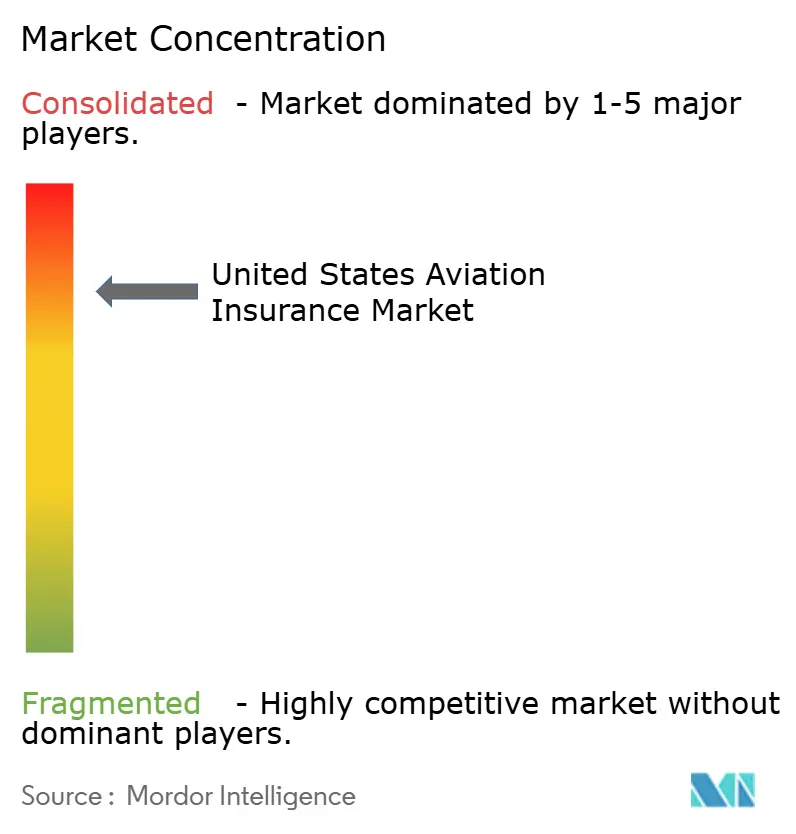
| Market Concentration | High |
Major Players *Disclaimer: Major Players sorted in no particular order Image © Mordor Intelligence. Reuse requires attribution under CC BY 4.0. | |
United States Aviation Insurance Market Analysis by Mordor Intelligence
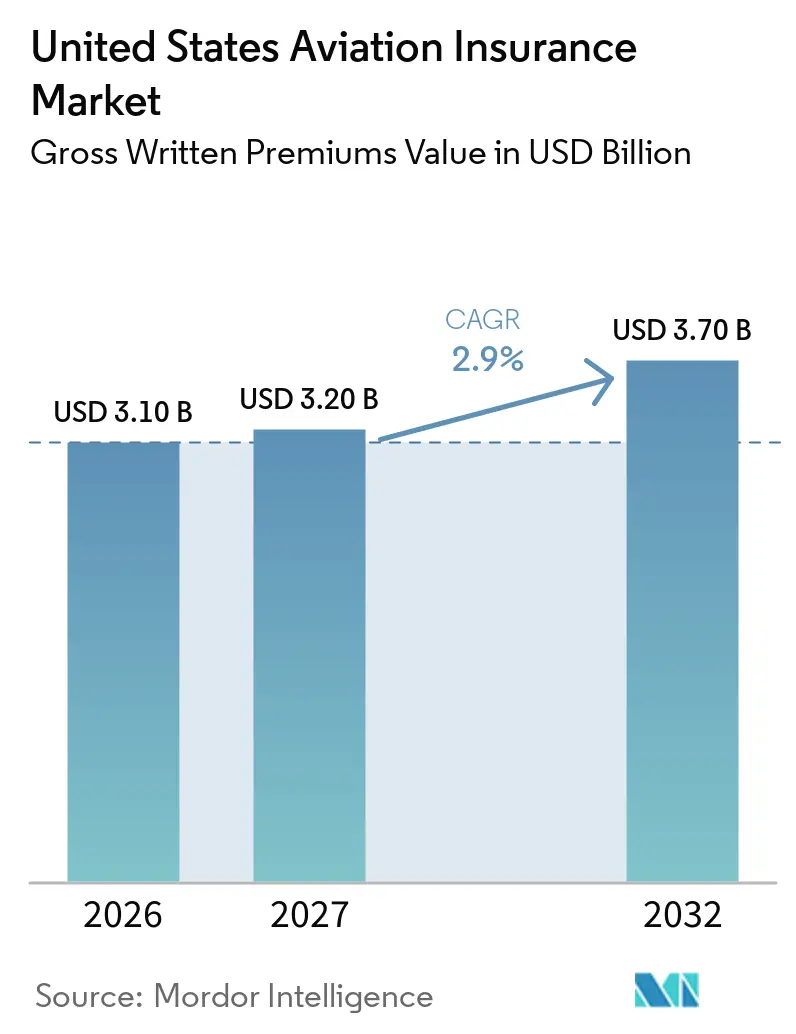
The United States Aviation Insurance Market size in terms of gross written premiums value is expected to increase from USD 3.10 billion in 2026 to USD 3.20 billion in 2027 and reach USD 3.70 billion by 2032, growing at a CAGR of 2.9% over 2027-2032.
The United States aviation insurance market is undergoing a continued repricing cycle following several years of underwriting losses, rather than growing solely due to increased exposure. Rising aircraft values, repair costs, and liability awards are driving closer reviews of coverage terms and premium rates. Emerging drone and electric vertical takeoff and landing (eVTOL) operations are generating demand for specialized insurance products, while lessor and lender requirements continue to support baseline demand for hull and liability coverage. Competition remains strong for standardized general aviation risks; however, insurers apply greater scrutiny to complex airline and manufacturer accounts due to claims severity and reinsurance discipline. These conditions favor insurers and intermediaries with the capabilities to assess technical risks, manage exposure accumulation at major airports, and structure coverage for emerging operating models.
Key Report Takeaways
- By coverage type, aviation operating and premises liability captured 35.4% of the United States aviation insurance market share in 2026, while aviation products liability is projected to grow at a 5.3% CAGR through 2032.
- By end user, airlines and commercial operators held 50.8% of the United States aviation insurance market share in 2026, while aviation products liability insureds are projected to grow at a 4.9% CAGR through 2032.
- By distribution channel, open-market broker placement captured 73.6% of the United States aviation insurance market share in 2026, while delegated authority is projected to grow at a 7.1% CAGR through 2032.
- By geography, the South captured 34.3% of the United States aviation insurance market share in 2026, while the West is projected to grow at a 3.8% CAGR through 2032.
Note: Market numbers in this report are based on Mordor Intelligence's proprietary estimation framework, which combines nine months of actuals with Q4 projections for base year 2026.
Market Trends and Insights
Drivers Impact Analysis of United States Aviation Insurance Market*
| Driver | (~) % Impact on CAGR Forecast | Geographic Relevance | Impact Timeline |
|---|---|---|---|
| Recovery and Expansion of United States Air Travel and Cargo Activity | +1.2% | National, strongest gains in South and West hub areas | Short term (≤ 2 years) |
| Growth in General Aviation Utilization and Flight Hours | +0.5% | National, concentrated in South, Midwest, and West | Medium term (2-4 years) |
| Rising Aircraft Values, Repair Costs, and Insured Asset Exposure | +0.9% | National, with primary effects on airline and aerospace risks | Short term (≤ 2 years) |
| Insurance Demand from Drones and Advanced Air Mobility | +0.6% | West and South, with spillover to Northeast and Midwest | Medium term (2-4 years) |
| Contractual Risk Transfer by Aircraft Lessors, Financiers, and Original Equipment Manufacturers | +0.4% | National, concentrated in major leasing and finance centers | Long term (≥ 4 years) |
| Higher Insurance Needs for Drones, Advanced Air Mobility, and Emerging Technology | +0.3% | West and Northeast, supported by national Federal Aviation Administration oversight | Long term (≥ 4 years) |
| Source: Mordor Intelligence | |||
Recovery and Expansion of United States Air Travel and Cargo Activity
Commercial aviation activity supports demand for aircraft hull, airline liability, and airport-related insurance in the United States aviation insurance market. The Federal Aviation Administration’s (FAA) fiscal year 2026–2046 aerospace forecast provides updated projections for commercial airline traffic and aviation operations, reflecting continued demand for air travel and associated aviation services[1]. Higher traffic volumes and fleet utilization can increase insured exposure, while concentrated aircraft movements at major airports create potential accumulation risks from ground collisions, fires, severe weather, and other incidents. Insurers must therefore consider aircraft values, route networks, airport concentration, and liability limits when assessing airline portfolios. Mandatory financial responsibility and insurance requirements for applicable air carriers also support baseline demand for aviation liability coverage.
Growth in General Aviation Utilization and Flight Hours
General aviation activity supports demand for aircraft hull, liability, and specialist coverage across private aircraft owners, business aviation operators, flight schools, and other users. The FAA’s 2026–2046 aerospace forecast projects the active general aviation fleet to increase by 12.1% between 2026 and 2046, while total general aviation flight hours are projected to rise by 25.5% between 2024 and 2046, equivalent to approximately 1.0% annual growth[2]. The outlook is uneven across aircraft categories, with turbine aircraft and business jets expected to contribute to activity growth while traditional piston aircraft face comparatively weaker prospects. Higher utilization can increase exposure to operational incidents, physical damage, and third-party liability claims, supporting demand for appropriate insurance coverage. Underwriting outcomes will continue to depend on aircraft type, operating profile, pilot experience, claims history, and the value of the insured aircraft.
Rising Aircraft Values, Repair Costs, and Insured Asset Exposure
Aircraft values, component availability, and specialized maintenance requirements influence the severity and cost of aviation insurance claims. When replacement parts are scarce, or repairs require specialized facilities and technical expertise, aircraft may remain grounded for longer periods, increasing repair expenses and potentially extending associated business interruption losses where coverage applies. Damage to composite structures, advanced avionics, engines, and other high-value components can also increase the cost of restoring an aircraft to service. Higher insured values and repair costs can raise potential claim severity and increase the importance of accurate aircraft valuations, appropriate policy limits, and effective risk selection. These factors reinforce the need for disciplined pricing, loss assessment, and reinsurance protection across airline, business aviation, and general aviation portfolios.
Insurance Demand from Drones and Advanced Air Mobility
Commercial drones and advanced air mobility technologies are creating additional specialist insurance opportunities within the United States aviation insurance market. The FAA’s 2026–2046 aerospace forecast identifies unmanned aircraft systems and advanced air mobility as emerging aviation segments, although the long-term impact of these technologies remains uncertain. Regulatory developments, including the June 2025 executive order on American drone leadership, seek to advance domestic drone deployment and establish an electric vertical takeoff and landing (eVTOL) integration pilot program. In April 2025, Apollo and Moonrock announced a drone, eVTOL, and aviation innovation insurance facility with liability coverage of up to USD 100 million and property damage coverage of up to USD 22.5 million, demonstrating the development of specialist capacity for complex and higher-value risks[3]. As commercial applications expand, insurers will need to assess evolving operating standards, third-party liability, product liability, physical damage, and limited historical loss data. The pace of insurance demand will depend on commercial deployment, regulatory implementation, and the ability of underwriters to price emerging risks reliably.
Restraints Impact Analysis of United States Aviation Insurance Market*
| Restraint | (~) % Impact on CAGR Forecast | Geographic Relevance | Impact Timeline |
|---|---|---|---|
| High-Severity Claims, Social Inflation, and Litigation Costs | -0.7% | National; nuclear verdict risk is highest in the Southeast and large metropolitan jurisdictions | Short term (≤ 2 years) |
| Volatile Reinsurance Capacity and Pricing | -0.5% | National; disproportionate effect on general aviation carriers ceding approximately 50% of premiums to reinsurers | Medium term (2–4 years) |
| Aging Fleet Maintenance, Parts Availability, and Repair Complexity | -0.4% | National; heightened impact on operators with aging aircraft fleets and limited access to specialized parts and maintenance facilities | Medium term (2–4 years) |
| Limited Loss History for eVTOL, UAS, and Automated Aircraft | -0.3% | National; concentrated in emerging advanced air mobility hubs and commercial drone operations | Long term (≥ 4 years) |
| Source: Mordor Intelligence | |||
High-Severity Claims, Social Inflation, and Litigation Costs
High-severity claims and rising litigation costs are increasing underwriting pressure in the United States aviation insurance market. Social inflation, including larger jury awards and more expensive liability litigation, can increase claim severity and make ultimate losses harder to estimate. The November 2025 UPS Airlines MD-11 crash in Louisville, Kentucky, illustrates the potential scale of aviation losses. The National Transportation Safety Board identified fatigue cracks and overstress failure in the aircraft’s left engine pylon attachment, while the investigation examined the maintenance history and mechanical failure. These risks can lead insurers to scrutinize liability limits, maintenance practices, and loss histories more closely, particularly for airline and aerospace accounts with substantial United States exposure.
Volatile Reinsurance Capacity and Pricing
Reinsurance remains important to the United States aviation insurance market because it enables primary insurers to spread large aircraft losses and support substantial policy limits. Changes in reinsurance pricing, available capacity, and risk appetite can influence primary insurers’ underwriting terms, retention levels, and willingness to cover complex or high-severity risks. Milliman reported that United States general aviation insurers ceded approximately 50% of direct written premiums to external reinsurers in 2025, reflecting the segment’s reliance on risk transfer to manage potentially large claims. Meanwhile, major aviation losses, rising repair costs, liability uncertainty, and geopolitical risks can affect renewal negotiations and the availability of coverage for particular exposures. These conditions make reinsurance costs and capacity important considerations for insurers and policyholders, although their effects vary by risk category and renewal terms.
*Our forecasts treat driver/restraint impacts as directional, not additive. The impact forecasts reflect baseline growth, mix effects, and variable interactions.
United States Aviation Insurance Market Segment Analysis
By Coverage Type:
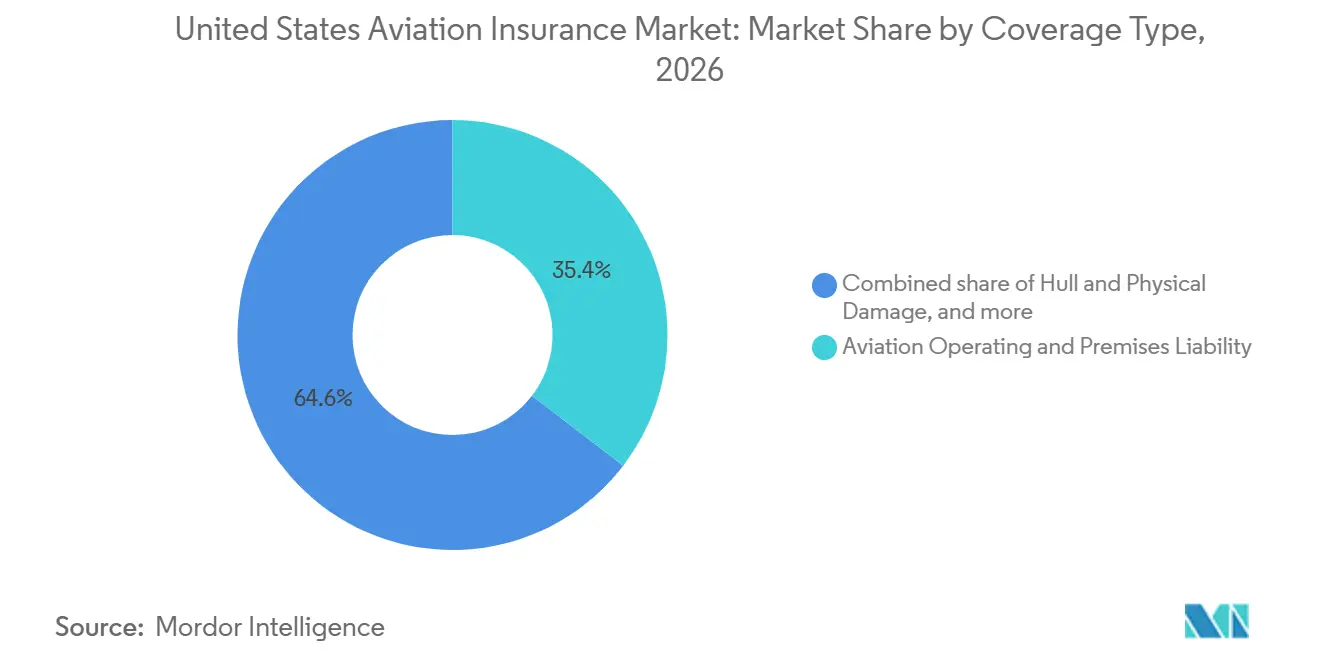
Liability Lines Lead as Products Claims Litigation AcceleratesAviation Operating and Premises Liability held 35.4% of the United States aviation insurance market in 2026. The segment serves commercial operators, airports, and fixed-base operators that face bodily injury and property damage exposure. Regulatory insurance requirements for applicable aviation operations and contractual obligations can sustain demand for liability coverage. Hull and Physical Damage remain another major coverage type because aircraft values require substantial protection. Aviation War and Allied Perils has a different risk profile, with coverage shaped by geopolitical developments, insurer capacity, and operator route exposure.
Aviation Products Liability is forecast to expand at a 5.3% CAGR through 2032, making it the fastest-growing coverage type. Demand for this coverage is linked to aircraft manufacturing, component supply, maintenance, repair, and overhaul activities, where alleged design defects, manufacturing deficiencies, or maintenance errors can result in substantial claims. The November 2025 UPS MD-11 crash in Kentucky illustrates the potential severity of technical failures, although the National Transportation Safety Board's investigation remains ongoing and does not establish a final liability determination. The Federal Aviation Administration's safety management system requirements apply to certain Part 135 operators and Part 21 design and manufacturing organizations, reinforcing the importance of documented safety processes and risk controls. Products and completed operations insurance remains relevant for original equipment manufacturers, component suppliers, and maintenance providers.
By End User:
Airlines Anchor Premium While Products Manufacturers Outgrow the MarketAirlines and Commercial Operators accounted for 50.8% of the United States aviation insurance market in 2026. High insured values, broad liability limits, and cargo coverage make this the largest end-user segment. Large fleet programs also require specialized policy structures and participation by multiple insurers. Airlines with major loss histories can face more restrictive capacity and detailed underwriting reviews. Airports and aviation infrastructure represent a distinct end-user category, with coverage designed around public liability, property damage, and operational risks.
Aviation Products Liability Insureds are expected to grow at a 4.9% CAGR through 2032. This group includes original equipment manufacturers, component manufacturers, and maintenance, repair, and overhaul providers. Higher aircraft production, complex component supply chains, and potential product-related claims can support demand for appropriate liability limits. Compliance with applicable safety management system requirements can also influence insurers' assessments of an organization's risk management practices, although compliance alone does not guarantee more favorable underwriting terms. Aircraft lessors and financiers remain important insurance stakeholders because lease agreements and financing arrangements commonly require specified hull and liability coverage to protect aircraft assets and contractual interests.
By Distribution Channel:
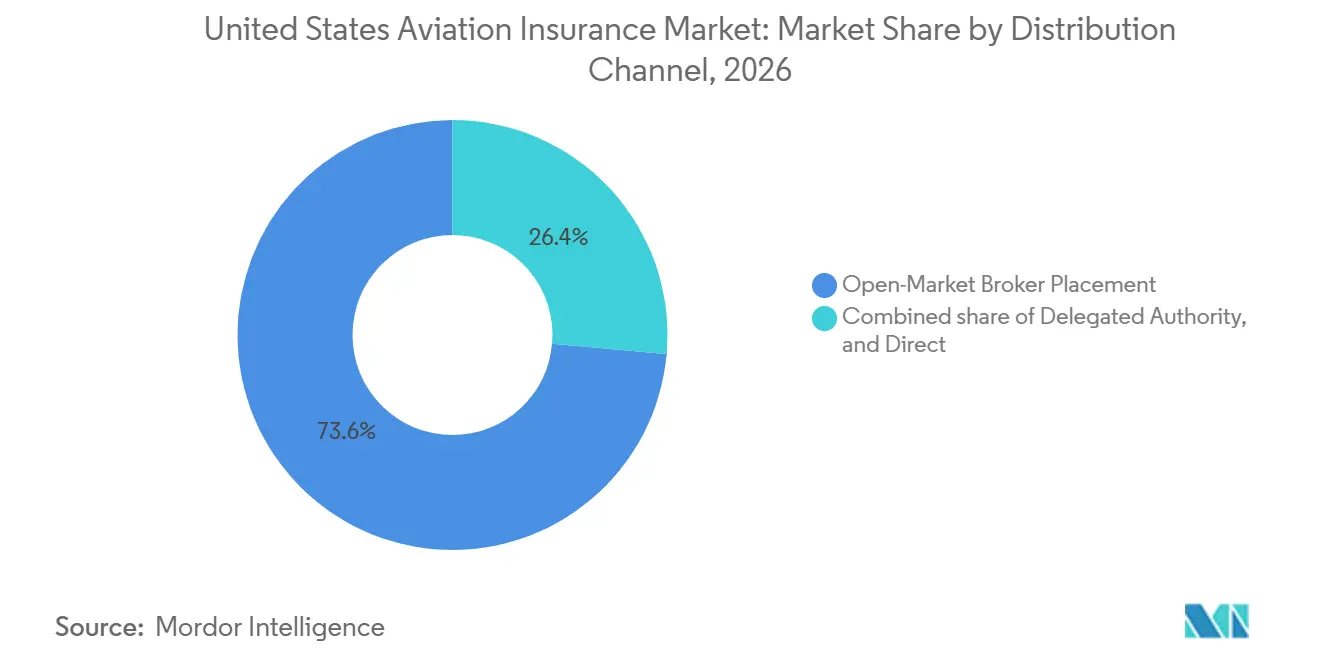
Open Market Dominates While Delegated Authority Reshapes PlacementsOpen-market broker placement commanded 73.6% of the United States aviation insurance market in 2026. It remains the leading route for complex airline programs, aviation war risks, and other high-limit placements. Brokers are important when policy wording, insurer participation, and risk details need to be tailored to an individual account. The Federal Aviation Administration's Modernization of Special Airworthiness Certification (MOSAIC) rule introduced changes to light-sport aircraft certification, pilot privileges, maintenance, and operations, with the principal aircraft certification provisions taking effect on July 24, 2026. These changes may influence insurance assessments for certain eligible aircraft and operating profiles.
Delegated authority is projected to grow at a 7.1% CAGR through 2032. This channel includes lineslips, binding authorities, and managing general agent facilities. It is suited to risks that can be placed using defined underwriting rules and pre-arranged capacity. Specialist brokers and managing general agents can use these arrangements to streamline placements for eligible risks, subject to delegated limits and insurer oversight. Direct distribution remains more practical for some standardized general aviation products, while complex airline, aerospace, and aviation war placements often require specialist intermediaries. The relative growth of each channel depends on insurer appetite, distribution agreements, the standardization of risks, and the availability of delegated capacity.
Geography Analysis
The South held 34.3% of the United States aviation insurance market in 2026. Major airports in Atlanta, Dallas-Fort Worth, and Miami support substantial commercial aviation activity and associated aircraft hull, airline liability, and airport liability exposures. Texas, Florida, Georgia, and other southern states also support extensive general aviation activity across business aviation, private aircraft, flight training, and specialized operations. Rotorcraft used in Gulf of Mexico energy operations create additional demand for coverage addressing aircraft damage, passenger liability, and offshore operating risks. The Federal Aviation Administration reports that the United States general aviation community includes more than 275,000 aircraft and generates more than USD 247 billion in annual economic activity, highlighting the scale of the wider aviation ecosystem.
The West is projected to grow at a 3.8% CAGR through 2032. The region has an established aerospace and technology base, alongside commercial drone operations and emerging electric vertical takeoff and landing aircraft development. California's aerospace manufacturers, technology companies, and aviation research ecosystem may support demand for specialist coverage as new aircraft and operating models progress toward commercial deployment. Pacific cargo gateways and major commercial airports also generate aircraft hull, liability, and airport-related insurance exposures. Regional growth will depend on commercial adoption, regulatory approvals, aircraft utilization, and insurers' ability to assess emerging risks, as technological development alone does not establish future insurance demand.
The Midwest is a mature component of the United States aviation insurance market. Chicago O'Hare, Minneapolis-Saint Paul, and a broad network of regional and general aviation airports support commercial, cargo, business aviation, and private aircraft activity. Aircraft manufacturers and suppliers, including Textron Aviation and other aerospace businesses operating across the region, generate potential products liability exposures associated with aircraft design, manufacturing, components, and maintenance. State insurance regulation also affects the placement and administration of multistate aviation programs, while the McCarran-Ferguson Act generally preserves an important role for state regulation of the business of insurance, subject to federal law. International insurance and reinsurance markets, including those in the United Kingdom and Asia-Pacific, can contribute capacity to cross-border aviation placements, although regional demand within the United States remains closely linked to domestic aviation operations, insured values, and liability exposures.
Competitive Landscape
The United States aviation insurance market is consolidated, with established insurers including AIG, Chubb, Allianz Commercial, AXA XL, Sompo International, Old Republic Aerospace, Global Aerospace, Starr, USAIG, Tokio Marine HCC, QBE, and Munich Re Specialty. These providers compete across commercial aviation, general aviation, aerospace liability, and specialist coverage lines. Specialist underwriters, managing general agents, and international reinsurance providers broaden the available coverage options, although complex airline and aerospace accounts continue to require substantial capacity and technical underwriting expertise.
In March 2026, Starr completed its acquisition of IQUW Group, expanding its specialty insurance platform and access to international underwriting markets. The transaction illustrates consolidation among specialty insurance groups seeking broader underwriting capabilities and distribution networks. The market's competitive structure continues to depend on insurers' risk appetite, access to reinsurance, pricing discipline, and ability to underwrite high-value aircraft and complex liability exposures.
Emerging opportunities include commercial drone insurance, cyber liability, connected-aircraft data protection, and electric vertical takeoff and landing operations. These risks require specialized underwriting approaches because regulatory requirements, operating models, and historical claims experience continue to evolve. Conduit Re and Tokio Marine Kiln contribute to the broader international aviation risk-transfer ecosystem, while Old Republic's April 2026 launch of Lodestar Claims & Risk Services strengthened its claims administration and risk-services operations rather than directly expanding aviation underwriting capacity.
United States Aviation Insurance Industry Leaders
-
American International Group
-
Chubb Ltd. Group
-
Sompo Group
-
Old Republic Group
-
Munich Re Group
- *Disclaimer: Major Players sorted in no particular order
United States Aviation Insurance Market Companies Covered in this Report
- American International Group (AIG)
- Chubb
- Sompo
- Old Republic Aerospace
- Munich Re Specialty
- Allianz Commercial
- AXA XL
- QBE Insurance Group
- Global Aerospace
- Starr Insurance Companies
- United States Aircraft Insurance Group (USAIG)
- Tokio Marine HCC
- Great American Insurance Group
- HDI Global Insurance Company
- Beazley, a company of Zurich
- Avemco Insurance Company
- Berkley Aviation
- Travelers
- United Aviation Insurance Group
Recent Industry Developments in United States Aviation Insurance Market
- September 2026: The Federal Aviation Administration announced the launch of a federal electric vertical takeoff and landing (eVTOL) pilot program in North Carolina to advance the next generation of aviation operations. The initiative supports the development and integration of emerging aircraft technologies in the United States. As these operations progress, insurers will need to evaluate aircraft damage, passenger and third-party liability, operating procedures, and limited historical claims experience.
- August 2026: The Federal Aviation Administration announced Phase 2 of its BEYOND program, expanding collaboration with state, local, tribal, and territorial entities to advance drone integration into the United States airspace. The program will support further testing of beyond visual line of sight operations, public safety missions, and on-airport drone activities. These developments may broaden the range of commercial drone risks requiring specialist insurance, subject to regulatory implementation and adoption.
- August 2026: Lockton launched a dedicated United States Aviation Practice to provide insurance placement and risk advisory services to aviation and aerospace clients nationwide. The practice brings together specialist capabilities for airlines, charter operators, fixed-base operators, manufacturers, and other aviation businesses. The expansion reflects continued investment in specialist brokerage services as aviation operators navigate complex insurance, regulatory, and geopolitical exposures.
- May 2026: Howden announced the launch of its United States Aviation Practice, providing specialist insurance placement and risk management services to commercial airlines, charter operators, fixed-base operators, aircraft manufacturers, and aerospace businesses. The practice is designed to combine technical aviation expertise with the group's broader insurance capabilities. Its launch adds another specialist brokerage platform serving United States aviation and aerospace clients.
United States Aviation Insurance Market Report Scope
Segmentation Overview
| Hull and Physical Damage |
| Aviation Operating and Premises Liability |
| Aviation Products Liability |
| Aviation War and Allied Perils |
| Other Specialty |
| Airlines and Commercial Operators |
| General and Business Aviation Operators |
| Aviation Products Liability Insureds |
| Aircraft Lessors and Financiers |
| Airports and Aviation Infrastructure |
| Open-Market Broker Placement |
| Delegated Authority |
| Direct |
| Northeast |
| Midwest |
| South |
| West |
| By Coverage Type | Hull and Physical Damage |
| Aviation Operating and Premises Liability | |
| Aviation Products Liability | |
| Aviation War and Allied Perils | |
| Other Specialty | |
| By End User | Airlines and Commercial Operators |
| General and Business Aviation Operators | |
| Aviation Products Liability Insureds | |
| Aircraft Lessors and Financiers | |
| Airports and Aviation Infrastructure | |
| By Distribution Channel | Open-Market Broker Placement |
| Delegated Authority | |
| Direct | |
| By Region | Northeast |
| Midwest | |
| South | |
| West |
Key Questions Answered in the Report
What is the projected size of the United States aviation insurance market by 2032?
The United States aviation insurance market is projected to reach USD 3.7 billion by 2032, growing at a 2.9% CAGR from 2027.
Which coverage type leads United States aviation insurance?
Aviation Operating and Premises Liability leads with a 35.4% share in 2026.
Which end user has the largest aviation insurance demand?
Airlines and Commercial Operators account for 50.8% of 2026 demand because of high aircraft values, broad liability limits, and cargo coverage needs.
What is the fastest-growing distribution channel for aviation cover?
Delegated Authority is projected to grow at a 7.1% CAGR through 2032 as facilities support defined underwriting rules and pre-arranged capacity.
Which United States region leads aviation insurance demand?
The South holds 34.3% share in 2026, supported by large airport hubs and extensive general aviation activity.
How are drones affecting aviation insurance demand?
Commercial drone registrations, advanced air mobility development, and new insurance facilities are expanding the need for specialized coverage.