
United States Air Compressor Market Size and Share
Market Overview
| Study Period | 2022 - 2032 |
|---|---|
| Forecast Data Period | 2027 - 2032 |
| Base Year Market Size (2026) | USD 5.17 Billion |
| Market Size (2027) | USD 5.44 Billion |
| Market Size (2032) | USD 6.92 Billion |
| Growth Rate (2027 - 2032) | 4.93 % |
| Market Concentration | Medium |
Major Players *Disclaimer: Major Players sorted in no particular order Image © Mordor Intelligence. Reuse requires attribution under CC BY 4.0. | |
United States Air Compressor Market Analysis by Mordor Intelligence
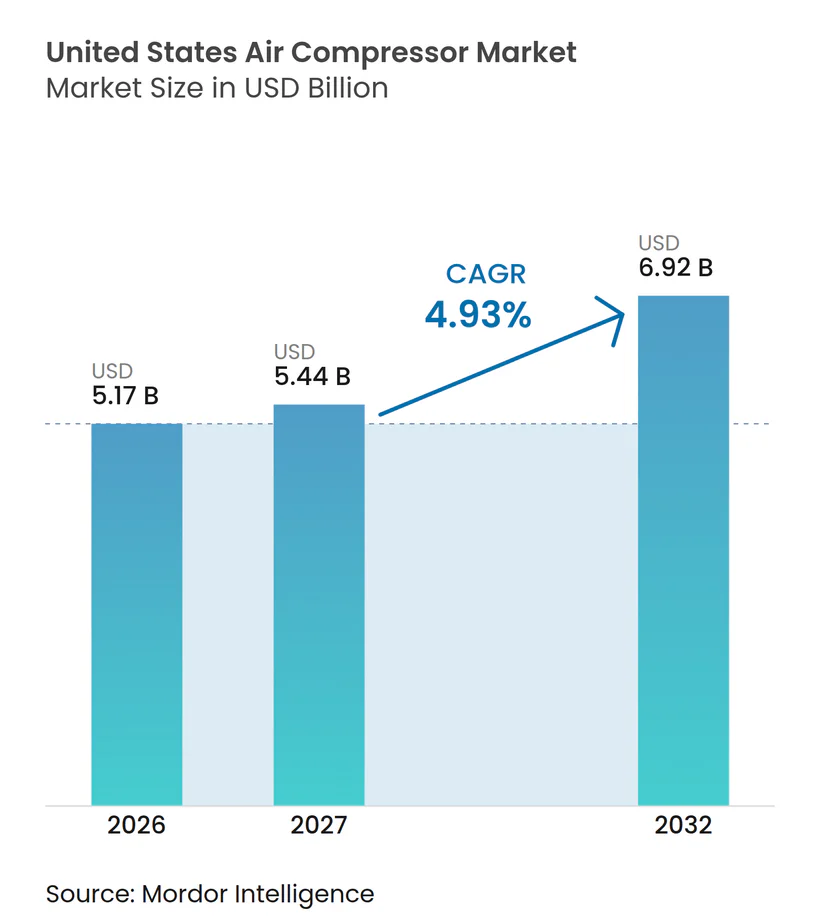
The United States Air Compressor Market size was valued at USD 5.17 billion in 2026 and is estimated to grow from USD 5.44 billion in 2027 to reach USD 6.92 billion by 2032, at a CAGR of 4.93% during the forecast period (2027-2032). The 2027 starting point reflects a replacement cycle shaped by the Department of Energy efficiency rules for certain compressors, which became mandatory in January 2025.[1] Compressed air remains essential to plant operations, but many sites still have limited visibility into how systems perform across shifts and load conditions. This supports demand for efficient equipment, variable-speed controls, and connected monitoring that can show where energy and maintenance costs arise. The United States air compressor market also benefits from LNG construction, semiconductor investment, and the need for reliable industrial utility systems, while service coverage and compliance capabilities are becoming more important in supplier selection. Cost pressure, uncertain factory utilization, and a proposed DOE policy change could still delay purchases at smaller sites.[2]
Key Report Takeaways
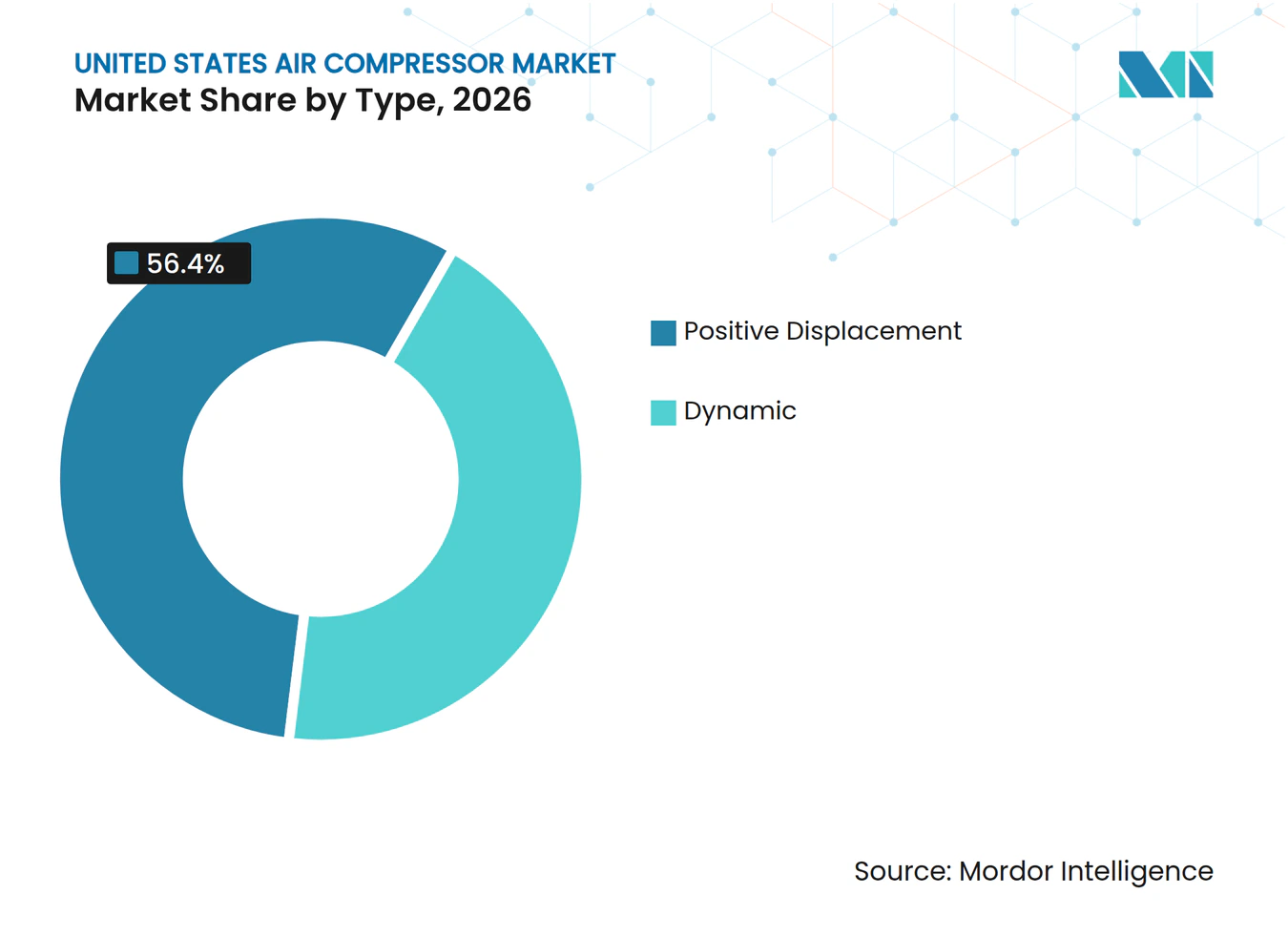
- By type, Positive Displacement compressors held 56.4% of revenue in 2026, while Dynamic compressors are forecast to grow at a 5.4% CAGR through 2032.
- By cooling method, Air-Cooled compressors accounted for 78.3% of revenue in 2026, while Water-Cooled compressors are forecast to grow at a 5.1% CAGR through 2032.
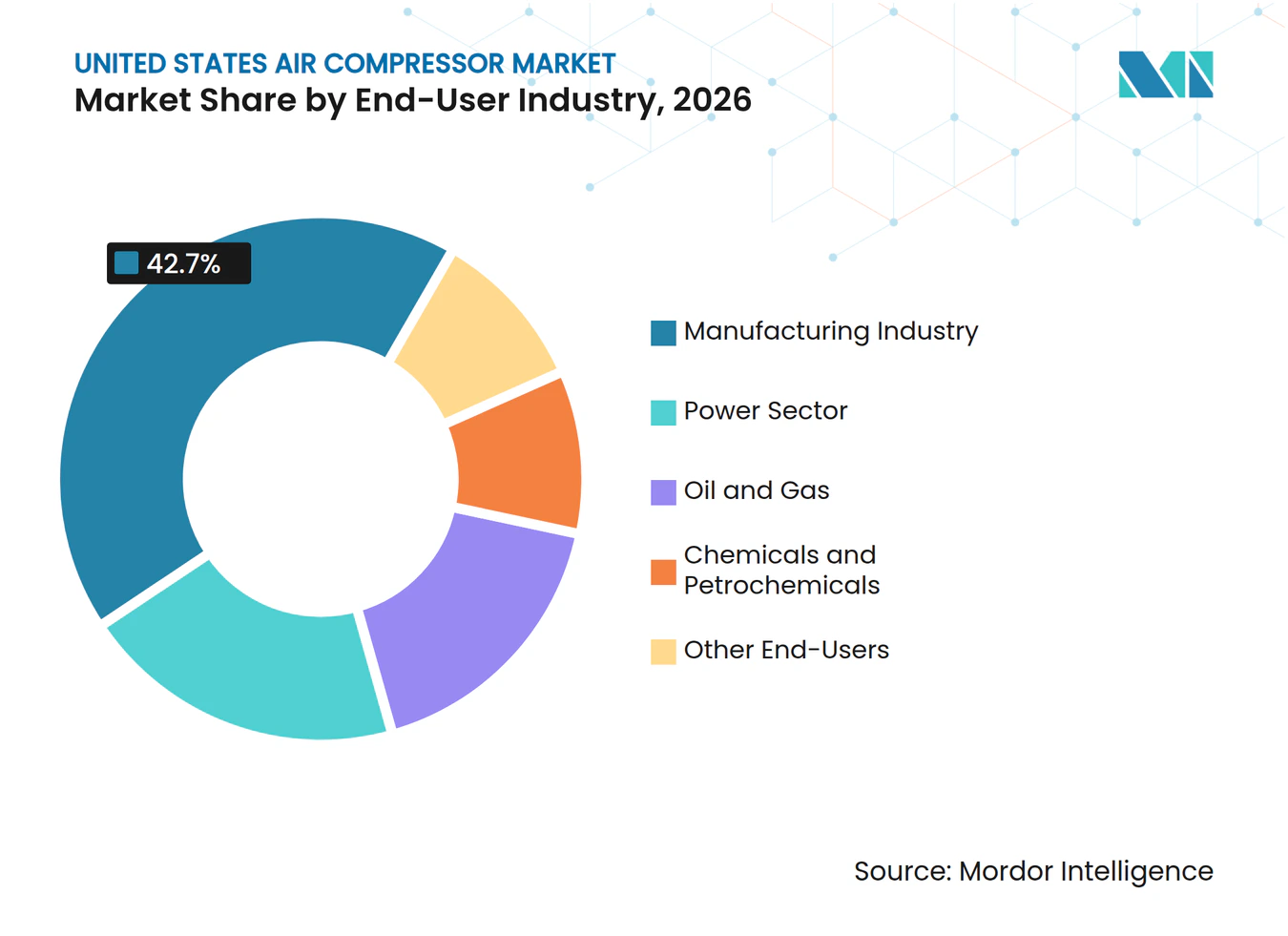
- By end-user industry, Manufacturing held 42.7% of revenue in 2026, while Oil and Gas is forecast to grow at a 5.2% CAGR through 2032.
Note: Market numbers in this report are based on Mordor Intelligence's proprietary estimation framework, which combines nine months of actuals with Q4 projections for base year 2026.
United States Air Compressor Market Trends and Insights
Drivers Impact Analysis*
| Driver | (~) % Impact on CAGR Forecast | Geographic Relevance | Impact Timeline |
|---|---|---|---|
| Industrial Automation and Manufacturing Modernization | +1.2% | National, with early gains in the Midwest automotive belt, Texas, and the Carolinas | Medium term (2-4 years) |
| Energy Efficiency and Lifecycle Cost Reduction | +1.0% | National | Short term (≤ 2 years) |
| Semiconductor, Battery, and Advanced Manufacturing Capacity Expansion | +0.8% | Arizona, Ohio, Texas, New York, and Idaho | Long term (≥ 4 years) |
| Infrastructure, LNG, Water, and Wastewater Investment | +0.7% | Gulf Coast, including Texas and Louisiana, and national water utilities | Long term (≥ 4 years) |
| DOE Efficiency-Compliance Replacement of Legacy Rotary Units | +0.6% | National | Short term (≤ 2 years) |
| Compressed-Air-as-a-Service and Performance Contracting | +0.4% | National, with early adoption in automotive and food processing | Medium term (2-4 years) |
| Source: Mordor Intelligence | |||
Industrial Automation and Manufacturing Modernization
Many manufacturing facilities use compressed air in automation and production processes, so plant modernization can create demand even when workforce growth is limited. Sites that add automated lines often need more stable air supply, better controls, and equipment that can adjust to changing production loads. The DOE Industrial Assessment Centers program continues to support efficiency projects at small and mid-sized manufacturers, including compressed-air improvements.[3] These projects can reveal oversized systems and air losses that were not visible under older operating practices. The United States air compressor market therefore gains both replacement demand and service opportunities when facilities redesign their utility systems around real operating data. It also makes reliable system assessment a more valuable part of the customer relationship.
Energy Efficiency and Lifecycle Cost Reduction
The DOE standards apply to oil-flooded rotary screw compressors within specified flow and pressure ranges and require minimum isentropic efficiency levels. This creates a direct reason to replace or redesign equipment that no longer meets the required level. Variable-speed compressors can reduce energy use where air demand changes throughout the day, particularly when equipment runs below full load. The value of these systems depends on a plant's load profile, maintenance practices, and electricity costs, rather than purchase price alone. The United States air compressor market is consequently shifting toward systems that can document operating savings over the life of the equipment. Suppliers that can quantify those savings have a clearer basis for winning upgrade projects.
Semiconductor, Battery, and Advanced Manufacturing Capacity Expansion
Semiconductor facilities need clean, continuous utility air because contamination or unplanned interruptions can disrupt production. The CHIPS and Science Act provides USD 52.7 billion in incentives and has helped support new semiconductor capacity across several states.[4] These facilities typically need oil-free air systems that meet strict purity specifications and can operate continuously. Battery plants add similar demand during construction and in controlled manufacturing processes where stable air quality matters. This work broadens the United States air compressor market beyond general manufacturing and favors suppliers with engineering support, clean-air capabilities, and local service capacity. The same requirements make execution quality more important than simple equipment availability.
Infrastructure, LNG, Water, and Wastewater Investment
The United States sanctioned more than 80 billion cubic meters per year of LNG liquefaction capacity in 2025, the highest annual total on record for the country. Large LNG projects use compressors in refrigerant cycles and related process systems, making final investment decisions important for equipment planning. Baker Hughes received orders for six centrifugal compressors for Rio Grande LNG Train 4 and eight compressors for Port Arthur LNG Phase 2 during 2025. Water and wastewater systems provide a separate source of demand for continuous-duty aeration equipment. Together, these projects make the United States air compressor market less dependent on any single factory investment cycle. They also create a longer schedule for service and replacement work after the initial equipment delivery.
Restraints Impact Analysis*
| Restraint | (~) % Impact on CAGR Forecast | Geographic Relevance | Impact Timeline |
|---|---|---|---|
| High Upfront Cost and Periodic Maintenance Requirements | -0.9% | National, with the greatest effect on small and mid-sized manufacturers | Medium term (2-4 years) |
| Steel, Electronics, and Skilled-Service Supply Constraints | -0.7% | National, with greater pressure where service infrastructure is limited | Short term (≤ 2 years) |
| Legacy-System Compatibility and Controls-Integration Friction | -0.6% | National, concentrated in older Midwest and Northeast manufacturing sites | Medium term (2-4 years) |
| Cybersecurity and Data-Ownership Risk in Connected Compressors | -0.4% | National, with elevated exposure in connected manufacturing and critical infrastructure | Long term (≥ 4 years) |
| Source: Mordor Intelligence | |||
High Upfront Cost and Periodic Maintenance Requirements
Modern variable-speed compressors can cost more than fixed-speed alternatives, which remains difficult for smaller manufacturers with uncertain output schedules. The business case depends on accurate estimates of run time, system leakage, and energy savings. Service contracts can move equipment spending into operating budgets and make maintenance costs more predictable. However, these contracts require nearby technicians and parts availability to support promised uptime. The United States air compressor market will see slower adoption where buyers cannot confidently measure lifecycle savings or secure dependable service support. This makes transparent performance guarantees more useful for buyers weighing a higher initial purchase price.
Steel, Electronics, and Skilled-Service Supply Constraints
Air compressor equipment depends on metal components, controls, and service labor that can face supply and cost pressure. Connected and variable-speed models need technicians who understand both mechanical systems and digital diagnostics. This requirement is harder to meet in smaller industrial locations where specialist service coverage is limited. ISO 11011 provides a framework for auditing compressed-air systems, but effective use requires personnel who can interpret both process and energy data. These constraints can extend lead times and make buyers more cautious, especially when the United States air compressor market is serving price-sensitive mid-sized facilities. Suppliers with trained local teams and secure component access can reduce this point of hesitation.
*Our forecasts treat driver/restraint impacts as directional, not additive. The impact forecasts reflect baseline growth, mix effects, and variable interactions.
Segment Analysis
By Type: Dynamic Compressors Gain in High-Precision Applications
Positive Displacement compressors held 56.4% of the United States air compressor market share in 2026. Rotary screw and reciprocating models are widely used in automotive plants, food processing, plastics, metal fabrication, workshops, and high-pressure applications. Their broad installed base supports a stable replacement market and a large service opportunity. DOE requirements are directing more purchases toward efficient rotary screw units that meet the applicable standards. Variable-speed equipment is becoming more relevant where production loads vary across shifts. Portable units also remain important in construction and field service, where mobility and reliable output carry more weight than advanced controls. The United States air compressor industry retains a strong Positive Displacement base because these products serve a wide range of pressure, flow, and installation needs. That breadth reduces reliance on any one high-growth application. It also allows distributors to build service relationships across very different industrial customers.
Dynamic compressors are projected to grow at a 5.4% CAGR through 2032, making them the fastest-growing type in the United States air compressor market. Centrifugal systems are well suited to LNG facilities and semiconductor fabs that require high continuous flow and clean air. The 2025 Baker Hughes awards for Rio Grande LNG Train 4 and Port Arthur LNG Phase 2 show how a small number of large projects can produce significant equipment demand. Cleanroom customers also favor oil-free systems because air purity requirements limit the acceptable equipment set. Atlas Copco began a 63,000 sq ft expansion of its centrifugal compressor manufacturing site in Voorheesville, New York, in June 2025. This investment signals continued attention to process applications with high technical requirements. Dynamic equipment has a narrower customer base than Positive Displacement products, but its projects are typically larger and more demanding. That combination supports faster growth while increasing the importance of application engineering and aftermarket support. It can also lengthen qualification cycles, since buyers must validate equipment against exact process conditions.



By Cooling Method: Water-Cooled Systems Gain on Semiconductor and Data Center Demand
Air-Cooled equipment accounted for 78.3% of 2026 revenue in the United States air compressor market. Its leadership reflects lower installation expense, simpler maintenance, and broad suitability for light and medium industrial facilities. Air-Cooled designs also serve portable applications in construction, utilities, and general industrial work. The segment will still need to respond to changing performance requirements for commercial screw compressors. Buyers are increasingly looking at energy use under actual load conditions, not only nameplate capacity. This favors models with controls that can maintain performance across different operating environments. Air-Cooled systems remain the standard choice where space, water access, and maintenance resources are limited. Their large installed base also creates steady opportunities for upgrades, parts, and maintenance. This keeps the category relevant even when new plant construction moderates.
Water-Cooled compressors are forecast to advance at a 5.1% CAGR through 2032 in the United States air compressor market. Semiconductor facilities often integrate water-cooled utility systems with broader chiller and cleanroom infrastructure. This arrangement can support stable performance in continuous, high-load operation. Data centers and large process sites may also need high-pressure, high-purity instrument air that benefits from purpose-built system design. Kaeser expanded its Fredericksburg, Virginia, facility in 2025 to add custom-engineered compressed-air, vacuum, and blower assembly capacity. Such investments strengthen suppliers' ability to serve engineered projects rather than standard product orders. Water-Cooled systems are less common than Air-Cooled products, but they fit applications where heat management and uninterrupted operation are essential. Their growth will depend on the pace of new semiconductor, data center, and large process investments. These buyers also tend to value documented reliability over a low initial purchase cost.
By End-User Industry: Oil and Gas Leads Growth on LNG Pipeline
Manufacturing held 42.7% of United States air compressor market share in 2026. Automotive, electronics, pharmaceuticals, food processing, and metal fabrication all use compressed air for tools, spraying, instrumentation, and automation. The segment's breadth gives suppliers a diverse customer base across many regions. Manufacturing customers are also central to demand for upgrades that reduce energy costs and improve system monitoring. Plants with older fixed-speed fleets may replace equipment as efficiency requirements and maintenance needs become more pressing. Food and pharmaceutical operations place added emphasis on air quality and dependable service. The United States air compressor industry therefore relies on manufacturing not only for volume, but also for recurring aftermarket work. This steady base can offset the timing risk associated with large project awards in other sectors. It gives suppliers a broad foundation for demand across the national industrial base.
Oil and Gas is expected to grow at a 5.2% CAGR through 2032 in the United States air compressor market. LNG construction is the main reason for the segment's stronger outlook, particularly along the Gulf Coast. Port Arthur LNG Phase 2 represents USD 14 billion of capital expenditure and is expected to bring two additional trains into commercial operation in 2030 and 2031. These projects need compressor systems during construction, commissioning, and ongoing operations. Midstream maintenance also provides demand between major construction cycles. Chemicals, power generation, water treatment, construction, and other users add further resilience to the end-user mix. Suppliers that can support remote sites and meet demanding reliability requirements are likely to be better positioned in this segment. The United States air compressor market benefits when project-led demand is balanced by service revenue from existing infrastructure. This balance matters because LNG project schedules can vary even when long-term capacity plans remain intact.

Geography Analysis
The Gulf Coast, especially Texas and Louisiana, is the most compressor-intensive area of the United States air compressor market in 2026. Oil and gas, LNG, refining, and petrochemical activity create demand for high-flow process equipment and specialized service support. More than 80 billion cubic meters per year of new LNG liquefaction capacity was sanctioned nationally in 2025, with major Gulf Coast projects forming an important part of the pipeline. Baker Hughes' awards for Rio Grande LNG and Port Arthur LNG show the procurement scale associated with individual projects. Air Liquide announced an investment of up to USD 200 million in Louisiana in June 2025 to modernize an air separation unit and extend its pipeline network by 30 miles.
The Southeast is an expanding manufacturing and service corridor for the United States air compressor market. Atlas Copco announced U.S. assembly of G Series 90-250 HP oil-injected screw compressors at Bay Minette, Alabama, in June 2026. The company also broke ground on a 355,000 sq ft North American Service Center in Lancaster County, South Carolina, in September 2026, with operations planned from June 2027. The regional manufacturing base, port access, and lower-cost operating environment support new industrial investment. Newer facilities can install variable-speed equipment during initial construction rather than retrofit older systems.
Arizona and the Midwest, including Ohio and Indiana, are important locations for semiconductor and battery projects. These sites need clean, reliable compressed air and create demand for engineered oil-free systems. New York and Virginia also support the supply chain through compressor manufacturing and custom assembly investment, including Atlas Copco's Voorheesville expansion and Kaeser's Fredericksburg expansion. This wider geography makes regional service capability important because advanced facilities need rapid response and documented air quality.
Competitive Landscape
Market Concentration
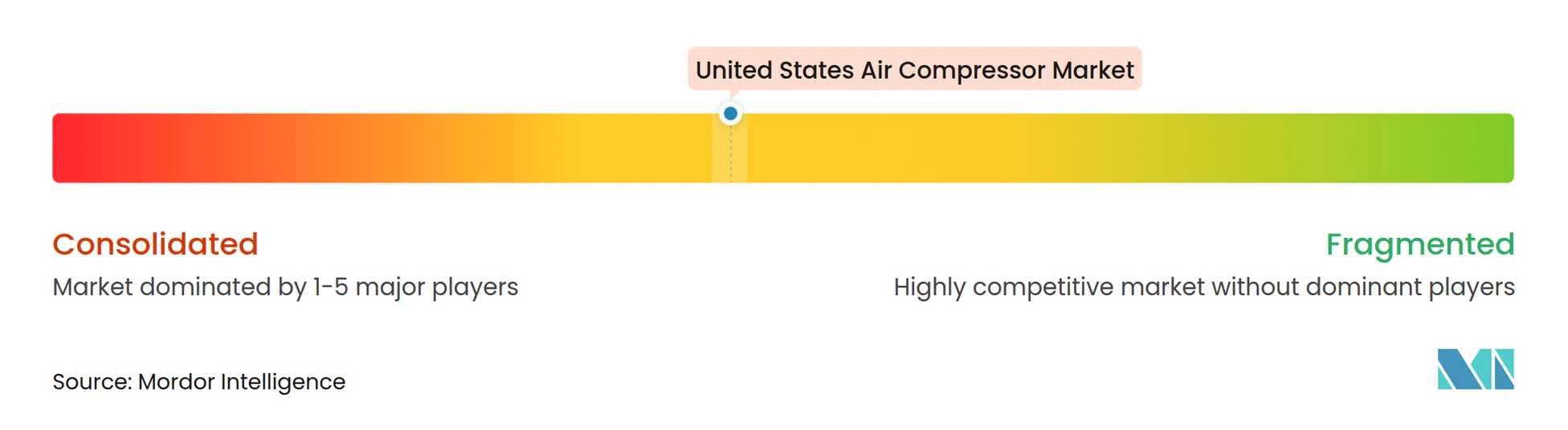
The United States air compressor market is moderately concentrated, with Atlas Copco, Ingersoll Rand, and Kaeser among the leading suppliers. Competition centers on product efficiency, technical fit, service coverage, and the ability to support customers after installation. Large suppliers have an advantage where customers want nationwide technician coverage, readily available parts, and performance-based service agreements. Atlas Copco is increasing its U.S. manufacturing and service footprint through localized G Series assembly in Alabama, a centrifugal compressor expansion in New York, and a new service center in South Carolina.
Ingersoll Rand and Garrett Motion announced a multiyear partnership in May 2026 to develop oil-free industrial air technologies, with initial customer availability expected before the end of 2026. The work targets applications where air purity can matter more than initial equipment cost. Service models are also becoming more important as equipment becomes connected and customers seek predictable operating costs. Compressed-Air-as-a-Service arrangements rely on suppliers having sufficient technicians, parts inventory, and system-monitoring capability. This gives established providers an advantage in secondary industrial markets where service density is difficult to build quickly.
Challengers continue to compete in specialized applications, regional distribution, and price-sensitive rotary screw products. ELGi reported strong North American revenue growth and moved toward direct distribution in California after divesting its interest in a local joint venture in July 2026. Kaeser is strengthening its custom engineering capacity in Virginia and continues to serve portable, industrial, and specialized air system requirements. Compliance with DOE efficiency rules and customer expectations for documented performance can be more difficult for suppliers without local testing, certification, and service resources. The competitive position of each supplier increasingly depends on whether it can support the full system life cycle.
United States Air Compressor Industry Leaders
-
Atlas Copco AB
-
Ingersoll Rand Inc.
-
Hitachi Global Air Power US, LLC
-
Kaeser Compressors, Inc.
-
ELGi Equipments Limited
- *Disclaimer: Major Players sorted in no particular order
Recent Industry Developments
- August 2026: Atlas Copco Group broke ground on a 355,000 sq ft North American Service Center in Lancaster County, South Carolina. The facility will warehouse compressed air equipment and millions of spare parts for North American customers. Operations are expected from June 2027. It will be Atlas Copco's fourth large-scale facility in the region, bringing its local footprint beyond 1 million sq ft.
- June 2026: Atlas Copco Compressors USA announced U.S. assembly of G Series 90-250 HP oil-injected screw compressors at its Bay Minette, Alabama, facility. The project localizes production to shorten delivery lead times and improve supply-chain flexibility for U.S. industrial customers.
- May 2026: Ingersoll Rand and Garrett Motion announced a multiyear strategic partnership to develop next-generation oil-free air technologies. The partnership combines Ingersoll Rand compressor system platforms with Garrett's oil-free centrifugal modules. Initial products are expected to reach select customers before the end of 2026, with wider rollout from 2027.
- October 2025: Baker Hughes received centrifugal compressor supply awards for two U.S. LNG projects. The company will supply six centrifugal compressors for Rio Grande LNG Train 4 and eight compressors across two trains for Port Arthur LNG Phase 2.
United States Air Compressor Market Report Scope
The air compressor market encompasses the manufacturing, distribution, sales, and servicing of mechanical devices that convert power (using an electric motor, diesel engine, or gasoline engine) into potential energy stored in pressurized air.
The United States air compressor market is segmented by type, cooling method, and end-user industry. By type, the market is segmented into positive displacement and dynamic compressors. By cooling method, the market is segmented into air-cooled and water-cooled compressors. By end-user industry, the market is segmented into oil and gas, the power sector, manufacturing, chemicals and petrochemicals, and other end-user industries. For each segment, the market sizing and forecasts are provided on the basis of value (USD).
| Positive Displacement |
| Dynamic |
| Air-Cooled |
| Water-Cooled |
| Oil and Gas |
| Power Sector |
| Manufacturing Industry |
| Chemicals and Petrochemicals |
| Other End-Users |
| By Type | Positive Displacement |
| Dynamic | |
| By Cooling Method | Air-Cooled |
| Water-Cooled | |
| By End-User Industry | Oil and Gas |
| Power Sector | |
| Manufacturing Industry | |
| Chemicals and Petrochemicals | |
| Other End-Users |
Key Questions Answered in the Report
What is the outlook for air compressors in the United States?
The United States air compressor market is projected to reach USD 6.92 billion by 2032, expanding at a 4.93% CAGR from 2027. Replacement demand, industrial modernization, LNG projects, and advanced manufacturing facilities provide the main sources of demand during the forecast period.
Which compressor type is growing fastest in the United States?
Dynamic compressors are forecast to grow at a 5.4% CAGR through 2032, supported by LNG and semiconductor applications. These applications require high flow, continuous operation, clean air, and detailed engineering support, which favors centrifugal equipment in many projects.
Why are variable-speed air compressors gaining adoption?
Variable-speed units can reduce energy use when air demand changes, and DOE efficiency requirements have increased attention to compliant, efficient equipment. Buyers also use connected controls to measure demand, find system losses, and build a clearer lifecycle-cost case for replacement.
Which end-user sector has the strongest growth outlook?
Oil and Gas is projected to grow at a 5.2% CAGR through 2032, supported by LNG investment and related infrastructure activity. Gulf Coast construction, commissioning, and maintenance work support demand for centrifugal and other specialized compressor systems.
What is driving demand for water-cooled compressors?
Semiconductor facilities, data centers, and continuous-process sites need stable operation and engineered heat management, supporting 5.1% CAGR growth for Water-Cooled units. These customers often value integration with wider cooling infrastructure, controlled air quality, and reliable operation throughout the year.
How competitive is the United States air compressor sector?
Competition is moderate, with established suppliers benefiting from service networks, technical capabilities, and compliance support while specialized challengers remain active. Supplier selection increasingly reflects local parts availability, trained technicians, efficiency documentation, and the ability to manage complex system requirements.