
United Kingdom Tokenized Deposit Market Size and Share
Market Overview
| Study Period | 2021 - 2032 |
|---|---|
| Forecast Data Period | 2027 - 2032 |
| Base Year Market Size (2026) | USD 0.17 Trillion |
| Market Size (2027) | USD 0.24 Trillion |
| Market Size (2032) | USD 1.05 Trillion |
| Growth Rate (2027 - 2032) | 34.30 % |
| Market Concentration | Low |
Major Players *Disclaimer: Major Players sorted in no particular order Image © Mordor Intelligence. Reuse requires attribution under CC BY 4.0. | |
United Kingdom Tokenized Deposit Market Analysis by Mordor Intelligence
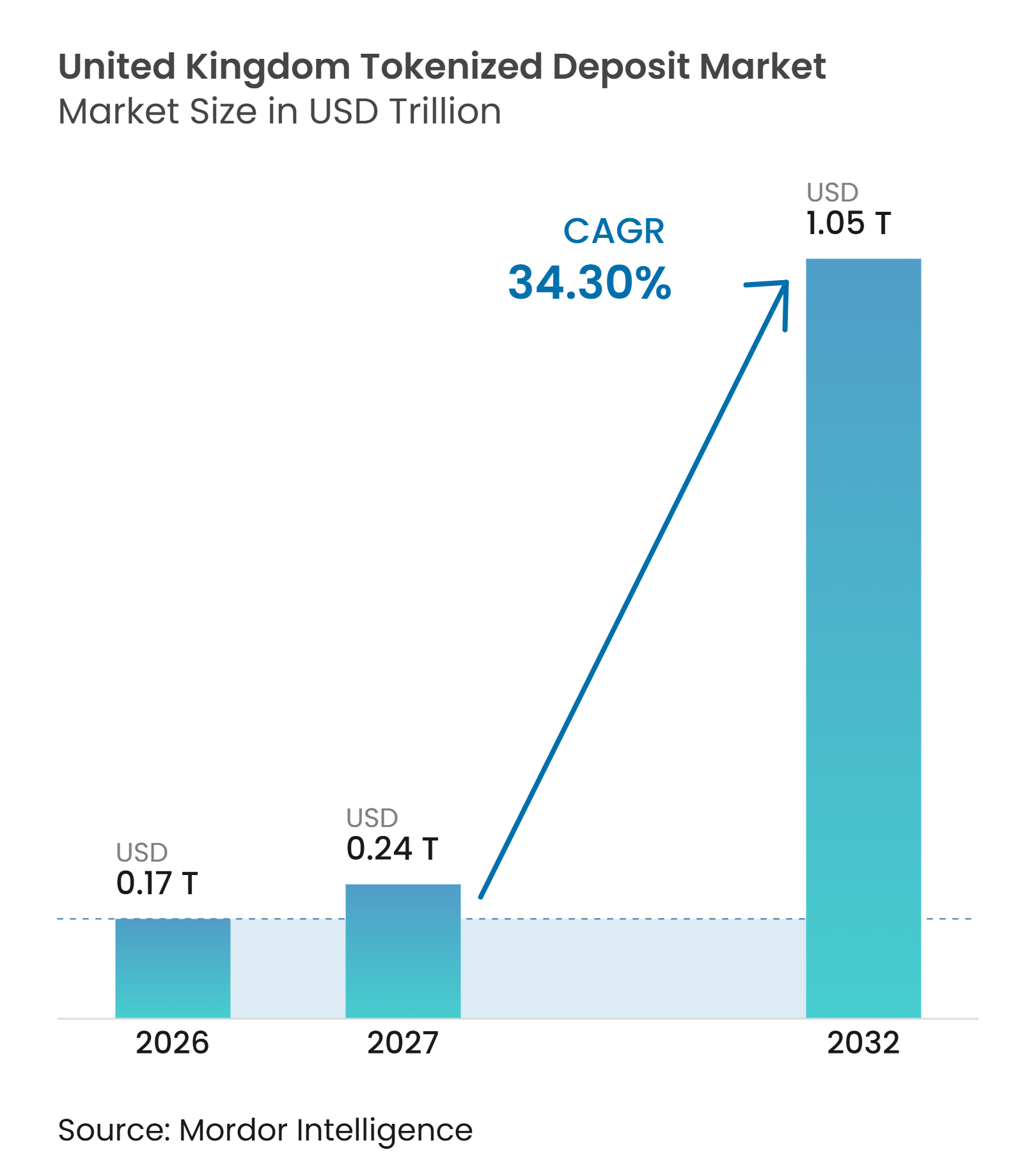
The United Kingdom Tokenized Deposit Market size is expected to grow from USD 0.17 trillion in 2026 to USD 0.24 trillion in 2027 and is forecast to reach USD 1.05 trillion by 2032 at 34.30% CAGR over 2027-2032.
Commercial deployment is moving beyond controlled interbank trials toward shared financial market infrastructure after the Great British tokenised deposit initiative completed live customer transactions across 7 United Kingdom banks in September 2026. Commercial banks fund 85% of household lending in the United Kingdom, which makes deposit-based programmable money important because it preserves the established credit-creation model. The Bank of England and the Financial Conduct Authority are supporting a shared roadmap for wholesale tokenization, while the Digital Securities Sandbox provides a regulated route for new settlement arrangements. The United Kingdom tokenised deposit market is also linked to cross-border demand through the Bank of England’s participation in Project Agorá, which brings together 7 central banks and more than 40 regulated institutions. Its immediate constraint is the lack of live central bank money synchronization, because the Bank of England does not target the RTGS synchronization service for live deployment until 2028.
Key Report Takeaways
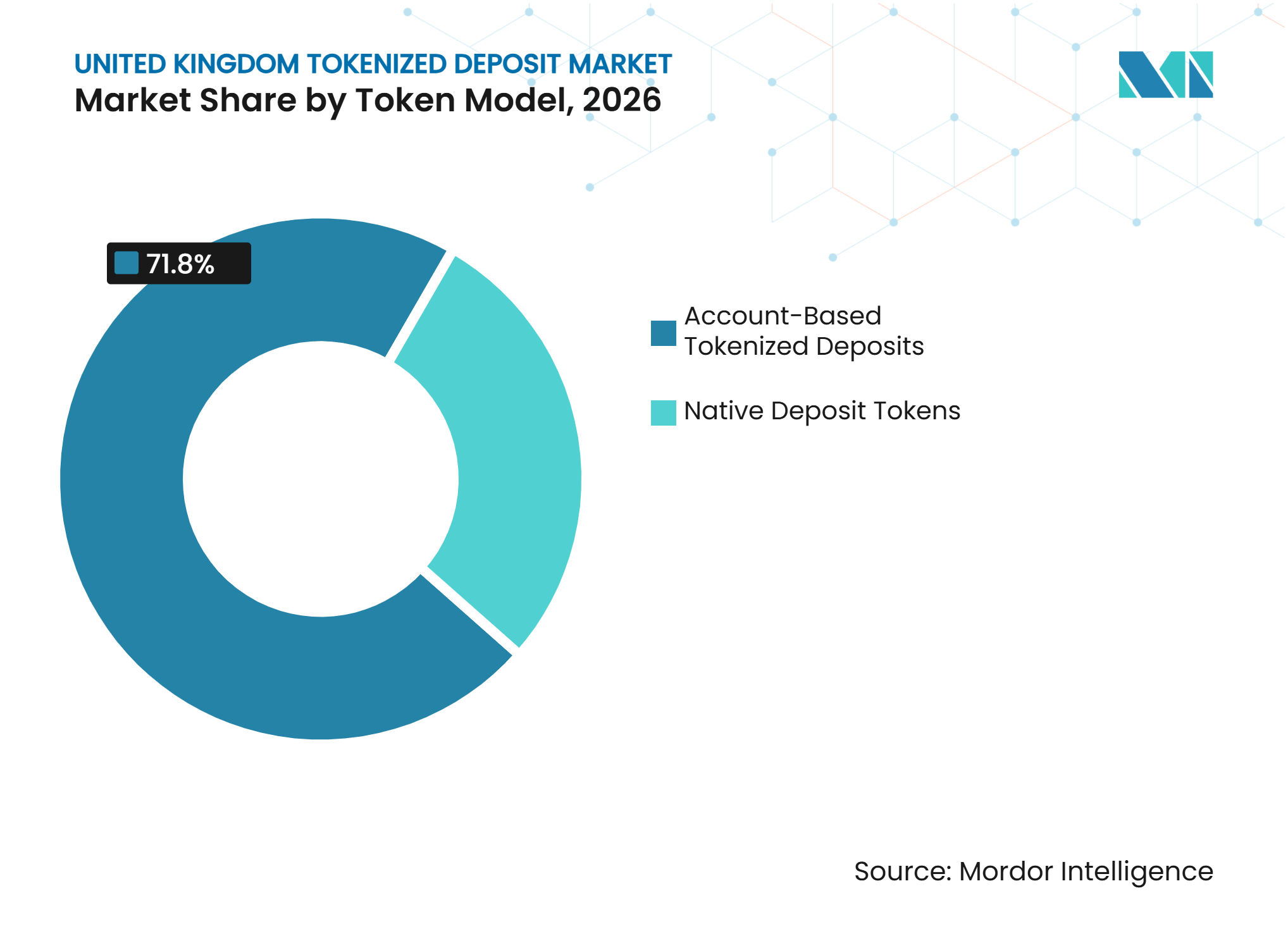
- By token model, account-based structures captured 71.8% of the United Kingdom tokenised deposit market share in 2026, while native deposit tokens are projected to grow at a 39.8% CAGR through 2032.
- By network model, single-bank networks held a 45.4% share of the United Kingdom tokenised deposit market size in 2026, while interbank shared multi-bank networks are forecast to grow at a 38.6% CAGR through 2032.
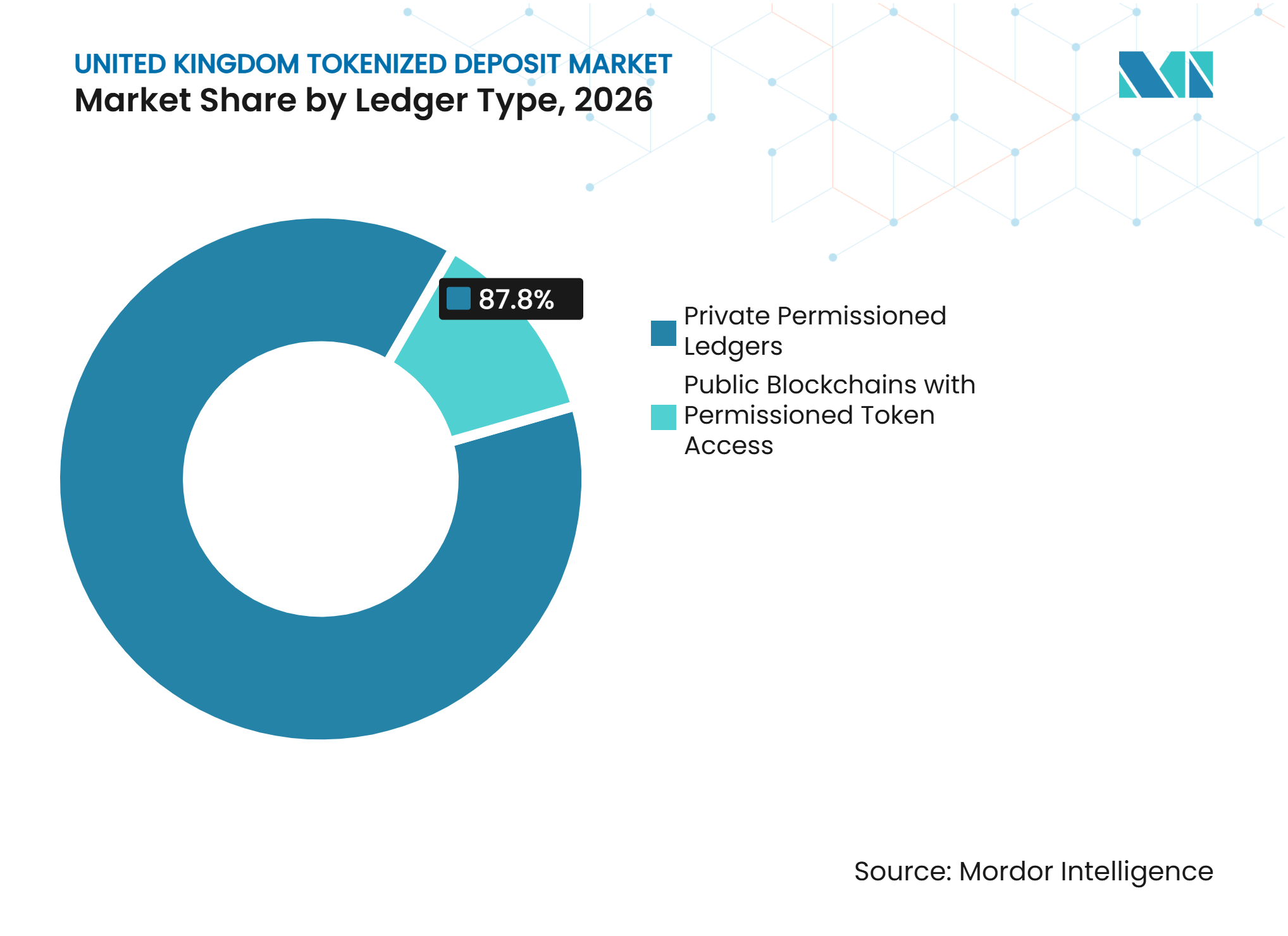
- By ledger type, private permissioned ledgers captured 87.8% of the United Kingdom tokenised deposit market share in 2026, while public blockchains with permissioned token access are projected to grow at a 42.4% CAGR through 2032.
- By use case, third-party commercial and institutional payments accounted for 27.8% of the United Kingdom tokenised deposit market share in 2026, while securities and digital-asset settlement is projected to grow at a 38.6% CAGR through 2032.
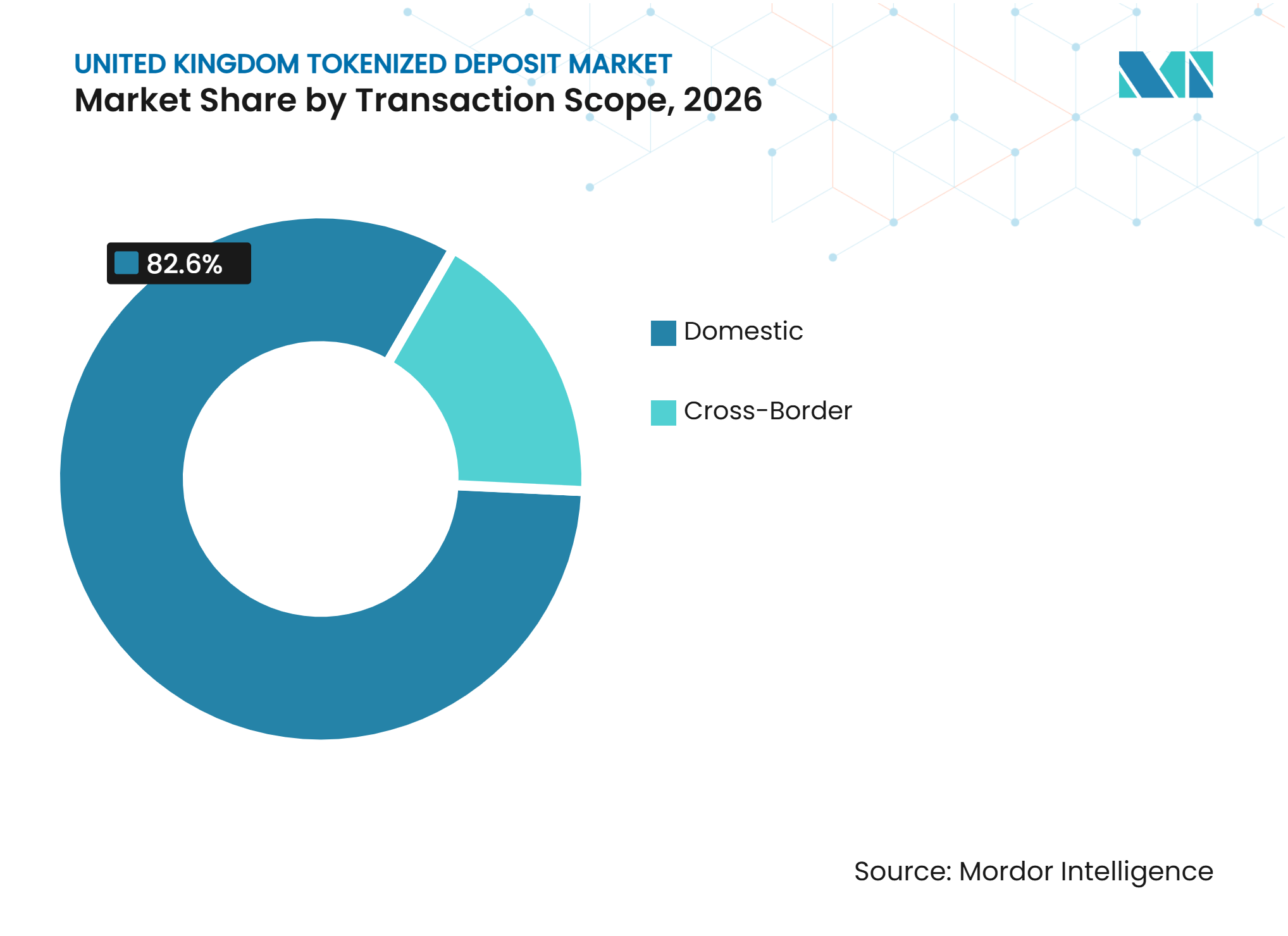
- By transaction scope, domestic transactions captured 82.6% of the United Kingdom tokenised deposit market share in 2026, while cross-border transactions are projected to grow at a 43.7% CAGR through 2032.
- By end user, banks and other deposit-taking institutions held 39.6% of the United Kingdom tokenised deposit market share in 2026, while payments, fintech, and digital-asset firms are forecast to grow at a 41.3% CAGR through 2032.
Note: Market numbers in this report are based on Mordor Intelligence's proprietary estimation framework, which combines nine months of actuals with Q4 projections for base year 2026.
Market Trends and Insights
Drivers Impact Analysis of United Kingdom Tokenized Deposit Market*
| Driver | (~) % Impact on CAGR Forecast | Geographic Relevance | Impact Timeline |
|---|---|---|---|
| Programmable And Conditional Payments Using Tokenised Bank Deposits | +8.2% | National, with early gains in Greater London and the South-East | Short term (≤ 2 years) |
| Atomic Settlement Of Tokenised Securities Using Commercial Bank Money | +7.0% | City of London DSS participants, with spill-over to international digital-securities markets | Short term (≤ 2 years) |
| Tokenised Deposits For Corporate Treasury And Liquidity Management | +5.8% | National, with cross-border spill-over to HSBC TDS markets in Luxembourg, Singapore, and Hong Kong | Medium term (2-4 years) |
| Regulatory Recognition Within The United Kingdom Deposit Framework | +5.0% | National, within the PRA and FCA regulatory perimeter | Short term (≤ 2 years) |
| Development Of Tokenised Wholesale Financial Market Infrastructure | +4.5% | National, extending to Group of Seven markets through Project Agorá | Medium term (2-4 years) |
| Cross-Border Wholesale Payment Use | +3.5% | Global, anchored by the Bank of England and 6 other central bank participants in Project Agorá | Long term (≥ 4 years) |
| Source: Mordor Intelligence | |||
Growth of Programmable and Conditional Payments Using Tokenised Bank Deposits
Programmable conditional payments became live consumer applications when the Great British Tokenised Deposit initiative completed remortgage transactions with automated fund release and a peer-to-peer marketplace payment in September 2026. These arrangements lock and release funds only when predefined conditions are met, which can reduce fraud exposure in online transactions. The Great British Tokenised Deposit parliamentary submission reported that 70% of United Kingdom fraud originates on online platforms[1]. Conditional logic operates above existing deposit infrastructure, allowing Financial Services Compensation Scheme protection to continue without a structural change to the underlying deposit. Quant Network provides the shared platform with ISO 20022-compatible messaging and its PayScript engine, enabling institutions without their own tokenized deposit capability to participate. The National Payments Vision supports the United Kingdom’s retail payments modernization agenda, giving the United Kingdom tokenised deposit market a policy basis for wider commercial deployment from 2027.
Demand for Atomic Settlement of Tokenised Securities Using Commercial Bank Money
Atomic delivery-versus-payment (DvP) settlement links the transfer of securities with the corresponding cash payment, reducing settlement risk by ensuring that both legs complete together or not at all. In July 2026, HSBC received Gate 2 approval under the United Kingdom’s Digital Securities Sandbox, allowing HSBC Orion to provide live digital securities depository services for digitally native bond issuance, servicing, and settlement[2]. HM Treasury appointed HSBC as the platform provider for the Digital Gilt Instrument (DIGIT) pilot, with the first issuance planned by the first quarter of 2027. The Bank of England’s Digital Securities Sandbox guidance permits commercial bank money with little or no credit or liquidity risk, or equivalent regulated private forms of money, as settlement assets within the Sandbox. Separately, Project Meridian Securities demonstrated atomic settlement of tokenized securities in central bank money using synchronization between RTGS and distributed-ledger platforms.
Adoption of Tokenised Deposits for Corporate Treasury and Liquidity Management
Corporate treasurers can use programmable tokenized deposits to establish rules for balance sweeping, supplier payments tied to milestones, and cross-jurisdictional liquidity redeployment. The Cambridge Centre for Alternative Finance found that institutional users have a clear yield requirement, which supports deposits that retain interest accrual over non-yielding stablecoins in regulated treasury use cases. HSBC’s Tokenised Deposit Service operates in the United Kingdom, Hong Kong, Singapore, Luxembourg, the United States, and the United Arab Emirates, supporting 7 currencies[3]. This operating model shows how single-bank networks can generate commercial activity before connecting to shared interbank infrastructure. Fnality introduced programmable earmarking in April 2025 with Banco Santander, Lloyds Banking Group, and UBS, supporting margin calls, collateral movement, and guaranteed supplier-payment release. The capability can improve working-capital management for multinational groups that manage liquidity across subsidiaries and payment cycles.
Regulatory Recognition of Tokenised Deposits Within the United Kingdom Deposit Framework
The United Kingdom applies a same-risks, same-rules principle, allowing authorized deposit-taking institutions to issue tokenized deposits without a separate banking category. This approach gives the United Kingdom tokenized deposit market a defined compliance route under existing banking authorization. The Prudential Regulation Authority’s May 2026 Dear Chief Executive Officer letter confirmed that tokenized deposits remain within existing Financial Services Compensation Scheme protection and single-customer-view requirements[4]. The letter also set expectations for the prudential treatment of tokenized collateral and stablecoin exposures. The Financial Conduct Authority and Bank of England roadmap addresses client-asset rules, tokenized collateral at central counterparties, and RTGS synchronization operator standards. Anti-money laundering and counter-terrorist financing requirements apply uniformly to United Kingdom-registered participants under the Money Laundering Regulations, creating a single compliance framework for domestic participants.
Restraints Impact Analysis of United Kingdom Tokenized Deposit Market*
| Restraint | (~) % Impact on CAGR Forecast | Geographic Relevance | Impact Timeline |
|---|---|---|---|
| Interoperability Constraints Across Bank Deposit Ledgers And Payment Infrastructure | -3.5% | National, with spill-over to cross-border workflows | Short term (≤ 2 years) |
| Liquidity Management And Deposit-Outflow Risks From Faster Tokenised Transfers | -3.0% | National, concentrated in PRA-regulated systemically important United Kingdom banks | Medium term (2-4 years) |
| Integration Costs And Limited Commercial Incentives For Tokenised Deposit Adoption | -2.5% | National, particularly for mid-tier banks and building societies outside GBTD | Medium term (2-4 years) |
| Settlement Asset Eligibility And Uncertainty Over Interoperability With Central Bank Money | -2.0% | National, dependent on United Kingdom RTGS renewal and extending to cross-border settlement | Long term (≥ 4 years) |
| Source: Mordor Intelligence | |||
Interoperability Constraints Across Bank Deposit Ledgers and Payment Infrastructure
Each participating bank retains a different core banking integration, even though the Great British Tokenised Deposit initiative has established shared payment infrastructure. Quant Network describes mirror and omnibus models, where either core banking remains authoritative or pooled reserves back tokens. These models require different reconciliation, audit, and credit-risk processes, which reduces the ease of cross-institution settlement. A deposit issued by one bank cannot transfer directly to another without an orchestration layer, preserving some latency and counterparty exposure. The Bank of England’s Synchronisation Lab operated as a non-live environment through 2026, but the live service is not planned until 2028. Swift’s blockchain-based ledger provides an interim option, as shown by the Standard Chartered and HSBC transaction in August 2026, but it still requires sequential messaging and bilateral setup.
Liquidity Management and Deposit-Outflow Risks From Faster Tokenised Transfers
Real-time tokenized transfers can change intraday liquidity needs when deposits move continuously rather than through traditional overnight cycles. Banks may need larger reserve buffers or expanded intraday credit access if deposit balances migrate more quickly between institutions. The Bank of England has recognized that major movement from commercial bank deposits into new forms of money could reduce credit availability. This concern is especially relevant in the United Kingdom, where commercial banks fund 85% of household lending, compared with 30% in the United States. Current liquidity coverage frameworks were developed around traditional settlement timing rather than continuous programmable flows. The Prudential Regulation Authority requires institutions to notify supervisors before material tokenized deposit rollouts, which adds a procedural step to implementation.
*Our forecasts treat driver/restraint impacts as directional, not additive. The impact forecasts reflect baseline growth, mix effects, and variable interactions.
United Kingdom Tokenized Deposit Market Segment Analysis
By Token Model:
Account-Based Structures Anchor Regulatory AdoptionAccount-based structures captured 71.8% of the United Kingdom tokenised deposit market share in 2026, reflecting a preference for designs that retain core banking records as the authoritative source. This structure maintains Financial Services Compensation Scheme eligibility, Prudential Regulation Authority single-customer-view standards, and anti-money laundering controls without a major change to established account processes. HSBC’s Tokenised Deposit Service and the mirror and omnibus models tested through the Great British Tokenised Deposit initiative show how account-based arrangements can serve both intraday treasury and retail payments. The design gives banks a route to add programmability while keeping their existing deposit administration and customer-protection responsibilities in place. It also supports adoption by institutions that need clear control over customer records and regulatory reporting.
Native deposit tokens are forecast to grow at a 39.8% CAGR through 2032, supported by wholesale demand for transferable and composable on-chain instruments. Monument Bank and the Midnight Foundation announced a plan to tokenize GBP 250 million (USD 318 million) of retail deposits on a privacy-enhancing public blockchain. Lloyds Banking Group used native tokenized GBP deposits on the Canton Network in January 2026 to purchase a tokenized gilt from Archax. That transaction showed that native deposits can support atomic settlement without an intermediate reconciliation stage. Financial Services Compensation Scheme compatibility remains a limit on retail use, while institutional settings face less prescriptive depositor-protection requirements.


By Network Model:
Shared Infrastructure Defines the Next Competitive WaveSingle-bank networks held 45.4% of the United Kingdom tokenised deposit market size in 2026, led by proprietary deployments that control issuance, transfers, and customer access within one institution. HSBC’s Tokenised Deposit Service converts customer deposits into digital tokens on a 1:1 basis for immediate, 24-hour transfers across 7 currencies in 6 markets. These networks can improve internal treasury positioning without creating direct interbank credit exposure. They are therefore useful for early commercial deployment, particularly where a bank serves clients across several operating markets. Their limitation is that liquidity remains within institution-specific pools unless connectivity with other networks is created.
Interbank shared multi-bank networks are projected to grow at a 38.6% CAGR through 2032, with the Great British Tokenised Deposit initiative forming the main domestic shared infrastructure. The initiative brought 7 major United Kingdom banks into live customer transactions in September 2026 and targets a transition to a financial market infrastructure platform in 2027. Bilateral and cross-network links include SWIFT’s blockchain ledger and the OSTTRA, Baton Systems, and Fnality foreign-exchange payment-versus-payment collaboration. Fnality’s earmarking service includes Banco Santander, Lloyds, and UBS, showing how shared infrastructure can support collateral and payment conditions. BNP Paribas joined the Sterling Fnality Payment System in July 2025 and completed an on-chain interest rate swap payment with Lloyds, demonstrating support for derivative-linked settlement.
By Ledger Type:
Private Ledgers Dominate, Public Permissioned Blockchains AcceleratePrivate permissioned ledgers accounted for an 87.8% share of the United Kingdom tokenised deposit market in 2026 because institutions can control governance, data visibility, and participant access. This approach aligns closely with Prudential Regulation Authority and Financial Conduct Authority expectations for confidentiality, segregation, and anti-money laundering controls. Private environments give banks a familiar structure for onboarding approved participants and managing operational accountability. They also support early deployment where institutions prioritize predictable governance over broader technical openness. The current position reflects the regulated banking sector’s preference for systems that mirror established control standards.
Public blockchains with permissioned token access are projected to grow at a 42.4% CAGR through 2032. Lloyds Banking Group’s January 2026 Canton Network transaction showed how transaction-level privacy can preserve counterparty confidentiality on a public blockchain. HSBC also simulated Tokenised Deposit Service settlement against digital assets on Canton in April 2026, with the option to connect to additional settlement rails. Monument Bank’s partnership with the Midnight Foundation applies zero-knowledge cryptography to protect retail balances while allowing regulatory access for auditors. Basel Committee treatment of permissionless-chain exposures remains a constraint, so active United Kingdom institutions use Canton’s curated-validator model to combine wider access with institutional privacy.

By Use Case:
Commercial Payments Lead While Securities Settlement ScalesThird-party commercial and institutional payments captured a 27.8% share in 2026, making them the leading use case in the United Kingdom tokenised deposit market. Their position reflects the practical value of conditional payment logic in trade finance and supplier-payment workflows. Programmable payments can link the release of funds to delivery, documentation, or other defined commercial events. The live Great British Tokenised Deposit transactions showed that similar logic can also be applied to remortgaging and peer-to-peer payments. This use case provides an accessible starting point because it improves payment control without requiring a wholesale securities transaction.
Securities and digital-asset settlement is forecast to grow at a 38.6% CAGR through 2032, supported by the Digital Securities Sandbox and the Digital Gilt Instrument pilot. HSBC Orion’s Gate 2 approval permits live digital bond issuance and settlement within the sandbox. The Digital Gilt Instrument will use a digitally native, short-dated instrument issued through the sandbox on HSBC Orion. Fnality, OSTTRA, and Baton Systems demonstrated a Sterling Fnality Payment System leg for foreign-exchange payment-versus-payment settlement in May 2025. HSBC’s service also supports continuous intraday treasury redeployment, shifting treasury operations from batch cycles to more continuous liquidity management.
By Transaction Scope:
Domestic Activity Leads as Cross-Border Corridors DevelopDomestic transactions held an 82.6% share of the United Kingdom tokenised deposit market in 2026, supported by the concentrated rollout of the Great British Tokenised Deposit initiative. The Sterling Fnality Payment System also provides domestic wholesale settlement infrastructure. United Kingdom participation is centered on tokenized sterling deposits, local banking relationships, and domestic payment use cases. The current domestic position reflects the relative maturity of shared infrastructure within the national banking system. It also gives participants an operating base before they connect to overseas corridors.
Cross-border transactions are projected to grow at a 43.7% CAGR through 2032, the highest rate among the transaction-scope segments. Standard Chartered and HSBC completed the first live interbank cross-border tokenized deposit transaction on SWIFT’s blockchain-based ledger in August 2026. Project Agorá has confirmed that settlement finality can be achieved across 7 central bank jurisdictions through a two-layer distributed ledger with jurisdictional privacy controls. HSBC identified cross-border payments as the area of strongest client demand in September 2025. The United Kingdom tokenised deposit market can therefore draw on domestic activity while developing links to Hong Kong, Singapore, Luxembourg, the United States, and the wider Asia-Pacific region.
By End User:
Incumbent Banks Lead as Fintech Platforms Scale FastestBanks and other deposit-taking institutions accounted for a 39.6% share in 2026 because they issue deposits and use them for intraday liquidity, interbank settlement, and securities clearing. Their role places them at the center of the operating model for the United Kingdom tokenised deposit market. They also carry the principal prudential, customer-protection, and anti-money laundering responsibilities attached to deposit issuance. Archax illustrates the role of capital-markets and investment firms because it acted as a counterparty in Lloyds Banking Group’s Canton Network tokenized deposit transaction. Such firms provide market infrastructure and trading connections that link bank-issued deposits to tokenized securities.
Payments, fintech, and digital-asset firms are forecast to grow at a 41.3% CAGR through 2032. Quant Network’s QuantNet framework brings together commercial bank money, tokenized deposits, and bank stablecoins through one orchestration environment. This model gives fintech firms access to programmable money services without requiring them to build proprietary deposit systems. Large corporates, multinationals, and small and medium-sized enterprises form the end-demand layer through supplier payments and liquidity management. Public-sector participation is linked to the Digital Gilt Instrument program, where further issuance depends on the first transaction planned for the first quarter of 2027.
Geography Analysis
London and the South-East: Commercial and Regulatory Center
London and the South East host the headquarters of all 7 Great British Tokenised Deposit member banks, as well as the Bank of England, the Financial Conduct Authority, and the Prudential Regulation Authority. This concentration makes the area the principal commercial and regulatory center for the United Kingdom tokenised deposit market. Quant Network’s shared platform connects participating banks through a payment-rail layer that supports conditional settlement between institutions. London’s role as the world’s largest foreign-exchange center creates demand for tokenized deposit foreign-exchange and payment-versus-payment settlement. HSBC Orion’s Gate 2 authorization and its proposed link with the London Stock Exchange Group place the City of London at the center of early digital-securities settlement activity. Anti-money laundering and counter-terrorist financing requirements under the Money Laundering Regulations apply consistently to participants registered anywhere in the United Kingdom.
Scotland and Northern England: Distributed Wholesale Adoption
Scotland supports wholesale tokenized deposit adoption through its financial-services base in Edinburgh and NatWest Group’s Royal Bank of Scotland heritage in commercial banking. Nationwide Building Society’s participation in the Great British Tokenised Deposit initiative connects the platform with property-transaction workflows. Scotland’s land registration and conveyancing rules create specific design needs for programmable remortgaging compared with English common-law processes. Monzo’s participation indicates that commercial rollout can extend beyond London to retail and small-business users in Manchester, Leeds, and Edinburgh. Northern England’s fintech clusters in Manchester and Leeds can support supplier-payment and trade-finance automation where working-capital timing is important for small and medium-sized enterprises. The United Kingdom tokenised deposit market therefore has a path from London-led infrastructure toward broader regional adoption as commercial services expand from 2027.
Connectivity Beyond Domestic Borders
Wales, Northern Ireland, and other English regions can use tokenized deposits for small-business payment workflows, particularly conditional supplier payments. This function can reduce working-capital pressure by releasing funds only when agreed conditions are satisfied. United Kingdom corporate customers can access cross-border tokenized deposit services through relationships with banks operating in Hong Kong, Singapore, Luxembourg, the United States, and the Asia-Pacific region. Project Agorá includes the Bank of England as 1 of 7 central bank participants and supports compatibility with an emerging multicurrency settlement architecture. The planned financial market infrastructure transition for the Great British Tokenised Deposit initiative in 2027 can extend coverage from London-centered institutional activity toward nationally accessible commercial deployment. International connectivity gives the United Kingdom a role in cross-jurisdictional settlement while domestic use cases remain the larger part of current activity.
Competitive Landscape
Market Concentration
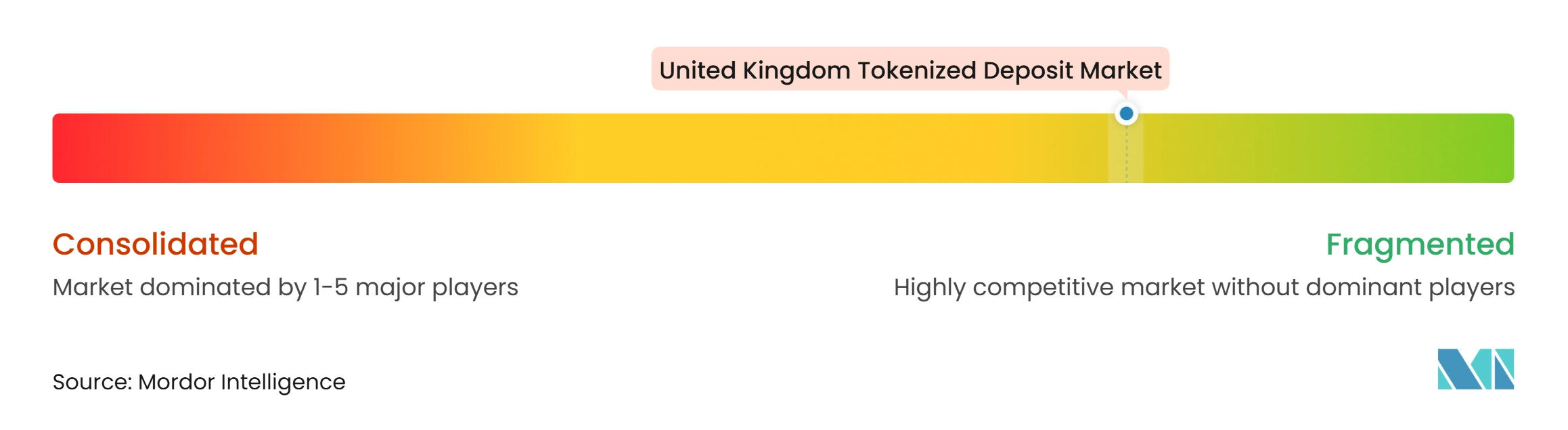
The United Kingdom tokenised deposit market is fragmented, with competition developing across commercial banks, shared tokenisation infrastructure, proprietary bank platforms and specialist settlement providers. The Great British Tokenised Deposit (GBTD) initiative, convened by United Kingdom Finance, brings together Barclays, HSBC United Kingdom, Lloyds Banking Group, Monzo, Nationwide, NatWest and Santander. Quant developed the shared platform, while Linklaters provided legal advice and developed the rulebooks, and EY supported project management. In September 2026, participating banks completed their first live retail transactions using tokenised sterling deposits, demonstrating the practical use of programmable commercial bank money.
Competition also extends beyond the shared initiative. HSBC operates its Tokenised Deposit Service across six markets, including the United Kingdom and the United States, while Standard Chartered provides separate tokenised-deposit capabilities. In August 2026, the two banks completed a live cross-border tokenised-deposit transaction using SWIFT’s blockchain-based ledger, demonstrating interoperability between their respective infrastructures. In January 2026, Lloyds Banking Group, Archax and Canton Network completed a gilt purchase using tokenised deposits, demonstrating another approach to connecting bank money with digital securities.
Specialist providers add further diversity to the market. In March 2026, Monument Bank announced a partnership with the Midnight Foundation to tokenise retail deposits using privacy-enhancing blockchain infrastructure. Fnality also develops distributed-ledger-based wholesale payment and settlement infrastructure, supported by a USD 136 million Series C funding round announced in September 2025. These distinct approaches indicate that competition spans deposit issuance, programmable payments, privacy-focused tokenisation, and wholesale settlement infrastructure.
United Kingdom Tokenized Deposit Industry Leaders
-
Lloyds Banking Group plc
-
HSBC Holdings plc
-
Barclays PLC
-
NatWest Group plc
-
Santander UK plc
- *Disclaimer: Major Players sorted in no particular order
United Kingdom Tokenized Deposit Market Companies Covered in this Report
- Lloyds Banking Group plc
- HSBC Holdings plc
- Barclays PLC
- NatWest Group plc
- Santander UK plc
- Nationwide Building Society
- Monzo Bank Limited
- Monument Bank Limited
- Citi
- Standard Chartered PLC
- Virgin Money
- Quant Network Limited
- R3
- DXC Technology
- EY
- Linklaters LLP
- Archax Ltd
- Canton Network
- Midnight Foundation
- Mastercard Incorporated
Recent Industry Developments in United Kingdom Tokenized Deposit Market
- October 2026: HM Treasury published the Digital Gilt Instrument (DIGIT) collection on GOV.UK, confirming design features: digitally native, short-dated, DSS-issued on HSBC Orion, and preparing for further DIGIT issuances subject to the Q1 2027 first-transaction success. The announcement cements the United Kingdom’s position as the first Group of Seven nation advancing sovereign tokenized bond issuance within a live regulated environment.
- August 2026: Standard Chartered and HSBC executed the first live cross-border interbank tokenized deposit transaction on SWIFT’s blockchain-based ledger. SWIFT confirmed that 17 banks across 6 continents were preparing live transactions on the same infrastructure, advancing the cross-border tokenized deposit interoperability corridor.
- July 2026: HSBC Orion received Gate 2 DSS approval, the first live DSD status in the DSS, enabling live digital bond issuance. HSBC and LSEG signed an MOU for a bilateral DSD link to provide investor access to DIGIT through LSEG’s DSD platform alongside HSBC Orion, advancing inter-depository interoperability.
- May 2026: The FCA and Bank of England jointly published a shared wholesale tokenization roadmap via a Call for Input, committing to regulatory clarity on tokenized collateral at CCPs and RTGS synchronization operator standards. The PRA simultaneously issued a Dear CEO letter reaffirming tokenized deposit compliance expectations across FSCS, AML/CTF, and prudential treatment of tokenized assets.
United Kingdom Tokenized Deposit Market Report Scope
Segmentation Overview
| Account-Based Tokenized Deposits |
| Native Deposit Tokens |
| Single-Bank (Intra-Bank) Networks |
| Interbank – Shared Multi-Bank Networks |
| Interbank – Bilateral and Cross-Network Links |
| Private Permissioned Ledgers |
| Public Blockchains with Permissioned Token Access |
| Securities and Digital-Asset Settlement and Collateral Management |
| FX and PvP Settlement |
| Intra-Group Treasury and Liquidity Management |
| Third-Party Commercial and Institutional Payments |
| Retail and Other Payments |
| Domestic |
| Cross-Border |
| Banks and Other Deposit-Taking Institutions | |
| Capital-Markets and Investment Firms | |
| Payments, Fintech and Digital-Asset Firms | |
| Nonfinancial Corporates | Large Corporates and Multinationals |
| SMEs | |
| Public Sector and Government Entities | |
| Individuals |
| By Token Model | Account-Based Tokenized Deposits | |
| Native Deposit Tokens | ||
| By Network Model | Single-Bank (Intra-Bank) Networks | |
| Interbank – Shared Multi-Bank Networks | ||
| Interbank – Bilateral and Cross-Network Links | ||
| By Ledger Type | Private Permissioned Ledgers | |
| Public Blockchains with Permissioned Token Access | ||
| By Use Case | Securities and Digital-Asset Settlement and Collateral Management | |
| FX and PvP Settlement | ||
| Intra-Group Treasury and Liquidity Management | ||
| Third-Party Commercial and Institutional Payments | ||
| Retail and Other Payments | ||
| By Transaction Scope | Domestic | |
| Cross-Border | ||
| By End User | Banks and Other Deposit-Taking Institutions | |
| Capital-Markets and Investment Firms | ||
| Payments, Fintech and Digital-Asset Firms | ||
| Nonfinancial Corporates | Large Corporates and Multinationals | |
| SMEs | ||
| Public Sector and Government Entities | ||
| Individuals | ||
Key Questions Answered in the Report
What is driving growth in the United Kingdom tokenised deposit market?
Programmable payments, tokenized securities settlement, corporate treasury use, and clearer regulation support growth. The market is forecast to reach USD 1,045.8 billion by 2032 at a 34.3% CAGR.
Which token model leads tokenized deposit adoption in the United Kingdom?
Account-based structures lead with a 71.8% share in 2026 because they align with Financial Services Compensation Scheme protection and Prudential Regulation Authority operating requirements.
Which United Kingdom tokenized deposit use case is growing fastest?
Securities and digital-asset settlement is projected to grow at a 38.6% CAGR through 2032, supported by the Digital Securities Sandbox and the Digital Gilt Instrument pilot.
How do tokenized deposits support corporate treasury operations?
They enable rule-based balance sweeping, supplier payments, and liquidity redeployment while retaining the interest-bearing features of bank deposits.
What limits wider adoption of tokenized deposits in the United Kingdom?
Interoperability between bank ledgers, intraday liquidity risks, integration costs, and the delayed live RTGS synchronization service remain the key constraints.
Which transaction scope is growing fastest for United Kingdom tokenized deposits?
Cross-border transactions are forecast to grow at a 43.7% CAGR through 2032, supported by the Standard Chartered and HSBC transaction and Project Agorá.