
United Kingdom SME Insurance Market Size and Share
Market Overview
| Study Period | 2021 - 2032 |
|---|---|
| Forecast Data Period | 2027 - 2032 |
| Base Year Market Size (2026) | USD 20.60 Billion |
| Market Size (2027) | USD 21.40 Billion |
| Market Size (2032) | USD 26.40 Billion |
| Growth Rate (2027 - 2032) | 4.30 % |
| Market Concentration | High |
Major Players *Disclaimer: Major Players sorted in no particular order Image © Mordor Intelligence. Reuse requires attribution under CC BY 4.0. | |
United Kingdom SME Insurance Market Analysis by Mordor Intelligence
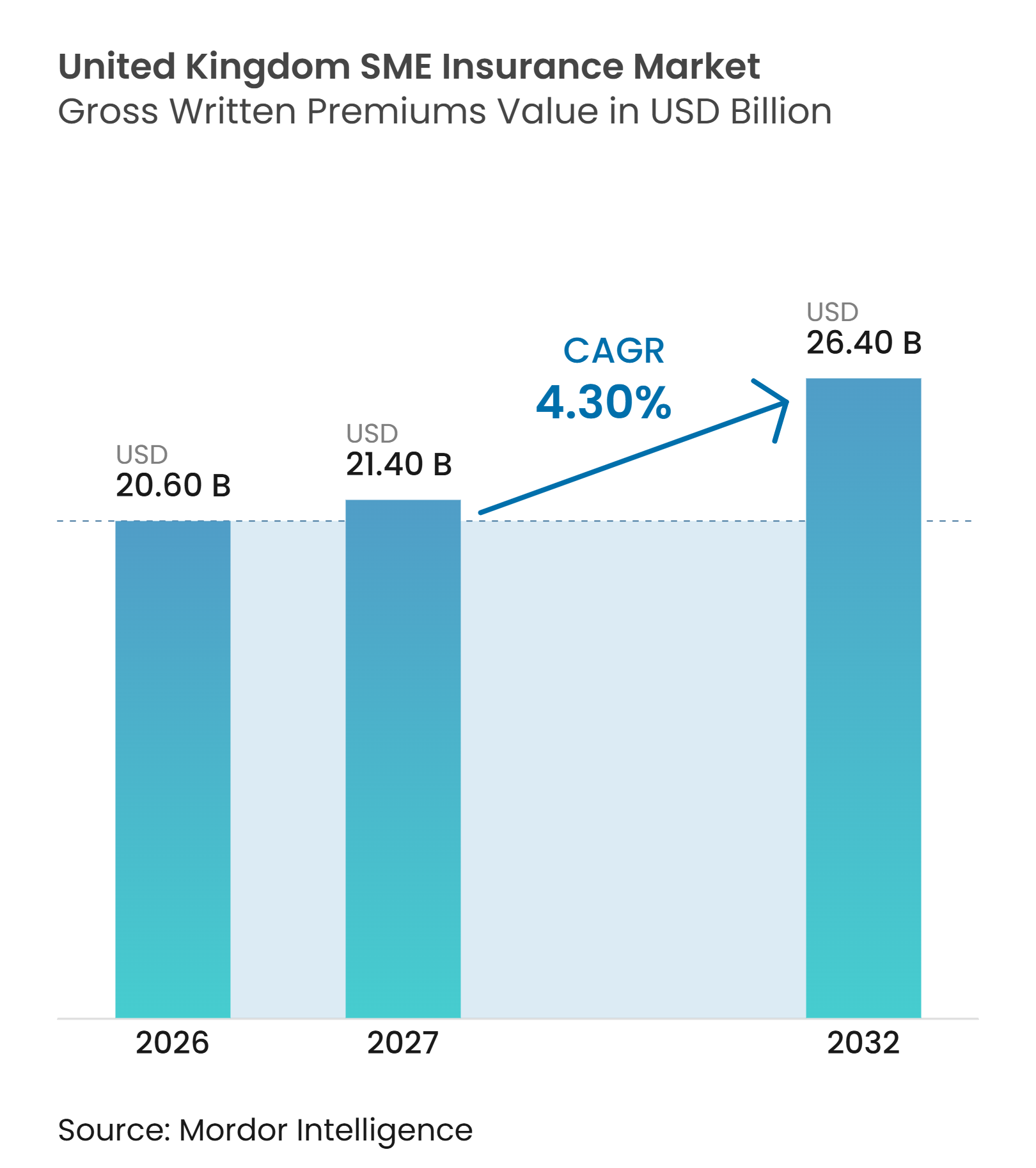
The United Kingdom SME Insurance Market size in terms of gross written premiums value is expected to grow from USD 20.60 billion in 2026 to USD 21.40 billion in 2027 and is forecast to reach USD 26.40 billion by 2032 at 4.30% CAGR over 2027-2032.
The United Kingdom SME insurance market is being shaped by lower commercial insurance rates alongside higher costs for rebuilding, reinstatement, and cyber recovery. Commercial rates have fallen for 10 consecutive quarters through Q2 2026, which can improve affordability but can also encourage buyers to prioritize price over adequate limits. The United Kingdom had an estimated 5.7 million private-sector SMEs in 2025, while 74% of SMEs reported some level of underinsurance, leaving a broad protection gap across smaller firms. Cyber losses, rising property repair costs, and more complex contractual requirements are increasing the need for broader cover. Carriers, brokers, banks, and software platforms are responding with modular products and simpler digital journeys, which creates room for the United Kingdom SME insurance market to extend coverage among firms that remain uninsured or underinsured.
Key Report Takeaways
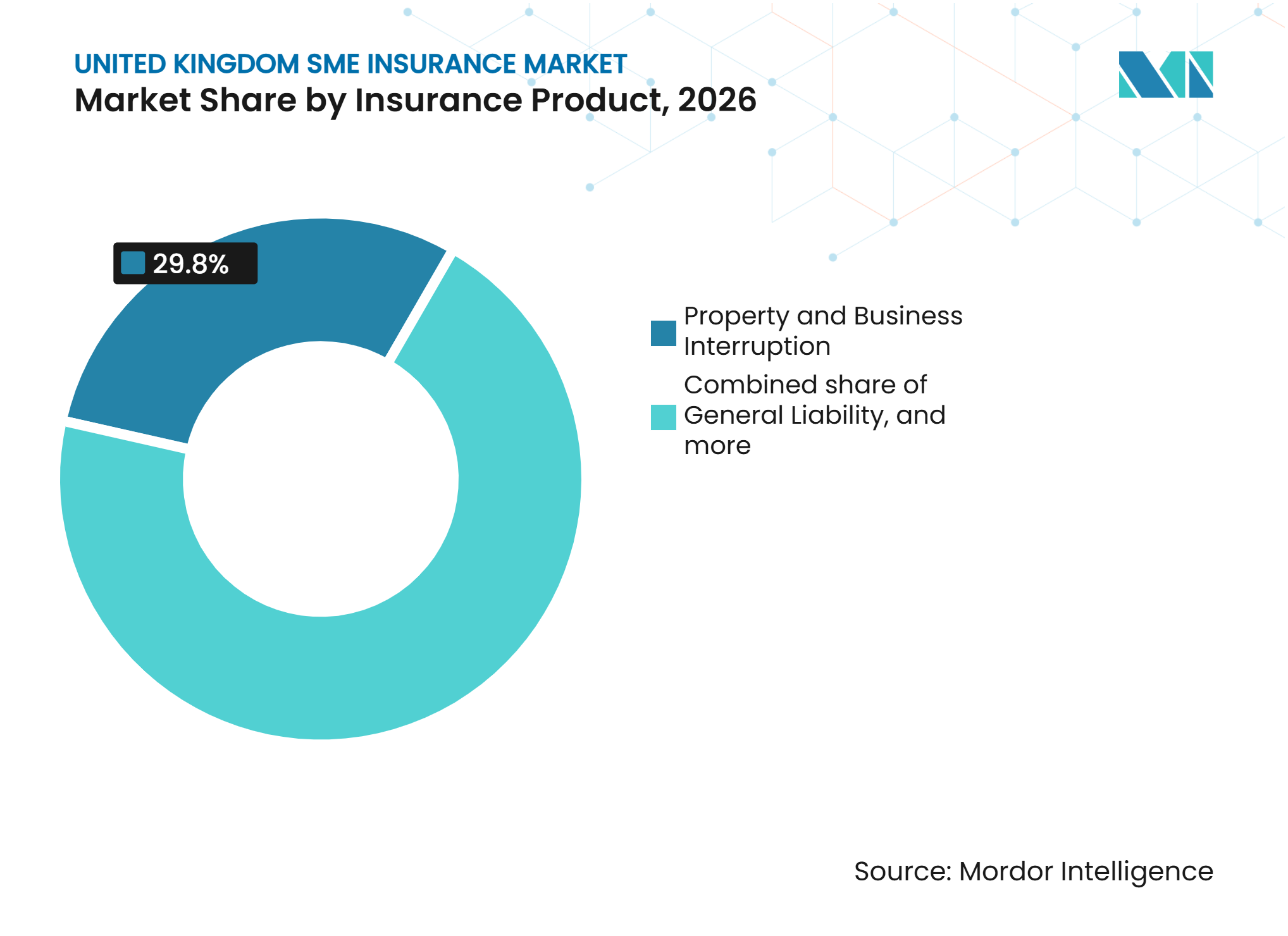
- By insurance product, Property and Business Interruption captured 29.8% of the United Kingdom SME insurance market share in 2026, while Specialty Residual is projected to grow at 10.5% CAGR through 2032.
- By enterprise size, Micro Enterprises accounted for 43.3% of the United Kingdom SME insurance market share in 2026, while Medium Enterprises is projected to grow at 5.5% CAGR through 2032.
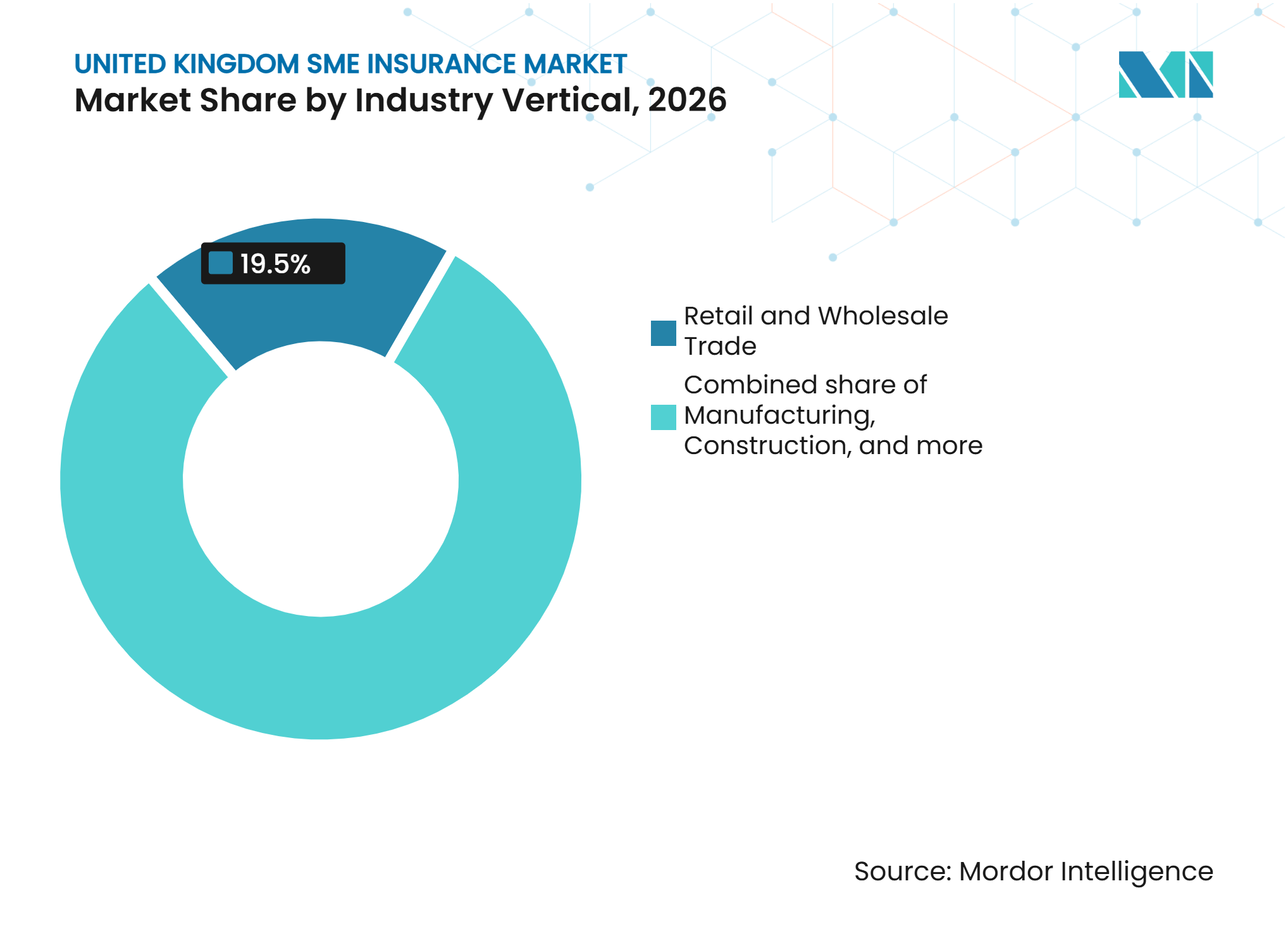
- By industry vertical, Retail and Wholesale Trade captured 19.5% of the United Kingdom SME insurance market share in 2026, while Healthcare and Social Work is projected to grow at 6.5% CAGR through 2032.
- By distribution channel, Insurance Brokers captured 65.4% of the United Kingdom SME insurance market share in 2026, while Embedded, Affinity and Other Partnerships is projected to grow at 9.7% CAGR through 2032.
- By geography, England captured 83.7% of the United Kingdom SME insurance market share in 2026, while Northern Ireland is projected to grow at 4.8% CAGR through 2032.
Note: Market numbers in this report are based on Mordor Intelligence's proprietary estimation framework, which combines nine months of actuals with Q4 projections for base year 2026.
Market Trends and Insights
Drivers Impact Analysis of United Kingdom SME Insurance Market*
| Driver | (~) % Impact on CAGR Forecast | Geographic Relevance | Impact Timeline |
|---|---|---|---|
| Rising Cyberattacks, Ransomware and Digital Business-Interruption Exposure | +1.4% | Global, concentrated in England, London, and South East | Short term (≤ 2 years) |
| Mandatory Employers' Liability Insurance and Business-Specific Contractual Coverage Requirements | +0.7% | England and Wales primarily, with spillover to Scotland and Northern Ireland | Short term (≤ 2 years) |
| Growth of Microbusinesses, Sole Traders and Self-Employed Enterprises | +0.6% | National, with concentration in London and South East | Medium term (2-4 years) |
| Increasing Demand for Sector-Specific, Modular and Flexible SME Insurance Packages | +0.5% | National, strongest in England and emerging in Scotland | Medium term (2-4 years) |
| Rising Property, Repair, Rebuilding and Business-Interruption Costs | +0.9% | National, amplified in high-density urban and coastal areas | Short term (≤ 2 years) |
| Digital Insurance Distribution Through Brokers, Price-Comparison Platforms, Banks and Accounting Software | +0.5% | National, with early adoption in London and major urban centers | Medium term (2-4 years) |
| Source: Mordor Intelligence | |||
Rising Cyberattacks, Ransomware and Digital Business-Interruption Exposure
Ransomware accounted for 52% of United Kingdom cyber incidents in 2025, up from 48% in 2024, and 59% of incidents involved data exfiltration. Supply-chain breaches increased from 6% to nearly 20% of all incidents, extending the risk from a small firm’s own systems to its larger trading partners. Cyber insurance claims payouts reached GBP 197.3 million (USD 252.5 million) in 2024, compared with GBP 59.7 million (USD 76.4 million) in 2023, while the average claim rose from GBP 113,000 (USD 144,640) to GBP 276,000 (USD 353,280)[1]. Only 47% of United Kingdom businesses carry some form of cyber cover, and adoption among sole traders is 13.1%, indicating that protection has not kept pace with exposure. CFC Underwriting introduced a customer business interruption endorsement in January 2026 that covers revenue loss when a customer experiences a cyber incident, addressing a gap that is particularly relevant to manufacturing and wholesale firms. The United Kingdom SME insurance market therefore has a clear opportunity to expand cyber protection through policies that address customer and supply-chain disruption as well as direct attacks.
Mandatory Employers' Liability Insurance and Business-Specific Contractual Coverage Requirements
Every employer operating in Great Britain must maintain employers’ liability cover of at least GBP 5 million (USD 6.4 million) under the Employers’ Liability Compulsory Insurance Act 1969[2]. This statutory obligation provides a durable source of demand for the United Kingdom SME insurance market because new employers cannot readily defer the purchase. The Financial Conduct Authority’s PS25/21 took effect in December 2025 and changed employers’ liability reporting by replacing annual policy notifications with a breach-only model while retaining annual director and auditor reporting. The move reduces administrative steps but retains the integrity of the Employers’ Liability Tracing Office register. Consumer Duty monitoring also places pressure on distributors to place cover correctly when inadequate coverage leads to poor claims outcomes. Public liability in construction and retail, together with professional indemnity in technology and advisory services, adds a second layer of contractual demand that supports bundled policies.
Growth of Microbusinesses, Sole Traders and Self-Employed Enterprises
The United Kingdom had 5.7 million private-sector SMEs at the start of 2025, with sole proprietorships representing 57% of businesses and micro businesses representing 99.2% of SMEs[3]. The Office for National Statistics recorded 2.79 million VAT and or PAYE-registered businesses in March 2026, a 1.9% increase from 2025, and every United Kingdom region grew for the first time since 2017. Incorporated companies now account for 77.3% of VAT and or PAYE-registered businesses, which can create new requirements for employers’ liability, professional indemnity, and property protection. Zurich expanded its tradespeople product to include homeworkers in July 2025, noting that 56% of United Kingdom SMEs operate from home. This product change recognizes that work location and business activity are becoming less standardized. The United Kingdom SME insurance market can reach this population with cover that reflects home-based and flexible operating models.
Increasing Demand for Sector-Specific, Modular and Flexible SME Insurance Packages
Modular product design has become a central part of competition among larger insurers serving the United Kingdom SME insurance market. Aviva completed the modularization of its commercial combined proposition in January 2026, allowing brokers to add buildings, business interruption, goods in transit, and engineering breakdown within one eTraded journey. Allianz launched Smart Broker Brief in August 2025 and used more than 40 data points to pre-populate underinsurance analysis at the quote stage[4]. These tools can make brokers more efficient while drawing attention to coverage gaps before a policy is bound. PS25/21 removed mandatory 12-month product review cycles and replaced them with risk-proportionate intervals, allowing carriers that invest in outcomes monitoring to revise products more quickly. The change supports faster refinement of policies for distinct occupations and risk profiles. Flexible packaging is likely to remain important as SMEs seek cover that reflects their actual activities rather than a broad standard package.
Restraints Impact Analysis of United Kingdom SME Insurance Market*
| Restraint | (~) % Impact on CAGR Forecast | Geographic Relevance | Impact Timeline |
|---|---|---|---|
| Premium Affordability Constraints and Price-Led Purchasing Among Micro and Small Enterprises | -1.1% | National, most acute among sole traders and micro businesses in Wales and North East England | Medium term (2-4 years) |
| Low Insurance Penetration, Underinsurance and Limited Awareness of Business-Specific Risks | -0.9% | National, concentrated in non-employer and newly incorporated segments | Long term (≥ 4 years) |
| Cybersecurity Eligibility Thresholds, Coverage Exclusions and Insurer Risk-Selection Constraints | -0.7% | National, particularly affecting micro and small businesses with limited cybersecurity controls and risk-management capabilities | Medium to long term (3-5 years) |
| Underwriting Complexity and Limited Risk Data for New, Small and Non-Standard Businesses | -0.6% | National, particularly affecting startups, newly incorporated businesses, sole traders and businesses operating in non-standard sectors | Long term (≥ 4 years) |
| Source: Mordor Intelligence | |||
Premium Affordability Constraints and Price-Led Purchasing Among Micro and Small Enterprises
Cost remains the most common barrier to adequate SME cover, with 36% of uninsured SMEs naming cyber insurance cost as their main obstacle. A comprehensive cyber policy covering business interruption, ransomware, and data breach carried a median cost of GBP 55,000 (USD 70,400), which is beyond the reach of businesses with turnover below GBP 500,000 (USD 640,000). Commercial insurance rates fell 8% in Q2 2026 after 10 consecutive quarters of declines, but lower premiums can still encourage buyers to reduce limits rather than maintain adequate protection. Financial Conduct Authority Consumer Duty actions have saved consumers an estimated GBP 157 million (USD 201 million) and reduced average premium finance interest rates by 4.1 percentage points since 2022. Absolute multi-line policy costs nonetheless remain material for microbusiness revenue margins. Carriers must show that lower-priced cover produces good claims outcomes, so price reduction alone is not a complete response.
Low Insurance Penetration, Underinsurance and Limited Awareness of Business-Specific Risks
Seventy-four percent of United Kingdom SMEs reported some degree of underinsurance, and 55% had a protection gap in at least 1 core cover class. These cover classes include professional indemnity, public liability, property, and employers’ liability. Sixty-five percent of small business owners could not accurately describe public liability insurance, compared with 77% for cyber insurance and 80% for professional indemnity. Aviva reported that 68% of brokers in early 2026 had seen more claims declined or settled for less because of underinsurance. Affected clients faced financial pressure in 56% of cases, operational disruption in 37%, and business closure in 26% of severe cases. Consumer Duty monitoring makes this a regulatory and commercial issue because firms serving retail SME customers need to demonstrate good claims outcomes.
*Our forecasts treat driver/restraint impacts as directional, not additive. The impact forecasts reflect baseline growth, mix effects, and variable interactions.
United Kingdom SME Insurance Market Segment Analysis
By Insurance Product:
Property Cover Leads While Specialty Lines ExpandProperty and Business Interruption held 29.8% of the United Kingdom SME insurance market share in 2026. The segment reflects the need to protect premises, stock, trading activity, and the mandatory employers’ liability baseline for firms with employees. Rebuild costs have increased, and Aviva found that 67% of properties in its 2025 portfolio review were underinsured. The same review identified an average 79% shortfall against estimated rebuilding costs, showing that routine renewal increases may not fully correct inadequate declared values. General Liability, Professional Indemnity and Errors and Omissions, Workers’ Compensation and Employers’ Liability, and Commercial Motor form the mid-tier mix. These products are supported by legal requirements, contractual obligations, and an expanding population of SME employers.
Specialty Residual is projected to grow at 10.5% CAGR through 2032, making it the fastest-growing product category in the United Kingdom SME insurance market. The category includes cyber, crime and fidelity, directors and officers, and surety cover. Insurers are reducing entry-level cyber question sets for SMEs with turnover below GBP 50 million (USD 64 million), which can simplify access for smaller buyers. Data breach liability, supply-chain cyber obligations, and contractual expectations are moving some specialty protections closer to standard business needs. Hiscox updated its technology insurance in June 2025 with affirmative artificial intelligence claims coverage for network security, data, and interruption losses. The changes show why specialty products need policy language that keeps pace with technology-related risks.


By Enterprise Size:
Micro Enterprises Lead While Medium Firms Grow FasterMicro Enterprises accounted for 43.3% of the United Kingdom SME insurance market share in 2026. Their position reflects 1.15 million micro employers in early 2025 and a wider population of non-employing businesses. Twenty-four percent of small business owners delayed purchasing insurance until their business was profitable, which leaves many firms exposed during their most financially vulnerable period. The group includes businesses across trades, retail, professional services, and home-based activities. That diversity makes it difficult for carriers to use a single product structure without risking a mismatch between price and cover. PS25/21 may reduce governance burdens for carriers serving high-volume, lower-margin microbusiness portfolios.
Medium Enterprises are forecast to grow at 5.5% CAGR through 2032. These companies increasingly use formal risk-management processes and tend to buy more than 1 line of coverage. Governance obligations can also raise demand for management liability and financial lines protection as firms scale. Small enterprises show higher cyber cover adoption than microbusinesses, at 55% compared with 42%. They remain price-sensitive, however, which supports demand for broker-led and digitally traded package policies. The United Kingdom SME insurance market can benefit when these firms move from basic cover toward broader, multi-line protection.
By Industry Vertical:
Retail Leads While Healthcare and Social Work AdvanceRetail and Wholesale Trade accounted for 19.5% of the United Kingdom SME insurance market share in 2026. Trading firms commonly need property, stock, public liability, commercial motor, and goods-in-transit cover. Their broad insurance needs arise from physical premises, customer contact, inventory movement, and delivery activity. Manufacturing and Construction form the next tier, with industrial cyber incidents increasing the need for resilience documentation before cover is bound. Professional, Scientific and Technical Services represented 15.3% of VAT and/or PAYE-registered businesses in 2026, supporting demand for professional indemnity among advisory, engineering, and technology firms. Accommodation and Food Service, Transportation and Storage, and Agriculture, Forestry and Fishing have separate licensing, vehicle, and weather-related needs.
Healthcare and Social Work is projected to grow at 6.5% CAGR through 2032. Independent providers delivering National Health Service-commissioned services are increasing the need for appropriate protection. The Care Quality Commission requires registered care providers to demonstrate public and employers’ liability insurance. Patient-data systems also add cyber exposure to the segment’s established liability and property risks. The Personal Injury Discount Rate increased to +0.5% in January 2025, reducing lump-sum compensation payments in the sector. This development supports a more competitive underwriting environment for healthcare SMEs.

By Distribution Channel:
Brokers Retain Scale While Embedded Partnerships AccelerateInsurance Brokers held 65.4% of the United Kingdom SME insurance market share in 2026. Their position is supported by their ability to advise on multi-cover risks and navigate requirements that are not easily standardized. Aviva’s modular commercial combined proposition enables straight-through digital processing for multi-cover policies that previously required manual underwriting. Zurich broadened its online tradespeople proposition in July 2025 to include homeworkers, indicating that eTrade capacity is expanding to accommodate more varied SME risks. Agents, direct insurer sales, and bancassurance continue to serve microbusinesses and sole traders with standardized products. The United Kingdom SME insurance market remains reliant on brokers where coverage needs are complex or several policies must work together.
Embedded, Affinity and Other Partnerships are projected to grow at 9.7% CAGR through 2032. Business banking platforms can bring employers’ liability, public liability, and professional indemnity options closer to the point at which an owner manages payments and finances. Pre-populated policy journeys can remove steps for owners who have limited time to research insurance. Vertical software platforms can also place insurance prompts next to payments, accounting, payroll, or business management activity. This model may reach firms that have delayed a traditional insurance purchase. It does not eliminate the need for specialist advice where risks are more complex. Instead, it extends the range of contact points through which SMEs can begin an insurance journey.
Geography Analysis
England accounted for 83.7% of the United Kingdom SME insurance market share in 2026. The country had 5.0 million of the United Kingdom’s 5.7 million SMEs at the start of 2025. London and the South East accounted for around 34% of the business population, concentrating professional services, financial services, and technology SMEs. These clusters have above-average needs for professional indemnity, cyber, and management liability cover. Building safety and energy-efficiency requirements add costs to post-loss rebuilding calculations. Underinsurance remains important because properties with outdated values can have inadequate sums insured even where premiums soften.
Scotland and Wales hold meaningful secondary positions in the United Kingdom SME insurance market. Scotland had 176,000 VAT and or PAYE-registered businesses in March 2026, up 2.1% from 2025. Acrisure United Kingdom Broking rebranded 2 Scottish brokers in July 2025, including Affinity Brokers Limited in Glasgow, indicating continued consolidation in regional distribution. Wales had 106,000 registered businesses in 2026. Its smaller business base influences the scale of the opportunity for carriers and brokers. Both nations require products that respond to local firm density, sector mix, and affordability needs.
Northern Ireland is forecast to grow at 4.8% CAGR through 2032, the fastest geographic rate in the United Kingdom SME insurance market. It had 82,000 VAT and or PAYE-registered businesses in March 2026, compared with 80,000 in 2025. Manufacturing, construction, and professional services are supporting the expansion of its SME base. Fifty-six percent of Northern Ireland SMEs were confident in their 12-month growth prospects, compared with 49% in Scotland and 30% in Wales. As firms move beyond sole-proprietor status, they can need employers’ liability, professional indemnity, and multi-site property protection at the same time. Zurich maintains a Belfast office serving construction, engineering, marine, motor, property, and casualty risks, reflecting the local risk profile.
Competitive Landscape
Market Concentration
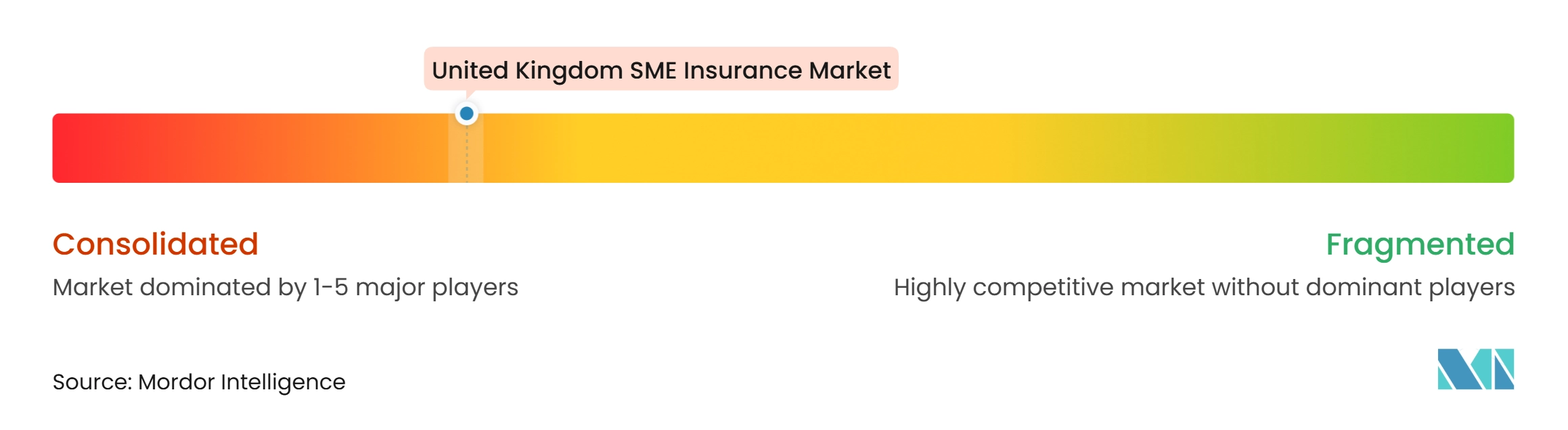
The United Kingdom SME insurance market has established insurers at the upper end and a broad group of specialist managing general agents, digital providers, and regional brokers below them. Aviva, AXA United Kingdom, Allianz, Zurich, and Hiscox hold leading positions in eTrade commercial lines. Aviva modularized its commercial combined proposition in January 2026 and introduced automatic 24-month business interruption cover in October 2025. The company also launched a refreshed professional indemnity product on Acturis eTrade in April 2026 for SME risks with turnover of up to GBP 25 million (USD 32 million). These actions are designed to improve broker access and make multi-cover placement easier. Larger carriers are using modular products, underwriting data, and product-governance changes to manage cyber and specialty risks while reducing unnecessary administrative steps.
Hiscox reported insurance contract written premium of GBP 2.4 billion (USD 3.1 billion) for H1 2026, up 10.1%, and reported United Kingdom retail premium growth of 10.2%. The company raised its full-year retail growth target to 9% and reported an undiscounted combined ratio of 90.4%. Specialist platforms are focusing on cyber, financial lines, and non-standard SME risks. Superscript opened a Glasgow hub in March 2026 and reported 25% partnership growth alongside double-digit revenue growth. Digital platforms can differentiate by simplifying placement while maintaining specialist underwriting for complex exposures. These moves show that competition is focused on distribution speed, specialist coverage, and regional reach.
A large opportunity remains among the estimated 4.3 million non-employing United Kingdom businesses. These firms interact daily with accounting software, banking applications, and sector-specific software, but many have not bought adequate cover. Embedded channels can make the purchase more relevant by connecting it with finance, payroll, and operational activity. The United Kingdom SME insurance market also needs products that address the protection gap without relying only on annual renewal information. CFC’s customer business interruption extension is an example of a policy response to a supply-chain exposure that smaller firms may otherwise overlook. Financial Conduct Authority consultation CP26/22 may simplify certain insurance rules further, creating room for domestic specialists to serve business that larger carriers find more burdensome to maintain. Competition will remain active as insurers balance accessible digital journeys with adequate cover and claims outcomes.
United Kingdom SME Insurance Industry Leaders
-
Aviva plc
-
AXA UK plc
-
Allianz Insurance plc
-
Zurich Insurance Company Ltd
-
Hiscox Ltd
- *Disclaimer: Major Players sorted in no particular order
United Kingdom SME Insurance Market Companies Covered in this Report
- Aviva plc
- AXA UK plc
- Allianz Insurance plc
- Zurich Insurance Company Ltd
- Hiscox Ltd
- NFU Mutual
- Markel Group Inc.
- QBE Insurance Group Limited
- AIG
- Chubb Limited
- Covéa Insurance plc
- Intact Financial Corporation
- Travelers Companies, Inc.
- Ecclesiastical Insurance Office plc
- CFC Underwriting Limited
- Zego
- Simply Business
- Superscript
Recent Industry Developments in United Kingdom SME Insurance Market
- March 2026: Superscript entered next phase of United Kingdom growth with Glasgow hub. Superscript opened a regional hub in Glasgow, added the gig economy as a core strategic segment, and reported 25% partnership growth and strong double-digit revenue growth over the preceding 12 months.
- January 2026: CFC launched customer business interruption extension for SME cyber. CFC introduced a cyber endorsement covering SME revenue loss when a customer, not the SME itself, suffers a cyber incident, addressing a material supply-chain coverage gap for manufacturers and wholesale and distribution businesses.
- August 2026: Allianz launched Smart Broker Brief and upgrades QuoteSME platform. Allianz introduced the Smart Broker Brief, using more than 40 data points to identify potential underinsurance, alongside QuoteSME upgrades that flag underinsurance risk at the quote stage.
- July 2026: Zurich expanded tradespeople product to include homeworkers. Zurich rebranded its tradespeople offering to include homeworkers, accountants, cake makers, craft businesses, and well-being services, noting that 56% of United Kingdom SMEs operate from home.
United Kingdom SME Insurance Market Report Scope
Segmentation Overview
| Property and Business Interruption |
| General Liability |
| Professional Indemnity / Errors & Omissions |
| Workers’ Compensation and Employers’ Liability |
| Commercial Motor and Goods in Transit |
| Specialty Residual (Cyber, Crime/Fidelity, SME D&O/Management Liability, Surety/Bonds, etc.) |
| Micro Enterprises |
| Small Enterprises |
| Medium Enterprises |
| Retail and Wholesale Trade |
| Manufacturing |
| Construction |
| Professional, Scientific and Technical Services |
| Healthcare and Social Work |
| Transportation and Storage |
| Accommodation and Food Service |
| Agriculture, Forestry and Fishing |
| Other Services and Residual |
| Insurance Brokers |
| Insurance Agents |
| Direct Insurer Sales |
| Bancassurance |
| Embedded, Affinity and Other Partnerships |
| England |
| Scotland |
| Wales |
| Northern Ireland |
| By Insurance Product | Property and Business Interruption |
| General Liability | |
| Professional Indemnity / Errors & Omissions | |
| Workers’ Compensation and Employers’ Liability | |
| Commercial Motor and Goods in Transit | |
| Specialty Residual (Cyber, Crime/Fidelity, SME D&O/Management Liability, Surety/Bonds, etc.) | |
| By Enterprise Size | Micro Enterprises |
| Small Enterprises | |
| Medium Enterprises | |
| By Industry Vertical | Retail and Wholesale Trade |
| Manufacturing | |
| Construction | |
| Professional, Scientific and Technical Services | |
| Healthcare and Social Work | |
| Transportation and Storage | |
| Accommodation and Food Service | |
| Agriculture, Forestry and Fishing | |
| Other Services and Residual | |
| By Distribution Channel | Insurance Brokers |
| Insurance Agents | |
| Direct Insurer Sales | |
| Bancassurance | |
| Embedded, Affinity and Other Partnerships | |
| By Geography | England |
| Scotland | |
| Wales | |
| Northern Ireland |
Key Questions Answered in the Report
What is the size of the United Kingdom SME insurance sector?
It is valued at USD 20.6 billion in 2026 and is expected to reach USD 26.4 billion by 2032 at a 4.3% CAGR.
Which insurance product has the largest share among United Kingdom SMEs?
Property and Business Interruption leads with 29.8% share in 2026. The segment serves businesses that need protection for premises, stock, rebuilding costs, and loss of trading income after a covered event.
What is the fastest-growing insurance product for United Kingdom SMEs?
Specialty Residual is projected to grow at 10.5% CAGR through 2032 as cyber and other specialty risks become more important.
Why is cyber cover becoming more important for smaller firms?
Ransomware represented 52% of United Kingdom cyber incidents in 2025, while only 47% of businesses carry some form of cyber cover.
Which distribution channel dominates SME policy placement?
Insurance Brokers lead distribution with 65.4% share in 2026, although embedded and affinity partnerships are projected to grow at 9.7% CAGR.
Which part of the United Kingdom is expected to grow fastest?
Northern Ireland is forecast to expand at 4.8% CAGR through 2032, supported by growth in its SME base and stronger business confidence.