
United Kingdom Senior Living Market Size and Share
Market Overview
| Study Period | 2021 - 2032 |
|---|---|
| Forecast Data Period | 2027 - 2032 |
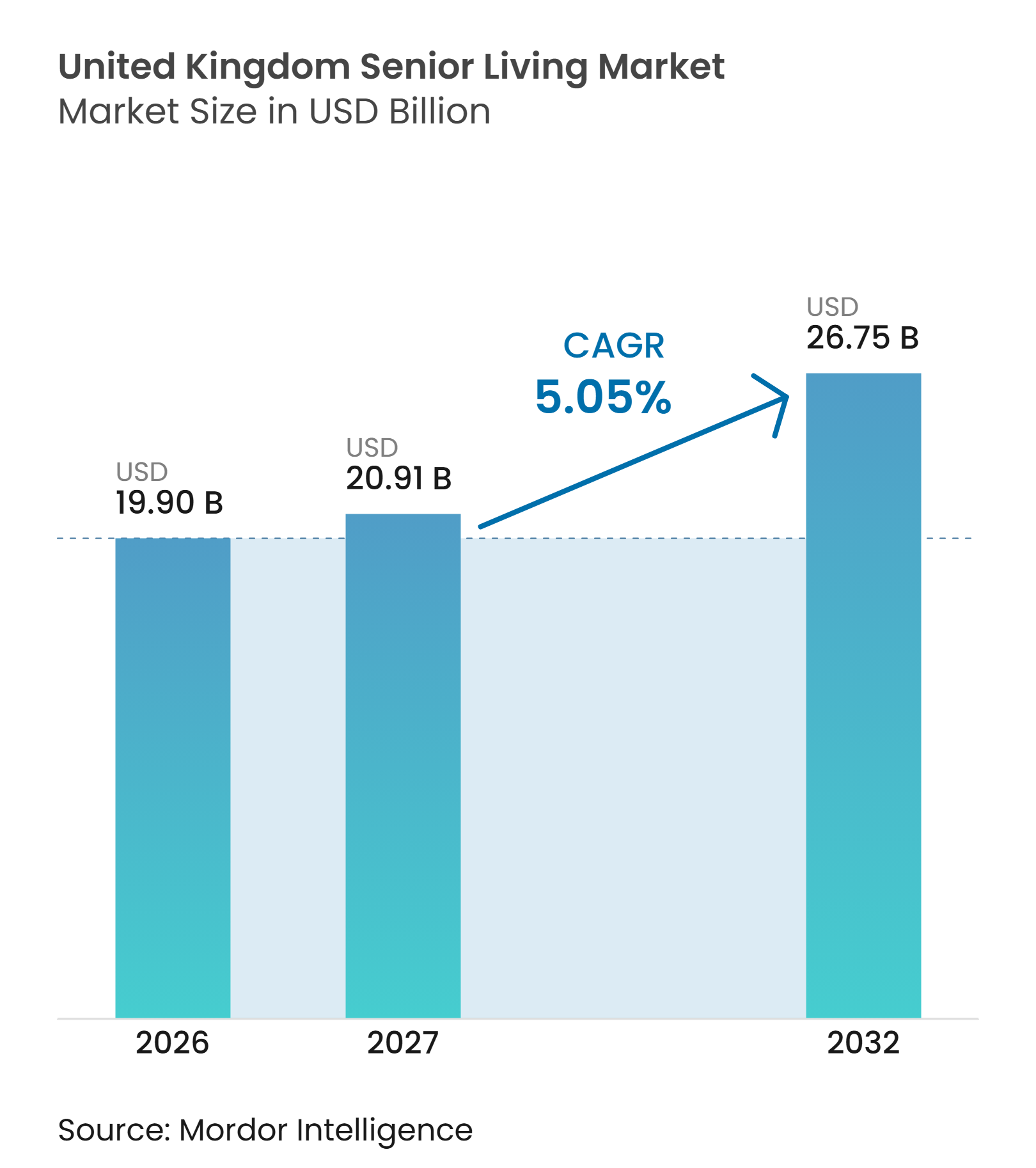
| Base Year Market Size (2026) | USD 19.90 Billion |
| Market Size (2027) | USD 20.91 Billion |
| Market Size (2032) | USD 26.75 Billion |
| Growth Rate (2027 - 2032) | 5.05 % |
| Market Concentration | Medium |
Major Players *Disclaimer: Major Players sorted in no particular order Image © Mordor Intelligence. Reuse requires attribution under CC BY 4.0. | |
United Kingdom Senior Living Market Analysis by Mordor Intelligence
The United Kingdom Senior Living Market size is projected to expand from USD 19.90 billion in 2026 and USD 20.91 billion in 2027 to USD 26.75 billion by 2032, registering a CAGR of 5.05% between 2027 and 2032.
Population aging is widening the pool of households that need accessible homes and care, especially among people aged 85 and older. The United Kingdom senior living market also faces a supply gap because new projects require land, planning approval, construction capacity, and trained staff. Institutional ownership is becoming more important, which supports financing for established operators but raises the divide between large platforms and smaller providers. Providers that combine independent apartments with higher-care options can retain residents as needs change. Cost pressure, workforce shortages, and affordability will continue to limit how quickly the United Kingdom senior living market can turn demand into new capacity.
Key Report Takeaways
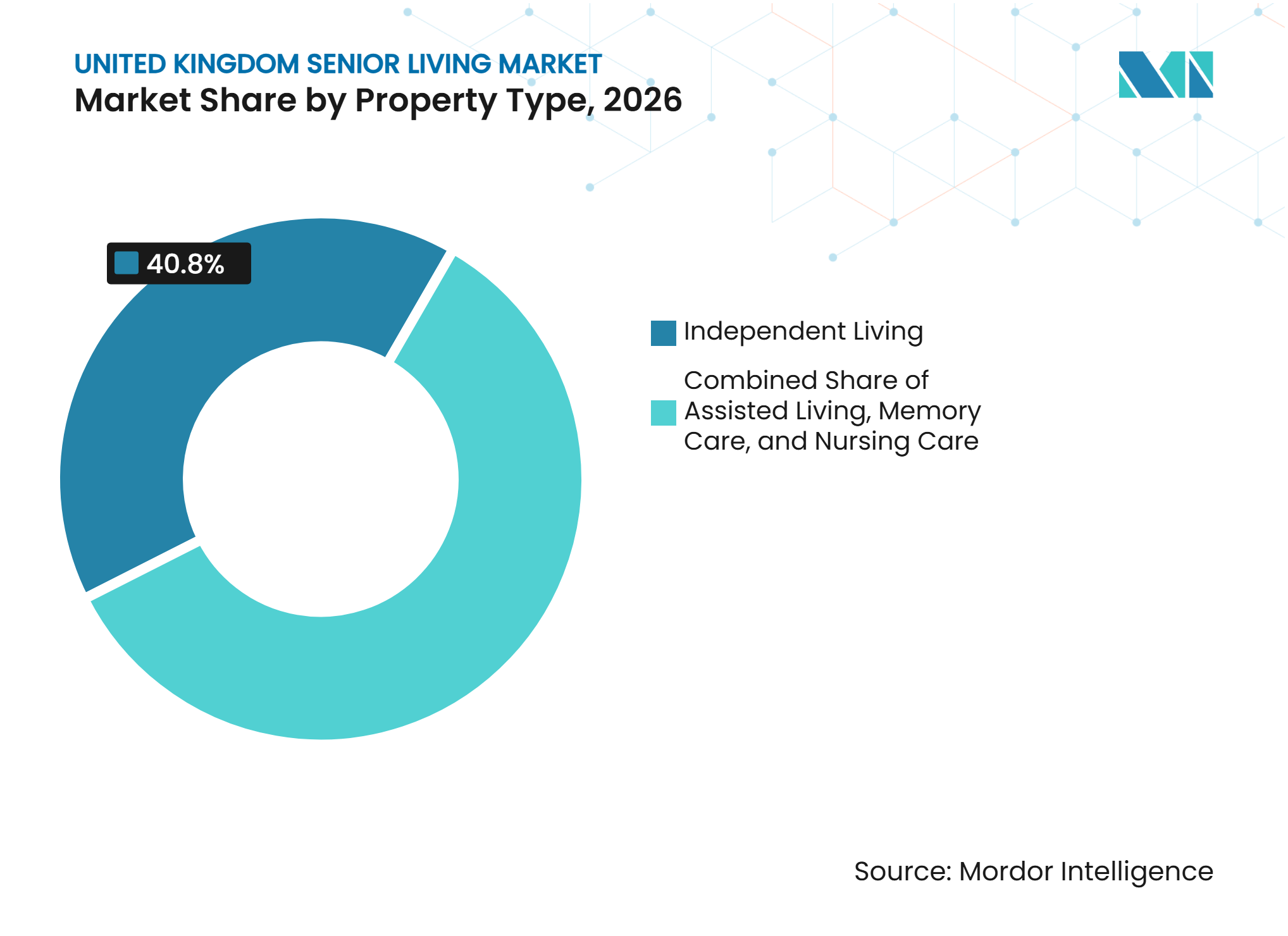
- By property type, independent living held 40.8% of the United Kingdom senior living market share in 2026, while memory care is forecast to grow at a 5.85% CAGR through 2032.
- By business model, long-lease / rental held 55.6% of the United Kingdom senior living market share in 2026, while hybrid (sale + lease) is forecast to grow at a 6.03% CAGR through 2032.
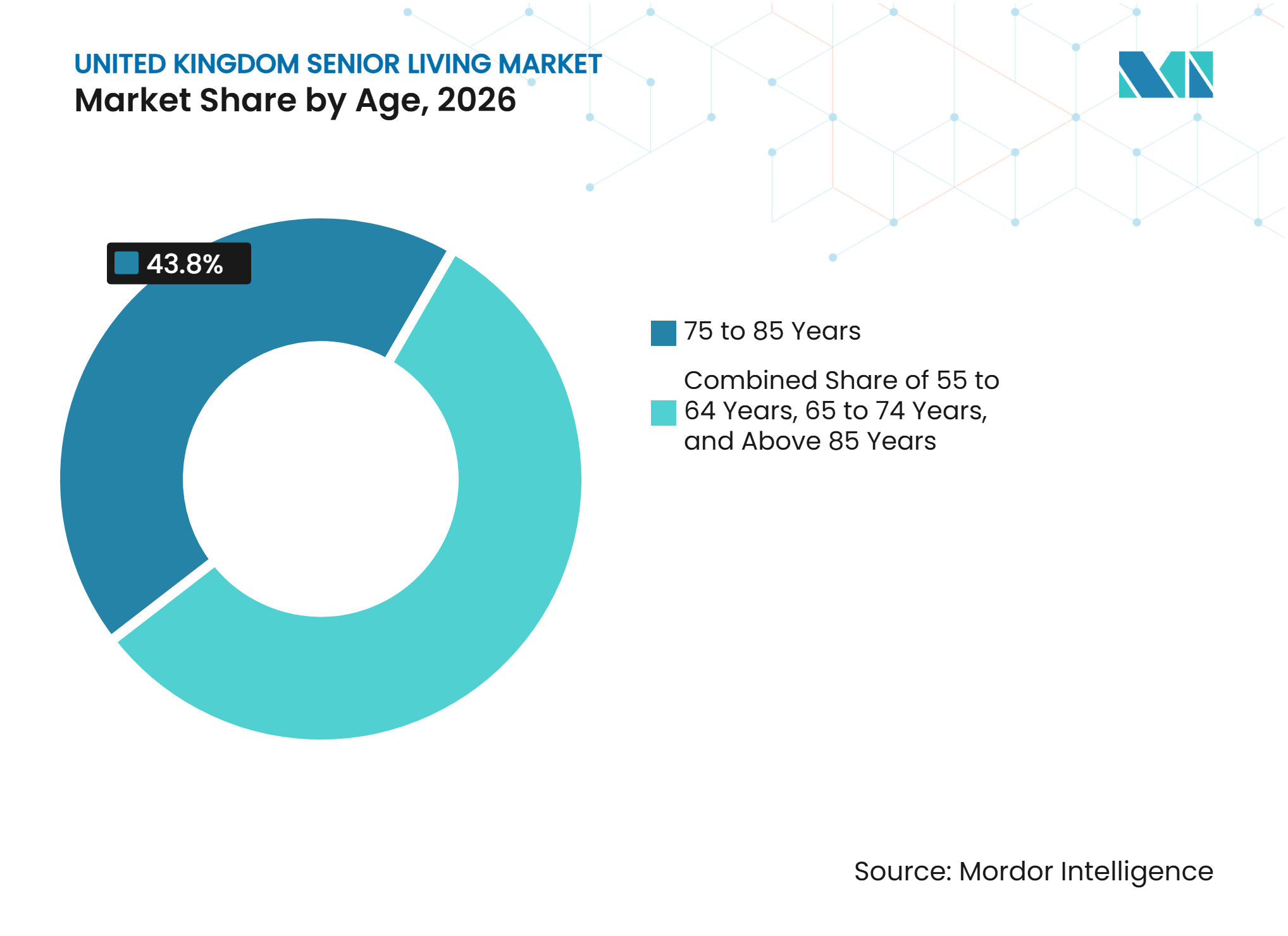
- By age, the 75 to 85 years segment held 43.8% of the United Kingdom senior living market size in 2026, while the above 85 years segment is forecast to grow at a 5.79% CAGR through 2032.
- By geography, England held 79.9% of the United Kingdom senior living market share in 2026, while Northern Ireland is forecast to grow at a 6.11% CAGR through 2032.
Note: Market numbers in this report are based on Mordor Intelligence's proprietary estimation framework, which combines nine months of actuals with Q4 projections for base year 2026.
Market Trends and Insights
Drivers Impact Analysis of United Kingdom Senior Living Market*
| Drivers | (~) % Impact on CAGR Forecast | Geographic Relevance | Impact Timeline |
|---|---|---|---|
| Institutional Investment in Senior Housing | +1.4% | England, especially the South East, North West, and London | Short term (≤ 2 years) |
| Growth in the Older Population | +1.2% | England, Scotland, and Northern Ireland | Long term (≥ 4 years) |
| Rising Need for On-Site Care and Support | +0.9% | England, Wales, and Scotland | Medium term (2-4 years) |
| Preference for Independent, Low-Maintenance Living | +0.7% | England and Scotland | Medium term (2-4 years) |
| Accessible and Adaptable Housing Policy | +0.4% | England, Northern Ireland, and Wales | Medium term (2-4 years) |
| Expansion into Underserved Regional Areas | +0.3% | Northern Ireland, North East England, Yorkshire and the Humber, and Wales | Long term (≥ 4 years) |
| Source: Mordor Intelligence | |||
Institutional Investment in Senior Housing
Institutional capital is changing ownership structures in the United Kingdom senior living market. Welltower completed major United Kingdom acquisitions in October 2025, including portfolios operated by Barchester Healthcare and HC-One. Audley Group and Elysian Residences merged in July 2025 to create a larger retirement village platform. These transactions show that operating income from mature communities can support larger funding structures. Larger owners can fund acquisitions and new construction more easily than operators with a small group of sites. This shift can improve delivery capacity, although it may also increase competitive pressure on independent providers.
Growth in the Older Population
The growing older population remains the core source of demand for senior housing and care. England, Scotland, and Northern Ireland each recorded growth in their populations aged 65 and older through mid-2025. The United Kingdom had 645,000 people aged 90 and older in 2025, representing a 55.2% increase since 2005. The United Kingdom senior living market is therefore moving beyond traditional retirement locations as rural and coastal communities age. England had nearly 11 million residents aged 65 and older in 2025. Developers that can serve these areas may find demand where dedicated supply remains limited.
Rising Need for On-Site Care and Support
The need for on-site care supports assisted living, extra-care housing, and memory care formats. England has a significant population of people aged 65 and older living with a formal dementia diagnosis[1]. Dementia changes the physical design and staffing needs of senior communities. Research published in 2025 found that 40% of people with dementia in England live alone. Northumberland County Council approved a 36-bed complex care facility in February 2026 for people with advanced dementia. Communities with a range of care settings can reduce disruption when a resident’s needs become more complex.
Preference for Independent, Low-Maintenance Living
Many older households want to retain independence while reducing home maintenance obligations. The Department for Work and Pensions found that adults aged 40 to 75 were actively considering later-life housing choices in its 2024 research. This preference supports retirement apartments that provide accessible design, shared facilities, and optional support. It also increases the importance of clear service charges and understandable tenure terms. Operators can respond with apartments that offer social activity without requiring full-time care. The United Kingdom senior living market can reach a wider group when products address both lifestyle and future care needs.
Restraints Impact Analysis of United Kingdom Senior Living Market*
| Restraints | (~) % Impact on CAGR Forecast | Geographic Relevance | Impact Timeline |
|---|---|---|---|
| High Land and Construction Costs | -0.8% | England, particularly London and the South East | Short term (≤ 2 years) |
| Shortage of Qualified Care Professionals | -0.6% | England, Scotland, and Wales | Medium term (2-4 years) |
| Complex Planning and Approval Requirements | -0.4% | England, Wales, and Scotland | Medium term (2-4 years) |
| High Accommodation Prices and Service Charges | -0.3% | London, the South East, and East of England | Long term (≥ 4 years) |
| Source: Mordor Intelligence | |||
High Land and Construction Costs
High land and construction costs constrain the financial case for new projects. These costs are particularly difficult in London and the South East, where land values are high. Developers must fund specialist design, accessible layouts, shared facilities, and construction before homes generate income. Higher build costs can delay projects or reduce the number of affordable homes that a site can support. Smaller operators face greater risk because they have less access to long-term capital. The United Kingdom senior living market will need viable cost structures to convert demand into completed communities.
Shortage of Qualified Care Professionals
Care workforce shortages limit capacity and raise operating costs for care-intensive settings. The adult social care vacancy rate was 7% in 2024-25, while homecare vacancies exceeded 10% in March 2025[2]. Care England reported a sharp fall in international recruits and a reduction in British nationals working in care roles. The Care Quality Commission warned that visa restrictions could increase workforce pressure. The sector will require 470,000 new posts by 2040, according to Skills for Care. Staffing constraints make it harder to expand nursing and memory care services even when demand is strong.
*Our forecasts treat driver/restraint impacts as directional, not additive. The impact forecasts reflect baseline growth, mix effects, and variable interactions.
United Kingdom Senior Living Market Segment Analysis
By Property Type:
Independent Living Leads While Memory Care Grows FastestIndependent living held 40.8% of the United Kingdom senior living market size by property type in 2026. It serves older adults who want an accessible, lower-maintenance home without routine on-site personal care. Its scale reflects the large group of active older homeowners who relocate before they need intensive support. Shared dining, fitness, social space, and housekeeping options can make these communities more attractive than conventional housing, particularly for people seeking community without surrendering privacy. Independent living providers must still account for the likelihood that residents’ needs will change over time.
Memory care is forecast to grow at a 5.85% CAGR through 2032, making it the fastest-growing property type. The segment is supported by a recorded 483,000 dementia diagnoses among people aged 65 and older in England. Specialist layouts, trained staff, secure outdoor spaces, and consistent routines are important for this resident group. Extra-care housing also overlaps with memory care needs, as 2025 research found that 1 in 5 extra-care residents lived with dementia. Providers that combine independent, assisted, and memory care units on one campus can support residents through different stages of need, while reducing the need for disruptive moves.



By Business Model:
Long-Lease / Rental Remains Largest While Hybrid Formats ExpandLong-lease / rental accounted for 55.6% of sector revenue by business model in 2026. This model gives residents a defined right to occupy a home while providing operators with stable service income. It remains familiar to households with experience in property ownership or renting. However, operators must clearly communicate financial terms, as older buyers often consider exit fees, resale timelines, maintenance obligations, and their ability to plan for future care costs. The model remains significant across retirement apartments and larger village communities.
Hybrid (sale + lease) is forecast to grow at a CAGR of 6.03% through 2032. This model combines purchase elements with ongoing occupancy arrangements to address concerns regarding fees and resale. Hybrid structures can provide operators with recurring income while offering residents greater flexibility than traditional leasehold formats. New tenure approaches also aim to simplify contract terms for residents, family members, and advisers involved in the decision-making process. The Older People’s Housing Taskforce has outlined a policy case for housing that better meets the needs of an aging population. The United Kingdom senior living industry can expand its appeal by offering tenure options that provide financial certainty alongside quality care options.
By Age:
The 75 to 85 Years Group Leads While Demand Intensifies Above 85 YearsThe 75 to 85 years age group accounted for 43.8% of the United Kingdom senior living market share in 2026. This group represents a core demand base for independent living and assisted living services. Many individuals in this cohort can choose to relocate before a health event necessitates the decision. They often seek smaller homes, social connections, accessible facilities, future care options, and reassurance that support will be available if their circumstances change. Providers must demonstrate clear value, as this group can compare senior living communities with remaining in conventional homes.
The population aged above 85 years is forecast to grow at a CAGR of 5.79% through 2032. This group is more likely to require mobility support, nursing care, memory care, frequent health monitoring, and staff capable of managing complex conditions. The population aged 85 years and older is projected to nearly double to 3.3 million by 2047[3]. This demographic profile favors communities that provide a continuum of care rather than requiring residents to relocate as their care needs increase. It also heightens the need to recruit an adequate number of qualified care staff for higher-acuity settings.

Geography Analysis
England accounted for 79.9% of sector revenue in 2026. Its scale reflects a long history of retirement housing and care development across the South East, South West, and East of England, as well as higher concentrations of older residents in several regions. The South West has a particularly high concentration of older residents, supporting local demand for accessible housing. However, England also faces some of the most significant affordability, land availability, and staffing pressures. The government increased funding for nursing care in April 2025, providing partial relief to nursing providers. However, this support does not address broader workforce and construction-related challenges.
Scotland and Wales have distinct policy environments and local demand patterns. Scotland’s population aged 65 years and older increased by 2.1% in the year to mid-2025. In 2025, a dementia-friendly care village in the Scottish Borders received planning approval and is expected to open in 2027. Wales introduced a mandatory care home rating system in April 2025. This system may enable families to compare care quality more easily while increasing pressure on weaker providers to improve their services or exit the sector.
The Northern Ireland senior living market is forecast to grow at a CAGR of 6.11% through 2032, the fastest growth rate among the geographic segments. The region has lower penetration of purpose-built senior living facilities than England, creating opportunities for new formats that combine accessible housing with support services. Its 10-year adult social care plan emphasizes independence, digital care, and early intervention. The Commissioner for Older People has also highlighted significant housing challenges among older private renters. These conditions underscore the need for suitable and affordable housing, although new developments must continue to meet local funding and planning requirements.
Competitive Landscape
Market Concentration
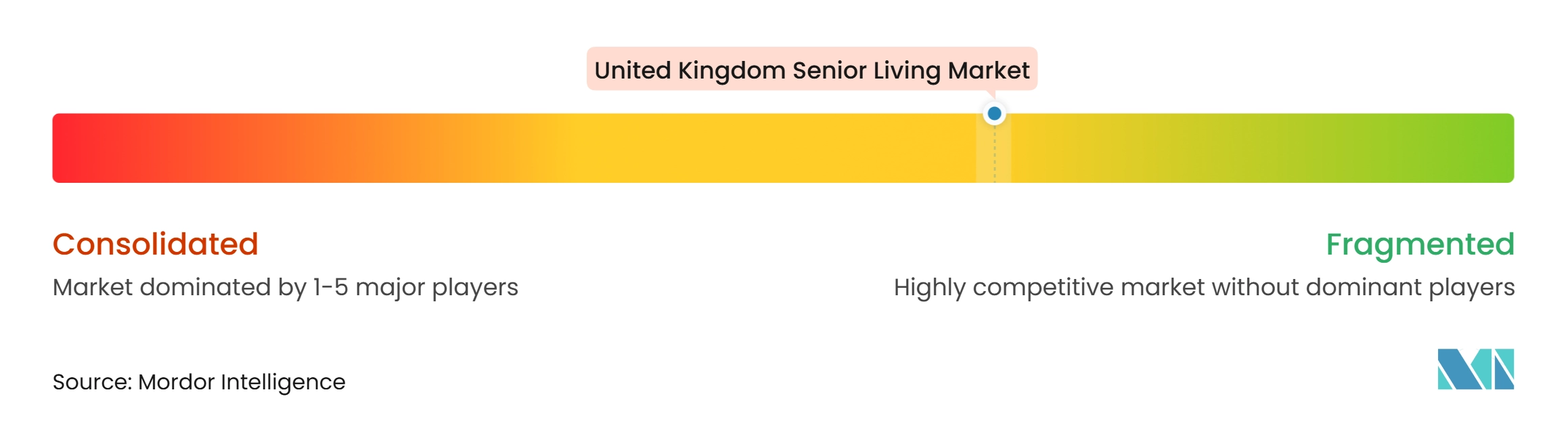
The United Kingdom senior living market remains moderately fragmented among operators, although ownership is becoming more concentrated. Key domestic developers include McCarthy Stone, Churchill Retirement Living, Lifestory Group, and Audley Group. Large not-for-profit providers include Anchor, Housing 21, The ExtraCare Charitable Trust, and Methodist Homes. Welltower’s planned 2025 portfolio acquisitions are expected to establish it as a major owner of seniors housing assets in the United Kingdom. The market includes both integrated, well-funded platforms and smaller providers with local portfolios.
Strategic activity is increasingly focused on scale, partnerships, and broader access. Audley Group and Elysian Residences merged in July 2025, creating a platform comprising more than 30 retirement villages. In January 2026, Churchill Living partnered with Housing 21 to deliver 309 social-rented retirement apartments. These initiatives demonstrate how operators and investors are using acquisitions and delivery partnerships to expand capacity.
Competition also depends on service quality, care capabilities, and site design. New dementia-focused developments increasingly incorporate features such as fall sensors, medication support, clear layouts, and secure outdoor areas. Providers also compete by offering independent living, assisted living, and memory care within a single location, which can improve continuity of care for residents and their families. Mid-market housing and underserved regions represent significant opportunities, as many households cannot access luxury retirement villages. The United Kingdom senior living market will favor operators that balance affordability, transparent terms, appropriate care provision, and reliable staffing.
United Kingdom Senior Living Industry Leaders
-
McCarthy Stone
-
Churchill Retirement Living
-
Lifestory Group
-
Audley Group
-
Vistry Group
- *Disclaimer: Major Players sorted in no particular order
United Kingdom Senior Living Market Companies Covered in this Report
- McCarthy Stone
- Churchill Retirement Living
- Lifestory Group
- Audley Group
- Vistry Group
- Retirement Villages Group
- Beechcroft Developments
- Inspired Villages Group
- Cognatum
- Bupa, Richmond Villages
- Anchor
- Housing 21
- The ExtraCare Charitable Trust
- MHA
- Sanctuary Supported Living
- Barchester Healthcare
- HC-One
- Care UK
- Avery Healthcare
- Maria Mallaband Care Group
- Hallmark Luxury Care Homes
- The Orders of St John Care Trust
- Nellsar
- Gracewell Healthcare
- Omega Healthcare Investors Inc
Recent Industry Developments in United Kingdom Senior Living Market
- October 2026: CareTrust REIT signed a definitive agreement with LNT Care Developments to acquire 45 newly built care homes in the United Kingdom for USD 1.46 billion. The initial transaction closing included 24 homes valued at USD 764 million. Crystal Care leased the homes under a triple-net structure, with plans to transition to a senior housing operating portfolio model within two to four years after completion.
- June 2026: Social Housing REIT agreed to acquire Residential Secure Income’s retirement housing business for USD 143.7 million. The portfolio includes 1,907 senior living rental flats and 256 housing manager units. The acquisition broadens the platform across specialized supported housing, senior living, and care homes.
- June 2026: Montpelier Estates and Hervines Group formed a joint venture to develop and operate the USD 19.9 million Chatham Waters Care Home in Medway, Kent. The facility will provide residential, dementia, and respite care within a wider waterfront regeneration project.
United Kingdom Senior Living Market Report Scope
Segmentation Overview
| Assisted Living |
| Independent Living |
| Memory Care |
| Nursing Care |
| Outright Sale (Freehold) |
| Long-Lease / Rental |
| Hybrid (Sale + Lease) |
| 55 to 64 Years |
| 65 to 74 Years |
| 75 to 85 Years |
| Above 85 Years |
| England | London |
| Rest of England | |
| Scotland | |
| Wales | |
| Northern Ireland |
| By Property Type | Assisted Living | |
| Independent Living | ||
| Memory Care | ||
| Nursing Care | ||
| By Business Model | Outright Sale (Freehold) | |
| Long-Lease / Rental | ||
| Hybrid (Sale + Lease) | ||
| By Age | 55 to 64 Years | |
| 65 to 74 Years | ||
| 75 to 85 Years | ||
| Above 85 Years | ||
| By Geography | England | London |
| Rest of England | ||
| Scotland | ||
| Wales | ||
| Northern Ireland | ||
Key Questions Answered in the Report
What is the forecast growth rate for United Kingdom senior living through 2032?
The United Kingdom senior living market is forecast to grow at a 5.05% CAGR from 2027 to 2032, reaching USD 26.8 billion by 2032.
Which property type is growing fastest in United Kingdom senior living?
Memory care is the fastest-growing property type, with a forecast CAGR of 5.85% through 2032.
What is driving demand for memory care homes in the United Kingdom?
England recorded 483,000 formal dementia diagnoses among people aged 65 and older, supporting demand for specialist settings.
Which business model leads senior housing in the United Kingdom?
Long-lease / rental is the largest business model, holding a 55.6% share in 2026.
Which United Kingdom region is expected to grow fastest for senior living?
Northern Ireland is forecast to record the fastest growth, at a 6.11% CAGR through 2032.
What are the key constraints on new senior living development?
High development costs, care workforce shortages, planning delays, and affordability pressures remain the main barriers.