
United Kingdom Beer Market Size and Share
Market Overview
| Study Period | 2022 - 2032 |
|---|---|
| Forecast Data Period | 2027 - 2032 |
| Base Year Market Size (2026) | USD 24.37 Billion |
| Market Size (2027) | USD 25.16 Billion |
| Market Size (2032) | USD 29.99 Billion |
| Growth Rate (2027 - 2032) | 3.58 % |
| Market Concentration | Medium |
Major Players *Disclaimer: Major Players sorted in no particular order Image © Mordor Intelligence. Reuse requires attribution under CC BY 4.0. | |
United Kingdom Beer Market Analysis by Mordor Intelligence
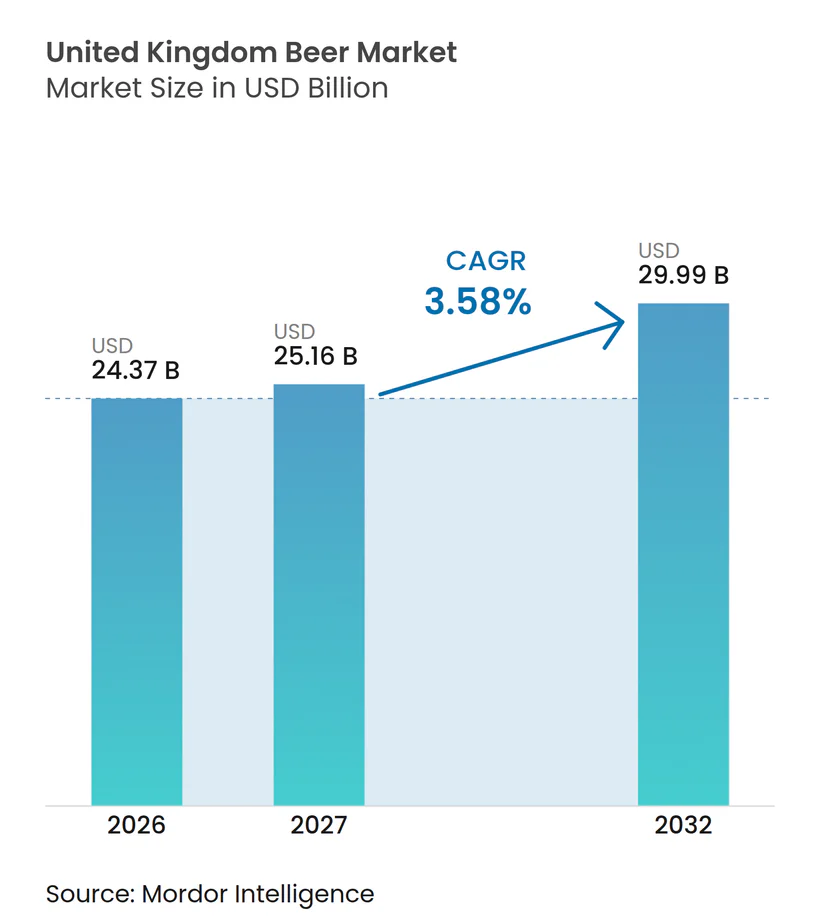
The United Kingdom beer market size grows from USD 24.37 billion in 2026 to USD 25.16 billion in 2027, and is forecast to reach USD 29.99 billion by 2032 at a 3.58% CAGR over 2027-2032. Value is expected to grow faster than volume as premium products, duty-related price changes, and higher spending per occasion reshape sales. Pubs, sporting events, concerts, and a broader range of alcohol-free options support the United Kingdom beer market. Producers are investing in premium serves, draught quality, hospitality venues, and brands that perform across on-trade and retail channels. These factors provide scope for value growth in the United Kingdom beer market, even as total consumption occasions remain under pressure.
Key Report Takeaways
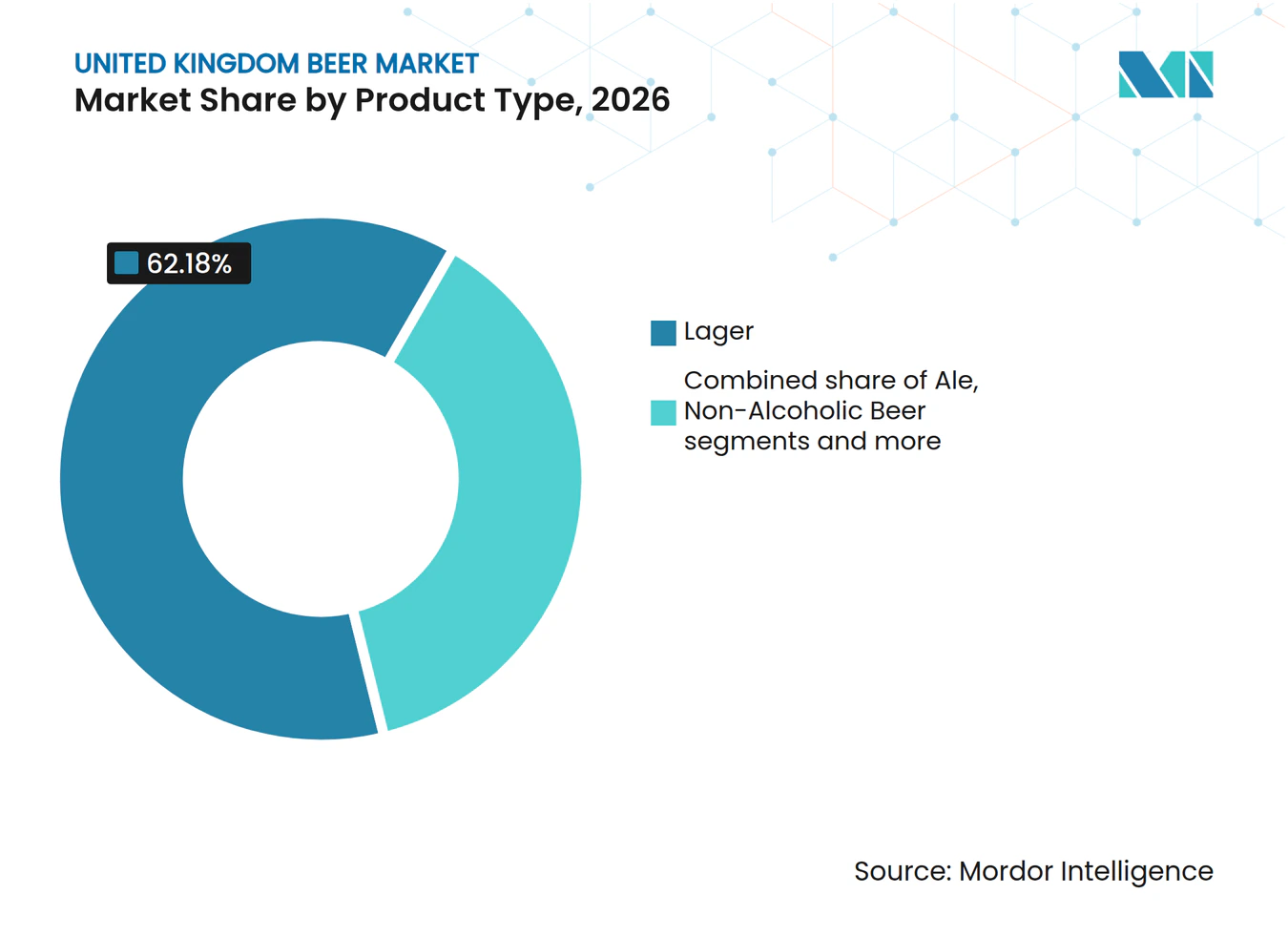
- By product type, lager led the United Kingdom beer market with a 62.18% share in 2026, while non-alcoholic beer is anticipated to register the fastest CAGR of 4.73% during 2027-2032.
- By category, standard retained a 68.25% share in 2026, while premium is anticipated to expand at a 5.15% CAGR through 2032.
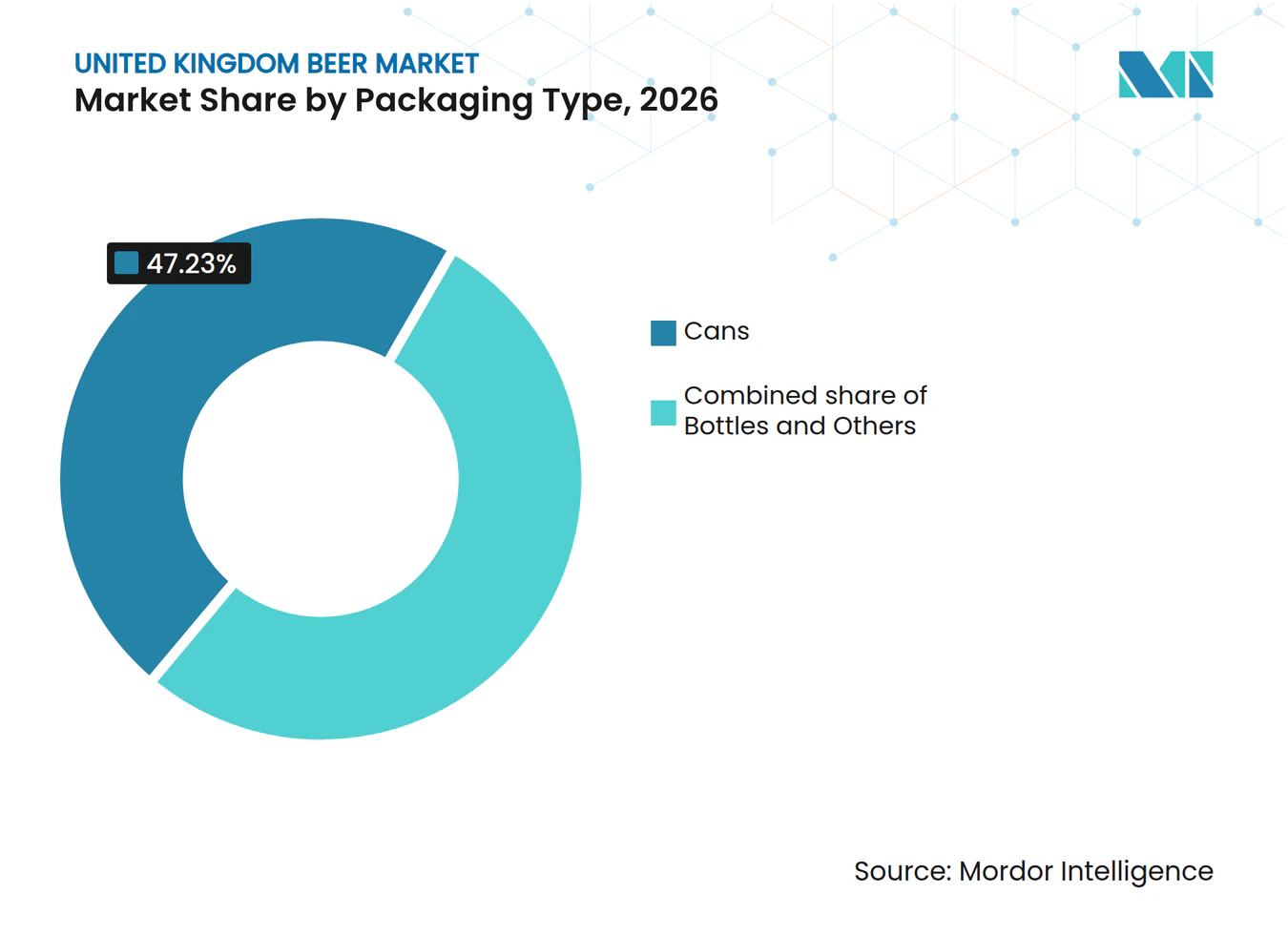
- By packaging type, cans led the market with a share of 47.23% in 2026, while bottles are anticipated to register the fastest CAGR of 4.36% during 2027-2032.
- By distribution channel, on-trade led the market with a share of 55.82% in 2026, while off-trade is anticipated to register the fastest CAGR of 5.32% during 2027-2032.
Note: Market numbers in this report are based on Mordor Intelligence's proprietary estimation framework, which combines nine months of actuals with Q4 projections for base year 2026.
United Kingdom Beer Market Trends and Insights
Drivers Impact Analysis*
| Driver | (~) % Impact on CAGR Forecast | Geographic Relevance | Impact Timeline |
|---|---|---|---|
| Premiumisation and consumer preference for quality beer | +0.7% | National, strongest in London and the South East | Medium term (2-4 years) |
| Expansion of tourism and hospitality-related consumption | +0.5% | National, concentrated in London, Edinburgh, and major tourist cities | Short term (≤ 2 years) |
| Product innovation and demand for new flavors | +0.4% | National, cross-channel | Medium term (2-4 years) |
| Wider availability of non-alcoholic beer | +0.6% | National, with strong London and on-trade distribution gains | Short term (≤ 2 years) |
| Brewing infrastructure and supply-chain capabilities | +0.3% | National, particularly England and Scotland | Long term (≥ 4 years) |
| Craft brewery and specialty beer expansion | +0.4% | National, with strength in London, Manchester, and Edinburgh | Medium term (2-4 years) |
| Source: Mordor Intelligence | |||
Premiumisation and Consumer Preference for Quality Beer
Premiumization is reshaping value creation in the United Kingdom beer market. Consumers are increasingly willing to pay more for beer that is well served and suited to social occasions. According to HEINEKEN’s 2025 beer report, 50% of consumers are willing to pay a premium for a high-quality serve. Premium international lagers, stouts, specialty bottled beers, and well-maintained draught lines enable pub operators to protect margins. This trend strengthens the incentive for brewers to invest in service quality alongside retail distribution. The United Kingdom beer market benefits when suppliers make premium products accessible while maintaining relevance among regular beer drinkers. As a result, brewers that combine consistent product quality, distinctive brand positioning, and reliable availability across on-trade and off-trade channels are better placed to capture higher-value spending.
Expansion of Tourism and Hospitality-Related Consumption
Tourism, concerts, sports, and local leisure spending remain key sales drivers for pubs and bars. According to UKHospitality’s June 2025 report, the Oasis reunion tour generated more than GBP 4 million in beer and cider sales across two concert nights in Cardiff in July 2025[1]. These developments extend customer visits, enhance service environments, and encourage higher-value purchases. Such events also enable breweries and pub operators to enhance brand visibility through event-linked promotions, targeted beer offerings, and partnerships with hospitality venues, supporting sustained sales beyond peak event periods. This also strengthens demand for draught beer and premium offerings as pubs create more engaging social experiences around major sporting and entertainment events. The United Kingdom beer market will benefit when operators convert demand generated by national events into repeat visits rather than one-time sales spikes.
Product Innovation and Demand for New Flavors
Product innovation supports the United Kingdom beer market, as breweries diversify their portfolios to meet evolving consumer preferences for distinctive flavors and alternative beer formulations. In September 2025, the United Kingdom Government confirmed its commitment to supporting growth in the no- and low-alcohol market, recognizing these products as beverages specifically developed to replicate traditional alcoholic drinks, including beer[2]. In June 2026, the Government reiterated plans to review the labeling threshold for alcohol-free drinks and explore measures related to their sale to individuals under 18 years of age, reflecting continued policy attention toward this evolving product category. These developments underscore the importance of product formulation and portfolio diversification in helping brewers address varied consumption preferences and expand consumer choice.
Wider Availability of Non-Alcoholic Beer
The increasing availability of non-alcoholic beer in supermarkets, pubs, bars, and restaurants is improving product accessibility and creating additional consumption occasions in the United Kingdom beer market. In March 2026, the United Kingdom Office for National Statistics (ONS) added alcohol-free beer to its Consumer Prices Index basket for the first time, reflecting rising sales, a broader product range, and increased shelf-space allocation[3]. This development highlights the product’s growing relevance in the United Kingdom consumer market and its expanding presence across retail channels. Greater availability also allows consumers seeking to moderate their alcohol intake to select beer alternatives during social occasions, supporting category penetration across both on-trade and off-trade channels.
Restraints Impact Analysis*
| Restraint | (~) % Impact on CAGR Forecast | Geographic Relevance | Impact Timeline |
|---|---|---|---|
| High excise taxation and price sensitivity | -0.8% | National, under Treasury and duty rules | Medium term (2-4 years) |
| Alcohol advertising and promotion restrictions | -0.3% | National, under Advertising Standards Authority and Portman Group codes | Long term (≥ 4 years) |
| Local sales and trading-hour restrictions | -0.3% | National, with more stringent rules in Scotland | Long term (≥ 4 years) |
| Competition from alternative alcoholic beverages and changing preferences | -0.5% | National, cross-channel | Short term (≤ 2 years) |
| Source: Mordor Intelligence | |||
High Excise Taxation and Price Sensitivity
Beer duty and broader operating costs continue to limit pricing flexibility. HM Treasury introduced a 1.7% reduction in draught duty effective February 1, 2025, equivalent to 1 penny per average-strength pint, as part of a GBP 85 million support package. The policy also increased the duty differential between qualifying draught products and packaged equivalents to 13.9%. However, smaller brewers remain significantly exposed to tax, labor, energy, packaging, and distribution costs. While the United Kingdom beer market can sustain value growth, ongoing cost pressures may constrain independent operators’ ability to invest, hire, and maintain competitive product pricing. These financial pressures can narrow profit margins, forcing brewers and pub operators to absorb higher costs or pass them on to consumers, potentially weakening demand among price-sensitive customers.
Competition from Alternative Alcoholic Beverages and Changing Preferences
Beer competes with ready-to-drink products, adult soft drinks, and other beverages that target similar social occasions. Moderation trends also influence the number and types of drinks consumers choose. While these trends may reduce alcoholic beer consumption, they can shift spending toward alcohol-free beer and more specialized products. The United Kingdom beer market requires brands to maintain relevance within mixed drinking groups. Product quality, flavor variety, and pub availability remain important as consumers have more alternatives than before. Producers that offer mainstream brands alongside alcohol-free options are better positioned to adapt to changing consumer preferences.
*Our forecasts treat driver/restraint impacts as directional, not additive. The impact forecasts reflect baseline growth, mix effects, and variable interactions.
Segment Analysis
By Product Type: Non-Alcoholic Formats Challenge Lager’s Volume Dominance
Lager accounts for 62.18% of the United Kingdom beer market in 2026, reinforcing its continued importance in national production, distribution, consumer consumption patterns, and the core draught offering at most pubs. It remains the primary choice for everyday consumption across pubs, restaurants, supermarkets, and convenience stores, supported by the wide availability of familiar brands at multiple price points. Its scale provides large brewers with a stable platform for brand investment, draught distribution, retailer negotiations, and supply planning nationwide. Stout and ale remain important alternatives, particularly in venues where consumers seek greater variety, stronger brand identity, and products suited to longer social occasions.
Non-alcoholic beer is projected to grow at a CAGR of 4.73% through 2032, making it the fastest-growing product type in the United Kingdom beer market. The segment caters to consumers who want to participate in beer-drinking occasions while reducing or avoiding alcohol, including those who alternate between alcoholic and alcohol-free products. Expanded draught availability has increased the relevance of alcohol-free beer for pub operators, compared with when the category primarily relied on packaged products stored in refrigerators. Imported and specialty formats also broaden the product offering, although their success depends on providing consumers with a clear reason to switch from familiar lager brands.



By Category: Standard Beer Supports Scale While Premium Beer Drives Value
Standard beer accounted for 68.25% of market value in 2026, reflecting its role in regular household and pub consumption across the country. It remains relevant across income groups and supports high-volume retail distribution through supermarket multipacks and convenience purchases. The segment provides brewers with predictable demand but faces pricing pressure from private-label products, value-oriented retail formats, and rising operating costs. Standard brands must maintain quality and availability while limiting price increases that could weaken loyalty among frequent buyers. This balance is particularly important for large suppliers with broad portfolios in the United Kingdom beer market, where flagship lager brands continue to support distribution network scale.
Premium beer is forecast to grow at a CAGR of 5.15% through 2032. Premium products benefit as consumers choose fewer drinks but seek a better serving experience, distinctive recipes, stronger provenance, or familiar brand associations. This trend creates opportunities for world lagers, stouts, specialty bottles, craft beers, and well-executed draught offerings across pubs and retail channels. The United Kingdom beer industry is leveraging premium packaging and tap quality to create value in both on-trade and off-trade channels. However, premium expansion requires disciplined pricing, as wider availability in discount retailers can create tension with on-trade pricing positions and venue margins.
By Packaging Type: Sustainability Economics Accelerate Can Adoption
Cans accounted for 47.23% of the market value in 2026 and remain the leading packaging format. They offer practical advantages in transport, storage, shelf life, and recycling, making them suitable for national retailers and independent producers. Cans are also well suited for supermarkets, convenience stores, outdoor events, and multipack purchases, where portability and consistent product quality are important. Their role remains strong as producers manage packaging costs and pursue efficient nationwide distribution without increasing handling requirements. In the United Kingdom beer market, cans help protect product quality, reduce logistics complexity, and provide consumers with convenient packaging choices.
Bottles are forecast to register a CAGR of 4.36% through 2032. Glass packaging remains valuable for premium serves, gifting, specialist retail, and brands that use packaging to communicate provenance, quality, or a more formal drinking occasion. The format enables producers to differentiate premium world lagers and craft beer offerings from mainstream products when consumers compare products on shelves. However, packaging policies and cost pressures make glass less suitable for value-oriented products operating on tight margins. Consequently, producers are adopting a split packaging strategy, with cans serving high-volume convenience occasions and bottles supporting higher-value occasions in the United Kingdom beer market.

By Distribution Channel: Off-Trade Gains as On-Trade Preimmunizes Revenue Per Visit
On-trade venues accounted for 55.82% of market value in 2026 and remain critical to brand experience, serving, and product trial. Pubs, bars, and restaurants enable brewers to influence how consumers serve, price, present, and pair products with food or events. These venues also support event-driven consumption related to sports, music, tourism, and regular community activities. On-trade demand remains particularly important for premium beer and draught alcohol-free options, as service quality can influence repeat purchases.
The off-trade channel is forecast to grow at a CAGR of 5.32% through 2032, outpacing the overall United Kingdom beer market. Grocery stores, convenience outlets, and specialist retailers provide consumers with access to a broader range of premium, craft, imported, and alcohol-free beers for at-home consumption and social occasions. This channel creates opportunities for brands to reach consumers at home but also intensifies price comparisons between established brands and emerging alternatives. Suppliers need clear packaging options and strong product differentiation to avoid competing solely on price.
Geography Analysis
England accounts for the largest share of beer consumption in the United Kingdom beer market. London plays a particularly important role in premium products, alcohol-free beer, tourism, and high-value hospitality occasions, reflecting a more advanced moderation trend in the capital. The city’s pubs, restaurants, and events also make it a key test market for new product launches and expanded draught distribution.
Regional cities across England benefit from tourism, sporting events, and investment in local hospitality. Suburban and rural pubs remain important venues for community consumption and local brewer distribution. The product mix of premium and alcohol-free beer is likely to vary between urban and nonurban areas due to differences in price points and consumption occasions. England’s scale requires suppliers to maintain national coverage while tailoring product portfolios to local demand.
Scotland holds a distinct position through craft ale, stout, heritage brewing, and tourism, while Wales benefits from event-related demand in Cardiff. Northern Ireland is smaller in volume but benefits from Guinness’s strong cultural relevance. Diageo opened the Guinness Open Gate Brewery in London in May 2026 following a GBP 73 million investment, reinforcing the brand’s presence in the United Kingdom. Domestic production of internationally positioned brands also demonstrates how the United Kingdom beer market connects local manufacturing with demand for European brands.
Competitive Landscape
Market Concentration
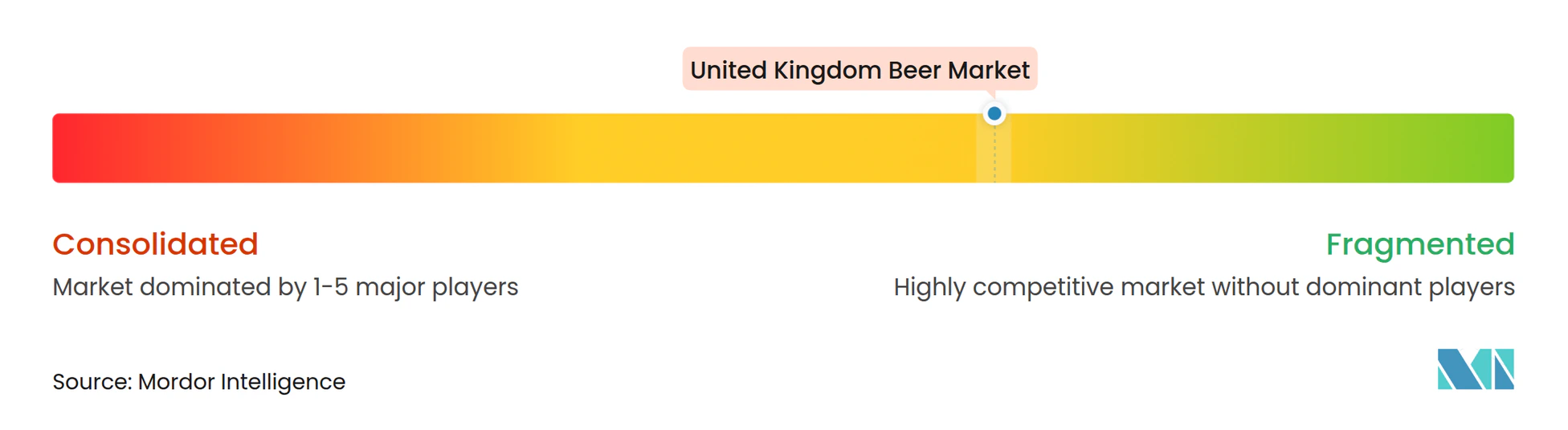
The United Kingdom beer market is moderately fragmented, comprising large multinational brewers and a broad base of independent and craft businesses. AB InBev, HEINEKEN, Carlsberg Britvic, Molson Coors, and Diageo benefit from strong national distribution networks, established brands, and diverse product portfolios across multiple price points. Their scale enables investment in pubs, advertising, product development, retail relationships, supply chains, and large-scale national launches. Independent brewers compete through local identity, specialty styles, direct consumer relationships, and strong connections to specific venues and regions. The coexistence of large-scale brand portfolios and locally differentiated offerings intensifies competition across price points, distribution networks, and consumer preferences.
Large suppliers are investing to protect their routes to consumers and enhance the quality of drinking occasions. Stonegate’s growth in alcohol-free sales also highlights why suppliers are expanding draught no-alcohol offerings across major pub estates. These strategies prioritize improved consumer occasions, stronger brand awareness, broader product choice, and higher-quality service rather than solely increasing volume. Investments in dispensing infrastructure, venue enhancements, and product accessibility also help suppliers strengthen relationships with pub operators and secure greater point-of-sale visibility.
The craft tier faces a more challenging operating environment, as smaller brewers have limited capacity to absorb cost increases and less access to established distribution networks. Nevertheless, these producers continue to influence the United Kingdom beer market through new styles, local partnerships, specialty venues, and direct consumer engagement. The market remains moderately fragmented because no single supplier controls all major drinking occasions, distribution channels, or product categories. Consequently, competitive differentiation depends on balancing cost efficiency and distribution reach with product innovation, regional loyalty, and distinctive brand positioning.
United Kingdom Beer Industry Leaders
-
AB InBev UK Limited
-
Carlsberg Britvic plc
-
Heineken UK Limited
-
Molson Coors Beverage Company
-
Asahi UK Limited
- *Disclaimer: Major Players sorted in no particular order
Recent Industry Developments
- May 2026: Diageo has opened the Guinness Open Gate Brewery in London, supported by a GBP 73 million investment. The venue creates a dedicated brand experience in the United Kingdom, the company’s largest beer-consumption market. The opening reinforces Diageo’s strategy to leverage Guinness’s cultural relevance and drive on-trade recruitment and international brand positioning. Guinness 0.0 is the United Kingdom’s leading alcohol-free beer.
- May 2026: HEINEKEN UK launched Outd00r Brewing, a 0.0% isotonic lager containing electrolytes and vitamin C, in original and lemon flavors. Available in 330 ml cans through Ocado, David Lloyd, and Waitrose, the product expands the company’s portfolio into functional beverages and targets consumers seeking alcohol-free options that support active lifestyles.
- March 2026: Carlsberg Britvic introduced Mythos, a Greek-style premium lager brewed and canned in the United Kingdom. The product became initially available at Tesco and Booker on in 660 ml bottles and multipacks of 440 ml cans. This launch strengthens Carlsberg Britvic's international lager portfolio and broadens consumer choice in the premium beer segment.
- September 2025: Greene King began constructing a new GBP 40 million brewery at Suffolk Business Park in Bury St Edmunds. The company expects to complete the facility in 2027. The brewery will modernize production, enhance sustainability, and secure Greene King’s long-term brewing capabilities, including cask ale production.
United Kingdom Beer Market Report Scope
Beer is an alcoholic beverage made by fermenting malted grains, primarily barley, with water, hops, and yeast.
The United Kingdom beer market is segmented by product type, category, packaging type, and distribution channel. By product type, the market is segmented into ale, lager, non-alcoholic beer, and others. By category, the market is segmented into standard and premium. By packaging type, the market is segmented into bottles, cans, and others. By distribution channel, the market is segmented into on-trade and off-trade (specialty liquor stores and other off-trade channels). The market forecasts are provided in terms of value (USD) and volume (liters).
| Ale |
| Lager |
| Non-Alcoholic Beer |
| Others |
| Standard |
| Premium |
| Bottles |
| Cans |
| Others |
| On-Trade | |
| Off-Trade | Specialty Liquor Stores |
| Other Off Trade Channels |
| By Product Type | Ale | |
| Lager | ||
| Non-Alcoholic Beer | ||
| Others | ||
| By Category | Standard | |
| Premium | ||
| By Packaging Type | Bottles | |
| Cans | ||
| Others | ||
| By Distribution Channel | On-Trade | |
| Off-Trade | Specialty Liquor Stores | |
| Other Off Trade Channels | ||
Key Questions Answered in the Report
What is the size of the United Kingdom beer market and how fast is it expected to grow?
The United Kingdom beer market was valued at USD 24.37 billion in 2026 and is estimated to reach USD 25.16 billion in 2027. The market is further projected to grow to USD 29.99 billion by 2032, registering a CAGR of 3.58% during 2027-2032.
Which product type held the largest share in the United Kingdom beer market in 2026?
Lager was the leading product type segment, accounting for 62.18% of the market in 2026.
Which category dominated the United Kingdom beer market in 2026?
Standard category dominated the market with a 68.25% share in 2026.
What was the leading packaging type in the United Kingdom beer market in 2026?
Cans were the most preferred packaging type, holding a 47.23% market share in 2026.
Which distribution channel accounted for the largest share of the market in 2026?
The On-Trade channel led the market with a 55.82% share in 2026.