
United Arab Emirates Surveillance Camera Market Size and Share
Market Overview
| Study Period | 2021 - 2031 |
|---|---|
| Forecast Data Period | 2026 - 2031 |
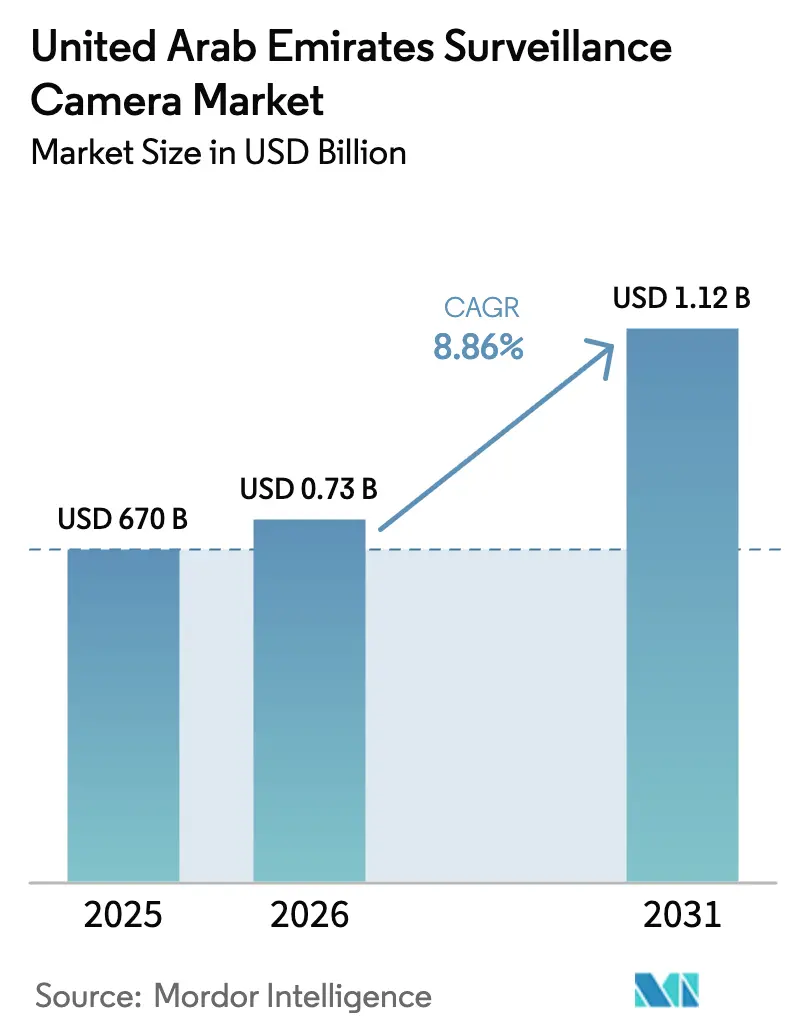
| Base Year Market Size (2025) | USD 670 Billion |
| Market Size (2026) | USD 0.73 Billion |
| Market Size (2031) | USD 1.12 Billion |
| Growth Rate (2026 - 2031) | 8.86 % |
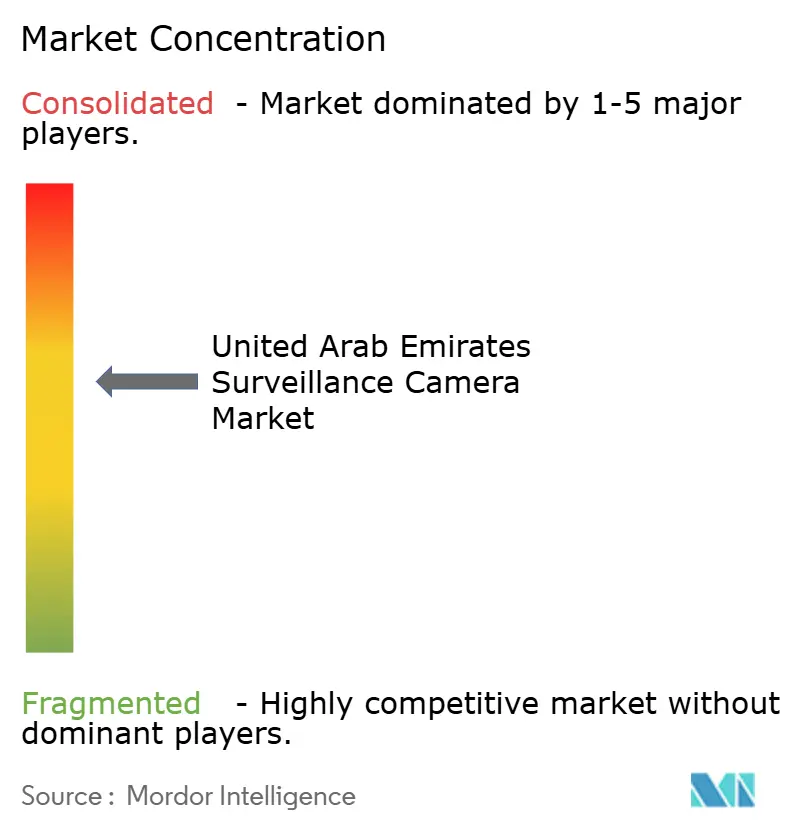
| Market Concentration | Medium |
Major Players *Disclaimer: Major Players sorted in no particular order Image © Mordor Intelligence. Reuse requires attribution under CC BY 4.0. | |
United Arab Emirates Surveillance Camera Market Analysis by Mordor Intelligence
UAE surveillance camera market size in 2026 is estimated at USD 729.36 million, growing from 2025 value of USD 670 million with 2031 projections showing USD 1.12 billion, growing at 8.86% CAGR over 2026-2031. The expansion outpaces most regional peers, underpinned by strict regulatory mandates, accelerated smart-city roll-outs and security preparations linked to mega-events. Dubai remains the single-largest demand centre, while Abu Dhabi is closing the gap on the back of critical-infrastructure upgrades and strong digital-government agendas. Rapid residential adoption, the pivot to 4K and thermal imaging, and the rising use of edge-compute hardware are redrawing competitive boundaries as buyers prioritise analytics-ready solutions. At the same time, data-sovereignty rules, capacity constraints among certified integrators and tariff differentials on premium hardware are reshaping deployment economics across the UAE surveillance camera market.[1]Security Industry Regulatory Agency, “Standard and Technical Specifications of the Security Systems,” sira.gov.ae
Key Report Takeaways
- By emirate, Dubai led with 43.65% of UAE surveillance camera market share in 2025, while Abu Dhabi is forecast to grow at a 9.71% CAGR to 2031.
- By end-user industry, Government & Public Safety commanded 40.55% revenue share in 2025; Residential & Smart Homes is advancing at an 11.2% CAGR through 2031.
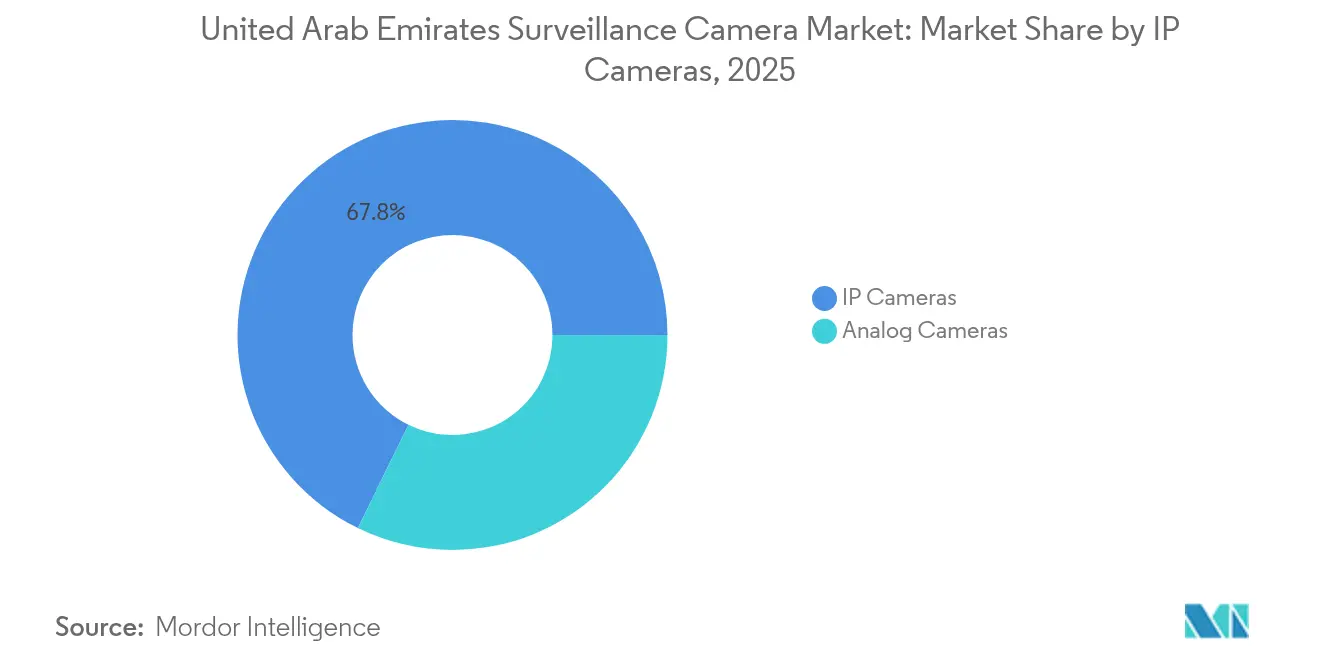
- By type, IP cameras captured 67.75% of UAE surveillance camera market share in 2025; the segment is expected to expand at an 11.36% CAGR between 2026-2031.
- By camera form factor, dome cameras held 30.45% share of the UAE surveillance camera market size in 2025, whereas thermal cameras are projected to rise at a 10.42% CAGR.
- By resolution, Full HD systems accounted for 45.30% of the UAE surveillance camera market size in 2025, while 4K & above solutions are set to grow at a 10.5% CAGR.
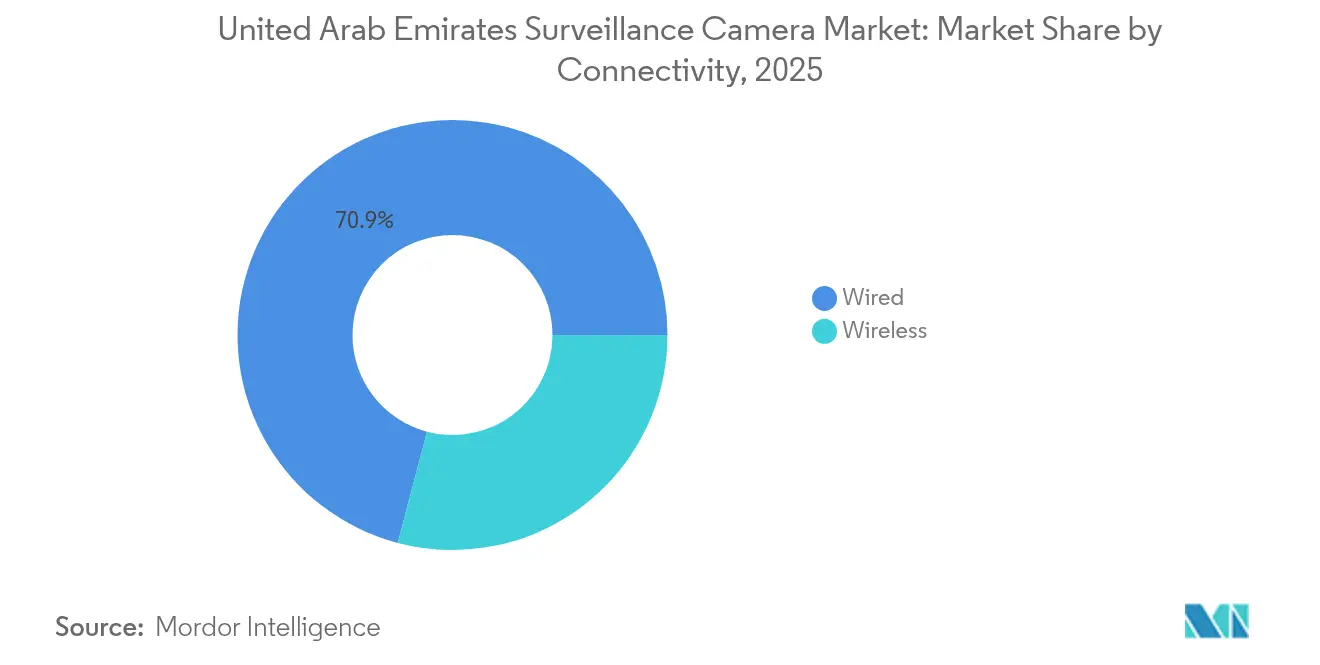
- By connectivity, wired deployments represented 70.90% share in 2025; the wireless segment records the highest projected CAGR at 11.83% through 2031.
Note: Market size and forecast figures in this report are generated using Mordor Intelligence’s proprietary estimation framework, updated with the latest available data and insights as of 2026.
United Arab Emirates Surveillance Camera Market Trends and Insights
Drivers Impact Analysis*
| Driver | (~) % Impact on CAGR Forecast | Geographic Relevance | Impact Timeline |
|---|---|---|---|
| Mandatory Integration of IP CCTV under UAE Safety & Security Standards (SIRA, ADQCC) | +2.2% | National, with stricter enforcement in Dubai and Abu Dhabi | Medium term (2-4 years) |
| Smart Dubai 2030 & Abu Dhabi Digital initiatives accelerating AI-video analytics | +1.5% | Dubai and Abu Dhabi, with gradual adoption in Northern Emirates | Long term (≥ 4 years) |
| Preparation for mega-events (COP28 legacy / Expo City) driving dense camera networks | +1.0% | Dubai, with spillover effects to Abu Dhabi | Short term (≤ 2 years) |
| National AI Strategy 2031 incentives for edge-compute surveillance hardware | +1.2% | National, with early adoption in Dubai | Medium term (2-4 years) |
| Central Bank Circular 19/2023 raising bank branch CCTV specifications | +0.8% | National | Short term (≤ 2 years) |
| ADNOC downstream expansion boosting perimeter-security demand | +0.6% | Abu Dhabi, with supply chain effects in Dubai | Medium term (2-4 years) |
| Source: Mordor Intelligence | |||
Mandatory Integration of IP CCTV under UAE Safety & Security Standards
Revisions to SIRA and ADQCC regulations mandate Full HD 1080p resolution, network connectivity and certified installation for new systems, effectively phasing out lower-grade analog units. Banking, government and critical-infrastructure operators are leading the upgrade wave, while price-sensitive users delay investment until compliance deadlines near. Certified-integrator scarcity is lifting project lead-times and installation margins, shaping a premium service segment and reinforcing the UAE surveillance camera market as an integrator-driven ecosystem
Smart Dubai 2030 & Abu Dhabi Digital Initiatives Accelerate AI Analytics
Dubai and Abu Dhabi pursue full digital-service coverage, catalysing procurement of cameras able to run edge-level AI models for traffic, energy and public-space management. Milestone Systems’ Project Hafnia lifted traffic-analytics accuracy above 95% by training models on 100 live feeds, a benchmark that is now standard for urban projects. City planners increasingly specify interoperable platforms that push surveillance from passive recording to real-time urban-operations data sources.
Preparation for Mega-events Driving Dense Camera Networks
COP28 alone introduced more than 12,000 additional units linked to analytics engines, creating long-term sensor grids for Expo City and nearby districts. Legacy infrastructure from Expo 2020 and Formula 1 continues to inform baseline coverage densities for premium commercial properties, tourism venues and mixed-use developments across the UAE surveillance camera market.
National AI Strategy 2031 Incentives Propel Edge Compute Adoption
Government subsidies and talent-attraction measures accelerate the shift to cameras with embedded GPUs that handle analytics locally, trimming bandwidth use and safeguarding data residency. G42’s agreement to import NVIDIA chips earmarks one-fifth of volumes for domestic surveillance applications, dramatically increasing edge-processing capacity. The resulting performance uptick supports complex use cases like facial identification in high-footfall zones.
Restraints Impact Analysis*
| Restraint | (~) % Impact on CAGR Forecast | Geographic Relevance | Impact Timeline |
|---|---|---|---|
| Federal Decree-Law 45/2021 on Personal Data Protection raising compliance cost | -1.1% | National, with stricter enforcement in free zones | Medium term (2-4 years) |
| Import tariffs on 4K & thermal cameras vs GCC peers | -0.6% | National | Short term (≤ 2 years) |
| Cyber-security gaps in legacy analog estates delaying upgrades | -0.8% | National, with higher impact in Northern Emirates | Medium term (2-4 years) |
| Shortage of certified IP-surveillance integrators inflating project timelines | -0.7% | National, with acute shortages in Abu Dhabi and Northern Emirates | Short term (≤ 2 years) |
| Source: Mordor Intelligence | |||
Federal Decree-Law 45/2021 on Personal Data Protection
Comprehensive privacy obligations force operators to deploy encryption, appoint data-protection officers and conduct impact assessments for biometric processing. Compliance costs weigh heaviest on SMEs, delaying adoption and prompting a move toward edge processing that keeps footage within facility boundaries.
Import Tariffs on 4K & Thermal Cameras
A differential duty structure against high-spec hardware inflates capital expenditure for premium deployments compared with GCC peers. Integrators respond by sourcing partially-assembled units for local completion, fostering an emergent domestic value-adding segment within the UAE surveillance camera market’s supply chain.
*Our forecasts treat driver/restraint impacts as directional, not additive. The impact forecasts reflect baseline growth, mix effects, and variable interactions.
Segment Analysis
By Type: IP Dominance Accelerates Analytics Integration
IP systems generated 67.75% of UAE surveillance camera market share in 2025 and are tracking an 11.36% CAGR to 2031 as organisations prioritise cloud-ready architectures. The UAE surveillance camera market size linked to IP deployments is projected to climb sharply as Full HD mandates and AI applications expand bandwidth budgets.
Analog share continues to erode, confined largely to small-business retrofits and budget-constrained northern-emirate projects. IP’s native compatibility with facial recognition and behavioural-analysis software cements its position, sparking parallel investments in gigabit switching, fibre backbones and petabyte-scale storage arrays.



By Camera Form Factor: Thermal Imaging Redefines Detection Parameters
Dome units led installations at 30.45% in 2025, valued for discrete aesthetics in retail and hospitality. Thermal models, however, deliver the fastest 10.42% CAGR as critical-infrastructure operators demand accurate detection in sand-laden, low-visibility environments.
Bullet cameras remain popular for perimeter lines, while PTZ units gain traction in traffic corridors that require proactive subject tracking. Emerging demand for fisheye and box models indicates a shift toward application-specific optics across the UAE surveillance camera market.
By Resolution: 4K Adoption Accelerates Analytics Capabilities
Full HD platforms accounted for 45.30% of UAE surveillance camera market size in 2025, but the 4K-and-above tier is advancing at a 10.5% CAGR as forensic-grade detail becomes an operational norm. Storage arrays are thus engineered for higher ingest rates, driving secondary sales of solid-state recorders and smart-compression software.
Standard-definition units are relegated to legacy pockets pending upgrade cycles. Demand from government and banking segments for fine-grained evidence is hastening 4K deployment, further embedding analytics in day-to-day security workflows.
By Connectivity: Wireless Growth Challenges Infrastructure Paradigms
Wired links retained 70.90% dominion in 2025, yet wireless shipments are pacing a 11.83% CAGR through 2031 thanks to rapid-install residential and event-based use cases. Hybrid topologies that blend fibre trunks with mesh-wireless edge nodes emerge as a cost-optimised architecture across the UAE surveillance camera market.
Enhanced 128-bit encryption and adaptive bit-rate codecs mitigate interference and privacy concerns, widening wireless acceptance even in mid-tier commercial properties.
By End-user Industry: Residential Segment Disrupts Commercial Dominance
Government & Public Safety projects contributed 40.55% revenue in 2025, sustained by smart-city budgets and law-enforcement directives. The UAE surveillance camera market size tied to Residential & Smart Homes, however, is accelerating at an 11.2% CAGR as consumers fold security feeds into single-pane smart-home dashboards.
Banking upgrades driven by Circular 19/2023, ADNOC’s industrial roll-outs and retail analytics use cases round out demand diversity, ensuring integrators cultivate vertical-specialist practices.
Geography Analysis
Dubai controls 43.65% of the UAE surveillance camera market, a position cemented by its early smart-city moves and dense post-Expo sensor grids that now underpin retail analytics, tourism safety and municipal-service automation. Mega-event legacies provide ready-made infrastructure and skilled operational teams, raising the emirate’s baseline specification for new commercial builds.
Abu Dhabi delivers the highest 9.71% CAGR outlook as ADNOC’s downstream projects harden facilities with 4K thermal lines and radar-integrated cameras. Hub71’s start-up ecosystem also channels AI innovation into surveillance applications ranging from predictive maintenance to crowd-flow optimisation, reinforcing the emirate’s shift toward edge-compute deployments.
Sharjah and the Northern Emirates trail the technology curve by roughly two years yet present meaningful upside. Industrial-zone growth, logistics-corridor expansions and gradual regulatory harmonisation foster fresh tenders for mid-range IP systems. Price sensitivity sustains analog volumes, but escalating compliance requirements are steering these markets toward UAE surveillance camera market norms set by Dubai and Abu Dhabi.
Competitive Landscape
The UAE surveillance camera market features moderate fragmentation. Chinese suppliers Hikvision and Dahua dominate unit volumes, leveraging aggressive price-performance ratios, while Axis Communications, Honeywell and Hanwha Vision defend premium segments by emphasising cybersecurity certificates and open-platform flexibility. Heightened scrutiny of data-sovereignty risks narrows public-sector avenues for some Chinese brands, giving Western and local vendors an entrée into high-compliance bids. [3]SourceSecurity.com, “Hikvision news | Security news,” sourcesecurity.com
Partnership models are multiplying. Axis’ joint venture in Dubai Investments Park combines global R&D with local assembly to cut lead times and navigate tariff headwinds. Service-centric Video Surveillance-as-a-Service propositions gain traction among SMEs seeking OPEX-friendly pathways to 4K and analytics without upfront infrastructure investment.
Technology differentiation is concentrating on edge-ready chipsets. Hanwha Vision’s AI-enabled line and Axis’ on-device analytics releases at Intersec 2025 showcase reduced latency and lower cloud-egress costs. Product roadmaps increasingly integrate zero-trust firmware and secure-boot architectures to match Federal Decree-Law 45/2021 requirements.
United Arab Emirates Surveillance Camera Industry Leaders
Hangzhou Hikvision Digital Technology Co., Ltd.
Dahua Technology Co., Ltd.
Axis Communications AB
ZKTeco Co., Ltd.
CP PLUS (Aditya Infotech Ltd)
- *Disclaimer: Major Players sorted in no particular order

Recent Industry Developments
- May 2025: G42 agreed to import over 1 million NVIDIA AI chips annually, earmarking 20% for domestic surveillance deployments.
- April 2025: Dubai expanded its AI-enabled traffic-surveillance network, leveraging Milestone Systems’ Project Hafnia to push model accuracy above 95%.
- March 2025: ADNOC launched a perimeter-security upgrade featuring thermal cameras and radar detection across downstream assets.
- January 2025: Hanwha Vision introduced AI-powered surveillance suites focused on urban-security use cases.


United Arab Emirates Surveillance Camera Market Report Scope
Surveillance cameras monitor public areas from a distance, often in plain view. The market size is defined by the revenue generated from surveillance camera sales across multiple end-user industries sold by various vendors. Additionally, the study delves into growth trends and the influence of macroeconomic factors on the market.
The UAE surveillance camera market is segmented by type (analog and IP-based) and end-user industry (government, banking, healthcare, transportation and logistics, industrial, and other end-user industries [education institutions, retail, and enterprises]). The report offers market forecasts and size in value (USD) for all the above segments.
| Analog Cameras |
| IP Cameras |
| Dome |
| Bullet |
| Box Style |
| PTZ |
| Thermal |
| Fisheye |
| Standard Definition / HD (≤720p) |
| Full HD (1080p) |
| 4K and Above |
| Wired |
| Wireless |
| Government and Public Safety |
| Banking and Financial Services (BFSI) |
| Healthcare Facilities |
| Transportation and Logistics |
| Industrial and Critical Infrastructure |
| Commercial Retail and Hospitality |
| Residential and Smart Homes |
| Education Institutions |
| Abu Dhabi |
| Dubai |
| Sharjah and Northern Emirates |
| By Type | Analog Cameras |
| IP Cameras | |
| By Camera Form Factor | Dome |
| Bullet | |
| Box Style | |
| PTZ | |
| Thermal | |
| Fisheye | |
| By Resolution | Standard Definition / HD (≤720p) |
| Full HD (1080p) | |
| 4K and Above | |
| By Connectivity | Wired |
| Wireless | |
| By End-user Industry | Government and Public Safety |
| Banking and Financial Services (BFSI) | |
| Healthcare Facilities | |
| Transportation and Logistics | |
| Industrial and Critical Infrastructure | |
| Commercial Retail and Hospitality | |
| Residential and Smart Homes | |
| Education Institutions | |
| By Geography (Emirate) | Abu Dhabi |
| Dubai | |
| Sharjah and Northern Emirates |


Key Questions Answered in the Report
What is the current size of the UAE surveillance camera market?
The market is valued at USD 729.36 million in 2026 and is set to reach USD 1.12 billion by 2031.
Which emirate leads demand for surveillance cameras?
Dubai accounts for 43.65% of national demand, reflecting its advanced smart-city infrastructure.
Why are IP cameras gaining share over analog models?
Regulatory mandates for Full HD resolution and network integration make IP platforms essential for compliance and AI analytics.
How is Federal Decree-Law 45/2021 affecting deployments?
The law raises data-protection requirements, pushing users toward edge-compute cameras and increasing compliance costs for smaller operators.
Which segment is the fastest-growing within the market?
Residential & Smart Homes is expanding at an 11.2% CAGR as consumers integrate security into broader smart-home ecosystems.
What technological trend is most influencing future purchases?
Edge-enabled 4K and thermal cameras that support on-device AI analytics are becoming the new benchmark for premium installations.
Page last updated on:


 Your data is secure and never sold or shared.


