
Unconcentrated Orange Juice Market Size and Share
Market Overview
| Study Period | 2021 - 2031 |
|---|---|
| Market Size (2026) | USD 4.56 Billion |
| Market Size (2031) | USD 6.43 Billion |
| Growth Rate (2026 - 2031) | 7.11 % |
| Fastest Growing Market | Asia-Pacific |
| Largest Market | Europe |
| Market Concentration | Medium |
Major Players *Disclaimer: Major Players sorted in no particular order Image © Mordor Intelligence. Reuse requires attribution under CC BY 4.0. | |
Unconcentrated Orange Juice Market Analysis by Mordor Intelligence
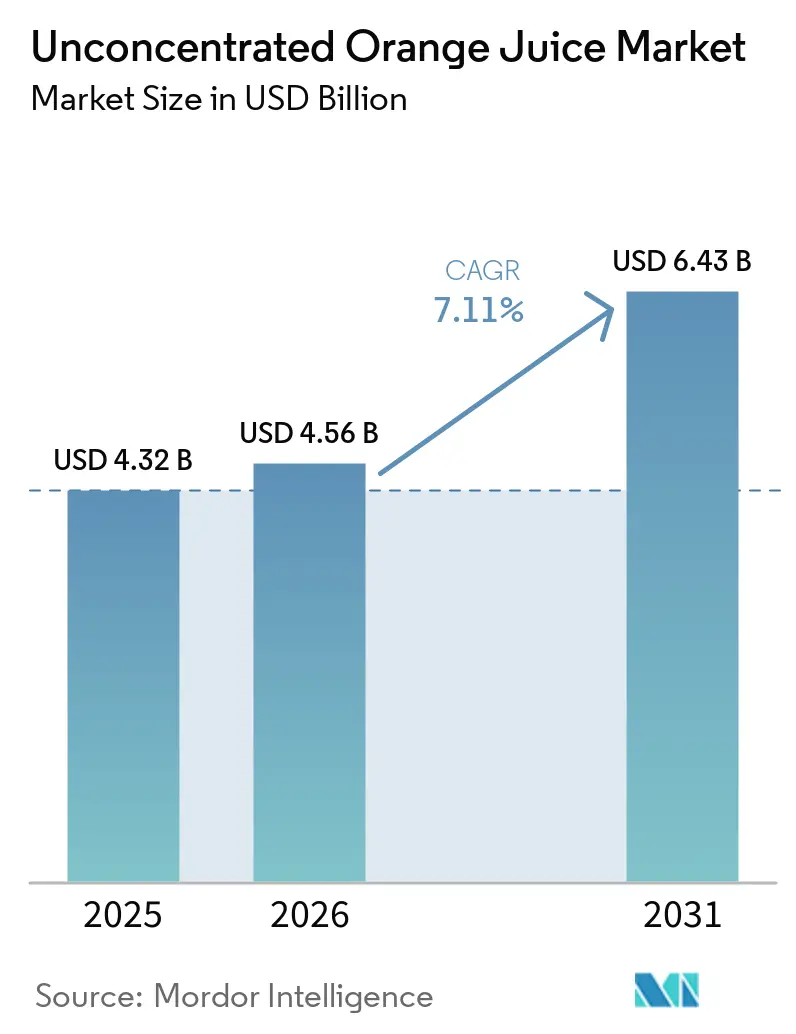
The unconcentrated orange juice market size was valued at USD 4.32 billion in 2025 and is estimated to grow from USD 4.56 billion in 2026 to reach USD 6.78 billion by 2031, at a CAGR of 7.11% during the forecast period (2026-2031). The unconcentrated orange juice market is moving toward premium, minimally processed products, especially not-from-concentrate, or NFC, juice. Supply disruptions have increased the importance of Brazilian processors and their ability to serve export markets. Clean formulations, transparent sourcing, and nutritional value are becoming more important to purchase decisions in mature markets. Higher retail prices may constrain household purchasing frequency and support private-label products. Companies that protect product quality while managing costs and distribution reach have an opportunity to strengthen their position in the unconcentrated orange juice market.
Key Report Takeaways
- By category, conventional products held 82.36% of the unconcentrated orange juice market share in 2025, while organic products are projected to expand at an 8.64% CAGR through 2031.
- By packaging type, bottles held 48.72% of the unconcentrated orange juice market share in 2025, while cartons are projected to expand at an 8.11% CAGR through 2031.
- By distribution channel, supermarkets and hypermarkets held 42.71% of the unconcentrated orange juice market share in 2025, while online retail is projected to expand at an 8.56% CAGR through 2031.
- By geography, Europe held 37.68% of the unconcentrated orange juice market share in 2025, while Asia-Pacific is projected to expand at an 8.14% CAGR through 2031.
Note: Market size and forecast figures in this report are generated using Mordor Intelligence’s proprietary estimation framework, updated with the latest available data and insights as of January 2026.
Global Unconcentrated Orange Juice Market Trends and Insights
Drivers Impact Analysis*
| Driver | (~) % Impact on CAGR Forecasts | Geographic Relevance | Impact Timeline |
|---|---|---|---|
| Demand for natural, minimally processed beverages | +2.0% | Global | Medium term (2-4 years) |
| Natural and clean-label beverage demand | +1.5% | North America and Europe | Medium term (2-4 years) |
| Demand for not-from-concentrate orange juice | +1.2% | Europe, North America, and Asia-Pacific | Long term (≥ 4 years) |
| Consumption of organic and premium juices | +0.8% | North America and Europe | Long term (≥ 4 years) |
| Expansion of cold-pressed and high-pressure processing juices | +0.6% | North America and Europe | Medium term (2-4 years) |
| Growth of e-commerce and direct-to-consumer sales | +0.5% | Global, strongest in Asia-Pacific and North America | Short term (≤ 2 years) |
| Source: Mordor Intelligence | |||
Rising Demand for Natural and Minimally Processed Beverages
The unconcentrated orange juice market is benefiting from demand for products with simple ingredients and limited processing. NFC products allow brands to position juice around fruit content and a chilled format rather than around a shelf-stable commodity. A 150 ml serving of 100% orange juice provides more than 90% of the recommended daily intake of vitamin C, which gives producers a clear nutrition message. This proposition is relevant for households that place greater importance on recognizable ingredients and nutritional content. Premium pricing remains possible where the product experience supports the claim of higher quality. The category therefore depends on maintaining a clear difference between NFC juice and conventional products.
Increasing Natural and Clean-Label Beverage Trends
Clean-label requirements affect the formulation, sourcing, and labeling decisions of suppliers to the unconcentrated orange juice market. European rules require producers to provide full ingredient information and maintain standards for products described as 100% juice. Retailers can use these requirements when reviewing products and selecting suppliers. The result is greater attention to traceability and product consistency throughout the supply chain. Brazilian NFC exports to Spain reached 40,025 tonnes from September through November 2025, 5 times the volume recorded in the same period of 2024[1]. This flow showed the growing role of Brazilian supply in a European retail environment that values clear product positioning.
Growing Demand for Not-From-Concentrate Orange Juice
NFC demand supports investment in processing, storage, and export capacity within the unconcentrated orange juice market. Brazilian NFC export volume increased 12.7% to 347,100 tonnes in the 2025/26 harvest season. Louis Dreyfus Company invested USD 25 million in 2 NFC storage and pasteurization tanks at Matão, São Paulo, in July 2024. The investment tripled NFC storage capacity to 30 million liters and expanded annual production capacity to 300 million liters. High-pressure processing can preserve taste and nutritional markers in refrigerated orange juice for 3 months under validated conditions. This longer commercial window can support shipments to distant retail markets without weakening a fresh-product proposition.
Growth of E-Commerce and Direct-to-Consumer Sales
Digital sales give smaller brands a route to consumers without requiring immediate national supermarket listings. This channel is useful for organic suppliers and companies that need to explain sourcing, certification, and handling practices. It also supports recurring deliveries of chilled juice where cold-chain coverage is available. Innocent Drinks introduced price-marked packs of Orange Juice Smooth in June 2025 through Co-op Wholesale and Nisa stores at GBP 2.49 for 750 ml. The move showed that brand owners are balancing convenience-channel price visibility with broader premium distribution. The unconcentrated orange juice market can benefit as online and convenience channels serve different purchase occasions.
Restraints Impact Analysis*
| Restraint | (~) % Impact on CAGR Forecasts | Geographic Relevance | Impact Timeline |
|---|---|---|---|
| High raw material costs | -0.8% | Global | Short term (≤ 2 years) |
| High cold-chain and transportation costs | -0.5% | Asia-Pacific, South America, and Middle East and Africa | Medium term (2-4 years) |
| Competition from other healthy beverages | -0.4% | North America and Europe | Medium term (2-4 years) |
| Packaging and sustainability challenges | -0.3% | Europe and North America | Long term (≥ 4 years) |
| Source: Mordor Intelligence | |||
High Raw Material Costs
Citrus supply risk remains a central restraint for the unconcentrated orange juice market. Florida orange production stood at 12.9 million 90 lb boxes in the 2025/26 season, following extensive damage from citrus greening disease[2]. Fundecitrus estimated the São Paulo and West-Southwest Minas Gerais crop at 292.94 million boxes in April 2026. Brazil’s crop recovery gave processors temporary raw-material relief after the weak 2024/25 season. However, a poor Brazilian harvest can quickly affect product availability and retail pricing in importing markets. This exposure makes diversified sourcing and long-term grove investment important for processors and brand owners.
High Cold-Chain and Transportation Costs
NFC juice requires continuous refrigeration from pressing to final retail distribution. This requirement raises the cost of serving remote markets and creates a barrier for smaller processors. The infrastructure challenge is especially relevant in parts of Asia-Pacific, South America, and Middle East and Africa where chilled distribution is still developing. Higher transport and storage costs can limit price reductions even when fruit costs decline. They can also widen the shelf-price difference between NFC juice and frozen concentrate. The unconcentrated orange juice market will need efficient cold-chain networks to convert interest in premium products into repeat purchases.
*Our forecasts treat driver/restraint impacts as directional, not additive. The impact forecasts reflect baseline growth, mix effects, and variable interactions.
Segment Analysis
By Category: Conventional Products Retain the Broadest Consumer Base
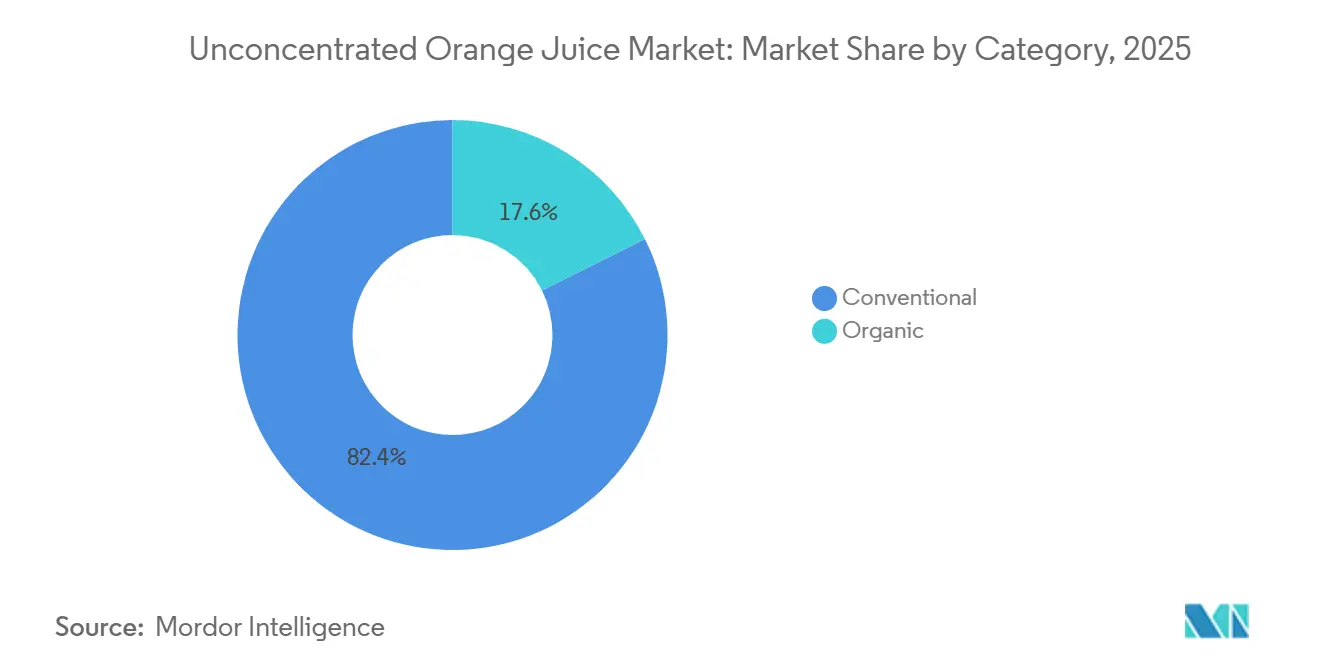
Conventional products held 82.36% of the unconcentrated orange juice market share in 2025. Their lead reflects established purchase habits and the broad availability of accessible NFC products in mainstream retail. Conventional products give large suppliers the volume base needed to operate chilled distribution efficiently. They also remain relevant for households that are sensitive to changes in retail prices. Major producers can use line extensions to bring organic options into an established portfolio. This approach allows brands to serve different price points while retaining shelf presence.
Organic products are forecast to record an 8.64% CAGR through 2031, the highest rate within the category segmentation. The unconcentrated orange juice market size for organic products is supported by consumer interest in certification, traceability, and premium product standards. USDA Organic and EU Organic rules require a 3-year pesticide-free land history and independent audit processes. These requirements make certification a tangible product attribute rather than a general marketing claim. Uncle Matt’s Organic and Lakewood Organic have built their position around this certification-led approach. Organic growth is likely to depend on whether brands can justify higher prices through quality, sourcing, and clear labeling.
By Packaging Type: Bottles Lead While Cartons Address Sustainability Requirements
Bottles held 48.72% of the unconcentrated orange juice market share in 2025. Their leading position reflects their use in refrigerated retail and their connection with transparent, ready-to-drink packaging. Clear PET bottles allow consumers to see juice color and texture before purchase. This visual feature helps brands communicate an NFC product proposition at the shelf. Bottles also fit the established cold-case layouts used by supermarkets and convenience stores. Their continued use will depend on how producers respond to recycled-content requirements and packaging waste rules.
Cartons are forecast to grow at an 8.11% CAGR through 2031. The unconcentrated orange juice market size for cartons is supported by extended shelf-life technology that can keep chilled NFC juice stable for 45 to 60 days without preservatives. Cartons can also support lower packaging weight and formats that align with sustainability requirements. The EU Packaging and Packaging Waste Regulation advanced through legislative review during 2024 and 2025. These rules encourage packaging choices with recycled content and a lower reliance on virgin materials. Cans remain the smallest packaging format because producers must manage the technical requirements associated with fresh citrus acidity and a premium product identity.
By Distribution Channel: Supermarkets Remain Central as Online Retail Expands
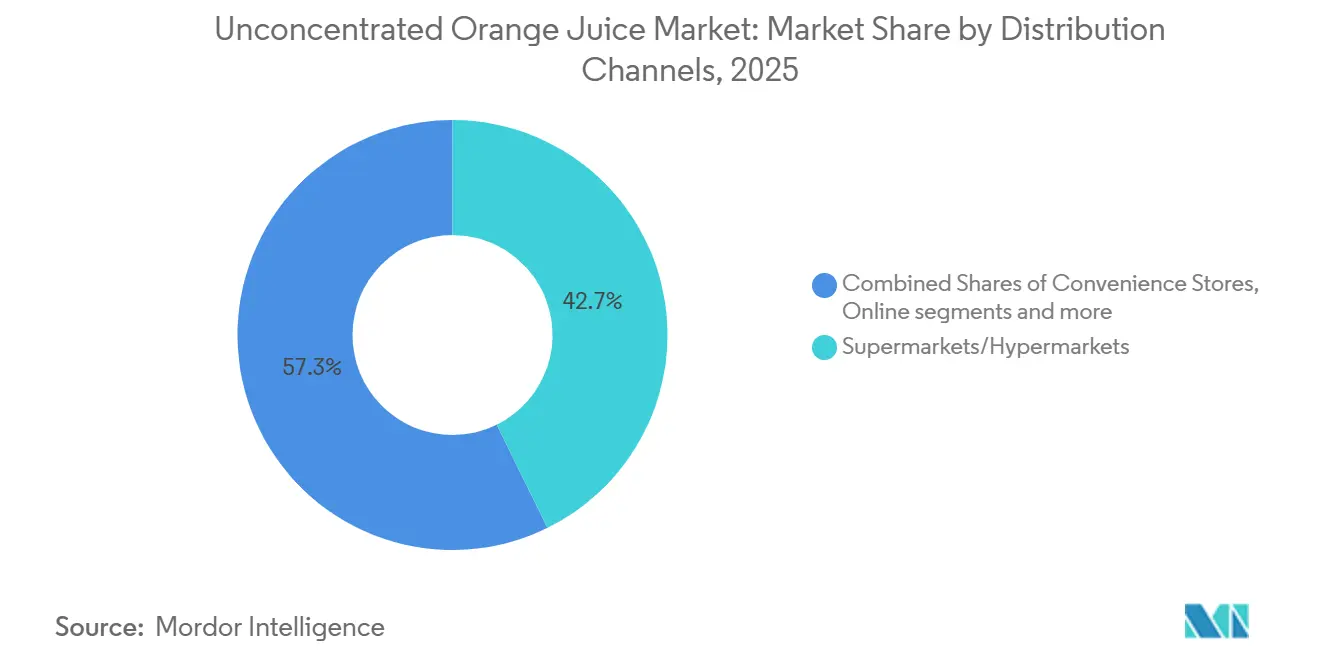
Supermarkets and hypermarkets held 42.71% of the unconcentrated orange juice market share in 2025. They provide the refrigeration capacity and product range needed to sell chilled juice in the mainstream. Retailers also use chilled juice to increase basket value. High throughput helps supermarkets maintain the cold-chain conditions required by NFC products. Their scale gives national brands a reliable route to consumers across mature markets. Supermarkets are likely to remain central even as other channels grow faster.
Online retail is projected to expand at an 8.56% CAGR through 2031. The unconcentrated orange juice market size in online retail benefits from home delivery and from the ability to describe a product’s origin and certification. Direct-to-consumer models can help emerging suppliers reach consumers when physical shelf access is limited. Convenience and grocery stores continue to serve immediate consumption and quick-trip occasions in urban areas. Foodservice, airline catering, specialty health retailers, and office delivery services provide additional outlets for higher-value offerings. Each channel requires producers to balance delivery economics with the product quality expected of chilled NFC juice.

Geography Analysis
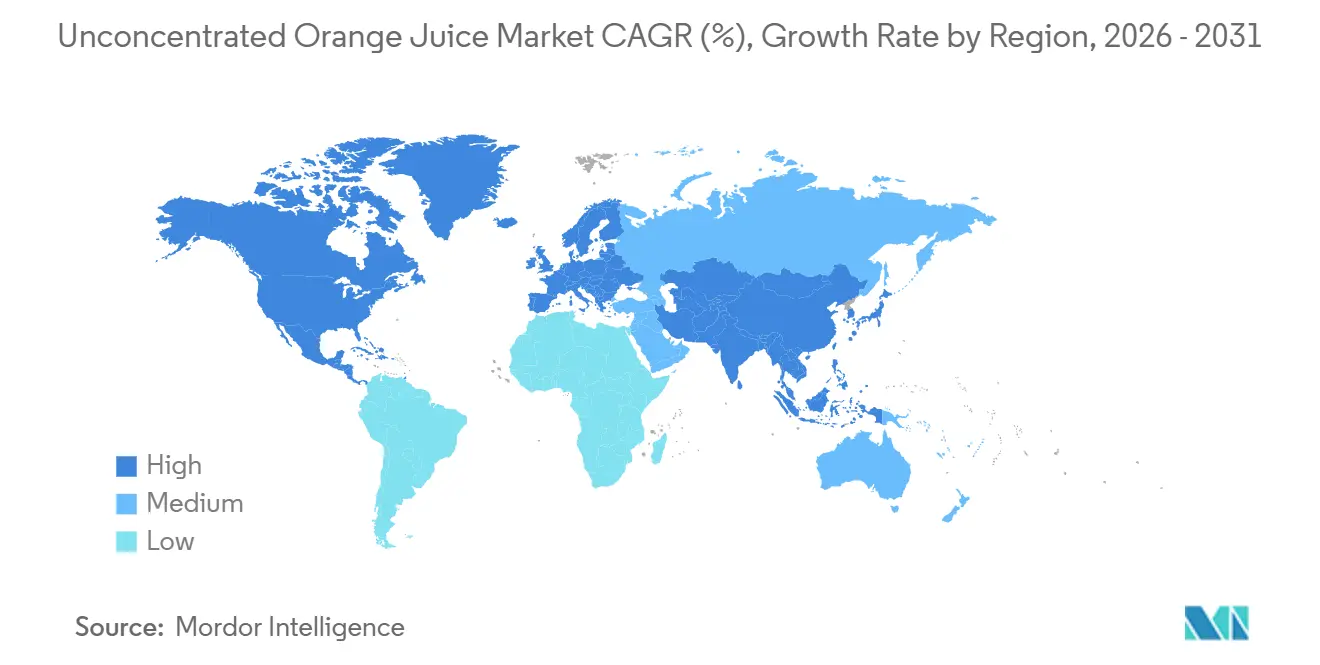
Europe held 37.68% of the unconcentrated orange juice market share in 2025, making it the largest regional market. The region has established demand for juice with clear ingredients and product-origin information. Germany, France, the United Kingdom, the Netherlands, and Spain are important markets for refrigerated premium juice. Spain is also increasing its role as an import and processing hub for Brazilian supply. Spanish imports of Brazilian orange juice reached 40,025 tonnes from September through November 2025. Higher household prices may affect purchase frequency and increase private-label demand across the region.
North America is the second-largest regional market and relies on premiumization to support value growth. Florida production reached 12.9 million 90 lb boxes in the 2025/26 season, which reinforced U.S. dependence on imported supply. The United States became the leading single-country destination for Brazilian orange juice during the 2025/26 season. In July 2026, the FDA amended the standard of identity for pasteurized orange juice by reducing the minimum Brix level from 10.5° to 10° and permitting up to 15% Citrus reticulata juice[3]. FDA Mexico and Canada also contribute to regional citrus flows as processors seek greater supply diversity.
Asia-Pacific is projected to expand at an 8.14% CAGR through 2031, the fastest rate among the geographic segments. China, India, Japan, Vietnam, and Indonesia offer a wider consumer base for chilled premium juice as retail refrigeration expands. Chilled delivery networks can improve access in cities beyond traditional supermarket catchments. South America has a smaller domestic consumer base but remains strategically important because Brazil supplies export markets. Brazil consumed 58,700 metric tonnes of NFC orange juice domestically in 2025. The Middle East and Africa remain import-led markets where modern retail investment and cold-chain development will shape the pace of expansion.
Competitive Landscape
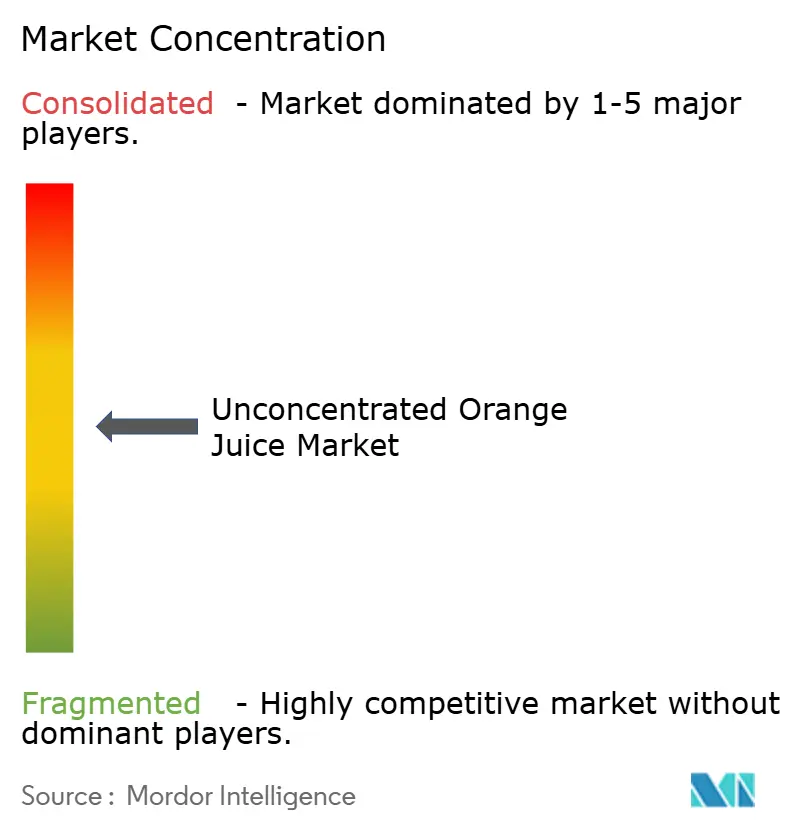
The unconcentrated orange juice market has a moderate concentration because processing capacity is concentrated among a limited group of suppliers, while brand competition remains broad. Citrosuco, Sucocitrico Cutrale, and Louis Dreyfus Company hold important positions in Brazil’s São Paulo citrus belt. Their vertical integration spans grove management, processing, shipping, and export terminals. This structure gives them sourcing and logistics advantages during periods of supply stress. The concentration of processing infrastructure makes reliable fruit access a major competitive factor. Branded businesses must therefore compete through product range, customer relationships, and differentiated positioning.
Louis Dreyfus Company’s July 2024 investment of USD 25 million in Matão expanded its NFC capacity and showed continued confidence in export demand. The company is also developing a citrus waste-to-biogas facility in Bebedouro. Citrosuco received long-term institutional backing for orchard expansion in São Paulo’s citrus corridor. These actions support supply security, quality consistency, and processing resilience. They also show why established processors can invest through periods of volatile fruit availability. International’s growing Brazilian citrus sourcing points to continued interest in the region’s export capacity.
At the brand level, companies are extending familiar juice brands into functional and adjacent beverage formats. Innocent Drinks launched its fruit and veg forever brand strategy and refreshed visual identity across European communications in March 2026. Tropicana Brands Group is investing USD 11.5 million at its City of Industry, California, facility and expects completion by September 2026. It also introduced Hydrate+ in the United Kingdom in April 2026. Refresco completed its acquisition of SunOpta in May 2026, adding aseptic manufacturing and plant-based beverage capabilities to its North American business.
Unconcentrated Orange Juice Industry Leaders
-
PepsiCo, Inc.
-
Florida’s Natural Growers
-
Sucocitrico Cutrale Ltda.
-
Louis Dreyfus Company B.V.
-
COFCO International Limited
- *Disclaimer: Major Players sorted in no particular order
Recent Industry Developments
- October 2026: Pilmifresh presented a 100% NFC orange juice made from ripe oranges of Spanish origin at the SIAL Paris 2026 product showcase. The product is intended primarily as an ingredient for food and beverage manufacturers producing juices, nectars, and soft drinks.
- September 2026: TIPCO introduced a refreshed packaging design and updated consumer communication for its 100% NFC orange juice in Thailand. The initiative emphasizes the product's natural orange ingredients, quality, and the distinction between NFC juice and juice made from concentrate.
- May 2025: Louis Dreyfus Company introduced its Montebelo Brasil packaged fresh fruit juice brand in Indonesia, marking its expansion into Asia. The range includes 100% NFC juices, including orange juice with and without pulp.
Global Unconcentrated Orange Juice Market Report Scope
The unconcentrated orange juice market is segmented by category into conventional and organic; by packaging type into cartons, bottles, and cans; and by distribution channel into supermarkets/hypermarkets, convenience/grocery stores, online retail channels, and other distribution channels. By geography, the market is segmented into North America, Europe, Asia-Pacific, South America, and the Middle East and Africa. The market sizing has been done in value terms in USD for all the abovementioned segments.
| Conventional |
| Organic |
| Cartons |
| Bottles |
| Cans |
| Supermarkets/Hypermarkets |
| Convenience/Grocery Stores |
| Onine Retail Channels |
| Other Distribution Channels |
| North America | United States |
| Canada | |
| Mexico | |
| Rest of North America | |
| Europe | Germany |
| United Kingdom | |
| France | |
| Italy | |
| Spain | |
| Netherlands | |
| Sweden | |
| Poland | |
| Belgium | |
| Rest of Europe | |
| Asia-Pacific | China |
| India | |
| Japan | |
| Australia | |
| South Korea | |
| Vietnam | |
| Indonesia | |
| Rest of Asia-Pacific | |
| South America | Brazil |
| Argentina | |
| Chile | |
| Peru | |
| Colombia | |
| Rest of South America | |
| Middle East and Africa | United Arab Emirates |
| Saudi Arabia | |
| South Africa | |
| Nigeria | |
| Rest of Middle East and Africa |
| Category | Conventional | |
| Organic | ||
| Packaging Type | Cartons | |
| Bottles | ||
| Cans | ||
| By Distribution Channels | Supermarkets/Hypermarkets | |
| Convenience/Grocery Stores | ||
| Onine Retail Channels | ||
| Other Distribution Channels | ||
| By Geography | North America | United States |
| Canada | ||
| Mexico | ||
| Rest of North America | ||
| Europe | Germany | |
| United Kingdom | ||
| France | ||
| Italy | ||
| Spain | ||
| Netherlands | ||
| Sweden | ||
| Poland | ||
| Belgium | ||
| Rest of Europe | ||
| Asia-Pacific | China | |
| India | ||
| Japan | ||
| Australia | ||
| South Korea | ||
| Vietnam | ||
| Indonesia | ||
| Rest of Asia-Pacific | ||
| South America | Brazil | |
| Argentina | ||
| Chile | ||
| Peru | ||
| Colombia | ||
| Rest of South America | ||
| Middle East and Africa | United Arab Emirates | |
| Saudi Arabia | ||
| South Africa | ||
| Nigeria | ||
| Rest of Middle East and Africa | ||
Key Questions Answered in the Report
What is the forecast value of unconcentrated orange juice by 2031?
The category is forecast to reach USD 6.43 billion by 2031, growing at a 7.11% CAGR from 2026.
Which product category is growing fastest?
Organic unconcentrated orange juice is projected to grow at an 8.64% CAGR through 2031.
Which packaging format is growing fastest?
Cartons are projected to grow at an 8.11% CAGR through 2031, supported by shelf-life technology and sustainability requirements.
Which region is growing fastest for unconcentrated orange juice?
Asia-Pacific is projected to grow at an 8.14% CAGR through 2031.