
Unattended Ground Sensors Market Size and Share
Market Overview
| Study Period | 2020 - 2032 |
|---|---|
| Market Size (2027) | USD 512.26 Million |
| Market Size (2032) | USD 708.33 Million |
| Growth Rate (2027 - 2032) | 6.70 % |
| Fastest Growing Market | Asia-Pacific |
| Largest Market | North America |
| Market Concentration | Medium |
Major Players *Disclaimer: Major Players sorted in no particular order Image © Mordor Intelligence. Reuse requires attribution under CC BY 4.0. | |
Unattended Ground Sensors Market Analysis by Mordor Intelligence
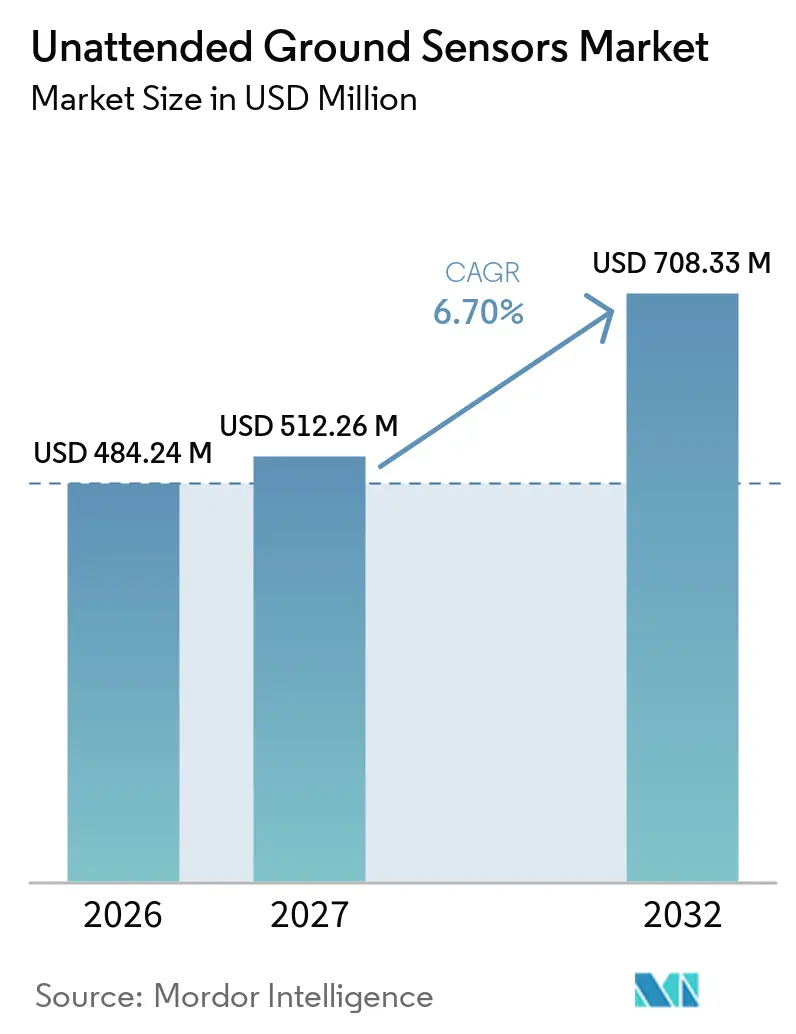
The unattended ground sensors market size was valued at USD 484.24 million in 2026 and is forecast to grow from USD 512.26 million in 2027 to USD 708.33 million by 2032, at a 6.70% CAGR during the forecast period (2027-2032). The market is supported by sustained defense and border-security procurement rather than short procurement cycles. Spending growth in Asia-Pacific, Europe, and North America creates a larger funding base for persistent surveillance systems. Operators are shifting from camera-based perimeter coverage to autonomous nodes that combine seismic, acoustic, magnetic, and infrared sensors. This shift in the unattended ground sensors market favors systems that can classify events at the edge and send fewer transmissions across constrained networks. Competition centers on program relationships, interoperability, and the ability to reduce maintenance in difficult terrain. Commercial users also create a second demand channel as energy sites, ports, and data centers seek continuous perimeter coverage.
Key Report Takeaways
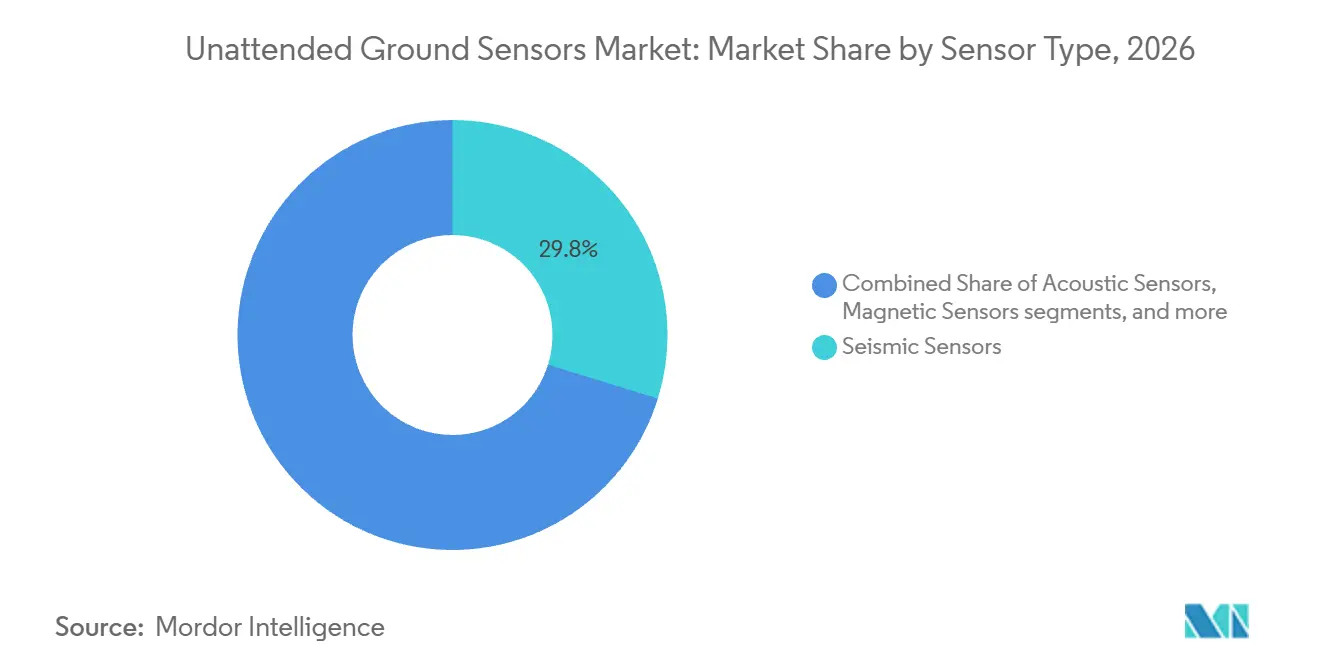
- By sensor type, seismic sensors held 29.78% of the unattended ground sensors market share in 2026, while others are forecast to grow at an 8.45% CAGR through 2032.
- By deployment, fixed systems held a 43.56% share of the unattended ground sensors market in 2026, while portable systems are forecast to grow at an 8.21% CAGR through 2032.
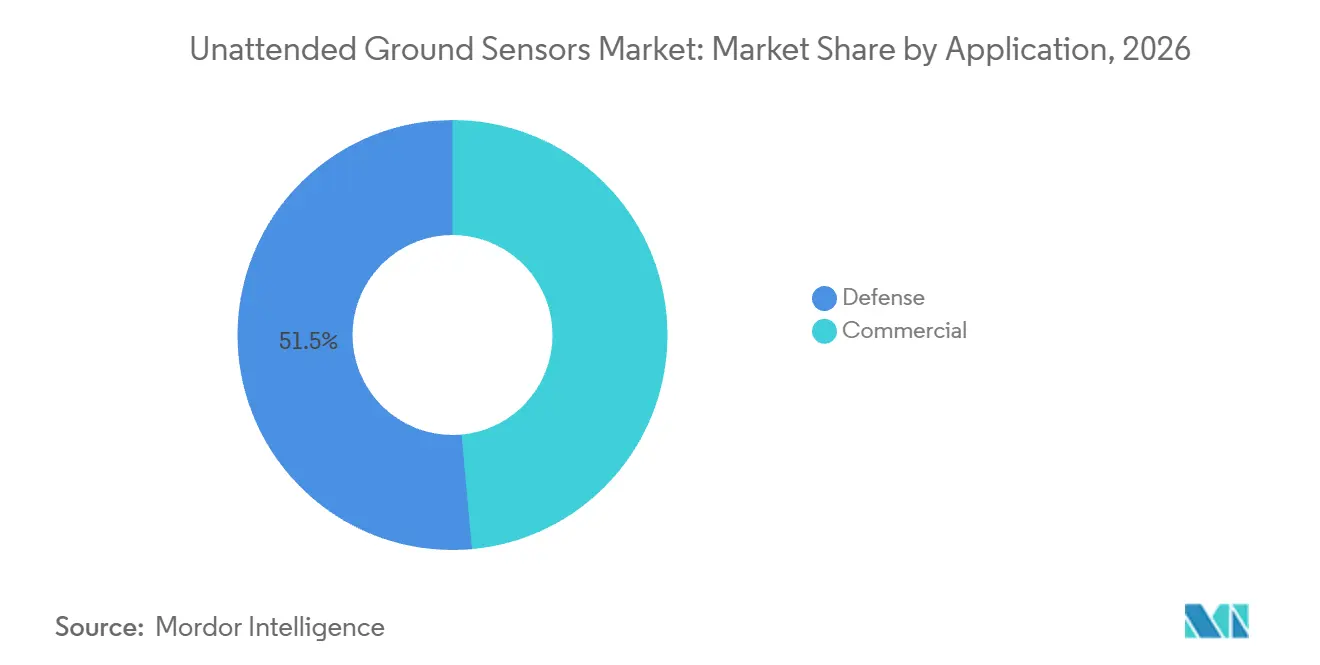
- By application, defense held a 51.45% share of the unattended ground sensors market in 2026, while commercial is forecast to grow at an 8.10% CAGR through 2032.
- By power source, primary battery held a 42.41% share of the unattended ground sensors market in 2026, while solar and hybrid energy harvesting is forecast to grow at a 9.21% CAGR through 2032.
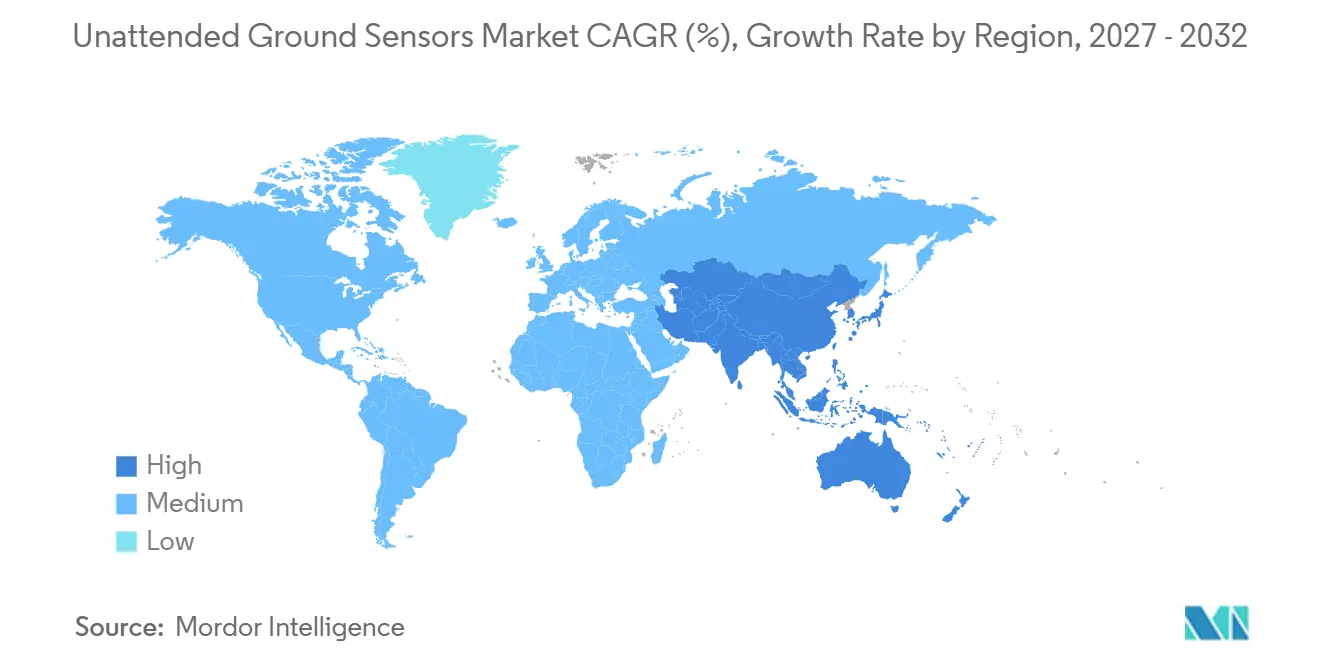
- By geography, North America accounted for 38.55% of the unattended ground sensors market in 2026, while Asia-Pacific is forecast to grow at an 8.56% CAGR through 2032.
Note: Market numbers in this report are based on Mordor Intelligence's proprietary estimation framework, which combines nine months of actuals with Q4 projections for base year 2026.
Global Unattended Ground Sensors Market Trends and Insights
Drivers Impact Analysis*
| Driver | (~) % Impact on CAGR Forecast | Geographic Relevance | Impact Timeline |
|---|---|---|---|
| Defense modernization and persistent battlefield ISR | +1.20% | North America, Europe, Asia-Pacific | Medium term (2-4 years) |
| Rising border and perimeter surveillance requirements | +1.00% | North America, Europe, Middle East | Short term (≤ 2 years) |
| Critical infrastructure protection spending | +0.70% | North America, Europe, Asia-Pacific, Middle East | Medium term (2-4 years) |
| Edge AI for detection in communications-constrained areas | +0.80% | Global, led by the US, Israel, and the UK | Long term (≥ 4 years) |
| Anti-jam mesh networking for contested environments | +0.60% | Asia-Pacific, North America, Eastern Europe | Long term (≥ 4 years) |
| Multi-sensor detection of personnel, vehicles, and low-altitude drones | +0.50% | Global | Medium term (2-4 years) |
| Source: Mordor Intelligence | |||
Rising Border and Perimeter Surveillance Requirements
The unattended ground sensors market benefits from public programs that convert border-security priorities into funded surveillance deployments. In July 2026, the US Office of Management and Budget allocated USD 1.59 billion for the implementation of Border Surveillance Technology. Elbit Systems of America began deploying AI-enabled Integrated Surveillance Towers in the Del Rio area of Texas in July 2025 under a USD 1.8 billion indefinite-delivery, indefinite-quantity contract. The company stated that each tower secures 100 square miles without continuous agent monitoring. European demand follows a similar operational need for persistent perimeter awareness. The EU-funded PROTEAS project integrates unattended sensors, access control, and satellite communications to protect Special Operations Forces command posts. The resulting pipeline of unattended ground sensors supports repeat orders for nodes, software, and maintenance services.
Defense Modernization and Persistent Battlefield ISR
The unattended ground sensors market gains from modernization programs that treat sensing as part of a wider fire-control and reconnaissance network. In August 2025, the US Army awarded Phase 0 FALCONS agreements to Leonardo DRS, Elbit America, and QinetiQ. Each agreement was valued at USD 2 million and supports a system intended to more than double the detection range of the legacy LRAS3. Networked architectures connect scout and fire-support data, reducing the time between detection and engagement. Asia-Pacific procurement capacity is also widening. China recorded its 31st consecutive year of military-spending growth in 2025, while India raised spending by 8.90% to USD 92.10 billion. These budgets support continued investment in battlefield ISR systems. Modernization in the unattended ground sensors market favors vendors that can integrate new sensors with existing command systems.
Edge AI for Detection in Communications-Constrained Areas
Edge processing expands the unattended ground sensors market where communications are unreliable, monitored, or subject to interference. Leonardo DRS introduced its SAGEcore ruggedized AI platform in October 2025 to process multiple sensor feeds on tactical platforms in denied, disconnected, intermittent, and limited environments. The platform uses the Sensor Open Systems Architecture (SOSA) standard for integration across sensor sources. Project Q presented a seismic-acoustic mission kit with on-sensor AI inference at EUROSATORY 2026. Local inference can reduce operating burdens in the unattended ground sensors market, reduce bandwidth demand, and lower a node's electromagnetic signature. It also allows commanders to retain useful surveillance when network capacity becomes limited.
Multi-Sensor Detection of Personnel, Vehicles, and Low-Altitude Drones
Demand for multi-sensor systems is broadening as users require unattended ground sensors to detect people, vehicles, and low-altitude drones on a single network. McQ received an USD 8.37 million US Marine Corps production contract in July 2025 for RANGER 4-in-1 kits. The RANGER node combines seismic, acoustic, magnetic, and tamper detection, including acoustic unmanned-aircraft detection. General Atomics Electromagnetic Systems demonstrated its Fencepost acoustic surveillance system at T-REX 25 and AUSA 2025.[1] The company reported passive detection and tracking of Group 1-3 unmanned aircraft at 5-7 km across complex terrain and congested radio-frequency conditions. Systems unable to classify small drones may require later upgrades, which strengthens the case for modular, multi-modal designs. This supports common architectures for unattended ground sensors in perimeter security and tactical reconnaissance missions.
Restraints Impact Analysis*
| Restraint | (~) % Impact on CAGR Forecast | Geographic Relevance | Impact Timeline |
|---|---|---|---|
| Procurement, integration, and lifecycle costs | -0.90% | Global, particularly emerging-economy defense budgets | Medium term (2-4 years) |
| Weather, terrain, and electromagnetic interference | -0.70% | Global, especially Arctic, tropical, and radio-frequency-dense urban settings | Short term (≤ 2 years) |
| RF discoverability, jamming, and cybersecurity exposure | -0.60% | Global, with elevated risk in Asia-Pacific and Eastern Europe | Long term (≥ 4 years) |
| Soil-specific calibration and false-alarm burden | -0.40% | All terrestrial deployment regions | Medium term (2-4 years) |
| Source: Mordor Intelligence | |||
Weather, Terrain, and Electromagnetic Interference
Environmental conditions restrain unattended ground sensors market adoption because they complicate the distinction between a threat and ordinary background activity. Wind, rainfall, livestock, machinery, and radio-frequency activity can affect seismic and acoustic readings. Seismo-acoustic monitoring requires local parametric models to separate explosion signals from industrial background vibration. Mixed clay, sand, and rock profiles can require threshold changes at each installation site. This work adds setup time and can produce false alarms if calibration is incomplete. The UK MoD's 2025 autonomous sensor competition used the NATO SAPIENT framework as a compliance reference for sensor management. Wider implementation may reduce integration burden, but terrain-specific calibration remains necessary in dense networks. Electromagnetic interference adds another constraint, where radio-frequency congestion affects data transmission.
Procurement, Integration, and Lifecycle Costs
Acquisition, integration, and sustainment costs can delay unattended ground sensors market programs, especially where procurement budgets are limited. Nodes with multi-modal sensing, local processing, and resilient mesh communications require more hardware and software than basic systems. Battery replacement is also costly when crews must enter remote or exposed locations. New nodes can also require tailored middleware to connect with existing command systems. These costs favor market vendors that can demonstrate simple integration, efficient power management, and long service intervals. Smaller forces may therefore defer upgrades even when the operational case is clear.
*Our forecasts treat driver/restraint impacts as directional, not additive. The impact forecasts reflect baseline growth, mix effects, and variable interactions.
Segment Analysis
By Sensor Type: Seismic Sensing Anchors the Market, Fusion Platforms Accelerate
Seismic sensors accounted for 29.78% of the unattended ground sensors market share in 2026, making them the largest sensor category. Their position reflects passive operation, long-standing NATO validation, and established methods for classifying footsteps, wheeled vehicles, and tracked armor. Passive geophone-based sensing is useful where operators want to limit electronic emissions. The European Leadership Network reported in 2025 that seismo-acoustic monitoring can support detection and localization of artillery strikes and border intrusions over wide areas. Acoustic sensors support detection of helicopters, drones, and mortars, broadening the role of ground networks. Ukraine began domestic production of acoustic sensors for artillery-position detection in 2025. That activity shows how conflict conditions are building demand for local sensing capacity. Their established field record keeps seismic sensing central to layered surveillance designs.
Magnetic and infrared sensors add vehicle and thermal-signature detection to layered arrays. These combinations improve classification confidence when individual signals are unclear. The others category is projected to grow at an 8.45% CAGR through 2032. This unattended ground sensors market size opportunity is linked to a preference for fewer nodes per protected area. Integrated systems can simplify deployment and improve event verification. They can also address new risks from small drones without requiring a separate sensor network. The tradeoff is greater upfront complexity and a stronger need for reliable edge analytics. Growth depends on reliable fusion software that can interpret multiple data streams without increasing false alarms.

By Deployment: Fixed Networks Hold Ground, Portable Systems Sprint Ahead
Fixed systems accounted for 43.56% of the unattended ground sensors market share in 2026. They suit borders, airbase perimeters, and critical-infrastructure sites where direct power, fiber backhaul, and long operating life justify permanent installation. Fixed networks can support larger sensor arrays and stable command-and-control connections. Their installed base is strengthened by infrastructure security requirements and long-term defense programs. Portable systems are forecast to grow at an 8.21% CAGR through 2032 as forces favor rapid emplacement and maneuver. These systems answer a tactical need in contested environments where static equipment can be found and targeted. Deployment choices, therefore, depend on the trade-off between persistent coverage and the ability to relocate quickly. Both models remain relevant in the unattended ground sensors market because defense and civil users operate across very different site conditions.
Project Q introduced its Plug-and-Fight-capable mission kit at EUROSATORY 2026 as an example of portable design. Its seismic-acoustic nodes can be deployed by a small team and connected to existing command systems. This approach reduces the time between arrival and sensor coverage. In April 2025, Reach Power demonstrated wireless power delivery to a concealed McQ RANGER sensor at T-REX 25-1. The test transmitted power at up to 200 feet without line of sight. This supports the unattended ground sensors market as deployed systems become less dependent on frequent field servicing. It also aligns portable deployment with requirements for immediate command-and-control integration.
By Application: Defense Remains the Core, Commercial Demand Diversifies the Pipeline
Defense accounted for 51.45% of the unattended ground sensors market in 2026. Military procurement provides the largest demand base because users need persistent surveillance across borders, bases, and operational areas. In November 2025, Bertin Exensor received a 9-year frame contract from the Dutch MoD.[2] Such multi-year arrangements provide manufacturers with predictable production demand, while reinforcing the importance of interoperability, training, maintenance, and spare parts in purchasing decisions. This procurement pattern provides defense manufacturers with a stable basis for longer product support cycles and enables users to plan sustainment, training, and spare-parts needs across successive years.
Commercial applications are projected to expand at an 8.10% CAGR through 2032. Energy operators, port logistics sites, and data-center campuses can use autonomous networks to monitor extended boundaries with fewer personnel. Pipeline protection is a relevant use case because remote routes need continuous intrusion detection. Commercial buyers generally apply similar sensing principles but prioritize asset protection, operational continuity, and manageable service costs. The demand base is therefore separate from military budgets, even when systems use common hardware. This diversification reduces dependence on defense procurement cycles within the unattended ground sensors industry. It also raises requirements for easy deployment and system integration. Manufacturers that can adapt military-grade systems for civil operating environments can address a broader group of end users. This segment can therefore provide manufacturers with opportunities beyond traditional armed forces programs.
By Power Source: Battery Dependence Creates Logistical Exposure, Renewables Gain Traction
Primary batteries accounted for 42.41% of the unattended ground sensors market share in 2026. Their leadership reflects the installed base of battery-powered nodes across military and border programs. Battery power enables deployment where grid access is unavailable or undesirable. Its limitation is finite operating life, which can require personnel to return to difficult or hostile locations. The US Army Research Laboratory described an AIHPA testbed in September 2025 that combines photovoltaic, battery, and hydrogen fuel-cell power sources. External batteries remain relevant for fixed sites where cabling or hardened battery units are practical. These choices show why power design directly affects sensor availability and operating risk. Operators are consequently assessing energy systems as part of every deployment decision.
Solar and hybrid energy harvesting is projected to grow at a 9.21% CAGR through 2032, the fastest rate among power sources. Long-duration unattended missions can become impractical when they rely solely on primary batteries. Hybrid systems combine renewable energy sources with stored or fuel-cell power to extend operating life. The US Army ERDC nanogrid at White Sands combined hydrogen fuel and solar power to provide continuous off-grid power to perimeter sensors. It delivered 9 kW for sensor operations in an infrastructure-denied setting. This reduces the frequency of resupply activity and supports more persistent coverage. Power autonomy is therefore a central feature of the unattended ground sensors industry as users seek fewer maintenance sorties. The approach is particularly relevant where access routes make regular battery exchange difficult.
Geography Analysis
North America accounted for 38.55% of the unattended ground sensors market share in 2026, supported by the region's deep procurement base. US Army programs include FALCONS, RANGER contracts, and associated border deployments. The US Office of Management and Budget allocated USD 1.59 billion for border surveillance technology and USD 4.47 billion for barrier-system attribute upgrades, including sensor integration. These allocations support procurement through 2029. Canada expanded the regional opportunity in August 2026 through its MINERVA call for domestically produced uncrewed ground surveillance systems. Mexico remains relevant because cross-border surveillance deployments connect its security needs to US programs. The combination of defense, border, and infrastructure requirements supports continued regional demand for unattended ground sensors. The regional unattended ground sensors market also attracts vendors capable of supporting large, multi-year federal programs.
Europe is emerging as the second-largest regional demand center as NATO members strengthen eastern-flank readiness. Germany increased defense spending by 24% to USD 114 billion in 2025 after changes to the treatment of military outlays under its constitutional debt brake. The Dutch contract with Bertin Exensor provides a 9-year framework for UUGS procurement and maintenance. The arrangement creates a reference for longer procurement structures among allied defense ministries. EU-funded PROTEAS work also combines sensors with access control and satellite communications. Interoperability requirements are likely to align system specifications across the region. These conditions favor systems that can operate with shared technical and data standards. European buyers also need resilient links and support arrangements that fit national procurement processes.
Asia-Pacific is forecast to grow at an 8.56% CAGR through 2032, making it the fastest-growing regional component of the unattended ground sensors market size. China's 2025 military expenditure reached USD 336 billion, up 7.40%. India raised military expenditure by 8.90% to USD 92.10 billion. Japan is expanding its Ground Self-Defense Force into cross-domain ISR roles. India is expected to record the highest growth in regional procurement, supported by a 90% rise in domestic defense production between FY2019-20 and FY2024-25. The Middle East sustains specialized demand around military bases and energy facilities. South America and Africa add incremental demand through border-monitoring and bilateral defense initiatives.
Competitive Landscape
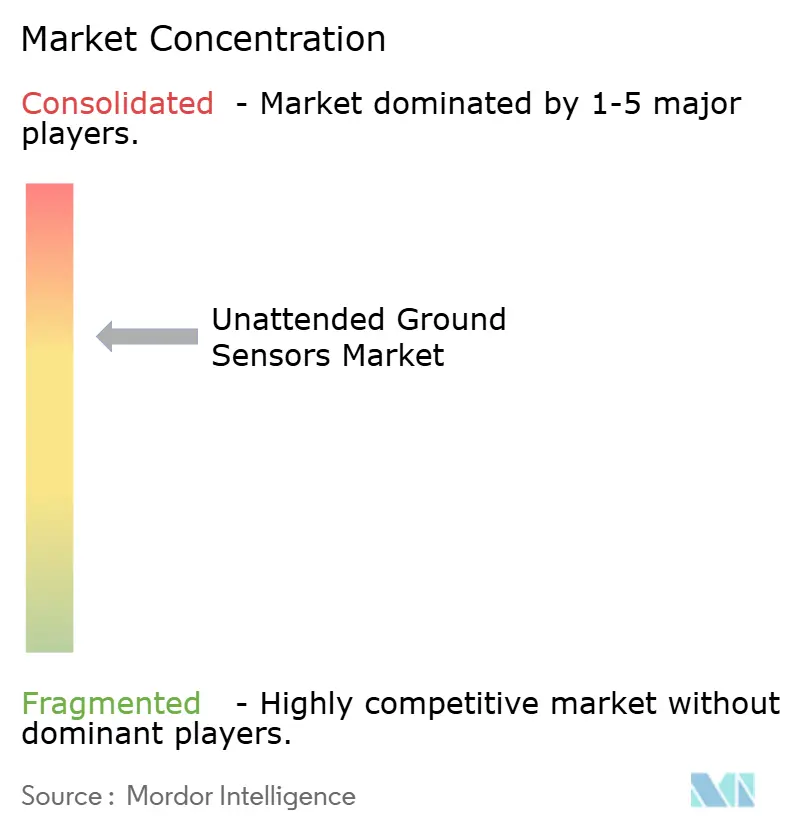
The unattended ground sensors market is moderately consolidated, led byBertin Exensor (Bertin Technologies), Elbit Systems Ltd., L3Harris Technologies, Inc., SensoGuard Ltd., and Textron Systems Corporation. These larger contractors compete through program-of-record relationships and systems integration capabilities. McQ Inc., Anduril Industries, Inc., and Applied Research Associates, Inc. operate as specialist vendors with focused technical offerings. The US Army's FALCONS Phase 0 awards were granted concurrently to Leonardo DRS, Elbit America, and QinetiQ, an approach that maintains vendor competition as requirements are developed. Leonardo DRS has focused on software-defined integration through its SAGEcore platform and the SOSA open standard. Competitive advantage depends on combining sensor hardware with secure data processing and command-system connectivity. Program access and installed-base support remain important alongside individual product performance. Buyers also value vendors that can manage secure integration, maintenance, and training over long operating periods.
Vendors are also addressing environments in which active radar and optical systems can be located electronically. General Atomics EMS positions Fencepost as an acoustic surveillance system for low-signature threats in complex terrain. Project Q uses seismic-acoustic nodes, on-sensor inference, and GNSS-denied capability in its mission-kit design.[3] These approaches address demand for passive sensing with limited radio-frequency exposure. New companies can enter the market through GNSS-independent, attritable sensor systems developed for allied programs. Their designs show how passive collection and local processing are becoming related purchasing criteria.
The competitive landscape requires balancing established defense relationships with specialized engineering capabilities. Larger vendors can manage long procurement cycles, training, maintenance, and systems integration, while specialist firms can differentiate through passive detection, compact multi-sensor nodes, and edge AI. This creates a market where both scale and niche technical depth can secure programs. Procurement decisions also depend on whether a vendor can meet interoperability, security, and service requirements.
Unattended Ground Sensors Industry Leaders
-
L3Harris Technologies, Inc.
-
Elbit Systems Ltd.
-
SensoGuard Ltd.
-
Textron Systems Corporation (Textron Inc.)
-
Bertin Exensor (Société Bertin Technologies)
- *Disclaimer: Major Players sorted in no particular order
Recent Industry Developments
- June 2026: Bertin Exensor entered into a strategic collaboration with Micropol Fiberoptic, under which Micropol will supply tactical fiber-optic infrastructure, including ruggedized tactical cabling and Falcon Expanded Beam connectors, for integration into Bertin Exensor's sensor platform, thereby strengthening the stealth capabilities of the Flexnet T-UGS.
- June 2026: German defense technology company Project Q unveiled a new Unattended Ground Sensor (UGS) Mission Kit at Eurosatory 2026. The device sits low to the ground and detects troop movements, offering armed forces a passive surveillance capability designed for large-area monitoring in contested and communications-constrained environments.
- November 2025: SensoGuard Ltd. secured its largest-ever order from the Israeli MoD for more than 3,500 unattended ground sensor (UGS) systems. This milestone, in its decade-long partnership, reflects a significant increase in Israel's efforts to protect its borders and achieve terrain dominance.
Global Unattended Ground Sensors Market Report Scope
The unattended ground sensors (UGS) market comprises sensor-based surveillance and monitoring systems designed to autonomously detect, identify, classify, and track personnel, vehicles, and other activities without continuous human intervention. The market covers seismic, acoustic, magnetic, infrared, and other sensor technologies deployed across defense and commercial applications, including battlefield intelligence, surveillance and reconnaissance (ISR), border security, perimeter protection, critical infrastructure monitoring, and remote-area surveillance. The scope includes fixed and portable sensor systems, along with associated communication modules, processing units, and power solutions that enable remote monitoring, real-time threat detection, and transmission of surveillance data.
The unattended ground sensors market is segmented by sensor type, deployment, application, power source, and geography. By sensor type, the market is segmented into seismic sensors, acoustic sensors, magnetic sensors, infrared sensors, and others. By deployment, the market is segmented into fixed systems and portable systems. By application, the market is segmented into defense and commercial. By power source, the market is segmented into primary battery, external battery, and solar and hybrid energy harvesting. The report also covers market sizes and forecasts for the unattended ground sensors market across major countries in major countries across different regions. For each segment, the market size is provided in terms of value (USD).
| Seismic Sensors |
| Acoustic Sensors |
| Magnetic Sensors |
| Infrared Sensors |
| Others |
| Fixed Systems |
| Portable Systems |
| Defense |
| Commercial |
| Primary Battery |
| External Battery |
| Solar and Hybrid Energy Harvesting |
| North America | United States | |
| Canada | ||
| Mexico | ||
| Europe | United Kingdom | |
| France | ||
| Germany | ||
| Italy | ||
| Spain | ||
| Russia | ||
| Rest of Europe | ||
| Asia-Pacific | China | |
| India | ||
| Japan | ||
| South Korea | ||
| Australia | ||
| Rest of Asia-Pacific | ||
| South America | Brazil | |
| Argentina | ||
| Rest of South America | ||
| Middle East and Africa | Middle East | United Arab Emirates |
| Saudi Arabia | ||
| Israel | ||
| Rest of Middle East | ||
| Africa | South Africa | |
| Rest of Africa | ||
| By Sensor Type | Seismic Sensors | ||
| Acoustic Sensors | |||
| Magnetic Sensors | |||
| Infrared Sensors | |||
| Others | |||
| By Deployment | Fixed Systems | ||
| Portable Systems | |||
| By Application | Defense | ||
| Commercial | |||
| By Power Source | Primary Battery | ||
| External Battery | |||
| Solar and Hybrid Energy Harvesting | |||
| By Geography | North America | United States | |
| Canada | |||
| Mexico | |||
| Europe | United Kingdom | ||
| France | |||
| Germany | |||
| Italy | |||
| Spain | |||
| Russia | |||
| Rest of Europe | |||
| Asia-Pacific | China | ||
| India | |||
| Japan | |||
| South Korea | |||
| Australia | |||
| Rest of Asia-Pacific | |||
| South America | Brazil | ||
| Argentina | |||
| Rest of South America | |||
| Middle East and Africa | Middle East | United Arab Emirates | |
| Saudi Arabia | |||
| Israel | |||
| Rest of Middle East | |||
| Africa | South Africa | ||
| Rest of Africa | |||
Key Questions Answered in the Report
What is the value of unattended ground sensors market in 2026?
The unattended ground sensors market value is USD 484.24 million in 2026 and is projected to reach USD 708.33 million by 2032, at a 6.70% CAGR.
Which sensor type leads demand?
Seismic sensors lead with a 29.78% share in 2026 because passive detection supports personnel and vehicle classification.
Why are portable unattended sensors gaining adoption?
Portable systems are forecast to grow at an 8.21% CAGR because users need rapidly deployable coverage in contested locations.
Which application is growing fastest?
Commercial use is forecast to expand at an 8.10% CAGR as infrastructure operators seek autonomous perimeter monitoring.
What power technology is growing fastest?
Solar and hybrid energy harvesting is projected to grow at a 9.21% CAGR as users seek to reduce battery-replacement missions.
Which region is projected to grow fastest?
Asia-Pacific is forecast to grow at an 8.56% CAGR through 2032, supported by rising defense spending and ISR modernization.