
Market Overview
| Study Period | 2020 - 2031 |
|---|---|
| Forecast Data Period | 2026 - 2031 |
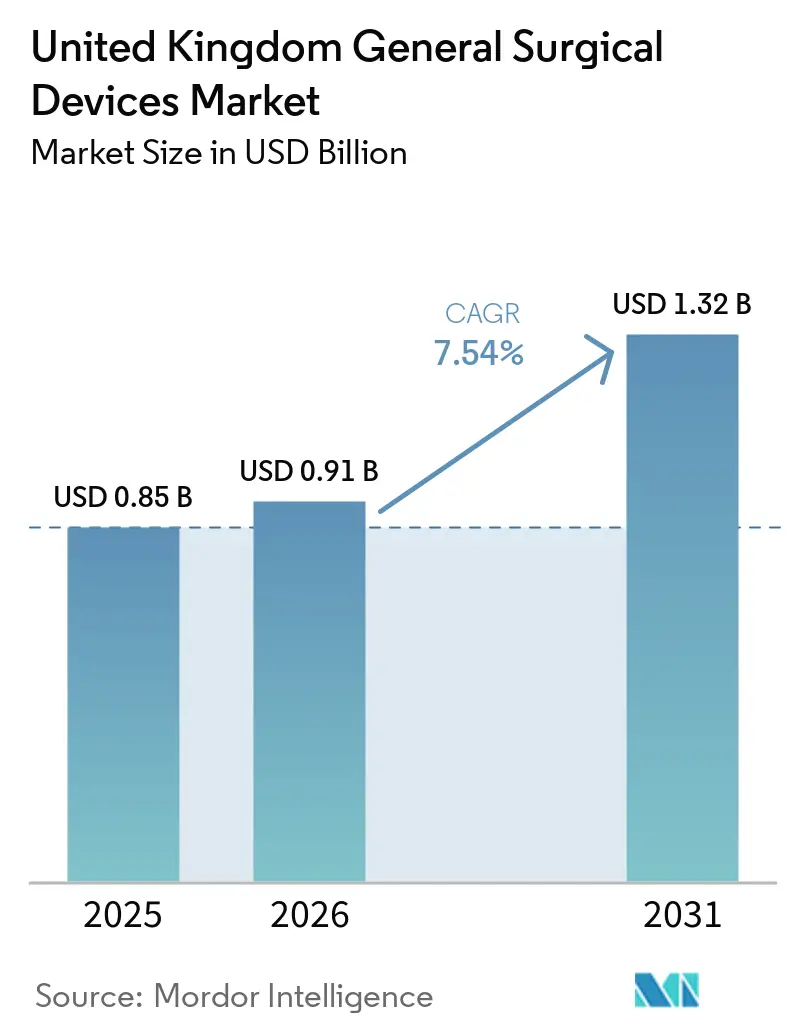
| Base Year Market Size (2025) | USD 0.85 Billion |
| Market Size (2026) | USD 0.91 Billion |
| Market Size (2031) | USD 1.32 Billion |
| Growth Rate (2026 - 2031) | 7.54 % |
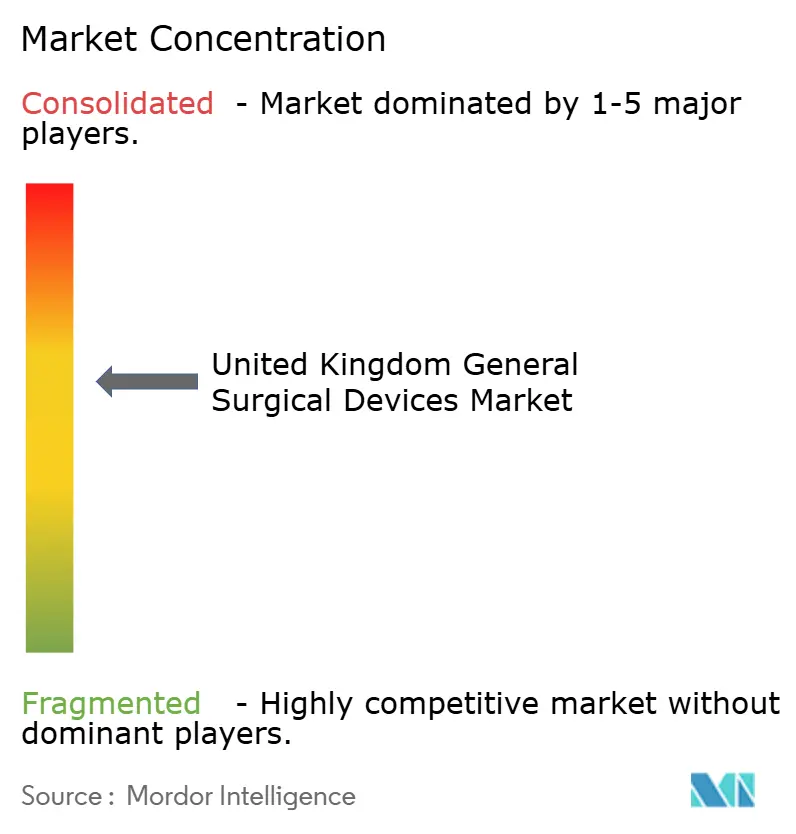
| Market Concentration | Medium |
Major Players *Disclaimer: Major Players sorted in no particular order Image © Mordor Intelligence. Reuse requires attribution under CC BY 4.0. | |
United Kingdom General Surgical Devices Market Analysis by Mordor Intelligence
The United Kingdom General Surgical Devices Market size was valued at USD 0.85 billion in 2025 and estimated to grow from USD 0.91 billion in 2026 to reach USD 1.32 billion by 2031, at a CAGR of 7.54% during the forecast period (2026-2031). Growth is anchored in the National Health Service (NHS) pivot toward minimally invasive and day-case surgery, the rapid approval of 11 robotic systems by the National Institute for Health and Care Excellence (NICE),[1] and sustained demand for data-rich surgical analytics despite capital budget headwinds. A rising trauma and chronic-disease burden, especially among an aging population, accelerates orthopedic and cardiovascular procedures, while carbon-footprint-linked procurement criteria advantage suppliers of reusable or low-waste instruments. Regulatory transitions to UKCA marking create short-term uncertainty, but phased implementation mitigates immediate supply shocks and favors incumbents with strong compliance infrastructure.
Key Report Takeaways
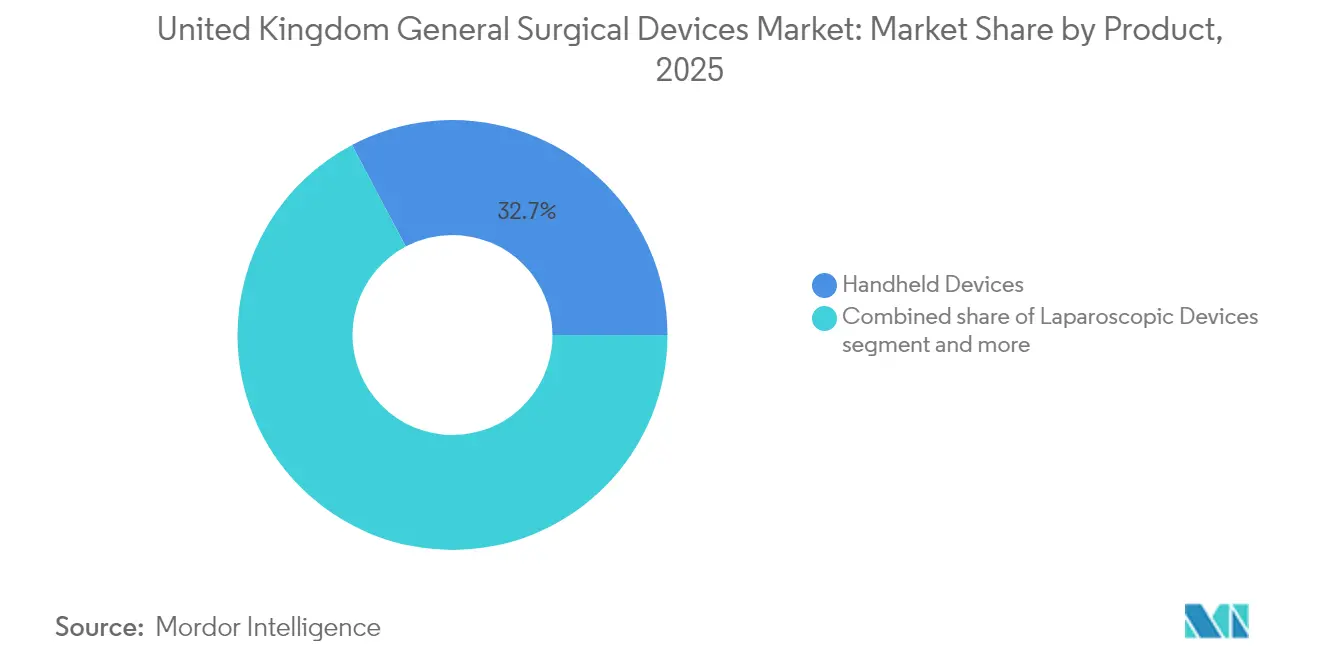
- By product, Handheld Devices led with 32.74% revenue share in 2025, while Wound Closure Devices are projected to grow at an 8.59% CAGR to 2031.
- By procedure approach, Minimally Invasive Surgery captured 72.88% of the UK general surgical devices market share in 2025 and is advancing at an 8.34% CAGR through 2031.
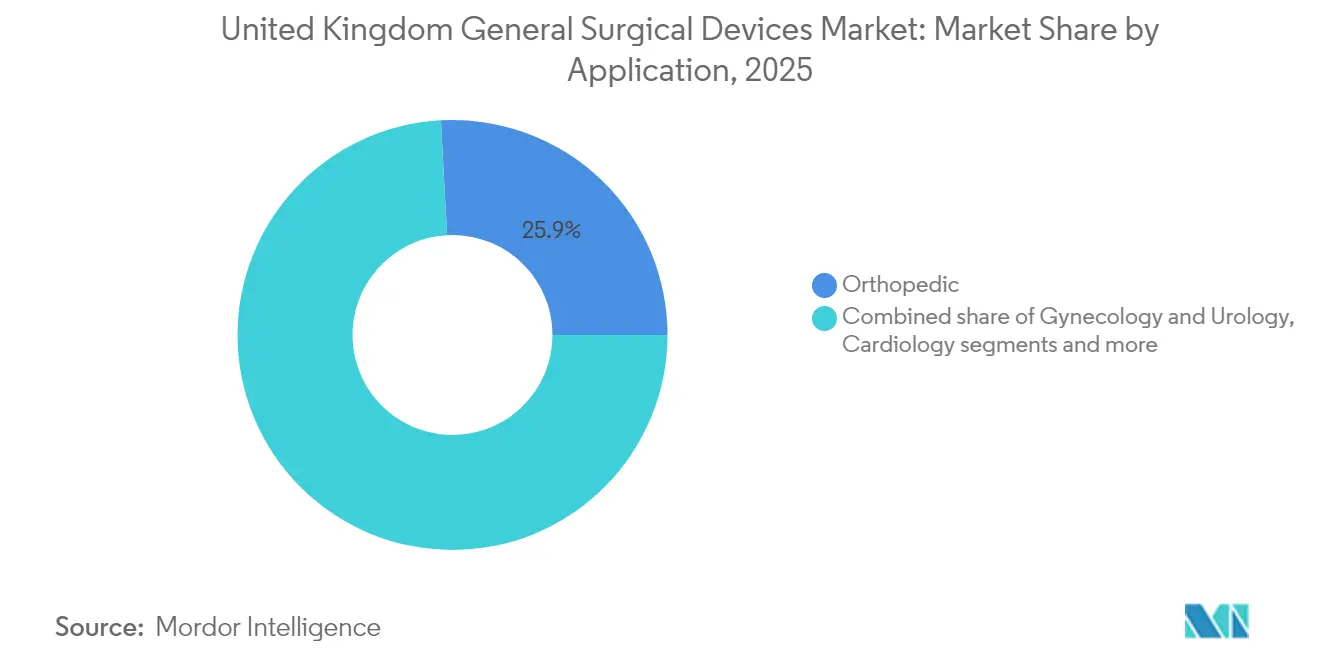
- By application, Orthopedic procedures accounted for a 25.86% share of the UK general surgical devices market size in 2025; Gynecology and Urology applications are expanding fastest at an 8.55% CAGR to 2031.
- By end user, hospitals held 71.12% share in 2025, whereas ambulatory surgical centres are poised for a 7.88% CAGR to 2031.
Note: Market size and forecast figures in this report are generated using Mordor Intelligence’s proprietary estimation framework, updated with the latest available data and insights as of 2026.
United Kingdom General Surgical Devices Market Trends and Insights
Drivers Impact Analysis*
| Driver | (~) % Impact on CAGR Forecast | Geographic Relevance | Impact Timeline |
|---|---|---|---|
| Rising demand for minimally-invasive devices | +2.1% | National, with concentration in major NHS trusts | Medium term (2-4 years) |
| Increasing prevalence of trauma & chronic diseases | +1.8% | National, with higher impact in aging population centers | Long term (≥ 4 years) |
| NHS long-term plan to cut inpatient stay via day-case surgery | +1.5% | National, with early adoption in specialized surgical centers | Medium term (2-4 years) |
| Shift to single-use instruments to mitigate hospital-acquired-infection risk | +1.2% | National, with priority in high-risk surgical departments | Short term (≤ 2 years) |
| OR digitalisation enabling device-level data analytics | +0.8% | National, with leading implementation in teaching hospitals | Medium term (2-4 years) |
| Carbon-footprint‐linked procurement scoring in NHS supply chain | +0.3% | National, with emphasis on sustainability-focused trusts | Long term (≥ 4 years) |
| Source: Mordor Intelligence | |||
Rising demand for minimally invasive devices
Robotic and laparoscopic platforms continue to displace open techniques, with Portsmouth’s Queen Alexandra Hospital converting all keyhole day-case procedures to Da Vinci systems and cutting length of stay for eligible patients. The Versius Surgical Registry recorded only 5.4% conversions in 2,083 procedures, underscoring reliability and surgeon acceptance. Paediatric adoption is growing after Southampton Children’s Hospital performed the UK’s first robotic kidney surgery in children. Integration of analytics modules, such as Versius Clinical Insights, supplies real-time benchmarks that shorten learning curves for new users.[2]
Increasing prevalence of trauma & chronic diseases
Elective-care recovery plans highlight orthopedic robotics: Barking, Havering and Redbridge (BHR) Hospitals logged 100 robotic joint replacements by mid-2024 with the Mako robot, citing accuracy gains and faster mobilisation. Negative-pressure wound therapy systems like PICO Single Use are scaling for complex wounds, lowering infection incidence and length of stay. The geko neuromuscular stimulator improved venous-leg-ulcer healing probability by 68%, offering 15% cost offsets on long-term wound care.[3] Collectively, these dynamics lift procedure volumes and diversify device demand across hospitals.
NHS long-term plan to cut inpatient stay via day-case surgery
The NHS's systematic expansion of day-case surgery capabilities is reshaping device procurement priorities toward portable, efficient, and patient-friendly technologies. Remote-monitoring contracts published on the Find-a-Tender portal demonstrate NHS appetite for virtual wards and post-operative telehealth tools that pair with connected surgical devices. These priorities sustain demand for lightweight electrosurgical units, advanced hemostats and app-enabled wound closures.
Shift to single-use instruments to mitigate hospital-acquired-infection risk
Mandatory single-use protocols for tonsillectomy and other high-risk ENT procedures remain in force due to prion disease concerns. Multicentre evidence shows equivalent safety to reusable sets while removing cross-contamination risk. Sustainability pushes have catalysed hybrid approaches: life-cycle assessments indicate 38-56% lower carbon impact for reusable alternatives in some categories, spurring R&D into reprocessing-compatible alloys.
Restraints Impact Analysis*
| Restraint | (~) % Impact on CAGR Forecast | Geographic Relevance | Impact Timeline |
|---|---|---|---|
| Stringent MDR/UKCA regulatory timelines | -1.4% | National, with higher impact on smaller device manufacturers | Short term (≤ 2 years) |
| Capital-budget headwinds in NHS trusts | -1.1% | National, with acute pressure on foundation trusts | Medium term (2-4 years) |
| Supply chain vulnerabilities | -0.7% | National, with regional variations in supplier diversity | Short term (≤ 2 years) |
| Surgeons' skills gap for advanced robotics | -0.5% | National, with concentration in specialized surgical centers | Long term (≥ 4 years) |
| Source: Mordor Intelligence | |||
Stringent MDR/UKCA regulatory timelines
Brexit-driven divergence requires UKCA marking for new devices from 2028, while transitional relief permits CE-marked products until then. Manufacturers must create incident-report data feeds conforming to new schemas by June 2025, elevating compliance costs. Overseas firms must appoint UK Responsible Persons, adding logistical layers and delaying launch timelines.
Capital-budget headwinds in NHS trusts
A USD 6.4 billion annual investment gap restricts equipment renewal, forcing trusts to chase 4% efficiency savings and favour outcome-based or lease contracts over outright purchases. Capital allocations for 2025-26 reach only USD 3.96 billion, underscoring scarcity relative to operating budgets.[4] Surgical device manufacturers are responding by developing leasing programs, servitization models, and outcome-based contracts that align payment structures with clinical value delivery rather than upfront capital requirements.
*Our forecasts treat driver/restraint impacts as directional, not additive. The impact forecasts reflect baseline growth, mix effects, and variable interactions.
Segment Analysis
By Product: Handheld Devices Lead Market Share
Handheld Devices generated 32.74% of 2025 revenue within the UK general surgical devices market. The UK general surgical devices market size for this segment equated to USD 0.28 billion in 2025 and is projected to advance at 6.18% CAGR through 2031. Hospitals favour their portability and cross-specialty utility, which maximises usage rates versus capital-intensive robots. Wound Closure Devices, led by bioabsorbable electro-stimulation sutures, will climb fastest at 8.59% CAGR, backed by evidence of accelerated healing and lower infection risk.
Continuous innovation sustains demand for electrosurgical pencils, laparoscopic graspers and access trocars. Standardised procedure packs promoted by NHS Supply Chain strengthen procurement of bundled device kits that reduce set-up time and logistics complexity. Domestic producers are responding to import competition with quality-assured European steel and value-added servicing.

By Procedure Approach: Minimally Invasive Surgery Dominates
Minimally invasive surgery devices accounted for 72.88% of the UK general surgical devices market share in 2025; it is forecast to rise at an 8.34% CAGR, reflecting the NHS's strategic commitment to procedures that reduce patient trauma, accelerate recovery, and optimize resource utilization. Implementation of minimally invasive mitral valve surgery in novice centers demonstrated comparable outcomes to conventional approaches while achieving significant reductions in hospital stays from 7 to 5 days.
Open Surgery maintains relevance for complex cases requiring direct visualization and tactile feedback, representing the remaining market share with steady demand in trauma, emergency, and specialized procedures. The procedural shift toward minimally invasive approaches is creating training requirements for surgical teams, with AI-driven education systems demonstrating improved skill acquisition and retention in laparoscopic techniques.
By Application: Orthopedic Procedures Lead, Gynecology and Urology Surge
Orthopedics generated the single-largest revenue block at 25.86% in 2025 thanks to high joint-replacement volumes and trauma repairs. Cardiology applications maintain steady growth through continued innovation in minimally invasive cardiac procedures and device technologies. Neurology procedures benefit from precision requirements that favor robotic assistance and advanced imaging capabilities. Other Applications encompass diverse surgical specialties with varying growth trajectories based on technological advancement and clinical adoption patterns.
Gynecology and Urology together achieve the swiftest expansion at 8.55% CAGR, spurred by Olympus 4K endoscopy optics and first-in-region robotic hysterectomies. Narrow-band imaging and blue-light cystoscopy advance tumour detection rates, stimulating device upgrades at cancer hubs. Dartford and Gravesham NHS Trust performed the first robotic-assisted hysterectomy in Kent and Medway using the da Vinci system, demonstrating the expanding adoption of robotic technologies in gynecological procedures.
By End User: Hospitals Dominate, Ambulatory Centres Accelerate
Hospitals controlled 71.12% revenue in 2025 because complex robotics and vascular interventions remain inpatient-centric. Yet ambulatory surgical centres will grow 7.88% annually. The shift toward ambulatory care is supported by evidence showing that complex procedures like thyroidectomy, joint arthroplasty, and spinal surgery can be safely performed in day-case settings with appropriate patient selection and care protocols.
Trusts pursuing bed-capacity relief invest in portable anaesthesia, smart wound closure and remote-monitoring kits that enable safe discharge. Outcome-based contracts tie device payments to reduced readmissions, appealing in tight capital-budget settings. The British Association of Day Surgery's promotion of best practices and educational initiatives is facilitating the safe expansion of complex procedures into ambulatory settings, creating sustained demand for appropriate surgical technologies.
Geography Analysis
England comprises roughly 84% of the UK population and commands the lion’s share of the UK general surgical devices market, anchored by London, Manchester and Birmingham teaching hospitals that pioneer robotics and digital analytics. Guy’s and St Thomas’ adoption of the Versius robot exemplifies early-mover leverage over neighbouring trusts.
Scotland, Wales and Northern Ireland show differentiated procurement rules: Northern Ireland still adheres to EU MDR, requiring CE marking, whereas UKCA applies to Great Britain, creating dual-path compliance for multi-site vendors. Wales leads in digital performance analytics, with two health boards integrating Versius Clinical Insights for continuous quality improvement.
Regional integrated-care systems increasingly pool demand via collaborative tenders that weight carbon metrics, whole-life cost and clinical outcomes, favouring suppliers equipped with validated environmental data.
Regulatory Landscape
General surgical devices in the United Kingdom are regulated as medical devices under the Medical Devices Regulations 2002 (as amended), with the Medicines and Healthcare products Regulatory Agency (MHRA) acting as the competent authority for registrations, vigilance, and enforcement. Post-Brexit conformity requirements continue to run on a dual-track basis: CE-marked devices remain accepted in Great Britain under transitional arrangements, while UKCA becomes the long-term route as the UK moves toward a standalone framework. This transition also includes requirements for overseas manufacturers to appoint a UK Responsible Person and maintain UK device registration details with the MHRA.
In 2026, regulatory reform activity increased, with the MHRA publishing draft Medical Devices (Amendment) Regulations 2026 (8 May 2026) and running a stakeholder impact survey from 11 May 2026 to 19 June 2026. The MHRA also tightened registration data quality by removing Pseudo GMDN terms from migrated device registration accounts effective 31 March 2026, requiring updates to active GMDN codes. For suppliers supplying handheld instruments, electrosurgical tools, and wound-closure adjuncts into NHS channels, this raises portfolio maintenance effort for both incumbents and new entrants.
Value Chain Analysis
The UK general surgical devices value chain starts with raw materials and components (medical-grade stainless steel, polymers, coatings, and electronics for energy-based and connected instruments). It then covers design, manufacturing, and quality assurance aligned to MHRA requirements and NHS tender specifications. Imports remain important for many device categories, while in-country value add is concentrated in final assembly for some product lines, kitting into standardized procedure packs, and service layers such as instrument maintenance, decontamination support, and recycling programs that reduce theatre downtime and simplify logistics.
Distribution and purchasing are strongly shaped by centralized and collaborative procurement. NHS Supply Chain frameworks and trust-level tenders steer channel access, with procurement shifting toward total cost of ownership and sustainability metrics. In June 2026, the UK published national Value-Based Procurement (VBP) standard guidance for medical technology, including a minimum 10% weighting for social value. The guidance pushes suppliers to evidence carbon-footprint data, resilience measures (for example, Tier 2 and Tier 3 monitoring), and broader outcomes-based propositions alongside price and availability.
Competitive Landscape
The UK general surgical devices market hosts moderate fragmentation: top five firms hold 48% revenue, with Intuitive Surgical, CMR Surgical, Stryker, Smith & Nephew and Medtronic in the lead. Hologic’s USD 310 million acquisition of Endomagnetics adds magnetic-tracing tech to its breast-surgery suite, signalling portfolio deepening. Smith & Nephew earmarked USD 3.92 billion for R&D and M&A to expand orthopedics and wound care, illustrating capital-intensive playbooks.
Emerging disruptor CMR Surgical combines ergonomic arm design with cloud-based analytics to lower operating height and deliver benchmarking dashboards that resonate with NHS digital roadmaps. Its mooted USD 4 billion sale could reshape bargaining power if a larger conglomerate absorbs its installed base.
Post-Brexit supply chain resilience has become a differentiator; vendors now dual-source critical components and hold six months’ inventory to mitigate port delays. Outcome-based pricing—where payment hinges on reduced complications or days-of-stay—gains favour as trusts pursue cost-containment without deferring innovation.
United Kingdom General Surgical Devices Industry Leaders
-
B. Braun SE
-
Stryker
-
Boston Scientific Corporation
-
Medtronic plc
-
Stryker Corporation
-
Johnson & Johnson (Ethicon)
- *Disclaimer: Major Players sorted in no particular order
Market Opportunities and Future Outlook
Opportunities center on procurement models and adoption programs that help reduce barriers to upgrading core instrument sets without large upfront capital. The NHS MedTech Funding Mandate (effective from April 2024) provides a route for selected NICE-recommended, cost-saving technologies to be adopted with fewer funding constraints, and the NHS MedTech spend base (around GBP 13 billion) makes even incremental penetration meaningful for suppliers that can evidence pathway impact such as shorter length of stay or reduced complications. Within the report scope, this supports whitespace for data-linked instruments and adjunct devices that fit day-case pathways, including advanced handheld energy tools, hemostasis solutions, and post-operative monitoring-compatible wound management.
Regulatory and commercial reforms also create clearer routes for differentiated entrants. The MHRA has advanced medical device reform, with post-market surveillance requirements taking effect in 2025 and further consultation activity in 2026. It has also signaled streamlined routes to market, including reliance concepts and ongoing recognition of established approvals. In parallel, a MedTech Commercial Strategy program has been tendered to reduce fragmentation across NHS England, DHSC, and NHS Supply Chain, creating clearer requirements for suppliers that can package compliant documentation, traceability-ready registration data (active GMDN maintenance), and value-based evidence into national and regional tenders.
Recent Industry Developments
- July 2026: Surgical Holdings added Bissinger Medizintechnik bipolar electrosurgical instruments to its UK distribution portfolio, expanding access to reusable forceps and scissors used across multiple surgical specialties. The new line supports supply continuity for electrosurgical consumables and helps hospitals source options consistent with availability and reprocessing workflows.
- May 2026: Stryker launched the Pangea Plating System in Europe and completed the first clinical case at St. George's University Hospital in London. The launch brings new orthopedic fixation options into UK hospitals, where procedure volume and throughput targets drive demand for updated instrument and implant ecosystems.
- November 2024: Halma acquired Lamidey Noury Medical to expand its healthcare device offerings through portfolio consolidation. The deal points to ongoing M&A activity that can broaden distribution reach and product breadth for surgical device categories used by UK providers.
Research Methodology Framework and Report Scope
Market Definition and Coverage
This market is defined as revenue generated in the United Kingdom from general surgical devices used in the operating room to access, visualize, cut, grasp, dissect, and seal tissue in open and minimally invasive procedures.
Scope exclusions: We exclude surgical sutures, single-use drapes, and large capital robotic surgery platforms from this sizing.
Segmentation Overview
- By Product
- Handheld Devices
- Laparoscopic Devices
- Electrosurgical Devices
- Wound Closure Devices
- Trocars and Access Devices
- Other Products
- By Procedure Approach
- Open Surgery
- Minimally Invasive Surgery
- By Application
- Gynecology and Urology
- Cardiology
- Orthopedic
- Neurology
- Other Applications
- By End User
- Hospitals
- Ambulatory Surgical Centres
- Other End Users
Data Sources, Market Sizing, and Validation
Desk Research
Desk work starts by building a simple fact base on surgery activity, hospital purchasing, and device adoption patterns in the UK. For this, we rely on public sources such as NHS England statistics and publications, UK Office for National Statistics health and population tables, guidance and safety notices from the Medicines and Healthcare products Regulatory Agency, and tariff and import codes published by HM Revenue and Customs.
Next, we refine the storyline by reading clinical guidelines and evidence summaries, plus academic articles that explain how procedure approach and technique changes affect device use. We also review company annual reports, investor presentations, association websites, and reputable press coverage to confirm product mix shifts and pricing direction. Where helpful, we use paid subscriptions for company financials and news intelligence, and we use patent databases to track product launches and technology movement. These examples are not exhaustive, and other public and paid sources are also referenced to collect, cross-check, and clarify data points.
Primary Interviews and Surveys
Primary work is used to stress-test model inputs that desk sources cannot reliably pin down, especially typical device use per procedure, procurement cycles, and how pricing changes after tender renewals. We speak with a mix of hospital procurement stakeholders, operating room clinicians, and distribution-side professionals across the UK, so assumptions can be adjusted to what is happening in current practice.
Distribution of primary research fieldwork respondents
| Company type | Respondent position |
|---|---|
| Top tier: 27% | CXOs: 15% |
| Mid tier: 57% | Functional/Unit leaders: 29% |
| Smaller Players: 16% | Managers: 56% |
Market-Sizing & Forecasting
Sizing is built using a top-down approach, where procedure volumes and surgical setting mix are reconstructed into an addressable device demand pool. We then convert that demand to revenue using realistic utilization and pricing assumptions. In parallel, we run selective bottom-up checks by sampling a set of common device categories and validating the implied volumes and average selling prices through channel discussions and hospital buying behavior.
Several inputs drive the outcome, so we track them closely, and we update the model if they move. Examples include elective surgery throughput and waiting list pressure, the open versus minimally invasive mix for common procedures, average instrument set usage per case, replacement and reprocessing patterns for reusable tools, tender timing in large NHS trusts, and the direction of average selling price changes after contract renewals. Forecasting is then done using scenario analysis, where near-term procedure recovery, procurement cadence, and inflationary pricing are varied within ranges confirmed by interviews. A central case is selected once the assumptions reconcile with observed market signals. When any sub-category has weak public visibility, gaps are handled using conservative adoption curves, and the implied totals are re-checked with expert feedback.
Data Validation & Update Cycle
Outputs are validated by comparing the modeled totals with independent demand signals, such as procedure activity direction, public procurement patterns, and the expected share of general surgical tools within broader surgical device spend. When a number looks off, we trace it back to the driver level so unit rates, pricing, or procedure mix assumptions can be corrected before sign-off.
We follow a multi-step analyst review process so logic and math are checked more than once, and any large variances between sources are documented and explained. Reports are refreshed annually, with interim updates when a material event occurs, such as a major guideline change, reimbursement shift, or a procurement pattern change. Before delivery, a final pass is completed so clients receive the latest updated view rather than an older snapshot.
Mordor Intelligence's UK General Surgical Devices Market Sizing Compared With Other Published Estimates
Published market sizes for UK general surgical devices often do not line up, even when the market name looks the same, because each study draws the line around products and care settings a bit differently. The table makes this visible quickly, since the figures spread mainly due to what gets counted inside the market and how prices and procedure activity are carried forward.
The table shows a lower value than some widely circulated numbers, and in Mordor Intelligence's model revenue is counted for general surgical instruments used for access, cutting, grasping, sealing, and visualization, while excluding sutures, single-use drapes, and large capital robotics platforms (which can inflate totals if they are bundled in). Differences can also come from whether the year is treated as a base case or an aggressive recovery scenario for elective surgery, how currency timing is handled, and whether tender-led price resets are applied consistently across the forecast window.
Benchmark comparison
| Source | Market Size | Gaps in Research Methodology |
|---|---|---|
| Mordor Intelligence | USD 0.91 B (2026) | |
| Global Consultancy A | USD 1.50 B (2024) | Uses a broader product boundary that groups in surgical sutures and staplers and also includes robotic surgical systems, which pushes up the revenue pool beyond general surgical instruments. |
| Regional Consultancy B | USD 0.85 B (2025) | Anchors the estimate to a different base year and tends to hold procedure recovery and tender pricing more conservatively, which reduces the implied instrument demand and average selling price progression. |
Overall, the spread across sources is explained by scope choices first, and then by how procedure mix, pricing resets, and base-year alignment are treated. By keeping the model tied to a defined instrument demand pool and checking it against practical purchasing behavior, the result stays traceable to clear inputs and repeatable steps.
Key Questions Answered in the Report
What is the current size of the UK general surgical devices market?
The UK general surgical devices market size is USD 0.91 billion in 2026 and is projected to hit USD 1.32 billion by 2031.
Which product category leads revenue in 2025?
Handheld Devices hold the top position with 32.74% revenue share, driven by their cross-specialty versatility.
Why are data-enabled robotic systems gaining faster acceptance than earlier robotic generations?
The newest platforms bundle cloud analytics that benchmark surgeon performance and flag workflow bottlenecks, helping trusts justify capital outlays through measurable productivity gains and shorter learning curves.
How is the single-use versus reusable instrument debate evolving in UK theatres?
Infection-control protocols still favour single-use instruments for high-risk ENT and neurosurgery, yet trusts are piloting hybrid sets that combine critical disposable items with reprocessable handles to balance safety and environmental goals.