United Kingdom Automotive LED Lighting Market Size and Share
Market Overview
| Study Period | 2020 - 2031 |
|---|---|
| Forecast Data Period | 2026 - 2031 |
| Base Year Market Size (2025) | USD 620.12 Million |
| Market Size (2026) | USD 660.23 Million |
| Market Size (2031) | USD 810.37 Million |
| Growth Rate (2026 - 2031) | 4.18 % |
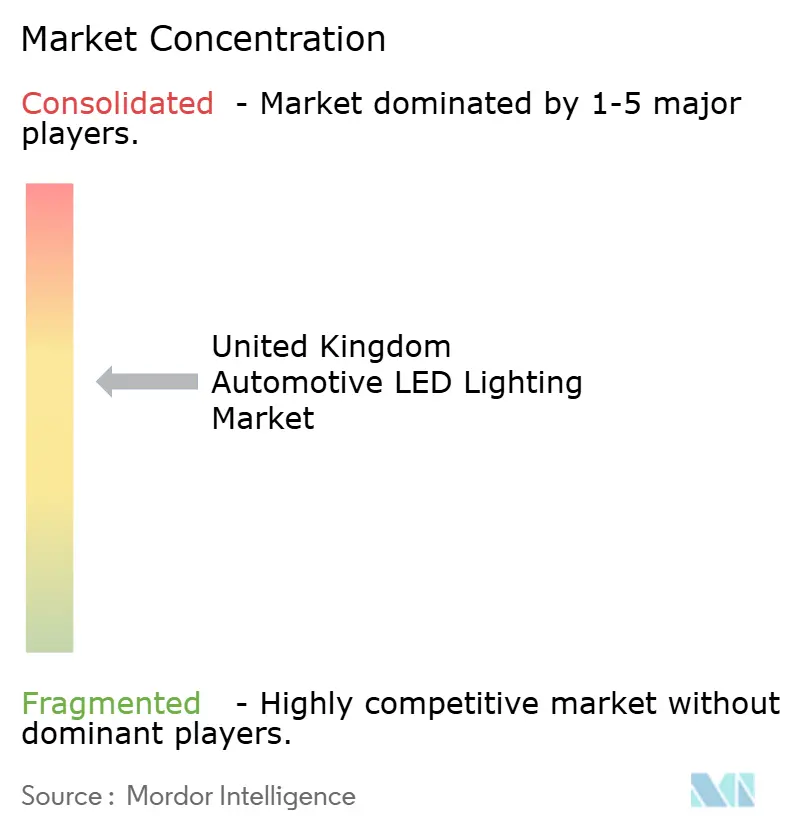
| Market Concentration | Medium |
Major Players *Disclaimer: Major Players sorted in no particular order Image © Mordor Intelligence. Reuse requires attribution under CC BY 4.0. | |
United Kingdom Automotive LED Lighting Market Analysis by Mordor Intelligence
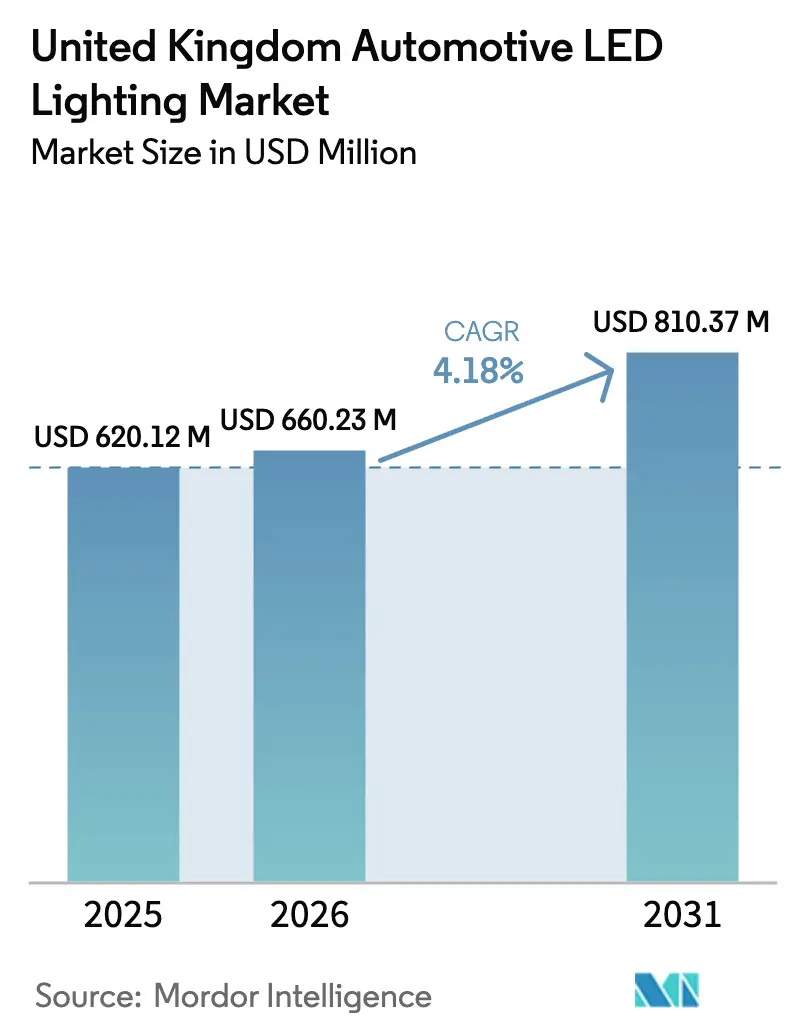
The United Kingdom Automotive LED Lighting Market size is projected to be USD 620.12 million in 2025, USD 660.23 million in 2026, and reach USD 810.37 million by 2031, growing at a CAGR of 4.18% from 2026 to 2031. The steady uptrend reflects the country’s migration from halogen toward semiconductor‐based illumination, a shift accelerated by mandatory LED head-lamp rules, expanding electric-vehicle (EV) registrations, and a vibrant retrofit culture that prizes design flexibility and lower energy draw. Rising smart-motorway coverage is pushing adaptive head-lamp adoption, while declining emitter prices down 15-20% between 2023 and 2025 are squeezing the halogen cost advantage. Supply-chain pressures for gallium-nitride wafers and rare-earth phosphors remain a constraint, yet Tier-1 suppliers are mitigating risk through multi-sourcing and localized inventories. Competitive intensity is tempered by circular-economy moves such as remanufactured LED head-lamps, which lower total cost of ownership and widen market access.
Key Report Takeaways
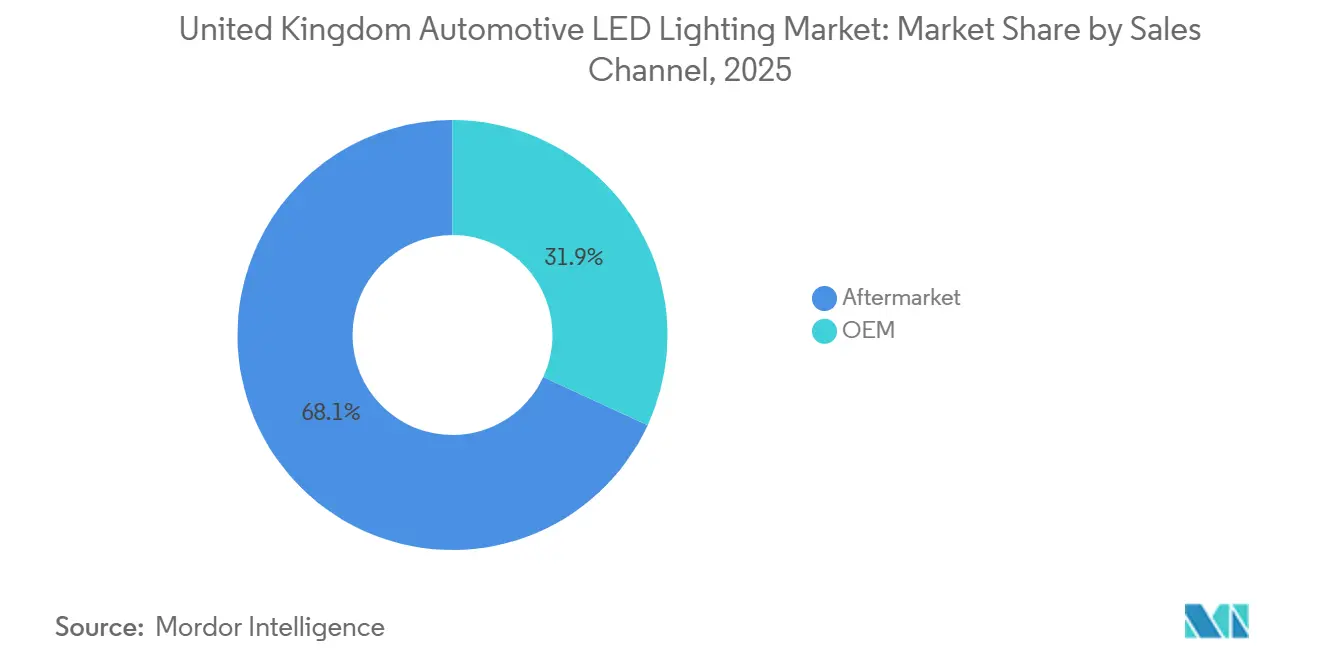
- By sales channel, the aftermarket commanded 68.11% of revenue in 2025, while OEM sales are projected to expand at a 4.83% CAGR through 2031.
- By vehicle type, passenger cars held 62.36% share in 2025, whereas light commercial vehicles are advancing at a 5.12% CAGR to 2031.
- By application, headlamps led with 44.23% of 2025 sales, and ambient lighting is the fastest-growing application at a 6.12% CAGR to 2031.
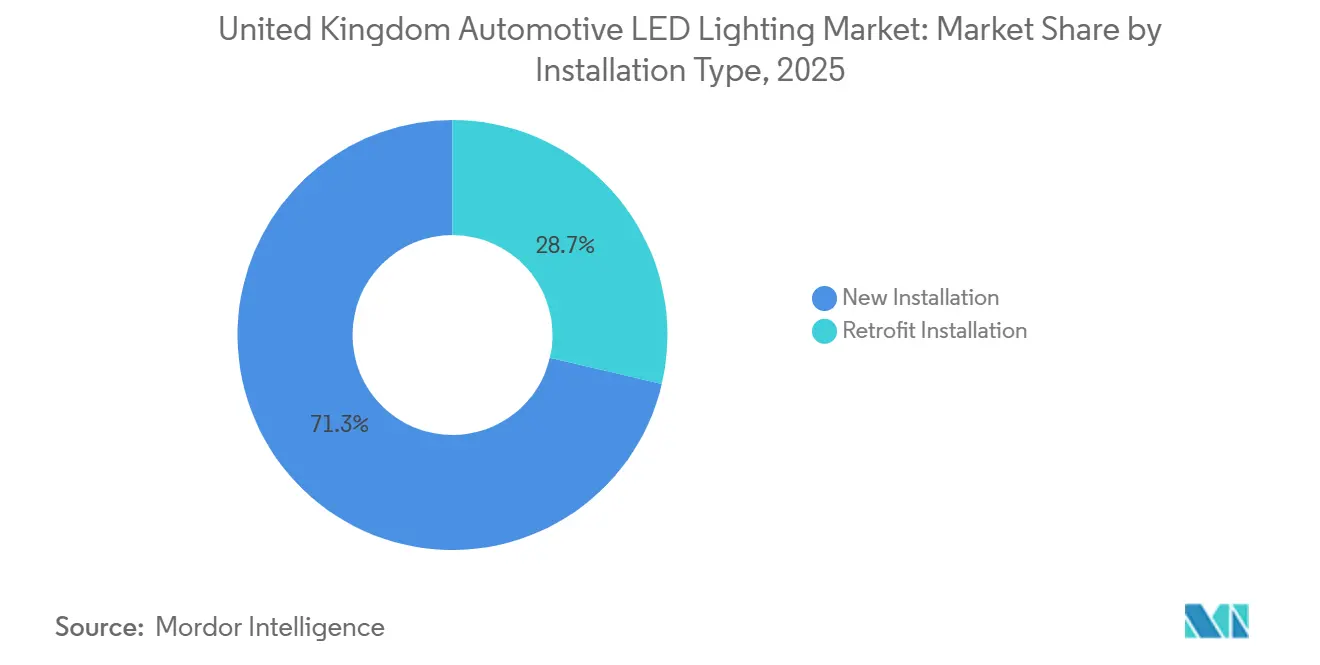
- By installation type, new installation represented 71.34% of revenue in 2025, while retrofit installation is increasing at a 5.86% CAGR to 2031.
Note: Market size and forecast figures in this report are generated using Mordor Intelligence’s proprietary estimation framework, updated with the latest available data and insights as of January 2026.
United Kingdom Automotive LED Lighting Market Trends and Insights
Drivers Impact Analysis*
| Driver | (~) % Impact on CAGR Forecast | Geographic Relevance | Impact Timeline |
|---|---|---|---|
| Mandatory LED Head-Lamp Regulations for New Vehicles | +1.2% | England, Scotland, Wales, Northern Ireland | Medium term (2–4 years) |
| Declining LED Component Costs and Higher Energy Efficiency | +0.9% | Global, aftermarket concentration in England | Long term (≥ 4 years) |
| Rising Electric-Vehicle Sales Boosting Demand for Advanced Lighting | +1.1% | London, Birmingham, Edinburgh, Glasgow | Medium term (2–4 years) |
| Aftermarket Demand for Aesthetic and Performance Upgrades | +0.7% | Southeast and Midlands of England, Wales, Scotland | Short term (≤ 2 years) |
| Smart-Motorway Projects Driving Adaptive Head-Lamp Adoption | +0.5% | M25, M1, M6 corridors | Medium term (2–4 years) |
| Tax Incentives for Domestic Semiconductor Packaging | +0.3% | Manufacturing clusters in England, Scotland | Long term (≥ 4 years) |
| Source: Mordor Intelligence | |||
Mandatory LED Head-Lamp Regulations for New Vehicles
The 2024 rule requiring LED or equivalent semiconductor head-lamps on new type-approved vehicles has turned compliance into a non-negotiable design parameter. Domestic plants assembled 779,584 cars in 2024, and more than 2 million new vehicles reached UK roads in 2025, each now budgeting for LED modules.[1] Tier-1 suppliers have compressed validation cycles joint programs between Valeo and ams OSRAM trimmed ambient-lighting integration from two years to under one setting a new pace for head-lamp rollouts. Ready-certified products such as the ECE R128-approved XLS LR6 rear LED shorten OEM testing, further accelerating penetration. Assembly lines have retooled for thermal-management demands, raising capital outlays yet lowering inventory obsolescence risk. Overall, this regulation adds 1.2 percentage points to the forecast CAGR of the United Kingdom automotive LED lighting market.
Declining LED Component Costs and Higher Energy Efficiency
Emitter oversupply in Asian fab clusters shaved up to one-fifth off LED prices between 2023 and 2025, unlocking mass-market adoption of 180-lumen rear modules once limited to premium trims. Power draw for full-LED head-lamps is 40-60% lower than halogen, an energy gain prized by EV makers seeking longer WLTP ranges. The United Kingdom counted 1.759 million zero-emission vehicles on the road in 2025, a captive base for energy-efficient lighting.[2] Marelli’s LeanLight architecture cut cost by 22% and parts count by 34%, illustrating the march toward cost parity. These gains lift retrofit appeal but compress margins, as plug-and-play kits reach price points acceptable to value-oriented drivers.
Rising Electric-Vehicle Sales Boosting Demand for Advanced Lighting
EVs secured 22.7% of new-car registrations and 9.8% of light commercial vehicle sales in Q3 2025, up 65% year on year. Battery-powered models mandate energy-sipping auxiliaries, pushing OEMs to bundle adaptive matrix head-lamps with driver-assistance packages Auto High Beam featured on 83.6% of new vehicles in 2025. ams OSRAM’s pixelated EVIYOS platform, with EUR 350 million (USD 395 million) in lifetime design-wins, is entering UK-bound production ramps, supporting fine-grain beam shaping without glare. The link between EV incentives and LED demand means any subsidy rollback or charging-infrastructure shortfall would translate quickly into module order volatility. Even so, rising fleet electrification keeps this driver’s medium-term impact high at +1.1 percentage points.
Aftermarket Demand for Aesthetic and Performance Upgrades
The UK automotive aftermarket generated GBP 62.2 billion (USD 78.5 billion) in turnover and employed 339,000 people in 2024, supporting a vast network of garages stocking ECE-approved LED kits. Consumer motivations range from color-tunable daytime running lights to quicker brake-light response. Retrofit kits priced at GBP 150–400 (USD 189–504) vastly outperform halogen bulbs on longevity, and Retrofit Installation is climbing at 5.43% annually. Strict glare rules enforced during MOT tests favor branded solutions such as the NIGHT BREAKER LED H7, the first on-road-legal retrofit in Europe, which underpins sustained short-term demand.
Restraints Impact Analysis*
| Restraint | (~) % Impact on CAGR Forecast | Geographic Relevance | Impact Timeline |
|---|---|---|---|
| Higher Upfront Cost of LED Modules vs Halogen | −0.6% | England, Wales, Northern Ireland | Short term (≤ 2 years) |
| Supply-Chain Risk for Gallium-Nitride and Rare-Earth Inputs | −0.4% | Global, UK exposure via Tier-1 supply | Medium term (2–4 years) |
| Stringent UK Glare Regulations Limiting High-Lumen Retrofits | −0.3% | National enforcement | Long term (≥ 4 years) |
| Surge in Imported Halogen-Equipped Used Vehicles | −0.2% | Wales, Northern Ireland | Short term (≤ 2 years) |
| Source: Mordor Intelligence | |||
Higher Upfront Cost of LED Modules vs Halogen
Full-LED head-lamp assemblies still price 40-70% above halogen, producing payback periods longer than many ownership cycles in cost-sensitive regions. A retrofit pair can cost up to GBP 400 (USD 504) installed versus GBP 50 (USD 63) for halogen bulbs, limiting penetration among budget-constrained motorists. FORVIA HELLA’s 9M 2025 margin squeezed to 2.7% as suppliers absorbed cost inflation rather than pass it through, underscoring profitability pressure. Price resistance is most acute in Northern Ireland and Wales, where used-vehicle sales dominate, clipping 0.6 percentage points from the forecast CAGR.
Supply-Chain Risk for Gallium-Nitride and Rare-Earth Inputs
China refines more than 80% of rare-earths and dominates gallium refining, while key nitride wafer capacity sits in Malaysia, Taiwan, and Japan. ams OSRAM’s Half-Year 2024 report flagged export-license dependencies and highlighted “local-for-local” sourcing plans to mitigate potential blockages. FORVIA HELLA is shifting production to Eastern Europe to cut exposure and costs.[3] Any upstream disruption could force OEMs to fall back on halogen for lower trims, subtracting 0.4 percentage points from growth.
*Our forecasts treat driver/restraint impacts as directional, not additive. The impact forecasts reflect baseline growth, mix effects, and variable interactions.
Segment Analysis
By Sales Channel: Aftermarket Scale Anchors Growth
The aftermarket represented 68.11% of United Kingdom automotive LED lighting market revenue in 2025, buoyed by a 41.964 million-vehicle parc where the median age exceeds eight years. Independent garages leverage this installed base, offering retrofit kits that reduce energy draw and bulb-replacement downtime. The United Kingdom automotive LED lighting market size for OEM sales is smaller, yet OEM revenue is forecast to climb at a 4.83% CAGR as factory-fit LED head-lamps become standard equipment on new EVs and ADAS-enabled models.
OEM adoption is propelled by the 2024 mandate and by design-win pipelines exceeding EUR 2.5 billion (USD 2.83 billion) at ams OSRAM, evidencing long-term volume visibility. Valeo’s April 2025 rollout of a remanufactured LED head-lamp blurs the aftermarket–OEM divide by offering OE quality at retrofit prices. Meanwhile, distributors need value-added services mobile fitting or subscription lighting upgrades to protect margins against falling component costs.

By Vehicle Type: Light Commercial Vehicles Gain Momentum
Passenger cars delivered 62.36% of United Kingdom automotive LED lighting market share in 2025 thanks to their registration volume and high LED take-rates in premium trims. Yet light commercial vehicles (LCVs) are expanding at 5.12% through 2031 as last-mile operators electrify vans and specify adaptive LEDs compatible with smart-motorway systems.
Zero-emission LCVs captured 9.8% of registrations in Q3 2025, up from 5.7% a year earlier. Fleet managers view LED efficiency 40-60% lower power draw than halogen as critical for range and payload. Orders such as FORVIA HELLA’s 2025 LED work-lamp contract with a European bus maker confirm spillover into heavy vehicles. Two-wheelers lag due to cost sensitivity, but an emerging micro-mobility segment could shift that balance later in the decade.
By Installation Type: Retrofit Builds Speed Under Regulatory Guardrails
New installation dominated at 71.34% of revenue in 2025, a lead reinforced by regulatory compulsion for OEM fitment. The United Kingdom automotive LED lighting market size linked to retrofit installation is smaller but projected to rise at 5.43% CAGR as used-car owners swap halogen for plug-and-play LEDs.
Strict MOT glare checks channel demand toward branded kits such as LEDDriving HL EASY, the first retrofit to secure Europe-wide on-road approval. Valeo’s remanufactured modules introduce a hybrid option that mixes OE quality with aftermarket flexibility. Component price deflation continues to cut barriers but narrows distributor margins, encouraging consolidation among smaller chains that cannot fund compliance testing.
By Application: Head-Lamps Lead, Ambient Lighting Excels
Head-lamps delivered 44.23% of 2025 revenue and remain the flagship application because of high unit price and mandatory status under UNECE standards. Adaptive matrix systems enabled by EVIYOS 25,600-pixel emitters add premium revenue layers.
Ambient lighting, though a smaller base, is growing at a 5.86% CAGR on the back of intelligent RGB strips that sync with infotainment cues. The Valeo-ams OSRAM collaboration shortened integration timelines to under a year, accelerating rollout across premium cabins. Exterior running lights, taillights, and fog lamps show stable growth, while interior dome lamps complete the migration from incandescent to LED as platform modularity improves cost efficiency.
Geography Analysis
England anchors the United Kingdom automotive LED lighting market, reflecting its share of vehicle registrations, EV uptake, and aftermarket infrastructure. Zero-emission vehicles reached 4.2% of the 41.607 million licensed vehicles nationwide in 2025, with London and Birmingham leading adoption. England’s smart-motorway corridors (M25, M1, M6) demand adaptive head-lamps, pulling matrix LED technology into mid-range models.
Scotland holds outsize influence relative to population, as Edinburgh and Glasgow deploy charging networks that lift EV penetration and LED fitment rates. Rural stretches benefit from improved night visibility, making LED upgrades popular among fleet operators. Wales and Northern Ireland trail in share because of lower median incomes and higher reliance on imported used vehicles equipped with halogen, a trend that lengthens the retrofit window.
Regional MOT enforcement is consistent, yet Wales and Northern Ireland experience stricter glare re-tests for retrofits, adding compliance costs. Production shifts by Tier-1s FORVIA HELLA’s move toward Eastern Europe may trim UK module assembly, but local tax incentives for semiconductor packaging could lure new back-end capacity to northern England and Scotland, buffering supply-chain risk.
Competitive Landscape
Global Tier-1s Valeo, Hella, Koito, ams OSRAM, Marelli dominate OEM design wins, embedding vertically integrated emitter, optic, and software capabilities. ams OSRAM booked EUR 2.5 billion (USD 2.83 billion) in automotive LED design-wins in H1 2024, making lighting its largest segment.[4] Valeo’s remanufactured head-lamp initiative signals a circular-economy play that could reset price anchors and warranty norms.
Marelli’s h-Digi microLED head-lamp, winner of the 2024 CLEPA Top Innovator award, demonstrates migration of high-resolution matrix lighting into volume segments. Marelli’s Chapter 11 filing in June 2025 introduces counterparty risk for long-lead UK programs, potentially diverting contracts to more solvent rivals. Chinese entrants offer low-cost gallium-nitride emitters but face hurdles meeting ECE and TISAX standards.
Strategic focus is shifting toward software-updatable lighting that monetizes over-the-air animations. Sustainability credentials increasingly influence sourcing; Marelli’s products contained 21% recycled resin in 2024, while Valeo and Forvia pursue ISO 14001 compliance to satisfy OEM carbon-footprint targets.
United Kingdom Automotive LED Lighting Industry Leaders
-
Valeo SE
-
Hella GmbH & Co. KGaA (FORVIA SE)
-
Koito Manufacturing Co., Ltd.
-
ams OSRAM AG
-
Marelli Holdings Co., Ltd.
- *Disclaimer: Major Players sorted in no particular order
Recent Industry Developments
- January 2026: ams OSRAM began volume shipment of EVIYOS 2.0-based 25,600-pixel modules to a German OEM supplying UK-bound EVs.
- November 2025: FORVIA HELLA reported 9M FY2025 Lighting sales of EUR 2.699 billion (USD 3.05 billion), with operating margin down to 2.7%, and launched an efficiency program relocating production to Eastern Europe.
- June 2025: Marelli filed for voluntary U.S. Chapter 11 with USD 1.24 billion debtor-in-possession financing, stating operations would continue during restructuring.
- April 2025: Valeo and Stellantis rolled out Europe’s first remanufactured LED head-lamp, targeting aftermarket and aftersales channels across the United Kingdom.
United Kingdom Automotive LED Lighting Market Report Scope
The United Kingdom automotive LED lighting market is experiencing significant growth, driven by advancements in LED technology, increasing adoption of energy-efficient lighting solutions, and rising consumer preference for enhanced vehicle aesthetics and safety. The market is also influenced by stringent government regulations promoting the use of eco-friendly lighting systems in vehicles.
The United Kingdom Automotive LED Lighting Market Report is Segmented by Sales Channel (OEM, Aftermarket), Vehicle Type (Passenger Cars, Light Commercial Vehicles, Heavy Commercial Vehicles, Two-Wheelers), Installation Type (New Installation, Retrofit Installation), Application (Exterior Lighting: Headlamps, Daytime Running Lights, Taillights, Fog Lamps, Turn Signals, Other Exterior Lightings; Interior Lighting: Dome and Map Lights, Ambient Lighting, Instrument Cluster and Infotainment Back-Lighting, Other Interior Lightings), and Geography (England, Scotland, Wales, Northern Ireland). The Market Forecasts are Provided in Terms of Value (USD).
| OEM |
| Aftermarket |
| Passenger Cars |
| Light Commercial Vehicles |
| Heavy Commercial Vehicles |
| Two-Wheelers |
| New Installation |
| Retrofit Installation |
| Exterior Lighting | Headlamps |
| Daytime Running Lights | |
| Taillights | |
| Fog Lamps | |
| Turn Signals | |
| Other Exterior Lightings | |
| Interior Lighting | Dome and Map Lights |
| Ambient Lighting | |
| Instrument Cluster and Infotainment Back-Lighting | |
| Other Interior Lightings |
| By Sales Channel | OEM | |
| Aftermarket | ||
| By Vehicle Type | Passenger Cars | |
| Light Commercial Vehicles | ||
| Heavy Commercial Vehicles | ||
| Two-Wheelers | ||
| By Installation Type | New Installation | |
| Retrofit Installation | ||
| By Application | Exterior Lighting | Headlamps |
| Daytime Running Lights | ||
| Taillights | ||
| Fog Lamps | ||
| Turn Signals | ||
| Other Exterior Lightings | ||
| Interior Lighting | Dome and Map Lights | |
| Ambient Lighting | ||
| Instrument Cluster and Infotainment Back-Lighting | ||
| Other Interior Lightings | ||
Market Definition
- INDOOR LIGHTING - It incorporates all LED based lamps and fixtures/luminaire that are used to illuminate indoor section of residential, commercial, industrial buildings and agricultural lighting. LED offers efficient brightness with higher durability in comparison to other lighting technology.
- OUTDOOR LIGHTING - It incorporates the LED lighting fixtures that is used for illumination for exterior/outdoor illumination. For instance, LED lighting fixtures used to illuminate streets and highways, transport hubs, stadiums and other public places such as parking spaces.
- AUTOMOTIVE LIGHTING - It refers to the lighting fixtures installed for illumination and signaling purposes. It is used in both exterior and interior lighting of the vehicle. Headlamps, fog lamp, daytime running light (DRLs) are examples of exterior light whereas cabin light are interior lights.
- END USER - It refers to the end use application area where the LED fixture will be installed. For instance, in terms of indoor lighting, we have residential, commercial and industrial as end user category. For automotive lighting, primary end user considered are automotive manufacturers and aftermarket sale
| Keyword | Definition |
|---|---|
| Lumen | Lumen is a unit of luminous flux in the International System of Units that is equal to the amount of light given out through a solid angle by a source of one-candela intensity radiating equally in all directions. |
| Footcandle | A foot-candle (or foot-candle, fc, lm/ft2, or ft-c) is a measurement of light intensity. One foot-candle is defined as enough light to saturate a one-foot square with one lumen of light. |
| Colour Rendering Index (CRI) | Color Rendering Index (CRI) is a measurement of how natural colors render under an artificial white light source when compared with sunlight. The index is measured from 0-100, with a perfect 100 indicating that colors of objects under the light source appear the same as they would under natural sunlight. |
| Luminous flux | Luminous flux is a measure of the power of visible light produced by a light source or light fitting. It is measured in lumens (lm). |
| Annual Energy Cost | Annual Energy Cost means the average daily energy consumption multiplied by 365 (days per year), expressed in kilowatt hour per year (kWh/a). |
| Constant voltage drivers | Constant voltage drivers are designed for a single direct current (DC) output voltage. Most common constant voltage drivers (or Power Supplies) are 12VDC or 24VDC. An LED light that is rated for constant voltage usually specifies the amount of input voltage it needs to operate correctly. |
| Constant Current Driver | Constant current LED drivers are designed for a designated range of output voltages and a fixed output current (mA). LEDs that are rated to operate on a constant current driver require a designated supply of current usually specified in milliamps (mA) or amps (A). These drivers vary the voltage along an electronic circuit which allows current to remain constant throughout the LED system. |
| Minimum Energy Performance Standards (MEPS) | Minimum Energy Performance Standards specify the minimum level of energy performance that appliances and equipment must meet or exceed before they can supply or used for commercial purposes. |
| Luminous Efficacy | Luminous efficacy is a measurement commonly used in the lighting industry that indicates the ability of a light source to emit visible light using a given amount of power. |
| Solid State Lighting | Solid-state lighting (SSL) is a type of lighting that uses semiconductor light-emitting diodes (LEDs), organic light-emitting diodes (OLED), or polymer light-emitting diodes (PLED) as sources of illumination rather than electrical filaments, plasma (used in arc lamps such as fluorescent lamps), or gas. |
| Rated Lamp Life | Lamp life, also referred to as rated life, is the time in hours a lamp will last before a percentage of lamps will burn out. |
| Color Temperature | Colour temperature is a scale that measures how ‘warm’ (yellow) or ‘cool’ (blue) the light from a particular source is. It is measured in degrees of the Kelvin scale (abbreviated to K), and the higher the number, the ‘cooler’ the light. The lower the ‘K’ number, the ‘warmer’ the light. |
| Ingress Protection rating (IP rating) | The IP (Ingress Protection) rating of a bulb or light fixture declares the level of protection it has against dirt and water. |
| Fidelity Index | The general colour fidelity index, Rf, represents how closely the colour appearances of the entire sample set are reproduced (rendered) on average by a test light as compared to those under a reference illuminant. |
| Gamut Index | The gamut area is defined as “the area enclosed by a set of test color samples illuminated by a light source, in a two-dimensional chromaticity diagram or a plane of color space.”1 Within a defined color space, a “gamut” describes the subset of colors that can be perceived under specific lighting conditions. |
| Binning | In the lighting industry, the act of "binning" of LEDs is the process of sorting LEDs by certain characteristics, such as color, voltage, and brightness. |
| Accent lighting | Accent lighting, also called highlighting, emphasizes objects by focusing light directly on them. Accent lighting is used inside and outside the home to feature locations such as an entrance or to create dramatic effects. |
| Dimmable driver | A dimming driver has two functions: As a driver, it converts the 230V AC mains input to a low voltage DC output. As a dimmer, it reduces the amount of electrical energy flowing to the LEDs, thereby causing them to dim. |
| Flicker | Flicker is the repeated and frequent variation in the output of a light source over time. |
| Fluorescent | A property of materials defined as the ability to emit light after absorbing electromagnetic radiation such as visible or UV light. |
| Candela | The candela is the unit of luminous intensity in the International System of Units. It measures the light output per unit solid angle emitted from a light source in a specific direction. |
| LUX | Lux is used to measure the amount of light output in a given area - one lux is equal to one lumen per square meter. It enables us to measure the total "amount" of visible light present and the intensity of the illumination on a surface. |
| Uniformity (U0) | The uniformity of lighting has significant effects on visual performance in both indoor and outdoor areas. Uniformity (represented as U0) value can be found by dividing the minimum brightness (Emin) resulting from calculations according to the current lighting order, to the average brightness value (Eavg). |
| Visible Light Spectrum | The visible light spectrum is the segment of the electromagnetic spectrum that the human eye can view. More simply, this range of wavelengths is called visible light. Typically, the human eye can detect wavelengths from 380 to 700 nanometers. |
| Ambient Temperature | Ambient Temperature is the temperature of the air surrounding an electrical enclosure. |
| Current-controlled dimming control | Current-controlled dimming controls LED brightness by varying the applied current using a 0-10V dimmer. Current-controlled dimming is smooth and HD-video friendly. It can only dim to a minimum of 5% of light output. |
| Design Light Consortium | It is a partnership of energy efficiency stakeholders in the United States and Canada to “promote quality, performance and energy efficient lighting solutions for the commercial sector”. |
| Pulse Width Modulation | Pulse-width modulation, or pulse-duration modulation, is a method of controlling the average power delivered by an electrical signal. |
| Surface Mounted Device | A surface mount device (SMD) is an electronic device whose components are mounted or placed directly on the surface of a printed circuit board. |
| Alternating Current | Alternating current is an electric current which periodically reverses direction and changes its magnitude continuously with time, in contrast to direct current, which flows only in one direction. |
| Direct Current | Direct current (DC) is an electric current that is uni-directional, so the flow of charge is always in the same direction. |
| Beam Angle | Beam angle (also called beam spread) is a measure of how light is distributed. On any plane perpendicular to the centerline of the light, the beam angle is the angle between two rays where the light intensity is 50% of the maximum light intensity. |
| LED Based Solar High Mast Lighting Systems | A Solar LED High Mast Light is a raised source of High illumination lights (6~8 lights) and with high intensity on the middle of major junctions (Ring roads, Outer Ring roads), turned on or lit automatically in the absence of light (at specified timings or at periodic times, every night). |
| Surface Mounted Diode (SMD) LEDs | A surface mount diode is a type that emits light and is flat mounted and soldered onto a circuit board. |
| Chip on Board (COB) LEDs | A COB LED is basically multiple LED chips (usually 9 or more) glued directly onto a substrate by the manufacturer to form a single module. |
| Dual In-Line Package (DIP) LEDs | A dual in-line package (DIP or DIL) is an electronic component package with a rectangular case and two parallel rows of electrical connector pins. |
| Graphene LED Lights | A graphene LED light bulb is simply an LED light bulb where the filament has been coated in graphene. A graphene LED bulb is reported to be 10% more efficient than regular LED light bulbs and they are cheaper to manufacture and buy. |
| LED Corn Bulbs | LED Corn lights are designed as an energy efficient alternative to high intensity discharge (HID) and SON lamps. It uses a large number of LEDs on a metal structure to provide sufficient light. This arrangement of LEDs looks a lot like a corn cob, hence the name "corn light". |
| Per Capita Income | Per capita income or total income measures the average income earned per person in a given area in a specified year. It is calculated by dividing the area's total income by its total population. Per capita income is national income divided by population size. |
| Charging Stations | A charging station, also known as a charging station or electric vehicle utility, is a power supply that provides electrical energy for charging plug-in electric vehicles. |
| Headlight | A headlight is a light that is mounted on the front of a car and illuminates the road in front of it. Low beam and high beam LED headlights are additional categories for these LED headlights. |
| Day Time Running Light (DRLs) | A daytime running lamp is a white, yellow, or amber lighting device mounted on the front of a road-going motor vehicle or bicycle. |
| Directional Signal Light | Directional signal lights are the front and rear lights on an automobile that flash to show the direction of a turn. |
| Stop Light | A red light that is mounted to the back of a car and turns on when the brakes are used to show that the car is stopped. |
| Reverse Light | The reverse light is at the back of the vehicle to indicate its backward motion. |
| Tail Light | A red light that can be seen in the dark is mounted on the rear of a road vehicle. Stop, reverse, and directional signal lights are all part of it. |
| Fog Light | Bright lights in automobiles used to increase visibility on the road in foggy conditions or to warn other drivers of the presence of the vehicle. |
| Passenger Vehicle | A passenger vehicle is a road vehicle, other than a moped or a motorcycle, intended for the transportation of people and designed for up to 8 to 9 seats. |
| Commercial Vehicle | A commercial vehicle (Bus, Truck, Van) is any type of motor vehicle used to transport goods or pay passengers. |
| Two Wheelers (2W) | A two-wheeler is a vehicle that runs on two wheels. |
| Streets & Roadways | Both roads and streets refer to hard, flat surfaces on the ground on which vehicles, people, and animals can travel. Since streetways are usually in cities and towns, they often have houses and buildings on both sides. The roadway is in the countryside and sometimes passes through forests and fields |
| Horticulture Lighting | Horticulture is the science and art of sustainably growing, producing, marketing and using high quality, intensively cultivated food and ornamental plants. |
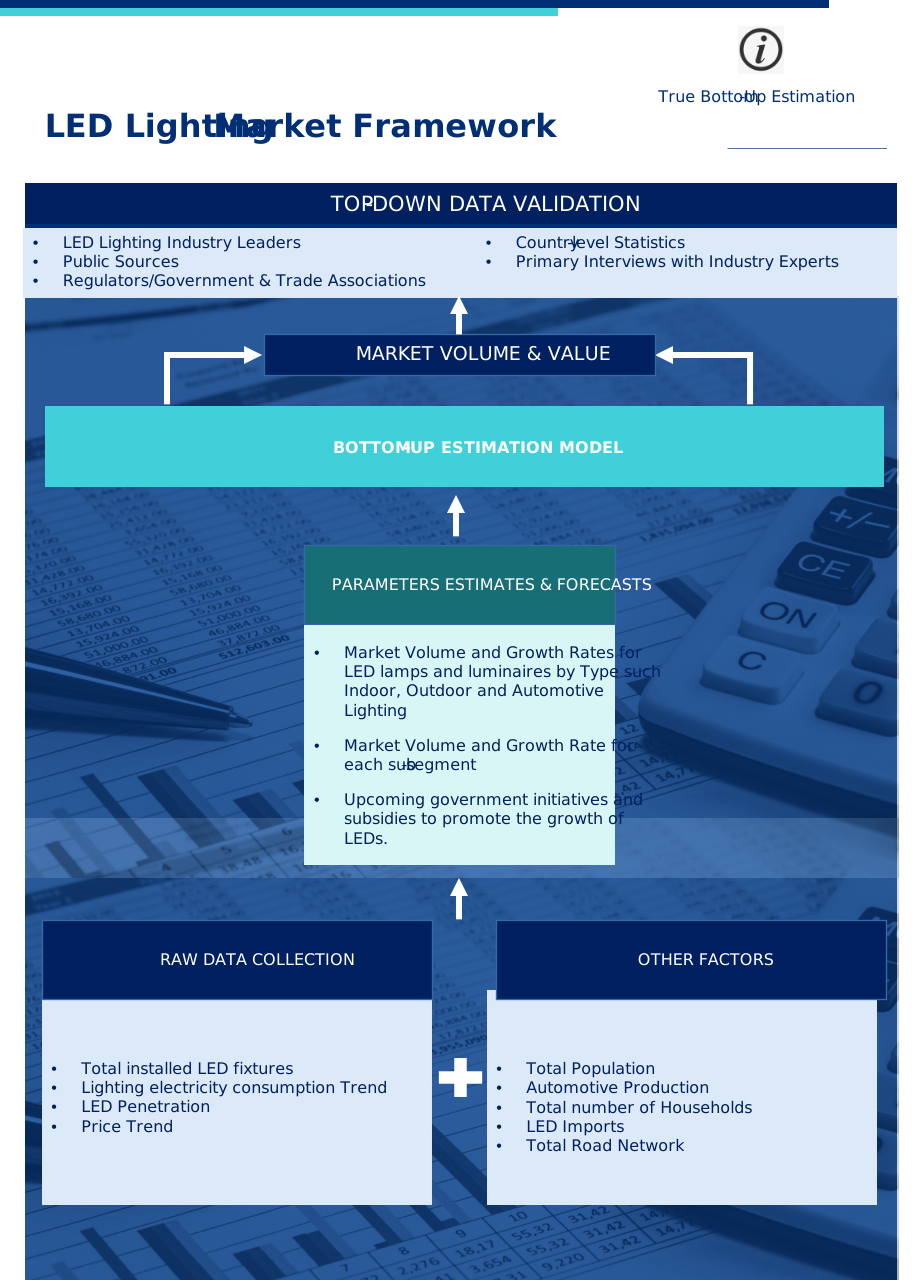
Research Methodology
Mordor Intelligence has followed the following methodology in all our data center reports.
- Step 1: Raw Data Collection: To understand the market, initially, all crtical data points were identified. Critical information about countries and regions of interest including Per-capita Income, Population, Automotive Production, Interest rate on Auto-Loans, Number of Automobiles on Road, Total LED Import, Lighting Electricity Consumption among others were recorded or estimated based on internal calculations.
- Step 2: Identify Key Variables: To build a robust forecasting model, key variables such as Number of Households, Automotive Production, Road Networks among others were identified. Through an iterative process, the variables required for the market forecast were set, and the model was built using these variables.
- Step 3: Build a Market Model: Based on data and critical industry trend data (variables), including LED pricing, LED penetration rate, and project macro and micor economic factors were utilized for building the market forecasting.
- Step 4: Validate and Finalize: In this crucial step, all market numbers and variables derived through an internal mathematical model were validated through an extensive network of primary research experts from all the markets studied. The respondents are selected across levels and functions to generate a holistic picture of the market studied.
- Step 5: Research Outputs: Syndicated Reports, Custom Consulting Assignments, Databases & Subscription Platforms