Spain Automotive LED Lighting Market Size and Share
Market Overview
| Study Period | 2020 - 2031 |
|---|---|
| Forecast Data Period | 2026 - 2031 |
| Base Year Market Size (2025) | USD 580 Billion |
| Market Size (2026) | USD 0.62 Billion |
| Market Size (2031) | USD 0.86 Billion |
| Growth Rate (2026 - 2031) | 6.75 % |
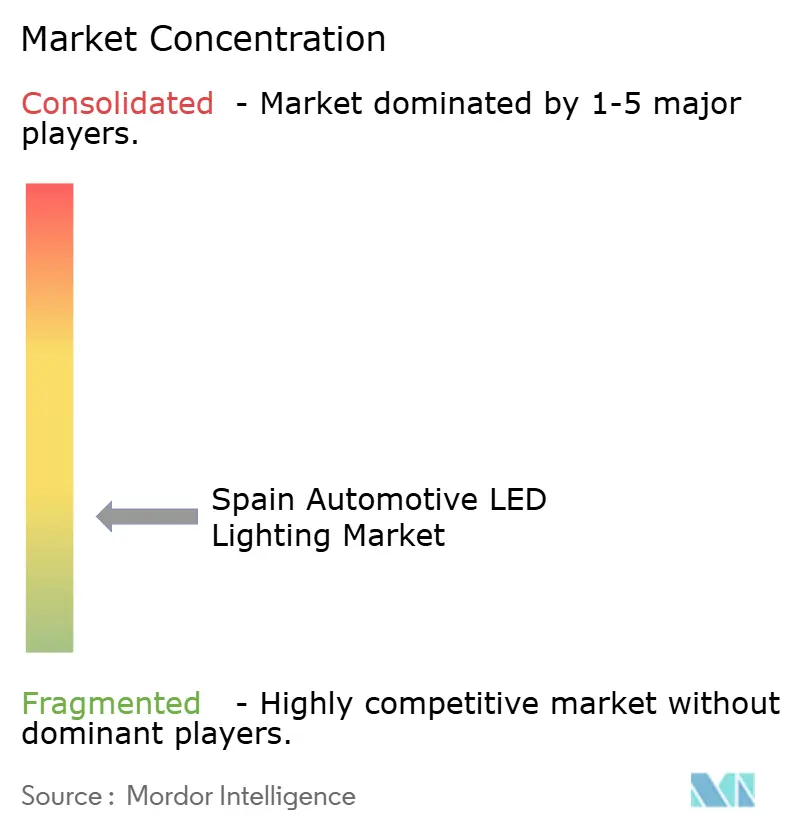
| Market Concentration | Low |
Major Players *Disclaimer: Major Players sorted in no particular order Image © Mordor Intelligence. Reuse requires attribution under CC BY 4.0. | |
Spain Automotive LED Lighting Market Analysis by Mordor Intelligence
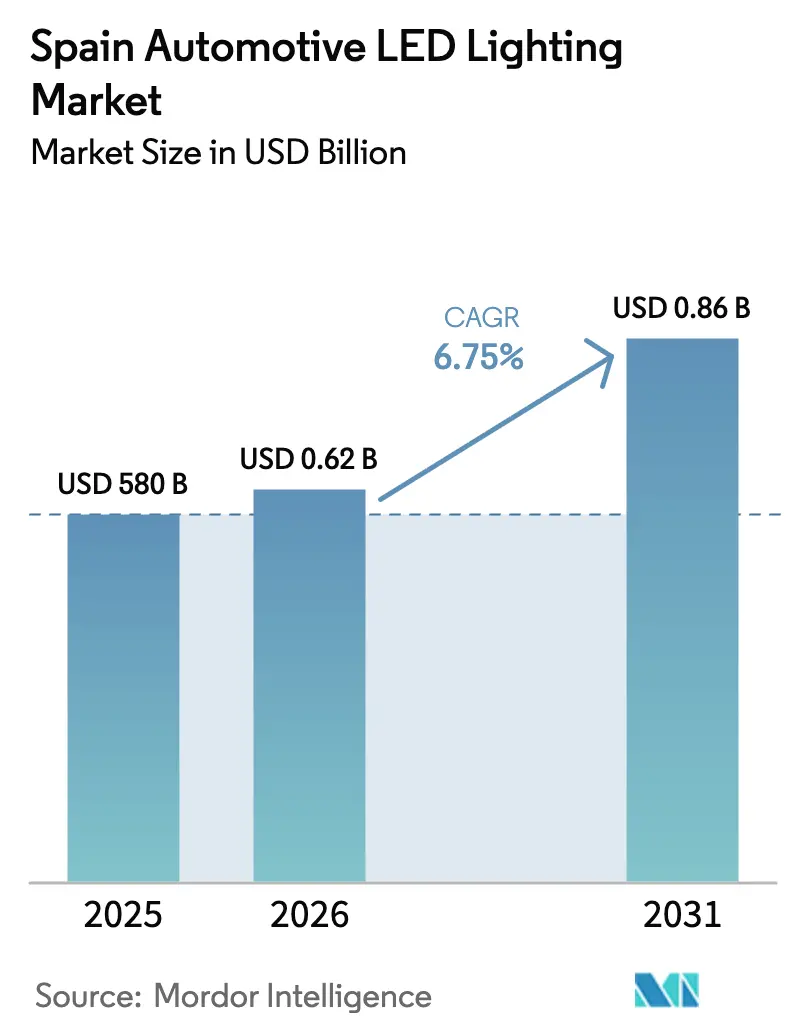
The Spain automotive LED lighting market size is expected to grow from USD 580 million in 2025 to USD 620 million in 2026 and is forecast to reach USD 860 million by 2031 at 6.75% CAGR over 2026-2031. Solid OEM demand for energy-efficient light sources, Spain’s position as Europe’s second-largest vehicle producer, and multi-billion-dollar government programs that link electrification with domestic industrial policy underpin this expansion. Tight integration between LED modules and advanced driver-assistance features, falling lumen-per-dollar costs, and mandatory daytime-running-light (DRL) requirements are accelerating technology adoption. However, semiconductor supply volatility and a lingering upfront price premium versus halogen or xenon lamps are tempering the growth pace. OEM channel dominance, rising retrofit opportunities, and Spain’s 2026 V-16 connected-beacon mandate combine to keep lighting investment resilient, even during cyclical swings in vehicle sales.
Key Report Takeaways
- By sales channel, the OEM segment held 80.45% of Spain automotive LED lighting market share in 2025; aftermarket sales post the fastest 7.1% CAGR to 2031.
- By vehicle type, passenger cars secured 67.94% of Spain automotive LED lighting market size in 2025 and advance at a 8.65% CAGR through 2031.
- By installation, new-build fitment accounted for 60.78% of Spain automotive LED lighting market size in 2025, whereas retrofit installations expand at a 7.35% CAGR to 2031.
- By application, exterior lighting commanded 76.89% of Spain automotive LED lighting market share in 2025; interior lighting climbs at a 7.2% CAGR over the same span.
Note: Market size and forecast figures in this report are generated using Mordor Intelligence’s proprietary estimation framework, updated with the latest available data and insights as of 2026.
Spain Automotive LED Lighting Market Trends and Insights
Drivers Impact Analysis*
| Driver | (~) % Impact on CAGR Forecast | Geographic Relevance | Impact Timeline |
|---|---|---|---|
| EV-driven OEM LED Adoption Surge | +1.9% | Spain, with spillover to Iberian Peninsula | Medium term (2-4 years) |
| EU-Mandated Daytime Running Lights Compliance | +1.3% | Spain and broader EU market | Short term (≤ 2 years) |
| Rapid Decline in LED Unit Cost per Lumen | +1.4% | Global, with concentrated impact in Spain | Medium term (2-4 years) |
| Aftermarket Demand for Retrofit Safety Upgrades | +0.8% | Spain, with regional variations | Short term (≤ 2 years) |
| PERTE VEC Funding Channeling Into LED Modules | +0.6% | Spain, focused on Valencia and Catalonia | Long term (≥ 4 years) |
| Iberian Smart-Road Pilots Using V2X-Ready Lamps | +0.5% | Spain and Portugal | Long term (≥ 4 years) |
| Source: Mordor Intelligence | |||
EV-Driven OEM LED Adoption Surge
OEM electrification strategies make low-wattage LED packages a design default because they reduce lighting power draw by as much as 70%, thereby protecting the real-world range of battery electric models. [1]European Alternative Fuels Observatory, “Spain: BEV passenger car sales increased by 7.8% in 2024,” alternative-fuels-observatory.europa.euSpain’s target of 5.5 million EVs by 2030, Volkswagen Group’s EUR 7 billion Spanish electrification plan, and the 40 GWh gigafactory in Valencia anchor high-volume demand for integrated headlamp, DRL, and signal modules. High-pixel-count matrix systems, such as CUPRA’s 25,000-pixel headlights, illustrate how LEDs are migrating from premium to mainstream trims. [2]SEAT CUPRA Media Center, “CUPRA upgrades Formentor and Leon with Matrix LED Ultra headlights,” seat-cupra-mediacenter.com Lower heat generation further eases thermal loads on battery cooling circuits, reinforcing OEM preference for LED architecture.
EU-Mandated Daytime Running Lights Compliance
ECE R87 stipulates automatic DRLs on all passenger vehicles sold in the EU, pushing universal LED fitment because of instant switch-on and optical efficiency. Spain, with 17 car plants feeding European markets, must certify compliant light signatures across entire production runs. The December 2024 rule permitting ECE-certified LED bulb substitutions further widens the compliant retrofit pool. Regulatory certainty underpins tooling investment and long-run component contracts for domestic module makers.
Rapid Decline in LED Unit Cost per Lumen
Volume scale in flip-chip and chip-on-board processes slashed packaged-LED cost curves, allowing adaptive-beam sets once reserved for luxury sedans to appear in B-segment crossovers. ams OSRAM’s EVIYOS micro-matrix platform integrates more than 25,000 addressable pixels, reducing optic count and assembly steps. [3]ams OSRAM, “Automotive & Mobility – Dynamic Forward Lighting,” ams-osram.com Single-layer aluminum substrates paired with active-matrix drivers trim material spend by roughly 70% compared with legacy passive boards, unlocking LED affordability for Spain’s high-volume compact-car programs.
Aftermarket Demand for Retrofit Safety Upgrades
Spain’s sizeable in-use fleet makes the retrofit channel a high-growth niche, especially as DRL and headlamp upgrades deliver tangible night-driving benefits in diverse topography. Philips’ road-approved Ultinon Pro6000 bulbs promise up to 300% greater beam intensity while keeping glare within ECE limits. The 2024 regulatory alignment, which removed incandescent-lamp-only constraints, allows fitters to replace halogen H7 sets with plug-and-play LEDs without requiring re-homologation.
Restraints Impact Analysis*
| Restraint | (~) % Impact on CAGR Forecast | Geographic Relevance | Impact Timeline |
|---|---|---|---|
| Higher Up-Front Cost vs. Halogen/Xenon | -1.0% | Spain, with variations by vehicle segment | Short term (≤ 2 years) |
| Supply-Chain Volatility for LED Driver ICs | -0.9% | Global, with acute impact in Spain | Medium term (2-4 years) |
| Limited Domestic Testing Capacity for ADB Systems | -0.7% | Spain, with regional concentration challenges | Medium term (2-4 years) |
| Skills Gap in Opto-Mechatronics Workforce | -0.5% | Spain, with focus on industrial regions | Long term (≥ 4 years) |
| Source: Mordor Intelligence | |||
Higher Up-Front Cost vs. Halogen/Xenon
LED sets still command a 200-300% bill-of-material premium over halogen, pressuring price-sensitive A- and B-segment models. Spanish retrofit rules require headlamp leveling and washing systems for LED units exceeding 2,000 lumens, layering more cost onto older vehicles. Although lifetime energy and maintenance savings offset purchase price, immediate cash-outlay concerns limit penetration in cost-conscious fleets.
Supply-Chain Volatility for LED Driver ICs
Texas Instruments lifted list prices by 15-30% on signal-chain devices used in automotive LED drivers, illustrating persistent chip-supply dislocations. Automotive-grade microcontrollers and buck-boost converters face 40-week lead times, forcing Spanish Tier-1s to carry excess inventory or swap in alternate reference designs. Such disruptions inject cost chaos and scheduling risk into new-model launch calendars.
*Our forecasts treat driver/restraint impacts as directional, not additive. The impact forecasts reflect baseline growth, mix effects, and variable interactions.
Segment Analysis
By Sales Channel: OEM Integration Drives Technology Leadership
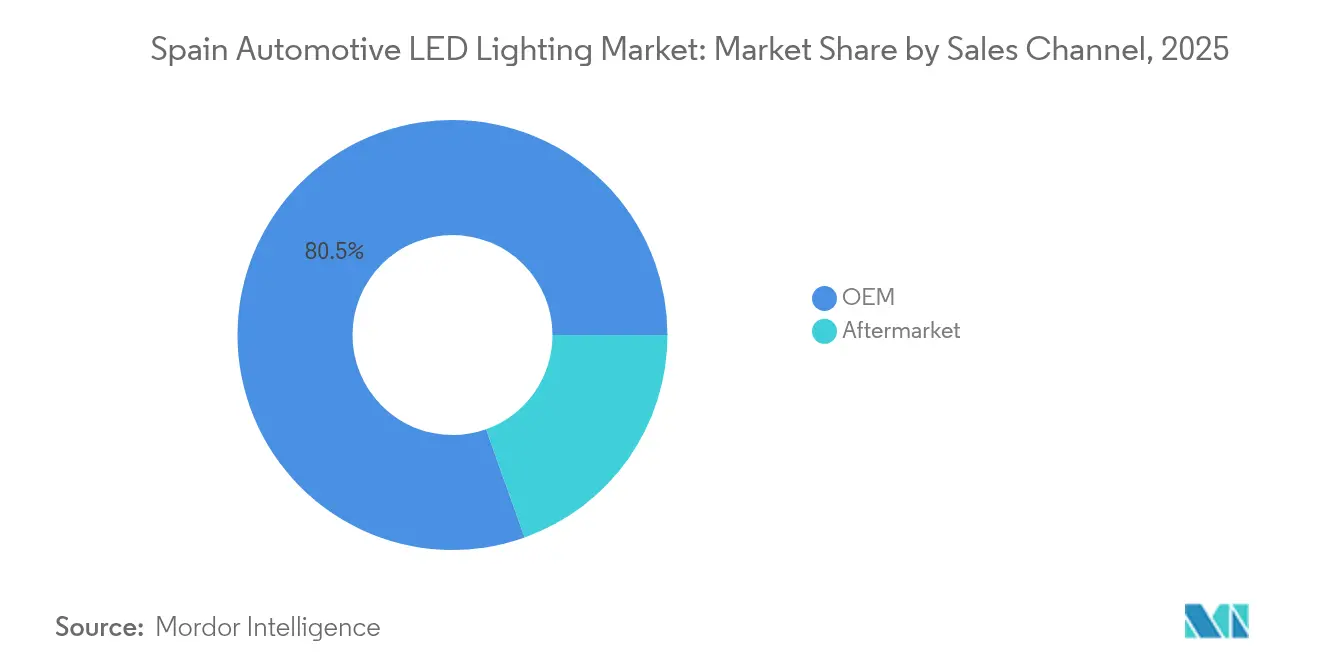
OEM deliveries generated 80.45% of Spain automotive LED lighting market size in 2025 because factory programs embed advanced light sources into vehicle electrical backbones from day one. Suppliers co-design headlamps, DRLs and rear clusters alongside power-train and ADAS teams, achieving weight, thermal and software synergies that retrofit kits cannot fully replicate. Matrix-beam examples from CUPRA and dynamic interior modules co-developed by Valeo and ams OSRAM illustrate the integrated pathway from chip to CAN bus. The aftermarket channel, although smaller, benefits from Spain’s relaxed retrofit regulations and should outpace OEMs at a 7.1% CAGR as cost-per-lumen curves fall and consumers seek safety upgrades.
OEM volume gives Tier-1s negotiating leverage on semiconductor allocation, partially shielding the channel from supply shocks. Aftermarket distributors instead use multi-brand procurement to hedge shortages yet still face longer replenishment cycles. Both channels converge on software-defined lighting architectures that allow feature unlocks via over-the-air updates, blurring the line between factory fitment and field upgrades.



By Vehicle Type: Passenger Cars Accelerate Electrification Integration
Passenger cars accounted for 67.94% of Spain automotive LED lighting market share in 2025 and post the strongest 8.65% CAGR to 2031 as EV uptake and infotainment-rich interiors demand sophisticated illumination. Spain registered 58,675 new BEV passenger cars in 2024, a 7.8% jump that feeds LED module pull-through on every trim sold. Light commercial vehicles trail at 32.06% share yet gain steady ground because parcel fleets value LED longevity and low maintenance.
Localization plays a crucial role: Ebro’s Barcelona plant sources one-quarter of structural and tech parts locally, stimulating a cluster of optics molders and thermal-substrate suppliers. Passenger-car programs anchor those clusters with large, predictable volumes, while commercial-vehicle variants copy-paste headlamp toolings to speed homologation.
By Installation Type: New Installation Leverages OEM Integration
New-vehicle fitment delivered 60.78% of Spain automotive LED lighting market size in 2025. OEM workflows allocate optical envelopes, driver PCBs, and LIN/CAN nodes during the body-in-white phase, ensuring electrical compatibility and crash-worthiness. The retrofit slice, although just 39.22%, outperforms with a 7.35% CAGR to 2031, thanks to clear legal pathways for ECE-approved bulb swaps and an aging fleet seeking performance gains.
Process innovations favor both segments. Active-matrix driver ICs are mounted directly onto aluminum substrates, cutting solder joints and boosting reliability for lifetime applications. Retrofit kits adopt the same board-on-substrate layouts but package them into H7 or H15 footprints, simplifying DIY installation.

By Application: Exterior Lighting Maintains Safety-Critical Dominance
Exterior systems headlamps, DRLs, tail-lamps, and turn signals - held 76.89% of Spain automotive LED lighting market share in 2025 because they fulfill regulatory safety roles. Upcoming V-16 beacons will connect with DGT 3.0 servers, reinforcing exterior lighting’s pivotal safety function. Interior ambient packages occupy 23.11% share but log a 7.2% CAGR, propelled by user-experience differentiation and customizable light signatures in connected cabins.
MicroLED and meta-optics converge to shrink exterior modules without sacrificing photometric output, freeing fascia real estate for sensors. Inside, dynamic RGB addressability syncs with navigation cues or driver-monitoring alerts, transforming lighting into a subtle human-machine interface layer.
Geography Analysis
Spain manufactures vehicles in 17 plants across 10 autonomous communities, collectively exporting EUR 44 billion worth of cars and components in 2024. Valencia captures marquee investments, such as Volkswagen’s 40 GWh cell plant, which attracts LED heat-sink suppliers and automated optic-alignment specialists. Catalonia hosts SEAT’s Martorell body shop and Ebro’s electrified SUV line, nurturing a dense network of PCB assemblers and lens-coating vendors.
The Basque Country excels in precision machining and high-speed pick-and-place automation, feeding LED sub-component flows to Tier-1s nationwide. OPmobility’s Spanish lighting plants generated EUR 398.7 million in the first half of 2024, underscoring the local revenue weight inside the group portfolio. Renewable-power purchase agreements lower electricity costs for energy-intensive SMT reflow processes, giving Spanish sites a green advantage over other EU hubs.
Cross-border smart-road pilots with Portugal test V2X-ready lamp clusters on the A-62 corridor, while the upcoming V-16 beacon mandate guarantees a nationwide rollout of connected-lighting devices. These projects generate real-world datasets that Spanish suppliers can leverage in bids across Europe, reinforcing the country’s thought-leadership in intelligent illumination.
Competitive Landscape
Innovation and Sustainability Drive Future Success
Spain automotive LED lighting market shows high concentration: FORVIA HELLA, Valeo, and ams OSRAM together own more than 60% of OEM bookings, driven by long-running platform contracts and deep R&D spending. FORVIA HELLA posted EUR 8.1 billion in 2024 sales, with growth of 3.3%, channeling double-digit R&D ratios into pixelated beam formers and software-updatable logic. Valeo’s December 2024 coalition with ams OSRAM on mood-adaptive cabin lighting merges semiconductor pixels and optical diffusers in turnkey modules.
White-space niches emerge in ADB validation services, V2X-encoded lamps, and modular retrofit kits targeting the 26 million-unit Spanish car parc. Local SMEs exploit these micro-segments by specializing in optical-algorithm stacks or patent-light plastic-lens coatings. Yet barriers remain steep: homologation costs, ASIC availability, and OEM cybersecurity audits deter smaller challengers.
M&A and carve-outs reshape the field. ams OSRAM’s January 2025 divestiture of its ENI lamp business freed capital for automotive microLED focus. Similar portfolio pruning among Tier-1s could surface additional Spanish assets for strategic investors.
Spain Automotive LED Lighting Industry Leaders
HELLA GmbH & Co. KGaA (FORVIA)
Marelli Holdings Co., Ltd.
Stanley Electric Co., Ltd.
Valeo SE
ams OSRAM AG
- *Disclaimer: Major Players sorted in no particular order

Recent Industry Developments
- July 2025: CUPRA launched 25,000-pixel Matrix LED Ultra headlights on the Formentor and Leon, adding ground-projection welcome graphics.
- May 2025: Industry ministry awarded EUR 41 million under PERTE VEC III to 21 companies, including EUR 2.9 million for Forvia Interior Systems to localize LED modules.
- April 2025: Government topped up MOVES III with EUR 400 million, extending EV purchase subsidies and home-charger tax deductions to Dec 2025.
- March 2025: Columbus McKinnon won gigafactory intralogistics contracts for PowerCo Valencia, worth up to USD 100 million.


Spain Automotive LED Lighting Market Report Scope
Daytime Running Lights (DRL), Directional Signal Lights, Headlights, Reverse Light, Stop Light, Tail Light, Others are covered as segments by Automotive Utility Lighting. 2 Wheelers, Commercial Vehicles, Passenger Cars are covered as segments by Automotive Vehicle Lighting.| OEM |
| Aftermarket |
| Passenger Cars |
| Light Commercial Vehicles |
| Heavy Commercial Vehicles |
| Two-Wheelers |
| New Installation |
| Retrofit Installation |
| Exterior Lighting | Headlamps |
| Daytime Running Lights | |
| Taillights | |
| Fog Lamps | |
| Turn Signals | |
| Other Exterior Lightings | |
| Interior Lighting | Dome and Map Lights |
| Ambient Lighting | |
| Instrument Cluster and Infotainment Backlighting | |
| Others Interior Lightings |
| By Sales Channel | OEM | |
| Aftermarket | ||
| By Vehicle Type | Passenger Cars | |
| Light Commercial Vehicles | ||
| Heavy Commercial Vehicles | ||
| Two-Wheelers | ||
| By Installation Type | New Installation | |
| Retrofit Installation | ||
| By Application | Exterior Lighting | Headlamps |
| Daytime Running Lights | ||
| Taillights | ||
| Fog Lamps | ||
| Turn Signals | ||
| Other Exterior Lightings | ||
| Interior Lighting | Dome and Map Lights | |
| Ambient Lighting | ||
| Instrument Cluster and Infotainment Backlighting | ||
| Others Interior Lightings | ||


Market Definition
- INDOOR LIGHTING - It incorporates all LED based lamps and fixtures/luminaire that are used to illuminate indoor section of residential, commercial, industrial buildings and agricultural lighting. LED offers efficient brightness with higher durability in comparison to other lighting technology.
- OUTDOOR LIGHTING - It incorporates the LED lighting fixtures that is used for illumination for exterior/outdoor illumination. For instance, LED lighting fixtures used to illuminate streets and highways, transport hubs, stadiums and other public places such as parking spaces.
- AUTOMOTIVE LIGHTING - It refers to the lighting fixtures installed for illumination and signaling purposes. It is used in both exterior and interior lighting of the vehicle. Headlamps, fog lamp, daytime running light (DRLs) are examples of exterior light whereas cabin light are interior lights.
- END USER - It refers to the end use application area where the LED fixture will be installed. For instance, in terms of indoor lighting, we have residential, commercial and industrial as end user category. For automotive lighting, primary end user considered are automotive manufacturers and aftermarket sale
| Keyword | Definition |
|---|---|
| Lumen | Lumen is a unit of luminous flux in the International System of Units that is equal to the amount of light given out through a solid angle by a source of one-candela intensity radiating equally in all directions. |
| Footcandle | A foot-candle (or foot-candle, fc, lm/ft2, or ft-c) is a measurement of light intensity. One foot-candle is defined as enough light to saturate a one-foot square with one lumen of light. |
| Colour Rendering Index (CRI) | Color Rendering Index (CRI) is a measurement of how natural colors render under an artificial white light source when compared with sunlight. The index is measured from 0-100, with a perfect 100 indicating that colors of objects under the light source appear the same as they would under natural sunlight. |
| Luminous flux | Luminous flux is a measure of the power of visible light produced by a light source or light fitting. It is measured in lumens (lm). |
| Annual Energy Cost | Annual Energy Cost means the average daily energy consumption multiplied by 365 (days per year), expressed in kilowatt hour per year (kWh/a). |
| Constant voltage drivers | Constant voltage drivers are designed for a single direct current (DC) output voltage. Most common constant voltage drivers (or Power Supplies) are 12VDC or 24VDC. An LED light that is rated for constant voltage usually specifies the amount of input voltage it needs to operate correctly. |
| Constant Current Driver | Constant current LED drivers are designed for a designated range of output voltages and a fixed output current (mA). LEDs that are rated to operate on a constant current driver require a designated supply of current usually specified in milliamps (mA) or amps (A). These drivers vary the voltage along an electronic circuit which allows current to remain constant throughout the LED system. |
| Minimum Energy Performance Standards (MEPS) | Minimum Energy Performance Standards specify the minimum level of energy performance that appliances and equipment must meet or exceed before they can supply or used for commercial purposes. |
| Luminous Efficacy | Luminous efficacy is a measurement commonly used in the lighting industry that indicates the ability of a light source to emit visible light using a given amount of power. |
| Solid State Lighting | Solid-state lighting (SSL) is a type of lighting that uses semiconductor light-emitting diodes (LEDs), organic light-emitting diodes (OLED), or polymer light-emitting diodes (PLED) as sources of illumination rather than electrical filaments, plasma (used in arc lamps such as fluorescent lamps), or gas. |
| Rated Lamp Life | Lamp life, also referred to as rated life, is the time in hours a lamp will last before a percentage of lamps will burn out. |
| Color Temperature | Colour temperature is a scale that measures how ‘warm’ (yellow) or ‘cool’ (blue) the light from a particular source is. It is measured in degrees of the Kelvin scale (abbreviated to K), and the higher the number, the ‘cooler’ the light. The lower the ‘K’ number, the ‘warmer’ the light. |
| Ingress Protection rating (IP rating) | The IP (Ingress Protection) rating of a bulb or light fixture declares the level of protection it has against dirt and water. |
| Fidelity Index | The general colour fidelity index, Rf, represents how closely the colour appearances of the entire sample set are reproduced (rendered) on average by a test light as compared to those under a reference illuminant. |
| Gamut Index | The gamut area is defined as “the area enclosed by a set of test color samples illuminated by a light source, in a two-dimensional chromaticity diagram or a plane of color space.”1 Within a defined color space, a “gamut” describes the subset of colors that can be perceived under specific lighting conditions. |
| Binning | In the lighting industry, the act of "binning" of LEDs is the process of sorting LEDs by certain characteristics, such as color, voltage, and brightness. |
| Accent lighting | Accent lighting, also called highlighting, emphasizes objects by focusing light directly on them. Accent lighting is used inside and outside the home to feature locations such as an entrance or to create dramatic effects. |
| Dimmable driver | A dimming driver has two functions: As a driver, it converts the 230V AC mains input to a low voltage DC output. As a dimmer, it reduces the amount of electrical energy flowing to the LEDs, thereby causing them to dim. |
| Flicker | Flicker is the repeated and frequent variation in the output of a light source over time. |
| Fluorescent | A property of materials defined as the ability to emit light after absorbing electromagnetic radiation such as visible or UV light. |
| Candela | The candela is the unit of luminous intensity in the International System of Units. It measures the light output per unit solid angle emitted from a light source in a specific direction. |
| LUX | Lux is used to measure the amount of light output in a given area - one lux is equal to one lumen per square meter. It enables us to measure the total "amount" of visible light present and the intensity of the illumination on a surface. |
| Uniformity (U0) | The uniformity of lighting has significant effects on visual performance in both indoor and outdoor areas. Uniformity (represented as U0) value can be found by dividing the minimum brightness (Emin) resulting from calculations according to the current lighting order, to the average brightness value (Eavg). |
| Visible Light Spectrum | The visible light spectrum is the segment of the electromagnetic spectrum that the human eye can view. More simply, this range of wavelengths is called visible light. Typically, the human eye can detect wavelengths from 380 to 700 nanometers. |
| Ambient Temperature | Ambient Temperature is the temperature of the air surrounding an electrical enclosure. |
| Current-controlled dimming control | Current-controlled dimming controls LED brightness by varying the applied current using a 0-10V dimmer. Current-controlled dimming is smooth and HD-video friendly. It can only dim to a minimum of 5% of light output. |
| Design Light Consortium | It is a partnership of energy efficiency stakeholders in the United States and Canada to “promote quality, performance and energy efficient lighting solutions for the commercial sector”. |
| Pulse Width Modulation | Pulse-width modulation, or pulse-duration modulation, is a method of controlling the average power delivered by an electrical signal. |
| Surface Mounted Device | A surface mount device (SMD) is an electronic device whose components are mounted or placed directly on the surface of a printed circuit board. |
| Alternating Current | Alternating current is an electric current which periodically reverses direction and changes its magnitude continuously with time, in contrast to direct current, which flows only in one direction. |
| Direct Current | Direct current (DC) is an electric current that is uni-directional, so the flow of charge is always in the same direction. |
| Beam Angle | Beam angle (also called beam spread) is a measure of how light is distributed. On any plane perpendicular to the centerline of the light, the beam angle is the angle between two rays where the light intensity is 50% of the maximum light intensity. |
| LED Based Solar High Mast Lighting Systems | A Solar LED High Mast Light is a raised source of High illumination lights (6~8 lights) and with high intensity on the middle of major junctions (Ring roads, Outer Ring roads), turned on or lit automatically in the absence of light (at specified timings or at periodic times, every night). |
| Surface Mounted Diode (SMD) LEDs | A surface mount diode is a type that emits light and is flat mounted and soldered onto a circuit board. |
| Chip on Board (COB) LEDs | A COB LED is basically multiple LED chips (usually 9 or more) glued directly onto a substrate by the manufacturer to form a single module. |
| Dual In-Line Package (DIP) LEDs | A dual in-line package (DIP or DIL) is an electronic component package with a rectangular case and two parallel rows of electrical connector pins. |
| Graphene LED Lights | A graphene LED light bulb is simply an LED light bulb where the filament has been coated in graphene. A graphene LED bulb is reported to be 10% more efficient than regular LED light bulbs and they are cheaper to manufacture and buy. |
| LED Corn Bulbs | LED Corn lights are designed as an energy efficient alternative to high intensity discharge (HID) and SON lamps. It uses a large number of LEDs on a metal structure to provide sufficient light. This arrangement of LEDs looks a lot like a corn cob, hence the name "corn light". |
| Per Capita Income | Per capita income or total income measures the average income earned per person in a given area in a specified year. It is calculated by dividing the area's total income by its total population. Per capita income is national income divided by population size. |
| Charging Stations | A charging station, also known as a charging station or electric vehicle utility, is a power supply that provides electrical energy for charging plug-in electric vehicles. |
| Headlight | A headlight is a light that is mounted on the front of a car and illuminates the road in front of it. Low beam and high beam LED headlights are additional categories for these LED headlights. |
| Day Time Running Light (DRLs) | A daytime running lamp is a white, yellow, or amber lighting device mounted on the front of a road-going motor vehicle or bicycle. |
| Directional Signal Light | Directional signal lights are the front and rear lights on an automobile that flash to show the direction of a turn. |
| Stop Light | A red light that is mounted to the back of a car and turns on when the brakes are used to show that the car is stopped. |
| Reverse Light | The reverse light is at the back of the vehicle to indicate its backward motion. |
| Tail Light | A red light that can be seen in the dark is mounted on the rear of a road vehicle. Stop, reverse, and directional signal lights are all part of it. |
| Fog Light | Bright lights in automobiles used to increase visibility on the road in foggy conditions or to warn other drivers of the presence of the vehicle. |
| Passenger Vehicle | A passenger vehicle is a road vehicle, other than a moped or a motorcycle, intended for the transportation of people and designed for up to 8 to 9 seats. |
| Commercial Vehicle | A commercial vehicle (Bus, Truck, Van) is any type of motor vehicle used to transport goods or pay passengers. |
| Two Wheelers (2W) | A two-wheeler is a vehicle that runs on two wheels. |
| Streets & Roadways | Both roads and streets refer to hard, flat surfaces on the ground on which vehicles, people, and animals can travel. Since streetways are usually in cities and towns, they often have houses and buildings on both sides. The roadway is in the countryside and sometimes passes through forests and fields |
| Horticulture Lighting | Horticulture is the science and art of sustainably growing, producing, marketing and using high quality, intensively cultivated food and ornamental plants. |


Research Methodology
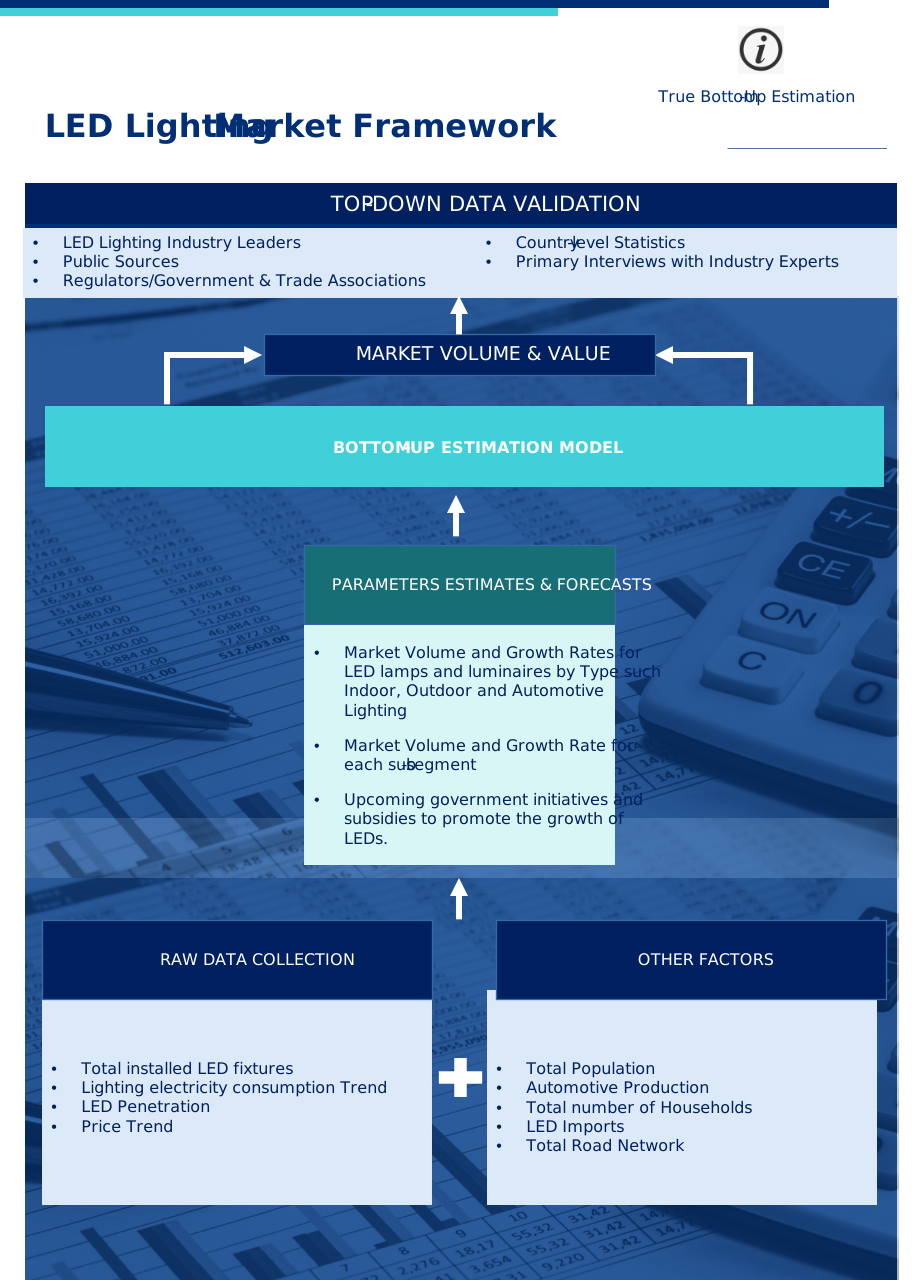
Mordor Intelligence has followed the following methodology in all our data center reports.
- Step 1: Raw Data Collection: To understand the market, initially, all crtical data points were identified. Critical information about countries and regions of interest including Per-capita Income, Population, Automotive Production, Interest rate on Auto-Loans, Number of Automobiles on Road, Total LED Import, Lighting Electricity Consumption among others were recorded or estimated based on internal calculations.
- Step 2: Identify Key Variables: To build a robust forecasting model, key variables such as Number of Households, Automotive Production, Road Networks among others were identified. Through an iterative process, the variables required for the market forecast were set, and the model was built using these variables.
- Step 3: Build a Market Model: Based on data and critical industry trend data (variables), including LED pricing, LED penetration rate, and project macro and micor economic factors were utilized for building the market forecasting.
- Step 4: Validate and Finalize: In this crucial step, all market numbers and variables derived through an internal mathematical model were validated through an extensive network of primary research experts from all the markets studied. The respondents are selected across levels and functions to generate a holistic picture of the market studied.
- Step 5: Research Outputs: Syndicated Reports, Custom Consulting Assignments, Databases & Subscription Platforms