
UAE Takaful Market Size and Share
Market Overview
| Study Period | 2021 - 2032 |
|---|---|
| Forecast Data Period | 2027 - 2032 |
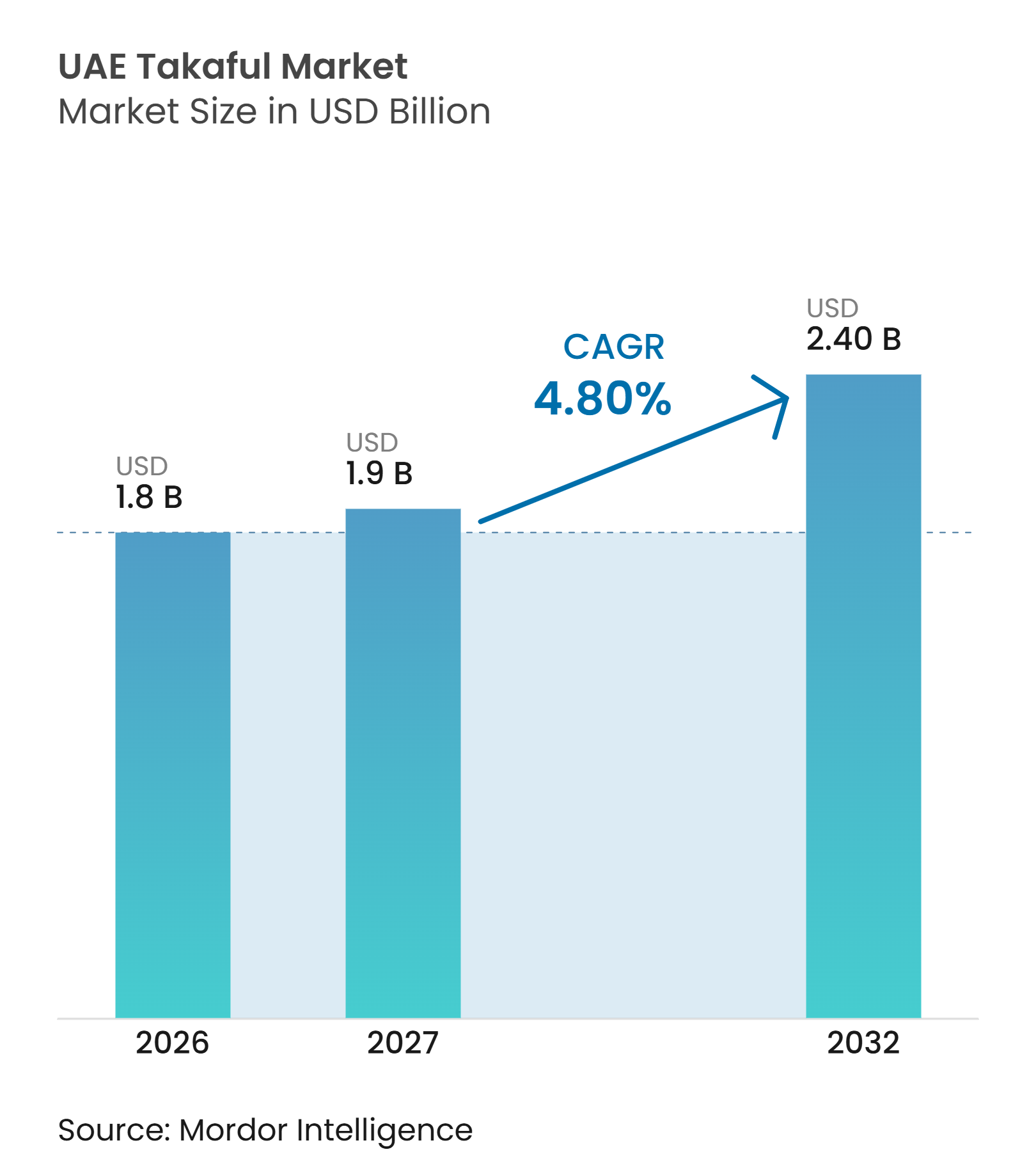
| Base Year Market Size (2026) | USD 1.8 Billion |
| Market Size (2027) | USD 1.9 Billion |
| Market Size (2032) | USD 2.40 Billion |
| Growth Rate (2027 - 2032) | 4.80 % |
| Market Concentration | High |
Major Players *Disclaimer: Major Players sorted in no particular order Image © Mordor Intelligence. Reuse requires attribution under CC BY 4.0. | |
UAE Takaful Market Analysis by Mordor Intelligence
The UAE Takaful Market size is expected to increase from USD 1.8 billion in 2026 to USD 1.9 billion in 2027 and reach USD 2.40 billion by 2032, growing at a CAGR of 4.80% over 2027-2032.
The UAE Takaful market recorded gross written contributions of AED 6.4 billion (USD 1.74 billion) in 2025, up 18.5% from 2024, accounting for 8.5% of the country's total insurance market. The wider insurance sector grew 14.9% to AED 74.8 billion (USD 20.37 billion), supported by rising health and property insurance demand. Mandatory health coverage across all seven emirates supports market expansion, while evolving regulatory requirements reinforce risk management and governance. However, profitability remains sensitive to claims costs, pricing adequacy, and reinsurance expenses. Insurers can strengthen competitiveness through efficient claims management, digital distribution, bank partnerships, and tailored Sharia-compliant products.
Key Report Takeaways
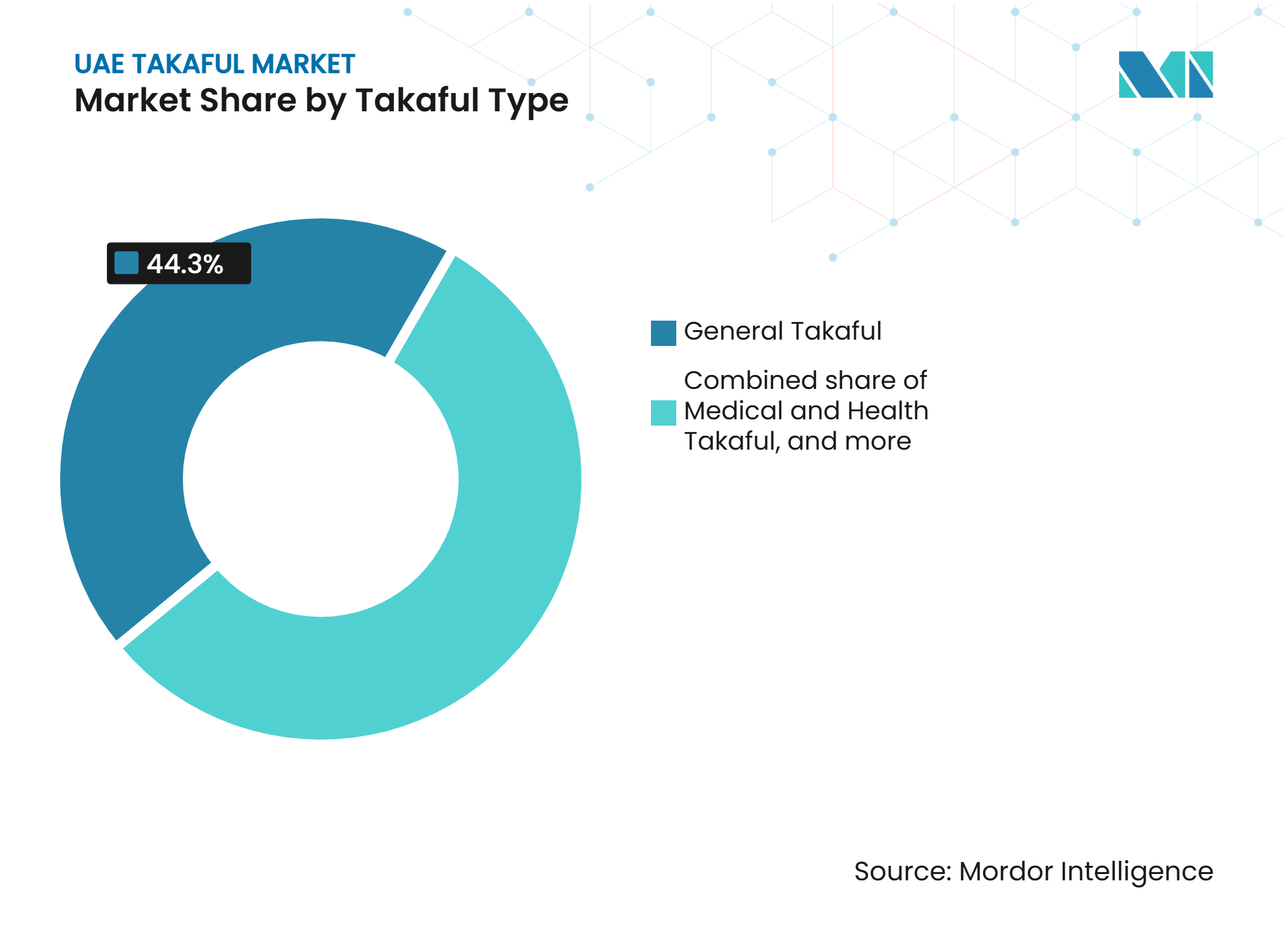
- By takaful type, general takaful captured 44.3% of the UAE takaful market share in 2026, while savings & investment-linked takaful is projected to grow at a 6.5% CAGR through 2032.
- By distribution channel, agents & brokers captured 52.1% of the UAE takaful market share in 2026, while embedded, affinity & other non-bank partnerships are projected to grow at a 9.8% CAGR through 2032.
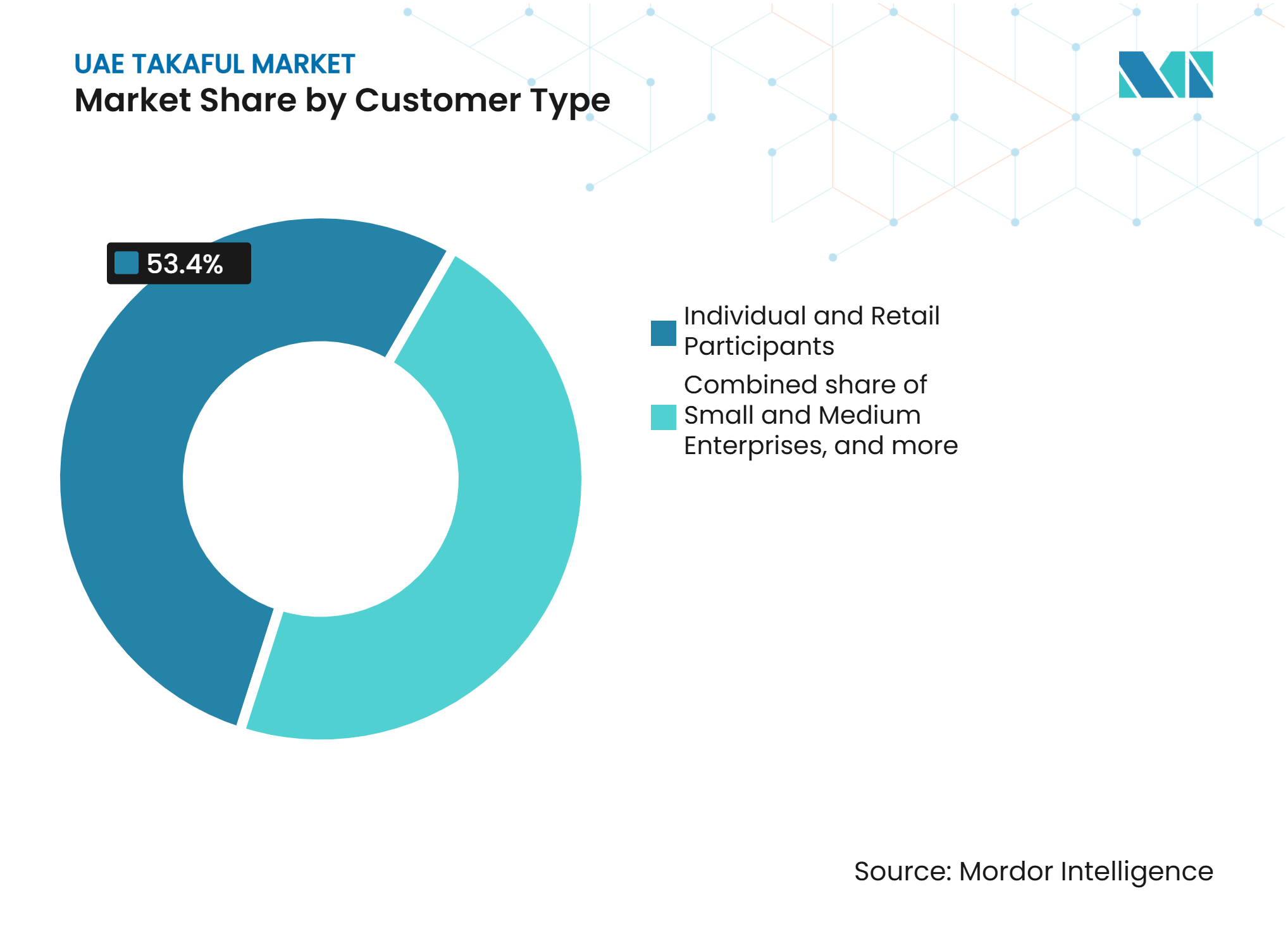
- By customer type, individual & retail participants captured 53.4% of the UAE takaful market share in 2026, while SMEs are projected to grow at a 5.8% CAGR through 2032.
Note: Market numbers in this report are based on Mordor Intelligence's proprietary estimation framework, which combines nine months of actuals with Q4 projections for base year 2026.
Market Trends and Insights
Drivers Impact Analysis of UAE Takaful Market*
| Driver | (~) % Impact on CAGR Forecast | Geographic Relevance | Impact Timeline |
|---|---|---|---|
| Mandatory Health Insurance Expansion | +1.1% | National, with strongest near-term gains in Sharjah, Ajman, Ras Al Khaimah, Umm Al Quwain, and Fujairah | Short term (≤ 2 years) |
| Islamic Finance Ecosystem | +0.8% | National, led by Abu Dhabi and Dubai banking hubs | Medium term (2-4 years) |
| Bancatakaful and Digital Distribution | +0.6% | National, with early traction in Dubai and Abu Dhabi | Medium term (2-4 years) |
| SME and Corporate Risk Exposure | +0.6% | National, concentrated in Dubai and Sharjah free zones | Medium term (2-4 years) |
| Family Takaful and Long-Term Protection Demand | +0.5% | National, supported by expatriate demand in Abu Dhabi and Dubai | Long term (≥ 4 years) |
| Regulatory Standardization | +0.4% | National, across all 7 emirates | Long term (≥ 4 years) |
| Source: Mordor Intelligence | |||
Mandatory Health Insurance Expansion Increasing the Addressable Takaful Pool
The UAE’s mandatory basic health insurance scheme was extended to private-sector employees and domestic workers in Sharjah, Ajman, Umm Al Quwain, Ras Al Khaimah and Fujairah from 1 January 2025, complementing existing requirements in Abu Dhabi and Dubai[1]. The number of active health insurance policies across the UAE increased by 26.1% in 2025, according to the Central Bank of the UAE’s annual insurance statistics. This expansion creates additional opportunities for takaful operators offering eligible basic health plans, particularly for employers in the northern emirates.
Strong Islamic-Finance Ecosystem Supporting Sharia-Compliant Insurance Demand
The UAE’s established Islamic finance ecosystem supports opportunities for Sharia-compliant protection and savings products. National Bonds reported that bondholders’ funds exceeded AED 18 billion (USD 4.9 billion) in 2025, increasing 14% year-on-year, while digital savings activity rose 72%[2]. Although these figures relate to savings and investment rather than insurance, they indicate continued activity in Sharia-compliant financial services and provide a relevant backdrop for takaful operators developing family protection and savings-linked offerings.
Expansion of Bancatakaful and Digital Distribution Channels
Bank partnerships and digital distribution are creating additional routes to market for UAE takaful operators. In August 2026, SALAMA and Abu Dhabi Islamic Bank advanced their bancassurance partnership to offer solutions spanning protection, savings, education, retirement, and long-term wealth planning[3]. In September 2026, Sukoon Takaful and Ajman Bank signed a memorandum of understanding to expand customer access to Sharia-compliant takaful solutions. These partnerships demonstrate how bank distribution can help operators reach customers and integrate protection products into broader financial planning.
Growth of SME and Corporate Risk Exposure
Small and medium-sized enterprises account for more than 94% of registered UAE businesses, but their insurance use remains below their economic role[4]. This gap gives the UAE Takaful market an opportunity to expand group health, employee benefits, liability, and property cover. Digital underwriting can make smaller policies more workable by lowering manual administration costs. Mashreq and Sukoon Insurance introduced embedded SME coverage through MashreqBiz in July 2026, allowing businesses to obtain workmen’s compensation and third-party liability cover within a digital banking platform. This approach can make insurance available at a point where businesses already manage cash flow, payments, and staffing needs. SME policies also fit well with the growing use of embedded insurance and bank-led distribution.
Restraints Impact Analysis of UAE Takaful Market*
| Restraint | (~) % Impact on CAGR Forecast | Geographic Relevance | Impact Timeline |
|---|---|---|---|
| Limited Understanding of Takaful Funds and Surplus Mechanisms | -0.6% | National, more acute in northern emirates and lower-income expatriate groups | Medium term (2-4 years) |
| Conventional Insurance Competition on Price and Simplicity | -0.5% | National, strongest in motor, travel, and basic health cover | Short term (≤ 2 years) |
| Qard Hasan Exposure from Fund Deficits | -0.3% | National, with higher risk for operators with limited capital buffers | Medium term (2-4 years) |
| Fund Segregation and Sharia Governance Requirements | -0.4% | National, with the highest burden on smaller operators and new takaful windows | Long term (≥ 4 years) |
| Source: Mordor Intelligence | |||
Limited Consumer Understanding of Takaful Fund and Surplus Mechanisms
Takaful products differ from conventional insurance through their participant-fund structure, fee arrangements, and surplus treatment. Under the UAE Central Bank’s regulatory framework, surplus distribution is subject to an approved policy and applicable regulatory requirements; a surplus is not guaranteed to every participant. Clear communication of contributions, operator fees, fund management and surplus eligibility is therefore important when customers compare products. Takaful operators can strengthen customer understanding through transparent policy documentation, digital explanations and financial education.
Pricing Competition and Participant-Fund Deficits
The UAE Takaful market faces pricing pressure from conventional insurers, particularly in motor and health insurance, where customers often compare premiums, coverage and claims service. At the same time, takaful operators must maintain sufficient contributions to cover claims, operating expenses and fund obligations. Deficits in participant risk funds may require qard hasan support from shareholders, increasing the importance of disciplined underwriting and effective fund management. For example, Abu Dhabi National Takaful reported outstanding shareholder qard hasan of AED 22.2 million at the end of 2025, while Takaful Emarat reported a participant-fund deficit of AED 6.55 million. These pressures reinforce the need for accurate risk pricing, efficient claims management and strong fund governance to sustain profitability and financial resilience.
*Our forecasts treat driver/restraint impacts as directional, not additive. The impact forecasts reflect baseline growth, mix effects, and variable interactions.
UAE Takaful Market Segment Analysis
By Takaful Type:
General Lines Anchor Contributions While Savings Takaful Gains PaceGeneral Takaful held 44.3% of the United Arab Emirates Takaful market share in 2026. Motor, property, fire, engineering, liability, and credit cover support its role because many are linked to vehicle registration, commercial leases, project finance, or infrastructure contracts. Motor takaful remains a major part of the category because vehicle owners need coverage to register and operate cars. Marine and aviation policies also serve the United Arab Emirates’ role in logistics and transport. Medical and health takaful remains closely connected to general lines through employer health obligations and the extension of mandatory cover across all emirates in 2025.
Savings & Investment-Linked Takaful is forecast to grow at 6.5% CAGR through 2032, the highest rate within takaful type. The United Arab Emirates Takaful market size for this segment is supported by long-term expatriate residents planning for retirement, education expenses, and wealth transfer. Family protection plans continue to meet demand for Sharia-compliant mortality coverage alongside pensions and end-of-service benefits. Manulife introduced Manulife Maseera Indexed Takaful in June 2026, combining protection, wealth accumulation linked to the S&P 500 Sharia Index, and Hibah nomination within one structure. The category is moving closer to wealth-planning products, which broadens competition beyond basic insurance protection.


By Distribution Channel:
Broker Dominance Persists as Embedded Models Reshape BoundariesAgents & Brokers held 52.1% of the UAE Takaful market share in 2026. The channel remains important for complex commercial placements, group health plans, and customers who need advice before purchasing coverage. Sector-wide insurance broker activity reached AED 38.1 billion (USD 10.4 billion) in gross written premiums during 2025, while commission expense totaled AED 6.3 billion (USD 1.7 billion), based on reporting of the CBUAE annual statistics. These figures show that intermediaries retain a central role in arranging complex coverage. Bancatakaful is also expanding as banks use existing customer relationships to introduce life, wealth, and protection products.
Embedded, Affinity & Other Non-Bank Partnerships are projected to grow at a 9.8% CAGR through 2032. The UAE Takaful market size for this channel is linked to distribution at the point where a customer is already conducting a financial or commercial transaction. MashreqBiz introduced embedded SME insurance with Sukoon Insurance in July 2026, enabling workmen’s compensation and third-party liability cover to be bought through a digital banking environment. Non-bank platforms can include e-commerce, fintech, and travel services, where operators can develop new distribution without replacing established bank agreements. Open finance tools can also make it easier to connect banks, insurers, and third parties through shared digital systems.
By Customer Type:
Retail Scale Masks Surging SME DemandIndividual & Retail Participants accounted for 53.4% of the UAE Takaful market share in 2026. This customer base includes UAE nationals seeking Sharia-compliant insurance, established expatriates building savings, and newer residents meeting health coverage requirements. The range of customer needs allows companies to build separate propositions for protection, health, savings, and investment needs. Large corporates and government or institutional participants are smaller in number but have higher-value policies. These accounts often require specialist brokers, claims experience, and proven underwriting capability.
SMEs are forecast to grow at 5.8% CAGR through 2032, making them the fastest-growing customer group. More than 94% of registered UAE businesses are SMEs, yet many still have limited commercial insurance protection. Group health and employee-benefit takaful can be particularly relevant because employers may value the potential benefit of a well-performing participant fund. Digital underwriting and embedded banking distribution can lower the costs of servicing smaller policies. This can make the UAE Takaful industry more accessible to businesses that previously found formal cover too costly or difficult to arrange.

Geography Analysis
Abu Dhabi and Dubai lead the UAE Takaful market size because they have the most mature health coverage frameworks and the greatest concentration of employers. Abu Dhabi’s health system was established under Law No. 23 of 2005, while Dubai’s employer coverage program operates under Law No. 11 of 2013. Both emirates also contain large concentrations of corporate headquarters, logistics businesses, real estate companies, and professional service providers. These activities support demand for commercial property, liability, motor, life, and group health coverage. The UAE insurance sector held capital equal to 455% of the statutory minimum in 2025, reflecting the sector’s financial depth.
The northern emirates have become more important to the UAE Takaful market since nationwide mandatory health coverage began in January 2025. Sharjah, Ajman, Ras Al Khaimah, Umm Al Quwain, and Fujairah were central to the 26.1% increase in active health policies recorded during 2025. This creates a near-term opening for basic group health takaful, especially among businesses bringing staff into formal coverage for the first time. Over time, the same customers can become candidates for broader employee benefits, property, and liability protection. Price sensitivity remains high because smaller employers often have tighter health budgets than companies in Abu Dhabi and Dubai.
Ras Al Khaimah adds demand from manufacturing and quarrying businesses that require engineering, property, and employer liability cover. Fujairah supports marine cargo and hull takaful because of its role as an oil-transit center. Sharjah provides additional SME demand through its manufacturing and trading corridors. Operators with established relationships in these emirates are better placed to capture a larger share of specialized coverage needs.
Competitive Landscape
Market Concentration
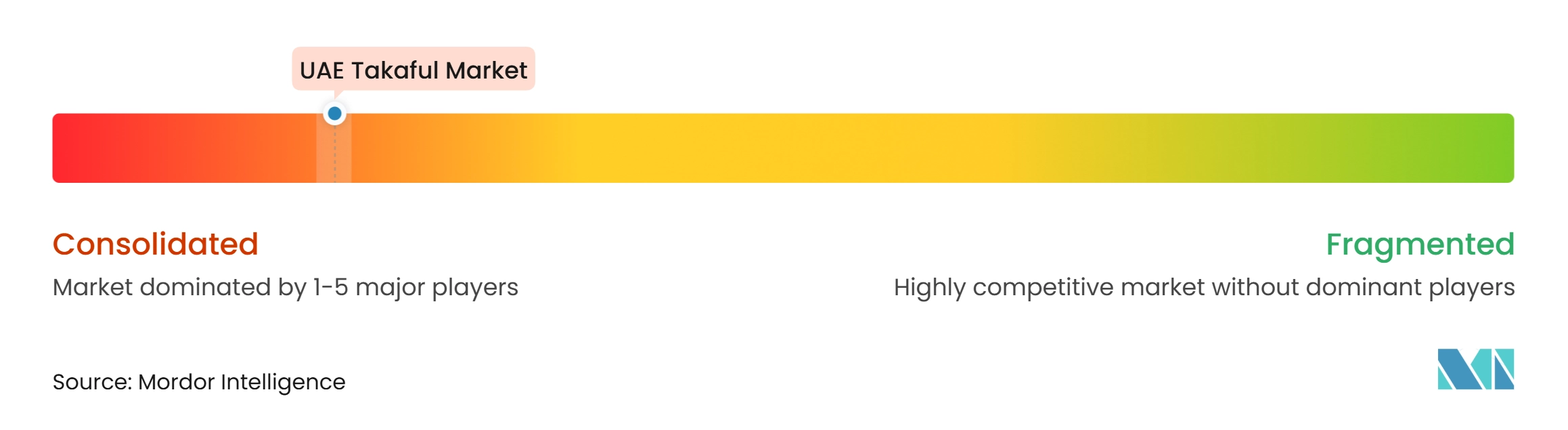
The UAE Takaful market is concentrated, with competition distributed across multiple national operators offering Family and General Takaful products through direct sales, brokers, bancassurance partnerships, and digital channels. Abu Dhabi National Takaful, Takaful Emarat, Orient Takaful, SALAMA, and Sukoon Takaful are among the established participants, alongside other locally licensed operators, including YAS Takaful, Aman, Watania Takaful General, Watania Takaful Family, and Methaq Takaful. Differences in product portfolios, Sharia governance, underwriting capabilities, distribution networks, and customer segments contribute to varied competitive positions rather than dominance by a single provider.
Competition is increasingly shaped by bancassurance partnerships, digital distribution, product diversification, and regulatory compliance. SALAMA expanded its partnership with Abu Dhabi Islamic Bank to cover protection, savings, education, retirement, and wealth planning products. Sukoon Takaful also partnered with Ajman Bank in September 2026 to extend its distribution reach across the northern emirates. Such partnerships enable operators to access established banking customer bases and distribute Sharia-compliant insurance products through additional channels. Meanwhile, direct digital sales and broker-led distribution allow providers to reach customers beyond traditional bank partnerships.
The Central Bank of the UAE's Takaful Insurance Fund requirements, effective September 2026, introduce additional governance and financial management requirements for operators. These requirements increase the importance of regulatory compliance, fund segregation, Sharia governance, and operational capabilities across the market. Digital transactions, embedded SME coverage, and savings-linked Family Takaful provide opportunities for providers to differentiate through accessible products and cost-efficient distribution. Consequently, competition is expected to depend on product innovation, claims management, customer experience, regulatory compliance, and distribution partnerships.
UAE Takaful Industry Leaders
-
Islamic Arab Insurance Company P.J.S.C. (SALAMA)
-
Abu Dhabi National Takaful Company P.S.C.
-
Takaful Emarat - Insurance P.S.C.
-
Sukoon Takaful P.J.S.C.
-
Watania International Holding PJSC
- *Disclaimer: Major Players sorted in no particular order
UAE Takaful Market Companies Covered in this Report
- Islamic Arab Insurance Company P.J.S.C. (SALAMA)
- Abu Dhabi National Takaful Company P.S.C.
- Takaful Emarat – Insurance P.S.C.
- Watania International Holding PJSC
- Sukoon Takaful P.J.S.C.
- Orient Takaful P.J.S.C.
- Dubai Islamic Insurance & Reinsurance Co. (AMAN)
- Methaq Takaful Insurance
- YAS Takaful
Recent Industry Developments in UAE Takaful Market
- September 2026: Sukoon Takaful and Ajman Bank signed a memorandum of understanding to distribute Sharia-compliant takaful solutions through Ajman Bank's network, extending bancatakaful reach into the northern emirates among a newly mandated health-insurance workforce.
- August 2026: SALAMA and Abu Dhabi Islamic Bank marked the next phase of their bancatakaful partnership, expanding to protection, savings, education, retirement, and wealth planning, with investment solutions co-developed with ADIB Capital.
- July 2026: Mashreq and Sukoon Insurance launched embedded SME insurance on MashreqBiz, enabling businesses to purchase workers’ compensation and third-party liability cover directly inside the digital banking platform.
- April 2026: SALAMA completed its capital restructuring, converting an AED 155 million (USD 42.2 million) mandatory convertible sukuk subscribed by Eshraq Investments and Humana Holding into new equity, restoring regulatory solvency.
UAE Takaful Market Report Scope
Segmentation Overview
| Family Takaful | Family Protection / Life Takaful |
| Savings and Investment-Linked Takaful | |
| Medical and Health Takaful | |
| General Takaful | Motor Takaful |
| Property and Fire Takaful | |
| Marine and Aviation Takaful | |
| Engineering and Construction Takaful | |
| Liability Takaful | |
| Travel and Personal Accident Takaful | |
| Credit and Other General Takaful |
| Agents and Brokers |
| Bancatakaful |
| Direct Distribution |
| Embedded, Affinity and Other Non-Bank Partnerships |
| Individual and Retail Participants |
| Small and Medium Enterprises |
| Large Corporates |
| Government and Institutional Participants |
| By Takaful Type | Family Takaful | Family Protection / Life Takaful |
| Savings and Investment-Linked Takaful | ||
| Medical and Health Takaful | ||
| General Takaful | Motor Takaful | |
| Property and Fire Takaful | ||
| Marine and Aviation Takaful | ||
| Engineering and Construction Takaful | ||
| Liability Takaful | ||
| Travel and Personal Accident Takaful | ||
| Credit and Other General Takaful | ||
| By Distribution Channel | Agents and Brokers | |
| Bancatakaful | ||
| Direct Distribution | ||
| Embedded, Affinity and Other Non-Bank Partnerships | ||
| By Customer Type | Individual and Retail Participants | |
| Small and Medium Enterprises | ||
| Large Corporates | ||
| Government and Institutional Participants | ||
Key Questions Answered in the Report
What is the forecast growth rate for UAE takaful?
The UAE Takaful market is forecast to grow at a 4.8% CAGR from 2027 to 2032, reaching USD 2.4 billion by 2032.
Which takaful type is growing fastest in the UAE?
Savings & Investment-Linked Takaful is the fastest-growing type, with a projected 6.5% CAGR through 2032.
What channel leads takaful distribution in the UAE?
Agents & Brokers lead distribution with a 52.1% share in 2026. Embedded and affinity partnerships are projected to grow fastest at 9.8% CAGR as banks and digital platforms integrate coverage into customer journeys.
Why are SMEs important for takaful providers?
SMEs represent more than 94% of registered UAE businesses and are the fastest-growing customer type, with a 5.8% CAGR forecast through 2032.
How has mandatory health cover affected takaful demand?
The extension of mandatory coverage across all emirates helped lift active health policies by 26.1% in 2025.
Which parts of the UAE offer the most growth potential?
Abu Dhabi and Dubai remain the largest demand centers. The northern emirates offer expanding health, SME, marine, manufacturing, and trade-related coverage opportunities after the nationwide health coverage expansion.