
UAE Sukuk Market Size and Share
Market Overview
| Study Period | 2021 - 2032 |
|---|---|
| Forecast Data Period | 2027 - 2032 |
| Base Year Market Size (2026) | USD 77.10 Billion |
| Market Size (2027) | USD 84.20 Billion |
| Market Size (2032) | USD 126.60 Billion |
| Growth Rate (2027 - 2032) | 8.50 % |
| Market Concentration | Low |
Major Players *Disclaimer: Major Players sorted in no particular order Image © Mordor Intelligence. Reuse requires attribution under CC BY 4.0. | |
UAE Sukuk Market Analysis by Mordor Intelligence
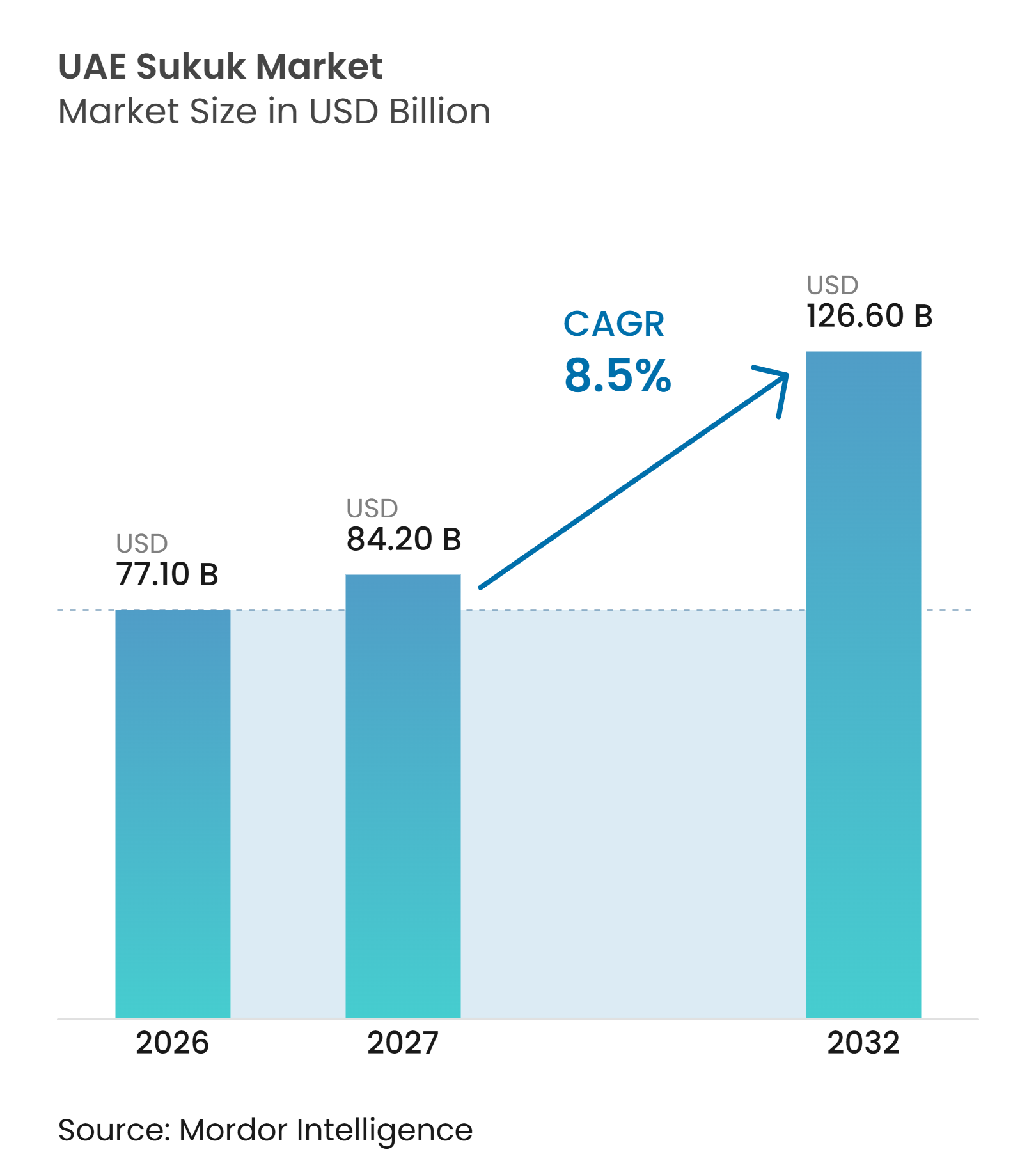
The UAE Sukuk Market size is expected to increase from USD 77.10 billion in 2026 to USD 84.20 billion in 2027 and reach USD 126.60 billion by 2032, growing at a CAGR of 8.5% over 2027-2032.
The UAE Cabinet approved the Islamic Finance and Halal Industry Strategy 2025–2031 in May 2025, setting targets of AED 660 billion (USD 179.7 billion) in domestic Sukuk issuances and AED 395 billion (USD 107.6 billion) in internationally listed UAE Sukuk by 2031. The strategy places Sukuk within the country’s wider effort to deepen Islamic finance and diversify funding channels. The Central Bank of the UAE oversees implementation through a committee chaired by its governor. Government issuance, wider access for individual investors, and digital distribution are strengthening the domestic foundation of the UAE Sukuk market. International listings on Nasdaq Dubai continue to give issuers access to a broad institutional investor base, while geopolitical risk and benchmark-rate changes can still affect pricing and issuance timing.
Key Report Takeaways
- By Sukuk type, Ijarah captured 31.8% of the UAE Sukuk market share in 2026, while Wakalah is projected to grow at a 10.8% CAGR through 2032.
- By issuer type, sovereign issuers captured 34.4% of the UAE Sukuk market share in 2026, while multilateral and supranational issuers are projected to grow at an 11.5% CAGR through 2032.
- By market type, international Sukuk captured 60.3% of the UAE Sukuk share in 2026, while domestic Sukuk is projected to grow at a 9.5% CAGR through 2032.
- By maturity, medium-term Sukuk captured 42.1% of the UAE Sukuk share in 2026, while perpetual Sukuk is projected to grow at a 10.5% CAGR through 2032.
- By label, plain or unlabelled Sukuk captured 81.8% of the UAE Sukuk share in 2026, while green Sukuk is projected to grow at a 15.6% CAGR through 2032.
Note: Market numbers in this report are based on Mordor Intelligence's proprietary estimation framework, which combines nine months of actuals with Q4 projections for base year 2026.
Market Trends and Insights
Drivers Impact Analysis of UAE Sukuk Market*
| Driver | (~) % Impact on CAGR Forecast | Geographic Relevance | Impact Timeline |
|---|---|---|---|
| Federal Funding Diversification Through AED-Denominated T-Sukuk | +1.5% | UAE-wide, with strong pull in Abu Dhabi and Dubai institutional markets | Medium term (2-4 years) |
| Expansion of the AED Sukuk Yield Curve Across Maturities | +0.9% | Domestic UAE market | Medium term (2-4 years) |
| Broadening Retail Participation Through Sovereign T-Sukuk | +0.8% | UAE-wide, with digital adoption strongest in Dubai and Abu Dhabi | Short term (≤ 2 years) |
| Digital Subscription and Secondary-Market Access | +0.7% | Dubai International Financial Centre and Abu Dhabi Global Market, with UAE-wide investor reach | Medium term (2-4 years) |
| Growth in Green and Sustainability-Linked Sukuk | +1.2% | Global, with primary issuance hubs in Dubai and Abu Dhabi | Medium term (2-4 years) |
| Refinancing Opportunities and Changes in Sukuk Funding Costs | +1.0% | UAE-wide, with spillover to regional corporate issuers | Short term (≤ 2 years) |
| Source: Mordor Intelligence | |||
Federal Government Funding Diversification Through AED-Denominated T-Sukuk
The Ministry of Finance’s T-Sukuk program is expanding the domestic funding base of the UAE Sukuk market. By December 2025, the federal government had completed 23 auctions with AED 27 billion (USD 7.19 billion) in outstanding Sukuk, all listed on Nasdaq Dubai[1]. The 2026 calendar includes institutional issuances across maturities from 2027 to 2033. The first 7-year dirham T-Sukuk, introduced in February 2026, was 6 times oversubscribed and extended the sovereign curve beyond 5 years. Regular sovereign pricing gives banks and companies a clearer reference point for their own dirham financing. The Central Bank of the UAE acts as the issuing agent, while the Higher Shariah Authority provides Shariah governance.
Growth in UAE Green and Sustainability-Linked Sukuk Issuance
Green and sustainability-linked instruments are widening the use cases available in the UAE Sukuk market. Emirates Islamic issued a USD 500 million Sustainability-Linked Financing Sukuk in September 2025 and described it as the world’s first transaction of its kind. The structure links financing terms to sustainability performance targets, which gives issuers a way to combine Shariah compliance with measurable financing commitments. Aldar Investment Properties issued a USD 500 million green Sukuk in March 2025, with an order book exceeding USD 3.6 billion[2]. Binghatti also listed a USD 500 million debut green Sukuk in November 2025 to support green-certified projects. The ICMA Green Bond Principles and applicable Shariah requirements remain important compliance references for labeled issuance.
Broadening Retail Investor Participation Through Sovereign T-Sukuk
The retail T-Sukuk initiative is opening sovereign Islamic securities to a wider base of UAE residents and citizens. The Ministry of Finance announced the initiative in October 2025 in collaboration with participating banks. ADIB introduced access through its Smart Sukuk platform, allowing customers to participate with AED 4,000 (USD 1,089) rather than the higher denominations associated with institutional and international issues[3]. The inaugural retail T-Sukuk in June 2026 attracted subscriptions 9 times the initial target and was listed on Nasdaq Dubai. A second retail offering followed in September 2026 through approved digital and banking channels. Broader ownership can make domestic demand more durable when overseas investors become cautious.
Digital Subscription and Secondary-Market Access for UAE Sukuk
Digital securities infrastructure is supporting more direct subscription and settlement options for the UAE Sukuk market. Emirates NBD issued the Middle East’s first United Arab Emirates dirham-denominated digital bond in January 2026 on Euroclear’s digital market infrastructure platform and listed it on Nasdaq Dubai[4]. This transaction showed how digital issuance could be used for dirham-denominated debt securities. The Dubai Financial Services Authority began engagement with firms selected for its Tokenisation Regulatory Sandbox in 2025, including firms considering tokenized Sukuk and fund products. Its participant pool included firms from the United Kingdom, the United States, and the Asia-Pacific region, alongside the UAE and other markets. The framework can lower operational barriers for smaller transactions if issuers and platforms meet regulatory and Shariah requirements. Digital access also supports the retail participation objective by improving distribution beyond traditional institutional channels.
Restraints Impact Analysis of UAE Sukuk Market*
| Restraint | (~) % Impact on CAGR Forecast | Geographic Relevance | Impact Timeline |
|---|---|---|---|
| Limited Diversity of AED-Denominated Corporate and Bank Issuers | -0.8% | Domestic UAE market | Medium term (2-4 years) |
| Global Benchmark Interest-Rate Volatility and Pricing Uncertainty | -1.0% | Global, with UAE international issuances most sensitive | Short term (≤ 2 years) |
| Regional Geopolitical Risks Affecting International Demand | -1.2% | MENA region, with spillover to the UAE international market | Short term (≤ 2 years) |
| Cross-Border Shariah Compliance and Structuring Complexity | -0.5% | Global issuers targeting the UAE, with stronger friction in non-GCC jurisdictions | Long term (≥ 4 years) |
| Source: Mordor Intelligence | |||
Regional Geopolitical Risks Affecting International Investor Demand
Regional geopolitical conditions can quickly change the timing and cost of international issuance in the UAE Sukuk market. Nasdaq Dubai recorded USD 13.8 billion in fixed-income listings during H1 2026, showing that the exchange remained active even during a more difficult period for public issuance. Investors can require higher returns when regional uncertainty rises, which raises the cost of market access for issuers. This pressure is generally stronger for issuers without sovereign support or a long record in the international market. Companies may then use private placements or bank funding while waiting for public market conditions to improve. Smaller emirates and lower-rated issuers can be more sensitive to these shifts because their pricing spreads have less room to absorb additional risk.
Global Benchmark Interest-Rate Volatility and Sukuk Pricing Uncertainty
International Sukuk pricing remains sensitive to changes in global benchmark rates because many transactions are dollar-denominated. This sensitivity affects both new issuances and the refinancing plans of companies with upcoming maturities. The UAE’s scheduled domestic T-Sukuk program provides a local curve, but it does not remove the influence of global dollar funding conditions on international transactions. Issuers may bring forward transactions when funding conditions appear favorable or postpone them when expected profit rates rise. Additional Tier 1 and perpetual structures require particular care because investors assess both the credit profile and the conditions for profit-rate resets. AAOIFI standards and transaction-level Shariah documentation add another review layer for hybrid or complex structures.
*Our forecasts treat driver/restraint impacts as directional, not additive. The impact forecasts reflect baseline growth, mix effects, and variable interactions.
UAE Sukuk Market Segment Analysis
By Sukuk Type:
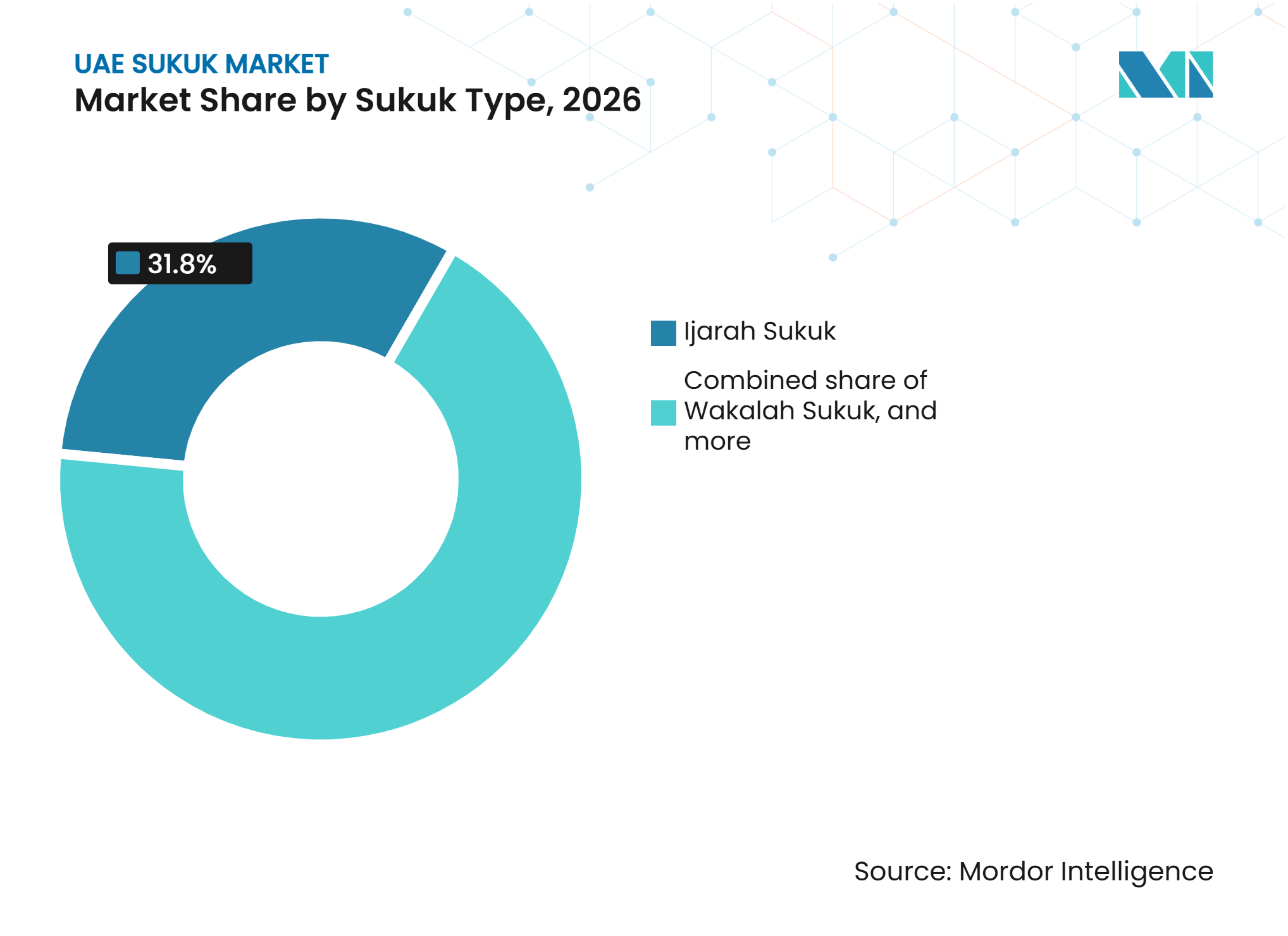
Ijarah Retains Scale While Wakalah ExpandsIjarah held 31.8% of UAE Sukuk share in 2026, making it the largest structure in the portfolio. Its leasing-based design provides a clear asset relationship, which supports investor review and Shariah approval across jurisdictions. Federal T-Sukuk have used Ijarah and Murabahah structures, reinforcing the role of these formats in sovereign financing. The UAE Sukuk market size for Ijarah benefits from predictable government auction schedules and established documentation practices. Ijarah remains relevant for issuers that want a familiar structure with identifiable underlying assets. Its scale also gives arrangers and investors a standard reference for comparing newer structures.
Wakalah is forecast to grow at 10.8% CAGR through 2032, the fastest rate among Sukuk types. The agency model can suit banks and corporates that do not hold eligible physical assets for a traditional lease-based structure. Wakalah structures can combine agency arrangements with other Shariah-compliant contracts, depending on the financing purpose and asset profile. Murabahah remains useful for trade finance and working-capital needs, particularly in financial services. Musharakah and Mudarabah continue to have narrower adoption because their profit-and-loss sharing features involve more complex accounting treatment. Hybrid structures combine more than one contract type when issuers need to manage the mix of tradable and nontradable proceeds under applicable AAOIFI standards.


By Issuer Type:
Sovereign Supply Supports a Broader Issuer BaseSovereign issuers captured 34.4% of the UAE Sukuk share in 2026. The federal government’s quarterly T-Sukuk auctions underpin this position and provide recurring domestic supply. In January 2026, a T-Sukuk auction received AED 5.15 billion (USD 1.40 billion) in bids for an AED 1.1 billion (USD 299.5 million) issuance. Sovereign issuance provides a pricing benchmark for banks, government-related entities, and companies. Financial institutions form the next major group, as Islamic banks use Sukuk to support Tier 1 and Tier 2 capital requirements. Non-financial corporate issuance is expanding across real estate, aviation, and utility-related activity.
Multilateral and supranational issuers are projected to grow at 11.5% CAGR through 2032. Nasdaq Dubai offers these borrowers an established venue for dollar-denominated Islamic securities. The Arab Energy Fund listed a USD 500 million 5-year Sukuk on Nasdaq Dubai in February 2026, its first transaction with this maturity. The transaction created a longer-tenor reference for comparable supranational borrowers. The Islamic Development Bank, the Islamic Corporation for the Development of the Private Sector, and similar institutions reinforce the exchange’s role as a gateway for development-oriented issuers. Recent corporate debuts by Arada Development and Dubai Aerospace Enterprise also show that the issuer base is widening beyond banks and sovereign-related borrowers
By Market Type:
International Listings Lead While Domestic Access DeepensInternational Sukuk captured 60.3% of the UAE Sukuk share in 2026. This position reflects the concentration of international listings on Nasdaq Dubai and the continued preference for dollar-denominated financing among large banks and corporates. Nasdaq Dubai reported USD 98.6 billion in outstanding Sukuk in H1 2026 across more than 100 listings. Indonesia had USD 24.05 billion in outstanding Sukuk on the exchange after its September 2025 dual-tranche listing. These listings show that the UAE functions as a cross-border issuance and listing center, not only as a domestic funding venue. International participation connects the market to investors from Europe, Asia-Pacific, and the wider MENA region.
Domestic Sukuk is forecast to grow at a 9.5% CAGR through 2032. The expansion is linked to institutional T-Sukuk auctions and the development of retail access through bank and digital channels. The 2026 issuance program sets out new dirham-denominated T-Sukuk across several maturities. Domestic instruments can serve investors whose liabilities and spending are denominated in dirhams. They can also widen the UAE Sukuk market size by bringing individual investors into a segment once dominated by institutions. International and domestic instruments therefore address different funding and investor needs rather than replacing one another. The balance between them will depend on the availability of corporate dirham issues and the depth of secondary-market trading.
By Maturity:
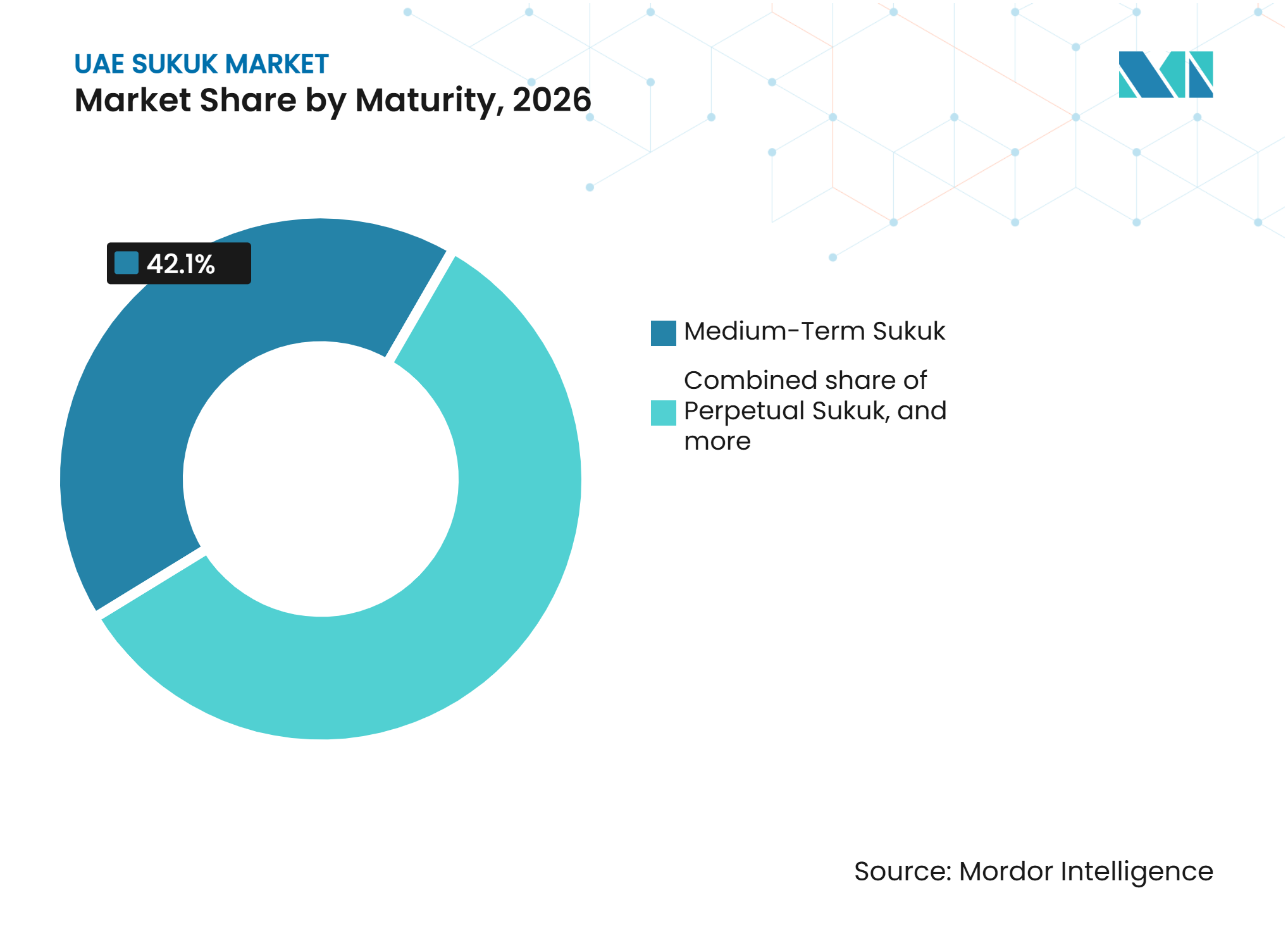
Medium-Term Instruments Remain Central as Perpetual Use GrowsMedium-term Sukuk captured 42.1% of the UAE Sukuk share in 2026. The category reflects the government’s use of 2-to-7-year T-Sukuk maturities under its institutional program. The February 2026 7-year tranche extended the dirham sovereign curve and provided a longer reference point for other issuers. Medium-term tenors offer investors a middle ground between short-term liquidity management and long-term duration exposure. This can suit bank treasuries and fund portfolios that need predictable income with manageable sensitivity to changing rates. The segment is likely to remain important as additional sovereign benchmarks are established.
Perpetual Sukuk is forecast to grow at 10.5% CAGR through 2032. Banks use these instruments to meet capital needs through Additional Tier 1 structures. Investors assess the issuer’s credit profile, the profit-rate conditions, and the timing of call options before participating. The category can combine long-dated funding with regulatory capital treatment. Corporate hybrid instruments are also broadening the practical scope of the maturity category. Short-term Sukuk remain relevant for liquidity needs, while long-term issues continue to support project financing. Issuers must align call features, profit-rate terms, and Shariah requirements with the needs of the target investor group.

By Label:
Plain Sukuk Provides Depth and Green Sukuk Gains MomentumPlain or unlabelled Sukuk captured 81.8% of the UAE Sukuk share in 2026. This share reflects the large outstanding stock of sovereign and institutional instruments that were structured before labeled sustainable finance became more common. A plain label does not prevent issuers from applying internal environmental, social, and governance practices. It does mean that investors may not receive the formal use-of-proceeds reporting associated with a green or sustainability-linked transaction. The UAE Sukuk market continues to rely on plain structures for a substantial part of its funding base. Their liquidity and established documentation will remain important even as labeled products expand.
Green Sukuk is forecast to grow at 15.6% CAGR through 2032. Aldar’s March 2025 green Sukuk and Binghatti’s November 2025 debut show how real estate issuers are using labeled financing for eligible projects. Emirates Islamic introduced a sustainability-linked format that ties financing terms to performance targets rather than a defined green asset pool. The two approaches broaden the range of issuers that can use labeled Sukuk. ICMA principles, issuer frameworks, and Higher Shariah Authority requirements determine the reporting and compliance conditions that apply. Grid infrastructure, renewable energy, water, and green-certified real estate could provide a wider eligible project pipeline.
Geography Analysis
Dubai: Islamic Capital Markets Headquarters
Dubai hosted USD 98.6 billion in outstanding Sukuk listings in H1 2026. Nasdaq Dubai provides the exchange infrastructure behind the city’s role in the UAE Sukuk market. The Dubai International Financial Centre gives international issuers a legal and financial services base for special purpose vehicles. The Dubai Financial Services Authority regulates securities activity in the center and provides an important compliance factor for international participants. Its Tokenisation Regulatory Sandbox supports regulated testing of digital securities products. Dubai’s real estate developers have also supported issuance through conventional and green Sukuk. Sobha Realty listed a USD 750 million green Sukuk in September 2025. The city’s market infrastructure helps issuers keep access to institutional capital during periods of greater volatility.
Abu Dhabi: Sovereign and Supranational Issuance Center
Abu Dhabi is the policy and sovereign issuance center for the UAE Sukuk market. The Central Bank of the UAE is headquartered in the emirate and coordinates the Islamic Finance and Halal Industry Strategy 2025–2031. Abu Dhabi Global Market and its Financial Services Regulatory Authority provide another regulated setting for Islamic securities and digital finance activity. First Abu Dhabi Bank combines a large regional distribution network with its own Sukuk program. Government-related companies, including energy and infrastructure entities, provide a potential pipeline for sustainable financing. The UAE Sukuk market size in Abu Dhabi is also supported by the emirate’s sovereign credit profile and institutional investor base. The regulatory influence of the Central Bank and ADGM can help establish consistent standards for future digital and sustainable structures.
Other Emirates and Global Connectivity
Sharjah and the other emirates add local issuer diversity to the UAE Sukuk market. Sharjah has maintained a sovereign Sukuk program and has used both dirham and dollar financing channels. Ajman Bank made its debut Nasdaq Dubai Sukuk listing in 2025, extending participation beyond the largest financial centers. Cross-border activity remains a defining feature because international sovereign and supranational issuers use Dubai to reach Gulf investors. Indonesia’s USD 24.05 billion outstanding portfolio on Nasdaq Dubai illustrates the scale of this connection. Issuers from Asia-Pacific and African markets can use the UAE platform to access Islamic and conventional capital pools. The 2031 target for AED 395 billion (USD 107.56 billion) in internationally listed Sukuk places continued importance on diversifying issuers beyond the GCC. This model links domestic policy goals with the UAE’s role in global Islamic capital markets.
Competitive Landscape
Market Concentration
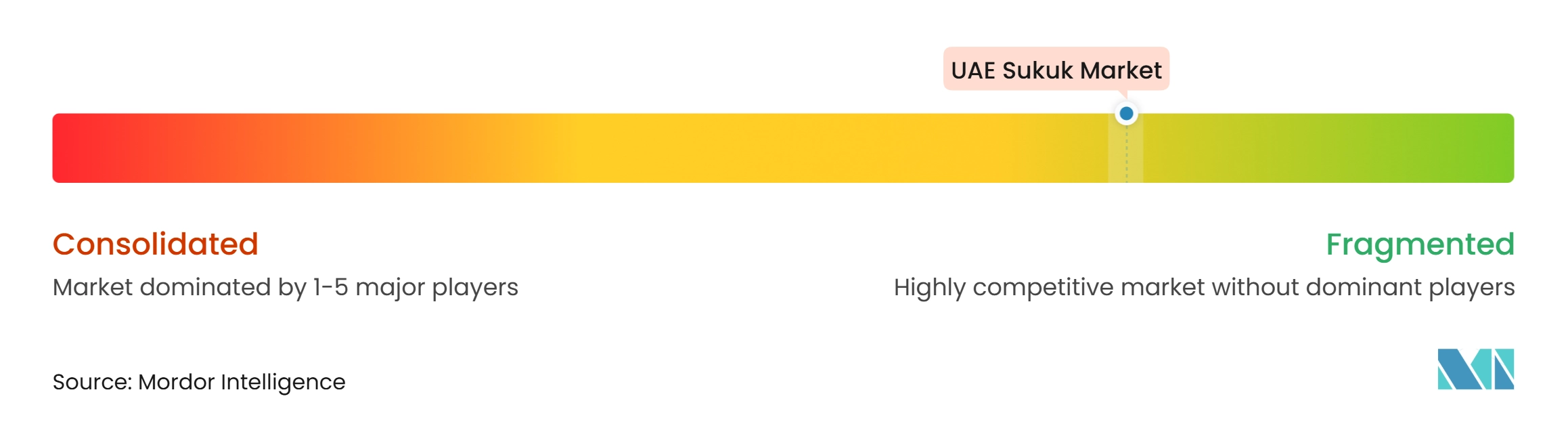
The UAE Sukuk market is fragmented, with competition distributed across domestic and international banks, Islamic financial institutions, sovereign borrowers, government-related entities, and corporate issuers. First Abu Dhabi Bank, Emirates NBD Capital, Dubai Islamic Bank, HSBC, and Standard Chartered participate in Sukuk arranging and underwriting, while Dubai Islamic Bank and Abu Dhabi Islamic Bank leverage their Shariah governance expertise and established customer distribution to compete for mandates. Conventional banks with Islamic finance capabilities also participate through their international investor networks and balance sheet capacity. The diversity of arrangers and issuers reduces dependence on a single institution and supports a competitive market structure.
Product innovation is an important competitive differentiator. Emirates Islamic issued its USD 500 million sustainability-linked financing Sukuk in September 2025, while Dubai Islamic Bank issued a USD 1 billion sustainability-linked Sukuk in November 2025, demonstrating the adoption of sustainability-linked structures among Islamic banks. Aldar’s green Sukuk further demonstrated the participation of property developers in labeled financing instruments. These transactions encourage arrangers to strengthen their capabilities in sustainability reporting, performance metrics, and Shariah documentation, enabling issuers to differentiate their offerings and access international investors.
Opportunities remain in dirham-denominated corporate Sukuk, retail-accessible instruments, and financing structures for water and climate adaptation projects. Mashreq’s Sukuk listing through Mashreq Al Islami reflects the participation of conventional banking groups in Islamic finance, while the Dubai Financial Services Authority’s tokenisation regulatory sandbox provides a framework for exploring tokenized financial products. Competitive positioning will depend on regulatory compliance, investor distribution, structuring expertise, and adherence to Shariah standards, with the Higher Shariah Authority supporting consistency in Islamic finance governance.
UAE Sukuk Industry Leaders
-
First Abu Dhabi Bank
-
Dubai Islamic Bank
-
Abu Dhabi Islamic Bank
-
Emirates NBD Bank
-
Emirates Islamic Bank
- *Disclaimer: Major Players sorted in no particular order
UAE Sukuk Market Companies Covered in this Report
- Abu Dhabi Islamic Bank
- Dubai Islamic Bank
- First Abu Dhabi Bank
- Emirates NBD Bank
- Emirates Islamic Bank
- Mashreqbank
- Sharjah Islamic Bank
- Ajman Bank
- DP World Limited
- Majid Al Futtaim Holding LLC
- Binghatti Holding Limited
- Sobha Realty
- Arada Development LLC
- Omniyat Holdings
- Aldar Properties PJSC
- Emaar Properties PJSC
- Dubai Aerospace Enterprise
- Abu Dhabi National Energy Company PJSC (TAQA)
- Abu Dhabi Commercial Bank (ADCB)
- Arab Energy Fund
Recent Industry Developments in UAE Sukuk Market
- September 2026: The UAE Ministry of Finance launched the second Sovereign Retail T-Sukuk issuance, offering a 5.06% annual profit rate and a five-year tenor. Subscriptions opened on 23 September to UAE nationals and residents through DFM’s eIPO platform, iVestor, the DFM app, and designated bank channels. The AED 50 million (USD 13.6 million) target issuance subsequently attracted AED 285 million (USD 77.6 million) in subscription orders, and the Sukuk began trading on Nasdaq Dubai on 2 October 2026.
- June 2026: The UAE Ministry of Finance launched its inaugural Sovereign Retail T-Sukuk with an initial issuance target of AED 50 million (USD 13.6 million), a two-year tenor, and a 4.30% annual profit rate. Subscription orders reached AED 445 million (USD 121.2 million), prompting an increase in the issuance size to AED 100 million (USD 27.2 million). The Sukuk was listed on Nasdaq Dubai, and trading commenced on 2 July 2026.
- February 2026: The UAE Ministry of Finance introduced its first seven-year AED-denominated Islamic Treasury Sukuk tranche, valued at AED 550 million (USD 150 million). The issuance attracted approximately AED 3.1 billion (USD 844 million) in bids, extending the sovereign dirham yield curve to a seven-year tenor for the first time under the program.
- February 2026: The Arab Energy Fund listed a USD 500 million, 10-year Sukuk on Nasdaq Dubai, carrying a 4.721% profit rate and maturing in 2036. The transaction attracted orders exceeding USD 1.6 billion, reflecting demand from regional and international investors.
UAE Sukuk Market Report Scope
Segmentation Overview
| Murabahah Sukuk |
| Ijarah Sukuk |
| Wakalah Sukuk |
| Musharakah Sukuk |
| Mudarabah Sukuk |
| Salam Sukuk |
| Istisna Sukuk |
| Hybrid / Composite Sukuk |
| Other Sukuk Types |
| Sovereign |
| Sovereign-Related / Quasi-Sovereign |
| Financial Institution |
| Non-Financial Corporate |
| Multilateral / Supranational |
| Domestic Sukuk |
| International Sukuk |
| Short-Term Sukuk |
| Medium-Term Sukuk |
| Long-Term Sukuk |
| Perpetual Sukuk |
| Plain / Unlabelled Sukuk |
| Green Sukuk |
| Sustainability / Sustainability-Linked / Social / Other labeled Sukuk |
| By Sukuk Type | Murabahah Sukuk |
| Ijarah Sukuk | |
| Wakalah Sukuk | |
| Musharakah Sukuk | |
| Mudarabah Sukuk | |
| Salam Sukuk | |
| Istisna Sukuk | |
| Hybrid / Composite Sukuk | |
| Other Sukuk Types | |
| By Issuer Type | Sovereign |
| Sovereign-Related / Quasi-Sovereign | |
| Financial Institution | |
| Non-Financial Corporate | |
| Multilateral / Supranational | |
| By Market Type | Domestic Sukuk |
| International Sukuk | |
| By Maturity | Short-Term Sukuk |
| Medium-Term Sukuk | |
| Long-Term Sukuk | |
| Perpetual Sukuk | |
| By Label | Plain / Unlabelled Sukuk |
| Green Sukuk | |
| Sustainability / Sustainability-Linked / Social / Other labeled Sukuk |
Key Questions Answered in the Report
What is the forecast for UAE Sukuk through 2032?
The UAE Sukuk market is projected to grow from USD 84.2 billion in 2027 to USD 126.6 billion by 2032, at an 8.5% CAGR.
Which Sukuk structure has the largest share in the UAE?
Ijarah held the largest share at 31.8% in 2026, while Wakalah is forecast to record the fastest growth at 10.8% CAGR through 2032.
Why is domestic T-Sukuk issuance important in the UAE?
Regular federal auctions develop a dirham yield curve, broaden funding sources, and create reference pricing for other issuers.
How are retail investors gaining access to UAE Sukuk?
The Ministry of Finance’s retail initiative uses participating banks and digital channels, with ADIB offering access through its Smart Sukuk platform.
What is driving demand for green Sukuk in the UAE?
Green projects in real estate, energy, water, and infrastructure are expanding the eligible financing pipeline, supported by issuer frameworks and Shariah oversight.
What are the main risks for international Sukuk issuers in the UAE?
Regional geopolitical uncertainty and changes in global benchmark rates can increase funding costs and affect the timing of public issuance.