
UAE Residential Construction Market Size and Share
Market Overview
| Study Period | 2021 - 2032 |
|---|---|
| Forecast Data Period | 2027 - 2032 |
| Base Year Market Size (2026) | USD 55.71 Billion |
| Market Size (2027) | USD 58.69 Billion |
| Market Size (2032) | USD 76.15 Billion |
| Growth Rate (2027 - 2032) | 5.35 % |
| Market Concentration | Medium |
Major Players *Disclaimer: Major Players sorted in no particular order Image © Mordor Intelligence. Reuse requires attribution under CC BY 4.0. | |
UAE Residential Construction Market Analysis by Mordor Intelligence
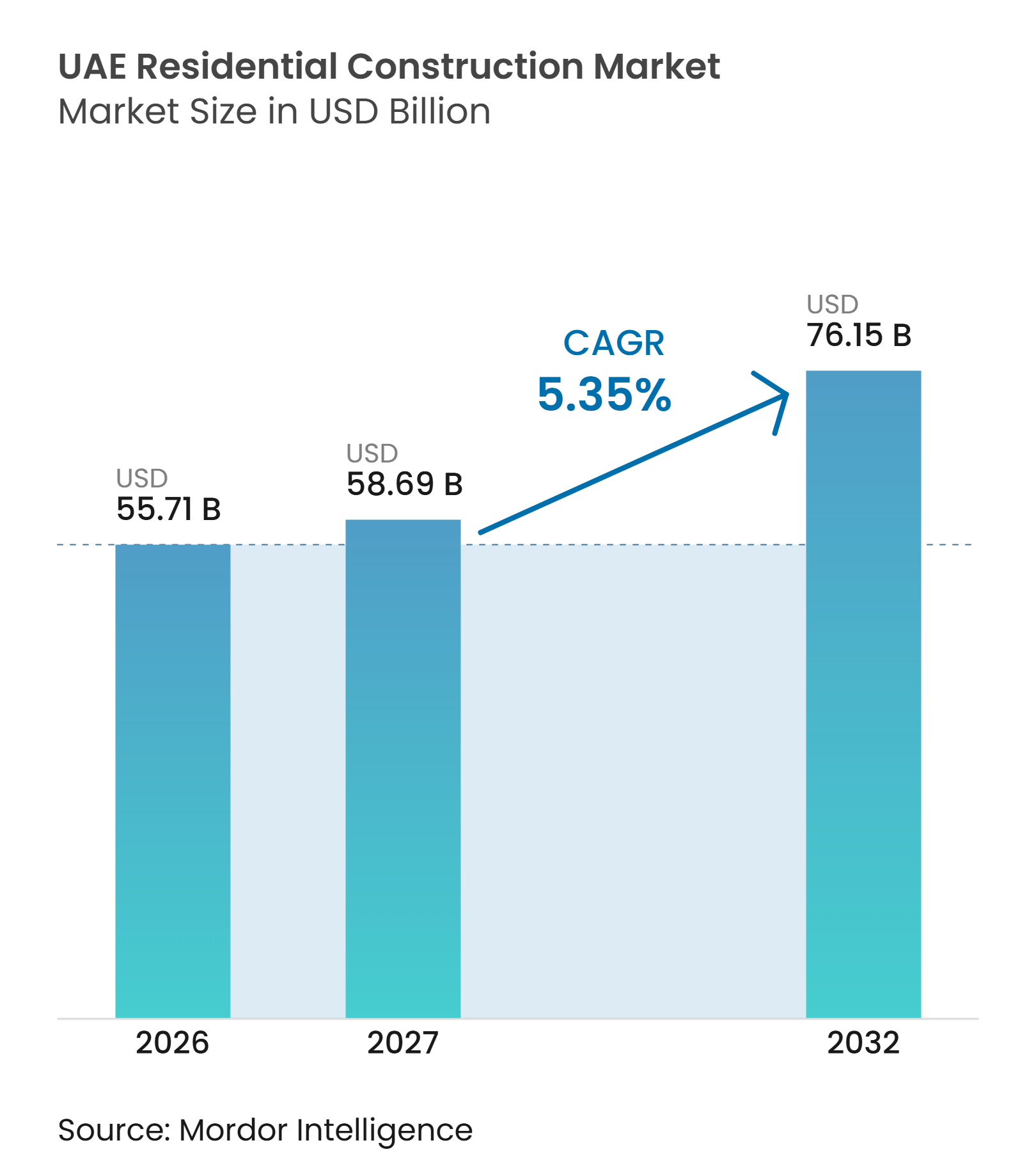
The UAE Residential Construction Market size is expected to increase from USD 55.71 billion in 2026 to USD 58.69 billion in 2027 and reach USD 76.15 billion by 2032, growing at a CAGR of 5.35% over 2027-2032.
The UAE residential construction market is supported by strong off-plan sales, continuing inflows of high-net-worth individuals, and public funding for Emirati housing communities. Developers are directing more capital toward master-planned projects that combine homes with services, retail areas, and cultural facilities. Higher sustainability requirements and premium design standards are raising the value of projects, even where unit volumes are not rising at the same rate. Dubai remains the main construction center, while Ras Al Khaimah is gaining importance through luxury development and resort-linked housing. The UAE residential construction market also faces pressure from construction costs, available skilled labor, and a large future apartment pipeline.
Key Report Takeaways
- By type, apartments and condominiums held 73.1% of the UAE residential construction market share in 2026, while villas and landed houses are forecast to grow at a 6.05% CAGR through 2032.
- By construction type, new construction accounted for 77.4% of the UAE residential construction market size in 2026, while renovation is projected to expand at a 5.93% CAGR through 2032.
- By construction method, conventional on-site construction held 92.2% of UAE residential construction market share in 2026, while modern methods of construction are forecast to grow at a 6.12% CAGR through 2032.
- By investment source, private investment accounted for 69.8% of UAE residential construction market size in 2026, while public investment is projected to advance at a 5.90% CAGR through 2032.
- By geography, Dubai held 48.1% of the UAE residential construction market share in 2026, while Ras Al Khaimah is forecast to expand at a 6.51% CAGR through 2032.
Note: Market numbers in this report are based on Mordor Intelligence's proprietary estimation framework, which combines nine months of actuals with Q4 projections for base year 2026.
Market Trends and Insights
Drivers Impact Analysis of UAE Residential Construction Market*
| Drivers | (~) % Impact on CAGR Forecast | Geographic Relevance | Impact Timeline |
|---|---|---|---|
| Sales Off-Plan Supporting New Launches | +1.2% | Dubai-led, with spillover to Abu Dhabi and Ras Al Khaimah | Short term (≤ 2 years) |
| Emirati Housing Programs Supporting Family Communities | +1.0% | Abu Dhabi and Dubai primarily, with Sharjah gaining | Medium term (2-4 years) |
| Metro and Road Infrastructure Opening Corridors | +0.7% | Dubai Blue Line and UAE-wide Etihad Rail nodes | Medium term (2-4 years) |
| Luxury and Branded Residence Demand | +0.6% | Dubai, Abu Dhabi, and Ras Al Khaimah | Short term (≤ 2 years) |
| Modular Construction Improving Delivery | +0.5% | Dubai and Abu Dhabi, with growing Northern Emirates adoption | Medium term (2-4 years) |
| Green Building Rules Raising Efficiency Standards | +0.4% | UAE-wide, with Dubai and Abu Dhabi leading | Long term (≥ 4 years) |
| Source: Mordor Intelligence | |||
Off-Plan Sales Supporting New Launches
Off-plan activity gives developers an important source of project funding in the UAE residential construction market. Dubai recorded more than 200,000 property transactions in 2025, and off-plan transactions accounted for 73% of that total. The value of those off-plan transactions reached USD 147.5 billion in 2025, following a 32% year-on-year increase in off-plan value. Payments collected during construction allow developers to fund later launches and reduce dependence on project debt. Emaar Development recorded USD 19.4 billion in property sales in 2025, while Binghatti sold more than 17,000 units during the year[1]. This funding cycle supports contractor workloads because new awards can follow land acquisition with less delay.
Emirati Housing Programs Supporting Family Communities
Government-backed housing programs are sustaining demand for villas, townhouses, and community infrastructure across the UAE residential construction market. Abu Dhabi announced a USD 28.8 billion housing plan in September 2025 that covers 13 residential communities, 25,244 homes over 5 years, and 14,876 residential plots[2]. Aldar Properties, Bloom Holding, and Modon Properties are named delivery partners for this plan. The Sheikh Zayed Housing Program issued 2,971 housing approvals worth USD 564 million between January and September 2025[3]. These projects require schools, mosques, parks, and utility connections alongside homes, which creates broader packages for contractors. Public housing timelines also provide a steadier work pipeline than projects that depend entirely on private buyer demand.
Metro and Road Infrastructure Opening Corridors
Transport investment is changing where residential development can move in the UAE residential construction market. The Dubai Metro Blue Line will include 14 stations across 30 km and is scheduled to begin service in 2029, serving Mirdif, Dubai Silicon Oasis, Dubai Creek Harbour, and International City. The confirmed stations give developers clearer evidence of future access in eastern Dubai districts. This can improve buyer confidence and help developers secure project financing earlier in the planning process. The operational Etihad Rail freight network is also shaping mixed-use and residential development opportunities around its nodes. New transport links matter because they extend the range of locations where larger residential communities can compete for demand.
Luxury and Branded Residences Raising Standards
Luxury and branded residences are increasing the technical requirements of the UAE residential construction market. Dubai had 166 active branded-residence projects and 51,692 units at the end of 2025 after 34 launches during the year. These projects accounted for 8% of the new residential supply scheduled for delivery by 2030. Branded-residence transaction value rose 51% during the first 9 months of 2025, reaching USD 13.6 billion, while branded homes commanded a 64% average premium. These projects require close coordination across building information modeling, facade works, mechanical, electrical, and plumbing systems, and interior finishes. This favors contractors that can demonstrate dependable delivery on premium projects.
Restraints Impact Analysis of UAE Residential Construction Market*
| Restraints | (~) % Impact on CAGR Forecast | Geographic Relevance | Impact Timeline |
|---|---|---|---|
| Construction Material and Subcontracting Costs | -0.8% | UAE-wide, with the greatest pressure in Dubai | Short term (≤ 2 years) |
| Rising Residential Completions and Supply Pressure | -0.7% | Dubai concentrated, with Abu Dhabi secondary | Medium term (2-4 years) |
| Regional Geopolitical Uncertainty | -0.5% | UAE-wide, with higher sensitivity near industrial zones | Medium term (2-4 years) |
| Skilled Construction and MEP Labor Shortages | -0.4% | UAE-wide, most acute in the Dubai mega-project corridor | Medium term (2-4 years) |
| Source: Mordor Intelligence | |||
Construction Cost Inflation Compressing Developer Margins
Rising input costs are limiting margins for some projects in the UAE residential construction market. Dubai’s Construction Cost Index increased 0.8% year-on-year in the first quarter of 2025, with equipment hire rising 2.5% and electrical works materials rising 5.9%. Developers with fixed off-plan sale prices have less ability to pass higher material and subcontracting costs to buyers. The pressure is strongest where many large projects compete for the same labor, steel, aluminum, glass, and mechanical equipment. Dubai Law No. 7 of 2025 also introduces contractor registration, professional certification, and subcontracting controls that add compliance work to project management. Developers may respond by pacing launches in mid-market and outer locations rather than cancelling viable projects.
Rising Residential Completions Creating Supply Pressure
The rising apartment completion pipeline creates a more selective demand environment for the UAE residential construction market. Dubai delivered 47,650 residential units in 2025, including 37,950 apartments and 9,700 villas. Its registered forward pipeline extends to 365,000 units through 2028 and remains heavily weighted toward apartments. The concentration of supply may cause more price pressure in apartment-dense secondary locations, while villa and townhouse demand remains tighter. The 2026 to 2029 registered pipeline allocates 85% of units to apartments and 15% to villas, leaving a clear gap for family-sized housing. Developers are therefore moderating selected apartment launches while retaining or restarting villa-led plans.
*Our forecasts treat driver/restraint impacts as directional, not additive. The impact forecasts reflect baseline growth, mix effects, and variable interactions.
UAE Residential Construction Market Segment Analysis
By Type:
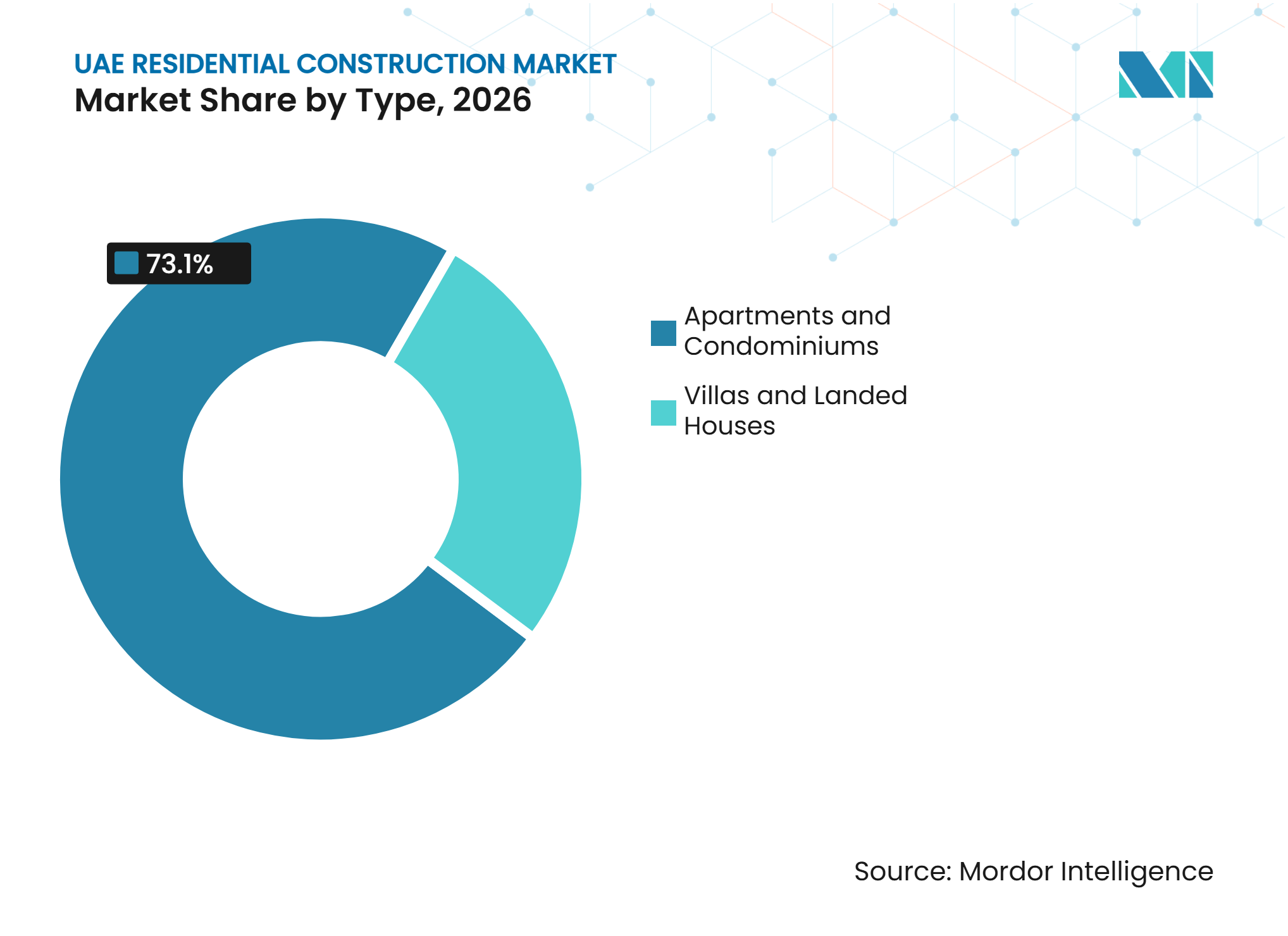
Apartments and Condominiums Lead While Villas and Landed Houses Grow FasterApartments and condominiums held 73.1% of the UAE residential construction market in 2026, reflecting the density and land-use economics of Dubai and Abu Dhabi. High-rise construction remains central to delivery in established urban districts, where existing services, employment centers, and transport networks support apartment demand. The segment is also supported by off-plan sales models that allow developers to launch multi-building projects in phases. Premium apartments and branded residences can require higher building specifications and more integrated mechanical, electrical, and plumbing work. This supports construction value even where the number of units does not rise at the same pace. The UAE residential construction market continues to rely on apartments for the largest share of development value.
Villas and landed houses are projected to record a 6.05% CAGR between 2027 and 2032, which is higher than the growth rate for the overall UAE residential construction market. Dubai’s registered pipeline for 2026 to 2029 includes 15% villas, compared with 85% apartments, creating a limited supply of family-sized housing. Emirati housing programs increase this demand because many public projects include villas, townhouses, private outdoor space, and community services. The Mohammed bin Rashid Housing Establishment is progressing 4 projects worth USD 899 million that will deliver 1,749 homes. This supports contractors with experience in low-rise communities, infrastructure, and phased handovers. The relatively smaller share of villas in the development pipeline, alongside sustained demand for family-oriented housing, supports the growth outlook for this segment.


By Construction Type:
New Construction Holds the Largest ValueNew construction accounted for 77.4% of the UAE residential construction market size in 2026. Large master-planned communities, ongoing tower programs, and government housing commitments support the segment's leading position. Developers are still awarding construction packages for villas, apartment buildings, infrastructure, landscaping, and shared amenities. The segment benefits from off-plan cash collections because early sales can fund progress across large sites. New residential projects must also meet higher green building and contractor compliance requirements. These requirements increase the importance of contractors that can manage design, procurement, documentation, and delivery together.
Renovation is forecast to grow at a 5.93% CAGR through 2032 as older residential stock enters a more active upgrade cycle. Buildings completed from 2010 to 2018 are increasingly reaching a point where mechanical systems, facades, and energy performance require investment. Dubai’s Al Sa’fat requirements apply a minimum Silver Sa’fa standard to new buildings and significant extensions. Major upgrades can therefore require standards similar to new construction. Owners of older multi-unit buildings are seeking energy improvements that can support rental performance and building certification. This creates work for firms with mechanical, electrical, plumbing, facade engineering, and building information modeling capabilities.
By Construction Method:
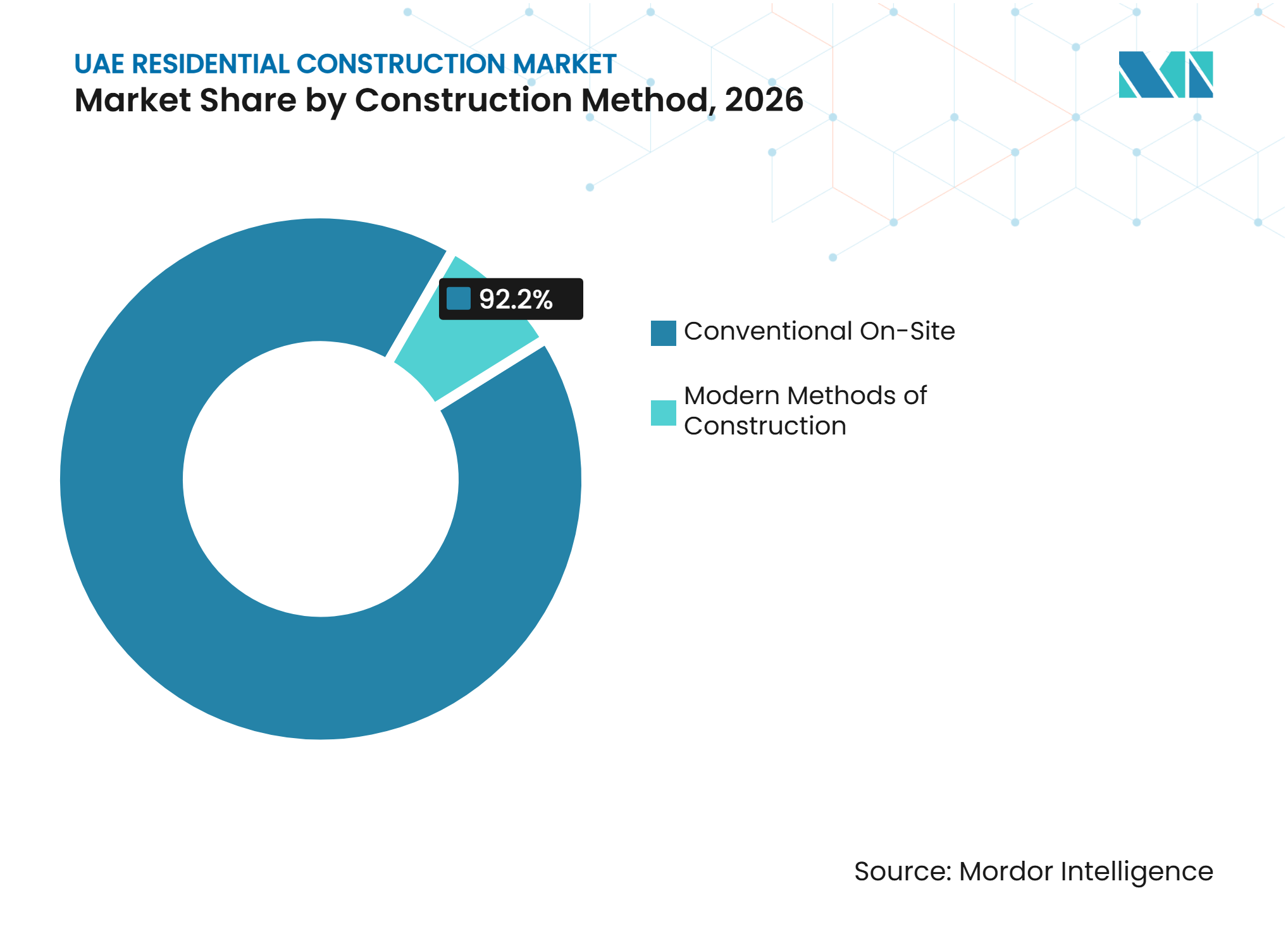
Conventional On-Site Delivery Remains DominantConventional on-site construction held 92.2% of the UAE residential construction market share in 2026. Established labor networks, material supply chains, and contractor practices continue to support this method. It remains suited to mixed project portfolios that include towers, villas, public infrastructure, and custom finishes. Many developers also use conventional methods because local contractors can scale crews across multiple active sites. However, project schedules are becoming more demanding as developers seek faster handovers and more predictable quality. These conditions are increasing interest in factory-based components within otherwise conventional projects.
Modern methods of construction are forecast to grow at a 6.12% CAGR through 2032, making them the fastest-growing construction method in the UAE residential construction industry. Factory-built bathroom pods, prefabricated partitions, and modular mechanical, electrical, and plumbing assemblies can reduce on-site activity and improve control over repeated components. Sobha Modular operates a UAE factory spanning 2.7 million square feet that supplies bathroom pods and prefabricated partitions to multi-tower sites. Eagle Hills completed a pilot residential tower in Abu Dhabi in 12 days using a factory-made modular system developed with Broad. Adoption will depend on developers accepting standardized formats and contractors developing reliable installation capacity. The method is most relevant where delivery pressure, labor constraints, and repeated unit layouts make off-site fabrication practical.

By Investment Source:
Private Investment Leads Current SpendingPrivate investment accounted for 69.8% of the UAE residential construction market size in 2026. Developers have benefited from strong off-plan sales, which provide greater visibility for project funding and construction scheduling. Private capital is especially active in Dubai’s apartment, villa, luxury, and branded-residence developments. Aldar reported a development backlog of USD 19.5 billion in 2025, giving it multi-year construction funding visibility. Developers are using these resources to advance communities in phases and to award packages over longer delivery periods. The UAE residential construction industry remains strongly shaped by the ability of private developers to turn sales receipts into construction starts.
Public investment is projected to grow at a 5.90% CAGR through 2032 as government housing mandates support construction beyond private demand cycles. Abu Dhabi’s housing plan commits USD 25.6 billion to housing unit construction across Abu Dhabi City, Al Ain, and Al Dhafra. Delivery arrangements with named partners give contractors a clearer order pipeline for labor and materials. Public projects also require roads, utilities, schools, mosques, parks, and other facilities that extend the scope of work beyond homes. The programs are important for villa and townhouse construction because they address citizen housing needs directly. Their multi-year nature can reduce the impact of slower private launches in individual locations.
Geography Analysis
Dubai
Dubai held 48.1% of the UAE residential construction market share in 2026 and remains the country’s largest construction center. Its off-plan sales activity creates a direct link between buyer demand, developer receipts, and contract awards. Meraas awarded USD 654 million in construction contracts for new phases of The Acres and The Acres Estates in April 2026. The awards cover 371 villas for United Engineering Construction and 186 villas for GCC Contracting. Nakheel had previously awarded USD 954 million in contracts for 544 villas on Palm Jebel Ali in April 2025. The Metro Blue Line is also encouraging interest in Dubai Silicon Oasis, International City, Mirdif, and Dubai Creek Harbour because stations will improve access before the line opens in 2029. Dubai’s residential pipeline remains apartment-heavy, but villas are receiving continued investment where family demand and premium locations support sales.
Abu Dhabi and Sharjah
Abu Dhabi’s residential activity is underpinned by a large public housing program and sustained private investment. The emirate approved USD 3.1 billion in housing benefits for 7,218 citizens in 2025, in addition to the broader USD 28.8 billion housing plan. Property transactions reached USD 14.7 billion in the first half of 2025, including USD 6.8 billion in residential unit sales. Estidama requires at least a one-Pearl rating for new residential buildings, which places greater importance on proven sustainability delivery. Sharjah is attracting developers seeking lower land costs and new community formats. Alef Group launched the USD 1.1 billion Linar waterfront development in Al Mamzar in June 2026. Azizi Developments announced the USD 8.2 billion Azizi Florence community in Sharjah in September 2026, including more than 10,000 homes and over 7,200 villas and townhouses.
Ras Al Khaimah and Rest of UAE
Ras Al Khaimah is forecast to grow at a 6.51% CAGR through 2032, making it the fastest-growing emirate in the UAE residential construction market. The USD 5.7 billion Wynn Al Marjan Island project is a major anchor for luxury development and related residential demand. Wynn Resorts completed USD 2.4 billion in financing for the project in February 2025, with the resort scheduled to open in September 2027. Janu Al Marjan Island was announced in 2025 as a second Wynn-Marjan joint venture and is expected to open in 2028. The emirate has also introduced Barjeel 13 Green Building Regulations, which provide a framework for new construction. The rest of the UAE continues to serve affordable and mid-market demand that moves beyond Dubai as housing costs rise.
Competitive Landscape
Market Concentration
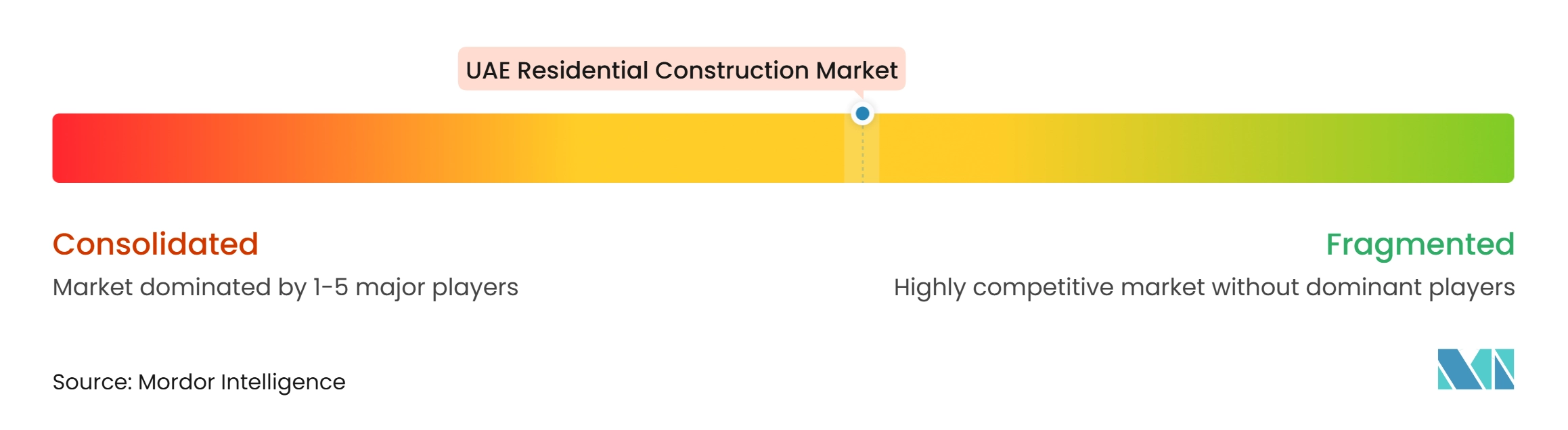
The UAE residential construction market includes large integrated contractors, developer construction arms, specialist mechanical, electrical, and plumbing firms, and growing modular suppliers. ALEC Engineering and Contracting, ASGC Construction, Arabian Construction Company, Trojan Construction Group, Al Naboodah Construction Group, and Dutco Construction compete for major residential packages. Emaar Engineering and Contracting, Aldar Projects, and Sobha Constructions add in-house delivery capabilities to major developer groups. Competition is strongest on large premium projects where project experience, financial capacity, planning systems, and quality assurance affect award decisions. Contractors with established luxury credentials are more likely to win repeat contracts because developers need reliable delivery across complex villas, towers, and mixed-use communities.
Repeat awards show how established project relationships influence competition in the UAE residential construction market. United Engineering Construction received a USD 518 million contract for the first phase of The Acres in November 2025. Meraas then awarded it work within the USD 654 million April 2026 expansion of The Acres and The Acres Estates. This pattern reduces procurement time for developers and gives contractors more predictable workloads. Contractors also compete through their ability to mobilize labor, manage supply chains, and meet the documentation requirements of large developers and public authorities. Dubai’s contractor registration and subcontracting controls are expected to favor more formally structured firms with clear compliance processes.
Modular delivery is creating a separate area of competition within the UAE residential construction market. LINQ Modular, which ALEC Holdings backs, is developing a two-story, three-bedroom townhouse as an off-the-shelf modular housing format for the UAE. International contractors such as China State Construction Engineering Corporation Middle East and Shapoorji Pallonji Middle East continue to compete through workforce capacity and pricing on larger contract packages. Firms that combine off-site fabrication with building information modeling and quality systems can offer shorter build cycles for standardized work. This gives modular specialists an opening where developers need fast delivery without reducing finish quality. Conventional contractors remain important because many UAE projects require custom design, extensive infrastructure, and high-end finishes. The competitive field therefore remains diverse rather than dominated by a small group of contractors.
UAE Residential Construction Industry Leaders
-
ALEC Engineering and Contracting LLC
-
ASGC Construction LLC
-
Arabian Construction Company
-
Trojan Construction Group
-
Al Naboodah Construction Group
- *Disclaimer: Major Players sorted in no particular order
UAE Residential Construction Market Companies Covered in this Report
- ALEC Engineering and Contracting LLC
- ASGC Construction LLC
- Arabian Construction Company
- Trojan Construction Group
- Al Naboodah Construction Group
- Dutco Construction LLC
- Shapoorji Pallonji Middle East
- China State Construction Engineering Corporation Middle East
- Khansaheb Civil Engineering
- Sobha Constructions
- Emaar Engineering and Contracting
- Aldar Projects
- Damac Properties - Project Construction
- United Engineering Construction
- Binghatti Developers
- Azizi Developments
- Nakheel
- Dubai Properties
- Arada
- Modon
- LINQ Modular
Recent Industry Developments in UAE Residential Construction Market
- September 2026: Nakheel, a member of Dubai Holding Real Estate, awarded a main construction contract worth USD 218 million to Metac General Contracting for Phases One and Three of Bay Grove Residences on Dubai Islands, covering 537 homes across 7 residential buildings, with completion targeted in late 2028.
- September 2026: Azizi Developments announced Azizi Florence, a USD 8.2 billion master-planned community in Sharjah comprising more than 10,000 residential units, including over 7,200 villas and townhouses, marking the company’s first entry into the Sharjah residential construction market.
- June 2026: Alef Group launched Linar, a USD 1.1 billion waterfront residential development in Al Mamzar, Sharjah, the group’s first coastal-frontage project, extending its portfolio beyond inland community formats.
UAE Residential Construction Market Report Scope
Segmentation Overview
| Apartments and Condominiums |
| Villas and Landed Houses |
| New Construction |
| Renovation |
| Conventional On-Site |
| Modern Methods of Construction |
| Public |
| Private |
| Dubai |
| Abu Dhabi |
| Sharjah |
| Ras Al Khaimah |
| Rest of the United Arab Emirates |
| By Type | Apartments and Condominiums |
| Villas and Landed Houses | |
| By Construction Type | New Construction |
| Renovation | |
| By Construction Method | Conventional On-Site |
| Modern Methods of Construction | |
| By Investment Source | Public |
| Private | |
| By Emirate | Dubai |
| Abu Dhabi | |
| Sharjah | |
| Ras Al Khaimah | |
| Rest of the United Arab Emirates |
Key Questions Answered in the Report
What is the projected value of UAE residential construction by 2032?
The UAE residential construction market is projected to reach USD 76.15 billion by 2032, expanding at a 5.35% CAGR from 2027. Growth is supported by off-plan sales, developer funding, citizen housing programs, and a rising share of projects that require higher sustainability and technical standards. Dubai remains the main location for current activity, while Ras Al Khaimah is adding growth through luxury and resort-linked development. Investors should also consider the difference between volume growth and project value, because more demanding specifications can lift contract values without an equal rise in completed homes. The outlook is therefore tied to funding conditions, government housing awards, and the ability of contractors to deliver larger projects within scheduled time frames.
Which residential property type holds the largest share in the UAE?
Apartments and condominiums lead with 73.1% of value in 2026. They remain the central format for projects in the urban areas of Dubai and Abu Dhabi, where developers can build at higher density near employment locations, established services, and transport networks. Branded apartments and premium towers also increase the technical scope of construction work through more detailed finishes and coordinated building systems. The large forward pipeline means developers must be selective about location, buyer profile, and pricing when bringing apartment projects to market. This does not remove the role of apartments in the sector, but it makes the quality and location of each project more important.
Which type of home is growing fastest in the UAE?
Villas and landed houses are forecast to grow at a 6.05% CAGR through 2032 because supply remains limited relative to family-home demand. Dubai’s 2026 to 2029 registered pipeline allocates 15% of units to villas and 85% to apartments. Public housing programs also favor villas and townhouses, which creates ongoing demand for contractors that can deliver roads, utilities, landscaping, and shared community facilities. Developers are also maintaining villa construction in premium communities where private outdoor space, family amenities, and lower-density settings are a central part of the buyer proposition. This gives low-rise contractors, infrastructure providers, and specialist suppliers a larger role in the next group of projects.
Why is Ras Al Khaimah growing faster than other emirates?
Ras Al Khaimah is forecast to grow at a 6.51% CAGR through 2032, supported by luxury and resort-linked development around Al Marjan Island. The USD 5.7 billion Wynn Al Marjan Island development is due to open in September 2027, and the Janu Al Marjan Island project is expected to open in 2028. These projects are bringing more branded residences and premium housing activity into the emirate. The shift requires a wider mix of residential contractors, specialist consultants, and suppliers that can meet the quality requirements of international resort-linked projects. Barjeel 13 Green Building Regulations also establish a clearer sustainability framework for construction activity in the emirate.
How are government housing programs affecting construction demand?
Public investment is expected to grow at a 5.90% CAGR through 2032 as housing programs support homes and community infrastructure. Abu Dhabi’s USD 28.8 billion plan covers 13 communities, 25,244 homes over 5 years, and 14,876 residential plots. The work includes villas, townhouses, schools, mosques, parks, and utility systems, which supports larger and longer-running contractor packages than housing construction alone. Government commitments can help stabilize work during periods when commercial developers slow selected launches in response to local supply or construction cost pressure. They also encourage contractors to strengthen capacity for low-rise communities and coordinated public infrastructure delivery.
What is the main construction method used for residential projects?
Conventional on-site construction holds 92.2% of value in 2026, although modern methods of construction are growing at a 6.12% CAGR. Conventional methods remain common because contractors have established labor and materials networks, and many projects need custom work. Modular components, bathroom pods, prefabricated partitions, and coordinated mechanical assemblies are gaining attention where developers need faster schedules and repeatable quality. Wider adoption will depend on factory capacity, standardized design choices, transport planning, installation skills, and developers’ confidence in off-site quality control. The most likely near-term outcome is a mixed approach where conventional contractors use more prefabricated elements within projects that still require substantial work on site.