
UAE Islamic Finance Market Size and Share
Market Overview
| Study Period | 2021 - 2032 |
|---|---|
| Forecast Data Period | 2027 - 2032 |
| Base Year Market Size (2026) | USD 401.54 Billion |
| Market Size (2027) | USD 446.5 Billion |
| Market Size (2032) | USD 772.90 Billion |
| Growth Rate (2027 - 2032) | 11.60 % |
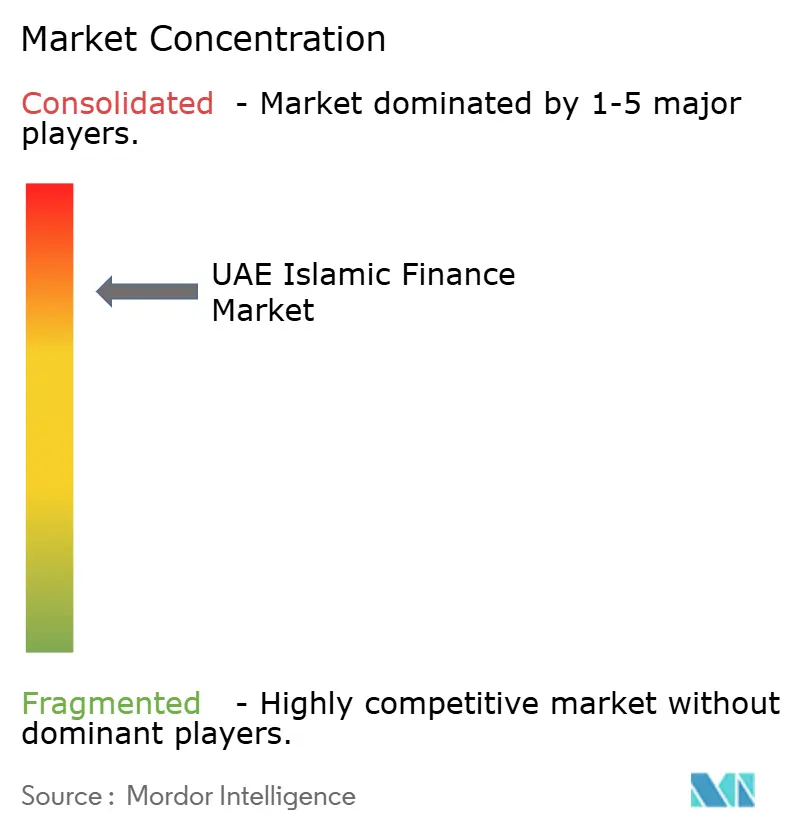
| Market Concentration | High |
Major Players *Disclaimer: Major Players sorted in no particular order Image © Mordor Intelligence. Reuse requires attribution under CC BY 4.0. | |
UAE Islamic Finance Market Analysis by Mordor Intelligence
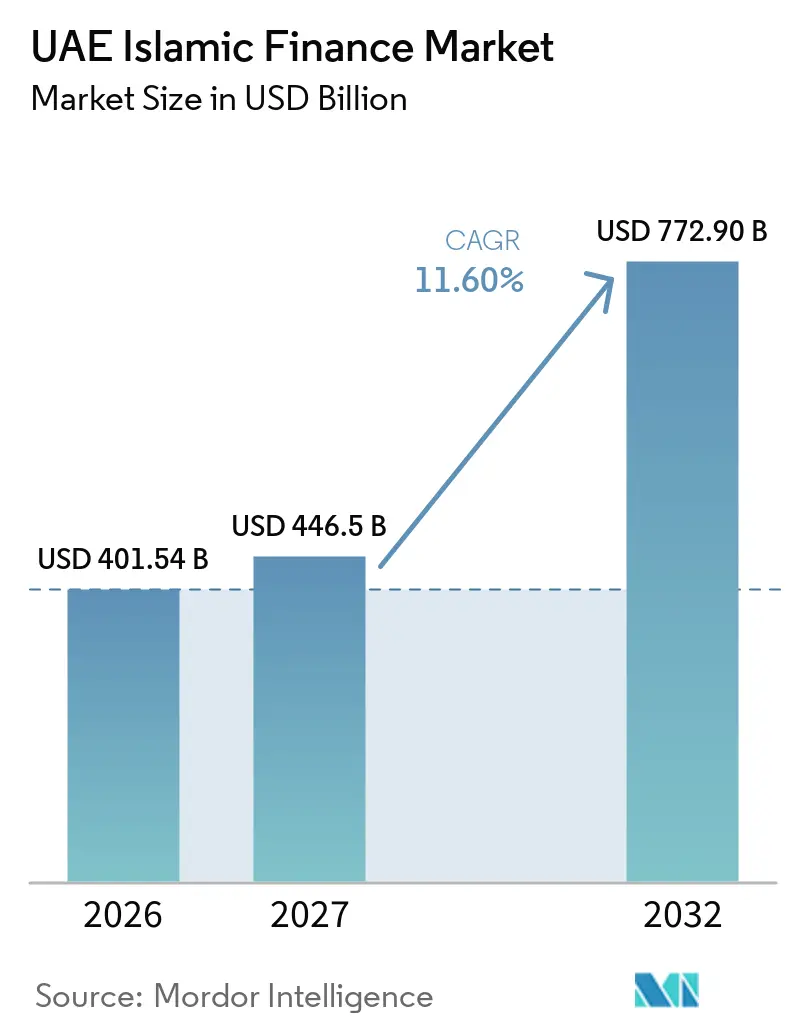
The UAE Islamic Finance Market size is projected to expand from USD 401.54 billion in 2026 and USD 446.5 billion in 2027 to USD 772.90 billion by 2032, registering a CAGR of 11.60% between 2027 and 2032.
The UAE Cabinet approved the National Strategy for Islamic Finance and Halal Industry in May 2025, placing Islamic banking, sukuk, and related services within a national policy program. The strategy has targets for domestic Islamic banking assets, locally listed sukuk, and internationally listed sukuk, which gives financial institutions a clearer framework for long-term investment. Federal Decree-Law No. 6 of 2025 also consolidated banking, payments, insurance, and financial services regulation, while recognizing the transaction structures used in Islamic finance. The UAE Islamic finance market continues to depend heavily on banking, but retail wealth products, sukuk infrastructure, and digital delivery are widening the service base. Competition is increasingly shaped by established banks that are adding digital capabilities and newer institutions that are focused on mobile-first products.
Key Report Takeaways
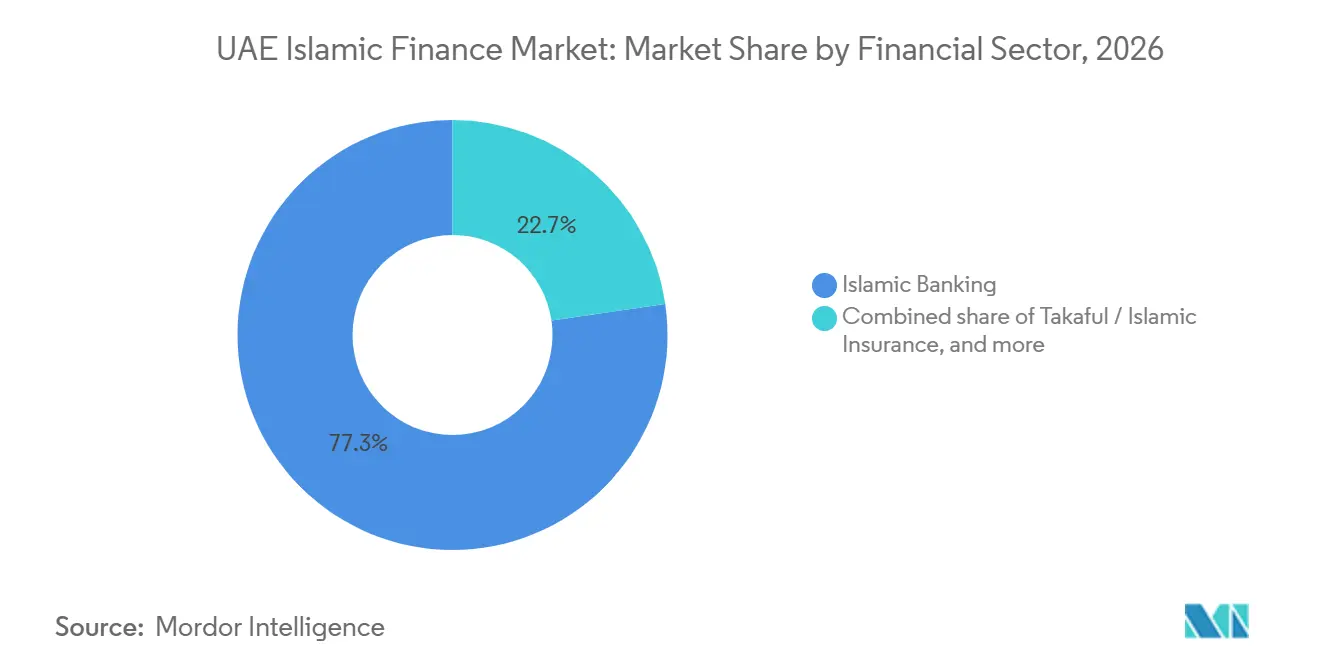
- By financial sector, Islamic banking captured 77.3% of the UAE Islamic finance market share in 2026, while Islamic funds are projected to grow at a 13.8% CAGR through 2032.
- By customer type, retail and individual customers accounted for 38.6% of the UAE Islamic finance market in 2026, while MSMEs are projected to grow at a 12.6% CAGR through 2032.
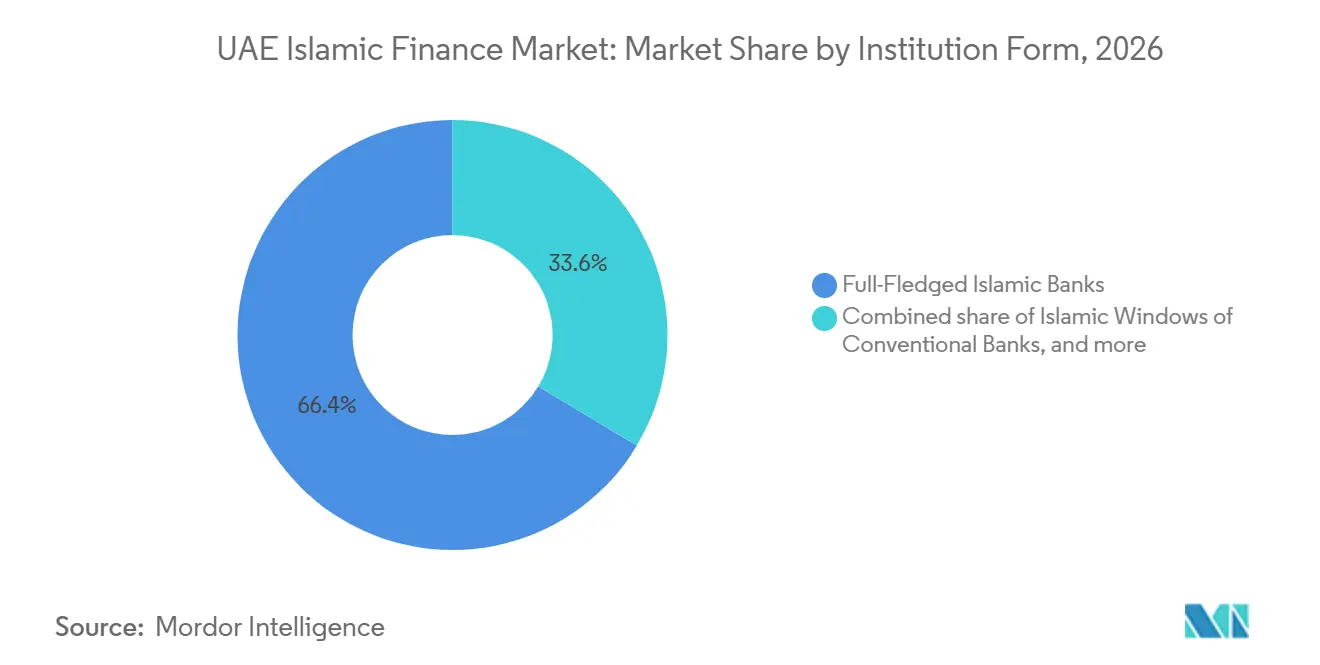
- By institution form, full-fledged Islamic banks captured 66.4% of the UAE Islamic finance market share in 2026, while Islamic fintech and specialist lenders are projected to grow at a 14% CAGR through 2032.
- By geography, Dubai held 44.6% of the UAE Islamic finance market in 2026, while the Northern Emirates are projected to grow at a 12.5% CAGR through 2032.
Note: Market numbers in this report are based on Mordor Intelligence's proprietary estimation framework, which combines nine months of actuals with Q4 projections for base year 2026.
UAE Islamic Finance Market Trends and Insights
Drivers Impact Analysis*
| Driver | (~) % Impact on CAGR Forecast | Geographic Relevance | Impact Timeline |
|---|---|---|---|
| Islamic Finance Strategy Supporting Institutional Scale | +3.5% | National, with early gains in Dubai and Abu Dhabi | Short term (≤ 2 years) |
| Expansion of Shariah-Compliant Banking Financing and Deposits | +2.8% | National, across all emirates | Medium term (2-4 years) |
| Domestic Sukuk and Islamic Money-Market Infrastructure | +1.5% | Dubai and Abu Dhabi | Medium term (2-4 years) |
| Sustainable Islamic Finance and Green Sukuk | +1.2% | Abu Dhabi and Dubai, with spillover to the Northern Emirates | Long term (≥ 4 years) |
| Digitalization and Shariah-Compliant Product Innovation | +1.5% | National, led by Dubai and Abu Dhabi | Short term (≤ 2 years) |
| Global Islamic Capital-Markets and Investment Hub Role | +1% | National, centered on Nasdaq Dubai and Abu Dhabi Global Market | Long term (≥ 4 years) |
| Source: Mordor Intelligence | |||
UAE Islamic Finance Strategy 2025-2031 Accelerating Institutional Scale
The National Strategy for Islamic Finance and Halal Industry, approved in May 2025, puts the UAE Islamic finance market within the national economic agenda. The strategy targets AED 2.56 trillion (USD 697.1 billion) in Islamic banking assets by 2031, and AED 660 billion (USD 179.7 billion) in locally listed sukuk. It also targets AED 395 billion ( USD 107.6 billion) in internationally listed sukuk, on UAE platforms[1]. The Central Bank of the UAE governor chairs the implementation committee, which links policy targets with supervision and market development. Federal Decree-Law No. 6 of 2025 supports the framework by recognizing Islamic structures that require transactions in real estate and goods and by exempting certain Islamic transactions from registration requirements. The Higher Shari'ah Authority has issued more than 280 standards, resolutions, and governance frameworks, giving institutions a clearer basis for product design and review.
Expansion of Shariah-Compliant Banking Financing and Deposit Base
Banking balance sheets remain the main growth base for the UAE Islamic finance market. Residential mortgages, corporate financing, trade activity, and current and savings accounts support both financing growth and deposit collection. Emirates Islamic reported total assets of AED 146 billion (USD 39.8 billion) in 2025, while customer financing rose 26% to AED 89 billion (USD 24.2 billion). Customer deposits increased 33% to AED 102 billion (USD 27.8 billion), and profit before tax rose 26% to AED 3.9 billion (USD 1.1 billion)[2]. ADIB added nearly 283,000 customers in 2025 and reported total assets of AED 281 billion (USD 76.5 billion), with a lower non-performing financing ratio. ADIB also reported that fees, foreign exchange, and wealth management accounted for 39% of operating income in 2025, showing that product income is becoming less dependent on financing margins.
Deepening Domestic Sukuk and Islamic Money-Market Infrastructure
The UAE is expanding its domestic Islamic money-market tools, which improve liquidity management for Islamic banks and investors. In January 2026, the Ministry of Finance recorded AED 5.15 billion (USD 1.4 billion) in bids against an AED 1.1 billion (USD 299.5 million) issuance in its T-Sukuk auction[3]. The auction was 4.7 times oversubscribed, indicating strong institutional demand for sovereign Shariah-compliant instruments. The Ministry launched the first 7-year T-Sukuk tranche in July 2026, creating a longer-duration government instrument for the local market. In September 2026, the Sovereign Retail T-Sukuk Programme offered retail access with a minimum subscription of AED 1,000 (USD 272.3) and a 5.06% profit rate. Wider retail participation can broaden the investor base and support a more active secondary market for the UAE Islamic finance market.
Institutionalization of Sustainable Islamic Finance and Green Sukuk
Sustainability-linked financing is becoming part of the product range available to UAE Islamic issuers. Abu Dhabi issued a USD 2 billion sovereign green sukuk in 2026, bringing new funding toward clean energy and sustainable infrastructure projects. Tabreed issued an inaugural USD 700 million green sukuk in March 2025 under a framework aligned with the International Capital Market Association Green Bond Principles[4]. The issuance gave Tabreed a financing route linked to its environmental infrastructure activities. Aldar Investment Properties also issued a USD 500 million green sukuk that received USD 3.6 billion in orders. Green sukuk supply can vary with market conditions, but the examples show that issuers can use Shariah-compliant structures to access sustainability-focused capital.
Restraints Impact Analysis*
| Restraint | (~) % Impact on CAGR Forecast | Geographic Relevance | Impact Timeline |
|---|---|---|---|
| Dependence on Islamic Banking Over Non-Bank Finance | -1.2% | National | Medium term (2-4 years) |
| Shariah Governance and Product Approval Complexity | -0.8% | National, concentrated in Dubai International Financial Centre and Abu Dhabi Global Market products | Long term (≥ 4 years) |
| Limited Depth of Takaful and Islamic Investment Products | -0.9% | National | Medium term (2-4 years) |
| Specialized Shariah and Islamic Finance Talent Requirements | -0.7% | National, especially Abu Dhabi and Dubai | Long term (≥ 4 years) |
| Source: Mordor Intelligence | |||
High Dependence on Islamic Banking Relative to Non-Bank Islamic Finance
Islamic banking held 77.3% of UAE Islamic finance assets in 2025, leaving the UAE Islamic finance market closely tied to one financial-sector category. This concentration limits the contribution from insurance, funds, and other non-bank products. Takaful generated AED 6.4 billion (USD 1.7 billion) in gross written contributions in 2025, following an 18.5% increase. However, Takaful represented only 8.5% of the UAE insurance sector, indicating a smaller position than Islamic banking has within financial services. Broader retail education, stronger product distribution, and a deeper investment-product range would help diversify demand. Progress is likely to require multiple development cycles because corporate customers already use established conventional insurance and investment channels.
Shariah Governance and Product-Approval Requirements Increasing Product Development Complexity
Islamic products require review through internal Shariah committees and compliance with the binding standards issued by the Higher Shari'ah Authority. This multi-layered process can increase development time and cost compared with conventional financial products. The task becomes more demanding when institutions introduce tokenized instruments, digital-asset services, AI-enabled underwriting, or other products without established Shariah precedents. Ruya worked with DDCAP Group on a digital Commodity Murabaha service that manages the transaction from initiation through settlement. Federal Decree-Law No. 6 of 2025 made Higher Shari'ah Authority resolutions binding on Islamic financial institutions and extended the Central Bank's licensing perimeter to relevant fintech platforms. These requirements strengthen customer confidence and consistency, but they can slow the commercial launch of new products.
*Our forecasts treat driver/restraint impacts as directional, not additive. The impact forecasts reflect baseline growth, mix effects, and variable interactions.
Segment Analysis
By Financial Sector: Islamic Banking Leads While Islamic Funds Grow Fastest
Islamic banking held 77.3% of the UAE Islamic finance market in 2026 and remained the largest financial-sector category. Its scale reflects long-standing retail deposit collection, corporate lending capacity, and the national reach of full-fledged Islamic banks. Emirates Islamic, ADIB, and DIB each recorded customer financing growth of at least 26% in 2025, supported by home financing, trade activity, and lending to government-related entities. The performance shows that banking continues to provide the largest share of assets and operating capacity in the UAE Islamic finance industry. Sukuk accounted for a meaningful part of domestic debt-capital-market activity, while Takaful contributions rose to AED 6.4 billion (USD 1.7 billion) in 2025. Takaful is growing from a smaller base and has more limited penetration than Shariah-compliant banking.
Islamic funds are projected to grow at a 13.8% CAGR from 2027 through 2032, the highest rate within the financial-sector categories. Retail access to sovereign T-sukuk can help develop fund products by introducing more savers to Shariah-compliant fixed-income instruments. The September 2026 retail program set a minimum subscription of AED 1,000 (USD 272.3) and a 5.06% profit rate. Ruya's retail Islamic wealth platform offers Shariah-screened stocks, exchange-traded funds, gold, sukuk, and digital assets. The range illustrates how wealth products are being combined with digital distribution. This may create a broader route into Islamic funds for customers who traditionally used deposits or direct property investment.
By Customer Type: Retail Leads on Scale While MSMEs Expand
Retail and individual customers accounted for 38.6% of the UAE Islamic finance market in 2026, making them the largest customer category. Home financing, personal financing, and current and savings accounts are central to this position. ADIB reported that its current and savings account base reached 64% of total deposits after growing 14% in 2025. This funding mix supports lower-cost deposits and indicates durable customer engagement. Government and government-related entities formed the next major customer base through project finance, sovereign sukuk, and national infrastructure transactions. Large corporates and financial institutions also generate demand for trade finance, sukuk, and cross-border transactions.
MSMEs are projected to grow at a 12.6% CAGR through 2032, the highest rate among the customer groups. The content identifies a USD 300 billion small and medium enterprise financing gap across the Middle East and North Africa region. Emirates Islamic launched Islamic smartSCF in October 2025 to give suppliers earlier access to cash from large corporate supply chains. Magnati and Aafaq Islamic Finance combined point-of-sale transaction information with real-time underwriting for small-business finance. The platform can support invoice financing, equipment financing, and receivables financing through Shariah-compliant structures. ADIB more than doubled its business banking customer base in the 2 years through mid-2026, showing that banks see commercial potential in this customer group.
By Institution Form: Full-Fledged Banks Lead While Fintech and Specialist Lenders Gain Reach
Full-fledged Islamic banks held 66.4% of the UAE Islamic finance market in 2026, supported by their large balance sheets, branch networks, and established customer relationships. DIB reported AED 416 billion (USD 113.3 billion) in total assets in 2025. Its alt app had more than 1.1 million registered users, and digital channels handled 51% of all customer transactions during the year. DIB reported that 97% of its customer base used digital channels and 80% of new-to-bank customers were onboarded digitally. Sharjah Islamic Bank reported assets of AED 94.5 billion (USD 25.7 billion) by June 2026. It approved a rights issue that would increase capital from AED 3.235 billion (USD 880.9 million) to AED 4.314 billion (USD 1.2 billion).
Islamic fintech and specialist lenders are projected to grow at a 14% CAGR through 2032. Islamic Windows of conventional banks extend global distribution networks and capital into Shariah-compliant products, but must meet the Central Bank's requirements for institutions that house Islamic windows. Ruya projected that it would exceed 160,000 customers by the end of 2026, compared with a base of zero in 2024. Mal received in-principle approval in May 2026 to establish an AI-native Islamic digital bank after raising USD 230 million in seed funding. Amlak Finance, Aafaq Islamic Finance, and Mawarid Finance operate in home finance, small-business and personal lending, and corporate Islamic finance. Their specialized product focus gives them a role in areas where large banks have historically allocated less attention.
Geography Analysis
Dubai held 44.6% of the UAE Islamic finance market in 2026, supported by its role in Islamic banking, sukuk listings, and financial-services activity. The emirate hosts DIB, Emirates Islamic, SALAMA, and firms operating within the Dubai International Financial Centre ecosystem. Nasdaq Dubai listed more sukuk than conventional bonds and equities combined in 2024. In May 2026, ADIB partnered with Dubai Holding Real Estate to offer Shariah-compliant home financing across Nakheel, Meraas, and Dubai Properties. This links Islamic finance activity to the emirate's large real-estate development base. Dubai also benefits when international issuers and investors choose UAE platforms for Islamic capital-market activity.
Abu Dhabi is centered on government-related entity financing, sovereign sukuk, sustainable finance, and Islamic wealth management. ADIB reported total assets of AED 281 billion (USD 76.5 billion) in 2025. It had mobilized AED 23.3 billion (USD 6.3 billion) in sustainable finance by the first half of 2026, toward its AED 60 billion (USD 16.3 billion) commitment by 2030. Abu Dhabi issued a USD 2 billion sovereign green sukuk in 2026. The Abu Dhabi Global Market regulatory setting also supports institutional activity in digital assets and token-related services. These features give Abu Dhabi a distinct role in the UAE Islamic finance market, particularly for sovereign, institutional, and sustainability-oriented transactions.
The Northern Emirates are projected to grow at a 12.5% CAGR through 2032, the fastest rate among the geographic categories. Sharjah Islamic Bank reported a financing portfolio of AED 49.9 billion (USD 13.6 billion) in the first half of 2026 after 9.4% growth. Ajman Bank reported 44% asset growth in 2025 to AED 32.9 billion (USD 9 billion) and 41% financing growth in the first quarter of 2026. Ruya is headquartered in Ajman but receives 25% of its customers from Abu Dhabi, demonstrating that digital providers can reach customers across emirates. Sharjah, Ajman, Ras Al Khaimah, Fujairah, and Umm Al Quwain benefit from local small-business and retail demand. The Rest of the UAE segment is served increasingly through digital platforms that can reach customers without a full branch network.
Competitive Landscape
The UAE Islamic finance market is consolidated. DIB reported total assets of AED 416 billion (USD 113.3 billion) in 2025, while ADIB reported AED 281 billion (USD 76.5 billion). Emirates Islamic reported AED 146 billion (USD 39.8 billion), and Sharjah Islamic Bank reported AED 90.3 billion (USD 24.6 billion) in 2025. These banks combine national customer access with product capabilities across retail, corporate, trade, and wealth activities. Islamic windows of conventional banks compete in sukuk structuring, trade finance, and corporate products by using wider international networks. Digital institutions add pressure in retail finance because they can acquire and serve customers without the fixed cost of a traditional branch footprint.
Leading banks have pursued practical steps to strengthen their positions. DIB increased its shareholding in T.O.M Katılım in Türkiye to 25% and acted as the exclusive banking partner at Make it in the Emirates 2026. ADIB launched ADIB Ventures to support Islamic fintech partnerships and new technology-focused services. Emirates Islamic introduced Islamic smartSCF in October 2025 to provide digital supply chain finance for corporate customers and their vendors. ADIB also partnered with Dubai Holding Real Estate in May 2026 to offer home financing across Nakheel, Meraas, and Dubai Properties. These moves reflect a focus on cross-border links, digital capabilities, and distribution partnerships rather than branch expansion alone.
Unmet demand remains in retail sukuk access, Shariah-compliant wealth products, small-business working capital, and sustainable financing. The sovereign retail T-sukuk programme addresses retail access by allowing lower minimum subscriptions, although secondary-market liquidity is still developing. SALAMA restored its solvency ratio after its April 2026 restructuring, which may give the Takaful provider a firmer base for growth. Mal's proposed AI-native digital bank and Ruya's community-bank approach can increase competitive pressure in retail and small-business finance. The competitive field, therefore, includes large universal Islamic banks, Islamic windows, specialized lenders, insurers, and mobile-first entrants.
UAE Islamic Finance Industry Leaders
-
Dubai Islamic Bank P.J.S.C.
-
Abu Dhabi Islamic Bank P.J.S.C.
-
Emirates Islamic Bank P.J.S.C.
-
Sharjah Islamic Bank P.J.S.C.
-
Al Hilal Bank P.J.S.C.
- *Disclaimer: Major Players sorted in no particular order
Recent Industry Developments
- September 2026: The UAE Ministry of Finance launched the second issuance under the Sovereign Retail T-Sukuk Programme, offering a 5.06% profit rate on a 5-year tenor, with subscriptions open from 23-28 September 2026 through approved digital channels, targeting AED 50 million (USD 13.6 million), with a minimum entry of AED 1,000 (USD 272.3), broadening retail access to sovereign Shariah-compliant fixed income.
- July 2026: The UAE Ministry of Finance launched the country's first 7-year tenor T-Sukuk tranche as part of the Islamic Treasury Sukuk Program 2026, attracting AED 5.88 billion in bids on an AED 1.1 billion (USD 0.30 billion) issuance, with the 7-year tranche listed on Nasdaq Dubai.
- May 2026: ADIB signed a strategic partnership with Dubai Holding Real Estate to provide Shariah-compliant home financing for customers purchasing off-plan and completed properties across Nakheel, Meraas, and Dubai Properties.
- April 2026: SALAMA completed its capital restructuring by converting AED 155 million (USD 42.2 million) in Mandatory Convertible Sukuk and issuing new shares, restoring its solvency ratio from 76% at year-end 2025 to 159% after the transaction.
UAE Islamic Finance Market Report Scope
| Islamic Banking |
| Takaful / Islamic Insurance |
| Sukuk |
| Islamic Funds |
| Retail / Individual Customers |
| MSMEs |
| Large Corporates |
| Government & Government-Related Entities |
| Financial Institutions |
| Other Customer Types |
| Full-Fledged Islamic Banks |
| Islamic Windows of Conventional Banks |
| Takaful / Cooperative Insurers |
| Islamic Fund Managers |
| Islamic Fintech & Specialist Lenders |
| Abu Dhabi |
| Dubai |
| Northern Emirates |
| Rest of UAE |
| By Financial Sector | Islamic Banking |
| Takaful / Islamic Insurance | |
| Sukuk | |
| Islamic Funds | |
| By Customer Type | Retail / Individual Customers |
| MSMEs | |
| Large Corporates | |
| Government & Government-Related Entities | |
| Financial Institutions | |
| Other Customer Types | |
| By Institution Form | Full-Fledged Islamic Banks |
| Islamic Windows of Conventional Banks | |
| Takaful / Cooperative Insurers | |
| Islamic Fund Managers | |
| Islamic Fintech & Specialist Lenders | |
| By Geography | Abu Dhabi |
| Dubai | |
| Northern Emirates | |
| Rest of UAE |
Key Questions Answered in the Report
What is the forecast growth rate for UAE Islamic finance?
The UAE Islamic finance market is projected to grow at an 11.6% CAGR from 2027 through 2032, reaching USD 772.9 billion.
Which financial sector holds the largest share in UAE Islamic finance?
Islamic Banking held 77.3% of UAE Islamic finance assets in 2026, supported by established retail deposits and corporate financing capacity.
Which customer group is growing fastest in UAE Islamic finance?
MSMEs are projected to grow at a 12.6% CAGR through 2032 as Islamic banks expand working-capital and supply-chain products.
Which emirate leads UAE Islamic finance?
Dubai held 44.6% of the UAE Islamic finance market in 2026 due to its banking base, sukuk listing activity, and financial-services ecosystem.
What is driving Islamic Funds growth in the UAE?
Islamic Funds are projected to grow at a 13.8% CAGR through 2032, supported by digital wealth platforms and wider access to Shariah-compliant fixed-income instruments.
How are digital banks changing Islamic financial services in the UAE?
Digital providers such as ruya and the proposed Mal platform are widening access to retail and small-business products, while established banks are increasing digital onboarding and transaction activity.