
UAE Embedded Insurance Market Size and Share
Market Overview
| Study Period | 2021 - 2032 |
|---|---|
| Forecast Data Period | 2027 - 2032 |
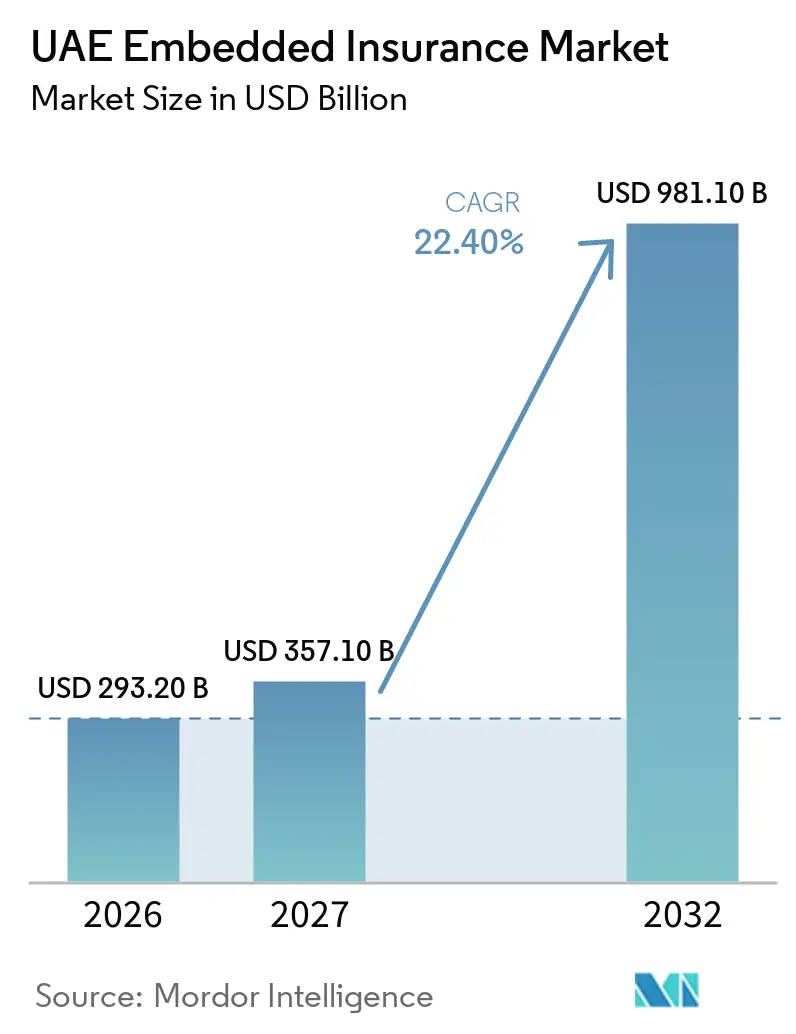
| Base Year Market Size (2026) | USD 293.20 Billion |
| Market Size (2027) | USD 357.10 Billion |
| Market Size (2032) | USD 981.10 Billion |
| Growth Rate (2027 - 2032) | 22.40 % |
| Market Concentration | Low |
Major Players *Disclaimer: Major Players sorted in no particular order Image © Mordor Intelligence. Reuse requires attribution under CC BY 4.0. | |
UAE Embedded Insurance Market Analysis by Mordor Intelligence
The UAE Embedded Insurance Market size was valued at USD 293.20 billion in 2026 and is estimated to grow from USD 357.10 billion in 2027 to reach USD 981.10 billion by 2032, at a CAGR of 22.40% during the forecast period (2027-2032).
The UAE embedded insurance market is expanding as insurance moves into vehicle services, banking applications, online checkout, and government service platforms. Mandatory health coverage across all 7 emirates, the Central Bank of the UAE licensing framework, and open finance rules are reshaping how insurance can be offered through digital channels. These changes encourage insurers, brokers, banks, and platforms to build services around real-time eligibility checks, quotations, payments, and policy issuance. The UAE embedded insurance market also benefits from government digital services that reduce documentation steps and bring mandatory transactions into connected user journeys. Competition is increasingly defined by the ability to combine licensed distribution, reliable data handling, and an easy claims experience.
Key Report Takeaways
- By insurance line, health and medical captured 32.4% of the UAE embedded insurance market share in 2026, while goods and device protection is projected to grow at a 25.8% CAGR through 2032.
- By embedding partner channel, e-commerce marketplaces and specialist online retailers held 27.1% of the UAE embedded insurance market size in 2026, while banks, fintechs, and buy now, pay later checkout platforms are projected to grow at a 28.6% CAGR through 2032.
- By policyholder, personal and consumer policyholders accounted for 70.3% of the UAE embedded insurance market share in 2026, while commercial and business policyholders are projected to grow at a 24.9% CAGR through 2032.
- By policy duration, annual and multi-year policies represented 61.8% of the UAE embedded insurance market share in 2026, while short-term and activity-specific policies are projected to grow at a 26.3% CAGR through 2032.
- By integration model, white-label and affinity integration accounted for 40.4% of the UAE embedded insurance market share in 2026, while API-integrated models are projected to grow at a 27.7% CAGR through 2032.
Note: Market numbers in this report are based on Mordor Intelligence's proprietary estimation framework, which combines nine months of actuals with Q4 projections for base year 2026.
Market Trends and Insights
Drivers Impact Analysis of UAE Embedded Insurance Market*
| Driver | (~) % Impact on CAGR Forecast | Geographic Relevance | Impact Timeline |
|---|---|---|---|
| High Digital-Payment Adoption and Mobile-First Insurance Distribution | +4.2% | Global, concentrated in Dubai and Abu Dhabi | Short-term (≤ 2 years) |
| E-Commerce, Marketplace and Checkout-Embedded Protection Growth | +3.8% | Dubai (e-commerce hub), spill-over to Abu Dhabi and Northern Emirates | Medium-term (2–4 years) |
| Mandatory Motor Insurance and Digital Vehicle-Ownership Journeys | +3.5% | National, early gains concentrated in Dubai and Abu Dhabi | Short-term (≤ 2 years) |
| UAE Digital Government Services and Integrated Financial-Service Distribution | +3.0% | National (TAMM in Abu Dhabi; DubaiNow/EVG in Dubai) | Medium-term (2–4 years) |
| SME Digitalisation and Embedded Commercial Risk Protection | +2.5% | National, with early gains in Dubai, Abu Dhabi, Sharjah | Medium-term (2–4 years) |
| Expatriate Travel, Residency, Health and Takaful-Linked Protection Opportunities | +2.8% | National, with Northern Emirates growth accelerating | Long-term (≥ 4 years) |
| Source: Mordor Intelligence | |||
High Digital-payment Adoption and Mobile-first Insurance Distribution
The UAE embedded insurance market gains a practical payment foundation from Aani, the instant payment service operated by Al Etihad Payments. More than 500,000 daily transactions and participation from over 57 licensed financial institutions had been reported by mid-2025, supporting faster payments within digital purchase journeys[1]. Digital wallets are already a familiar payment method for insurance customers in the UAE, which lowers the behavioral barrier to buying protection at the point of need. Insurers can use instant-payment rails to reduce the delay between a quotation, payment confirmation, and policy issuance. The model is particularly suited to frequent, low-premium products where conventional card costs can weaken unit economics. It also gives platforms a reason to include protection in the same mobile experience where customers already manage payments.
E-commerce, Marketplace, and Checkout-embedded Protection Growth
Digital retail journeys support the UAE embedded insurance market by creating clear opportunities to offer device protection and extended warranties. insureMO partnered with Yalla Compare to enable real-time application programming interface (API)-based distribution across insurance lines in the UAE[2]. Policybazaar.ae and Tabby introduced installment options for car and health insurance, including four-month interest-free payments and plans of up to 12 months through Tap Payments. In November 2025, insureMO and Nexacore are expected to begin deploying artificial intelligence-based repair and logistics capabilities for protection and extended warranty programs in the region. Direct integration between claim triggers, repair networks, and customer communications can enhance the credibility of checkout protection products after purchase. These capabilities help the UAE embedded insurance market evolve beyond a simple add-on model into a service that customers can access and use.
Mandatory Motor Insurance and Digital Vehicle-ownership Journeys
Mandatory third-party motor insurance creates recurring demand that digital vehicle platforms can integrate into a single transaction. By December 2025, Liva and Salik had reached more than 1.3 million drivers, generated AED 113 million (USD 30.8 million) in insurance quotations, and achieved a 25% fully online renewal completion rate. The average renewal transaction took three minutes, demonstrating the value of a connected digital journey for a mandatory purchase. Salik reported that revenue from Liva insurance services increased by 58% quarter-on-quarter in Q1 2026, indicating that embedded insurance can become a significant revenue stream for a mobility platform[3]. Shory’s service on TAMM 4.0 combines vehicle inspection, insurance renewal, and registration into a paperless session authenticated through UAE PASS.
Digital Government Services, SME Digitization, and Embedded Commercial Protection
UAE PASS serves as an identity layer that can eliminate manual document submission from insurance purchase journeys. In November 2025, insureMO announced a partnership with Yalla Compare to support product configuration, insurer connectivity, and real-time API distribution across the UAE. Shory's integration with Abu Dhabi's TAMM 4.0 platform provides another example, enabling customers to access vehicle insurance renewal within a broader digital government service journey. The UAE's Open Finance framework also establishes standardized infrastructure for consent-based financial data sharing and service initiation, although insurance distribution remains subject to applicable licensing requirements. Staff-assisted distribution continues to be relevant for complex coverage needs and customers who value human guidance.
Restraints Impact Analysis of UAE Embedded Insurance Market*
| Restraint | (~) % Impact on CAGR Forecast | Geographic Relevance | Impact Timeline |
|---|---|---|---|
| CBUAE Licensing, Electronic-sales Approvals, and Licensed-intermediary Dependence | -2.5% | National, with Dubai International Financial Centre and Abu Dhabi Global Market under separate frameworks | Short term (≤ 2 years) |
| Legacy Insurer Systems, API Integration Costs, and Inconsistent Data Quality | -2.0% | National, most acute for older national insurers outside digital free zones | Medium term (2-4 years) |
| Customer Trust, Claims Friction, and Insurance Mis-selling Risks | -1.5% | National, including Northern Emirates | Medium term (2-4 years) |
| Commission Compression, Partner Economics, and Insurer-platform Channel Conflict | -1.5% | National | Long term (≥ 4 years) |
| Source: Mordor Intelligence | |||
CBUAE Licensing, Electronic-sales Approvals, and Licensed-intermediary Dependence
Federal Decree-Law No. 6 of 2025 expanded the regulatory perimeter for entities that conduct, offer, issue, or facilitate licensed financial activities through technology or digital platforms. Article 62 extends the Central Bank of the UAE’s authorization requirements to platforms, application programming interfaces (APIs), and infrastructure providers that support regulated activities. The law took effect on September 16, 2025, and provides a regularization period for entities that need to revise existing arrangements. These requirements may delay product launches as platforms assess their regulatory status, contractual structures, and approval requirements. They may also favor firms with existing licensed intermediary relationships and established compliance processes. While the UAE embedded insurance market can continue to grow, implementation may remain uneven as smaller partners adapt to the clearer regulatory boundary.
Legacy Insurer Systems, API Integration Costs, Customer Trust, and Channel Economics
Many insurers use policy administration systems designed for branch and broker distribution rather than real-time digital transactions. While the Open Finance Regulation requires insurers to participate in standardized data-sharing arrangements, it does not fund the system upgrades needed to support each partner connection. Data inconsistencies can constrain instant underwriting, personalized pricing, and timely claims processing, weakening the customer experience that embedded distribution aims to deliver. Customers may also hesitate to purchase products when terms are unclear or when claims experiences fail to match the convenience of the purchase process. Meanwhile, platform partners often pursue revenue-sharing models that differ from traditional brokerage commissions. These factors can pressure margins and create channel conflicts among insurers, brokers, and high-traffic digital platforms.
*Our forecasts treat driver/restraint impacts as directional, not additive. The impact forecasts reflect baseline growth, mix effects, and variable interactions.
UAE Embedded Insurance Market Segment Analysis
By Insurance Line:
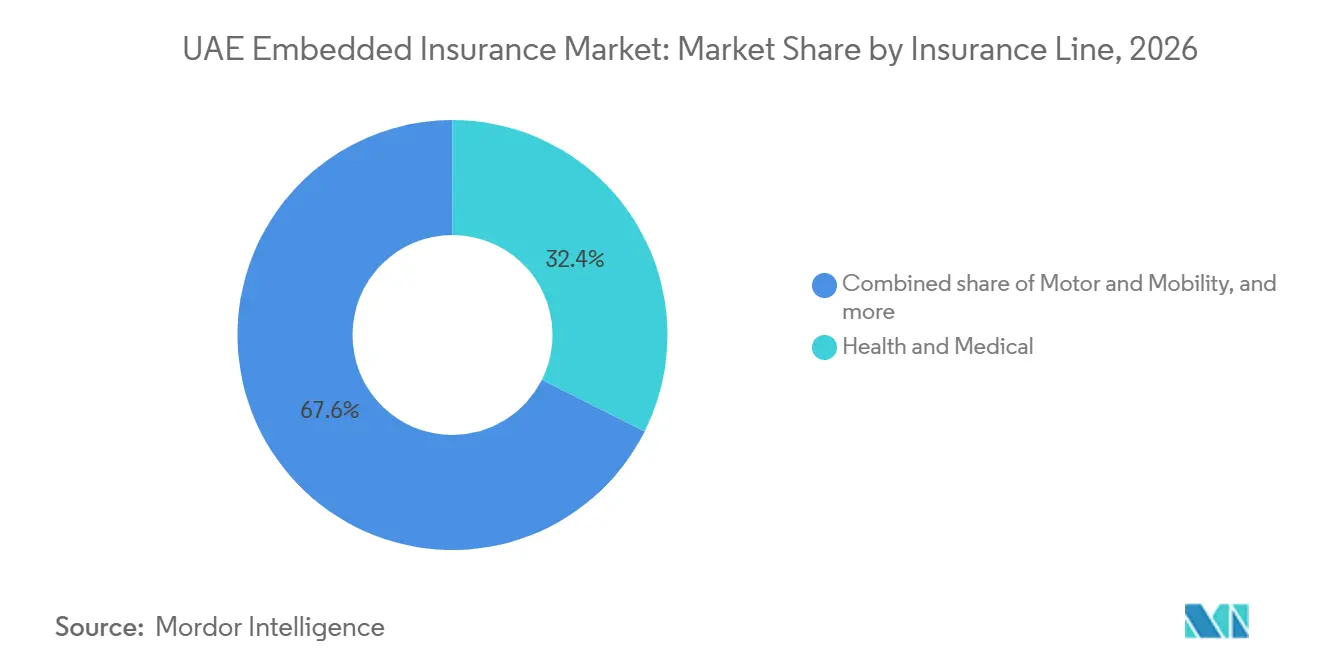
Health and Medical Anchors Demand, Device Protection AcceleratesHealth and medical insurance is projected to account for 32.4% of the UAE embedded insurance market in 2026. Mandatory coverage will support this position by creating recurring insurance needs related to employment and residency. The nationwide extension, scheduled to begin in January 2025, will bring private-sector workers and domestic employees in Sharjah, Ajman, Umm Al Quwain, Ras Al Khaimah, and Fujairah under the compulsory coverage framework. Human resources platforms can embed enrollment, renewals, and employee updates into routine administrative processes. This integration creates repeated customer interactions and can support relevant offers for other protection products.
Goods and device protection is forecast to grow at a CAGR of 25.8% between 2027 and 2032. The segment benefits when telecommunications providers, retailers, or original equipment manufacturers offer protection at the checkout stage. In November 2025, insureMO and Nexacore are expected to introduce repair and logistics capabilities for device protection and extended warranty programs. This service model can link approved claims with repair handling and status updates, addressing a key concern among customers purchasing add-on protection products. Motor and mobility, as well as travel and assistance, will also benefit from recurring mobility and tourism needs. Protection and savings, along with other insurance covers, will remain smaller segments, although they may be relevant for distributed Takaful products.
By Embedding Partner Channel:
E-commerce Leads, Banks and BNPL Platforms Expand FinancingE-commerce marketplaces and specialist online retailers are projected to account for 27.1% of the embedded partner channel in 2026. Their leading position reflects high online transaction volumes and the opportunity to offer protection directly before payment. The UAE embedded insurance industry can use the checkout process to present simple coverage options only when they relate to the item or activity being purchased. This channel is best suited to products with concise explanations, transparent pricing, and clear claims processes. It also provides insurers with direct data on the product, purchase time, and customer consent. These data points can support more relevant offers without requiring customers to begin a separate insurance journey.
Banks, fintechs, and buy now, pay later checkout platforms are projected to grow at a CAGR of 28.6% from 2027 to 2032. In August 2025, Wio Bank and Shory introduced car insurance through the Wio Personal application, allowing customers to spread payments over 3 to 48 months. In July 2026, Mashreq partnered with Sukoon to make workmen’s compensation and third-party liability insurance available through MashreqBiz, integrating insurance distribution with business banking. Travel, ticketing, mobility, telecommunications, utilities, physical retail, and original equipment manufacturers also retain specific roles where their user journeys naturally create a need for protection.
By Policyholder:
Consumer Demand Leads, Commercial Underinsurance Creates HeadroomPersonal and consumer policyholders accounted for 70.3% of the UAE embedded insurance market in 2026. Individuals typically access insurance through motor, health, travel, and device-related transactions. Digital distributors compete for this segment through comparison tools, identity verification, rapid policy issuance, and installment payment options. These features reduce the effort associated with purchases that consumers might otherwise postpone. Consumer demand also aligns well with platform-based distribution, as coverage can be matched to an immediate transaction. This creates a broad base for personal protection products across digital channels.
Commercial and business policyholders are forecast to grow at a CAGR of 24.9% between 2027 and 2032. The UAE embedded insurance market has significant growth potential, as many small and medium-sized enterprises remain underinsured despite their importance to registered business activity. Bayzat integrates employee benefits and health insurance with HR and payroll processes, helping businesses manage coverage alongside workforce administration. In September 2025, Creative Zone and Bayzat announced a partnership to integrate HR, payroll, and employee benefits solutions into the UAE business setup journey, making these services accessible to companies from an earlier stage of their development. Banks and digital business platforms can also distribute commercial insurance through established customer relationships, provided the relevant products are underwritten and issued by licensed insurers.
By Policy Duration:
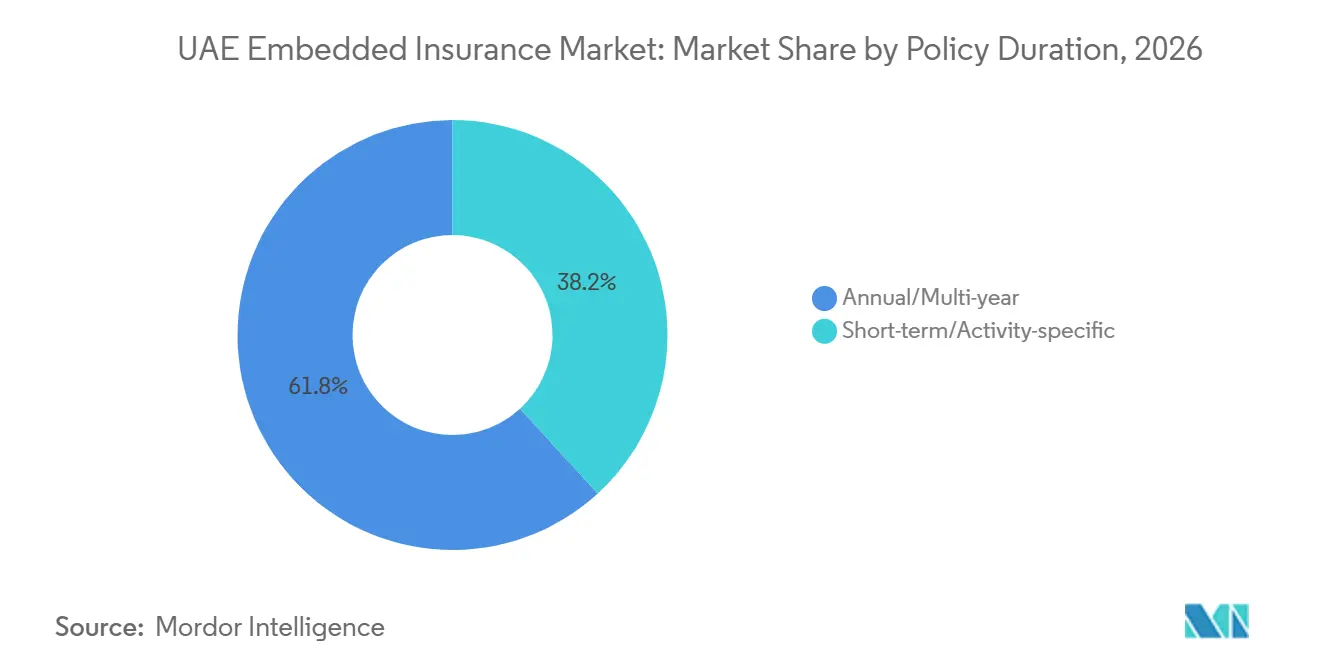
Annual Renewals Lead, Short-term Coverage Gains Use CasesAnnual and multi-year policies are projected to account for 61.8% of the UAE embedded insurance market in 2026. Motor and health insurance renewals support this position, as both categories align closely with recurring annual coverage requirements. In October 2025, Salik reported that 150,000 customers had received vehicle insurance renewal notifications through its WhatsApp channel, demonstrating how digital communications can connect customers with insurance renewal services. This model can make renewal more convenient while leaving underwriting and policy issuance to the insurer. Embedding reminders and renewal options into established customer touchpoints can reduce friction and support continuity of coverage.
Short-term and activity-specific coverage is projected to grow at a CAGR of 26.3% between 2027 and 2032. It offers opportunities across travel, events, ticketing, and mobility, where insurance needs can be linked to a particular booking or activity. Cover Genius illustrates this distribution model through its partnership with Luxury Escapes, which expanded travel protection offerings and introduced cancellation protection in April 2025. The company has licences or authorisations in more than 60 countries, including the United Arab Emirates among the markets served by the partnership. The UAE's Open Finance framework may further support consent-based data sharing and digital financial services, although its precise impact on embedded insurance implementation will depend on the applicable standards and integrations. Transparent pricing, clear exclusions, and responsive claims handling remain important to customer confidence.
By Integration Model:
White-label Affinity Leads, APIs Change Delivery EconomicsWhite-label and affinity integration accounted for 40.4% of the UAE embedded insurance market in 2026. Under this model, insurers offer insurance products under a platform’s brand or as an affinity offering through an established partner relationship. Non-technical platforms can often adopt this approach more easily because it requires less complex implementation. However, it may limit product personalization and real-time data exchange. The UAE embedded insurance market size for this model reflects the practical value of established partnerships in a regulated environment. This model remains suitable for platforms seeking to offer coverage without developing extensive technical capabilities.
API-integrated models are projected to grow at a CAGR of 27.7% from 2027 to 2032. The Open Finance Regulation places standardized interfaces at the center of insurance data sharing and service initiation. In November 2025, insureMO announced a partnership with Yalla Compare to support product configuration, insurer connectivity, and real-time API distribution across the UAE. Shory’s TAMM 4.0 service shows the more advanced version of this model through data validation, identity authentication, and policy issuance in one digital path. Staff-assisted integration remains relevant where customers need help with complex multi-line cover or where a human adviser adds value. Its relative role may narrow as digital journeys become easier for standard personal and business products.
Geography Analysis
Dubai remains the main hub for the UAE embedded insurance market, with a concentration of insurtechs, digital brokers, e-commerce platforms, and international participants. Its financial infrastructure includes the Dubai International Financial Centre, which gives international firms a regional setting for compliance and partnerships. Tourism, logistics, ride-hailing, and e-commerce activity create opportunities for travel, cargo, device, and mobility protection. Policybazaar.ae’s August 2026 integration with SAAED through the Emirates Vehicles Gate platform places comparison, quotation, payment, and policy issuance inside a vehicle management journey. The Central Bank of the UAE Sandbox Conditions Regulation, introduced in June 2024, also provides a defined testing environment for certain early-stage financial services products.
Abu Dhabi is developing government-integrated insurance distribution through TAMM, which brings insurance services into established digital government journeys. In October 2025, the Department of Health–Abu Dhabi and Daman made individual basic health insurance services available through TAMM, including subscriptions, renewals, modifications, and digital access to policy information. In May 2026, Abu Dhabi Pension Fund and Shory announced an agreement enabling more than 50,000 retirees to access vehicle insurance offers and discounts through TAMM, with options from more than 15 insurers. These initiatives demonstrate how government platforms can connect insurance distribution with existing administrative and customer service processes.
The Northern Emirates are the fastest-emerging geographic opportunity in the UAE embedded insurance market after mandatory health insurance was extended across all 7 emirates on January 1, 2025. Sharjah, Ajman, Umm Al Quwain, Ras Al Khaimah, and Fujairah gained new demand from workers and employers who previously operated outside the compulsory framework. The basic health insurance package is AED 320 (USD 87) per year and covers a network of seven hospitals, 47 clinics and medical centres, and 44 pharmacies. Employer platforms, human resources software, and digital brokers can use the new requirement to offer enrollment and renewal within a familiar workflow. Takaful-linked products may also find relevance in communities that prefer Shariah-compliant protection, although distribution models are still developing.
Competitive Landscape
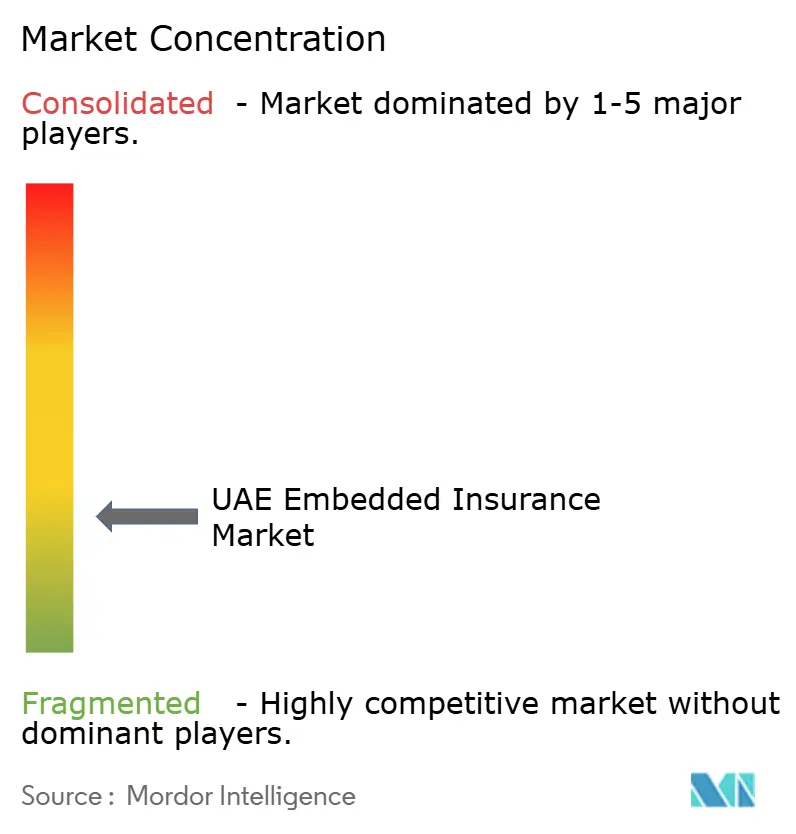
The UAE embedded insurance market is fragmented, comprising a diverse mix of licensed insurance distributors, traditional insurers, global embedded protection platforms, and technology providers. Shory, eSanad, and Bayzat operate alongside insurers such as Liva, Sukoon, and Abu Dhabi National Insurance Company through Mutakamela. Cover Genius provides embedded protection capabilities across multiple markets, including the UAE, while insureMO delivers API-based infrastructure that connects insurers with digital distributors and non-insurance platforms. Competition spans multiple business models, customer segments, and distribution channels. Participants differentiate themselves through integration capabilities, product specialization, customer experience, and regulatory compliance rather than through a single dominant distribution model.
Competition remains dynamic as companies expand digital renewal services, government platform integrations, and specialized insurance offerings. Shory introduced Shory AI to support conversational motor insurance comparison and purchasing. Sukoon deployed an AI voice bot for motor renewals in February 2026. Liva’s partnership with Salik demonstrates how mobility platforms can combine renewal reminders with insurance distribution to reach large customer bases. These initiatives highlight the range of approaches available to insurers and distributors, from automated customer engagement to embedded services offered through established digital platforms. The fragmented market structure enables firms to compete through partnerships and specialized capabilities without relying exclusively on traditional agent-led distribution.
Further opportunities include SME liability, workforce protection, Takaful-linked products, and coverage for emerging risks. Vertical software platforms can integrate insurance into sector-specific workflows while providing relevant business information to support underwriting. The UAE Open Finance framework provides a regulatory basis for consent-based data sharing and service initiation, subject to applicable requirements. Shory and OrbitWorks have explored satellite-data applications for insurance, including flood detection and fleet risk profiling. Liva and Relm Insurance partnered to address risks associated with digital assets, artificial intelligence, and biotechnology businesses in the UAE and Bahrain. The presence of established insurers, specialist distributors, technology providers, and emerging-risk partnerships reinforces the market’s fragmented competitive structure, with no single participant dominant across the full embedded insurance value chain.
UAE Embedded Insurance Industry Leaders
-
Orient Insurance PJSC
-
Abu Dhabi National Insurance Company PJSC
-
Sukoon Insurance PJSC
-
Dubai Insurance Company PJSC
-
Abu Dhabi National Takaful Company PJSC
- *Disclaimer: Major Players sorted in no particular order
UAE Embedded Insurance Market Companies Covered in this Report
- Shory Insurance
- Salik Company PJSC
- SlashData FZ-LLC
- Cover Genius
- eSanad
- Bayzat
- Liva Insurance Company
- Dubai Insurance Company PJSC
- Abu Dhabi National Takaful Company PJSC
- Orient Insurance PJSC
- Abu Dhabi National Insurance Company PJSC
- Sukoon Insurance PJSC
- HAYAH Insurance Company PJSC
Recent Industry Developments in UAE Embedded Insurance Market
- May 2026: Shory formalized MOUs with Mraijeb, combining digital insurance and security expertise for risk assessment, and with Sheel, exploring mobility and digital insurance integration. Shory also signed a strategic collaboration with OrbitWorks to explore satellite asset insurance and the use of geospatial intelligence, including flood detection and environmental monitoring data, to improve real-time risk modelling for fleet coverage and large-asset insurance in the UAE.
- January 2026: Salik signed a 10-year agreement with Dubai Airports to enable e-wallet parking payments across all Dubai International terminals, expanding Salik’s mobility finance infrastructure and creating further cross-sell touchpoints for embedded insurance products within the airport travel journey.
- December 2025: Liva Insurance announced the 1-year milestone of its collaboration with Salik, reaching over 1.3 million drivers, generating AED 113 million (USD 30.8 million) in insurance quotations, and recording a 25% fully online renewal completion rate with an average transaction time of 3 minutes.
- November 2025: insureMO and Nexacore Solutions launched a regional partnership deploying artificial intelligence-driven device protection and extended warranty infrastructure for the UAE, targeting telecommunications companies, original equipment manufacturers, and retailers seeking to embed protection plans at the point of sale.
UAE Embedded Insurance Market Report Scope
Segmentation Overview
| Motor and Mobility |
| Health and Medical |
| Goods and Device Protection |
| Travel and Assistance |
| Protection and Savings |
| Other Insurance Covers |
| E-commerce Marketplaces and Specialist Online Retailers |
| Physical Retail and OEM Points of Sale |
| Travel, Ticketing, and Mobility Platforms |
| Banks, Fintechs, and Buy Now, Pay Later (BNPL) Checkout Platforms |
| Telecommunications and Utility Providers |
| Other Non-Insurance Partners |
| Personal/Consumer |
| Commercial/Business |
| Short-term / Activity-specific |
| Annual / Multi-year |
| API-integrated |
| White-label / Affinity |
| Point-of-sale staff-assisted |
| By Insurance Line | Motor and Mobility |
| Health and Medical | |
| Goods and Device Protection | |
| Travel and Assistance | |
| Protection and Savings | |
| Other Insurance Covers | |
| By Embedding Partner Channel | E-commerce Marketplaces and Specialist Online Retailers |
| Physical Retail and OEM Points of Sale | |
| Travel, Ticketing, and Mobility Platforms | |
| Banks, Fintechs, and Buy Now, Pay Later (BNPL) Checkout Platforms | |
| Telecommunications and Utility Providers | |
| Other Non-Insurance Partners | |
| By Policyholder | Personal/Consumer |
| Commercial/Business | |
| By Policy Duration | Short-term / Activity-specific |
| Annual / Multi-year | |
| By Integration Model | API-integrated |
| White-label / Affinity | |
| Point-of-sale staff-assisted |
Key Questions Answered in the Report
What is driving growth in UAE embedded insurance?
The sector is projected to grow at a 22.4% CAGR from 2027 to 2032, supported by mandatory coverage, connected government services, open finance rules, and digital checkout journeys.
Which insurance line leads UAE embedded insurance?
Health and Medical insurance leads with 32.4% share in 2026, supported by mandatory health coverage and employer-based enrollment workflows.
Which embedded insurance channel is growing fastest in the UAE?
Banks, fintechs, and Buy Now, Pay Later checkout platforms are projected to grow at a 28.6% CAGR through 2032 as installment options and banking applications improve premium access.
How does open finance affect insurance distribution in the UAE?
The CBUAE Open Finance Regulation supports standardized data sharing and quote initiation, which can reduce technical barriers for compliant digital partnerships.
Why are the Northern Emirates important for embedded insurance?
Mandatory health insurance expanded to all 7 emirates in 2025, creating new employer onboarding and digital renewal opportunities in Sharjah, Ajman, Umm Al Quwain, Ras Al Khaimah, and Fujairah.
What limits adoption of embedded insurance in the UAE?
Licensing requirements, legacy insurer systems, unclear customer terms, claims friction, and channel economics can slow implementation even as demand grows.