
UAE Architectural Services Market Size and Share
Market Overview
| Study Period | 2021 - 2032 |
|---|---|
| Forecast Data Period | 2027 - 2032 |
| Base Year Market Size (2026) | USD 2.92 Billion |
| Market Size (2027) | USD 3.13 Billion |
| Market Size (2032) | USD 4.44 Billion |
| Growth Rate (2027 - 2032) | 7.24 % |
| Market Concentration | Low |
Major Players *Disclaimer: Major Players sorted in no particular order Image © Mordor Intelligence. Reuse requires attribution under CC BY 4.0. | |
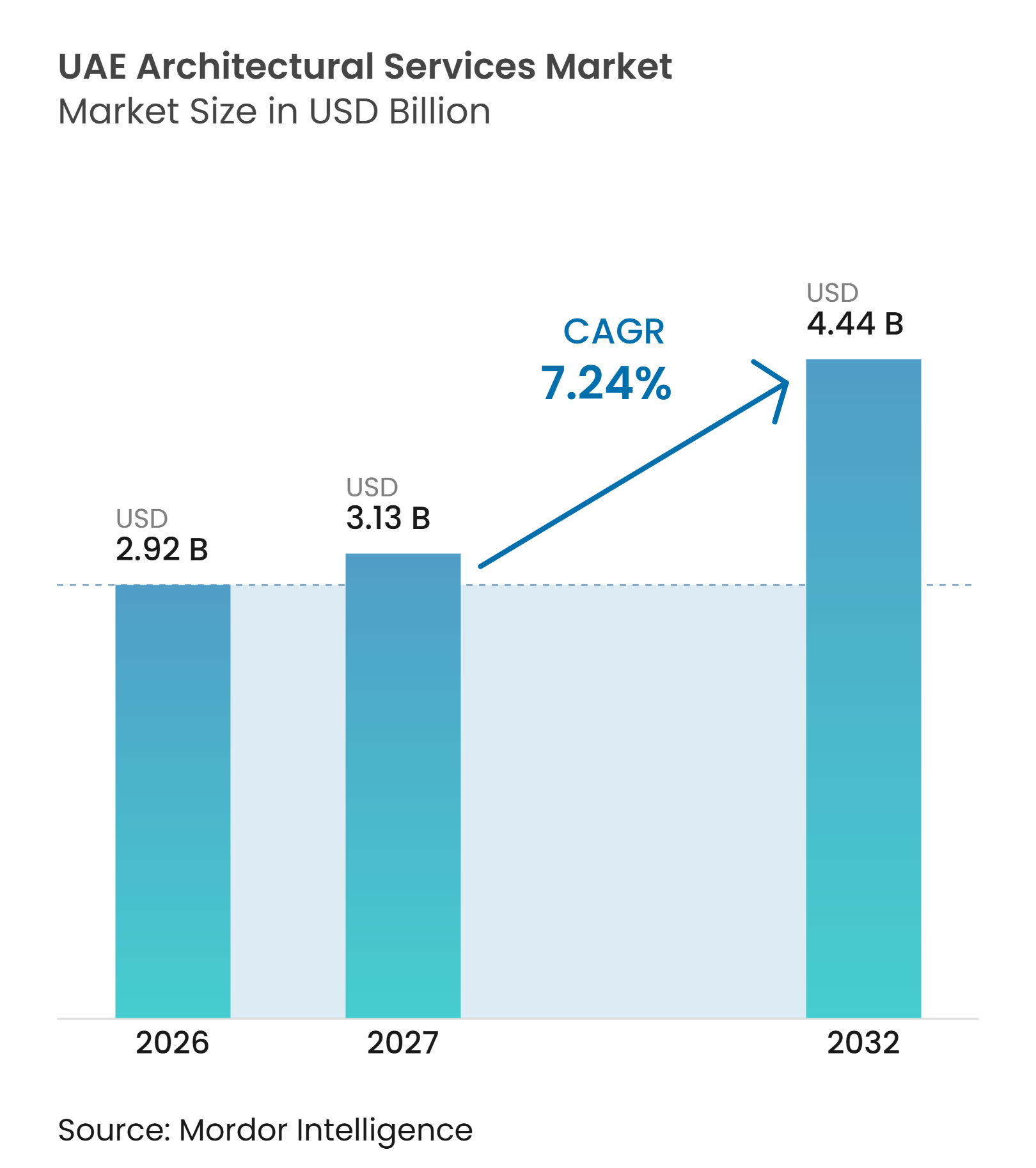
UAE Architectural Services Market Analysis by Mordor Intelligence
The UAE Architectural Services Market was valued at USD 2.92 billion in 2026 and is estimated to reach USD 3.13 billion in 2027 and USD 4.44 billion by 2032, growing at a CAGR of 7.24% during the 2027–2032 forecast period.
The UAE architectural services market is supported by a broader public works and mixed-use pipeline, including Abu Dhabi’s USD 15 billion public-private partnership infrastructure program for 24 projects across 2026 and 2027. Demand is also shifting from landmark-led construction toward data infrastructure, healthcare, education, and climate-ready district planning, which is widening the fee base for firms that can manage integrated, multi-phase briefs. The use of Building Information Modeling (BIM), artificial intelligence (AI), and digital twin platforms is shortening documentation cycles and moving public clients toward more continuous digital engagement models. Dubai remained the largest center of activity in 2026, while Abu Dhabi is set to post the fastest expansion through 2032, as cultural infrastructure, sovereign data projects, and mixed-income communities broaden the project mix in the UAE architectural services market. Cost pressure from imported building systems and delays linked to regional tensions are still limiting margins and complicating design timelines across the UAE architectural services market.
Key Report Takeaways
- By service type, architectural design services captured 35.5% of the UAE architectural services market share in 2026, while urban design and master planning services are projected to grow at an 8.11% CAGR between 2027 and 2032.
- By project type, new construction captured 69.1% of the UAE architectural services market share in 2026, while renovation is projected to grow at a 7.88% CAGR between 2027 and 2032.
- By end use, commercial captured 38.7% of the UAE architectural services market share in 2026, while infrastructure-linked buildings are projected to grow at an 8.22% CAGR between 2027 and 2032.
- By investment source, public investment captured 55.6% of the UAE architectural services market size in 2026, while the same public investment segment is projected to grow at a 7.61% CAGR between 2027 and 2032.
- By emirate, Dubai captured 45.5% of the UAE architectural services market share in 2026, while Abu Dhabi is projected to grow at an 8.30% CAGR between 2027 and 2032.
Note: Market numbers in this report are based on Mordor Intelligence's proprietary estimation framework, which combines nine months of actuals with Q4 projections for base year 2026.
Market Trends and Insights
Drivers Impact Analysis of UAE Architectural Services Market*
| Drivers | (~) % Impact on CAGR Forecast | Geographic Relevance | Impact Timeline |
|---|---|---|---|
| Expansion of giga developments and large master-planned communities | +2.0% | Dubai and Abu Dhabi, with spillover to the Northern Emirates | Medium term (2-4 years) |
| Investment in data centers, healthcare, education, and tourism infrastructure | +1.6% | Abu Dhabi, Dubai, and Sharjah | Short term (≤ 2 years) |
| Net zero policy and green building requirements | +1.3% | UAE-wide, concentrated in Dubai and Abu Dhabi | Long term (≥ 4 years) |
| Luxury residential, branded residences, and mixed-use development | +1.0% | Dubai, Abu Dhabi, and Ras Al Khaimah | Short term (≤ 2 years) |
| Use of AI, BIM, digital twins, and parametric design | +0.8% | UAE-wide, led by Abu Dhabi and Dubai | Medium term (2-4 years) |
| Population growth and expatriate inflows supporting social infrastructure | +0.5% | UAE-wide, focused on Dubai, Abu Dhabi, and Sharjah | Long term (≥ 4 years) |
| Source: Mordor Intelligence | |||
Expansion of Giga Developments and Luxury Residential Projects Raising Design Demand
Large district-scale projects are increasing the workload for the UAE architectural services market, as they require master planning, public realm design, housing layouts, and ongoing coordination across multiple phases. Dubai South’s HAYAT community secured a USD 544 million construction contract in January 2026 for 2,500 residential units, and the area’s 65% rise in business licenses in 2025 indicates the project is moving toward a broader live-work setting rather than a single housing scheme[1]. AtkinsRéalis’s appointment as master planner for ORA Developers’ BAYN waterfront community in Ghantoot, covering 9.6 million square meters and 9,000 residential units, showed how cross-emirate developments are widening the addressable scope of the UAE architectural services market. Palm Jebel Ali added further scale in April 2026, when Nakheel awarded USD 1 billion in construction contracts for 544 villas across Fronds A to F, each tied to 10 design typologies that reflect the need for repeated yet differentiated architectural packages. Luxury and branded residential launches are lifting fee values at the top end because developers are commissioning separate building, interior, and landscape design teams for the same scheme. This is helping the UAE architectural services market grow in both volume and value, while standard mid-market housing design is becoming more price-sensitive.
Rising Infrastructure Investments Unlocking Specialist Architectural Fee Pools
Infrastructure-linked buildings are becoming a steadier source of commissions for the UAE's architectural services market, as project demand is moving beyond the traditional residential cycle[2]. Abu Dhabi Investment Office and Abu Dhabi Projects and Infrastructure Center launched a USD 15 billion public-private partnership pipeline for 24 projects across 2026 and 2027, including USD 9.5 billion for transport, USD 3 billion for flood mitigation and stormwater works, and USD 2.5 billion for healthcare and education assets. Dubai Healthcare City Authority had already announced a USD 354 million Phase 1 development plan in 2025, including the district’s first LEED Platinum office tower designed by P&T Architects and Engineers. Aldar Education also committed USD 105.1 million in 2025 to relocate Cranleigh Abu Dhabi to a purpose-built campus on Saadiyat Island, reinforcing schools as a repeat category for specialized design work. In April 2026, KEO International Consultants partnered with Margulies Hoelzli Architecture to combine regional delivery capacity with hyperscale data center expertise, which showed how firms are adjusting to more technical commissions. As these building types move from occasional projects to repeating programs, the UAE architectural services market is gaining a more balanced revenue mix.
UAE Net Zero 2050 and Green Building Standards Raising Technical Requirements
Sustainability mandates are increasing design complexity in the UAE architectural services market, as clients now require buildings to meet stricter energy and performance standards[3]. The UAE’s net-zero commitment is backed by a planned USD 54.5 billion investment by 2030, which is pushing low-carbon design from a niche requirement into a mainstream part of project briefs. Peer-reviewed research published in 2025 showed that net-zero building design in the UAE’s hot arid climate needs passive cooling strategies, building-integrated photovoltaic systems, and stronger envelope engineering, all of which raise the technical threshold for ordinary design practices. Estidama requirements in Abu Dhabi and LEED-driven specifications in Dubai are also pulling sustainability criteria into the core design phase rather than leaving them as a late add-on. This is shifting demand toward firms that can combine architecture, sustainability compliance, and systems coordination into a single service line. Over time, these standards should continue to support the UAE architectural services market, while also separating technically strong firms from providers that still depend on basic drafting-led work.
Luxury Residential and Branded Residences Multiplying Design Commission Value
Dubai property transactions reached USD 117.4 billion in the first half of 2025, up 25% from a year earlier, while homes priced above USD 2.7 million rose more than 4 times versus recent historical levels. Each branded or super prime residential project creates layered demand for architecture because developers often appoint separate teams for master architecture, executive architecture, interior architecture, and landscape architecture. Al Ghurair Development’s appointment of Kengo Kuma for the Wedyan project on the Dubai Canal showed that developers are increasingly pairing globally known architects with specific landmark residences as part of the project’s market positioning. The launch of SAAS Properties’ Ritz-Carlton Residences and St. Regis Residences on Al Maryah Island in 2025, along with ANAX Developments’ ELLE Residences Dubai Islands, also showed that fashion and hospitality brands are becoming active participants in commissioning residential design. This is widening the fee pool for high-end projects and lifting the value of premium design mandates. At the same time, it is creating a clearer split between high-end bespoke work and standard residential design, which is putting more pressure on firms that sit in the middle.
Restraints Impact Analysis of UAE Architectural Services Market*
| Restraints | (~) % Impact on CAGR Forecast | Geographic Relevance | Impact Timeline |
|---|---|---|---|
| West Asia geopolitical tensions affecting confidence and project schedules | -1.5% | Gulf-wide supply chain, strongest effect on Dubai and Abu Dhabi projects | Short term (≤ 2 years) |
| Construction cost inflation and client-led design changes | -1.0% | UAE-wide, focused on large projects in Dubai and Abu Dhabi | Medium term (2-4 years) |
| Shortage of experienced architects and specialist design professionals | -0.8% | UAE-wide, most acute in data centers, healthcare, and sustainability design | Medium term (2-4 years) |
| Intense competition and pricing pressure among architecture firms | -0.6% | UAE-wide, most visible in mid-market residential and commercial work | Long term (≥ 4 years) |
| Source: Mordor Intelligence | |||
West Asia Geopolitical Tensions and Cost Escalation Delaying Projects
Regional tensions are limiting near-term momentum in the UAE's architectural services market, as project delivery schedules are becoming increasingly difficult to maintain. Around half of Dubai’s 2026 property handovers have been pushed into 2027 or later, delaying fee releases for design firms that depend on construction-linked milestones. Imported lifts, air conditioning systems, and mechanical, electrical, and plumbing components were 20% to 25% more expensive than pre-conflict levels, which often triggers client-led redesigns and scope cuts during design development. Supply chain disruption and higher shipping costs are also extending build timelines and raising working capital needs, which adds more pressure to approval cycles and fee recovery. Rising bids, contractor scarcity, and labor constraints are making cost plans less stable for architecture teams. This means the UAE architectural services market is still growing, but the fee cycle is becoming more uneven and more exposed to mid-project revisions.
Escalating Construction Costs Triggering Design Scope Revisions and Margin Erosion
Construction costs across the Gulf Cooperation Council rose sharply in the first half of 2026 due to geopolitical pressure, trade shifts, and supply chain disruptions. Cost escalation in the UAE is now being felt more through limited specialist contractor capacity than through broad-based material shortages. For architectural firms, this creates a direct margin issue because clients often request repeated design revisions after updated cost plans show that the original scope is no longer viable. The 2026 government requirement for a 1-to-1 ratio of Emiratis to foreign workers on government-funded projects has also tightened the availability of specialist labor and extended project timelines. As scope changes, longer approvals, and payment delays accumulate, mid-market firms are facing weaker backlog quality even while overall project values remain high.
*Our forecasts treat driver/restraint impacts as directional, not additive. The impact forecasts reflect baseline growth, mix effects, and variable interactions.
UAE Architectural Services Market Segment Analysis
By Service Type:
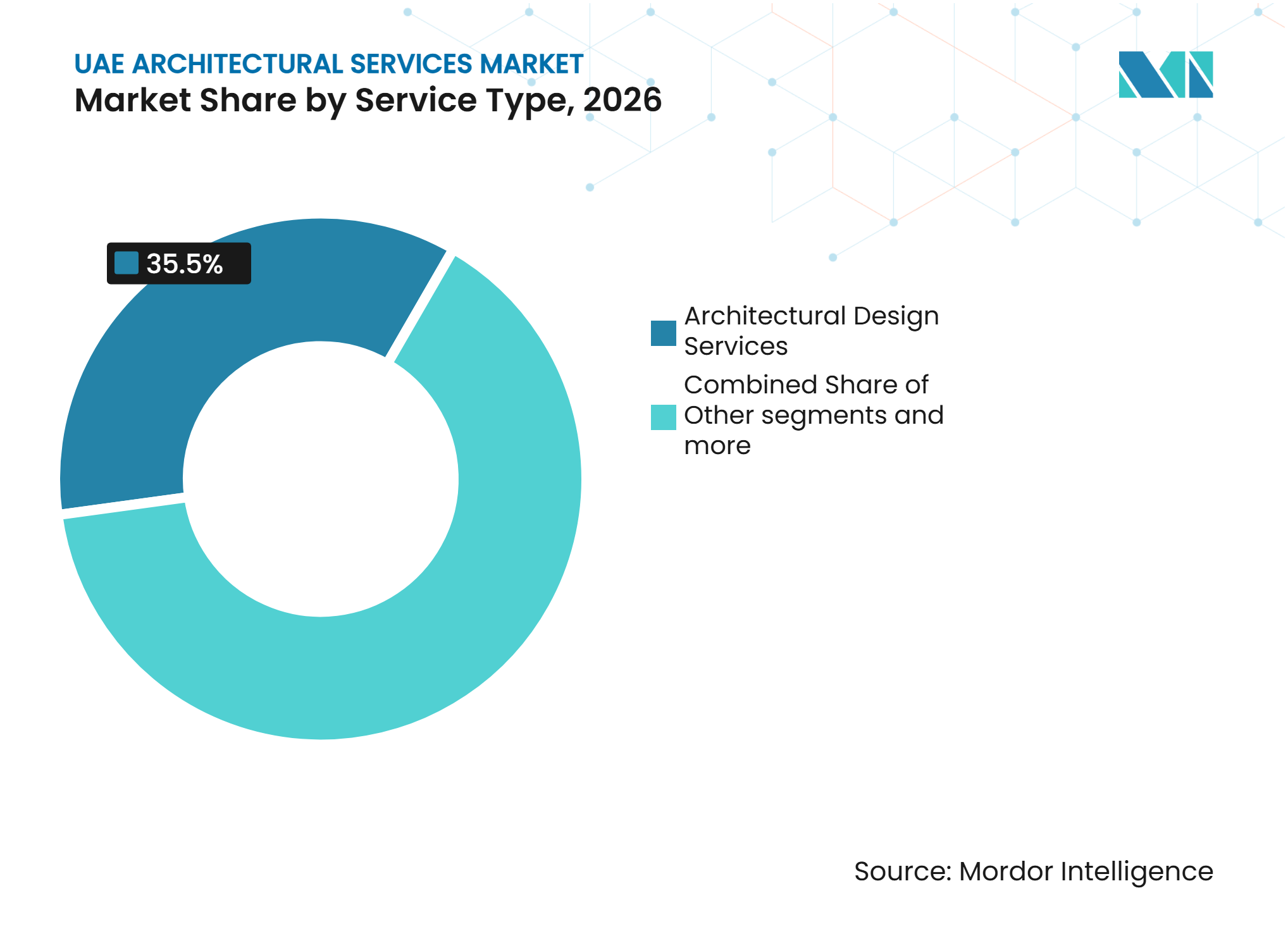
Architectural Design Services Retain the Largest ShareArchitectural design services captured 35.5% of the UAE architectural services market share in 2026, making it the largest service category. The segment remains central because almost all projects require concept design, schematic planning, technical design, and coordination before delivery begins. It benefits from continued activity across residential, commercial, public, and infrastructure-led developments. Urban design and master planning services are the fastest-growing service type, with an 8.11% CAGR expected between 2027 and 2032. Its growth reflects demand for larger developments that need coordinated planning across roads, utilities, public areas, and buildings.
AtkinsRéalis’s work on the BAYN project shows how master planning assignments are becoming wider in scope. The firm’s role includes planning and infrastructure coordination for a 9.6 million square meter waterfront project in Ghantoot. In the UAE architectural services market, developers increasingly combine early planning and architectural design in the same procurement package. This supports integrated firms but may reduce the opportunity for standalone design studios. BIM is also making documentation faster, while branded residences continue to support interior architecture and space planning work.



By Project Type:
New Construction Remains the Main Source of WorkNew Construction captured 69.1% of the UAE architectural services market share in 2026, supported by district-scale development, public infrastructure, new housing, and commercial projects. The segment remains the primary source of architecture work because developers and public entities continue to build complete communities and major facilities. Renovation is the fastest-growing project type and is expected to expand at a 7.88% CAGR between 2027 and 2032. This reflects the rising need to improve building performance and reposition existing assets. It also reflects greater attention to energy use and building compliance.
Renovation is creating more demand for architects who can combine design skills with technical upgrades. Work can include façade improvements, mechanical, electrical, and plumbing upgrades, better cooling strategies, and changes to internal spaces. Existing districts can require repeated renovation work rather than a single new construction commission. Expo City Dubai’s operational emissions targets show how large sites can become continuing improvement programs. The UAE architectural services market is therefore beginning to develop a more balanced mix between new construction and performance-led renovation.
By End Use:
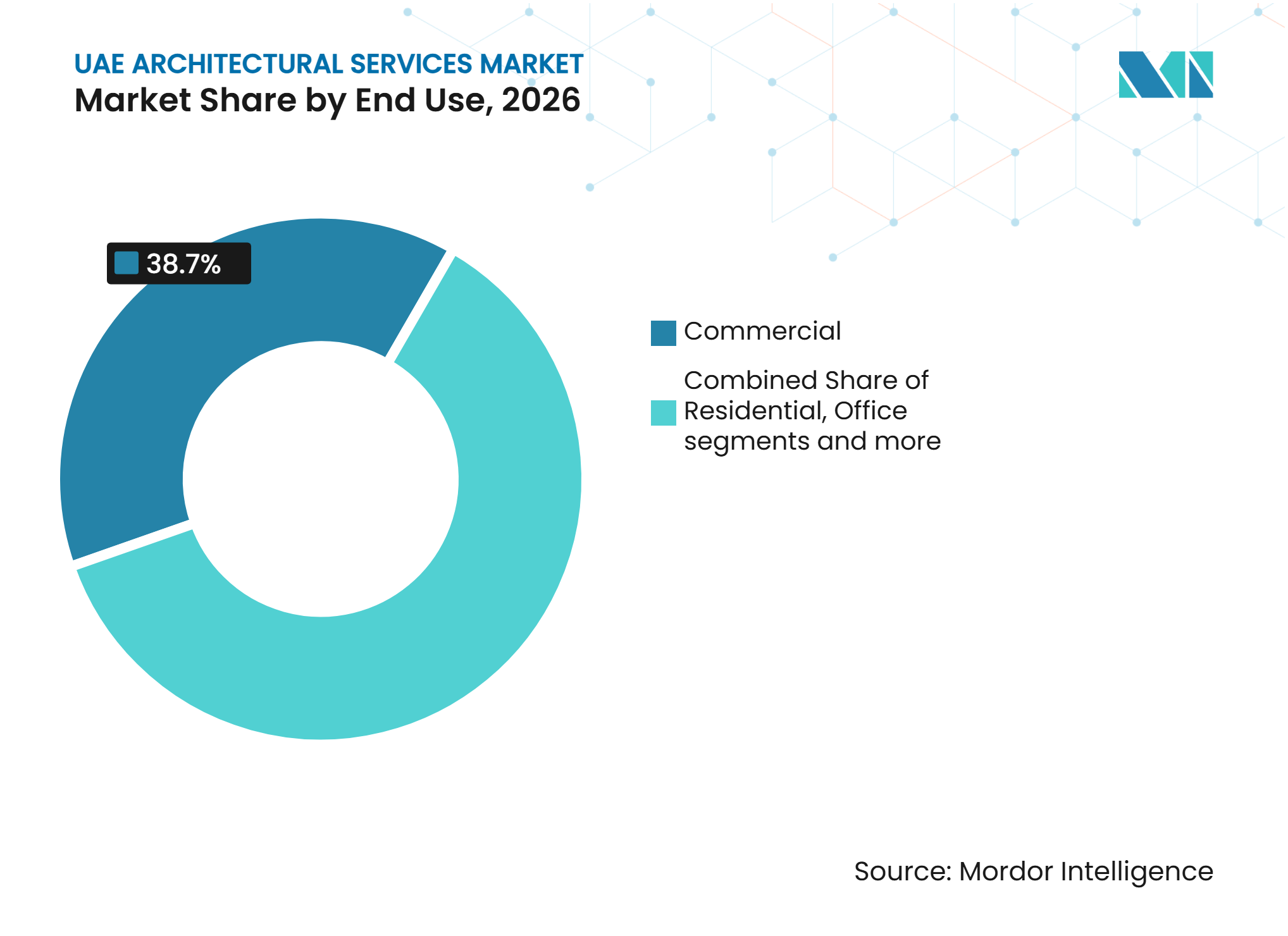
Commercial Projects Hold the Leading PositionCommercial captured 38.7% of the UAE architectural services market share in 2026, making it the largest end-use category. Offices, retail centers, mixed-use districts, hotels, and institutional properties continue to support this position. Infrastructure-linked buildings are the fastest-growing end-use sub-segment, with an expected 8.22% CAGR between 2027 and 2032. Data centers, logistics hubs, and transport-connected facilities are driving this growth because they need specialized technical design. These projects are more complex than typical commercial buildings and can create higher-value design assignments.
Khazna Data Centres received Tier III Certification of Design Documents for its QAJ01 facility in Ajman in February 2026. The 100-megawatt facility was described as the first certified AI data center with liquid cooling in the Middle East and North Africa region. Such projects increase the need for firms that understand resilience, cooling, power systems, and data center standards. Residential projects remain important, especially in premium and branded communities. Public sector buildings, logistics facilities, and healthcare campuses are also increasing their share of the UAE architectural services market as project funding broadens.

By Investment Source:
Public Investment Leads in Value and GrowthPublic investment captured 55.6% of the UAE architectural services market size in 2026, making it the largest investment source. The segment is also projected to grow at a 7.61% CAGR between 2027 and 2032. Government bodies and sovereign-linked developers are funding housing, transport, healthcare, education, cultural projects, and urban infrastructure. The USD 15 billion Abu Dhabi public-private partnership pipeline is a key example of the public capital supporting architectural demand. This gives firms with public procurement experience a strong source of future work.
Private investment represented 44.4% of the market in 2026 and remains important for branded residences, hospitality, and mixed-use developments. Private clients often use architectural quality to position a project, which can support premium commissions. Public clients usually focus more on coordination, regulatory needs, delivery certainty, and long-term operating requirements. The UAE architectural services industry therefore has two important client groups with different expectations. Firms that can serve both can balance high-volume public assignments with higher-value private design work.
Geography Analysis
Dubai
Dubai captured 45.5% of the UAE architectural services market share in 2026. The emirate has the strongest concentration of master developers and an active pipeline of luxury residential, mixed-use, retail, and hospitality projects. Palm Jebel Ali and Dubai South are supporting demand across housing, amenities, landscaping, and public spaces. Digital delivery requirements favor practices with established BIM systems and experience in coordinated submission processes. Dubai should remain the volume leader because of its broad development base and regular project launches.
Abu Dhabi
Abu Dhabi is projected to grow at an 8.30% CAGR between 2027 and 2032, making it the fastest-growing emirate in the UAE architectural services market. Public infrastructure, social facilities, cultural buildings, and data center campuses support growth. Stargate UAE is planned to deliver 200 megawatts of capacity in 2026 as part of a larger data center campus. The USD 15 billion public-private partnership program creates further visibility for firms with public delivery experience. Estidama requirements strengthen demand for sustainability design and technical documentation.
Rest of UAE
Sharjah, Ras Al Khaimah, Ajman, Fujairah, and Umm Al Quwain together represent a smaller but expanding part of the UAE architectural services market. Sharjah is building its sustainability profile through Sharjah Sustainable City 2 and Khalid bin Sultan City. Ras Al Khaimah is gaining attention through tourism, resorts, branded residences, and hospitality development on Al Marjan Island. The remaining emirates are adding opportunities in logistics, coastal housing, free-trade zone facilities, and specialist digital infrastructure.
Competitive Landscape
Market Concentration
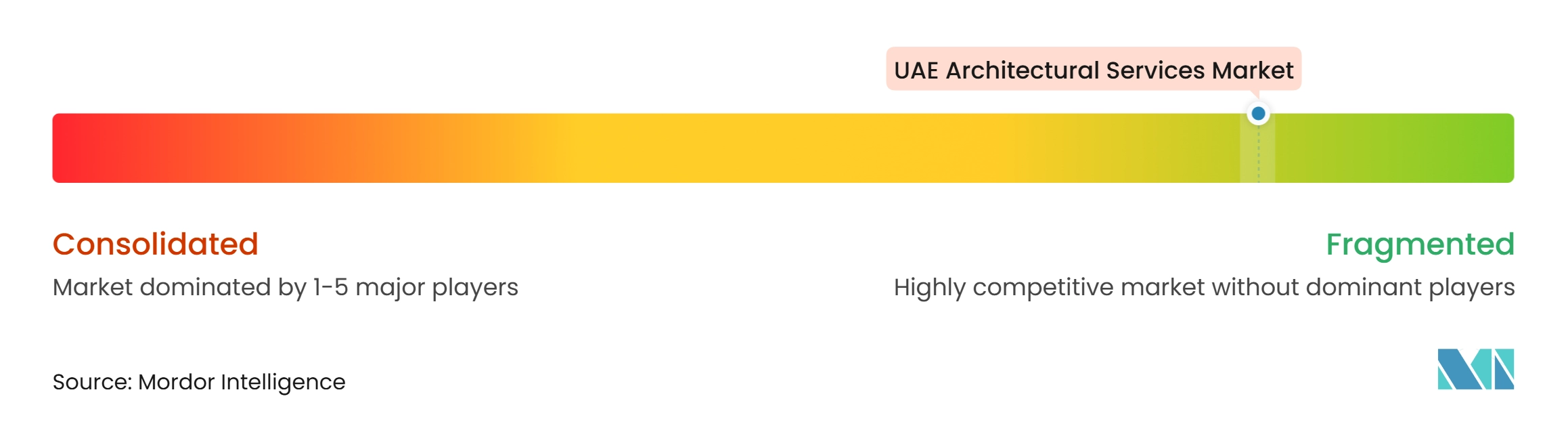
The UAE architectural services market is fragmented in nature. Global multidisciplinary firms such as AtkinsRéalis, AECOM, KEO International Consultants, and Stantec compete for major infrastructure, master-planning, and public projects. They combine architecture, engineering, project management, and sustainability support in a single appointment. Regional practices such as Dewan Architects + Engineers, SSH, Godwin Austen Johnson, BSBG, and Woods Bagot compete through local experience and established developer relationships.
Major players are changing their strategies to address data infrastructure and digital project delivery. KEO International Consultants partnered with Margulies Hoelzli Architecture in April 2026 to provide integrated data center design services. AtkinsRéalis secured the BAYN master-planning role while working with Dubai Future Solutions on future-city technology programs. These moves build current project revenue and long-term technical capability. They also make it harder for firms with narrow service offerings to win the largest integrated mandates.
Regional firms still have room to grow in specialist areas. Data-center-adjacent facilities, resilient infrastructure, and sustainable industrial buildings need skills that are not widely available in the local market. Partnerships can help firms access specialist expertise while retaining local delivery strength. Technical specialization should become a stronger source of differentiation as competition intensifies.
UAE Architectural Services Industry Leaders
-
KEO International Consultants
-
AECOM
-
AtkinsRéalis
-
Dewan Architects + Engineers
-
Gensler
- *Disclaimer: Major Players sorted in no particular order
UAE Architectural Services Market Companies Covered in this Report
- KEO International Consultants
- AECOM
- AtkinsRéalis
- Dewan Architects + Engineers
- Gensler
- Foster + Partners
- HKS Inc.
- HDR Inc.
- Perkins&Will
- Stantec
- SSH
- Godwin Austen Johnson
- Woods Bagot
- BSBG
- Norr
- CallisonRTKL
- RMJM
- DP Architects
- LWK + PARTNERS
- Aspect Studios
Recent Industry Developments in UAE Architectural Services Market
- June 2026: AtkinsRéalis was appointed master planner and infrastructure design lead for ORA Developers' BAYN waterfront community in Ghantoot, Abu Dhabi, a 9.6-million-square-meter development comprising 9,000 residential units, a 204-berth marina, and a 108,000-square-meter sports club. The mandate covers master planning, infrastructure design coordination, and public realm strategy, anchored by a USD 517.4 million Phase 1 construction contract that has already been awarded.
- June 2026: Dar Al Funoon Abu Dhabi cultural arts complex was launched near the Saadiyat Cultural District, envisioned as one of the region's largest performing arts venues, and is planned to open in 2030. The project expands Abu Dhabi's cultural architecture pipeline alongside the Louvre, Guggenheim, and Natural History Museum under development on Saadiyat Island.
- April 2026: KEO International Consultants and Margulies Hoelzli Architecture entered a strategic partnership to deliver end-to-end data center design solutions across the Gulf Cooperation Council and Europe, combining KEO's regional infrastructure capabilities with Margulies Hoelzli Architecture's hyperscale data center expertise across more than 30 countries and 1,200 megawatts of installed capacity.
UAE Architectural Services Market Report Scope
Segmentation Overview
| Architectural Design Services |
| Architectural Documentation & Delivery Services |
| Interior Architecture & Space Planning Services |
| Urban Design & Master Planning Services |
| Others |
| New Construction |
| Renovation |
| Residential |
| Commercial |
| Institutional |
| Industrial and Logistics |
| Infrastructure-linked Buildings |
| Others |
| Public |
| Private |
| Dubai |
| Abu Dhabi |
| Sharjah |
| Ras Al Khaimah |
| Rest of United Arab Emirates |
| By Service Type | Architectural Design Services |
| Architectural Documentation & Delivery Services | |
| Interior Architecture & Space Planning Services | |
| Urban Design & Master Planning Services | |
| Others | |
| By Project Type | New Construction |
| Renovation | |
| By End-Use | Residential |
| Commercial | |
| Institutional | |
| Industrial and Logistics | |
| Infrastructure-linked Buildings | |
| Others | |
| By Investment Source | Public |
| Private | |
| By Emirate | Dubai |
| Abu Dhabi | |
| Sharjah | |
| Ras Al Khaimah | |
| Rest of United Arab Emirates |
Key Questions Answered in the Report
What is the forecast value of UAE architectural services by 2032?
The UAE architectural services market is projected to reach USD 4.44 billion by 2032, growing at a 7.2% CAGR from 2027.
Which service type has the largest share?
Architectural design services leads with 35.5% of the market in 2026.
Which project type is growing fastest?
Renovation is forecast to grow at 7.88% CAGR between 2027 and 2032 as property owners focus more on energy performance and asset upgrades.
Why is Abu Dhabi the fastest-growing emirate?
Abu Dhabi is growing through data centers, public infrastructure, education, healthcare, cultural assets, and mixed-income housing projects.
What is driving technical design demand in the UAE?
Data centers, logistics, healthcare, and sustainability-compliant buildings are increasing demand for specialist design skills and BIM-based delivery.
What risks affect architecture firms in the UAE?
The main risks are material cost increases, delayed project timelines, specialist talent shortages, and pricing pressure in routine project types.