
Turkey Takaful Market Size and Share
Market Overview
| Study Period | 2021 - 2032 |
|---|---|
| Forecast Data Period | 2027 - 2032 |
| Base Year Market Size (2026) | USD 2.40 Billion |
| Market Size (2027) | USD 2.80 Billion |
| Market Size (2032) | USD 5.90 Billion |
| Growth Rate (2027 - 2032) | 15.80 % |
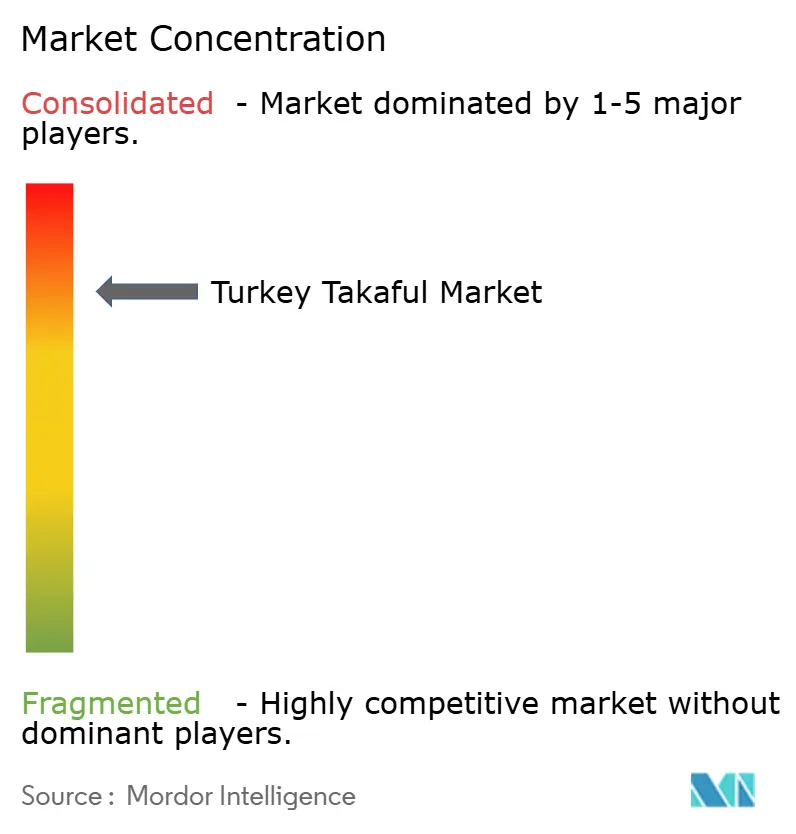
| Market Concentration | High |
Major Players *Disclaimer: Major Players sorted in no particular order Image © Mordor Intelligence. Reuse requires attribution under CC BY 4.0. | |
Turkey Takaful Market Analysis by Mordor Intelligence
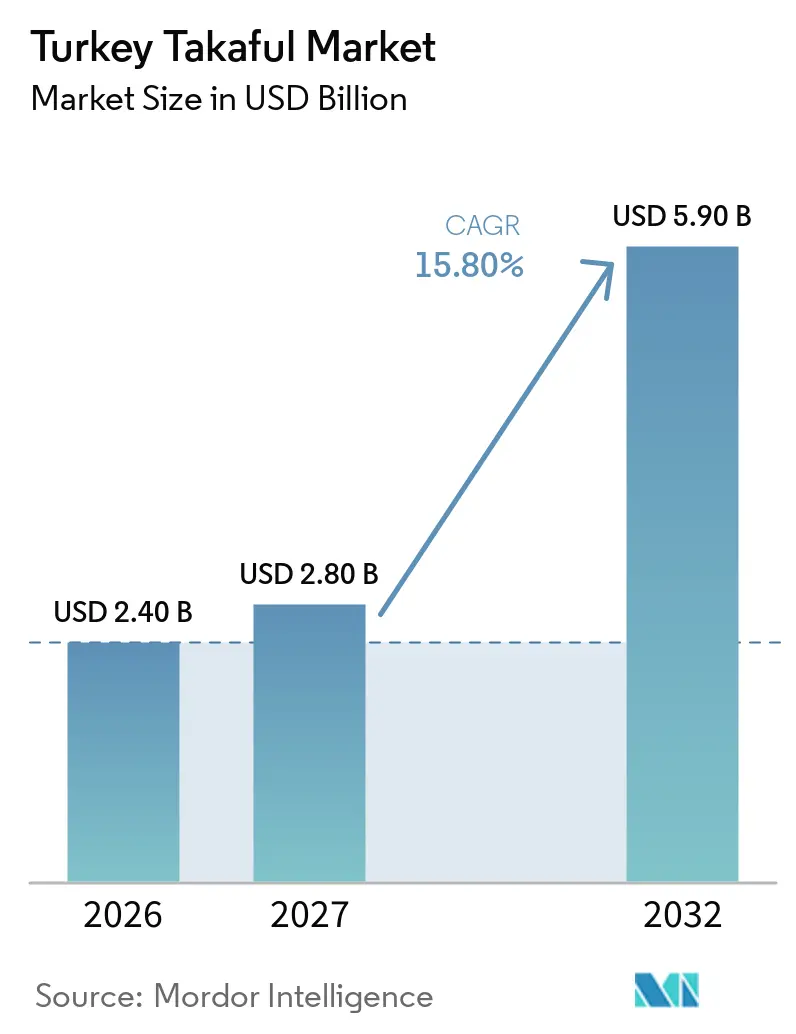
The Turkey Takaful Market size is projected to be USD 2.40 billion in 2026, USD 2.80 billion in 2027, and reach USD 5.90 billion by 2032, growing at a CAGR of 15.80% from 2027 to 2032.
The Turkey takaful market is expanding faster than the broader Turkish insurance sector, where participation insurance recorded 10.7% real growth in the first eight months of 2026, compared with 2.6% real growth for the total insurance sector. The difference points to a sustained change in demand for participation-compliant financial products rather than a short-term rise in insurance purchases. Regulatory work, participation banking, and low insurance penetration support the outlook for the Turkey Takaful market. Participation insurance reached 6.3% of domestic insurance premiums by August 2026, after reaching 6.5% in the first quarter, which marked a meaningful increase after a long period of limited movement. The Turkey Takaful market also benefits from a widening range of distribution routes, while operators continue to address underwriting capacity and consumer understanding.
Key Report Takeaways
- By takaful type, general takaful captured 78.9% of the Turkey takaful market share in 2026, while medical and health takaful is projected to grow at 18.4% CAGR through 2032.
- By distribution channel, agents and brokers accounted for 67.8% of the Turkey takaful market size in 2026, while embedded, affinity, and other non-bank partnerships are projected to grow at 19.8% CAGR through 2032.
- By customer type, individual and retail participants held a 65.3% share of the Turkey takaful market in 2026, while small and medium enterprises are projected to grow at 17.6% CAGR through 2032.
Note: Market numbers in this report are based on Mordor Intelligence's proprietary estimation framework, which combines nine months of actuals with Q4 projections for base year 2026.
Turkey Takaful Market Trends and Insights
Drivers Impact Analysis*
| Driver | (~) % Impact on CAGR Forecast | Geographic Relevance | Impact Timeline |
|---|---|---|---|
| Strengthening Participation Insurance Regulation and Institutional Infrastructure | +3.5% | National, with early concentration in Istanbul, Ankara, and Izmir, financial hubs | Medium term (2-4 years) |
| Expansion of Participation Bank and Bancassurance Distribution | +2.8% | National, with bancatakaful networks linked to participation-bank branch footprints | Medium term (2-4 years) |
| Growing Demand for Participation-Compliant Insurance Products | +3.2% | National, with the strongest uptake in provinces with high religious financial sensitivity | Short term (≤ 2 years) |
| Low Insurance Penetration and Protection Gap | +3.0% | National, with pronounced gaps in Central and Eastern Anatolia | Long term (≥ 4 years) |
| TARSIM Participation-Based Agricultural Insurance Infrastructure | +1.0% | Primarily rural Türkiye, including the Aegean, Central Anatolia, and Black Sea regions | Medium term (2-4 years) |
| Digital Distribution and Technology-Enabled Underwriting | +2.2% | Urban Türkiye, with early activity in Istanbul, Ankara, and Bursa | Short term (≤ 2 years) |
| Source: Mordor Intelligence | |||
Strengthening Regulation and Institutional Infrastructure Deepens Market Foundations
Türkiye’s participation insurance framework is progressing toward a more comprehensive regulatory structure. In December 2025, the Insurance and Private Pension Regulation and Supervision Agency (SEDDK) announced plans for a regulation covering participation insurance and individual pension activities. The regulation aims to expand product offerings, strengthen governance, and improve alignment with international standards, including AAOIFI’s Islamic Insurance Standard No. 26 and Islamic Reinsurance Standard No. 41. The proposed framework is expected to support the growth of participation insurance within the national insurance market. In August 2026, SEDDK published Circular No. 2026/26, which amended the existing framework for participation-based insurance and individual pension activities[1]. These regulatory developments are expected to strengthen governance and transparency, support customer confidence, and increase Türkiye’s attractiveness to international investors, including those from the Gulf Cooperation Council.
Participation Banking Network Creates a Structurally Advantaged Distribution Platform
Türkiye’s participation banking sector provides an established distribution base for participation insurers. According to Anadolu Agency, the country’s 11 participation banks operated 1,506 branches and employed 22,733 people as of March 2026. Their combined assets reached TRY 4.3 trillion (USD 95 billion) at the end of 2025, while net profit totalled TRY 86 billion (USD 1.9 billion)[2]. These established customer relationships offer participation insurers opportunities to expand cross-selling through bank branches and digital channels, particularly among retail customers and small businesses already familiar with Shariah-aligned financial products. Greater integration between participation banks and insurers could improve customer access and distribution efficiency, supporting the development of Türkiye’s takaful market.
Growing Demand for Participation-Compliant Insurance Products Signals a Consumer Behavior Shift
Türkiye’s participation insurance sector is expanding, creating opportunities to serve consumers seeking Shariah-compliant financial protection. In the first quarter of 2026, participation insurance accounted for 6.5% of total insurance premiums, exceeding the approximately 5% share recorded over the previous several years. In the first half of 2026, participation insurance premiums increased by 50.1% year on year to TRY 48.84 billion (USD 1.13 billion), while total industry premiums reached TRY 743.85 billion (USD 17.22 billion)[3]. This growth is expanding the addressable market for participation-compliant health and other insurance products. Health insurance premiums increased by 30%, supplementary health insurance enrollment exceeded 5.3 million, and participation funds accounted for 36% of assets in the automatic-enrollment pension system. Participation insurers could benefit from increasing awareness of Islamic finance and digital distribution channels to reach younger consumers.
Low Insurance Penetration and a Wide Protection Gap Create a Long-Runway Growth Opportunity
Türkiye’s insurance penetration stood at 1.9% of GDP in 2024, compared with the OECD average of 6.2%, indicating significant scope for insurance market expansion. Insurance adoption remains concentrated in western urban areas, while Central and Eastern Anatolia report lower levels of conventional insurance coverage. These regions include agricultural communities, small businesses, and consumers with strong preferences for participation-based financial products. TARSIM and digital distribution platforms can support the expansion of participation insurance products in areas where traditional agency networks have limited reach. Low insurance penetration across retail, commercial, and agricultural segments creates growth opportunities for the Türkiye takaful market.
Restraints Impact Analysis*
| Restraint | (~) % Impact on CAGR Forecast | Geographic Relevance | Impact Timeline |
|---|---|---|---|
| Limited Consumer Understanding of Participation Insurance Structures | -0.8% | National, most pronounced in non-metropolitan areas | Short term (≤ 2 years) |
| Limited Penetration of Participation Life and Long-Term Savings Products | -0.6% | National, with life and savings underpenetration broadly distributed | Long term (≥ 4 years) |
| Limited Participation Reinsurance Capacity and Specialized Expertise | -0.5% | Global constraint with domestic effects on large-risk underwriting capacity | Medium term (2-4 years) |
| Macroeconomic Volatility and Premium Affordability Pressure | -1.0% | National, with greater pressure in Central and Eastern Anatolia | Short term (≤ 2 years) |
| Source: Mordor Intelligence | |||
Consumer Awareness Gaps Constrain Conversion Rates Despite High Stated Demand
Türkiye’s participation insurance market continues to face a potential consumer awareness barrier as the sector expands. Many consumers remain unfamiliar with the differences between participation insurance and conventional insurance, including wakala and mudarabah arrangements, surplus distribution, and the separation of policyholder and shareholder funds. SEDDK’s participation insurance regulation addresses these areas through provisions on operating models, customer disclosures, governance, and training, providing a regulatory framework to improve product understanding. Distribution partners, including agents and brokers, play an important role in explaining coverage, contributions, exclusions, and claims procedures. Continued intermediary training and accessible consumer education can strengthen confidence in participation-compliant products and support the development of Türkiye’s takaful market.
Limited Participation Life and Long-Term Savings Products Restrict Product Depth
Family takaful accounted for 3.8% of Türkiye’s participation insurance premiums in the first half of 2026, totaling approximately TRY 1.85 billion (USD 46.8 million). General takaful represented the remaining 96.2%, with premiums of TRY 47.00 billion (USD 1.19 billion). Family takaful premiums grew by 41.2% year on year in nominal terms and 6.9% in real terms, compared with nominal growth of 50.5% for general takaful. Participation insurers accounted for 1.60% of Türkiye’s total life insurance market, compared with 7.47% of the non-life insurance market. The participation insurance market remains concentrated in general insurance, while family takaful has a relatively limited presence. Expanding family takaful will require greater consumer awareness of its long-term protection and savings benefits, along with products tailored to different household budgets and financial objectives. Accessible distribution channels and improved product awareness could support wider adoption and help diversify Türkiye’s participation insurance market beyond general insurance lines.
*Our forecasts treat driver/restraint impacts as directional, not additive. The impact forecasts reflect baseline growth, mix effects, and variable interactions.
Segment Analysis
By Takaful Type: General Coverage Leads While Medical and Health Coverage Accelerates
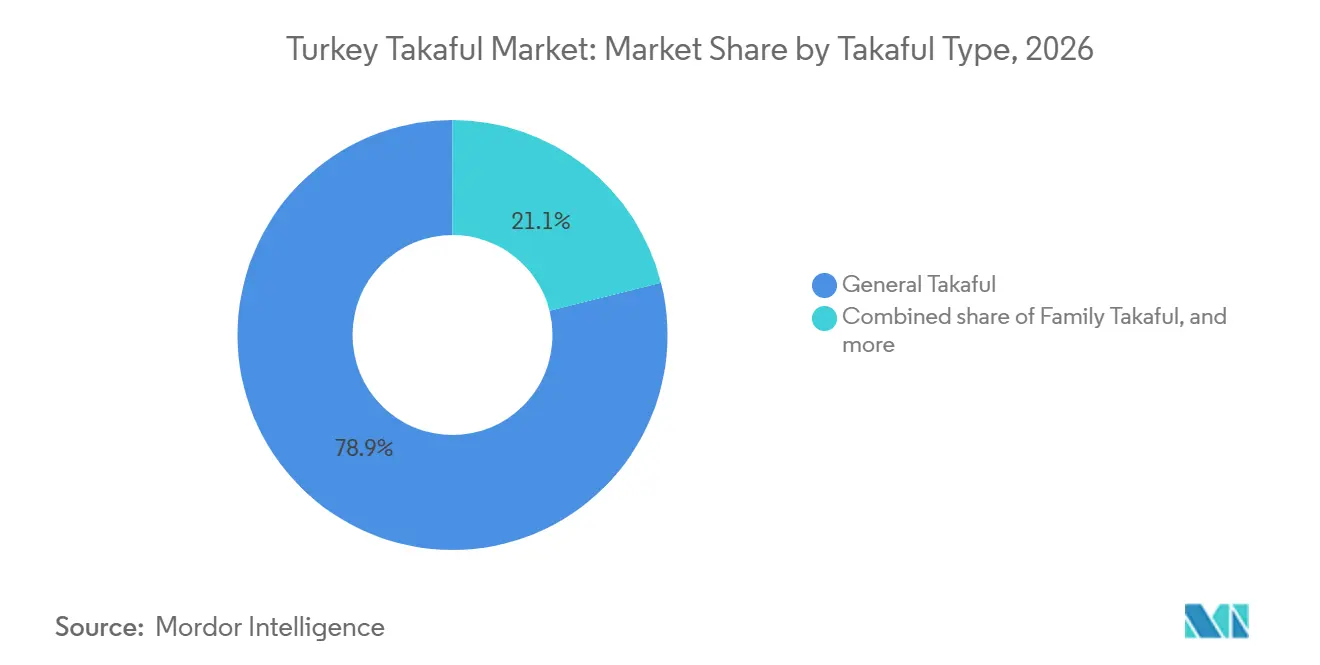
General takaful held 78.9% of total participation insurance contributions in 2026. Motor takaful, property and fire takaful, and engineering and construction takaful are key contributors. According to Anadolu Agency, motor insurance generated TRY 20.9 billion (USD 486.0 million) in participation insurance premiums during the first half of 2026, followed by fire and natural catastrophe insurance at TRY 5.96 billion (USD 138.6 million). These figures highlight the importance of motor and property-related protection in the market. Neova Katılım Sigorta also reported strong overall business growth, with total premiums reaching TRY 30.7 billion (USD 714.0 million) in 2025. Property and fire coverage remains relevant given Türkiye’s earthquake exposure, while marine and aviation coverage can support businesses involved in trade and logistics.
Medical and health takaful is forecast to grow at 18.4% CAGR from 2027 to 2032, making it the fastest-growing takaful type. Demand for private health coverage is supported by rising healthcare costs and interest in supplementary protection. TSB reported 5.23 million supplementary health insurance policyholders and 2.74 million private health insurance policyholders at the end of 2025. Family Takaful represented 3.8% of participation insurance premiums in the same period, with life participation insurance premiums of approximately TRY 1.85 billion (USD 35.6 million). This comparatively small share provides a potential opportunity to develop long-term protection and savings products.
By Distribution Channel: Agents and Brokers Retain Scale While Embedded Partnerships Gain Ground
Agents and brokers accounted for 67.8% of the Turkey takaful market size in 2026. Neova’s broker channel grew 67% in 2025, while its bancassurance channel expanded 48%, demonstrating the contribution of intermediary and bank-led distribution to the company’s growth. Brokers remain important for complex commercial policies that require tailored advice, while participating banks provide access to customers already familiar with Shariah-compliant financial products. Direct channels also serve consumers seeking convenient digital quotations and policy issuance.
Embedded, affinity, and other non-bank partnerships are projected to grow at a 19.8% CAGR through 2032. In June 2026, HDI Sigorta signed an agreement to sell HDI Katılım Sigorta to Aydın Grup, subject to regulatory approvals. Aydın Grup intends to leverage its retail, healthcare, and banking ecosystem to expand embedded insurance distribution. With an established network of consumer touchpoints, the group could offer participation insurance alongside related products and services. Partnerships with banks, e-commerce platforms, and telecommunications providers may further expand customer reach and reshape distribution economics across Turkey's takaful market.
By Customer Type: Individual Participants Lead While Small and Medium Enterprises Offer Faster Growth
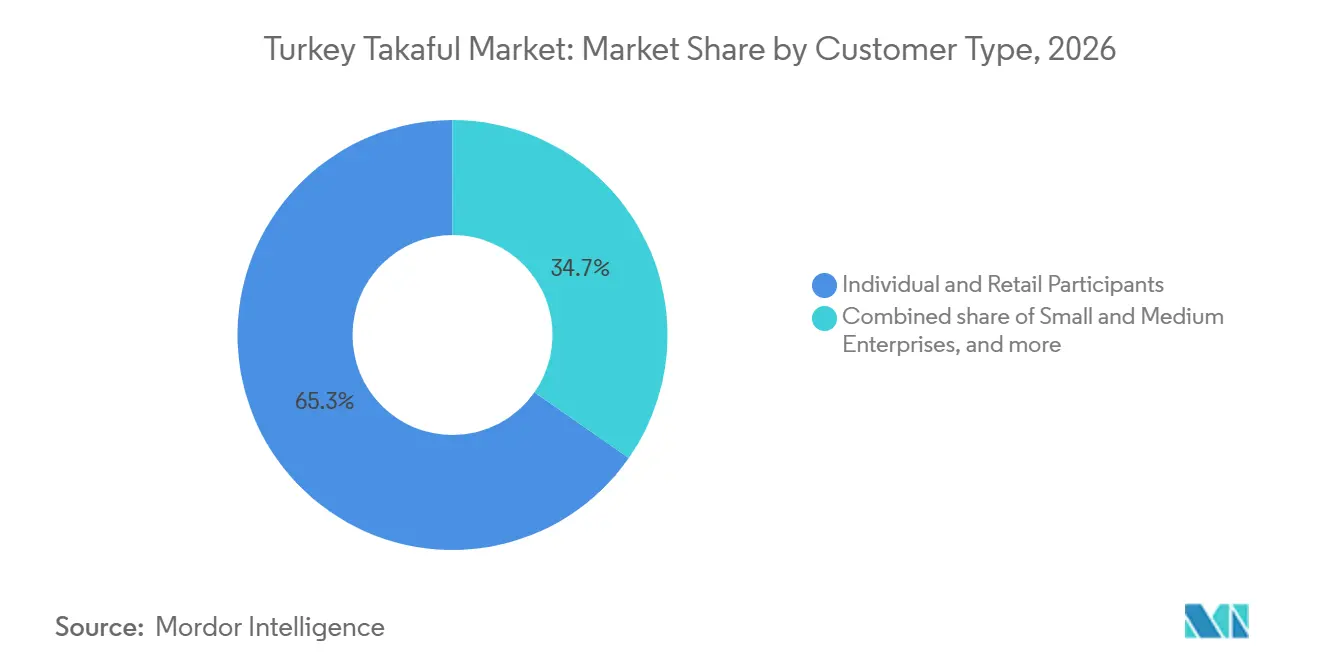
Individual and retail participants accounted for 65.3% of the Turkey takaful market in 2026, supported by demand for compulsory motor insurance, private health insurance, and personal protection products. Türkiye’s Private Health Insurance Regulation, effective January 2026, introduced standardized provisions for lifetime renewal guarantees, potentially supporting policyholder retention and longer-term customer relationships.
Small and Medium Enterprises (SMEs) are projected to record a 17.6% CAGR from 2027 to 2032, reflecting opportunities to expand participation in insurance among smaller businesses. Potential growth areas include commercial property, business interruption, liability, employee health, and trade-related protection. Digital distribution, simplified underwriting, and tailored Shariah-compliant coverage could improve accessibility for SMEs that are underserved by specialized participation insurance products. Türkiye’s SME ecosystem provides a substantial potential customer base for insurers.
Geography Analysis
Istanbul remains a key financial and commercial center for participation insurance, while Ankara, Izmir, and Bursa provide additional opportunities for bank-led and digital distribution. Agricultural insurance could help extend coverage to rural communities and small businesses. According to Anadolu Agency, TARSIM issued 2 million policies from January to July 2026, covering TRY 1.1 trillion in agricultural assets and 24 million dekars of land. Government premium support for eligible agricultural insurance policies ranges from 50% to 70%, depending on the product and risk covered. These established insurance structures could provide opportunities to expand access to participation-compliant agricultural coverage.
DASK earthquake insurance penetration in 2024 reached 64% in Marmara, 56% in the Aegean, 50% in Central Anatolia, 45% in the Black Sea region, and 61% in Eastern Anatolia. These regional differences indicate scope to strengthen earthquake-risk protection in areas with lower penetration. Türkiye’s developing participation reinsurance capacity may also support broader risk-transfer opportunities.
Competitive Landscape
The Turkey Takaful market is highly concentrated, with Neova Katılım Sigorta, Bereket Sigorta and Türkiye Katılım Sigorta accounting for a combined 89.9% of participation insurance premium production by July 2026. Neova recorded TRY 30.7 billion (USD 720.7 million) in premiums in 2025, while net profit increased 118% to TRY 2.4 billion (USD 56.3 million). Bereket Sigorta has introduced an internally developed artificial intelligence-based media monitoring system to support more proactive claims management. These developments highlight the importance of scale, profitability, and technology in strengthening operators’ competitive positions.
Türk Katılım Reasürans began international participation reinsurance operations on 1 July 2026, extending risk-transfer capacity for participation insurers. Separately, HDI Sigorta signed a share-transfer agreement in June 2026 to sell HDI Katılım Sigorta to Aydın Grup. Completion of the acquisition remains subject to regulatory and competition-authority approvals. Aydın Grup intends to strengthen its retail, health, and banking ecosystem through the acquisition, potentially creating additional opportunities for embedded and affinity insurance distribution.
Small and medium-sized businesses remain a potential growth opportunity for participation insurers, particularly in commercial property, liability and credit-related coverage. Türkiye’s draft participation insurance regulation proposes clearer separation of policyholder and shareholder funds, alongside separate and traceable reporting requirements. If implemented, these requirements could increase compliance demands while strengthening governance and transparency. Competition is therefore likely to depend increasingly on technology, distribution partnerships, product specialization and reinsurance capacity, alongside established agency networks.
Turkey Takaful Industry Leaders
-
Neova Katılım Sigorta AŞ
-
Bereket Sigorta AŞ
-
Türkiye Katılım Sigorta A.Ş.
-
Katılım Emeklilik ve Hayat AŞ
-
HDI Katılım Sigorta A.Ş.
- *Disclaimer: Major Players sorted in no particular order
Recent Industry Developments
- September 2026: Türk Katılım Reasürans, Turkey's sole participation reinsurer, reported the commencement of international participation reinsurance operations effective July 1, 2026. The company works with 51 insurance and reinsurance companies across 25 countries and provides coverage for risks in 85 countries; its equity stood at TRY 1.19 billion (USD 30 million) and total assets at TRY 4.35 billion (USD 110 million) as of June 2026. This expansion materially increases retakaful capacity available to domestic participation insurers, reducing reliance on conventional reinsurers for risk transfer.
- August 2026: SEDDK issued Circular 2026/26, strengthening advisory committee governance standards for all participation insurers. The circular mandates traceable decision records, standardized meeting minutes, and annual reporting of all committee resolutions to SEDDK by January each year.
- August 2026: Bereket Sigorta deployed an artificial intelligence-based media monitoring system developed by its internal teams. The system uses large language models and image processing to scan digital media in real time, match accident reports with the company’s portfolio, and identify potential fraud before a claims file is opened.
- June 2026: HDI Sigorta signed a share transfer agreement to sell its wholly owned subsidiary HDI Katılım Sigorta to Aydın Grup, subject to SEDDK and Competition Board approval. Aydın Grup stated that it intends to use its retail, health, and banking ecosystem to grow participation insurance distribution through embedded and affinity channels.
Turkey Takaful Market Report Scope
| Family Takaful | Family Protection / Life Takaful |
| Savings and Investment-Linked Takaful | |
| Medical and Health Takaful | |
| General Takaful | Motor Takaful |
| Property and Fire Takaful | |
| Marine and Aviation Takaful | |
| Engineering and Construction Takaful | |
| Liability Takaful | |
| Travel and Personal Accident Takaful | |
| Credit and Other General Takaful |
| Agents and Brokers |
| Bancatakaful |
| Direct Distribution |
| Embedded, Affinity and Other Non-Bank Partnerships |
| Individual and Retail Participants |
| Small and Medium Enterprises |
| Large Corporates |
| Government and Institutional Participants |
| By Takaful Type | Family Takaful | Family Protection / Life Takaful |
| Savings and Investment-Linked Takaful | ||
| Medical and Health Takaful | ||
| General Takaful | Motor Takaful | |
| Property and Fire Takaful | ||
| Marine and Aviation Takaful | ||
| Engineering and Construction Takaful | ||
| Liability Takaful | ||
| Travel and Personal Accident Takaful | ||
| Credit and Other General Takaful | ||
| By Distribution Channel | Agents and Brokers | |
| Bancatakaful | ||
| Direct Distribution | ||
| Embedded, Affinity and Other Non-Bank Partnerships | ||
| By Customer Type | Individual and Retail Participants | |
| Small and Medium Enterprises | ||
| Large Corporates | ||
| Government and Institutional Participants | ||
Key Questions Answered in the Report
What is the projected value of the Turkey Takaful market by 2032?
The Turkey Takaful market is projected to reach USD 5.9 billion by 2032, expanding at a 15.8% CAGR from 2027 to 2032.
Which takaful type has the largest share in Türkiye?
General Takaful leads with a 78.9% share in 2026, supported by motor, property and fire, and engineering and construction coverage.
Which insurance line is expected to grow fastest through 2032?
Medical and Health Takaful is expected to grow at 18.4% CAGR, supported by rising demand for supplementary health coverage.
How are participation insurance products mainly distributed in Türkiye?
Agents and Brokers are the leading channel with 67.8% share in 2026, while embedded and affinity partnerships are the fastest-growing channel at 19.8% CAGR.
Why are small and medium enterprises important for participation insurers?
Small and Medium Enterprises are projected to grow at 17.6% CAGR and represent a large underserved base of 3.5 million registered businesses.
How concentrated is participation insurance in Türkiye?
Neova Katılım Sigorta, Bereket Sigorta, and Türkiye Katılım Sigorta held a combined 89.9% share of sector premium production by July 2026.