
Turkey Sukuk Market Size and Share
Market Overview
| Study Period | 2021 - 2032 |
|---|---|
| Forecast Data Period | 2027 - 2032 |
| Base Year Market Size (2026) | USD 44.30 Billion |
| Market Size (2027) | USD 47.40 Billion |
| Market Size (2032) | USD 69 Billion |
| Growth Rate (2027 - 2032) | 7.80 % |
| Market Concentration | High |
Major Players *Disclaimer: Major Players sorted in no particular order Image © Mordor Intelligence. Reuse requires attribution under CC BY 4.0. | |
Turkey Sukuk Market Analysis by Mordor Intelligence
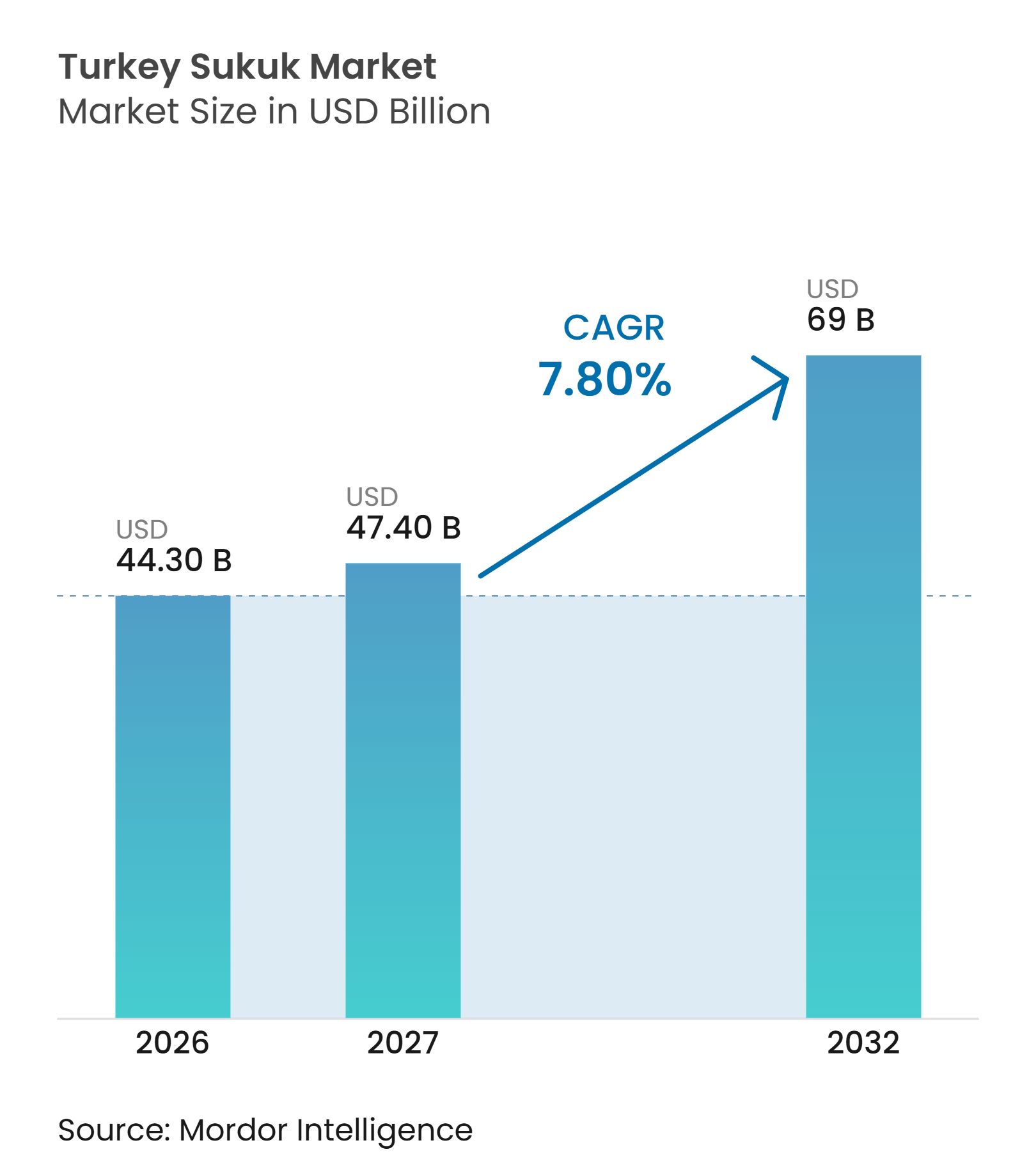
The Turkey Sukuk Market size is expected to increase from USD 44.30 billion in 2026 to USD 47.40 billion in 2027 and reach USD 69 billion by 2032, growing at a CAGR of 7.80% over 2027-2032.
The Turkish Treasury's lease-certificate program gives the market a stable sovereign base and helps establish reference pricing for other issuers. Participating banks are widening their funding sources through sukuk, while corporate issuers are starting to use structures that extend beyond government and real-estate-linked assets. International demand from the Gulf Cooperation Council, United Kingdom, United States, Europe, and Asia supports foreign-currency issuance and broadens the investor pool. The revised framework for green, sustainable, social, and sustainability-linked instruments adds a route for issuers seeking financing tied to eligible projects. Inflation, Turkish lira volatility, and limited domestic secondary-market liquidity remain material limits on investor participation and trading activity.
Key Report Takeaways
- By sukuk type, Ijarah captured 54.7% of the Turkey sukuk market share in 2026, while Wakalah is projected to grow at a 9.5% CAGR through 2032.
- By issuer type, sovereign issuers held 65.3% of the Turkey sukuk market share in 2026, while non-financial corporate issuers are forecast to grow at a 9.8% CAGR through 2032.
- By market type, domestic sukuk accounted for 75.4% of the Turkey sukuk market size in 2026, while international sukuk is projected to grow at a 9.6% CAGR through 2032.
- By maturity, medium-term sukuk held a 42.1% share of the Turkey sukuk market in 2026, while perpetual sukuk is projected to grow at a 10.5% CAGR through 2032.
- By label, plain and unlabelled sukuk captured 87.7% of the Turkey sukuk market share in 2026, while green sukuk is projected to grow at a 16.6% CAGR through 2032.
Note: Market numbers in this report are based on Mordor Intelligence's proprietary estimation framework, which combines nine months of actuals with Q4 projections for base year 2026.
Market Trends and Insights
Drivers Impact Analysis of Turkey Sukuk Market*
| Driver | (~) % Impact on CAGR Forecast | Geographic Relevance | Impact Timeline |
|---|---|---|---|
| Expansion of Turkish Treasury Lease-Certificate Issuance | +1.8% | Global, with primary gains in domestic Turkish lira and USD-denominated markets | Medium term (2-4 years) |
| Diversification of Participation Banks' Funding Sources Through Sukuk | +1.4% | Domestic, with spillover to Gulf Cooperation Council liquidity pools | Short term (≤ 2 years) |
| International Investor Demand for Turkish Sovereign Sukuk | +1.2% | Global, with the Gulf Cooperation Council as the core market, plus the United Kingdom, United States, and continental Europe | Medium term (2-4 years) |
| Development of TLREFK-Indexed Variable-Return Lease Certificates | +1.1% | Domestic | Short term (≤ 2 years) |
| Expansion of Green, Sustainable and Social Lease-Certificate Issuance | +0.9% | Global and domestic, aligned with the COP31 hosting commitment | Long term (≥ 4 years) |
| Broadening of Sukuk Issuance Across Sovereign and Corporate Issuers | +0.8% | Global, including the London Stock Exchange International Securities Market, Euronext Dublin, and Vienna Multilateral Trading Facility | Medium term (2-4 years) |
| Source: Mordor Intelligence | |||
Expansion of Turkish Treasury Lease-Certificate Issuance
The Turkish Treasury's domestic lease-certificate program remains the core support for the Turkey sukuk market. In 2025, the Ministry of Treasury and Finance issued TRY 233 billion (USD 5.43 billion) in domestic lease certificates, using the conversion embedded in the reported 2025 participation-bank figures[1]. The ministry also raised USD 2.5 billion through a 5-year international sukuk with a 6.75% lease rate, attracting 119 institutional investors and more than twice the offered amount. Middle Eastern investors represented 57% of demand for that issuance. In July 2026, the Treasury issued a USD 2.75 billion, 6-year sovereign sukuk that received USD 6.7 billion in orders. Repeated sovereign issuance gives corporate and quasi-sovereign borrowers reference pricing and supports a broader Turkish Shariah-compliant debt market.
Diversification of Participation Bank Funding and Corporate Issuance
Turkey's 8 participating banks issued TRY 213.9 billion (USD 4.9 billion) in sukuk during 2025. Ziraat Katılım issued TRY 76.3 billion (USD 1.8 billion), while Albaraka Türk issued TRY 49.3 billion (USD 1.1 billion), and Türkiye Emlak Katılım issued TRY 39.7 billion (USD 0.9 billion)[2]. Management contract, or wakala, structures represented 99.53% of participation-bank sukuk issued in 2025 and had an average tenor of 139.9 days. This structure supports frequent issuance but leaves funding dependent on continuing rollover demand. Corporate activity is also expanding, led by Türk Telekom's USD 600 million inaugural corporate sukuk in October 2025 and TPAO's USD 1 billion issuance in March 2026. These transactions show that Turkey's sukuk market participants can use operational assets and state-linked corporate programs alongside conventional sovereign structures.
International Demand and Product Innovation
Gulf Cooperation Council investors are central to demand for Turkey's dollar-denominated sovereign sukuk. In the June 2025 issuance, investors in the Middle East received 57% of allocations, while the United Kingdom received 17% and the United States received 14%. The Participation Banks Association of Türkiye and UK Export Finance signed a memorandum of understanding in July 2025 to strengthen Islamic finance cooperation. TLREFK, the Turkish Lira Overnight Participation Reference Rate, has also created a floating-return product for domestic investors. The Treasury issued TRY 80.07 billion (USD 1.8 billion) of TLREFK-linked lease certificates in September 2025[3]. It then issued TRY 66.6 billion (USD 1.6 billion) of 728-day TLREFK-linked certificates in August 2026 with an initial periodic return of 19.5%.
Green, Sustainable and Social Lease-Certificate Issuance
Green and other labeled instruments create a further route for the Turkey sukuk market to expand. The Capital Markets Board adopted revised guides for green, sustainable, social, and sustainability-linked capital market instruments on August 13, 2026. The rules brought social and sustainability-linked lease certificates into the framework and offered a 50% Board-fee discount for qualifying issuances[4]. The framework aligns Turkey's green sukuk rules with the International Capital Market Association's Green Bond Principles. A 2026 peer-reviewed study found positive net present value and an above-hurdle internal rate of return for green sukuk financing of solar projects in Turkey. The National Green Finance Strategy for 2026-2029 and Turkey's COP31 hosting commitment support the policy setting for these instruments.
Restraints Impact Analysis of Turkey Sukuk Market*
| Restraint | (~) % Impact on CAGR Forecast | Geographic Relevance | Impact Timeline |
|---|---|---|---|
| High Inflation and Turkish-Lira Exchange-Rate Volatility | -1.4% | Domestic, with spillover to Gulf Cooperation Council and European investors | Short term (≤ 2 years) |
| Limited Market Depth and Uneven Secondary-Market Liquidity | -0.9% | Domestic | Medium term (2-4 years) |
| Concentration of Issuance Among Sovereign and Bank-Related Issuers | -0.7% | Domestic | Medium term (2-4 years) |
| Foreign-Exchange Risk for International Investors in Turkish-Lira Sukuk | -0.8% | Global, including the Gulf Cooperation Council, Europe, and Asia-Pacific | Short term (≤ 2 years) |
| Source: Mordor Intelligence | |||
Inflation, Exchange-Rate Volatility, and Foreign-Exchange Risk
High inflation and Turkish lira depreciation affect domestic and international participation in the Turkey sukuk market. Domestic investors in Turkish lira sukuk need returns that protect purchasing power, which increases the relevance of TLREFK-linked structures. International investors in U.S. dollar sukuk are not directly exposed to Turkish lira returns, but lira volatility remains a signal of broader macroeconomic risk. Regional geopolitical events in early 2026 also increased risk premiums on Turkish sovereign securities before conditions partly recovered by midyear. The Banking Regulation and Supervision Agency and the Central Bank of the Republic of Turkey influence issuance strategy through oversight of participation-bank foreign-currency mismatches. These factors can narrow the pool of investors prepared to hold Turkish lira paper when conditions are unsettled.
Limited Secondary-Market Liquidity and Issuer Concentration
Secondary-market depth remains a structural limit for the Turkey sukuk market. Domestic Turkish-lira lease certificates are largely held by investors who intend to retain them, rather than trade them actively on Borsa İstanbul's Debt Securities Market. The 139.9-day average tenor of participation-bank sukuk in 2025 reflects the preference for short-duration instruments and repeated refinancing. Participation banks also have limited Shariah-compliant tools for managing excess liquidity at the Central Bank. A 2025 academic study proposed an investment wakala-based deposit arrangement between participation banks and the central bank as a possible solution. The market also remains concentrated among sovereign and bank-related issuers, which leaves fewer established channels for private-sector borrowers.
*Our forecasts treat driver/restraint impacts as directional, not additive. The impact forecasts reflect baseline growth, mix effects, and variable interactions.
Turkey Sukuk Market Segment Analysis
By Sukuk Type:
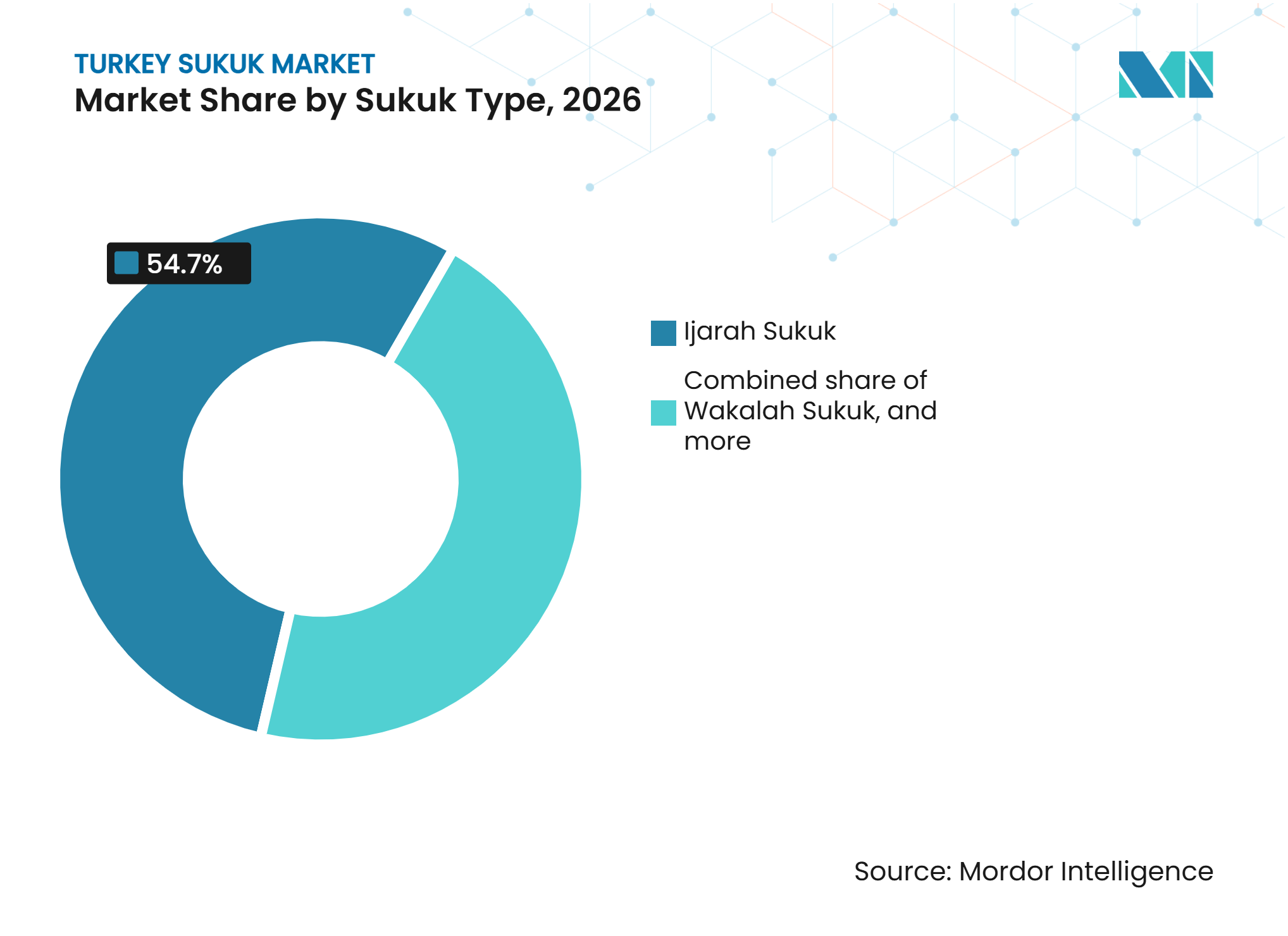
Ijarah Maintains the Base While Wakalah ExpandsIjarah captured 54.7% of the Turkey sukuk market share in 2026. Its leadership reflects the Treasury's lease-certificate structure, which transfers asset ownership to a Varlık Kiralama Şirketi, or asset leasing company, before the asset is leased back to the originator. This approach is established under Capital Markets Law No. 6362 and Capital Markets Board Communiqué III-61.1. It gives sovereign issuance a consistent asset-backed framework that domestic investors understand. The Ijarah structure also provides the foundation for a market that was initially centered on rental-income arrangements. Its scale continues to make it the reference product for the wider Turkey sukuk market.
Wakalah is projected to grow at a 9.5% CAGR through 2032. Participating banks use management-contract structures because they allow flexible pools of underlying assets and accommodate shorter tenors. According to the Participation Banks Association of Türkiye, TRY 776.3 billion (USD 18.08 billion) of TRY 861.5 billion (USD 20.06 billion) in cumulative sukuk issuance since 2013 used wakala structures by the first half of 2026. The Turkey sukuk market size for Wakalah is therefore supported by existing banking practices rather than a newly created product category. Murabahah, Musharakah, Mudarabah, hybrid, Salam, and Istisna products fill the remaining space in the product mix. Hybrid structures accounted for TRY 78.1 billion (USD 1.82 billion) in cumulative issuance, while purchase-and-sale structures accounted for TRY 5.9 billion (USD 0.14 billion). Türk Telekom's use of broadband-network capacity as the basis for its USD 600 million sukuk shows that issuers can apply the framework to nontraditional assets.


By Issuer Type:
Sovereign Leadership Supports Corporate EntrySovereign issuers held 65.3% of the Turkey sukuk market share in 2026. The Treasury uses lease certificates as a Shariah-compliant component of its broader borrowing program. State-linked and quasi-sovereign entities add to this institutional issuer base. Regular Treasury auctions also establish domestic and international reference points for pricing and maturity. This institutional base provides continuity when private issuance varies by funding need. It also explains why the market's development remains closely linked to public borrowing policy.
Non-financial corporate sukuk is projected to grow at a 9.8% CAGR through 2032. Türk Telekom issued a USD 600 million cross-border sukuk in October 2025, the first such issuance by a Turkish non-financial corporate. TPAO completed a USD 1 billion inaugural sukuk in March 2026 under its USD 4 billion program on the London Stock Exchange International Securities Market. TPAO then issued a USD 500 million tap, increasing its outstanding sukuk to USD 1.5 billion. Financial institutions remain the third main issuer group, with participating banks central to activity. BRSA prudential standards affect the capital treatment of their instruments and shape the use of Additional Tier 1 structures. Multilateral and supranational issuers remain a smaller part of the issuer mix.
By Market Type:
Domestic Issuance Provides the Main BaseDomestic sukuk accounted for 75.4% of the Turkey sukuk market size in 2026. Treasury Turkish lira auctions and participation-bank issuance provide the core of this domestic activity. Participation-bank sukuk had an average maturity of 139.9 days in 2025. This result shows a market that renews outstanding paper frequently instead of relying mainly on long-dated issuance. As of mid-2026, TRY 68.3 billion (USD 1.6 billion) was outstanding in active domestic sukuk, compared with TRY 861.5 billion (USD 20.1 billion) issued cumulatively since 2013. The difference reflects the rolling nature of short-tenor domestic issuance.
International sukuk is projected to grow at a 9.6% CAGR through 2032. Turkey is building a dollar-denominated yield curve and seeking more participation from Gulf Cooperation Council and Western institutional investors. The UK Export Finance memorandum with the Participation Banks Association of Türkiye created a further institutional channel for United Kingdom participation. Kuveyt Türk has issued USD 2.53 billion cumulatively in foreign-currency sukuk, while Albaraka Türk has issued USD 1.09 billion and Türkiye Finans has issued USD 1 billion. These bank transactions complement sovereign securities and supply benchmarks for potential new issuers. The expected COP31 event may also increase interest from investors who focus on environmental, social, and governance financing.
By Maturity:
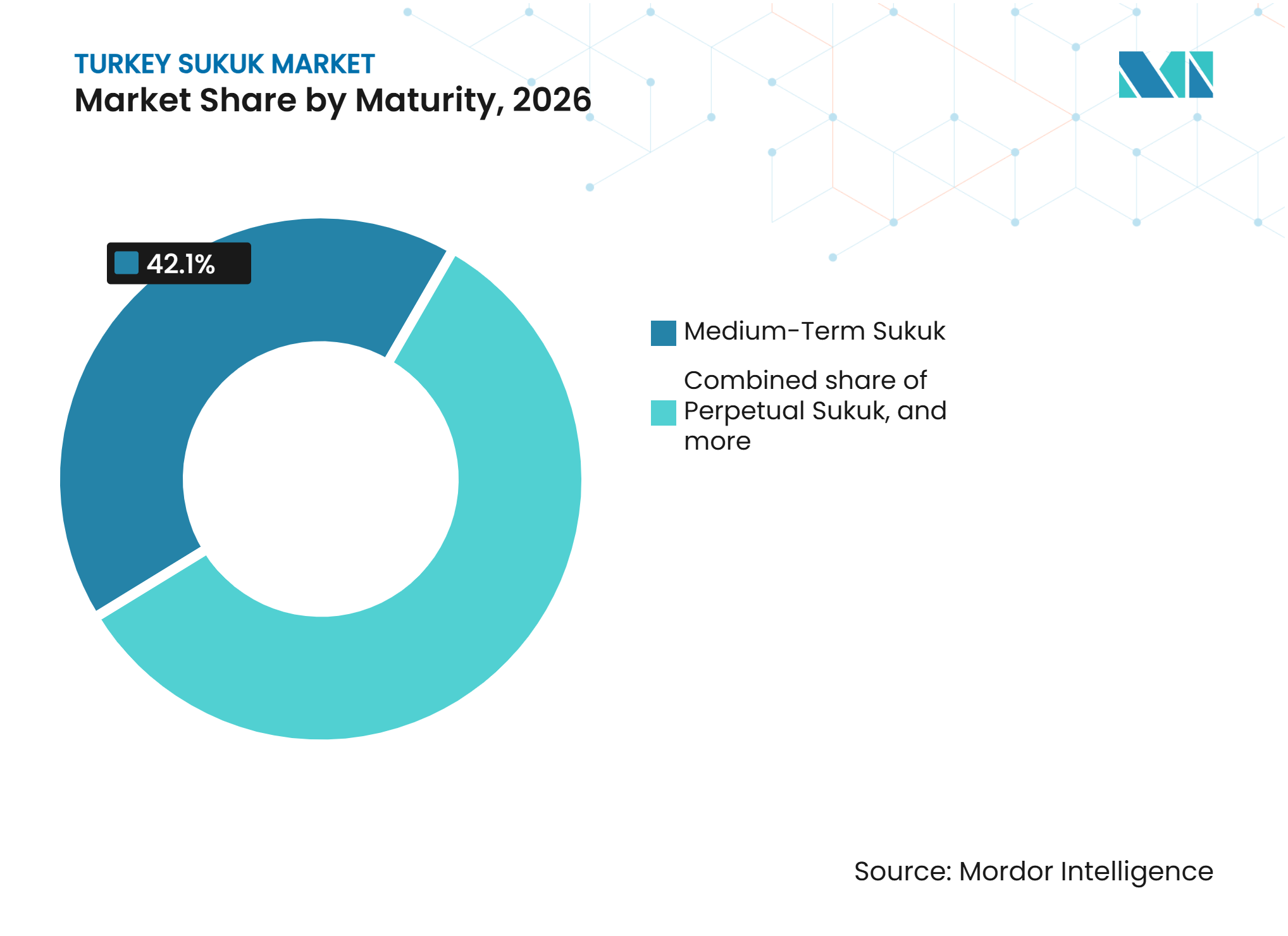
Medium-Term Instruments Lead While Perpetual Structures RiseMedium-term sukuk held 42.1% of the Turkey sukuk market share in 2026. The share reflects the Treasury's use of 3- to 7-year domestic issuance and participation-bank investment beyond short-term rollover needs. A 5-year domestic lease certificate issued in July 2025 raised TRY 23.77 billion (USD 0.55 billion), using the reported conversion basis. International sovereign deals also add longer-dated reference points. The June 2025 sovereign dollar sukuk had a 5-year maturity. The July 2026 sovereign dollar sukuk had a 6-year maturity.
Perpetual sukuk is projected to grow at a 10.5% CAGR through 2032. Participating banks use Additional Tier 1 sukuk to strengthen capital ratios while accessing international Islamic investors. Vakıf Katılım issued a USD 500 million Additional Tier 1 sukuk in October 2025 at an 8.375% coupon. The transaction received more than USD 1.8 billion in orders from over 80 institutional investors in the Gulf Cooperation Council, the United Kingdom, and Europe. Dünya Katılım completed an inaugural USD 100 million perpetual subordinated sukuk in July 2026. Short-term sukuk still supports liquidity management through sub-1-year Treasury certificates and bank paper.

By Label:
Plain Sukuk Dominates While Green Sukuk Gains GroundPlain and unlabeled sukuk captured 87.7% of the Turkey sukuk market share in 2026. This reflects the established composition of sovereign and participation-bank issuance, where use-of-proceeds labels have not been applied consistently. The segment continues to serve the primary financing needs of the Treasury and banks. Its scale means that labeled products still represent a small part of issuance. The existing base, however, can support broader adoption when issuers identify qualifying assets. The Turkey sukuk market remains anchored in these unlabeled structures even as policy support grows for more specialized instruments.
Green sukuk is projected to grow at a 16.6% CAGR through 2032. The Capital Markets Board's August 2026 guidance incorporated green, social, sustainable, and sustainability-linked instruments into a clearer regulatory setting. In 2025, domestic green and sustainable sukuk issuance totaled TRY 1.1 billion (USD 0.03 billion). The guidance provides a 50% fee discount for qualifying issuance and aligns with the International Capital Market Association's Green Bond Principles. A peer-reviewed study found that green sukuk can support solar-energy investment in Turkey under positive financial feasibility conditions. This combination of regulation and project financing can expand the labeled market while preserving the established plain-sukuk base.
Geography Analysis
Istanbul Financial Center
Istanbul Financial Center serves as Turkey's main domestic origination and listing hub for lease certificates. Participation-bank programs, including Albaraka Türk's approved TRY 80 billion (USD 1.9 billion) domestic issuance ceiling, are arranged through Istanbul-based asset leasing companies. The city concentrates structuring, Shariah compliance review, and Borsa İstanbul listing activity. Wakala structures and short maturities make Istanbul a continuously renewing primary-market center. Qualified institutional investors held 88% of participation-bank sukuk by value, indicating that the domestic market is still focused on a limited investor base. The Participation Banks Association of Türkiye has identified the lack of Shariah-compliant Central Bank liquidity options as an operational constraint for participation banks. This gap limits secondary-market activity and reinforces the market's reliance on new issuance and rollover.
Gulf Cooperation Council and Middle East
The Gulf Cooperation Council and the Middle East received 57% of the allocations in the USD 2.5 billion Turkish sovereign sukuk issued in June 2025. The United Kingdom received 17%, and the United States received 14%, showing that the transaction also drew demand from other established Islamic and conventional investment centers. TPAO's USD 1 billion sukuk in March 2026 received USD 5.5 billion in orders from 165 institutional investors across Europe, the Middle East, and Asia-Pacific. Kuwait Finance House Capital, Dubai Islamic Bank, Emirates NBD Capital, and Mashreq acted as joint global coordinators and bookrunners. The Participation Banks Association of Türkiye and Qatar Financial Centre have supported the possibility of a joint Turkey-Qatar issuance and cross-listing on Borsa İstanbul and the Qatar Stock Exchange. Such a link could deepen bilateral liquidity pools and reduce dependence on a single listing venue.
Europe, Asia-Pacific, and the United States
Türk Telekom's USD 600 million sukuk in October 2025 was listed on Euronext Dublin's Global Exchange Market and structured under Rule 144A and Regulation S for United States qualified institutional buyers and international investors. The transaction reached a 6.5% yield and used broadband-network capacity as the underlying asset. Kuveyt Türk issued MYR 800 million (USD 197 million) of ringgit-denominated sukuk, while Türkiye Finans issued MYR 1.2 billion (USD 0.29 billion), creating access to Southeast Asian Islamic liquidity. Ziraat Katılım also completed a EUR 250 million (USD 294 million) euro-denominated sukuk for continental European investors. These instruments broaden the geographic reach of the Turkish sukuk market beyond the Gulf Cooperation Council. A wider investor base can increase price competition among investors and reduce concentration by region. Regulatory requirements in the United States, Europe, and listed-market venues remain relevant to cross-border structures.
Competitive Landscape
Market Concentration
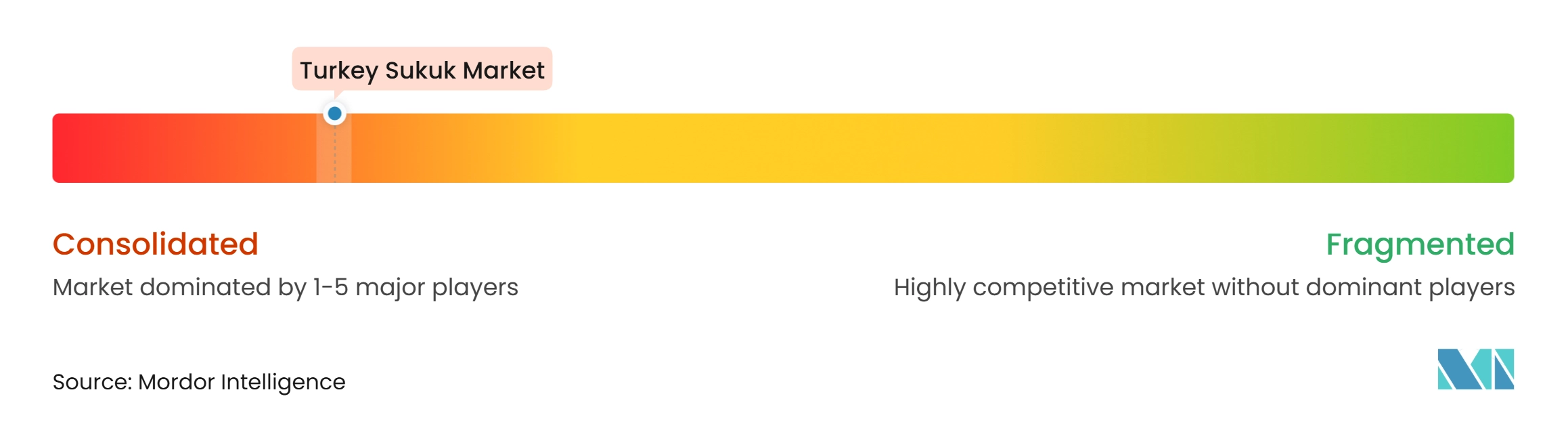
The Turkey Sukuk market is consolidated around the Ministry of Treasury and Finance and leading participating banks, with corporate issuers gradually expanding the competitive landscape. Ziraat Katılım, Albaraka Türk, Türkiye Emlak Katılım, Vakıf Katılım, and Kuveyt Türk are prominent participation-bank issuers, supported by domestic investor distribution and established Islamic finance capabilities. In 2025, Türkiye’s eight participation banks issued TRY 213.9 billion (USD 4.9 billion) in Sukuk. Ziraat Katılım accounted for TRY 76.3 billion (USD 1.7 billion), followed by Albaraka Türk at TRY 49.3 billion (USD 1.2 billion) and Türkiye Emlak Katılım at TRY 39.7 billion (USD 0.9 billion), based on the reported conversion figures. These issuance volumes reinforce the position of leading participation banks, while the Ministry of Treasury and Finance remains a major issuer in the broader market. Banks also use Turkish-lira wakala programmes, international Additional Tier 1 Sukuk, and foreign-currency issuance in USD, euros, and ringgit to diversify funding and meet capital requirements.
Corporate issuance is broadening beyond the participation-bank sector. Turkish Petroleum (TPAO) established a USD 4 billion Sukuk programme and completed its inaugural USD 1 billion issuance, followed by a USD 500 million tap, strengthening its position as a repeat corporate issuer. Türk Telekom also entered the international corporate Sukuk market with a USD 600 million, five-year issuance in October 2025, attracting demand from international investors. These transactions expand the issuer base and demonstrate that energy and telecommunications companies can access Shariah-compliant funding alongside banks and the sovereign.
Regulation and technology also influence market development. The Capital Markets Board of Türkiye’s Communiqué III-61.1 governs lease certificates, while its August 2026 guidelines introduced frameworks for green, sustainable, social, and sustainability-linked capital-market instruments. The Board also approved a 50% fee discount for issuances covered by the new guidelines, in addition to the existing discount applicable to lease certificates. Separately, İşbank issued a USD 100 million digitally native note in June 2025, with the International Finance Corporation as the sole investor, demonstrating the use of distributed-ledger technology in Türkiye’s debt markets.
Turkey Sukuk Industry Leaders
-
Ziraat Katılım Bankası
-
Albaraka Türk
-
Türkiye Emlak Katılım Bankası
-
Vakıf Katılım Bankası
-
Türkiye Finans
- *Disclaimer: Major Players sorted in no particular order
Turkey Sukuk Market Companies Covered in this Report
- Ziraat Katılım Bankası A.Ş.
- Albaraka Türk Katılım Bankası A.Ş.
- Türkiye Emlak Katılım Bankası A.Ş.
- Vakıf Katılım Bankası A.Ş.
- Türkiye Finans Katılım Bankası A.Ş.
- Kuveyt Türk Katılım Bankası A.Ş.
- Dünya Katılım Bankası A.Ş.
- Hayat Finans Katılım Bankası A.Ş.
- Republic of Türkiye Ministry of Treasury and Finance
- Nurol Group
- Garanti Finansal Kiralama A.Ş.
- Tera Group
- Aktif Bank
- Türkiye Halk Bankası (Halkbank)
- Bereket Group
- Ata Group
- Değer Varlık Yönetim A.Ş.
- GY Group
- D Varlık Kiralama A.Ş.
- Osmanlı Group
Recent Industry Developments in Turkey Sukuk Market
- August 2026: Turkey's Capital Markets Board adopted the Green, Sustainable and Social Capital Market Instruments Guide and the Sustainability-Linked Capital Market Instruments Guide, Decision i-SPK 128.29, dated August 13, 2026, introducing social instruments and sustainability-linked sukuk into the regulatory framework and providing a 50% CMB fee discount for qualifying issuances.
- July 2026: Dünya Katılım Bankası completed its inaugural USD 100 million Additional Tier 1 sukuk, structured as perpetual subordinated certificates through Dunya Katilim Sukuk Ltd. in the Cayman Islands and admitted to trading on the Vienna Stock Exchange's Multilateral Trading Facility, marking the bank's debut in international capital markets.
- June 2026: The Republic of Türkiye raised USD 2.75 billion through a 6-year Regulation S sukuk, attracting USD 6.7 billion in orders and settling on July 2, 2026, with maturity on July 2, 2032, marking the sovereign's largest single sukuk issuance and extending the dollar yield curve.
- March 2026: TPAO completed a USD 1 billion 5-year inaugural sukuk under its USD 4 billion program listed on the London Stock Exchange, with more than USD 5.5 billion in orders from 165 international institutional investors.
Turkey Sukuk Market Report Scope
Segmentation Overview
| Murabahah Sukuk |
| Ijarah Sukuk |
| Wakalah Sukuk |
| Musharakah Sukuk |
| Mudarabah Sukuk |
| Salam Sukuk |
| Istisna Sukuk |
| Hybrid / Composite Sukuk |
| Other Sukuk Types |
| Sovereign |
| Sovereign-Related / Quasi-Sovereign |
| Financial Institution |
| Non-Financial Corporate |
| Multilateral / Supranational |
| Domestic Sukuk |
| International Sukuk |
| Short-Term Sukuk |
| Medium-Term Sukuk |
| Long-Term Sukuk |
| Perpetual Sukuk |
| Plain / Unlabelled Sukuk |
| Green Sukuk |
| Sustainability / Sustainability-Linked / Social / Other labelled Sukuk |
| By Sukuk Type | Murabahah Sukuk |
| Ijarah Sukuk | |
| Wakalah Sukuk | |
| Musharakah Sukuk | |
| Mudarabah Sukuk | |
| Salam Sukuk | |
| Istisna Sukuk | |
| Hybrid / Composite Sukuk | |
| Other Sukuk Types | |
| By Issuer Type | Sovereign |
| Sovereign-Related / Quasi-Sovereign | |
| Financial Institution | |
| Non-Financial Corporate | |
| Multilateral / Supranational | |
| By Market Type | Domestic Sukuk |
| International Sukuk | |
| By Maturity | Short-Term Sukuk |
| Medium-Term Sukuk | |
| Long-Term Sukuk | |
| Perpetual Sukuk | |
| By Label | Plain / Unlabelled Sukuk |
| Green Sukuk | |
| Sustainability / Sustainability-Linked / Social / Other labelled Sukuk |
Key Questions Answered in the Report
What is the projected value of Turkey sukuk market by 2032?
The market is forecast to reach USD 69.0 billion by 2032, from USD 44.3 billion in 2026, at a 7.8% CAGR during 2027-2032.
Which sukuk type has the largest share in Turkey?
Ijarah leads with a 54.7% share in 2026, supported by the Treasury's established lease-certificate structure.
Which issuer category is growing fastest in Turkey's sukuk sector?
Non-Financial Corporate issuers are forecast to grow at a 9.8% CAGR through 2032, supported by major transactions from Türk Telekom and TPAO.
Why are international investors important for Turkish sukuk?
The Gulf Cooperation Council and Middle East received 57% of allocations in the June 2025 USD 2.5 billion sovereign sukuk, while the United Kingdom and United States also participated.
What is driving green sukuk adoption in Turkey?
Green Sukuk is projected to grow at a 16.6% CAGR through 2032, supported by the 2026 Capital Markets Board framework and the 50% qualifying fee discount.
What are the main constraints on Turkish sukuk issuance?
Inflation, Turkish lira volatility, limited secondary-market liquidity, and issuer concentration can constrain investor demand and trading activity.