
Turkey Islamic Finance Market Size and Share
Market Overview
| Study Period | 2021 - 2032 |
|---|---|
| Forecast Data Period | 2027 - 2032 |
| Base Year Market Size (2026) | USD 166.80 Billion |
| Market Size (2027) | USD 181 Billion |
| Market Size (2032) | USD 277.20 Billion |
| Growth Rate (2027 - 2032) | 8.90 % |
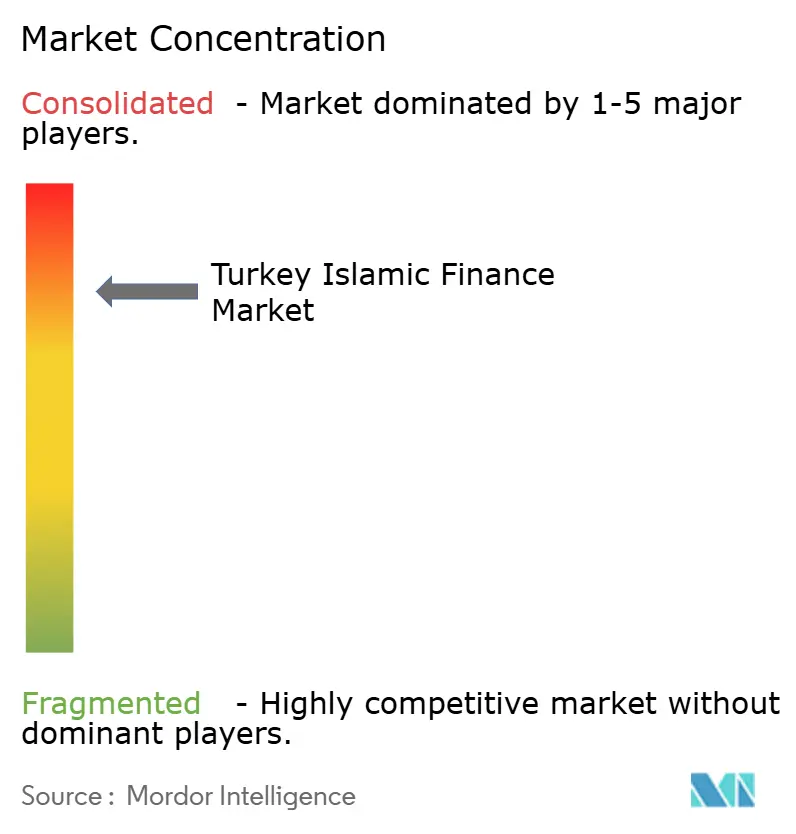
| Market Concentration | High |
Major Players *Disclaimer: Major Players sorted in no particular order Image © Mordor Intelligence. Reuse requires attribution under CC BY 4.0. | |
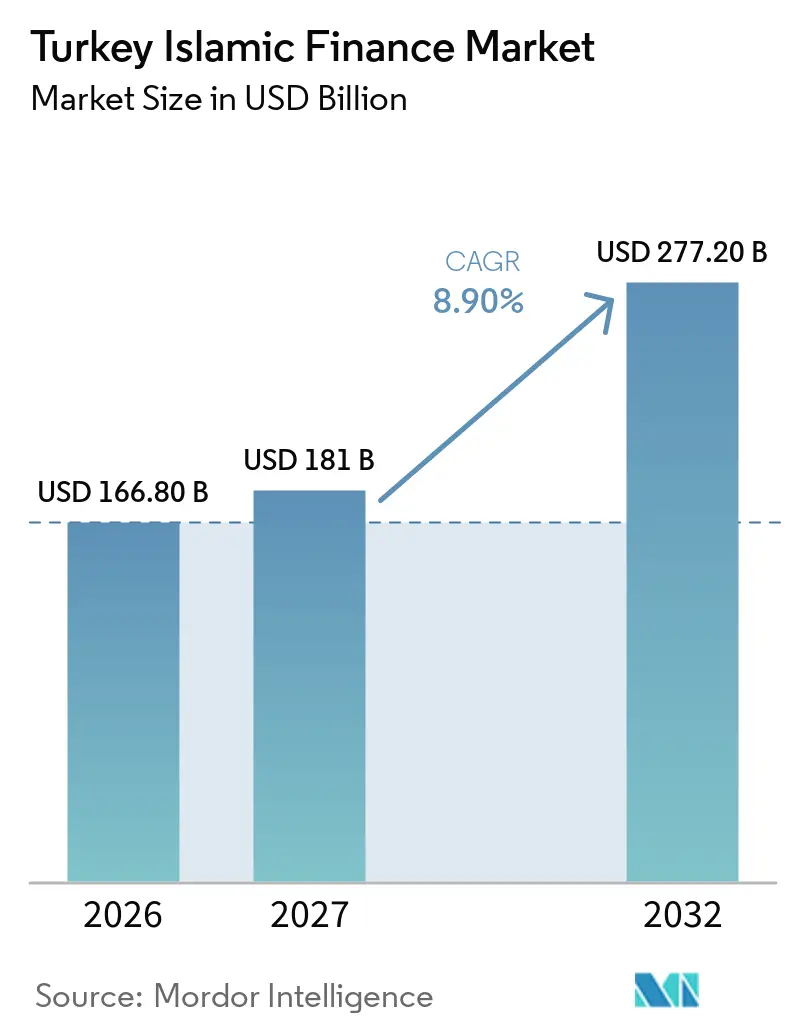
Turkey Islamic Finance Market Analysis by Mordor Intelligence
The Turkey Islamic Finance Market size is expected to grow from USD 166.80 billion in 2026 to USD 181 billion in 2027 and is forecast to reach USD 277.20 billion by 2032 at 8.90% CAGR over 2027-2032.
Turkey Islamic finance market is expanding through the continued development of participation banking, digital financial services, SME and export financing, sukuk issuance, and broader participation-finance regulation. The country ranked 10th among 140 countries in the 2025 Islamic Finance Development Indicator, highlighting the country's growing institutional presence in the global Islamic finance ecosystem. Participation banking remains the core of the domestic Islamic finance ecosystem. As of August 2026, participation banks reported TRY 5.35 trillion (USD 130.4 billion) in assets, while total participation-bank customers exceeded 22 million. Digital adoption has also accelerated, with more than 8.29 million active digital banking customers and over 4.17 million remote customer acquisitions. Government-backed participation banking remains an important growth catalyst. Digital participation banks are also reducing the cost of serving customers outside established branch networks. The opportunity remains linked to deeper sukuk markets, more retail investment products, and stronger financing access for smaller enterprises.
Key Report Takeaways
- By financial sector, Islamic banking is projected to account for 64.5% of the Turkey Islamic finance market in 2026, while Islamic non-bank financial institutions are expected to grow at a CAGR of 12.4% through 2032.
- By customer type, retail and individual customers are projected to account for 31.7% of the Turkey Islamic finance market in 2026, while MSMEs are expected to grow at a CAGR of 11.2% through 2032.
- By institution form, full-fledged Islamic banks are projected to account for 65.2% of the Turkey Islamic finance market in 2026, while licensed Islamic non-bank institutions are expected to grow at a CAGR of 10.7% through 2032.
- By geography, Istanbul is projected to account for 40.9% of the Turkey Islamic finance market in 2026, while the Rest of Türkiye is expected to grow at a CAGR of 11.6% through 2032.
Note: Market numbers in this report are based on Mordor Intelligence's proprietary estimation framework, which combines nine months of actuals with Q4 projections for base year 2026.
Market Trends and Insights
Drivers Impact Analysis of Turkey Islamic Finance Market*
| Driver | (~) % Impact on CAGR Forecast | Geographic Relevance | Impact Timeline |
|---|---|---|---|
| Government-Backed Expansion of Participation Banking | +3.2% | National, centered on Istanbul and Ankara with effects in the Aegean and Anatolia | Long term (≥ 4 years) |
| Digital-Only Participation Banking and Open-Banking Distribution | +1.8% | Istanbul and Rest of Marmara, with national digital reach | Medium term (2-4 years) |
| Micro, Small, and Medium Enterprise and Export-Finance Demand | +1.5% | National, with early gains in Aegean and West and Central Anatolia manufacturing corridors | Medium term (2-4 years) |
| Sukuk and Sustainable-Finance Development | +1.4% | Istanbul Financial Center, with access to Gulf Cooperation Council and Malaysian liquidity pools | Long term (≥ 4 years) |
| Istanbul Financial Center Regional-Hub Ambition | +0.8% | Istanbul, with cross-border capital links to Asia-Pacific and Middle East and North Africa markets | Long term (≥ 4 years) |
| Demand From Underserved and Values-Based Customers | +0.9% | Rest of Türkiye, Aegean, and West and Central Anatolia | Medium term (2-4 years) |
| Source: Mordor Intelligence | |||
Government-Backed Scale-Up of Participation Banking
State ownership has become a central part of participation banking expansion in Türkiye. Ziraat Katılım, Vakıf Katılım, and Emlak Katılım held leading positions in the sector by assets as of mid-2026 through their disclosures on the Public Disclosure Platform. President Erdoğan announced in June 2026 that Ziraat Katılım, Vakıf Katılım, and Halk Katılım would be merged into one institution[1]. The planned merger of Ziraat Katılım, Vakıf Katılım, and Halk Katılım could create a larger state-backed participation bank with greater balance-sheet scale and a broader distribution footprint. The Banking Regulation and Supervision Agency issued its Communiqué on Compliance with Participation Principles in December 2025, extending governance requirements to leasing, factoring, and asset management companies that operate on participation principles. The proposed Participation Finance Law also covers takaful, participation capital markets, and social finance, which would create a more unified legal framework for the sector.
Digital-Only Participation Banking and Open-Banking Distribution
Türkiye has three full-fledged digital participation banks: Hayat Finans, T.O.M. Katılım Bankası, and Adil Katılım. These providers can reach customer groups that are costly to serve through traditional branch networks. Dubai Islamic Bank increased its interest in T.O.M. Group from 20% to 25% in January 2025, demonstrating continued Gulf Cooperation Council investment in domestic digital participation banking[2]. As of August 2026, the Participation Banks Association of Türkiye recorded 4.17 million active digital banking customers and 7.65 million remote customer acquisitions. The Banking Regulation and Supervision Agency’s Digital Banks Regulation provides the operating framework for these providers. Open-banking application programming interfaces supervised by the Central Bank of the Republic of Türkiye can also help banks distribute Shariah-compliant products through third-party platforms.
Micro, Small, and Medium Enterprise and Export-Finance Demand
Participation finance supports micro, small, and medium enterprises (MSMEs) through asset-based financing and risk-sharing structures. Outstanding SME loans in Türkiye reached TRY 4.92 trillion (USD 127.5 billion) in April 2025, increasing 33.2% year over year, while participation banks accounted for 12% of SME financing despite representing 8.9% of total banking assets as of September 2025[3]. In May 2026, the Islamic Corporation for the Development of the Private Sector (ICD) announced a USD 30 million, four-year Shariah-compliant financing facility with Türkiye Emlak Katılım Bankası, marking ICD’s first thematic financing in Türkiye. Half of the facility was allocated to projects aligned with the specified UN Sustainable Development Goals. Export financing is another established application: participation banks facilitated USD 40.15 billion in Turkish exports in 2024, equivalent to 15.33% of total exports, while Türk Eximbank provided approximately USD 1.2 billion in participation-finance support during 2025. These developments indicate opportunities to expand Shariah-compliant funding for SME growth, equipment investment, supplier payments, and export-risk mitigation.
Sukuk and Sustainable-Finance Market Deepening
Türkiye’s sukuk market gained a major corporate benchmark in 2026 when TPAO completed its inaugural USD 1 billion sukuk in February, attracting more than USD 5.5 billion in orders and setting a record for corporate sukuk issuance in Türkiye[4]. Türk Telekom had previously issued a USD 600 million sukuk in October 2025, demonstrating international investor appetite for Shariah-compliant corporate funding. By August 2026, cumulative sukuk issuance by participation banks had reached TRY 909 billion (USD 6.5 billion), while cumulative Ministry of Treasury and Finance issuance stood at TRY 815 billion (USD 5.3 billion). These developments indicate growing access to domestic and international Islamic capital markets, creating potential for longer-term Shariah-compliant funding for corporate investment, infrastructure, and sustainable-finance initiatives.
Restraints Impact Analysis of Turkey Islamic Finance Market*
| Restraint | (~) % Impact on CAGR Forecast | Geographic Relevance | Impact Timeline |
|---|---|---|---|
| Limited Product and Liquidity Depth Compared With Conventional Banking | -1.5% | National, especially in secondary sukuk markets and small and medium enterprise and retail segments | Long term (≥ 4 years) |
| Shariah Standardization and Product-Approval Friction | -0.8% | National, with greater friction for cross-border issuers | Medium term (2-4 years) |
| Inflation, Currency Volatility, and Real-Return Uncertainty | -1.2% | National, particularly in the Rest of Türkiye, where household real incomes are lower | Short term (≤ 2 years) |
| Shortage of Specialized Human Capital | -0.7% | National, concentrated in Istanbul and Ankara, and more acute in the Aegean and Anatolia | Long term (≥ 4 years) |
| Source: Mordor Intelligence | |||
Limited Product and Liquidity Depth Compared With Conventional Banking
Türkiye’s participation-finance market faces potential constraints from short-term sukuk issuance and limited secondary-market liquidity, which may restrict institutional investors’ portfolio management flexibility. Live sukuk issuance stood at TRY 68.3 billion (USD 1.9 billion) in 2026, while average sukuk maturity was approximately 140 days. Qualified investors accounted for 87.97% of sukuk issuance, compared with 7.52% through public offerings and 4.52% through allocated sales, indicating a concentration in private placements that may constrain broader retail participation and price discovery. These figures suggest scope to deepen secondary-market trading and diversify the investor base, although they do not independently establish the market’s overall liquidity. The short average maturity of issuance also highlights the importance of developing longer-tenor domestic instruments, alongside international sukuk and other Shariah-compliant funding channels, to support borrowers with longer-term financing requirements.
Shariah Standardization and Product-Approval Friction
Türkiye’s participation-finance sector is subject to evolving governance requirements as regulators extend compliance standards beyond participation banks. In December 2025, the Banking Regulation and Supervision Agency (BRSA) issued a Communiqué on Compliance with Participation Principles covering participation-finance institutions and qualifying non-bank activities, including leasing, factoring, financing, and asset management. The framework establishes requirements for advisory committees, internal compliance, oversight, and documentation, supporting more consistent application of participation principles across the sector. However, implementation may increase governance and compliance demands for smaller providers. Cross-border issuers may also need to reconcile Turkish regulatory requirements with international investor and transaction-documentation standards. These developments strengthen the domestic governance framework, although the extent of any remaining product-approval delays will depend on implementation and the requirements applicable to individual institutions.
*Our forecasts treat driver/restraint impacts as directional, not additive. The impact forecasts reflect baseline growth, mix effects, and variable interactions.
Turkey Islamic Finance Market Segment Analysis
By Financial Sector:
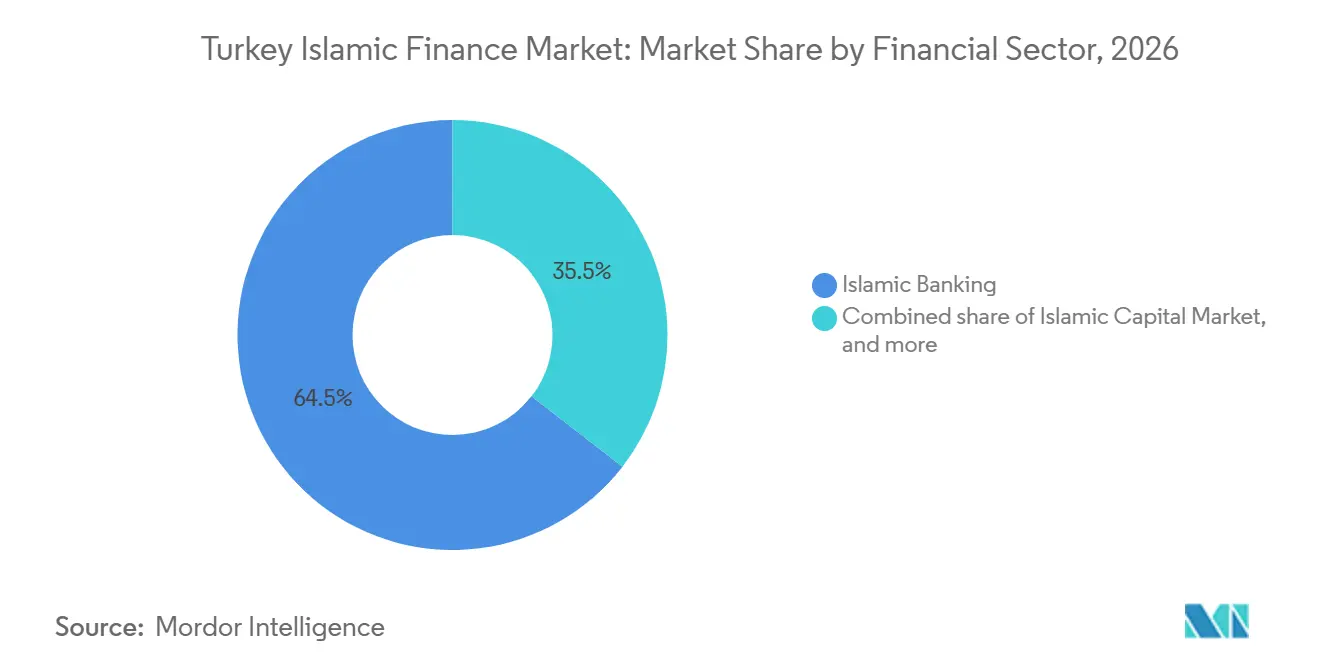
Islamic Banking Leads While Non-Bank Institutions Expand FasterIslamic banking held 64.5% of the Turkey Islamic finance market in 2026, making it the largest financial-sector segment. Participation banks remain the core channel for Shariah-compliant deposits, financing, trade finance, and other participation-finance products. The sector has continued to expand its asset base, branch network, digital infrastructure, and product offering. Participation banks accounted for 7.9% of total banking-sector financing, 10.4% of deposits, and 9.2% of banking-sector assets at the end of 2025.
Islamic capital markets provide an additional source of growth through sukuk, Islamic funds, and other participation-based investment products. Cumulative participation-bank sukuk issuance reached TRY 861.5 billion (USD 21.8 billion) from 2013 through the first half of 2026. Large corporate issuers have also used sukuk to diversify funding sources. Islamic non-bank financial institutions are projected to be the fastest-growing financial-sector category at a 12.4% CAGR during 2027–2032, supported by expansion in takaful, Islamic asset management, leasing, factoring, and other participation-based financial services.
By Customer Type:
Retail Deposits Lead While Micro, Small, and Medium Enterprises Gain MomentumRetail/individual customers accounted for 31.7% share of the Turkey Islamic finance market in 2026, supported by the role of participation banks in mobilizing household deposits and providing retail financing. The relatively high deposit penetration of participation banks indicates the importance of individual customers as a funding base. Large corporates, government-related entities, and financial institutions also contribute to demand through sukuk, trade finance, treasury products, and other participation-finance solutions.
MSMEs are projected to be the fastest-growing customer segment at an 11.2% CAGR through 2032. Growth in this segment is supported by increasing demand for working-capital finance, equipment finance, trade finance, and Shariah-compliant funding solutions. Total lending to SMEs exceeded TRY 4.9 trillion (USD 127.3 billion) in April 2025, while participation banks provided approximately TRY 894 billion (USD 23.2 billion) in SME financing. International development-finance initiatives, including the USD 30 million ICD facility for Türkiye Emlak Katılım Bankası, are also supporting greater access to Shariah-compliant financing for SMEs.
By Institution Form:
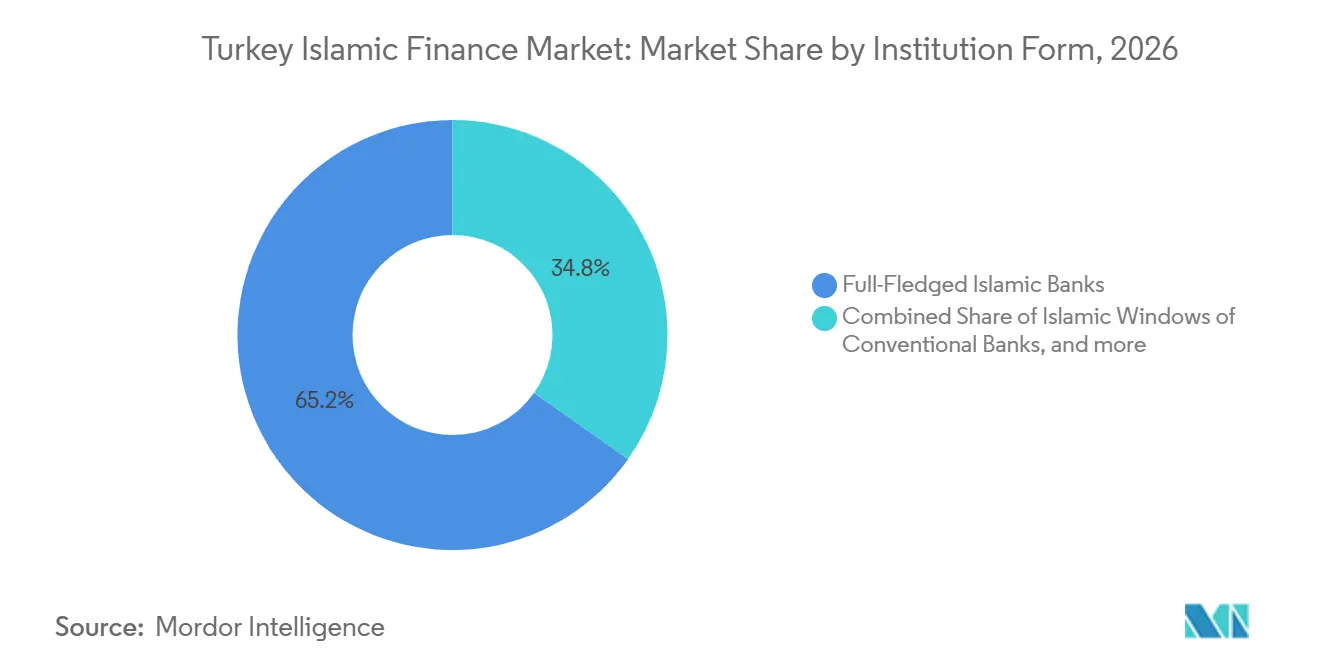
Full-Fledged Banks Remain Central While Licensed Non-Banks Gain GroundFull-fledged islamic banks accounted for 65.2% of the Turkey Islamic finance market in 2026. The segment’s leading position reflects established deposit-taking capabilities, financing portfolios, distribution networks, and growing digital channels. The combined assets of Türkiye's participation banks surpassed TRY 4.32 trillion (USD 112.2 billion) at the end of 2025, while major institutions continued to expand balance sheets during 2026.
Licensed Islamic non-bank institutions are forecast to grow at a 10.7% CAGR through 2032. This category includes takaful operators, participation pension companies, Islamic fund managers, leasing and factoring providers, and other regulated participation-finance institutions. Expansion is supported by broader participation-finance regulation, increasing demand for alternative Shariah-compliant products, and the development of insurance, asset-management, and investment solutions beyond traditional banking.
Geography Analysis
Istanbul accounted for 40.9% of the Türkiye Islamic finance market in 2026. Its position is supported by the Istanbul Financial Center and the concentration of major financial institutions and participation-bank headquarters in the city. Recent regulatory incentives for Istanbul Financial Center participants further support Istanbul’s role as a financial hub. More than 40 companies from East Asia and Gulf countries have also explored relocation or expansion opportunities through the center, reinforcing Istanbul’s position as a regional financial-services hub.
The rest of Marmara, the Aegean, and West and Central Anatolia form major industrial and agricultural economic bases, creating opportunities for greater participation and finance penetration through SME, agricultural, equipment, and trade financing. SME lending in Türkiye exceeded TRY 4.9 trillion (USD 126.4 billion) in April 2025, providing a substantial addressable financing base for participation-finance providers. The World Bank’s EUR 750 million (USD 867.8 million) Access to Finance for Jobs and Growth Project is expected to support financing for approximately 30,000 MSMEs, including women- and youth-led businesses.
The rest of Türkiye is the fastest-growing regional segment at an 11.6% CAGR through 2032. The region includes Central Anatolia, the Black Sea, Southeastern Anatolia, the Mediterranean, and Eastern Anatolia. Growth is supported by increasing demand for SME, agricultural, equipment, and trade finance, while digital participation banks such as T.O.M. Katılım and Hayat Finans can expand customer access beyond traditional branch networks. TKBB reported 4.17 million remote customer acquisitions in August 2026, highlighting the increasing role of digital distribution in expanding participation banking across Türkiye.
Competitive Landscape
The Turkey Islamic finance market is concentrated in participation banking, while non-bank participation-finance activities remain more fragmented. Leading participation banks maintain significant scale through asset bases, financing portfolios, branch networks, and digital channels. TKBB's June 2026 sector reports cover the major participation banks, including Kuveyt Türk, Vakıf Katılım, Ziraat Katılım, Albaraka Türk, Türkiye Finans, Emlak Katılım, Hayat Finans, and T.O.M. Bank. Non-bank competition spans participation insurance, pension, portfolio management, savings finance, and other Shariah-compliant financial services.
In June 2026, President Erdoğan announced the planned merger of Ziraat Katılım, Vakıf Katılım, and Halk Katılım, stating that combining the institutions’ strengths would create greater momentum for the participation-finance sector. The proposal could strengthen the position of the combined institution and reshape competition among Türkiye's leading participation banks. Kuveyt Türk remained a leading participation-finance institution, reporting TRY 1.60 trillion (USD 41.3 billion) in consolidated assets, TRY 30 billion (USD 774 million) in consolidated net profit, and 38% growth in funds provided in the first half of 2026. Digital participation banks such as Hayat Finans and T.O.M. Bank are increasing competition through digital-first customer acquisition, technology-enabled services, and simplified product experiences. TKBB lists these institutions among its current participation-bank members.
Dubai Islamic Bank increased its stake in T.O.M. Group from 20% to 25% in January 2025, strengthening international participation in Türkiye's digital Islamic-finance ecosystem. T.O.M. Group includes T.O.M. Katılım Bankası, T.O.M. Pay and T.O.M. Finansman. (DIB) Kuveyt Türk has also established a strong position in international sukuk markets, with cumulative international sukuk issuance of USD 2.53 billion through 2025. Competition is also increasing through new participation-bank entrants. The Banking Regulation and Supervision Agency approved Fuzul Katılım Bankası's establishment in March 2026 and Dost Katılım Bankası's establishment in June 2026. İktisat Katılım also received an operating licence in February 2026. These developments are expected to increase competition across retail banking, SME financing, digital banking, investment products, and other participation-finance segments.
Turkey Islamic Finance Industry Leaders
-
Kuveyt Türk Katılım Bankası A.Ş.
-
Vakıf Katılım Bankası A.Ş.
-
Ziraat Katılım Bankası A.Ş.
-
Albaraka Türk Katılım Bankası A.Ş.
-
Türkiye Emlak Katılım Bankası A.Ş.
- *Disclaimer: Major Players sorted in no particular order
Turkey Islamic Finance Market Companies Covered in this Report
- Kuveyt Türk Katılım Bankası
- Vakıf Katılım Bankası
- Ziraat Katılım Bankası
- Albaraka Türk Katılım Bankası
- Türkiye Finans Katılım Bankası
- Türkiye Emlak Katılım Bankası
- Dünya Katılım Bankası
- Hayat Finans Katılım Bankası
- T.O.M. Katılım Bankası
- Adil Katılım Bankası
- İktisat Katılım Bankası
- Kuveyt Türk Portföy Yönetimi
- Albaraka Portföy Yönetimi
- Vakıf Katılım Portföy Yönetimi
- Emlak Katılım Portföy Yönetimi
- Neova Katılım Sigorta
- Katılım Emeklilik ve Hayat
- Bereket Sigorta
- Ziraat Portföy Yönetimi
- Türk Eximbank or Halk Katılım
Recent Industry Developments in Turkey Islamic Finance Market
- September 2026: The Ministry of Treasury and Finance of Türkiye priced a USD 1.50 billion 10-year ESG sustainable bond at a 7.65% yield in international capital markets, attracting demand from over 100 accounts across the United Kingdom, Europe, and the Americas. Proceeds include Shariah-adjacent green and social project financing. This transaction brings Türkiye's total 2026 international capital market fundraising to USD 12.2 billion, reinforcing Istanbul's growing role as an ESG and Islamic capital market hub.
- June 2026: President Erdoğan announced the merger of Ziraat Katılım Bankası, Vakıf Katılım Bankası, and Halk Katılım Bankası at the 3rd Global Islamic Economy Summit in Istanbul. The merger is targeted for completion in the fourth quarter of 2026, when the combined institution is expected to operate under a new brand.
- June 2026: President Erdoğan announced the planned initial public offering of Türkiye Emlak Katılım Bankası, which would allow retail investors to hold equity in a state participation bank for the first time. The transaction would inject fresh capital and broaden public ownership of participation-finance institutions.
- May 2026: ICD signed and fully disbursed a USD 30 million, 4-year Shariah-compliant line of financing with Türkiye Emlak Katılım Bankası to expand access to Islamic finance for small and medium enterprises. This was ICD’s first thematic financing in Türkiye.
Turkey Islamic Finance Market Report Scope
Segmentation Overview
| Islamic Banking | |
| Islamic Capital Market | Sukuk |
| Islamic Funds | |
| Islamic Non-Bank Financial Institutions | Takaful / Islamic Insurance |
| Others (Pension, Financing Companies, etc.) |
| Retail / Individual Customers |
| MSMEs |
| Large Corporates |
| Government & Government-Related Entities |
| Financial Institutions |
| Other Customer Types |
| Full-Fledged Islamic Banks |
| Islamic Windows of Conventional Banks |
| Licensed Islamic Non-Bank Institutions (Takaful, Fund Managers, and Other Licensed Non-Banks) |
| Istanbul |
| Rest of Marmara |
| Aegean |
| West and Central Anatolia |
| Rest of Türkiye |
| By Financial Sector | Islamic Banking | |
| Islamic Capital Market | Sukuk | |
| Islamic Funds | ||
| Islamic Non-Bank Financial Institutions | Takaful / Islamic Insurance | |
| Others (Pension, Financing Companies, etc.) | ||
| By Customer Type | Retail / Individual Customers | |
| MSMEs | ||
| Large Corporates | ||
| Government & Government-Related Entities | ||
| Financial Institutions | ||
| Other Customer Types | ||
| By Institution Form | Full-Fledged Islamic Banks | |
| Islamic Windows of Conventional Banks | ||
| Licensed Islamic Non-Bank Institutions (Takaful, Fund Managers, and Other Licensed Non-Banks) | ||
| By Region | Istanbul | |
| Rest of Marmara | ||
| Aegean | ||
| West and Central Anatolia | ||
| Rest of Türkiye | ||
Key Questions Answered in the Report
What is the forecast growth rate for Islamic finance in Türkiye?
The Turkey Islamic finance market is forecast to grow at an 8.9% CAGR from 2027 to 2032.
Which financial sector holds the largest share in Türkiye?
Islamic banking held 64.5% of the sector in 2026, supported by 9 participation banks and a strong retail deposit base.
Which customer group is expected to grow fastest through 2032?
MSMEs are forecast to grow at 11.2% CAGR through 2032.
Why is Istanbul important for participation finance?
Istanbul held 40.9% of the sector in 2026 and combines participation-bank headquarters, the Istanbul Financial Center, capital-market infrastructure, and corporate issuers.
What is driving digital participation banking in Türkiye?
Hayat Finans, T.O.M. Katılım, and Adil Katılım use digital channels to reach customers beyond traditional branch networks.
What constraints affect participation finance growth in Türkiye?
Limited secondary sukuk liquidity, inflation, currency volatility, uneven product standardization, and a shortage of specialized talent can limit growth.