
Turbine Blade Imaging Inspection Systems Market Size and Share
Market Overview
| Study Period | 2020 - 2031 |
|---|---|
| Market Size (2026) | USD 349.46 Million |
| Market Size (2031) | USD 574.40 Million |
| Growth Rate (2026 - 2031) | 10.45 % |
| Fastest Growing Market | Asia-Pacific |
| Largest Market | Europe |
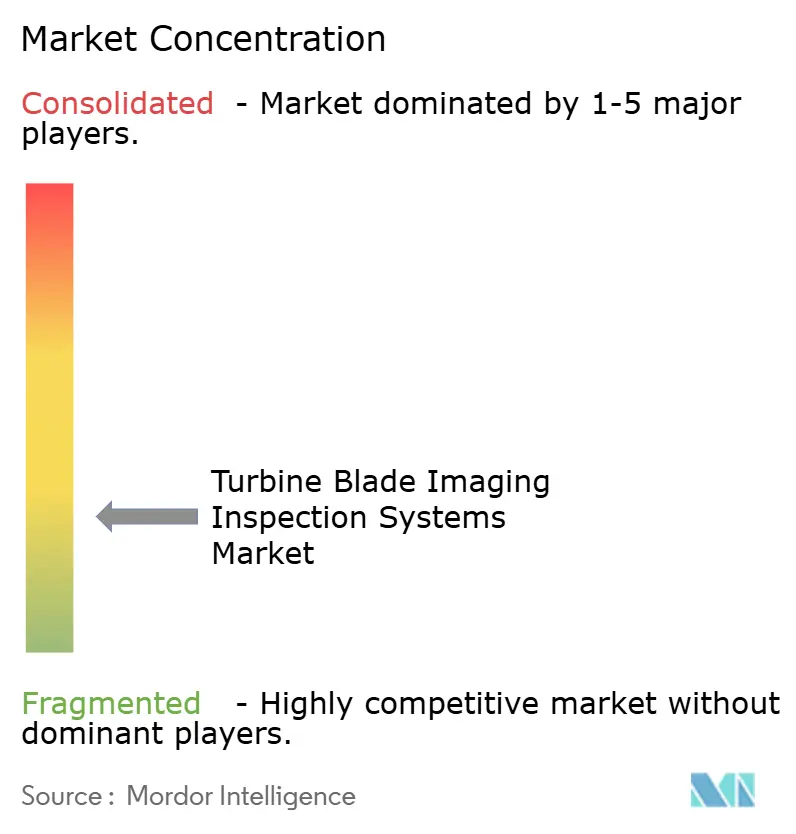
| Market Concentration | Low |
Major Players *Disclaimer: Major Players sorted in no particular order Image © Mordor Intelligence. Reuse requires attribution under CC BY 4.0. | |
Turbine Blade Imaging Inspection Systems Market Analysis by Mordor Intelligence
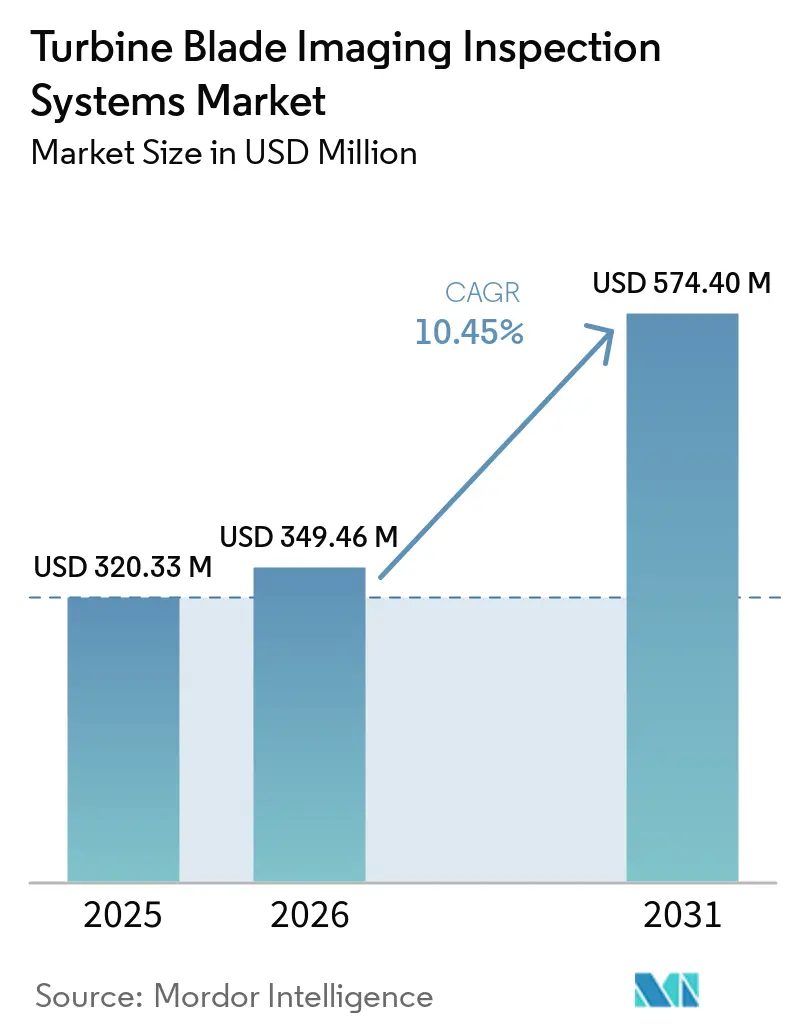
The Turbine Blade Imaging Inspection Systems Market size is expected to increase from USD 320.33 million in 2025 to USD 349.46 million in 2026 and reach USD 574.40 million by 2031, growing at a CAGR of 10.45% over 2026-2031.
Expansion of offshore wind capacity and the aging onshore fleet are increasing the need for certified blade-condition records. More turbines are moving beyond 15 years of operation, which increases the need for repeat inspections before life-extension decisions. Inspection data is becoming important for lender reviews, insurance documentation, and asset-management planning. The turbine blade imaging inspection systems market also benefits when operators replace manual access methods with drone, robotic, and sensor-led approaches. Regulatory requirements for structural integrity and operating authorization will continue to shape service availability and cost through 2031.
Key Report Takeaways
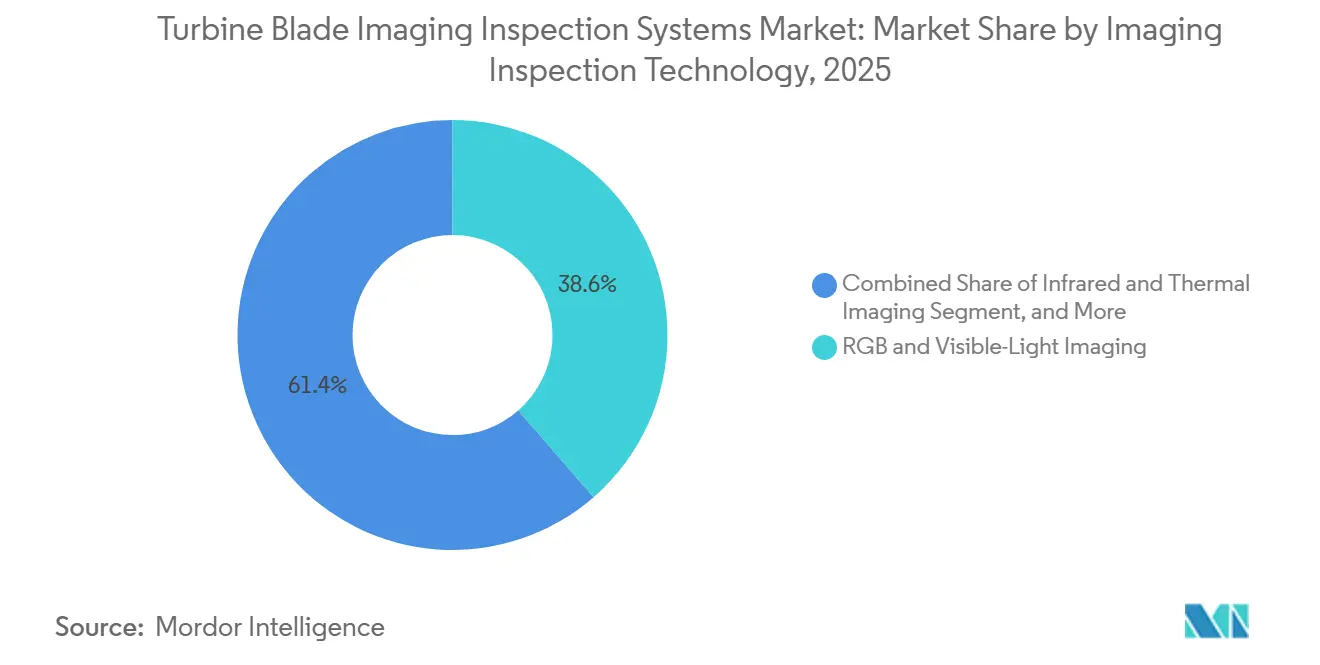
- By imaging/inspection technology, RGB and visible-light imaging held 38.60% share in 2025, while ultrasonic and phased-array inspection is projected to expand at a 13.50% CAGR through 2031.
- By inspection platform, drone-based systems held 46.20% share in 2025, while embedded and continuous monitoring systems are projected to expand at a 13.80% CAGR through 2031.
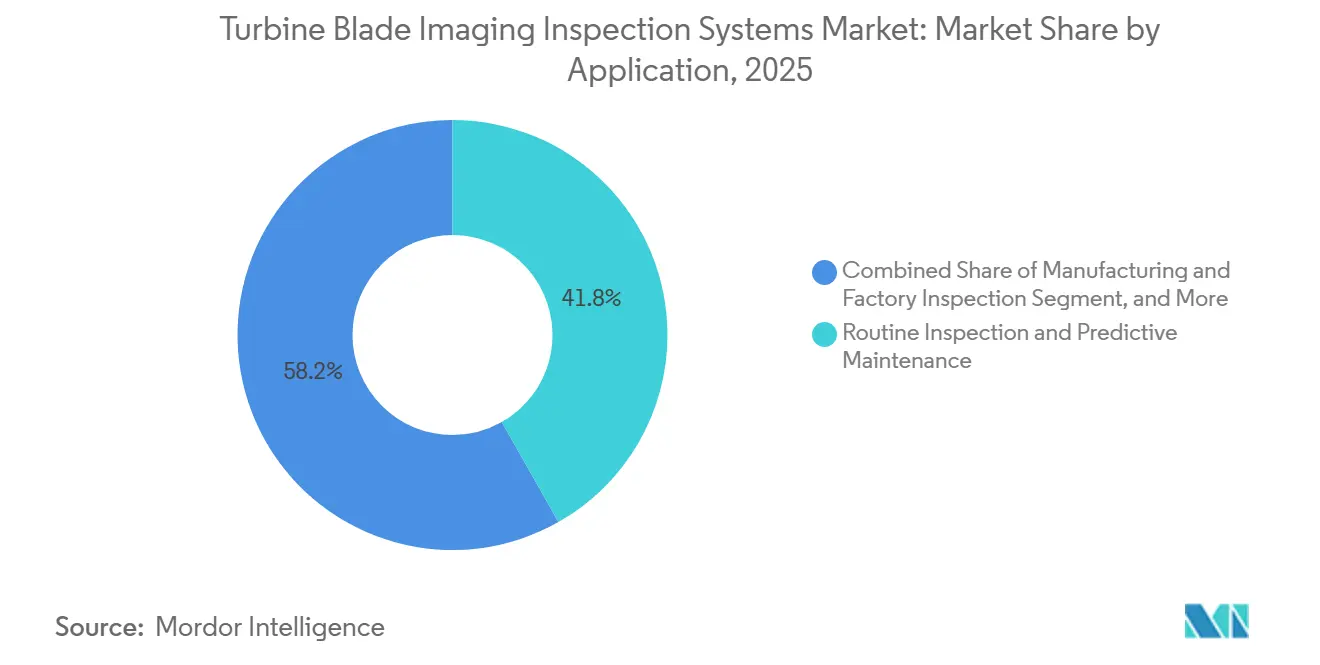
- By application, routine inspection and predictive maintenance held 41.80% share in 2025, while life-extension and repowering assessment is projected to expand at a 14.20% CAGR through 2031.
- By end-user, wind farm owners and operators held 48.50% share in 2025, while insurers and technical due diligence firms are projected to expand at a 12.70% CAGR through 2031.
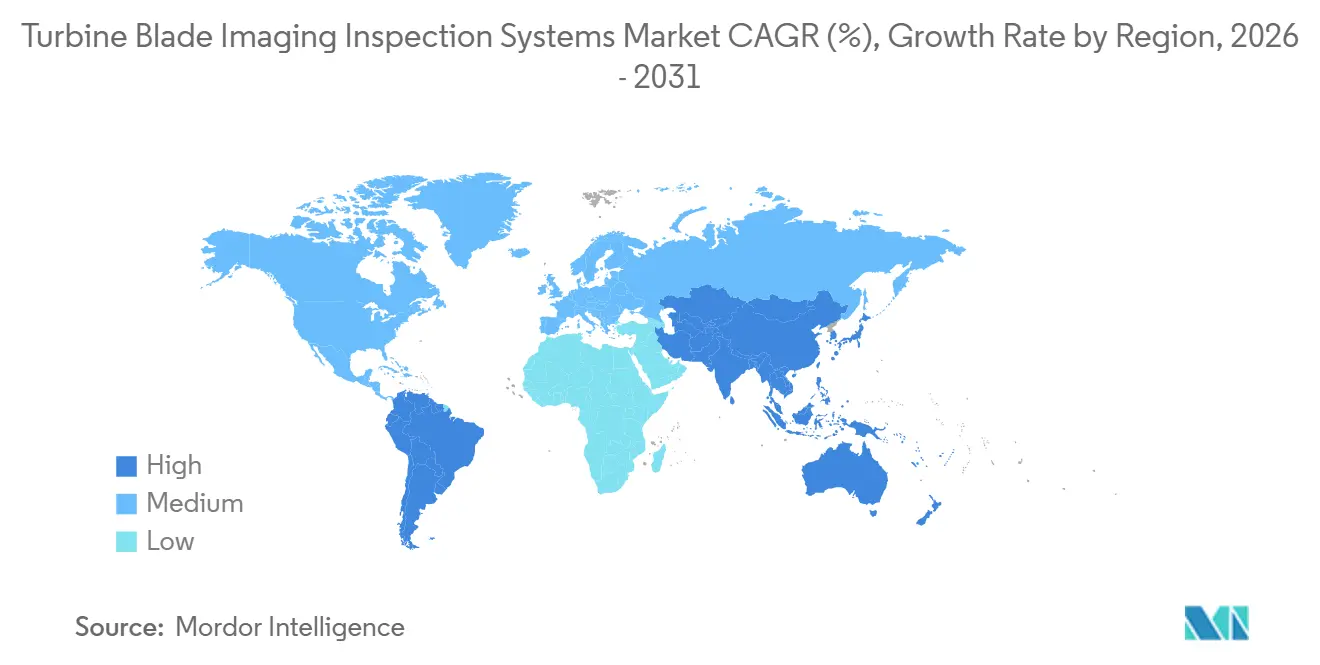
- By geography, Europe held 36.80% of the turbine blade imaging inspection systems market share in 2025, while Asia-Pacific is projected to expand at a 12.60% CAGR through 2031.
Note: Market size and forecast figures in this report are generated using Mordor Intelligence’s proprietary estimation framework, updated with the latest available data and insights as of January 2026.
Global Turbine Blade Imaging Inspection Systems Market Trends and Insights
Aging Turbine Fleets and Life-Extension Programs
The global onshore fleet is reaching a critical stage in its operating life, as a larger portion of turbines moves from routine operation into formal life-extension review. The United States had 25,000 turbines that were at least 15 years old, including 7,500 that were more than 20 years old, demonstrating the scale of the aging asset base. Wind Task 42 projected that the serviceable life-extension opportunity would rise from 33 GW in 2023 to 154 GW by 2033, which means technical reviews will become a more regular part of asset planning.[1]IEA Wind Task 42, “Lifetime Extension Assessment, Annual Report 2024,” IEA Wind, iea-wind.org. Operators need repeatable, defensible blade-condition records instead of a single inspection near the end of design life, because decisions must be supported over an extended operating period. IEC TS 61400-28:2025 requires structured evidence of structural integrity for continued operation beyond design life. The turbine blade imaging inspection systems market is therefore supported by linked decisions involving operators, lenders, insurers, and certification bodies.
Offshore Wind Expansion and Remote Inspection Needs
Offshore projects need remote inspection because vessel access, weather limits, long transit distances, and personnel risk restrict the practical use of manual work. Global offshore wind capacity reached 92.5 GW at the end of 2025 after 9.3 GW of new installations, creating a larger installed base that must be assessed in difficult marine settings. The Global Wind Energy Council expected offshore additions to accelerate during 2026-2030, which will increase the number of assets that need regular condition data. Offshore turbines installed in 2025 exceeded 10.3 MW on average, increasing the inspection scope and the potential consequence of missed blade damage for each asset. Drone and robotic systems can reduce repeated personnel transfers, while providers with BVLOS authorization can offer broader operating coverage and more flexible campaign planning. This supports demand across the turbine blade imaging inspection systems market.
Rising Adoption of Predictive and Condition-Based Maintenance
Condition-based maintenance is replacing fixed inspection calendars in many wind operations because it links maintenance activity to observed asset condition. Drone imaging and continuous monitoring can identify anomalies that require targeted follow-up work instead of treating every turbine in the same way. A monitoring event can therefore create an inspection requirement even when a scheduled annual visit is not due, raising the number of potential inspection touchpoints across the fleet. The embedded and continuous monitoring platform is projected to expand at a 13.80% CAGR through 2031, reflecting the role of persistent data collection in operating decisions. The turbine blade imaging inspection systems market benefits because operators can direct personnel, equipment, and vessel time toward confirmed damage locations. This approach supports better maintenance planning, improves the quality of inspection records, and reduces reliance on general visual reviews alone.
Increasing Blade Size and Composite Design Complexity
Larger blades require broader coverage, more careful measurement, and stronger evidence of internal condition than earlier turbine designs. Dongfang placed 153-meter blades into fatigue testing in 2025 for offshore deployment, illustrating the scale of designs now being prepared for the field. Research in Wind Energy Science reported that blade mass scales close to the 2.4th power of blade radius, which increases internal stresses and the complexity of inspecting large composite structures. A 10% increase in blade length can therefore raise structural mass by 25%. Older protocols designed for 40-60-meter blades may not provide adequate coverage density for newer designs, especially when both external surfaces and internal areas require review. The turbine blade imaging inspection systems market is shifting toward multimodal UAV payloads and internal crawlers that can address those distinct inspection tasks.
Restraints Impact Analysis*
| Restraint | (~) % Impact on CAGR Forecast | Geographic Relevance | Impact Timeline |
|---|---|---|---|
| Weather and Access Constraints for Imaging Platforms | -1.3% | Offshore markets globally, including the North Sea, North Atlantic, and typhoon-exposed Asia-Pacific | Long term (≥ 4 years) |
| Fragmented BVLOS and Automated-Inspection Regulation | -1.1% | Global, most acute in the United States and cross-border European operations | Medium term (2-4 years) |
| High Cost of Multimodal Imaging Hardware and Integration | -0.9% | Emerging wind markets in South America, Africa, and Southeast Asia | Medium term (2-4 years) |
| Proprietary Data Formats and Cybersecurity Exposure | -0.7% | Global, most pronounced in utility-scale and grid-integrated operations | Long term (≥ 4 years) |
| Source: Mordor Intelligence | |||
Weather and Access Constraints for Imaging Platforms
Offshore inspection remains dependent on weather conditions despite improvements in imaging platforms, automation software, and the ability to collect data from a distance. Drone operations in North Sea conditions faced wind-speed exceedances on 30-40% of winter working days, which concentrates available work into more favorable seasons. Robotic crawlers also face adhesion challenges when long blades experience dynamic flex during operation, limiting the conditions in which they can be deployed. Vessel access constraints can shift inspection backlogs to asset owners and can delay a campaign even when equipment and inspectors are available. These factors limit annual inspection throughput even where advanced systems are commercially available and technically capable of completing the work. The turbine blade imaging inspection systems market must therefore account for seasonal scheduling, access uncertainty, and the practical limits of offshore logistics.
Fragmented BVLOS and Automated-Inspection Regulation
Rules for autonomous inspection remain less mature than the technology itself, creating a gap between available flight capability and permitted commercial activity. The FAA published its Part 108 proposed rule for routine BVLOS operations in August 2025.[2]Federal Aviation Administration, “Normalizing Unmanned Aircraft Systems beyond Visual Line of Sight Operations,” Federal Register, federalregister.org. The proposal was under regulatory review during July 2026, and finalization was not expected before late 2027, leaving providers to operate under current limitations in the near term. European cross-border campaigns require separate national authorizations under EU UAV Regulation 2019/947, which adds administrative work and complicates regional deployment schedules. Smaller providers face higher compliance costs when they operate across jurisdictions and may need on-site personnel where autonomous coverage is restricted. The turbine blade imaging inspection systems market remains advantaged for firms that already hold relevant operating permissions and can offer services without the same authorization delay.
*Our forecasts treat driver/restraint impacts as directional, not additive. The impact forecasts reflect baseline growth, mix effects, and variable interactions.
Segment Analysis
By Imaging/Inspection Technology: RGB Leads, While Ultrasound Supports Subsurface Assessment
RGB and visible-light imaging held 38.60% of the turbine blade imaging inspection systems market share in 2025, supported by accessible hardware costs, established drone compatibility, and broad use in visual defect identification. RES Digital Solutions launched Smart Pilot in June 2026 to capture all 3 blades from a single stop with standard DJI hardware, rather than requiring proprietary equipment. The company stated that the software reduced inspection time by 25%, which can support more efficient field activity during limited weather windows.[3]RES Group, “Smart Pilot Enables Automated Blade Inspection with Reduced Downtime in a Single Flight,” RES Group, res-group.com. Infrared and thermal imaging complement visible-light inspection by identifying moisture ingress and delamination that an optical camera may not reveal. Higher-resolution thermal payloads extend the ability to collect reliable images from safer standoff distances.
Ultrasonic and phased-array inspection is projected to expand at a 13.50% CAGR from 2026 to 2031, as surface imaging alone does not provide sufficient evidence for all composite-blade assessments. The technology supports examination of subsurface conditions, which becomes more important where lenders and certification bodies require robust structural records. DNV-GL-ST-0376 and IEC 61400-23 requirements increase the relevance of volumetric inspection data in structural integrity work. A 2026 Scientific Reports study found 98.4% accuracy for a Swin Transformer system used in non-destructive blade surface defect detection. LiDAR, laser profilometry, shearography, and photothermal imaging serve specialized needs in factory acceptance testing, erosion mapping, and traceability programs.



By Inspection Platform: Drones Lead, While Continuous Monitoring Expands
Drone-based systems held 46.20% of the turbine blade imaging inspection systems market share in 2025, making drones the largest established inspection platform. Competition within this platform now depends more on autonomous flight planning, AI-assisted defect classification, and integration with digital twin systems than on basic airframe capability. Aerones released its Gen 3 Crawler in December 2025 for internal blade inspection, adding an option for work inside blade cavities where external drone imaging has limited reach. The crawler had an inspection speed of 20 cm/sec and demonstrated 110 meters of access inside a Siemens Gamesa B115 offshore blade. Together, drone and crawler systems allow service providers to address both exterior conditions and difficult internal locations within one inspection program.
Embedded and continuous monitoring systems are projected to expand at a 13.80% CAGR through 2031, because they create a persistent layer of anomaly detection between scheduled inspection visits. These systems do not displace periodic inspections, but they can direct field teams toward damage locations that need confirmation. An IEEE SIELMEN 2025 study described contactless strain sensors that transmit real-time composite-blade deformation data through edge computing. Ground-based optical and laser systems remain important for factory and commissioning applications, where stable positioning can support detailed measurement. Handheld and rope-access systems are declining as standalone approaches, but they remain useful for targeted maintenance after automated systems flag a potential defect.
By Application: Routine Inspection Leads, While Life Extension Accelerates
Routine inspection and predictive maintenance held 41.80% of the turbine blade imaging inspection systems market size in 2025, reflecting the largest established application base. Operators are moving from annual cycle inspections toward risk-stratified campaigns that use SCADA information and condition signals to prioritize field work. This approach supports recurring revenue while allowing maintenance teams to focus on turbines where available evidence suggests an issue. Manufacturing and factory inspection also creates upstream demand through in-line non-destructive testing and traceable production records. These records can reduce warranty-dispute costs for OEMs and provide a documented starting point for later operating-life assessments.
Life-extension and repowering assessment is projected to expand at a 14.20% CAGR from 2026 to 2031, as owners weigh blade replacement against inspection-supported extension. IEC TS 61400-28:2025 makes structured evidence important when an owner seeks operation beyond the original design life. Warranty and insurance validation also depend on documented inspection history in relevant European frameworks, making records useful beyond the maintenance function. Voliro had deployed its T platform for lightning-protection continuity testing across more than 40 turbine models in over 20 countries by 2025. These requirements extend the turbine blade imaging inspection systems market into financing, compliance, and post-event assessment work.
By End-User: Operators Lead, While Insurers Increase Demand
Wind farm owners and operators held 48.50% of end-user demand in 2025, because they carry the direct operating and financial consequences of unplanned blade damage. Their inspection spending is supported by the need to plan maintenance, preserve generation availability, and document asset condition over time. Credential requirements in European markets direct work toward qualified service providers instead of relying solely on in-house teams. Independent service providers combine NDT equipment, drone systems, and analytics into single inspection programs for OEMs and operators. This integrated offer reduces the number of suppliers that an owner must coordinate and clarifies responsibility for reports, certification, and remediation planning.
Insurers and technical due diligence firms are projected to expand at a 12.70% CAGR from 2026 to 2031, as blade failures become more relevant in energy-asset underwriting. Inspection documentation can support policy issuance, renewal, subsidy approval, claim review, and lender-led technical assessments. This changes blade information from an operating tool into a compliance deliverable that must be maintained and made available when required. OEMs and blade manufacturers use imaging systems mainly during production, where rising blade dimensions increase warranty exposure and the consequences of undetected defects. The turbine blade imaging inspection systems industry serves these different buyers through hardware, data services, and field inspection programs.
Geography Analysis
Europe held 36.80% of the turbine blade imaging inspection systems market share in 2025, the largest share among the regions covered. The region combines a dense offshore wind base, high labor costs that strengthen the case for remote inspection, and established integrity-audit requirements under IEC TS 61400-28:2025 and DNV-GL-ST-0376. Offshore wind capacity in Europe exceeded 38 GW by the end of 2025.[4]Global Wind Energy Council, “Global Wind Installations Rise Record 40% as Industry Charts Way Out of Energy Crisis,” Global Wind Energy Council, gwec.net. Nearly 2 GW was commissioned in the United Kingdom, Germany, and France during 2025. Certified BVLOS providers may benefit as European operating rules evolve for cross-border activity and frequent North Sea campaigns.
North America was the second-largest regional market, supported by the aging U.S. onshore fleet and accelerating Atlantic offshore development. The United States had 25,000 turbines older than 15 years, which creates a substantial base for life-extension and condition assessment work. The proposed FAA Part 108 framework could support longer-range automated campaigns once finalized and reduce the need for on-site support in some settings. South America remains an emerging area for the turbine blade imaging inspection systems market. Cost-sensitive operators in Brazil and Argentina favor drone-as-a-service models over direct equipment purchases and may rely on external providers for specialized hardware.
Asia-Pacific is projected to expand at a 12.60% CAGR through 2031. China and India account for 70-75% of regional demand, supported by large operating fleets and increasing needs for mid-life review. India had a 45 GW wind fleet, with many turbines installed between 2005 and 2015 entering higher blade-risk periods and becoming candidates for repowering decisions. Government-backed repowering programs are creating additional inspection needs, while Saudi Arabia, the United Arab Emirates, South Africa, and Nigeria provide demand from newer utility-scale and operating onshore projects.

Competitive Landscape
The turbine blade imaging inspection systems market is fragmented, with no single player identified as dominant across technology, platform, and geography. Specialized NDT suppliers, aerial and robotic service providers, and industrial imaging companies compete across different parts of the value chain. Eddyfi Technologies and Evident Corporation supply phased-array and ultrasonic hardware, while Aerones Engineering, BladeBUG, and Voliro Airborne Robotics deliver inspection campaigns using proprietary robotic platforms. Hexagon and Teledyne FLIR supply imaging and metrology components that can be integrated into third-party inspection systems. Independent service providers are gaining relevance because owners prefer unified accountability for data quality, report certification, and remediation planning.
Aerones raised USD 62 million from Activate Capital in June 2025 and opened its first U.S. facility in Denton, Texas, in early 2026. The company demonstrated robotic repair and AI-based blade health management at its February 2026 workshop in Denton, showing its focus on a combined inspection and maintenance service. Hexagon extended its Leica Absolute Tracker ATS800 with AI-based FeatureDetect capability in 2026. The system supports automated feature localization and semi-automated measurement for large composite structures, reducing the effort associated with detailed quality checks. These actions show how providers are linking equipment with automated data capture and analysis.
Competition is increasingly based on data quality, auditability, and diagnostic capability rather than equipment alone. A Scientific Reports study published in 2026 supported the use of transformer-based systems for blade-defect detection. Standards-aligned data formats and approved BVLOS operations are becoming practical procurement considerations, especially where site access is difficult. Smaller providers may find it harder to match proprietary software, integrated field capability, and compliance coverage.
Turbine Blade Imaging Inspection Systems Industry Leaders
Baker Hughes Company
Carl Zeiss AG
DJI Technology Co., Ltd.
Hexagon AB
Flyability SA
- *Disclaimer: Major Players sorted in no particular order

Recent Industry Developments
- June 2026: RES Digital Solutions launched Smart Pilot, a blade inspection automation software enabling single-stop inspection of all 3 blades using standard DJI hardware, reducing inspection time by 25% compared to conventional multi-stop methods and requiring no proprietary equipment.
- April 2026: Hexagon's Manufacturing Intelligence division expanded the AI-based FeatureDetect capability of its Leica Absolute Tracker ATS800, launched in 2025, enabling automated bolt-hole localization and semi-automated blade surface measurement during wind turbine manufacturing inspection, reducing cycle time from multiple days to hours for large composite structures.
- June 2025: Aerones raised USD 62 million from Activate Capital, bringing total cumulative funding to USD 175.2 million, to expand its robotic wind turbine inspection and maintenance fleet and international service center footprint.


Global Turbine Blade Imaging Inspection Systems Market Report Scope
Turbine Blade Imaging Inspection Systems are advanced, automated technologies used to detect internal and external defects in turbine blades, such as cracks, erosion, and thermal coating degradation, without damaging the component. These systems are critical for ensuring safety and operational efficiency in the aerospace and energy sectors.
The Turbine Blade Imaging Inspection Systems Market Report is Segmented by Imaging/Inspection Technology (RGB and Visible-Light Imaging, Infrared and Thermal Imaging, Ultrasonic and Phased-Array Inspection, LiDAR and Laser Profilometry, and Shearography and Photothermal Imaging), Inspection Platform (Drone-Based Systems, Robotic and Automated Crawling Systems, Ground-Based Optical and Laser Systems, Handheld and Rope-Access Systems, and Embedded and Continuous Monitoring Systems), Application (Manufacturing and Factory Inspection, Installation and Commissioning Inspection, Routine Inspection and Predictive Maintenance, Lightning, Storm, and Impact Damage Assessment, Warranty and Insurance Claim Validation, Life-Extension and Repowering Assessment, and Other Applications), End-User (Wind Turbine OEMs and Blade Manufacturers, Wind Farm Owners and Operators, Independent Service Providers, Insurers and Technical Due Diligence Firms, and Other End-Users), and Geography (North America, Europe, Asia-Pacific, Middle East, and Africa). The Market Forecasts are Provided in Terms of Value (USD).
| RGB and Visible-Light Imaging |
| Infrared and Thermal Imaging |
| Ultrasonic and Phased-Array Inspection |
| LiDAR and Laser Profilometry |
| Shearography and Photothermal Imaging |
| Drone-Based Systems |
| Robotic and Automated Crawling Systems |
| Ground-Based Optical and Laser Systems |
| Handheld and Rope-Access Systems |
| Embedded and Continuous Monitoring Systems |
| Manufacturing and Factory Inspection |
| Installation and Commissioning Inspection |
| Routine Inspection and Predictive Maintenance |
| Lightning, Storm, and Impact Damage Assessment |
| Warranty and Insurance Claim Validation |
| Life-Extension and Repowering Assessment |
| Other Applications |
| Wind Turbine OEMs and Blade Manufacturers |
| Wind Farm Owners and Operators |
| Independent Service Providers |
| Insurers and Technical Due Diligence Firms |
| Other End-Users |
| North America | United States |
| Canada | |
| Mexico | |
| South America | Brazil |
| Argentina | |
| Rest of South America | |
| Europe | Germany |
| United Kingdom | |
| France | |
| Italy | |
| Spain | |
| Rest of Europe | |
| Asia-Pacific | China |
| Japan | |
| India | |
| South Korea | |
| ASEAN | |
| Rest of Asia-Pacific | |
| Middle East | Saudi Arabia |
| United Arab Emirates | |
| Turkey | |
| Rest of the Middle East | |
| Africa | South Africa |
| Nigeria | |
| Rest of Africa |
| By Imaging/Inspection Technology | RGB and Visible-Light Imaging | |
| Infrared and Thermal Imaging | ||
| Ultrasonic and Phased-Array Inspection | ||
| LiDAR and Laser Profilometry | ||
| Shearography and Photothermal Imaging | ||
| By Inspection Platform | Drone-Based Systems | |
| Robotic and Automated Crawling Systems | ||
| Ground-Based Optical and Laser Systems | ||
| Handheld and Rope-Access Systems | ||
| Embedded and Continuous Monitoring Systems | ||
| By Application | Manufacturing and Factory Inspection | |
| Installation and Commissioning Inspection | ||
| Routine Inspection and Predictive Maintenance | ||
| Lightning, Storm, and Impact Damage Assessment | ||
| Warranty and Insurance Claim Validation | ||
| Life-Extension and Repowering Assessment | ||
| Other Applications | ||
| By End-User | Wind Turbine OEMs and Blade Manufacturers | |
| Wind Farm Owners and Operators | ||
| Independent Service Providers | ||
| Insurers and Technical Due Diligence Firms | ||
| Other End-Users | ||
| By Geography | North America | United States |
| Canada | ||
| Mexico | ||
| South America | Brazil | |
| Argentina | ||
| Rest of South America | ||
| Europe | Germany | |
| United Kingdom | ||
| France | ||
| Italy | ||
| Spain | ||
| Rest of Europe | ||
| Asia-Pacific | China | |
| Japan | ||
| India | ||
| South Korea | ||
| ASEAN | ||
| Rest of Asia-Pacific | ||
| Middle East | Saudi Arabia | |
| United Arab Emirates | ||
| Turkey | ||
| Rest of the Middle East | ||
| Africa | South Africa | |
| Nigeria | ||
| Rest of Africa | ||


Key Questions Answered in the Report
What is the size of the turbine blade imaging inspection systems market?
The market was valued at USD 320.33 million in 2025 and stands at USD 349.46 million in 2026. It is forecast to reach USD 574.40 million by 2031.
What is driving demand for turbine blade inspection systems?
Aging turbines, life-extension programs, offshore projects, and condition-based maintenance are increasing the need for documented blade-condition data.
Which inspection technology led in 2025?
RGB and visible-light imaging led with 38.60% share because it works with accessible drone hardware and supports software-led analysis.
Which platform is expanding fastest through 2031?
Embedded and continuous monitoring systems are projected to expand at a 13.80% CAGR because they identify anomalies that need targeted inspection.
Which region offers the strongest growth outlook?
Asia-Pacific is projected to expand at a 12.60% CAGR through 2031, supported by demand in China and India.
Why are insurers using blade inspection data?
Insurers and due diligence firms use documented blade condition to support underwriting, policy renewal, claim validation, and asset reviews.
Page last updated on:





