
Tugboats Market Size and Share
Market Overview
| Study Period | 2020 - 2032 |
|---|---|
| Market Size (2027) | USD 4.31 Billion |
| Market Size (2032) | USD 5.21 Billion |
| Growth Rate (2027 - 2032) | 3.87 % |
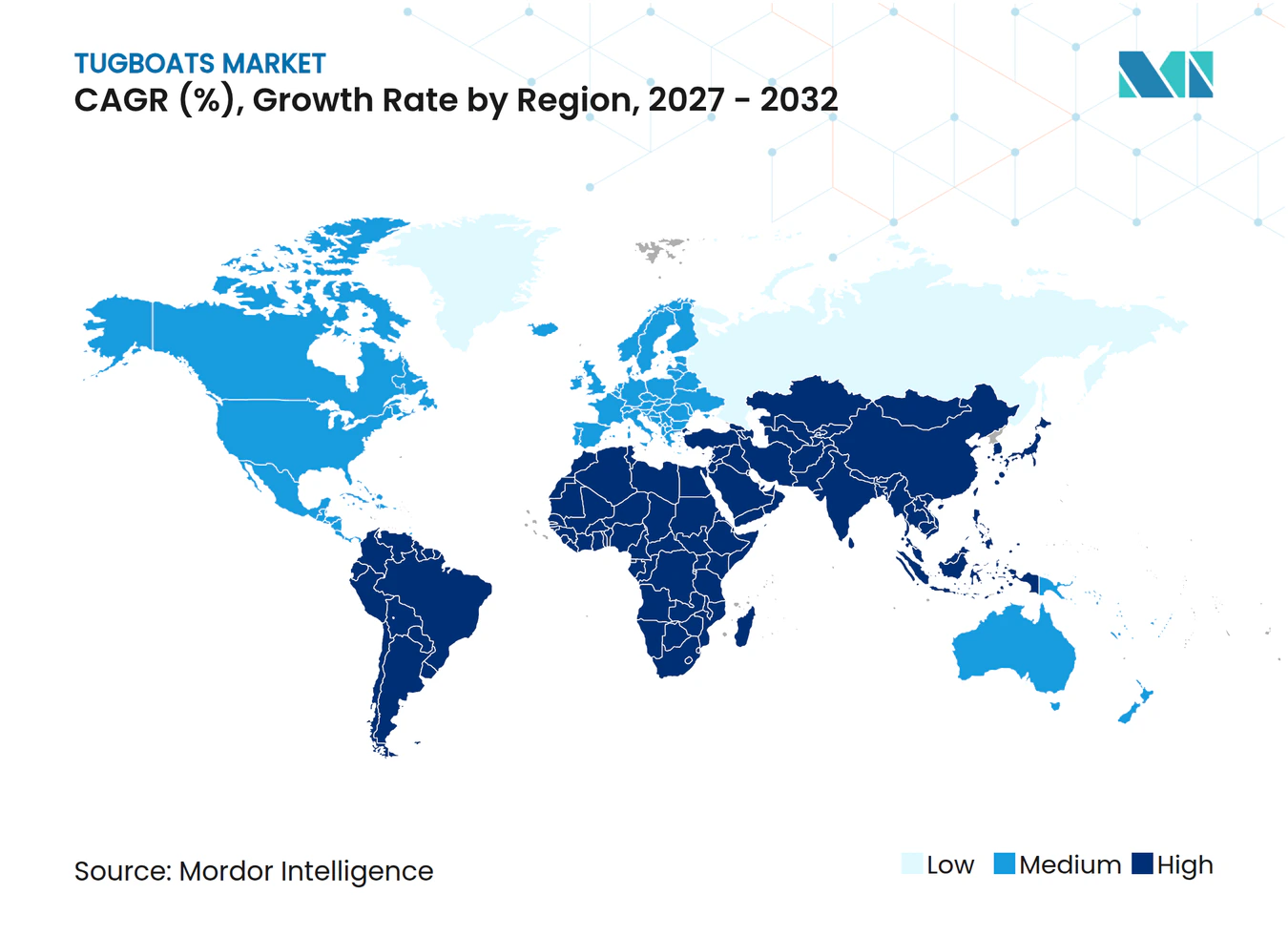
| Fastest Growing Market | Middle East and Africa |
| Largest Market | Asia-Pacific |
| Market Concentration | Medium |
Major Players *Disclaimer: Major Players sorted in no particular order Image © Mordor Intelligence. Reuse requires attribution under CC BY 4.0. | |
Tugboats Market Analysis by Mordor Intelligence
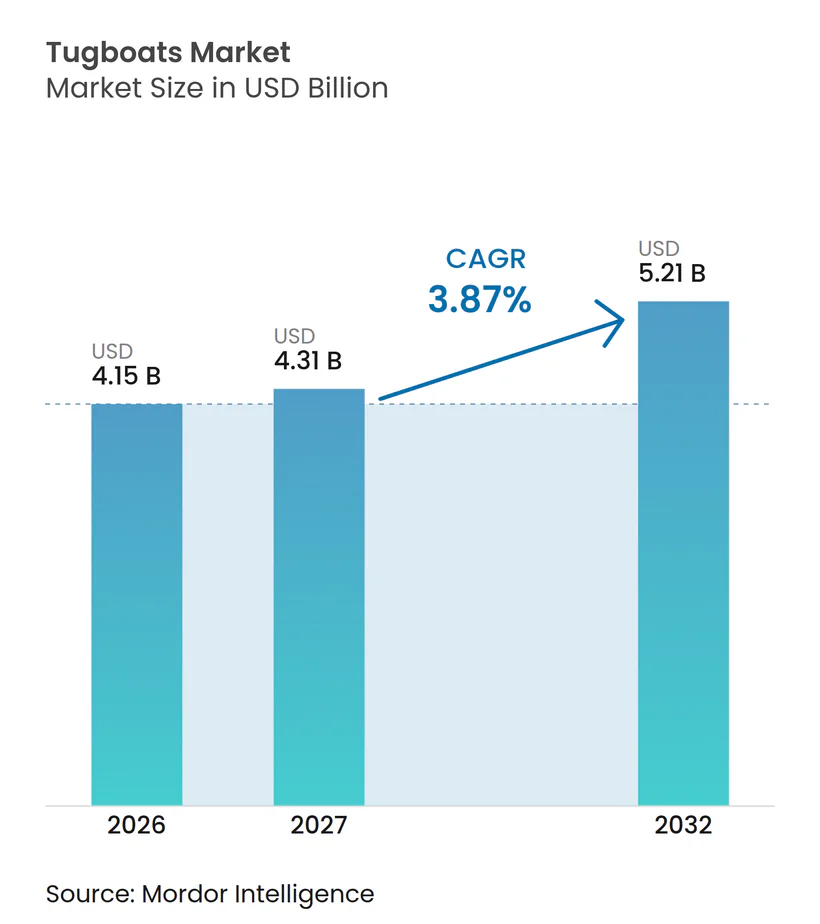
The tugboats market size was valued at USD 4.15 billion in 2026 and is expected to grow from USD 4.31 billion in 2027 to USD 5.21 billion by 2032, at a CAGR of 3.87% during 2027-2032. The tugboats market is supported by larger commercial vessels, which require higher bollard pull and more tugs for safe harbor maneuvers. Replacement demand also remains important because many operating vessels were built several decades ago and face tighter emissions requirements. Port procurement is moving toward hybrid, battery-electric, and alternative-fuel vessels, particularly where charging or bunkering systems are available. Shipyards and towage operators are balancing those requirements against high newbuild costs, equipment lead times, and limited specialist crews. The tugboats market therefore has opportunities in high-power harbor vessels, offshore support vessels, and practical retrofit solutions.
Key Report Takeaways
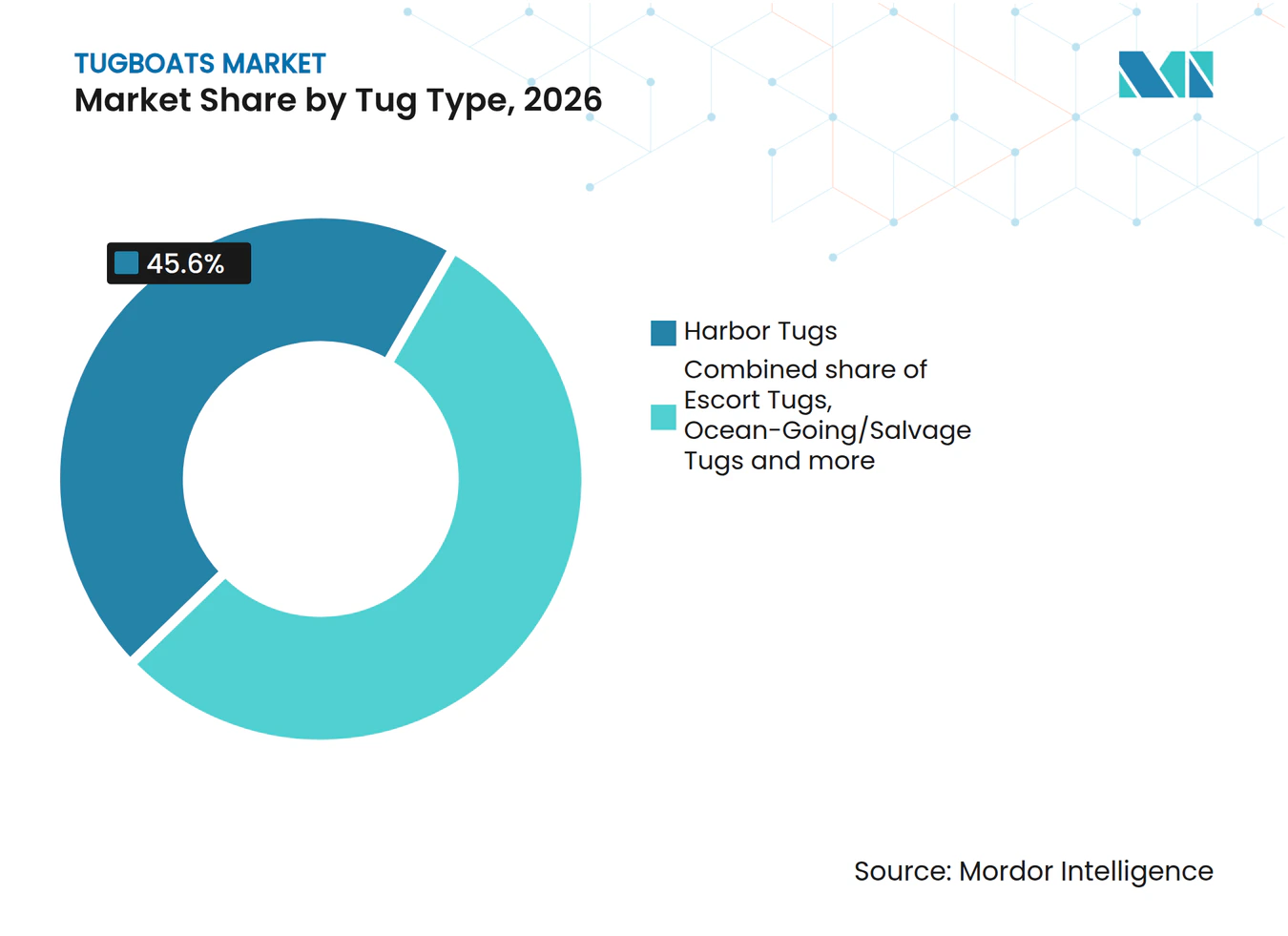
- By tug type, harbor tugs held a 45.60% share in 2026, while ocean-going and salvage tugs are projected to grow at a 6.67% CAGR through 2032.
- By drive type, azimuth stern drive held a 61.80% share in 2026, while tractor tugs are projected to grow at a 6.58% CAGR through 2032.
- By power source, diesel held an 87.23% share in 2026, while hybrid and battery-electric systems are projected to grow at an 8.79% CAGR through 2032.
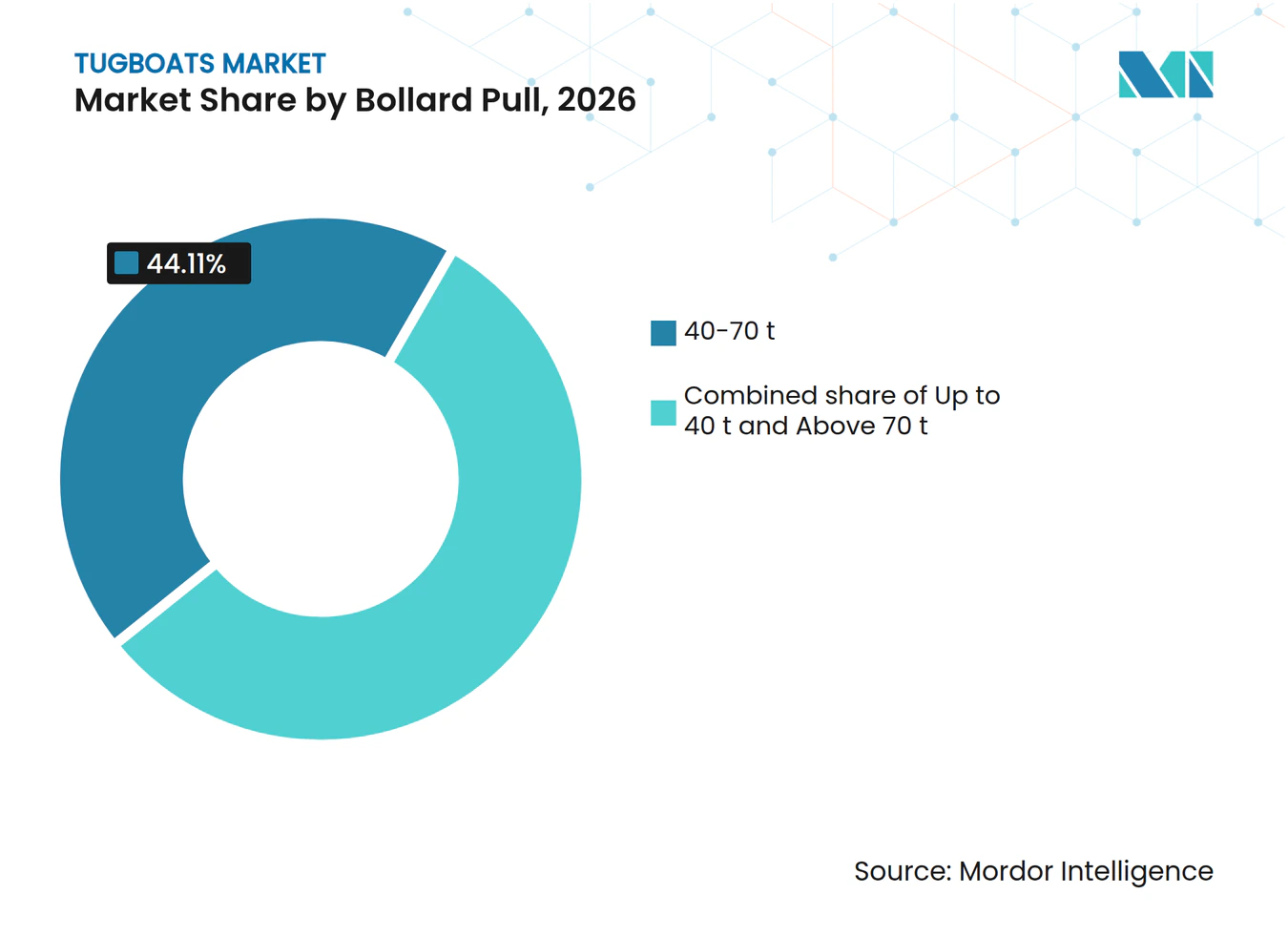
- By bollard pull, the 40–70 t range held a 44.11% share in 2026, while vessels above 70 t are projected to grow at a 6.89% CAGR through 2032.
- By activity, newbuild held an 81.50% share in 2026, while retrofit and repowering are projected to grow at a 7.40% CAGR through 2032.
- By application, port and harbor operations held a 54.31% share in 2026, while offshore oil and gas is projected to grow at a 6.37% CAGR through 2032.
- By geography, Asia-Pacific held a 41.70% share in 2026, while the Middle East and Africa is projected to grow at a 6.85% CAGR through 2032.
Note: Market numbers in this report are based on Mordor Intelligence's proprietary estimation framework, which combines nine months of actuals with Q4 projections for base year 2026.
Market Trends and Insights
Drivers Impact Analysis of Tugboats Market*
| Driver | (~) % Impact on CAGR Forecast | Geographic Relevance | Impact Timeline |
|---|---|---|---|
| Growth in Port Calls and Larger Vessel Sizes | +1.2% | Global, strongest in East Asia and Southeast Asia | Short term (≤ 2 years) |
| Fleet Renewal Driven by Aging Harbor Tugs | +0.9% | Global, concentrated in the United States, Europe, and Southeast Asia | Medium term (2–4 years) |
| Port Decarbonization and Zero-Emission Procurement | +0.7% | Northern Europe, North America, East Asia | Medium term (2–4 years) |
| Retrofit Demand for Hybrid Propulsion and Emissions Compliance | +0.6% | European Union ports, the West Coast of the United States, United Arab Emirates, and Singapore | Short term (≤ 2 years) |
| Expansion of Offshore Wind and Offshore Energy Support | +0.5% | Northern Europe, Asia-Pacific, and the East Coast of the United States | Long term (≥ 4 years) |
| High-Bollard-Pull Requirements for LNG and Large-Vessel Terminals | +0.4% | Middle East, Western Canada, East Australia, and West Africa | Medium term (2–4 years) |
| Source: Mordor Intelligence | |||
Growth in Port Calls and Larger Vessel Sizes
The tugboats market benefits when terminals receive larger container ships, tankers, and bulk carriers. These vessels can require multiple tugs simultaneously during berthing, unberthing, and escort operations. Their operating profile increases the required bollard pull and limits ports' ability to rely on smaller legacy vessels. This supports demand for higher-specification harbor tugs and creates stronger utilization for established towage operators. Svitzer commissioned the 81-tonne bollard-pull TRAnsverse 3200 at Newcastle, Australia, for demanding ship-handling and adverse weather conditions. The vessel illustrates how fleet planning is increasingly linked to anticipated vessel calls rather than only current traffic levels.
Fleet Renewal Driven by Aging Harbor Tugs
The tugboats market has a replacement base, as older vessels remain active across many regional fleets. Operators must evaluate the cost of upgrading existing hulls against the extended service life and compliance benefits offered by new vessels. PEMFC-battery hybrid systems can offer technical and economic advantages for port-vessel retrofits. Marine Group Boat Works completed a battery-electric conversion of the yard tug Marco V, demonstrating the viability of conversions when vessel specifications and operating cycles are suitable. However, retrofit demand is likely to remain selective, as complex propulsion systems require significant capital investment, yard time, and trained crews. Therefore, the tugboats market can support both replacement newbuilds and targeted upgrades rather than a single fleet-transition pathway.
Port Decarbonization and Zero-Emission Procurement
Port authorities are influencing tug specifications through concession terms and fleet procurement rules. The International Maritime Organization adopted draft net-zero measures in April 2025 that combine a marine fuel standard with a greenhouse gas pricing mechanism. These rules add direction to the wider shift toward lower-emission harbor activity. Port of Antwerp-Bruges launched Volta 1 in May 2025 as Europe’s first fully electric tug and reported a 2,782 kWh battery system, 70 t bollard pull, and a two-hour charging cycle. Such procurement favors builders that can integrate batteries, charging interfaces, and established tug designs. It also creates an opening for suppliers of power electronics, shore connections, and maintenance services.
Expansion of Offshore Wind and Offshore Energy Support
Demand for ocean-going tugs is rising alongside offshore energy projects that require towing, escort, anchor handling, and emergency response capabilities. These assignments typically extend beyond port limits and favor dedicated vessels with high bollard pull and endurance. In July 2025, KOTUG International deployed RAstar 3200 tugs SD Rosso and SD Chatboul to Senegal to support LNG and marine operations at the Greater Tortue Ahmeyim project [1]. Large-vessel terminals also require capable escort tugs for LNG carriers and other specialized calls. This demand supports a wider range of vessel specifications than conventional harbor work alone and increases the value of design expertise that combines escort performance, towing stability, and low-emission propulsion.
Restraints Impact Analysis of Tugboats Market*
| Restraint | (~) % Impact on CAGR Forecast | Geographic Relevance | Impact Timeline |
|---|---|---|---|
| High Newbuild and Retrofit Capital Costs | -0.7% | Global, acute in the United States and Western Europe | Short term (≤ 2 years) |
| Limited Port Charging and Alternative-Fuel Infrastructure | -0.5% | Developing Asia-Pacific ports, Sub-Saharan Africa, and South America | Medium term (2–4 years) |
| Volatile Shipyard Capacity, Equipment Lead Times, and Marine Financing Conditions | -0.4% | Global | Short term (≤ 2 years) |
| Shortage of Specialized Crews for Advanced Propulsion Systems | -0.3% | Global, most acute in South and Southeast Asia | Long term (≥ 4 years) |
| Source: Mordor Intelligence | |||
High Newbuild and Retrofit Capital Costs
Capital costs constrain the pace at which smaller operators can replace older vessels. Modern tug specifications require investment in engines, propulsion packages, battery systems, charging equipment, and emissions controls. In September 2025, Arc Boat Company and Curtin Maritime signed a USD 160 million contract for eight hybrid-electric ship-assist tugboats, with the first four committed for delivery before the end of 2027. Operators with long-term port contracts and strong financing access are better positioned to support investments at this scale. Smaller fleets may retain diesel vessels longer when contracts do not clearly account for higher capital costs. This creates a divided adoption pattern across the tugboats market.
Limited Port Charging and Alternative-Fuel Infrastructure
Electric and alternative-fuel tugs depend on infrastructure that is not available at every port. Volta 1 relies on a 1.5 MW shore connection, which illustrates the dedicated charging capacity required for high-duty harbor operations. Methanol and other fuels also need reliable supply arrangements across a vessel’s operating route. The technical change increases training needs for crews, maintenance teams, and port staff. The International Maritime Organization’s emissions framework provides a common policy direction, but local readiness still determines adoption timing. These limits may keep advanced vessels concentrated in prepared ports during the early years of the forecast period.
*Our forecasts treat driver/restraint impacts as directional, not additive. The impact forecasts reflect baseline growth, mix effects, and variable interactions.
Tugboats Market Segment Analysis
By Tug Type:
Harbor Work Supports Volume While Ocean-Going Assignments ExpandHarbor tugs accounted for 45.60% of the tugboats market share in 2026, driven by consistent demand for berthing, shifting, and departure support associated with port calls. Large container and bulk terminals require reliable tug availability throughout continuous operating cycles. The segment benefits from limited substitution options, as smaller or less capable vessels cannot perform high-risk maneuvers. Harbor operations also provide a stable demand base for vessel builders, as many ports renew their fleets through long-term service contracts. Escort tugs serve a related function at LNG terminals, in narrow passages, and along environmentally sensitive routes that require high maneuverability. Pusher tugs and towboats continue to see demand in inland logistics systems, particularly for bulk cargo transportation on rivers and protected waterways. Specialty and naval-support tugs generate smaller but significant demand from government and defense buyers.
Ocean-going and salvage tugs are forecast to expand at a CAGR of 6.67% through 2032, outpacing other tug types. Offshore energy development supports demand in this category, as vessel positioning, wet towage, and emergency support operations extend beyond conventional harbor limits. Longer contract durations than those for standard harbor assignments further support the tugboats market size for ocean-going and salvage operations. KOTUG’s deployment of two purpose-built tugs for Senegal’s GTA field demonstrates the need for specialist vessels in offshore locations. These vessels must combine bollard pull, endurance, and reliable towing equipment. Floating wind developments may create additional demand for high-capacity towing services, as projects require the offshore transportation of large structures. However, this category may remain more cyclical than harbor operations because it depends on the timing of energy and infrastructure projects. The higher projected growth rate for ocean-going and salvage tugs broadens the revenue base for specialized tug designers and operators in the tugboats market.



By Drive Type:
ASD Remains the Mainstream Choice While Tractor Tugs Serve Complex WorkAzimuth stern drive (ASD) held a 61.80% revenue share in 2026, giving it the largest position within the tugboats market. The configuration is widely used because it delivers maneuverability and can be applied across harbor, escort, and coastal assignments. Its established supplier base also supports maintenance access across a broad range of ports. The format suits operators that need a flexible vessel rather than a design optimized for a single task. Damen's partnership with AAAPropulsion, announced in September 2025, applies the A-Pod azimuthing thruster with a submerged electric motor to electric tug designs. This development indicates that ASD technology continues to evolve alongside electrification. Conventional propeller systems retain a place in older inland and river fleets where replacement budgets are limited. Their installed base will support maintenance and gradual upgrades even as new orders favor more maneuverable systems.
Tractor tugs are forecast to grow at a 6.58% CAGR through 2032, driven by operations that require strong transverse force and precise control. These vessels are well suited to escort and terminal operations where independent steering and braking performance are important. Demand for tractor designs is supported by LNG infrastructure development and other complex ship-handling assignments. Operators deploy them where the operational consequences of a loss of control are high. Their specialized propulsion arrangements can carry higher acquisition and maintenance costs than mainstream ASD vessels. This can limit adoption at smaller ports even where the performance benefits are recognized. The format is therefore likely to grow most strongly in premium applications with formal operating standards. It also gives shipyards an opportunity to compete through design capability rather than construction cost alone.
By Power Source:
Diesel Dominates the Operating Base While Electrified Newbuilds AdvanceDiesel accounted for 87.23% of revenue in 2026, reflecting the large installed fleet operating worldwide. Many operators continue to select diesel-powered vessels where fuel availability, repair capabilities, and capital budgets favor established technology. Diesel vessels also remain practical for long operating rotations and smaller ports that lack high-capacity shore power. However, procurement priorities are evolving. The International Maritime Organization’s Net-Zero Framework, approved in draft in April 2025 and now targeted for adoption at MEPC 85 in December 2026, is expected to reinforce the shift toward lower greenhouse gas emissions in shipping. The Canadian Arctic Emission Control Area, which entered into force under MARPOL Annex VI in March 2026, adds compliance pressure for newbuilds and vessel upgrades operating in Canadian waters. The immediate outcome will likely be a prolonged transition, during which diesel remains widely used alongside cleaner engines, aftertreatment systems, and hybrid support. Operators in the tugboats market must therefore manage their existing fleets while developing lower-emission vessel options.
Hybrid and battery-electric systems are projected to grow at a CAGR of 8.79% through 2032, the highest growth rate among power sources. Their adoption is strongest in ports with predictable duty cycles and charging-supportive shore infrastructure. The hybrid and battery-electric tugboats market is supported by operator interest in fuel savings, lower local emissions, and quieter port operations. Hybrid tug propulsion can reduce annual fuel consumption and operating costs in suitable port operations. The Port of Antwerp-Bruges provides a practical example through Volta 1 and its 2,782 kWh battery configuration. Methanol and LNG can support operations on routes where fully electric propulsion is not yet feasible. Adoption will depend on port charging infrastructure, fuel availability, crew training, and the ability of contracts to recover higher capital costs.
By Bollard Pull:
Mid-Range Vessels Lead Current Demand While Heavy-Pull Vessels Gain GroundThe 40–70 t range accounted for 44.11% of revenue in 2026, representing the broad middle of the tugboats market. This capacity range is suitable for a wide range of harbor and coastal assignments involving container vessels, tankers, and bulk carriers. It balances handling capability, vessel size, and operating costs. Ports deploy tugboats in this range to meet routine traffic requirements without incurring the higher costs associated with the largest escort vessels. Continued investment in established terminals and secondary ports supports the segment. It also benefits from replacing aging harbor fleets with vessels that comply with current safety and emissions requirements. Builders can offer standardized designs in this range, reducing delivery risk and supporting fleet commonality. These factors position mid-range capacity as a core requirement across both mature and developing port systems.
Vessels above 70 t are forecast to expand at a CAGR of 6.89% through 2032. The growing size of vessels and the development of specialized terminals are increasing the need for higher bollard pull in escort and harbor operations. This range is expected to benefit from demand at ports handling ultra-large container vessels, LNG carriers, and complex offshore assignments. In April 2026, Sanmar and Med Tugs agreed on the construction of an 80 t RAstar 2900SX and a 90 t RAstar 3200SX for operations at the Port of Piraeus. This order demonstrates the ongoing procurement of heavy-pull tugboats for large, operationally demanding ports. These vessels typically require higher capital expenditure and operators with clearly defined utilization plans. Consequently, demand is likely to remain concentrated among leading port hubs, energy terminals, and offshore service providers. The up-to-40 t category remains relevant for inland, river, and constrained coastal operations, where larger vessels cannot operate efficiently.

By Activity:
Newbuilds Lead Spending While Retrofit Work Addresses Selected Fleet NeedsNewbuild activity accounted for 81.50% of revenue in 2026, making it the largest activity segment. New vessels are favored where existing hulls cannot meet new safety, power, or emissions requirements at an acceptable cost. They also provide the opportunity to integrate batteries, alternative fuels, digital controls, and modern propulsion at the design stage. This is important for operators entering long concessions or serving ports with formal decarbonization plans. The tugboats market benefits from newbuild demand because each order supports shipyards, equipment suppliers, and service partners. Damen, Sanmar, Med Marine, and other specialist builders compete on proven designs and their ability to tailor vessels to local operating conditions. Newbuild decisions are often linked to long-term contracts, which provide demand visibility when financing can be secured. High capital requirements remain the principal limit on broader adoption.
Retrofit and repowering are forecast to grow at a 7.40% CAGR through 2032. This activity allows suitable mid-life vessels to improve emissions performance without immediate replacement. Retrofit demand is shaped by hull condition, expected service life, engine-room space, and the reliability of the operating schedule. Advanced retrofit power systems can offer workable technical and economic pathways for port vessels. Marine Group Boat Works converted the Marco V to battery-electric propulsion in May 2025, demonstrating a full conversion approach for a defined operating case. Retrofits are not a universal substitute for newbuilds because major conversions can be complex and expensive. They are most attractive where operators have viable hulls, known duty cycles, and accessible technical support. The segment offers shipyards and technology companies an additional route to serve aging fleets.
By Application:
Port Operations Provide the Base While Offshore Work Adds GrowthPort and harbor operations accounted for 54.31% of revenue in 2026 and remain the core application for tug services. These operations depend on vessel traffic, berth activity, pilotage practices, and local safety regulations. Regular ship movements support predictable tug schedules at container, bulk, and energy terminals. The tugboats market share of this application reflects the essential role of assisted maneuvering in busy ports. Larger commercial vessels increase the need for adequate bollard pull and standby capacity. Port operators also use towage contracts to enforce stricter requirements for emissions, performance, and crew competence. These factors support demand for replacements and newbuilds even where total port volumes remain stable. The application remains the principal source of recurring operator revenues.
Offshore oil and gas is forecast to grow at a 6.37% CAGR through 2032. Deepwater projects create demand for towing, positioning, escort, and emergency support beyond conventional harbor service. The tugboats market benefits from this application because assignments often require powerful, specialized vessels with long endurance. KOTUG's 2025 assignment of two RAstar 3200 tugs to Senegal for LNG operations illustrates the link between offshore infrastructure and specialist towage demand. Coastal and inland towing continues to serve commodity logistics and local transport networks. Salvage and naval applications add demand where governments and port authorities require response capability. Offshore work can be sensitive to project schedules and energy investment decisions, but it provides a higher-growth opportunity for operators that can maintain suitably capable fleets.
Geography Analysis
Asia-Pacific
Asia-Pacific held a 41.70% revenue share in 2026, making it the largest regional market in the tugboats market. The region has a dense network of container hubs, bulk terminals, island routes, and industrial ports. These conditions support demand for harbor assistance, coastal towing, and specialized vessel operations. China, South Korea, Japan, India, and Southeast Asian countries all have active shipbuilding and port systems. South Korea introduced the Meta 7 hybrid-electric tug at Busan in January 2025 as part of a move toward lower-emission port operations. China also delivered an all-electric tug in 2025, indicating continued investment in electric marine equipment. The regional mix supports both standardized ASD harbor tugs and more specialized offshore vessels. Government support for domestic shipbuilding can further strengthen local supply capability. Indonesia and other archipelagic markets have additional towing needs beyond major terminal work. The size and diversity of the Asia-Pacific make it important for both fleet volume and propulsion experimentation.
Middle East and Africa
The Middle East and Africa is forecast to grow at a 6.85% CAGR through 2032, the fastest regional rate. LNG terminals, offshore oil and gas activity, and port concessions are increasing demand for high-capacity harbor and escort fleets. Boluda Towage and Marsa Maroc committed to a 20-year towage concession at Nador West Med in April 2025, while DP World began operations at Tartus Port in November 2025 after a formal handover. Domestic vessel construction in Egypt can support local industrial capability, while major hubs need vessels suited to high-temperature conditions and growing LNG traffic. Infrastructure and financing will determine how quickly lower-emission configurations spread beyond major hubs.
North America, Europe, and South America
North America maintains a protected domestic construction base for many U.S. towing vessels, while ports in California are adopting advanced propulsion technologies. Arc’s USD 160 million contract with Long Beach-based Curtin Maritime for eight hybrid-electric tugboats supports zero-emission ship-assist capacity at U.S. ports. Europe prioritizes emissions compliance, battery systems, and alternative-fuel capabilities, as reflected in Fairplay Towage’s order for four LNG-compatible, IMO Tier III-compliant Damen tugboats. South America is developing through port expansion and commodity trade, while International Maritime Organization and European Union fuel regulations continue to influence fleet planning across these diverse markets.
Competitive Landscape
Market Concentration
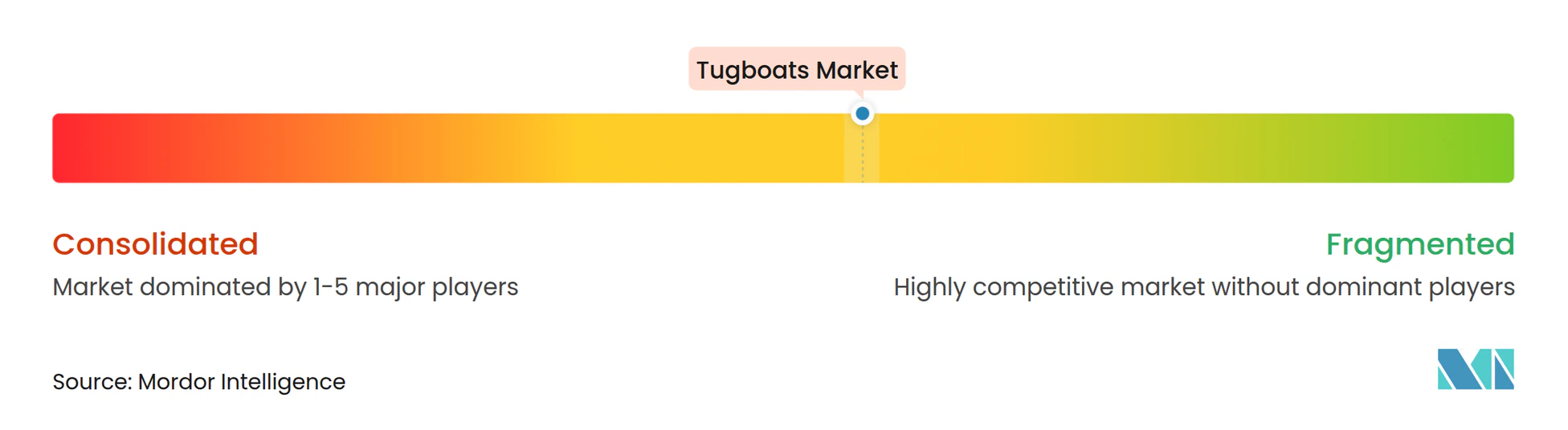
The tugboats market is moderately concentrated among specialist shipbuilders. Damen Shipyards, Sanmar Shipyards, Med Marine, Uzmar, and Chinese builders provide vessels for harbor, escort, and offshore applications, while Wärtsilä participates as a supplier of propulsion and power systems. Competition focuses on delivery capabilities, established hull designs, propulsion integration, and access to export markets. Turkish builders have secured notable orders for high-power and lower-emission vessels, while established manufacturers benefit from service networks and recognized design records. New entrants can compete by offering electrified powertrains or lower operating costs.
Damen partnered with AAAPropulsion in September 2025 to integrate the A-Pod azimuthing thruster into electric tug designs and improve hydrodynamic efficiency. Sanmar plans to deliver two high-bollard-pull vessels to Med Tugs for operations at the Port of Piraeus under an agreement [2]. Arc and Curtin Maritime have agreed to deploy eight hybrid-electric ship-assist tugs in the United States [3]. These developments highlight competition between established shipbuilding specialists and technology-focused entrants. Builders that meet port-specific emissions requirements are likely to hold an advantage in major tenders.
The tugboats market favors companies with strong technical partnerships, credible approval pathways, and a proven ability to deliver vessels into service. Standardized retrofits, compact zero-emission tugs, and condition-monitoring solutions create opportunities for suppliers serving smaller operators. High-power escort and offshore vessels represent a smaller but valuable demand segment. Conventional diesel and hybrid designs will continue to compete alongside one another, as infrastructure readiness varies by location.
Tugboats Industry Leaders
-
Damen Shipyards Group
-
Sanmar Shipyards
-
Med Marine
-
Wärtsilä
-
Cheoy Lee Shipyards Ltd.
- *Disclaimer: Major Players sorted in no particular order
Tugboats Market Companies Covered in this Report
- Damen Shipyards Group
- Sanmar Shipyards
- Robert Allan Ltd.
- Wärtsilä
- Med Marine
- Uzmar Shipyard
- Cheoy Lee Shipyards Ltd.
- Eastern Shipbuilding Group, Inc.
- Master Boat Builders, Inc.
- Kanagawa Dockyard Co., Ltd.
- Astilleros Gondán, S.A.
- Keppel Ltd.
- Ulstein Group
- Zhenjiang Shipyard Co., Ltd.
- Zamakona Yards
- Cochin Shipyard Limited
- Kongsberg Gruppen ASA
Recent Industry Developments in Tugboats Market
- September 2026: Svitzer ordered six additional 29-meter TRAnsverse tugs with 80 tons of bollard pull from Cheoy Lee Shipyards, taking its TRA2900 order at the yard to 14 vessels.
- August 2026: Wilson Sons christened WS Ariel, a 73.5-ton bollard pull Damen ASD 2312 tug built at its Guarujá shipyard to handle New Panamax ships in Brazil.
- April 2026: Svitzer contracted Rio Maguari Shipyard in Belém, Brazil, to build two TRAnsverse tugs, the first of the design to be built in the Americas.
- April 2026: Med Tugs ordered an 80-ton RAstar 2900SX and a 90-ton RAstar 3200SX escort tug from Sanmar Shipyards for operations at the Port of Piraeus.
Global Tugboats Market Report Scope
The Tugboats Market Report is Segmented by Tug Type (Harbor Tugs, Escort Tugs, Ocean-Going/Salvage Tugs, Pusher Tugs and Towboats (Including River), and Other Tug Types), Drive Type (Conventional (Fixed Pitch/Controllable Pitch Propeller), Azimuth Stern Drive (ASD), and Tractor (Voith/Azimuth)), Power Source (Diesel, Hybrid/Battery-Electric, and Other Power Sources (LNG, Methanol)), Bollard Pull (Up to 40 t, 40–70 t, and Above 70 t), Activity (Newbuild and Retrofit/Repowering), Application (Port and Harbor Operations, Offshore Oil and Gas, Coastal and Inland Towing, and Other Applications (Salvage, Naval)), and Geography (North America, Europe, Asia-Pacific, South America, and Middle East and Africa). The Market Forecasts are Provided in Terms of Value (USD) and Volume (Units).
Segmentation Overview
| Harbor Tugs |
| Escort Tugs |
| Ocean-Going/Salvage Tugs |
| Pusher Tugs and Towboats (Including River) |
| Other Tug Types |
| Conventional (Fixed Pitch/Controllable Pitch Propeller) |
| Azimuth Stern Drive (ASD) |
| Tractor (Voith/Azimuth) |
| Diesel |
| Hybrid/Battery-Electric |
| Other Power Sources (LNG, Methanol) |
| Up to 40 t |
| 40–70 t |
| Above 70 t |
| Newbuild |
| Retrofit/Repowering |
| Port and Harbor Operations |
| Offshore Oil and Gas |
| Coastal and Inland Towing |
| Other Applications (Salvage, Naval) |
| North America | United States |
| Canada | |
| Mexico | |
| Europe | Germany |
| United Kingdom | |
| Netherlands | |
| Norway | |
| Spain | |
| Italy | |
| France | |
| Russia | |
| Rest of Europe | |
| Asia-Pacific | China |
| Japan | |
| South Korea | |
| India | |
| Singapore | |
| Australia | |
| Indonesia | |
| Rest of Asia-Pacific | |
| South America | Brazil |
| Argentina | |
| Chile | |
| Colombia | |
| Peru | |
| Rest of South America | |
| Middle East and Africa | Saudi Arabia |
| United Arab Emirates | |
| Qatar | |
| Oman | |
| Turkiye | |
| Egypt | |
| South Africa | |
| Nigeria | |
| Morocco | |
| Rest of Middle East and Africa |
| By Tug Type | Harbor Tugs | |
| Escort Tugs | ||
| Ocean-Going/Salvage Tugs | ||
| Pusher Tugs and Towboats (Including River) | ||
| Other Tug Types | ||
| By Drive Type | Conventional (Fixed Pitch/Controllable Pitch Propeller) | |
| Azimuth Stern Drive (ASD) | ||
| Tractor (Voith/Azimuth) | ||
| By Power Source | Diesel | |
| Hybrid/Battery-Electric | ||
| Other Power Sources (LNG, Methanol) | ||
| By Bollard Pull | Up to 40 t | |
| 40–70 t | ||
| Above 70 t | ||
| By Activity | Newbuild | |
| Retrofit/Repowering | ||
| By Application | Port and Harbor Operations | |
| Offshore Oil and Gas | ||
| Coastal and Inland Towing | ||
| Other Applications (Salvage, Naval) | ||
| By Geography | North America | United States |
| Canada | ||
| Mexico | ||
| Europe | Germany | |
| United Kingdom | ||
| Netherlands | ||
| Norway | ||
| Spain | ||
| Italy | ||
| France | ||
| Russia | ||
| Rest of Europe | ||
| Asia-Pacific | China | |
| Japan | ||
| South Korea | ||
| India | ||
| Singapore | ||
| Australia | ||
| Indonesia | ||
| Rest of Asia-Pacific | ||
| South America | Brazil | |
| Argentina | ||
| Chile | ||
| Colombia | ||
| Peru | ||
| Rest of South America | ||
| Middle East and Africa | Saudi Arabia | |
| United Arab Emirates | ||
| Qatar | ||
| Oman | ||
| Turkiye | ||
| Egypt | ||
| South Africa | ||
| Nigeria | ||
| Morocco | ||
| Rest of Middle East and Africa | ||
Key Questions Answered in the Report
What is the projected value of the tugboats market by 2032?
The tugboats market is forecast to reach USD 5.21 billion by 2032, growing at a 3.87% CAGR from 2027 to 2032.
Which tug type is projected to grow the fastest?
Ocean-going and salvage tugs are forecast to grow at a 6.67% CAGR through 2032, supported by offshore energy and specialized towing work.
Which bollard-pull category is expanding fastest?
Vessels above 70 t are forecast to grow at a 6.89% CAGR as larger ships, LNG terminals, and offshore work need more pulling capacity.
What is driving new tugboat purchases?
Larger vessel calls, aging fleets, emissions requirements, and offshore support needs are leading reasons for new vessel orders.
Which region is forecast to grow fastest?
The Middle East and Africa is forecast to expand at a 6.85% CAGR through 2032, supported by port concessions, LNG infrastructure, and offshore activity.