
Transportation Technical Textiles Market Size and Share
Market Overview
| Study Period | 2021 - 2032 |
|---|---|
| Market Size (2027) | USD 71.97 Billion |
| Market Size (2032) | USD 87.56 Billion |
| Growth Rate (2027 - 2032) | 4.00 % |
| Fastest Growing Market | Middle East and Africa |
| Largest Market | Asia-Pacific |
| Market Concentration | Medium |
Major Players *Disclaimer: Major Players sorted in no particular order Image © Mordor Intelligence. Reuse requires attribution under CC BY 4.0. | |
Transportation Technical Textiles Market Analysis by Mordor Intelligence
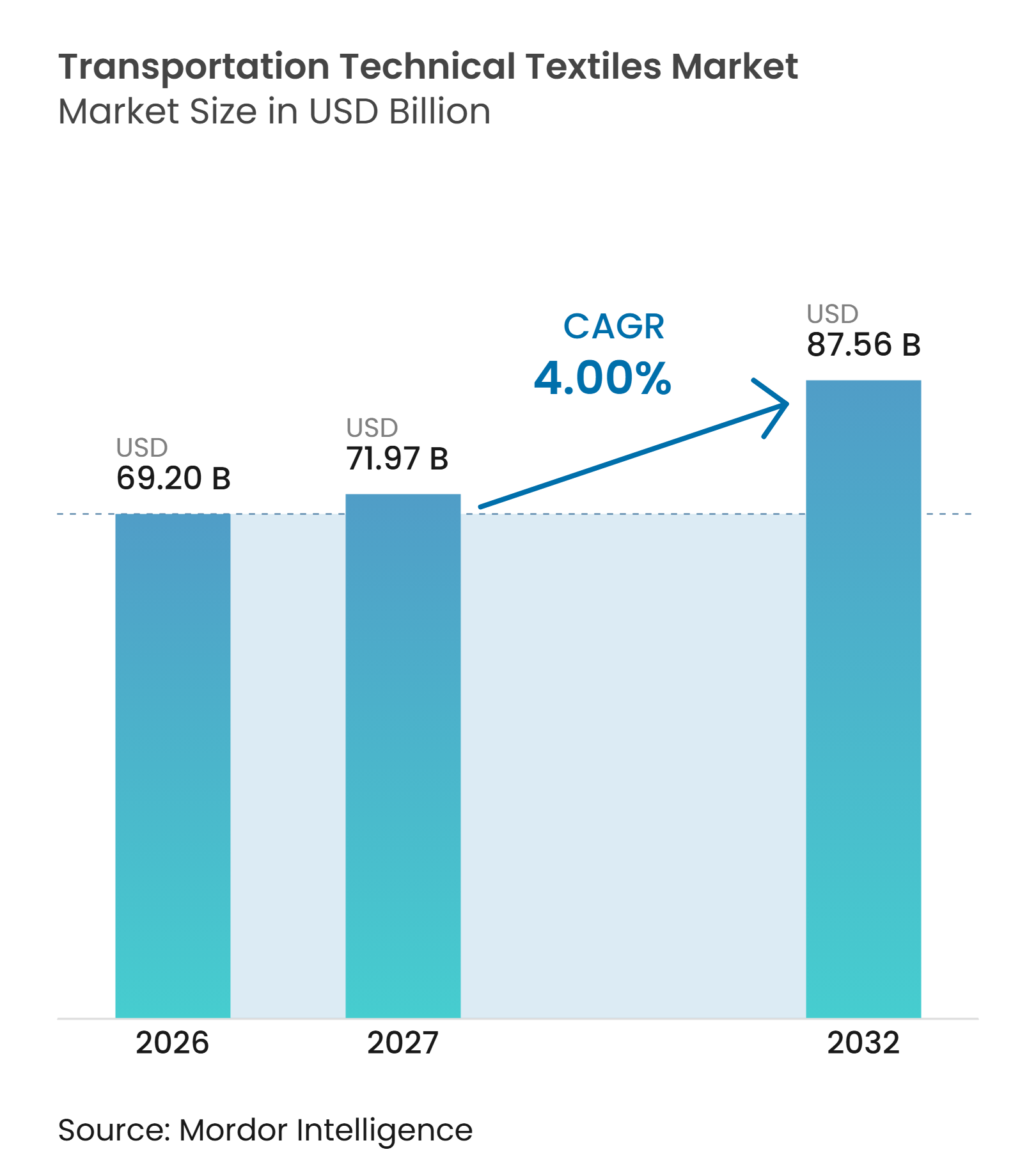
The Transportation Technical Textiles Market size is projected to expand from USD 69.20 billion in 2026 and USD 71.97 billion in 2027 to USD 87.56 billion by 2032, registering a CAGR of 4% between 2027 and 2032.
The transportation technical textiles market is supported by higher vehicle output, tighter safety rules, electric vehicle design requirements, and aircraft fleet renewal. Safety textiles, tire reinforcement, cabin materials, and composite structures link demand to several transport modes, which reduces dependence on a single vehicle cycle. Electric vehicles are raising specifications for acoustic insulation and battery protection because their cabins expose noises that combustion engines can mask. Long qualification cycles favor suppliers that already meet vehicle and aerospace requirements, while rail investment provides an additional source of demand. Input cost swings for polyester, nylon, and specialty fibers remain a constraint because supply contracts may delay price recovery for converters.
Key Report Takeaways
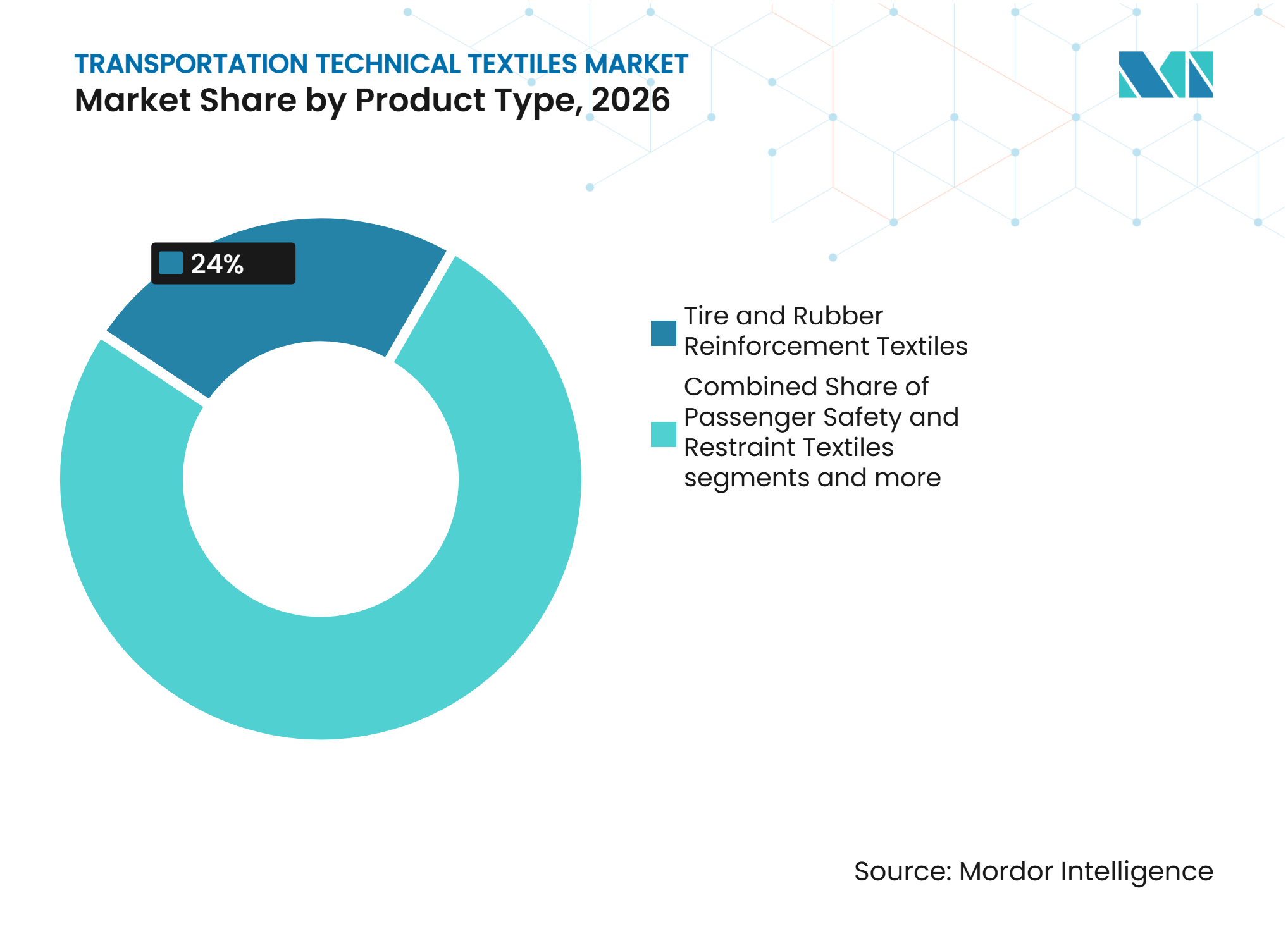
- By product type, tire and rubber reinforcement textiles held 24% of the transportation technical textiles market share in 2026, while structural and composite reinforcement textiles are projected to register the highest CAGR at 6.5% through 2032.
- By material type, polyester held 38% of the transportation technical textiles market share in 2026, while carbon fibers are projected to register the highest CAGR at 7.5% through 2032.
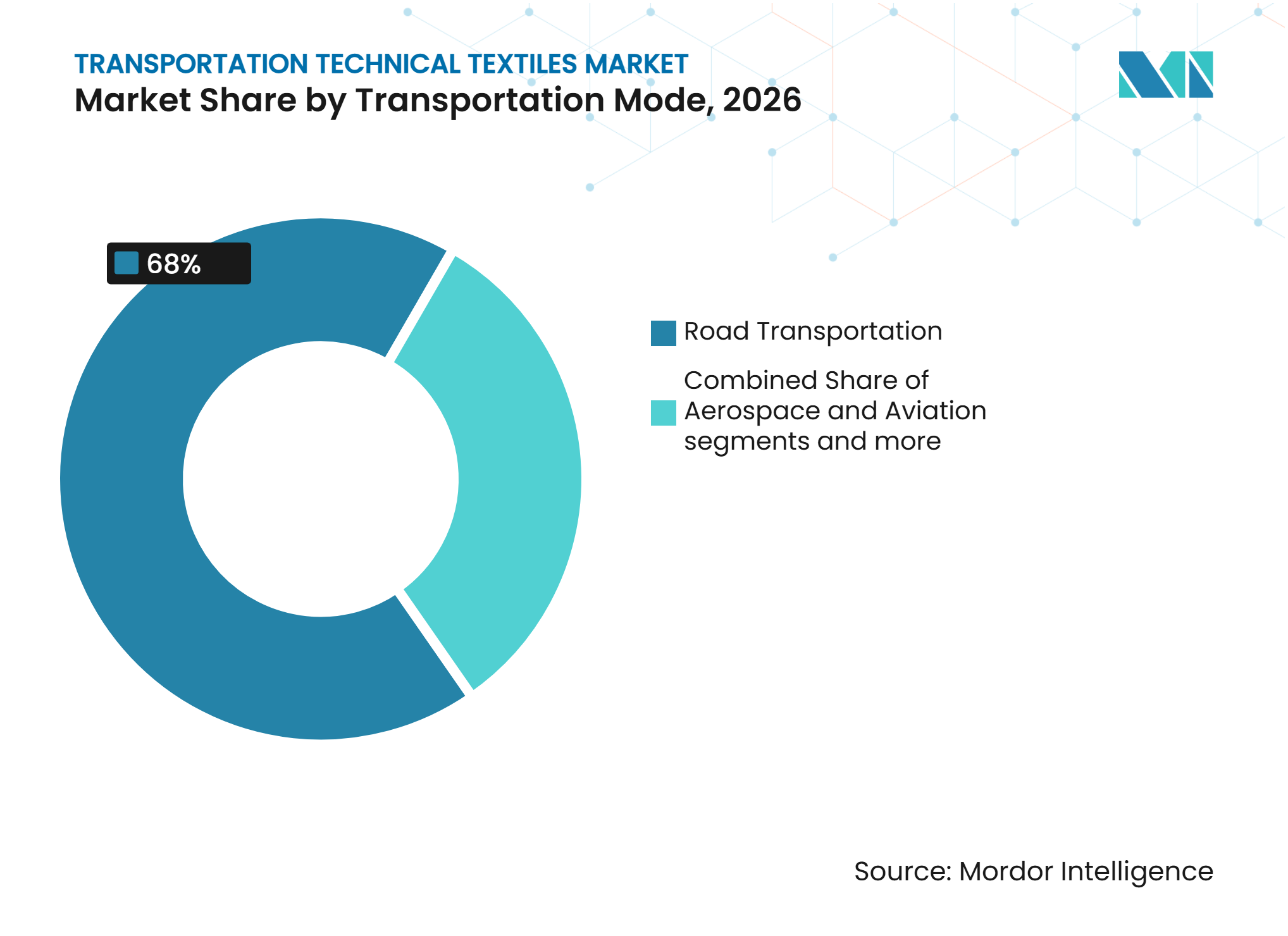
- By transportation mode, road transportation accounted for 68% of the transportation technical textiles market size in 2026, while aerospace and aviation are projected to register the highest CAGR at 5.8% through 2032.
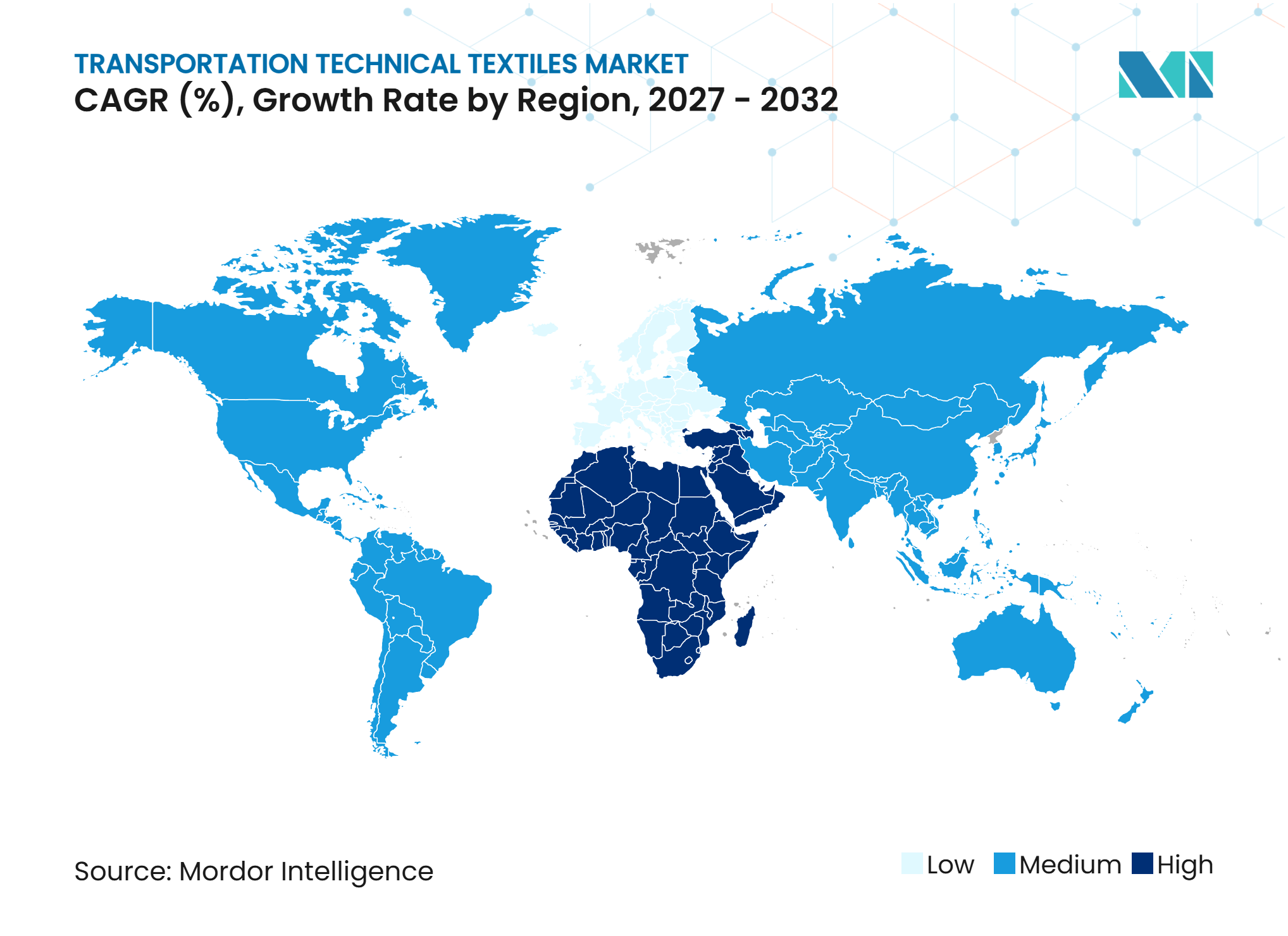
- By geography, Asia-Pacific held 48% of the transportation technical textiles market share in 2026, while the Middle East and Africa is projected to register a CAGR of 9.5% through 2032.
Note: Market numbers in this report are based on Mordor Intelligence's proprietary estimation framework, which combines nine months of actuals with Q4 projections for base year 2026.
Market Trends and Insights
Drivers Impact Analysis of Transportation Technical Textiles Market*
| Driver | (~) % Impact on CAGR Forecast | Geographic Relevance | Impact Timeline |
|---|---|---|---|
| Increasing Vehicle Production and Automotive Safety Requirements | +0.90% | Global, led by Asia-Pacific and India | Short term (≤ 2 years) |
| Rising Adoption of Electric and Hybrid Vehicles | +0.75% | China, Europe, North America | Medium term (2-4 years) |
| Growing Demand for Lightweight Automotive and Aerospace Materials | +0.65% | Global | Medium term (2-4 years) |
| Increasing Aircraft Production and Commercial Fleet Modernization | +0.50% | Asia-Pacific, North America, Europe | Long term (≥ 4 years) |
| Expansion of Vehicle Noise, Vibration and Harshness Control Requirements | +0.40% | Global, led by EV markets | Medium term (2-4 years) |
| Investments in Passenger Railway and Urban Transit Infrastructure | +0.30% | Asia-Pacific, South America, Europe | Long term (≥ 4 years) |
| Source: Mordor Intelligence | |||
Increasing Vehicle Production and Automotive Safety Requirements
Global motor vehicle production reached 96.4 million units in 2025, 3.9% above the prior year and the highest annual total since 2018.[1] Each new vehicle requires airbag fabrics, seat belt webbing, tire cord, and acoustic insulation, so output gains increase textile demand across several product lines. The transportation technical textiles market benefits from this broad parts content rather than from a single interior component. NHTSA's amended FMVSS 208 took effect on March 4, 2025, extending rear seat belt warning requirements across passenger seating positions in covered vehicles.[2] This requirement supports sensor-integrated restraint systems and high-performance webbing for United States-bound vehicle programs. India produced 6.49 million vehicles in 2025 and reported passenger vehicle sales above 4.6 million units, reinforcing demand for safety textiles as vehicle safety requirements expand.
Rising Adoption of Electric and Hybrid Vehicles
China produced 16.626 million new-energy vehicles in 2025, up 29% from 2024. Electric platforms place greater emphasis on nonwoven acoustic materials because motor, power-electronics, and gear noises become more noticeable in quieter cabins. A 2025 SAE review identified noise, vibration, and harshness management as a continuing engineering issue for electric vehicles.[3] Autoneum introduced E-Fiber Shield at IAA 2025 as a mica-free, flame-retardant textile designed for battery applications and thermal-runaway protection. Battery packs also increase vehicle mass, which creates demand for lighter acoustic and thermal components. The transportation technical textiles market therefore gains value per electric vehicle even where total vehicle volumes do not rise at the same rate.
Growing Demand for Lightweight Automotive and Aerospace Materials
Lightweight composites are becoming more relevant in vehicle and aircraft programs because they combine structural performance with lower component mass. Hyundai Motor Group and Toray Group signed an agreement in October 2025 to develop carbon fiber-reinforced composite materials for high-performance mobility applications. This type of joint development ties fiber suppliers more closely to platform design decisions and lengthens their commercial relationship with original equipment manufacturers. Airbus reported a year-end backlog of 8,754 commercial aircraft in 2025, which supports a multiyear requirement for composite reinforcements and interior materials. The transportation technical textiles market also benefits when suppliers can support both structural and interior applications across aerospace programs. Recycled-content composite approaches add a further design requirement where manufacturers seek lower material footprints without reducing performance.
Increasing Aircraft Production and Commercial Fleet Modernization
Commercial aircraft deliveries reached 1,411 units in 2025, up 25% from 2024, according to the United Kingdom aerospace trade association ADS. Airbus delivered 793 aircraft in 2025, and its backlog provides visibility for future production requirements. Aircraft use textile composites, insulation blankets, upholstery, and cabin materials that must meet strict flammability standards. FAA 14 CFR 25.853 shapes material selection for cabin components and creates a high entry threshold for suppliers. The installed commercial fleet also creates recurring demand through cabin refurbishment and maintenance cycles. This gives the transportation technical textiles market a source of aerospace demand that is not limited to new aircraft deliveries.
Restraints Impact Analysis of Transportation Technical Textiles Market*
| Restraint | (~) % Impact on CAGR Forecast | Geographic Relevance | Impact Timeline |
|---|---|---|---|
| Volatility in Polyester, Nylon and Specialty Fiber Prices | -0.60% | Global, most acute in Asia-Pacific | Short term (≤ 2 years) |
| Stringent Automotive and Aerospace Material Qualification Requirements | -0.45% | Global | Long term (≥ 4 years) |
| High Development and Certification Costs of Advanced Transport Textiles | -0.35% | Global, led by North America and Europe | Long term (≥ 4 years) |
| Competition from Non-Textile Lightweight Materials and Synthetic Surfaces | -0.25% | Europe, North America | Medium term (2-4 years) |
| Source: Mordor Intelligence | |||
Volatility in Polyester, Nylon and Specialty Fiber Prices
Fiber costs can move at different speeds because polyester and nylon depend on separate upstream supply chains. Nylon caprolactam faces a tighter supply position than the more widely traded polyester chain, which limits purchasing flexibility for converters. Changes in crude oil and petrochemical prices can create a timing gap because automotive supply agreements often update only quarterly or annually. Smaller manufacturers carry greater exposure when they cannot pass costs through quickly or produce their own feedstocks. Companies with polyester production and downstream conversion can partly reduce this risk through vertical integration. The transportation technical textiles market also faces added cost pressure where electric vehicle programs need premium aramid or high-tenacity nylon materials.
Stringent Automotive and Aerospace Material Qualification Requirements
Automotive and aerospace materials must pass layered testing, documentation, and customer approval processes before production release. FMVSS 302 governs the flammability of interior materials for United States-market vehicles, while IATF 16949 sets quality-management requirements across automotive supply chains. UNECE Regulation No. 118 sets fire behavior requirements for bus and coach interiors in markets that apply the regulation. FAA 14 CFR 25.853 imposes aircraft cabin flammability requirements and increases accountability for material changes. These rules protect existing certified suppliers, but they can delay product substitution and increase development costs for new entrants. The EU General Safety Regulation adds further active-safety obligations, including vehicle-to-pedestrian and cyclist emergency braking requirements from July 2026, which adds complexity to evolving vehicle safety architectures.
*Our forecasts treat driver/restraint impacts as directional, not additive. The impact forecasts reflect baseline growth, mix effects, and variable interactions.
Transportation Technical Textiles Market Segment Analysis
By Product Type:
Safety and Reinforcement Textiles Shape Market ProfileTire and rubber reinforcement textiles held 24% of the transportation technical textiles market share in 2026, supported by the steady use of high-tenacity polyester and nylon cord in radial tires. The segment serves a large replacement and original-equipment tire base, so demand is spread across passenger cars, commercial vehicles, and transport fleets. Each radial tire uses calibrated cord layers to manage operating forces, which preserves the role of textile reinforcement in tire construction. The need for dependable material performance at competitive cost reinforces the transportation technical textiles market size for this segment. Continental and Kordsa released their COKOON formaldehyde-free bonding technology royalty-free at Tire Technology Expo 2025, aiming to improve textile-to-rubber bonding without resorcinol. The move may support wider use of lower-impact tire reinforcement processes across the supply chain.
Structural and composite reinforcement textiles are projected to record a 6.5% CAGR through 2032, the highest product growth rate in the transportation technical textiles market. Aerospace requirements for carbon, glass, and aramid fabrics support this performance because composite content is high in modern airframes. Hexcel and KONGSBERG signed a five-year supply agreement in June 2025 for HexWeb honeycombs and HexPly prepregs used in defense and aerospace production. Passenger safety and restraint materials continue to benefit from stricter occupant-protection requirements, although their mature vehicle penetration limits their relative growth. Interior upholstery is shifting toward recycled and bio-based fibers as electric vehicle manufacturers make circularity part of materials selection. Acoustic, thermal, filtration, and exterior protection textiles complete the product profile and serve cabin comfort, air management, and recurring refurbishment needs.



By Material Type:
Polyester Dominant, Carbon Fibers Rising FastPolyester held 38% of the transportation technical textiles market share in 2026 because it is used across upholstery, acoustic felts, carpet backings, and tire cord. Its range of applications makes it difficult for a single alternative fiber to replace across all transport uses. The China Fiber Quality Monitoring Center stated in 2025 that recycled PET content in automotive interior fabrics was expected to exceed 45% across new EV models. Autoneum's Flexi-Light PET system uses up to 90% recycled PET and is designed to match conventional polyurethane foam in acoustic performance. Such products show how recycled polyester can meet both acoustic and circularity requirements. The transportation technical textiles industry continues to use polyester where cost, durability, and processing flexibility are important.
Carbon fibers are forecast to expand at a 7.5% CAGR through 2032, driven by aerospace production and lightweight vehicle applications. Toray's development agreement with Hyundai reflects a focus on composite materials for high-performance mobility platforms. Polyamide remains important for airbag cushions and high-tenacity seat belts because it provides strength, temperature resistance, and elongation performance. Glass fibers support railway, marine, and battery-protection composites where scale and flame resistance are relevant. Mitsubishi Chemical introduced GMTeFR in 2025 as a flame-retardant glass-fiber mat thermoplastic composite for electric vehicle battery trays. Natural and regenerated fibers are also entering selected interior applications where manufacturers prioritize lower material footprints.
By Transportation Mode:
Road Dominant, Aerospace AcceleratingRoad transportation accounted for 68% of the transportation technical textiles market size in 2026, reflecting the large number of passenger cars and commercial vehicles that use tires, restraints, upholstery, and acoustic products. Battery-electric passenger vehicles require more tailored acoustic and battery-protection materials than conventional vehicles. China's 2025 new-energy vehicle production of 16.626 million units supports this shift in specifications. Commercial vehicles use substantial tire cord volumes because truck radials need heavy-duty reinforcement. Kordsa presented its REV Technologies platform in 2025 for electric vehicle-compatible tire reinforcement, including recycled-PET cord fabric. The transportation technical textiles market retains its largest demand base in road transport because material use spans both new vehicles and replacement cycles.
Aerospace and aviation is expected to grow at a 5.8% CAGR through 2032, supported by a global aircraft backlog of 16,371 planes at the end of 2025. Composite-intensive narrowbody and widebody aircraft require high-performance reinforcements, cabin insulation, and seating materials. FAA flammability rules create a demanding approval environment that favors suppliers with established testing and production controls. Rail transport adds longer-duration demand through procurement of rolling stock, interior renovation, and required fire-resistant cabin materials. Amtrak increased its capital plan by 50% in 2025 compared with USD 4.5 billion deployed in 2024 and reported 111 trainsets and 125 locomotives in production. Marine applications are smaller, but long vessel service lives create recurring needs for compliant cabin interiors and protective textiles.

Geography Analysis
Asia-Pacific: Scale and Electrification Converge
Asia-Pacific held 48% of the transportation technical textiles market share in 2026. China produced 16.626 million new-energy vehicles in 2025, generating demand for acoustic nonwovens, thermal-protection materials, and battery-shield composites. India produced 6.49 million vehicles and recorded passenger vehicle sales above 4.6 million units in 2025, supporting demand for airbags and seat belt webbing. Regional electric vehicle programs are also increasing the use of recycled PET in interior fabrics. Vietnam's urban railway plans include USD 40 billion for Ho Chi Minh City through 2035 and a further USD 18 billion for Hanoi through 2045. These projects broaden the transportation technical textiles market beyond passenger vehicle production by creating long-term demand for rail cabin materials and acoustic underlays.
Europe: Regulations Set Performance Requirements
Europe experienced a 2.6% decline in car production in the first half of 2025, although the region remains important for materials standards and circular design requirements. The proposed revision to the EU End-of-Life Vehicle framework is shaping procurement interest in recycled content and recyclable multilayer components. This regulatory influence encourages suppliers to develop materials that can meet performance needs while supporting circularity targets. European premium vehicle programs continue to use composite solutions, including SAERTEX's carbon non-crimp fabric work for automotive structural applications. Railway demand is supported by EN 45545-2 requirements for fire behavior in rail interiors. FS Group's EUR 360 million (USD 423.5 million) investment in Italian intercity and suburban trainsets supports procurement of compliant upholstery and interior materials.
Emerging Regions: Transit Programs Add Demand Diversity
North American light vehicle production was estimated to decline 5.2% in 2025, but rail investment provides a separate source of demand for interior upholstery, acoustic liners, and fire-resistant seating materials. Amtrak's 2025 capital program supports this demand through new trainset and locomotive production. São Paulo committed BRL 28.5 billion (USD 5.1 billion) to rail projects covering upgrades and new stations. The program supports recurring demand for railway seating fabrics and protective interior materials. The Middle East and Africa is forecast to record a 9.5% CAGR through 2032, supported by metro fleet expansion and demand for compliant passenger-cabin textiles. Turkey remains a regional production hub through Kordsa, linking European original-equipment programs with neighboring transport procurement. The transportation technical textiles market size in these regions is supported by infrastructure demand even where vehicle assembly remains less extensive.
Competitive Landscape
Market Concentration
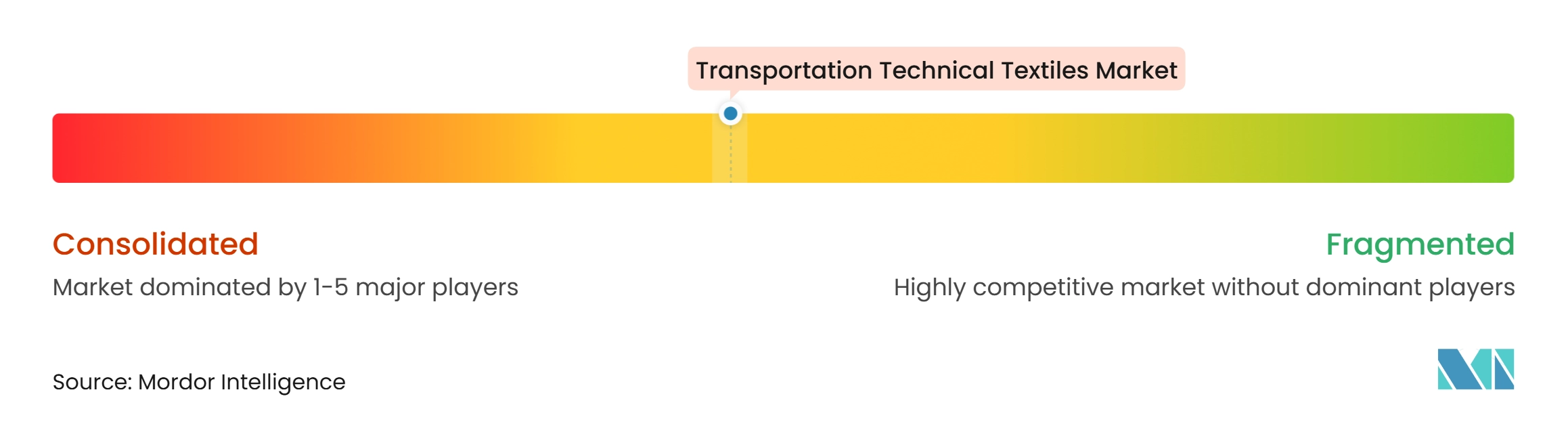
The transportation technical textiles market exhibits a medium level of market concentration. Vertically integrated specialists hold stronger positions in high-margin airbag fabrics, seat belt webbing, and aerospace composite reinforcement. Regional converters compete more directly in upholstery, carpet, and other cost-sensitive applications. OEM qualification requirements restrict the number of credible suppliers in safety-critical materials. This raises switching costs for customers and supports longer supplier relationships. The transportation technical textiles market also includes an expanding group of certified producers in China, India, South Korea, and Turkey.
Companies are focusing on platform-specific development, recycled fiber integration, and materials for electric vehicle applications. Hyundai Motor Group and Toray's October 2025 agreement is an example of a direct supplier and automaker collaboration on carbon fiber reinforced composites. Autoneum introduced E-Fiber Shield for electric vehicle battery applications and Flexi-Light PET for recycled acoustic insulation. Continental and Kordsa made COKOON available royalty-free to help lower formaldehyde use in textile-rubber bonding. These moves focus competition on design capability, certification, and environmental performance rather than on textile volume alone.
Battery-protection textiles remain open to several material approaches, including aramid composites, flame-retardant fabrics, and glass-fiber thermoplastic composites. Recycled-content yarn specialists and bio-based fiber suppliers are gaining attention as original equipment manufacturers set material sustainability targets. Developments in conductive fibers, sensor integration, and three-dimensional woven preforms may create further differentiation in safety and structural applications.
Transportation Technical Textiles Industry Leaders
-
Autoneum Holding AG
-
AUNDE Group SE
-
Asahi Kasei Corporation
-
Toyota Boshoku Corporation
-
SUMINOE Co., Ltd.
- *Disclaimer: Major Players sorted in no particular order
Transportation Technical Textiles Market Companies Covered in this Report
- Autoneum Holding AG
- AUNDE Group SE
- Asahi Kasei Corporation (Sage Automotive Interiors)
- Toyota Boshoku Corporation
- SUMINOE Co., Ltd.
- Seiren Co., Ltd.
- Freudenberg Performance Materials
- TWE Group
- Milliken & Company
- Toray Industries, Inc.
- HS Hyosung Advanced Materials Corporation
- Kordsa Teknik Tekstil A.Ş.
- SRF Limited
- Indorama Ventures Public Company Limited
- SAERTEX GmbH & Co. KG
- Hexcel Corporation
- Lantal Textiles AG
- Camira Fabrics Ltd.
- Glen Raven, Inc.
- Ahlstrom
- Sioen Industries NV
- Bcomp Ltd.
Recent Industry Developments in Transportation Technical Textiles Market
- January 2026: Toyoda Gosei's rear-side airbag was selected for use in Subaru's Impreza and Crosstrek passenger vehicle models for the North American market. The airbags are designed to deploy between the rear-seat passenger and the vehicle door during side-impact collisions, reducing the impact on the chest and abdomen.
- October 2025: Hyundai Motor Group and Toray Industries signed a Strategic Joint Development Agreement to co-develop carbon fiber-reinforced composite materials for high-performance vehicles and special-purpose mobility platforms, including lunar rovers, with CFRP production distributed across Toray Advanced Materials Korea, Toray Advanced Composites (Netherlands), and Euro Advanced Carbon Fiber Composites (Germany).
- July 2025: Autoneum presented Flexi-Light PET at the Automotive Acoustics Conference in Constance, Germany, a polyester felt-based sound insulation system composed of up to 90% recycled PET that matches or exceeds conventional polyurethane foam in mid-to-high-frequency acoustic performance.
- June 2025: Hexcel Corporation and KONGSBERG Defence & Aerospace signed a five-year supply partnership agreement for HexWeb engineered honeycombs and HexPly prepregs supporting KONGSBERG's strategic defense and aerospace production programs, cementing a long-term composite textile supply chain for high-value aerospace structures.
Global Transportation Technical Textiles Market Report Scope
The Transportation Technical Textiles Report is Segmented by Product Type (Passenger Safety and Restraint Textiles, Transportation Interior and Upholstery Textiles, and More), by Material Type (Polyester (PET), Polyamide (Nylon), and More), by Transportation Mode (Road Transportation, Aerospace and Aviation, and More), and by Geography (North America, Europe, and More). The Market Forecasts are Provided in Terms of Value (USD).
Segmentation Overview
| Passenger Safety and Restraint Textiles | Automotive Airbag Fabrics and Textile Cushions |
| Seat Belt Webbing | |
| Other Transportation Safety and Restraint Textiles | |
| Transportation Interior and Upholstery Textiles | Seat Upholstery and Seating Fabrics |
| Automotive and Transportation Carpets | |
| Other Transportation Interior Textiles (Headliner, Window-Shading, etc.) | |
| Tire and Rubber Reinforcement Textiles | |
| Acoustic, Thermal and Protective Insulation Textiles | |
| Transportation Filtration and Air Management Textiles | |
| Structural and Composite Reinforcement Textiles (carbon fiber, glass fiber reinforcement fabric, etc.) | |
| Transportation Exterior and Protective Textiles | |
| Other Transportation Technical Textiles |
| Polyester (PET) |
| Polyamide (Nylon) |
| Polypropylene (PP) |
| Polyethylene (PE) |
| Glass Fibers |
| Carbon Fibers |
| Aramid and Other High-Performance Synthetic Fibers |
| Natural and Regenerated Fibers |
| Other Specialty Fibers and Materials |
| Road Transportation | Passenger Cars | Internal Combustion Engine and Hybrid Passenger Cars |
| Battery Electric Passenger Cars | ||
| Commercial Vehicles | ||
| Two-Wheelers, Three-Wheelers and Other Road Vehicles | ||
| Aerospace and Aviation | Commercial and Business Aircraft | |
| Military Aircraft and Helicopters | ||
| Spacecraft and Other Aerospace Platforms | ||
| Rail Transportation | ||
| Marine Transportation | Commercial and Cargo Vessels | |
| Passenger, Cruise Vessels, Recreational and Other Marine Vessels | ||
| Other Specialized Transportation Platforms |
| North America | United States |
| Canada | |
| Mexico | |
| Europe | Germany |
| United Kingdom | |
| France | |
| Italy | |
| Spain | |
| Poland | |
| Rest of Europe | |
| Asia-Pacific | China |
| Japan | |
| India | |
| South Korea | |
| Thailand | |
| Indonesia | |
| Vietnam | |
| Rest of Asia-Pacific | |
| Middle East and Africa | Saudi Arabia |
| United Arab Emirates | |
| Turkey | |
| South Africa | |
| Rest of Middle East and Africa | |
| South America | Brazil |
| Argentina | |
| Rest of South America |
| By Product Type | Passenger Safety and Restraint Textiles | Automotive Airbag Fabrics and Textile Cushions | |
| Seat Belt Webbing | |||
| Other Transportation Safety and Restraint Textiles | |||
| Transportation Interior and Upholstery Textiles | Seat Upholstery and Seating Fabrics | ||
| Automotive and Transportation Carpets | |||
| Other Transportation Interior Textiles (Headliner, Window-Shading, etc.) | |||
| Tire and Rubber Reinforcement Textiles | |||
| Acoustic, Thermal and Protective Insulation Textiles | |||
| Transportation Filtration and Air Management Textiles | |||
| Structural and Composite Reinforcement Textiles (carbon fiber, glass fiber reinforcement fabric, etc.) | |||
| Transportation Exterior and Protective Textiles | |||
| Other Transportation Technical Textiles | |||
| By Material Type | Polyester (PET) | ||
| Polyamide (Nylon) | |||
| Polypropylene (PP) | |||
| Polyethylene (PE) | |||
| Glass Fibers | |||
| Carbon Fibers | |||
| Aramid and Other High-Performance Synthetic Fibers | |||
| Natural and Regenerated Fibers | |||
| Other Specialty Fibers and Materials | |||
| By Transportation Mode | Road Transportation | Passenger Cars | Internal Combustion Engine and Hybrid Passenger Cars |
| Battery Electric Passenger Cars | |||
| Commercial Vehicles | |||
| Two-Wheelers, Three-Wheelers and Other Road Vehicles | |||
| Aerospace and Aviation | Commercial and Business Aircraft | ||
| Military Aircraft and Helicopters | |||
| Spacecraft and Other Aerospace Platforms | |||
| Rail Transportation | |||
| Marine Transportation | Commercial and Cargo Vessels | ||
| Passenger, Cruise Vessels, Recreational and Other Marine Vessels | |||
| Other Specialized Transportation Platforms | |||
| By Geography | North America | United States | |
| Canada | |||
| Mexico | |||
| Europe | Germany | ||
| United Kingdom | |||
| France | |||
| Italy | |||
| Spain | |||
| Poland | |||
| Rest of Europe | |||
| Asia-Pacific | China | ||
| Japan | |||
| India | |||
| South Korea | |||
| Thailand | |||
| Indonesia | |||
| Vietnam | |||
| Rest of Asia-Pacific | |||
| Middle East and Africa | Saudi Arabia | ||
| United Arab Emirates | |||
| Turkey | |||
| South Africa | |||
| Rest of Middle East and Africa | |||
| South America | Brazil | ||
| Argentina | |||
| Rest of South America | |||
Key Questions Answered in the Report
What is the projected value of transportation technical textiles by 2032?
The transportation technical textiles market size is projected to reach USD 87.57 billion by 2032, from USD 71.97 billion in 2027.
What is the forecast CAGR for transportation technical textiles through 2032?
The sector is forecast to grow at a 4.00% CAGR from 2027 to 2032.
Which product category has the largest share in transportation technical textiles?
Tire and rubber reinforcement textiles held the largest product share at 24% in 2026.
Which material is growing fastest in transportation technical textiles?
Carbon fibers have the highest projected CAGR at 7.5% through 2032, supported by aerospace and lightweight mobility applications.
Why do electric vehicles increase technical textile demand?
Electric vehicles need stronger acoustic control, battery thermal protection, electrical insulation, and lighter components.
Which region leads transportation technical textiles demand?
Asia-Pacific held 48% of demand in 2026, while the Middle East is forecast to record the highest regional CAGR at 9.5% through 2032.