
Transparent Solar Cells Market Size and Share
Market Overview
| Study Period | 2022 - 2032 |
|---|---|
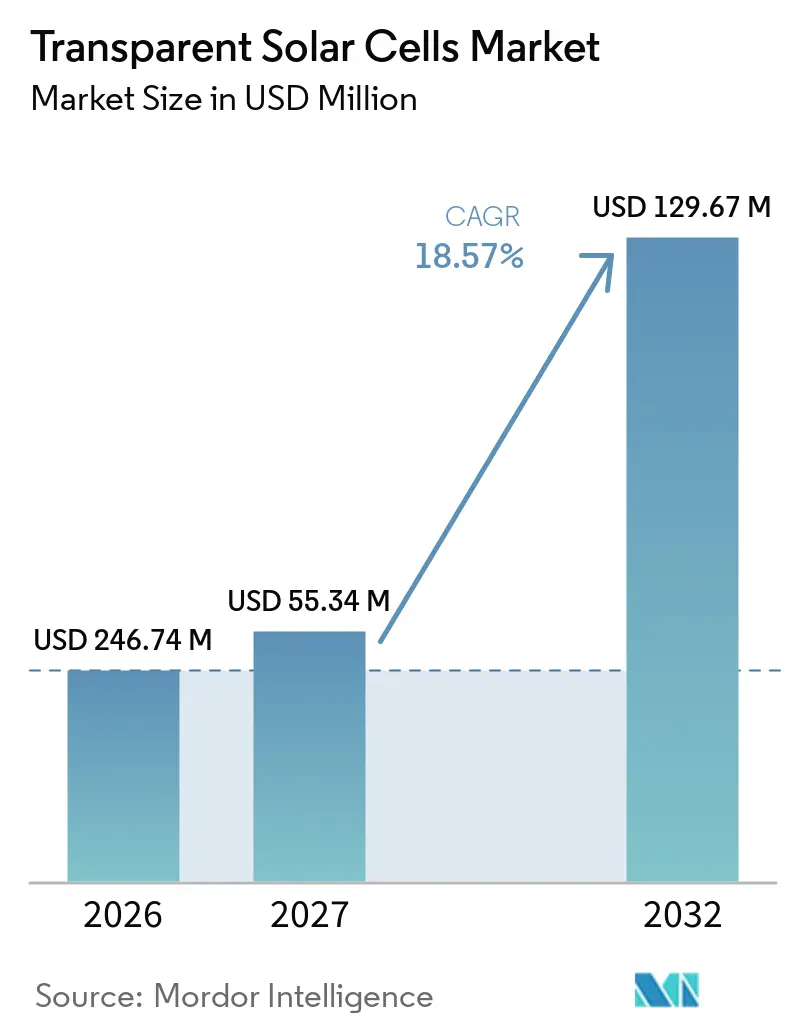
| Market Size (2027) | USD 55.34 Million |
| Market Size (2032) | USD 129.67 Million |
| Growth Rate (2027 - 2032) | 18.57 % |
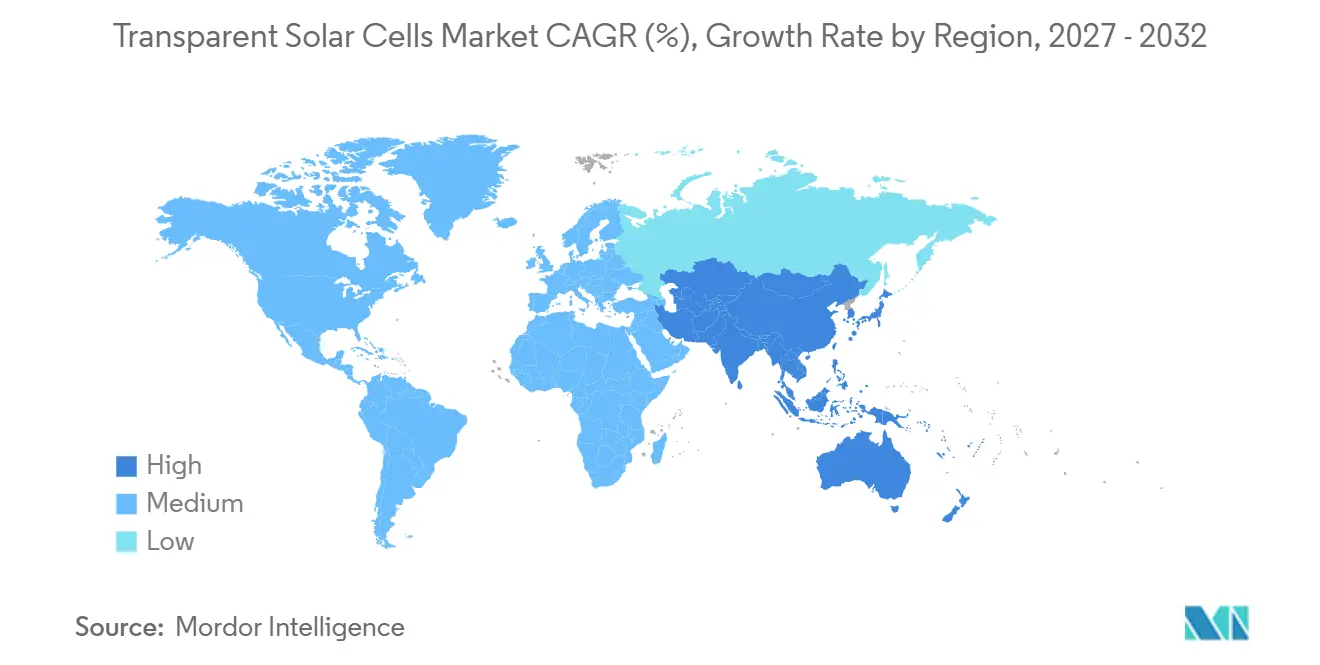
| Fastest Growing Market | Asia-Pacific |
| Largest Market | Asia-Pacific |
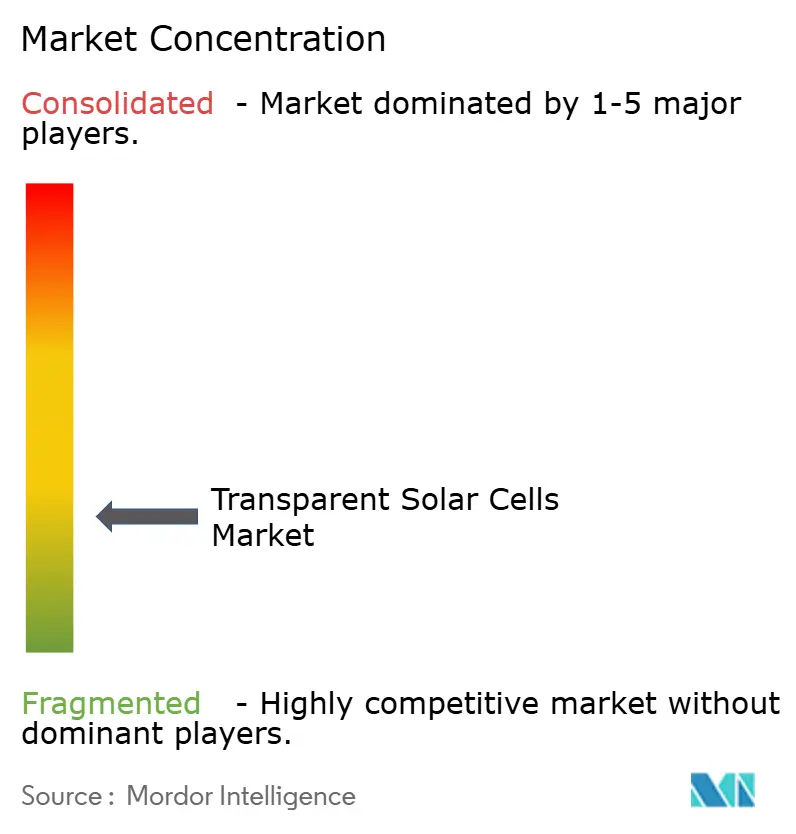
| Market Concentration | Low |
Major Players *Disclaimer: Major Players sorted in no particular order Image © Mordor Intelligence. Reuse requires attribution under CC BY 4.0. | |
Transparent Solar Cells Market Analysis by Mordor Intelligence
Global Transparent Solar Cells Market Analysis by Mordor Intelligence
The Transparent Solar Cells Market size is expected to increase from USD 46.74 million in 2026 to USD 55.34 million in 2027 and reach USD 129.67 million by 2032, growing at a CAGR of 18.57% over 2027-2032. The global transparent solar cells market is supported by building rules that require solar-ready designs and by a broader move toward buildings that produce part of their own power. Product development is also improving the practical case for transparent photovoltaic glazing, especially where it can be integrated into existing glass-making and lamination processes. The global transparent solar cells market serves a different buying decision from conventional utility solar because it competes with architectural glass, façade coatings, and smart-glass systems. This places value on daylight, thermal control, certification, and installation compatibility alongside electricity generation. The opportunity is strongest where transparent glazing can replace more than 1 building function without changing the appearance or use of the building.
Key Report Takeaways
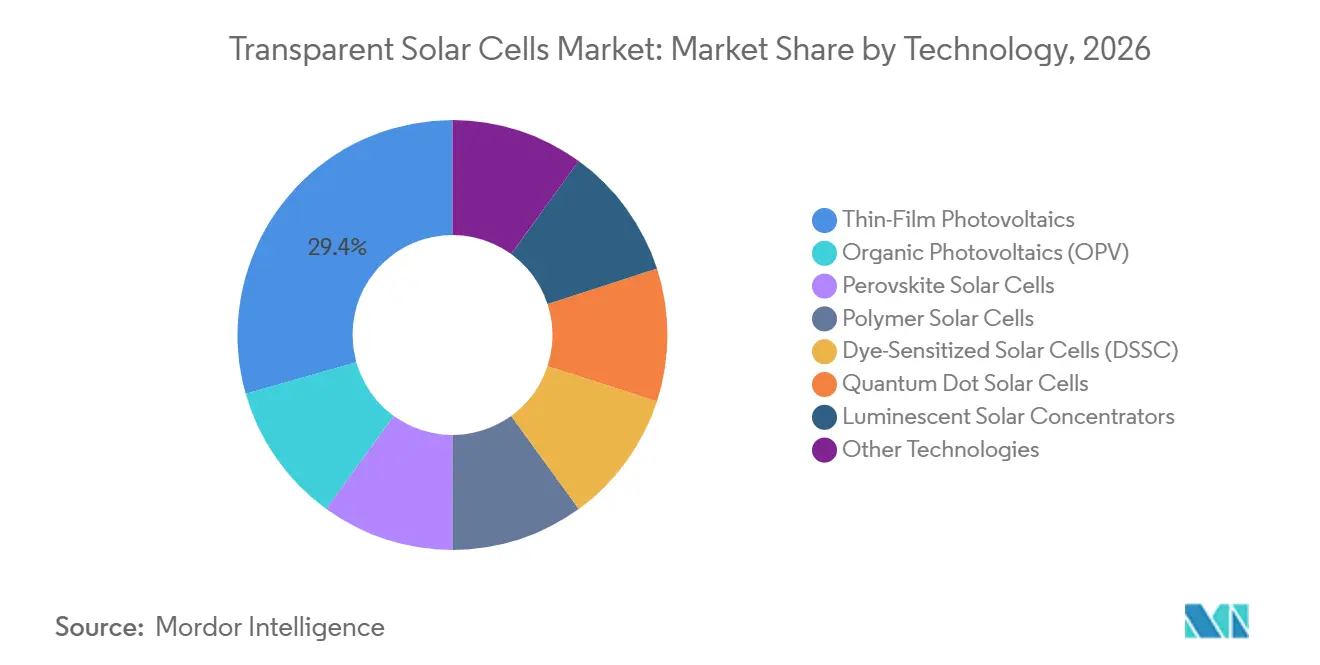
- By technology, Thin-Film Photovoltaics held a 29.4% share in 2026, while Perovskite Solar Cells recorded the highest projected CAGR at 19.7% through 2032.
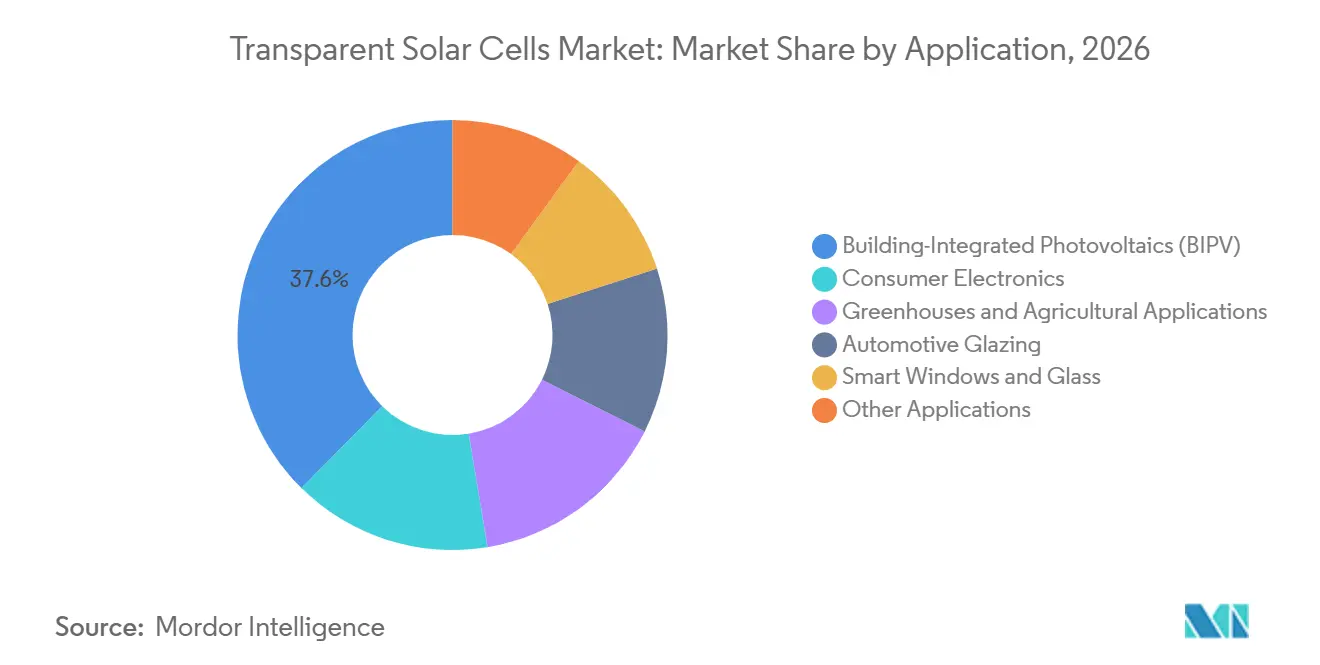
- By application, Building-Integrated Photovoltaics held a 37.6% share in 2026, while Smart Windows and Glass recorded the highest projected CAGR at 19.9% through 2032.
- By geography, Asia-Pacific held a 57.2% share in 2026 and is forecast to expand at a 19.3% CAGR through 2032.
Note: Market numbers in this report are based on Mordor Intelligence's proprietary estimation framework, which combines nine months of actuals with Q4 projections for base year 2026.
Market Trends and Insights
Drivers Impact Analysis of Transparent Solar Cells Market*
| Driver | (~) % Impact on CAGR Forecast | Geographic Relevance | Impact Timeline |
|---|---|---|---|
| Demand for Net-Zero and Energy-Positive Buildings | +3.5% | Global, with core demand in EU, East Asia, and North America | Medium term (2-4 years) |
| Government Incentives and Green-Building Codes | +2.8% | EU, China, South Korea, India | Medium term (2-4 years) |
| Commercialization of Transparent Organic Photovoltaics (OPV) and PV Glass Products | +3.2% | North America, Europe, Asia-Pacific | Short term (≤ 2 years) |
| Transparent Agrivoltaics for Greenhouse Yield and Energy Co-Production | +1.8% | Asia-Pacific, Europe, Latin America | Long term (≥ 4 years) |
| Integration of Power Generation into Vehicle Glazing and Electronics | +2.0% | Global, with early deployment in EU and East Asian EV markets | Medium term (2-4 years) |
| Retrofit Opportunity in Existing Glass Facades | +1.4% | Europe, North America | Long term (≥ 4 years) |
| Source: Mordor Intelligence | |||
Demand for Net-Zero and Energy-Positive Buildings
Buildings account for 40% of global energy consumption, which places building design at the center of energy policy and private investment in on-site generation. The revised Energy Performance of Buildings Directive requires solar systems on certain new EU public and commercial buildings from 2026 and sets zero-emission standards for new buildings by 2030. This schedule makes the global transparent solar cells market more relevant at the building-design stage, when architects select façade materials and systems. China added 11,140 MW of Building-Integrated Photovoltaics (BIPV) in 2024 and reached 28,129 MW of cumulative Building-Integrated Photovoltaics (BIPV) capacity, showing the scale that policy can support in a major construction market. The global transparent solar cells market can benefit where these rules make energy-producing building elements a design requirement rather than an optional upgrade. Building-Integrated Photovoltaics (BIPV) has a positive net present value in Europe but remains below 1% of global installed PV capacity, compared with 10% in Switzerland, leaving a gap between current adoption and the expected compliance need.[1]
Government Incentives and Green-Building Codes
Government incentives affect the financial case for the global transparent solar cells market because they can shorten the time needed to recover installation costs. ClearVue reported that Hong Kong's feed-in tariff reduced the modeled payback period for its Gen3 Building-Integrated Photovoltaics (BIPV) glazing from 4.6 years to 2.1 years. A shorter recovery period can make transparent glazing more relevant for commercial developers with limited equipment-return thresholds. South Korea announced a 2030 commercialization target for perovskite-silicon tandem panels and a plan for domestic and international certification systems. France and Germany use national Building-Integrated Photovoltaics (BIPV) certification pathways that complement EN 50583, while revisions seek closer alignment with EU construction and electrical rules. India's September 2025 Approved List of Models and Manufacturers (ALMM) revision illustrates that procurement rules can support domestic demand while also changing the position of overseas suppliers. The global transparent solar cells market therefore depends not only on incentives but also on whether certifications can be accepted across building, electrical, and procurement systems.
Commercialization of Transparent Organic Photovoltaics (OPV) and PV Glass Products
The global transparent solar cells market moved closer to commercial rollout in 2025 as companies reported larger formats, manufacturing progress, and certification activity. NEXT Energy Technologies expanded its pilot line to make 40-inch by 60-inch laminated transparent Organic Photovoltaics (OPV) windows and began UL certification work for grid-connected use in February 2025. A 2025 study reported semitransparent Organic Photovoltaics (OPV) devices with 6.05% light utilization efficiency and an operational T80 lifetime of 835 hours under ISOS-L-1 testing. Research published in December 2025 also reported 7,200 cm² perovskite modules made with green solvents, a certified 17.2% total-area efficiency, and successful IEC 61215 testing[2]. These results matter because commercial glazing needs stable output and evidence that it can meet recognized reliability requirements. NSG Group's March 2025 conversion of a Pilkington North America line to make Transparent Conductive Oxide (TCO) solar glass also shows that relevant coating and glass capacity can be adapted for photovoltaic supply chains.
Transparent Agrivoltaics for Greenhouse Yield and Energy Co-Production
The global transparent solar cells market has a distinct agrivoltaic greenhouse purchase case because operators must protect crop conditions while reducing energy use. A 2025 greenhouse study found that transparent photovoltaic window integration reduced energy consumption by 57% and water use by 29% without yield loss across tomato, bell pepper, spinach, and lettuce[3]. This result places crop preservation alongside electricity generation and operating cost in the decision process. Separate research found that semitransparent Organic Photovoltaics (OPV) and perovskite modules need to be designed by crop type because spectral needs are not identical across greenhouse production[4]. A simulation across 371 Chinese cities found that ST-OPV glazing in hot summer and warm winter zones could achieve annual combined energy savings of 1.43 GJ/m². The global transparent solar cells market has a distinct opening in greenhouses because opaque modules do not provide the same balance between light transmission and power generation.
Restraints Impact Analysis of Transparent Solar Cells Market*
| Restraint | (~) % Impact on CAGR Forecast | Geographic Relevance | Impact Timeline |
|---|---|---|---|
| Transparency-Efficiency Trade-Off | -2.1% | Global | Short term (≤ 2 years) |
| Durability and Certification Gaps at Commercial Scale | -1.5% | Global, especially EU and North America | Medium term (2-4 years) |
| High Installed Cost and Specialized Integration Requirements | -1.2% | Emerging markets, retrofit projects globally | Long term (≥ 4 years) |
| Lead Toxicity and End-of-Life Management for Some Perovskite Designs | -0.8% | EU and regions with Waste Electrical and Electronic Equipment (WEEE) and chemical safety regulations | Medium term (2-4 years) |
| Source: Mordor Intelligence | |||
Transparency-Efficiency Trade-Off
In the global transparent solar cells market, higher visible light transmission reduces the photons available for electricity generation, which remains a basic limit for transparent photovoltaic products. Semitransparent Organic Photovoltaics (OPVs) have reported average visible transmittance of 35% to 51% with power conversion efficiencies of 10% to 12%. These results remain below the reported opaque thin-film benchmarks of 23.1% for CdTe and 23.6% for CIGS. A 2025 review found that amorphous indium zinc oxide electrodes reached 18.2% power conversion efficiency in transparent perovskite devices, compared with 15.8% for conventional Indium Tin Oxide (ITO) electrodes. This points to electrode design as an important route to better performance, along with changes in absorber materials. IEC 63092 does not set efficiency floors for transparent glazing applications, so buyers still lack a common basis for comparing products that make different claims on light transmission and power output.
Lead Toxicity and End-of-Life Management for Some Perovskite Designs
The global transparent solar cells market faces a materials-management issue with lead-based perovskite cells as more Building-Integrated Photovoltaics (BIPV) products move from demonstrations into long-life building installations. A 2025 review estimated that global perovskite PV deployment could involve up to 100,000 metric tons of lead by 2030 and identified the risks linked to uncontrolled release. EU waste and chemical frameworks add pressure because commercial procedures for removing and processing transparent perovskite glazing are still limited. A 2025 study found that a recycling and remanufacturing pathway can compete with silicon technology on levelized cost when modules reach 20% efficiency and a 7-year life. The global transparent solar cells market will need product designs that address containment, collection, and recovery before developers can assess long-term project risk with confidence. Some developers are pursuing tin-based lead-free designs, while others are concentrating on encapsulation and recycling systems. These choices will affect how products are positioned in markets with stricter waste and chemical controls.
*Our forecasts treat driver/restraint impacts as directional, not additive. The impact forecasts reflect baseline growth, mix effects, and variable interactions.
Transparent Solar Cells Market Segment Analysis
By Technology:
Thin-Film Leads as Perovskite Closes the Commercialization GapThin-Film Photovoltaics held a 29.4% of the global transparent solar cells market share in 2026, supported by established CIGS and CdTe supply chains and a record of glazing integration. A 2025 assessment gave CIGS thin-film modules a score of 88.92 for aesthetic, economic, safety, and energy performance in building retrofit analysis, ahead of silicon PV and conventional façade cladding. Organic Photovoltaics (OPV) offers a different advantage through mechanical flexibility and compatibility with glass substrates and curtain-wall construction, as demonstrated by NEXT Energy Technologies' six-window Santa Barbara Building-Integrated Photovoltaics (BIPV) façade in July 2025. Polymer solar cells, DSSC, quantum dot cells, and luminescent solar concentrators remain focused on narrower needs, including diffuse-light settings, high-color-rendering uses, and skylights.
Perovskite Solar Cells are forecast to record the highest technology CAGR of 19.7% through 2032 as efficiency improves and more large modules enter certification testing. Perovskite single-junction cells reached 27% laboratory efficiency in 2025, while perovskite-silicon tandem devices exceeded 34.5%. UtmoLight reported 18.1% efficiency on 0.72-m² perovskite modules from its 150-MW pilot line, and research published in December 2025 reported large-area modules that passed IEC 61215 testing. IEC 63092-1 and IEC 63092-2 bring electrical and construction requirements together for Building-Integrated Photovoltaics (BIPV) modules, increasing the importance of compliance in commercial glazing tenders. The transparent solar cells industry therefore faces a split between thin-film products with established project records and perovskite products with faster technical progress but less broad market validation.

By Application:
Building-Integrated Photovoltaics (BIPV) Anchors Revenue While Smart Windows Drive Margin ExpansionBuilding-Integrated Photovoltaics held a 37.6% of the global transparent solar cells market share in 2026 and connects transparent photovoltaics to roofs, façades, and skylights in commercial construction. Building-Integrated Photovoltaics (BIPV) remains below 1% of globally installed PV power despite EU rules that will require solar-capable buildings from 2026 to 2030, creating a large difference between present use and the compliance pipeline. Automotive glazing is also gaining attention as electric vehicle makers assess photovoltaic panoramic roofs, and AGC presented a vehicle-integrated glass solution designed to generate power under partial shading at IAA Mobility 2025. Consumer electronics serve self-charging IoT and wearable uses, while greenhouses depend on the combined energy and crop-management case described above.
Smart Windows and Glass are forecast to record the highest application CAGR of 19.9% through 2032. The global transparent solar cells market size for this application benefits when a window manages solar heat and generates power in the same system. A 2025 study reported that ABPF-optimized ST-OPV windows reduced near-infrared transmission by 88.4% while reaching 6.05% light utilization efficiency. This can offer thermal control similar to premium low-emissivity coatings while adding generation, which changes comparisons among smart-glass options in commercial and hospitality projects. Gauzy launched SPD smart glass with embedded transparent solar capability at CES 2025, showing the move toward integrated light control and energy harvesting. The transparent solar cells industry has a clear opening where buyers can measure both energy and building-comfort benefits.
Geography Analysis
Asia-Pacific held a 57.2% share in 2026 and is forecast to grow at a 19.3% CAGR through 2032. China added 93 GW of solar capacity in May 2025, a 388% year-over-year increase, while Building-Integrated Photovoltaics (BIPV) remained a growing distributed-solar category, and September 2025 guidance improved grid-connection economics for such projects. South Korea's 2030 tandem-panel target and planned certification systems give the region an early policy framework for transparent perovskite products. India added 3.33 GW of renewable capacity in April 2025, while Australian research involving ClearVue Technologies, Macquarie University, and UNSW adds to the region's innovation base.
Europe is the second-largest regional market, supported by the EPBD requirement for solar integration on new EU buildings over 250 m² from 2026 and zero-emission standards for all new buildings by 2030. The global transparent solar cells market is therefore connected to construction specifications and glass-supply partnerships in Europe. Germany and France use EN 50583 Building-Integrated Photovoltaics (BIPV) pathways, while IEC 63092 is used as an institutional procurement reference in Australia and Canada. Heritage renovation is a distinct use case because rooftop PV can be limited while replacement glazing is allowed, and a 2025 study found that transparent PV glazing can improve annual energy self-sufficiency in listed buildings while meeting conservation limits.
North America is an innovation and early-adoption geography, with California serving as a key Organic Photovoltaics (OPV) window test environment. California Energy Commission support for NEXT Energy Technologies and commercial-building work by Ubiquitous Energy in Colorado provide developer reference projects. The global transparent solar cells market size in North America remains tied to commercial demonstrations, certification, and scale through established window supply chains. South America is at an earlier stage, although Brazil and Argentina offer greenhouse potential because of their agricultural base. The Middle East and Africa offer longer-term demand in the UAE and Saudi Arabia, where LEED and Estidama frameworks support high-specification commercial and hospitality projects.
Competitive Landscape
The global transparent solar cells market is fragmented at the product-innovation level, with specialists competing alongside major glass companies. Heliatek, NEXT Energy Technologies, Ubiquitous Energy, ClearVue Technologies, Onyx Solar Energy, PHYSEE Group, and Saule Technologies are developing Organic Photovoltaics (OPV) films, DSSC concentrators, luminescent laminates, and perovskite coatings. AGC Inc., Saint-Gobain, and Nippon Sheet Glass bring distribution networks and certification infrastructure for façade and glazing projects. Patent work is focused on transparent conductive oxide electrodes, perovskite encapsulation, lead containment, and wavelength-selective coatings. Competitive position depends on combining product performance with recognized construction and electrical compliance.
Companies are using different approaches to scale. NSG Group converted an Ohio float-glass facility to produce Transparent Conductive Oxide (TCO) solar glass in March 2025, linking photovoltaic materials to an established glass production base. Energy Technologies used a direct demonstration approach through its Santa Barbara Organic Photovoltaics (OPV) façade, showing how coated glass fits standard curtain-wall framing. ClearVue reported that Gen3 Solar Vision Glass exceeded 50 W per m² in September 2025, while processing time was halved and component count fell from 17 to 7. Supply-chain integration can reach more qualified customers, while direct installations provide proof in the building systems developers use.
China and South Korea have government support and faster domestic certification pathways that can shorten commercialization timelines compared with conventional IEC processes. This creates a challenge for European and U.S. companies that face longer certification cycles before reaching institutionally financed projects. The global transparent solar cells market remains constrained by the need for durable products that meet both energy and building requirements. A certified retrofit film for existing commercial façades remains an open product area because it must be installed without structural changes and still meet safety and electrical requirements.
Transparent Solar Cells Industry Leaders
-
Ubiquitous Energy, Inc.
-
Onyx Solar Group LLC
-
Heliatek GmbH
-
ClearVue Technologies Limited
-
Brite Solar S.A.
- *Disclaimer: Major Players sorted in no particular order
Transparent Solar Cells Market Companies Covered in this Report
- AGC Inc.
- Brite Solar S.A.
- ClearVue Technologies Limited
- Compagnie de Saint-Gobain S.A.
- Glass to Power S.p.A.
- Hanwha Solutions Corporation
- Heliatek GmbH
- LONGi Green Energy Technology Co., Ltd.
- NEXT Energy Technologies, Inc.
- Nippon Sheet Glass Co., Ltd.
- Onyx Solar Energy, S.L.
- Panasonic Holdings Corporation
- PHYSEE Group B.V.
- Polysolar Limited
- Saule Technologies S.A.
- Sharp Corporation
- SolarWindow Technologies, Inc.
- Trina Solar Co., Ltd.
- Ubiquitous Energy, Inc.
- Xiamen Solar First Energy Technology Co., Ltd.
Recent Industry Developments in Transparent Solar Cells Market
- October 2026: South Korean startup Hexa Energy launched its large-format transparent solar products in September 2026, using proprietary boron carbon nitride (BCN) materials to generate electricity while maintaining 30–60% visible-light transmittance. Its product portfolio includes Transol, designed for building windows and glass façades, and Flexol, an ultralight flexible solar cell delivering 192 W/m². The company is collaborating with Kolon Global on pilot projects and plans to establish its own manufacturing facility in 2027 to expand commercial production.
- November 2025: South Korea announced a formal 2030 perovskite-silicon tandem commercialization target with a commitment to build domestic and international certification systems, the first government-backed regulatory framework specifically designed for transparent perovskite Building-Integrated Photovoltaics (BIPV) products.
- September 2025: ClearVue Technologies announced SERIS-validated Gen3 Solar Vision Glass exceeding 50 W per square meter, a 66% improvement over the prior generation, with processing time halved and component count cut from 17 to 7, materially reducing production cost.
- July 2025: NEXT Energy Technologies installed a building-integrated Organic Photovoltaics (OPV) facade at its Santa Barbara, California headquarters, with six transparent Organic Photovoltaics (OPV)-coated windows using slot-die coating integrated into standard curtain-wall framing, serving as the first commercial Building-Integrated Photovoltaics (BIPV) Organic Photovoltaics (OPV) facade reference in North America.
Global Transparent Solar Cells Market Report Scope
Transparent solar cells are photovoltaic devices that convert sunlight into electricity while allowing a significant portion of visible light to pass through. Unlike conventional opaque solar panels, these cells use transparent or semi-transparent photovoltaic materials to capture ultraviolet (UV) and infrared (IR) radiation while maintaining visibility and natural daylight transmission.
The global transparent solar cells market is segmented by technology, application, and geography. By technology, the market is segmented into organic photovoltaics (OPV), perovskite solar cells, thin-film photovoltaics, polymer solar cells, dye-sensitized solar cells (DSSC), quantum dot solar cells, luminescent solar concentrators, and other technologies. By application, the market is segmented into building-integrated photovoltaics (BIPV), automotive glazing, consumer electronics, greenhouses and agricultural applications, smart windows and glass, and other applications. The report also covers the market size and forecasts for the global transparent solar cells market across 19 countries in key regions. For each segment, the market sizing and forecasts are provided on the basis of value (USD).
Segmentation Overview
| Organic Photovoltaics (OPV) |
| Perovskite Solar Cells |
| Thin-Film Photovoltaics |
| Polymer Solar Cells |
| Dye-Sensitized Solar Cells (DSSC) |
| Quantum Dot Solar Cells |
| Luminescent Solar Concentrators |
| Other Technologies |
| Building-Integrated Photovoltaics (BIPV) |
| Automotive Glazing |
| Consumer Electronics |
| Greenhouses and Agricultural Applications |
| Smart Windows and Glass |
| Other Applications |
| North America | United States |
| Canada | |
| Mexico | |
| Europe | Germany |
| France | |
| Italy | |
| Spain | |
| United Kingdom | |
| Netherlands | |
| Rest of Europe | |
| Asia-Pacific | China |
| India | |
| Japan | |
| South Korea | |
| Australia | |
| Rest of Asia-Pacific | |
| South America | Brazil |
| Argentina | |
| Rest of South America | |
| Middle East and Africa | Saudi Arabia |
| United Arab Emirates | |
| South Africa | |
| Rest of Middle East and Africa |
| By Technology | Organic Photovoltaics (OPV) | |
| Perovskite Solar Cells | ||
| Thin-Film Photovoltaics | ||
| Polymer Solar Cells | ||
| Dye-Sensitized Solar Cells (DSSC) | ||
| Quantum Dot Solar Cells | ||
| Luminescent Solar Concentrators | ||
| Other Technologies | ||
| By Application | Building-Integrated Photovoltaics (BIPV) | |
| Automotive Glazing | ||
| Consumer Electronics | ||
| Greenhouses and Agricultural Applications | ||
| Smart Windows and Glass | ||
| Other Applications | ||
| By Geography | North America | United States |
| Canada | ||
| Mexico | ||
| Europe | Germany | |
| France | ||
| Italy | ||
| Spain | ||
| United Kingdom | ||
| Netherlands | ||
| Rest of Europe | ||
| Asia-Pacific | China | |
| India | ||
| Japan | ||
| South Korea | ||
| Australia | ||
| Rest of Asia-Pacific | ||
| South America | Brazil | |
| Argentina | ||
| Rest of South America | ||
| Middle East and Africa | Saudi Arabia | |
| United Arab Emirates | ||
| South Africa | ||
| Rest of Middle East and Africa | ||
Key Questions Answered in the Report
What is the forecast growth rate for transparent solar cells through 2032?
The global transparent solar cells market is forecast to grow at an 18.57% CAGR from 2027 to 2032 and reach USD 129.67 million by 2032.
Which technology is growing fastest in transparent solar cells?
Perovskite Solar Cells are forecast to expand at a 19.7% CAGR through 2032, supported by efficiency gains and progress on large-area module certification.
What is the largest application for transparent solar cells?
Building-Integrated Photovoltaics held a 37.6% of application value in 2026, reflecting their use in roofs, façades, and skylights.
Why are transparent solar windows relevant to commercial buildings?
They can combine daylight access, thermal control, and power generation, making them relevant where building rules require solar-ready designs.
Which region leads transparent solar cell adoption?
Asia-Pacific held a 57.2% of value in 2026 and is forecast to grow at a 19.3% CAGR through 2032.
What limits wider deployment of transparent perovskite products?
The main limits are the trade-off between transparency and efficiency, commercial durability certification, and end-of-life management for lead-based designs.