
Transition Metals Market Size and Share
Market Overview
| Study Period | 2021 - 2031 |
|---|---|
| Market Size (2026) | USD 1.17 Trillion |
| Market Size (2031) | USD 1.46 Trillion |
| Growth Rate (2026 - 2031) | 4.52 % |
| Fastest Growing Market | Asia-Pacific |
| Largest Market | Asia-Pacific |
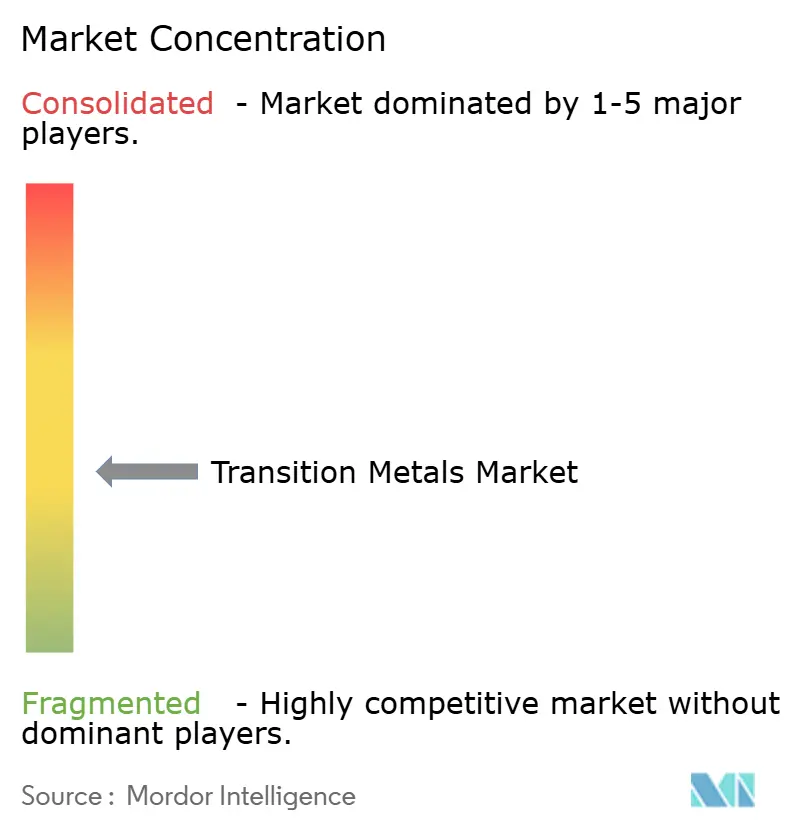
| Market Concentration | Medium |
Major Players *Disclaimer: Major Players sorted in no particular order Image © Mordor Intelligence. Reuse requires attribution under CC BY 4.0. | |
Transition Metals Market Analysis by Mordor Intelligence
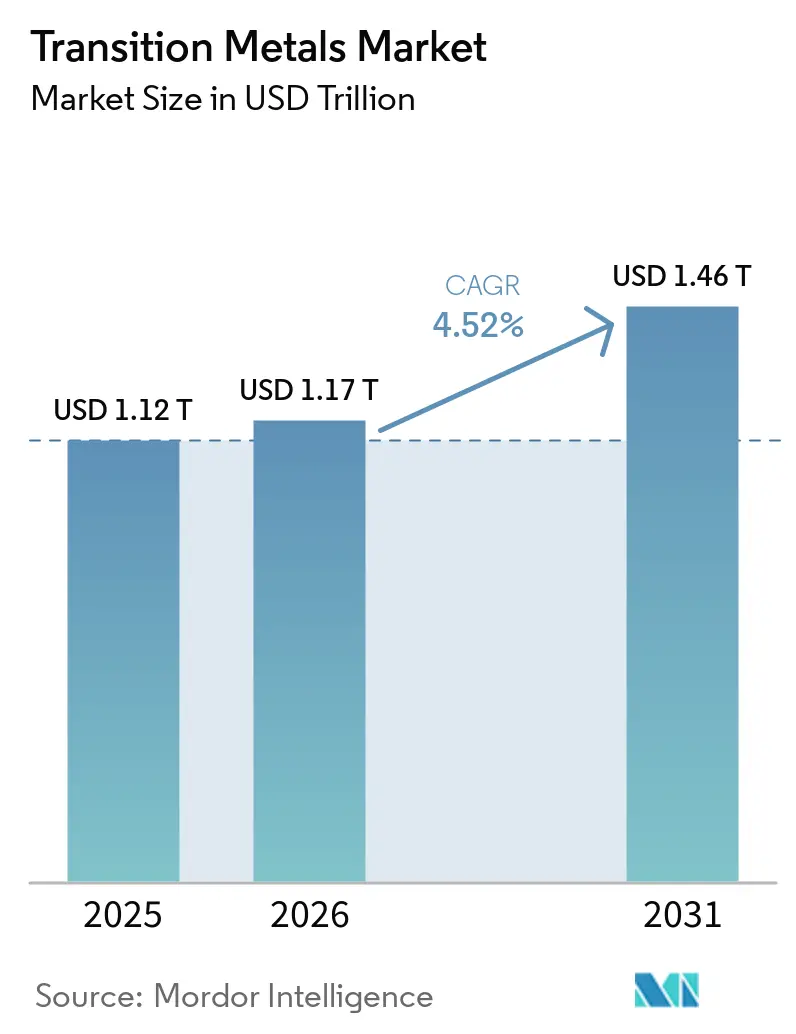
The Transition Metals Market size was valued at USD 1.12 trillion in 2025 and is estimated to grow from USD 1.17 trillion in 2026 to reach USD 1.46 trillion by 2031, at a CAGR of 4.52% during the forecast period (2026-2031). Infrastructure construction, power networks, and advanced manufacturing support demand across the transition metals market. Electrified transport also raises the use of copper, nickel, and cobalt in selected applications. Supply remains constrained by permitting, capital requirements, and concentrated refining capacity. Producers are responding through copper-focused acquisitions, brownfield projects, processing investment, and recycling. These factors support measured growth in the transition metals market through 2031.
Key Report Takeaways
- By type, iron held 39.14% of the transition metals market share in 2025, while nickel is projected to advance at a 5.08% CAGR through 2031.
- By form, plates and sheets held 29.52% of the transition metals market share in 2025, while wire is projected to advance at a 5.34% CAGR through 2031.
- By application, building and construction held 38.48% of the transition metals market share in 2025, while automotive is projected to advance at a 5.63% CAGR through 2031.
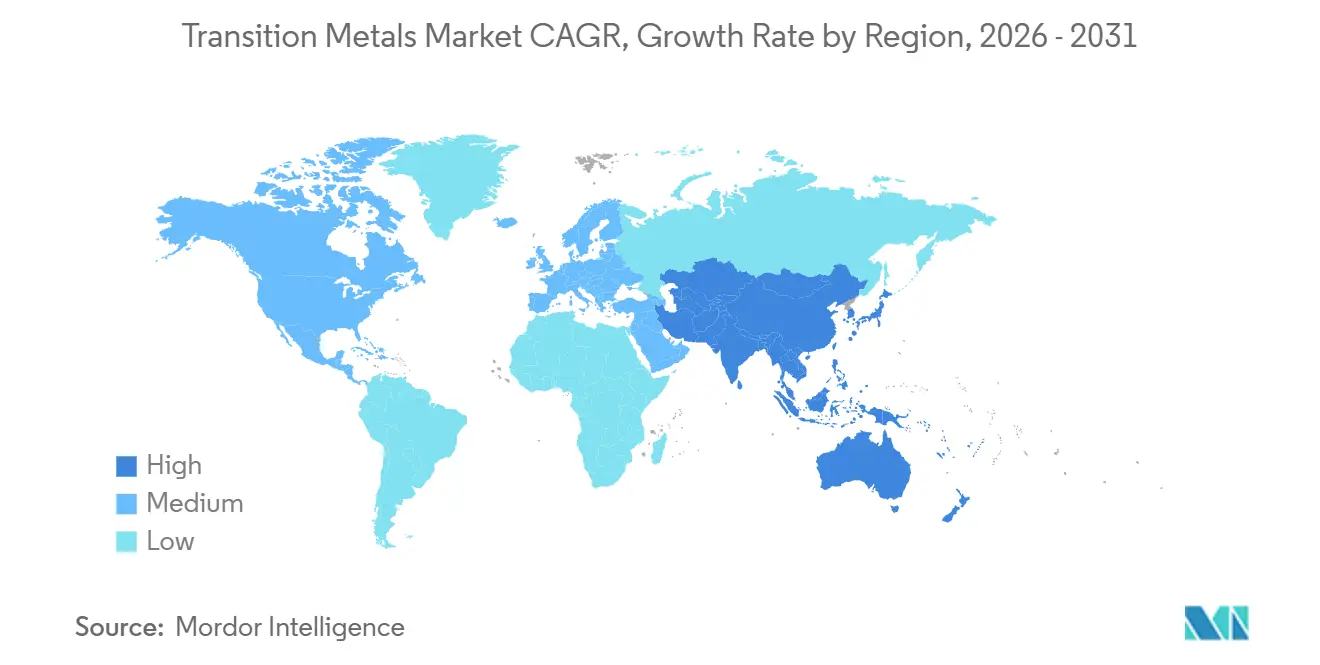
- By geography, Asia-Pacific held 43.43% of the transition metals market share in 2025 and is projected to advance at a 5.44% CAGR through 2031.
Note: Market size and forecast figures in this report are generated using Mordor Intelligence’s proprietary estimation framework, updated with the latest available data and insights as of January 2026.
Market Trends and Insights
Drivers Impact Analysis of Transition Metals Market*
| Driver | (~) % Impact on CAGR Forecast | Geographic Relevance | Impact Timeline |
|---|---|---|---|
| Infrastructure and Urban Construction Demand | +1.5% | Global, concentrated in South Asia, Southeast Asia, Africa, and the Middle East | Long term (≥ 4 years) |
| Electrification, Renewable Power and Grid Expansion | +1.2% | Global, highest intensity in APAC, North America, and Europe | Long term (≥ 4 years) |
| Electric Vehicle and Energy-Storage Material Intensity | +0.9% | Global, led by China, US, and Europe | Medium term (2-4 years) |
| Industrial Automation, Electronics and Advanced Manufacturing | +0.6% | Global, concentrated in East Asia, North America, and Germany | Medium term (2-4 years) |
| Refining Localization and Strategic Stockpiling | +0.3% | North America, Europe, Japan, Australia | Short term (≤ 2 years) |
| Source: Mordor Intelligence | |||
Infrastructure and Urban Construction Demand
Iron and steel remained central to infrastructure development, which gives the transition metals market a broad and durable demand base. Global steel demand is projected to reach 1,724 million metric tons in 2026, with India growing 7.4% and Africa growing 3.8%, compared with global growth of 0.3%[1]. India’s National Infrastructure Pipeline and rail investment create a longer planning horizon for steel procurement. Construction demand also extends beyond housing into transport, utilities, and public works. This broad project base helps sustain demand in the transition metals market when individual end uses soften.
Electrification, Renewable Power and Grid Expansion
Copper remains essential to electricity networks, making grid investment a major driver for the transition metals market. Refined copper demand reached nearly 28 million metric tons in 2025, and the International Energy Agency expects copper to record the largest volume growth among critical minerals through 2040[2]. Solar photovoltaic generation uses 4 to 5 metric tons of copper per megawatt, which is 4 to 5 times the copper use of gas-fired generation. Copper prices exceeded USD 14,000 per metric ton in May 2026 as mine supply grew only 0.8% in 2025. The International Copper Study Group projected a refined copper deficit of 150,000 metric tons in 2026 after a 178,000 metric ton surplus in 2025. Grid upgrades and charging infrastructure, therefore, reinforce the long-term position of copper within the transition metals market.
Electric Vehicle and Energy-Storage Material Intensity
Electric vehicles and energy storage continue to alter demand patterns in the transition metals market. Battery-sector nickel demand is estimated at 480,000 metric tons in 2026, up from 420,000 metric tons in 2025. Lithium iron phosphate batteries increased from 36% of global electric vehicle battery capacity in 2025 to 42% in 2026, reducing nickel use in a larger share of vehicles. Nickel-rich battery chemistries remain important for high-performance and long-range vehicles. Cobalt prices rose 130% in 2025 after the Democratic Republic of the Congo introduced an export quota system in October 2025 that capped exports at 96,600 metric tons annually. Stationary storage and backup power add demand beyond passenger vehicles, supporting a wider set of battery materials in the transition metals market.
Industrial Automation, Electronics and Advanced Manufacturing
Automation, electronics, and advanced manufacturing create additional outlets for the transition metals market. Semiconductor fabrication, industrial robotics, and server equipment require copper connections, nickel alloys, and titanium tooling. Higher-density circuit boards use more demanding copper foil specifications, while qualification cycles can extend 12 to 18 months before volume production. This raises the value of a reliable supply for processors that can meet specialized requirements. Aerospace and defense manufacturing also requires titanium and cobalt-bearing superalloys. These uses add to established construction and transport demand, which broadens the end-use base of the transition metals market.
Restraints Impact Analysis of Transition Metals Market*
| Restraint | (~) % Impact on CAGR Forecast | Geographic Relevance | Impact Timeline |
|---|---|---|---|
| Environmental Permitting and Compliance Costs | -0.8% | Global, especially the US, Canada, EU, and Australia | Long term (≥ 4 years) |
| Price Volatility and Capital-Intensive Mine Development | -0.7% | Global | Medium term (2-4 years) |
| Concentrated Refining and Trade-Route Exposure | -0.5% | EU, US, Japan, South Korea, India (net importers) | Short term (≤ 2 years) |
| Source: Mordor Intelligence | |||
Environmental Permitting and Compliance Costs
Environmental review requirements slow the development of new mines for the transition metals market. Mining projects in the United States, Canada, the European Union, and Australia can require multi-year environmental review processes. Longer timelines defer new supply even when prices support investment. Operating mines also face higher compliance expenses, which can raise production costs. These conditions favor expansions at existing sites where infrastructure and permitting knowledge already exist. The result is a supply response that may remain slower than demand growth in the transition metals market.
Price Volatility and Capital-Intensive Mine Development
Price cycles and high capital needs can delay supply additions for the transition metals market. Building 7 million metric tons of annual copper capacity through 2040 would require USD 156 billion in project investment at the cited capital intensity of USD 22,359 per metric ton of annual capacity. Battery metals capital spending fell by more than 20% in 2025, the largest single-year decline in more than a decade. Low lithium and nickel prices in 2024 and early 2025 caused developers to reduce investment. Battery chemistry changes also made investors cautious about mines focused on a single material. This financing environment can limit timely capacity additions across the transition metals market.
*Our forecasts treat driver/restraint impacts as directional, not additive. The impact forecasts reflect baseline growth, mix effects, and variable interactions.
Transition Metals Market Segment Analysis
By Type:
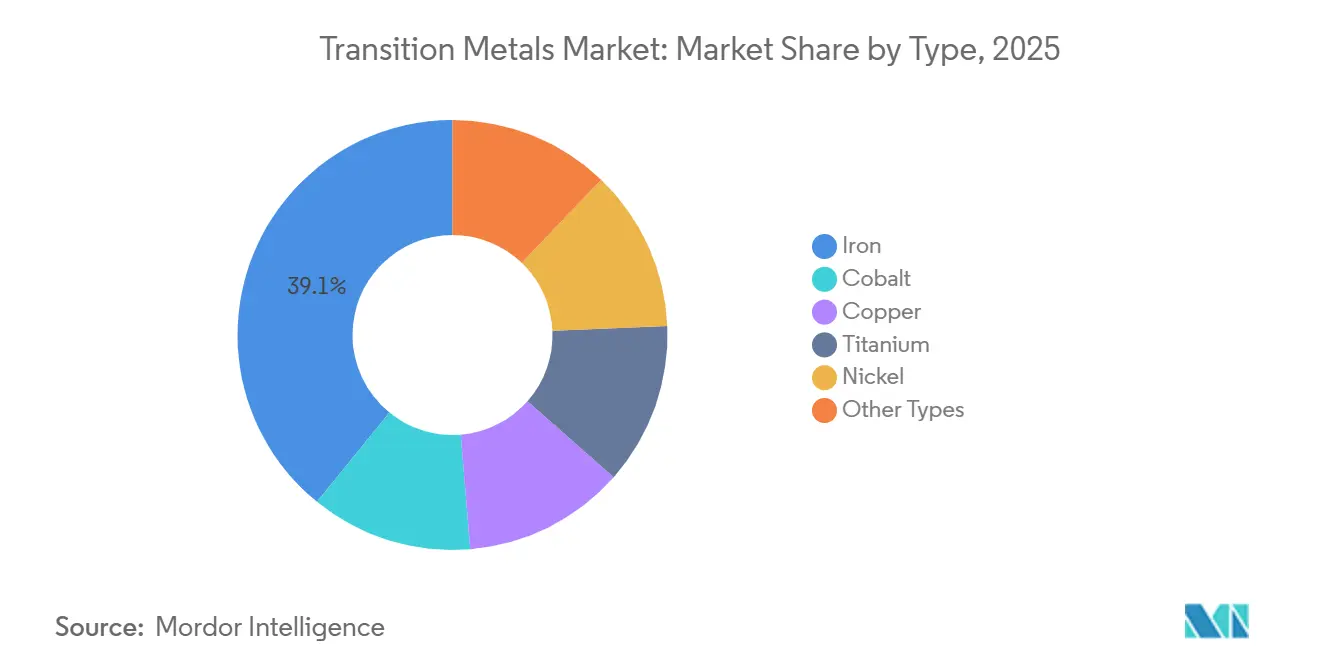
Iron Leads Demand, While Nickel Expands with Battery UseIron held 39.14% of the market revenue in 2025, supported by its role in construction, machinery, automotive production, and shipbuilding. Global crude steel output is projected to reach 1,869 million metric tons in 2026. India is projected to produce 174.9 million metric tons, while the Association of Southeast Asian Nations (ASEAN) is projected to produce 61.5 million metric tons. These figures show that steel demand is spreading across emerging manufacturing and construction centers. Copper remains strategically important because refined demand reached nearly 28 million metric tons in 2025. Titanium serves aerospace and defense supply chains, while cobalt supports battery and superalloy applications.
Nickel is projected to advance at a 5.08% CAGR through 2031. Its use in high-performance battery chemistries and stainless steel supports this outlook. China accounted for the majority of global nickel usage in 2025, and global nickel demand is projected to grow 4.3% in 2026. Indonesia controlled nearly two-thirds of the mined nickel supply and just under half of the refined nickel output in 2025. Vale’s Pomalaa High-Pressure Acid Leaching project targets autoclave commissioning in the second half of 2026. The rise of lithium iron phosphate chemistry limits the pace of nickel demand, even as total nickel use continues to increase.

By Form:
Wire Records the Fastest Growth from Grid InvestmentPlates and sheets held 29.52% of the revenue share in 2025, supported by structural steel demand in construction, offshore energy, and shipbuilding. India’s steel demand is projected to increase 6.7% in 2026, and Africa’s demand is projected to increase 4.4% in 2026. These demand centers support regional procurement for plates and sheets in the transition metals market. Nickel-plated steel sheets are also finding use in cylindrical battery cases. Dongkuk Industries began producing nickel-plated steel sheets for secondary battery cases in September 2026. The company is targeting mass production for 46-series battery formats in North America in 2027.
Wire is projected to advance at a 5.34% CAGR through 2031. Grid expansion and charging networks require copper wire at both the vehicle and grid-connection levels. A battery electric vehicle uses 83 kg of copper, compared with 23 kg in an internal combustion engine vehicle. Bars and rods serve reinforced concrete and engineering applications. Chinese rebar prices fell in 2025 as domestic construction weakened and exports increased. China’s share of world steel exports rose from 19% in 2019 to 41% in 2025. Powders and specialized forms support additive manufacturing, electronics, coatings, and chemical processing uses.
By Application:
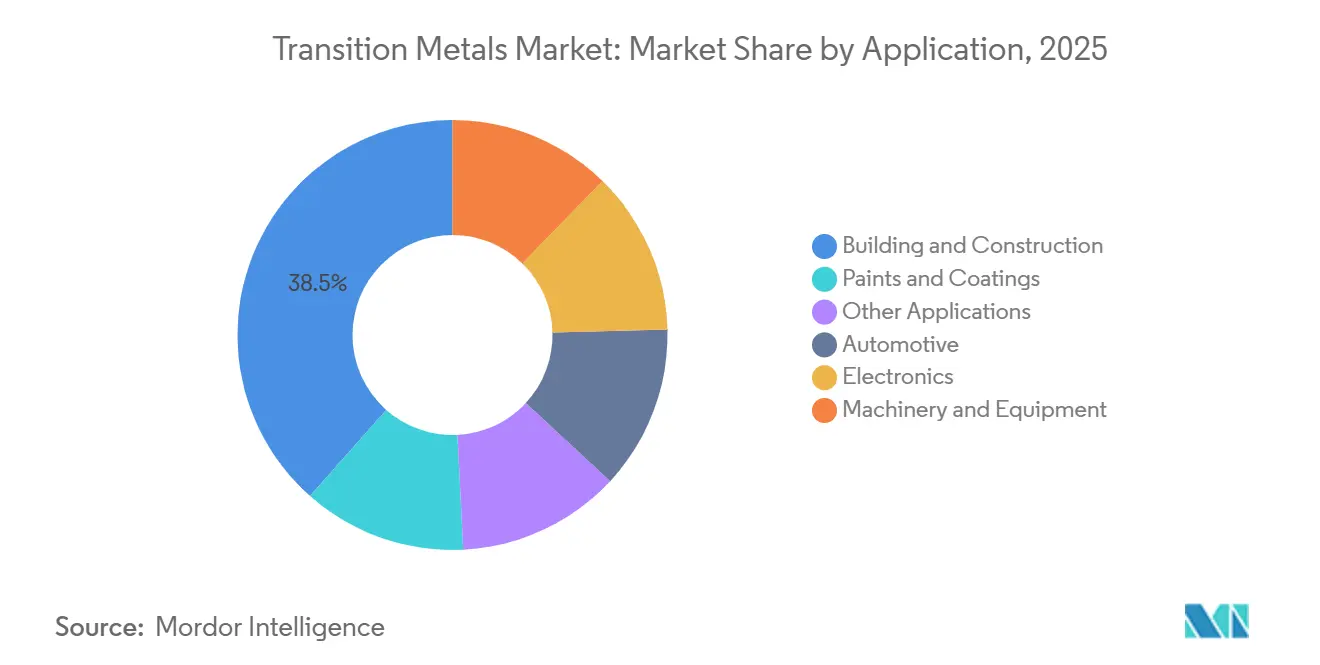
Building and Construction Holds the Largest Base, While Automotive Grows FastestBuilding and construction held 38.48% of the market revenue in 2025. The application draws on iron, steel, and structural copper across developed and developing economies. Global steel demand is projected to reach 1,724 million metric tons in 2026, with infrastructure and non-residential construction supporting demand. India’s projected 6.7% steel-demand growth in 2026 reflects the rising importance of South and Southeast Asia. New data center construction also adds demand for steel and electrical materials.
Automotive is projected to advance at a 5.63% CAGR through 2031. Electric vehicles raise per-vehicle use of copper, nickel, and cobalt. Electronics represent another major demand category, supported by server infrastructure, high-density circuit boards, and semiconductor fabrication equipment. Paints and coatings use cobalt and titanium compounds for pigments, adhesion, and ultraviolet stabilization. Lower-volatile-organic-compound waterborne formulations are changing the technical requirements for selected cobalt-based driers. Machinery, equipment, and other applications provide a diverse industrial demand base that can moderate swings in construction and automotive activity.
Geography Analysis
APAC Transition Metals Market
Asia-Pacific held 43.43% of the market revenue in 2025 and is projected to advance at a 5.44% CAGR through 2031. China controls the majority of global cobalt refining capacity and more than 90% of battery-grade graphite processing capacity. China’s steel consumption declined 6.9% in 2025 and is projected to decline 0.6% in 2026 as its property correction continues. India’s steel consumption rose 9.8% to 163.71 million metric tons in 2025 and is projected to rise 6.7% to 174.72 million metric tons in 2026. The Association of Southeast Asian Nations' demand is projected to grow 3.5% in 2026, supported by manufacturing investment and industrial expansion.
The Americas, Europe and Oceania Transition Metals Market
North America is supported by infrastructure investment, industrial policy, grid modernization, and data center construction. United States steel demand rose 0.7% in 2025 and is projected to grow 0.6% in 2026. Supply chain rules under the Inflation Reduction Act direct battery-material investment toward approved jurisdictions, including Australia, Canada, and Chile. Europe’s steel demand is projected to recover 1.4% in 2026, supported by infrastructure and defense spending. The European Union’s April 2026 steel safeguard regulation introduced 50% duties on out-of-quota imports and a melt-and-pour origin requirement.
MEA and South America Transition Metals Market
Africa’s steel demand is projected to grow 4.4% in 2026. The Middle East’s steel demand is projected to increase 1.6% in 2026 after a strong improvement in 2025. The Democratic Republic of the Congo controlled 73% of the global mined cobalt supply in 2025. South America supplies copper and iron ore through Chile and Brazil, but it has less refining capacity. Vale targets iron ore output of 335 to 345 million metric tons in 2026. This resource and processing gap is shaping investment priorities across the transition metals market.
Competitive Landscape
The transition metals market is moderately concentrated, with the top five players including BHP, Rio Tinto, Vale, Glencore, and Freeport-McMoRan. Processing is more concentrated in selected countries, particularly China and Indonesia. Anglo American and Teck Resources Limited announced a merger of equals in September 2025 to form Anglo Teck, a company with more than 70% copper exposure. The planned transaction reflects the increasing strategic value of copper portfolios. BHP is advancing a copper growth pipeline targeting 3% to 4% attributable copper-equivalent compound annual growth between fiscal years 2027 and 2035. Freeport-McMoRan is targeting a potential 60% increase in United States copper production from domestic assets.
BHP invested USD 4.7 billion in copper during fiscal year 2026 and submitted new concentrator plans for Escondida to Chilean environmental authorities. The Escondida plan favors a brownfield expansion route with lower development risk than a new mine. Rio Tinto and BHP completed the Resolution Copper land exchange in March 2026 and committed USD 0.5 billion over the following 2 years for drilling and development. Anglo American’s sale process for its Steelmaking Coal business shows the move toward simpler portfolios focused on critical minerals. These actions raise the importance of established ore bodies and operating capabilities within the transition metals market.
Processing, recycling, and local supply chains offer room for competitive differentiation in the transition metals market. Sumitomo Metal Mining Co., Ltd. opened Japan’s first electric vehicle battery recycling plant in September 2026, adding a domestic source of recovered battery materials. Vale’s Indonesia Growth Project includes USD 7.2 billion of planned investment across 3 processing sites. KGHM produced 710,000 metric tons of payable copper in 2025 and began constructing 3 new mine shafts in Poland in 2026. Freeport-McMoRan also converted the Bagdad mine haul-truck fleet to autonomous operations, its first fully autonomous United States site.
Transition Metals Industry Leaders
-
BHP
-
Rio Tinto
-
Glencore
-
Vale
-
Freeport-McMoRan
- *Disclaimer: Major Players sorted in no particular order
Transition Metals Market Companies Covered in this Report
- Anglo American
- ArcelorMittal
- BHP
- CMOC
- Freeport-McMoRan
- Glencore
- Jinchuan Group International Resources Co. Ltd
- KGHM
- Norilsk Nickel
- Nucor Corporation
- Rio Tinto
- Southern Copper Corporation
- Sumitomo Metal Mining Co., Ltd.
- Teck Resources Limited
- Vale
Recent Industry Developments in Transition Metals Market
- September 2026: The Democratic Republic of Congo established a task force to accelerate its strategic minerals partnership with the United States, focusing on copper and cobalt investments and Western-market supply agreements. The initiative supports diversification of global transition-metal supply chains for energy, electronics, and advanced manufacturing applications.
- July 2026: Vale’s High-Pressure Acid Leaching project in Morowali, Central Sulawesi, reached a construction milestone with the arrival of a key autoclave unit for the low-carbon nickel facility. The project forms part of Vale’s USD 7.2 billion Indonesian investment program, supporting additional nickel supply for battery materials and strengthening demand for transition metals.
Global Transition Metals Market Report Scope
Transition metals are metallic elements characterized by their ability to form various compounds and exhibit multiple oxidation states. They provide useful combinations of strength, conductivity, corrosion resistance, and thermal properties for engineered materials and industrial processes.
The Transition Metals Market is segmented by type, form, application, and geography. By type, the market is segmented into iron, copper, titanium, nickel, cobalt, and other types. By form, the market is segmented into plates and sheets, powders, bars and rods, wire, and other forms. By application, the market is segmented into building and construction, automotive, electronics, paints and coatings, machinery and equipment, and other applications. The report also covers the market size and forecasts for transition metals in 15 countries across major regions. For each segment, the market sizing and forecasts have been done on the basis of value (USD).
Segmentation Overview
| Iron |
| Copper |
| Titanium |
| Nickel |
| Cobalt |
| Other Types |
| Plates and Sheets |
| Powders |
| Bars and Rods |
| Wire |
| Other Forms |
| Building and Construction |
| Automotive |
| Electronics |
| Paints and Coatings |
| Machinery and Equipment |
| Other Applications |
| Asia-Pacific | China |
| India | |
| Japan | |
| South Korea | |
| ASEAN Countries | |
| Rest of Asia-Pacific | |
| North America | United States |
| Canada | |
| Mexico | |
| Europe | Germany |
| United Kingdom | |
| France | |
| Italy | |
| NORDIC Countries | |
| Rest of Europe | |
| South America | Brazil |
| Argentina | |
| Rest of South America | |
| Middle East and Africa | Saudi Arabia |
| South Africa | |
| Rest of Middle East and Africa |
| By Type | Iron | |
| Copper | ||
| Titanium | ||
| Nickel | ||
| Cobalt | ||
| Other Types | ||
| By Form | Plates and Sheets | |
| Powders | ||
| Bars and Rods | ||
| Wire | ||
| Other Forms | ||
| By Application | Building and Construction | |
| Automotive | ||
| Electronics | ||
| Paints and Coatings | ||
| Machinery and Equipment | ||
| Other Applications | ||
| By Geography | Asia-Pacific | China |
| India | ||
| Japan | ||
| South Korea | ||
| ASEAN Countries | ||
| Rest of Asia-Pacific | ||
| North America | United States | |
| Canada | ||
| Mexico | ||
| Europe | Germany | |
| United Kingdom | ||
| France | ||
| Italy | ||
| NORDIC Countries | ||
| Rest of Europe | ||
| South America | Brazil | |
| Argentina | ||
| Rest of South America | ||
| Middle East and Africa | Saudi Arabia | |
| South Africa | ||
| Rest of Middle East and Africa | ||
Key Questions Answered in the Report
What is the size of the transition metals market?
The transition metals market stands at USD 1.17 trillion in 2026 and is projected to reach USD 1.46 trillion by 2031.
Which type held the largest share in 2025?
Iron held 39.14% of the market share in 2025 because of its broad use in steel, construction, machinery, automotive production, and shipbuilding.
Which form is projected to grow fastest through 2031?
Wire is projected to advance at a 5.34% CAGR through 2031 as power grids and electric vehicle charging networks require more copper connections.
Which application held the largest share in 2025?
Building and construction held 38.48% of the market share in 2025, supported by demand for iron, steel, and structural copper.