
Transformer Insulation Market Size and Share
Market Overview
| Study Period | 2022 - 2032 |
|---|---|
| Market Size (2027) | USD 5.60 Billion |
| Market Size (2032) | USD 7.45 Billion |
| Growth Rate (2027 - 2032) | 5.86 % |
| Fastest Growing Market | Asia-Pacific |
| Largest Market | Asia-Pacific |
| Market Concentration | Medium |
Major Players *Disclaimer: Major Players sorted in no particular order Image © Mordor Intelligence. Reuse requires attribution under CC BY 4.0. | |
Transformer Insulation Market Analysis by Mordor Intelligence
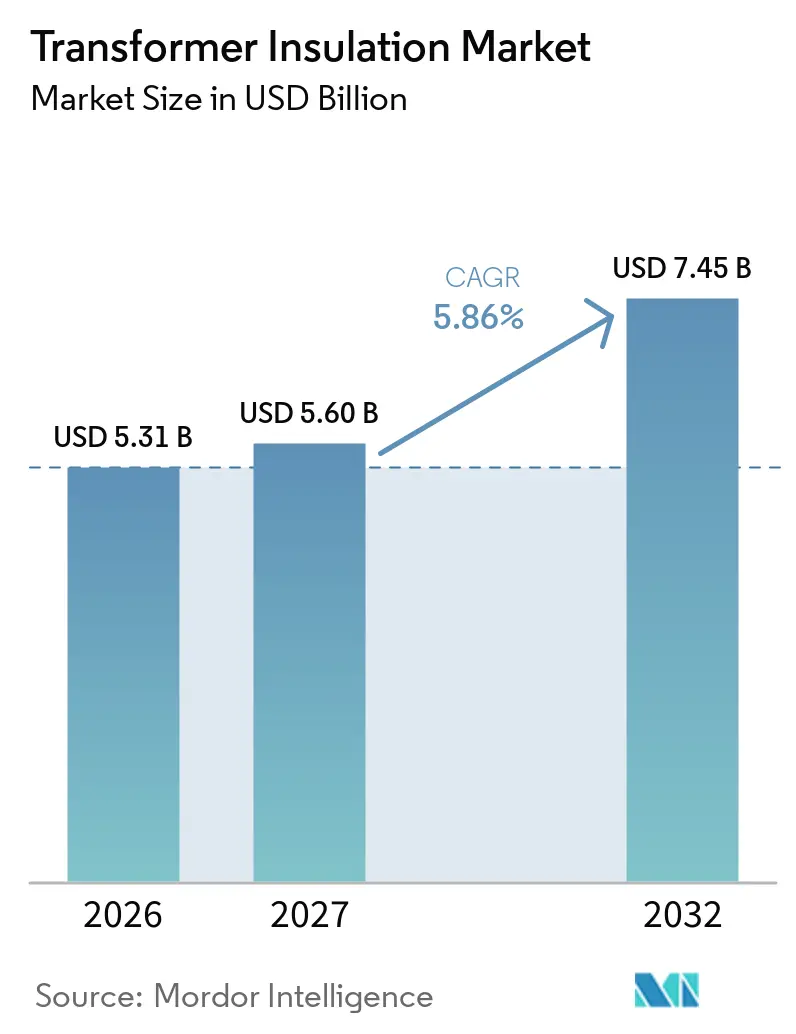
The transformer insulation market size was valued at USD 5.31 billion in 2026 and is estimated to grow from USD 5.60 billion in 2027 to USD 7.45 billion by 2032, at a CAGR of 5.86% during the forecast period (2027-2032). Replacement needs across aging power networks, grid investment for renewable electricity, and expanding data center construction support demand for insulation materials. Global transmission investment reached USD 140 billion in 2023 and needs to exceed USD 200 billion annually by the mid-2030s to meet rising electricity demand. Longer transformer delivery times and higher equipment prices increase the value of materials that support reliable operation and extend asset life. The transformer insulation market benefits when utilities seek higher thermal performance, stronger fire protection, and lower environmental impact. Competitive activity centers on qualified materials, production capacity, and the ability to meet utility specifications.
Key Report Takeaways
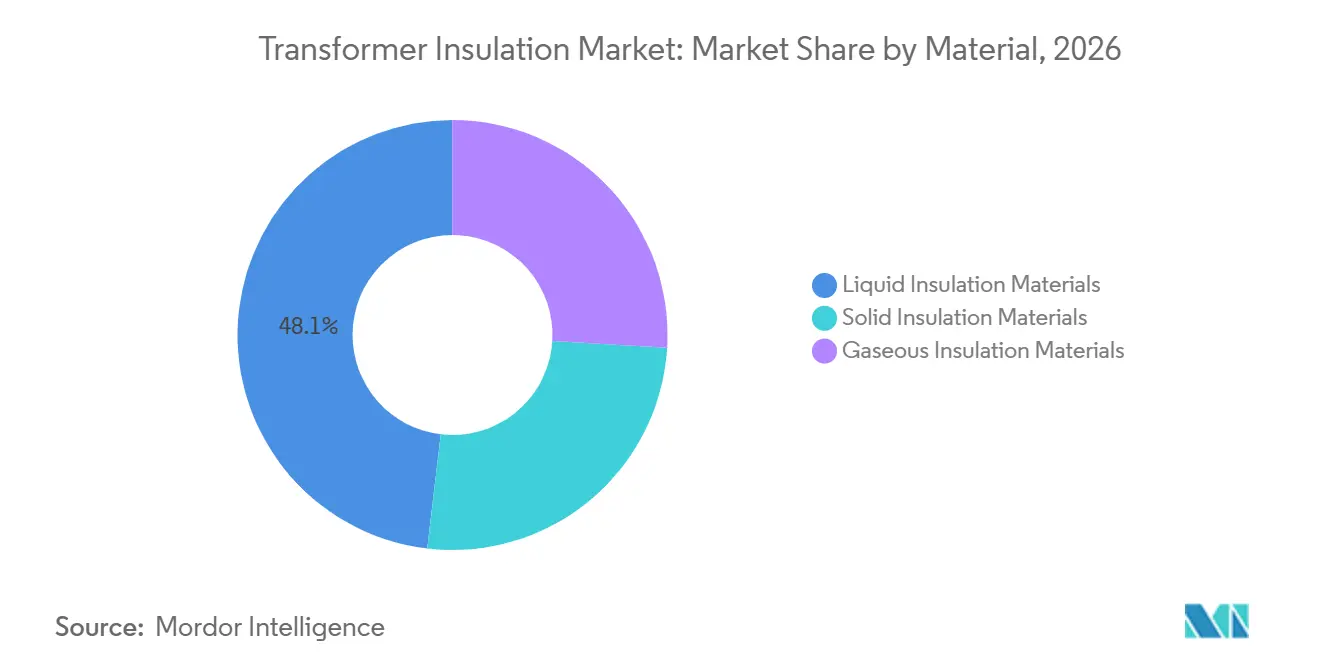
- By material, liquid insulation held 48.12% of the transformer insulation market share in 2026, while solid insulation is forecast to grow at a 6.18% CAGR through 2032.
- By voltage class, high voltage accounted for 40.54% of the transformer insulation market share in 2026, while extra-high voltage is forecast to expand at a 6.29% CAGR through 2032.
- By transformer type, liquid-filled transformers held 66.38% of the transformer insulation market share in 2026, while dry-type transformers are forecast to grow at a 6.43% CAGR through 2032.
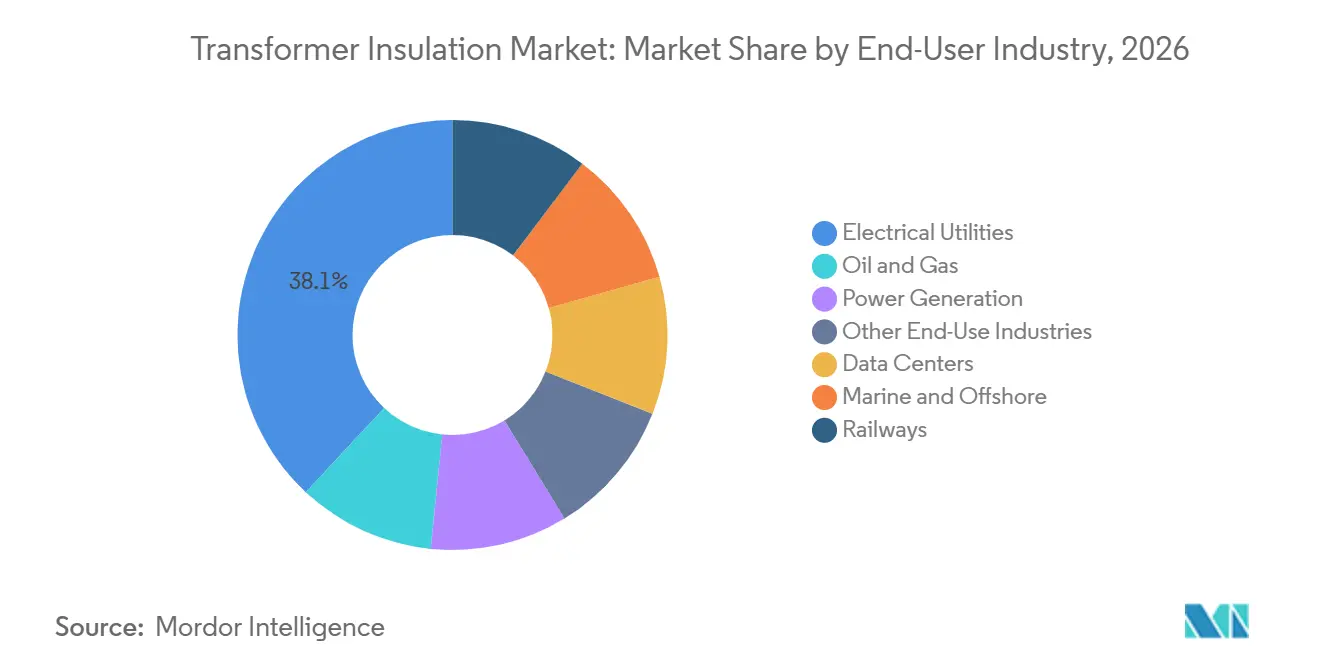
- By end-user industry, electrical utilities accounted for 38.05% of the transformer insulation market share in 2026, while data centers are forecast to expand at a 6.82% CAGR through 2032.
- By geography, Asia-Pacific held 42.69% of the transformer insulation market share in 2026 and is forecast to grow at a 6.74% CAGR through 2032.
Note: Market numbers in this report are based on Mordor Intelligence's proprietary estimation framework, which combines nine months of actuals with Q4 projections for base year 2026.
Market Trends and Insights
Drivers Impact Analysis of Transformer Insulation Market*
| Drivers | (~) % Impact on CAGR Forecast | Geographic Relevance | Impact Timeline |
|---|---|---|---|
| Grid Modernization and Aging Transformer Replacement | +1.5% | North America and Europe, with growing significance in the Asia-Pacific | Long term (≥ 4 years) |
| Renewable Energy and HVDC Interconnection Buildout | +1.3% | Global, with Asia-Pacific, Europe, China, India, the Nordics, and Germany most relevant | Medium term (2-4 years) |
| Data-Center and Electrification Load Growth | +1.4% | North America, Asia-Pacific, and spillover to the Middle East and Africa | Short term (≤ 2 years) |
| Fire-Safety and Environmental Preference for Ester Fluids and Dry-Type Systems | +0.9% | Europe and North America | Medium term (2-4 years) |
| High-Temperature Insulation for Transformer Capacity Uprating | +0.5% | Global, with early gains in South and Southeast Asia and North America | Long term (≥ 4 years) |
| Source: Mordor Intelligence | |||
Grid Modernization and Aging Transformer Replacement
Deferred capital spending in North American and European power networks has created a replacement backlog that supports demand for insulation in high-voltage and extra-high-voltage equipment. The U.S. Department of Energy estimates that 65% of U.S. power transformers are beyond their average 25-year service life[1]. The International Energy Agency (IEA) reported that transformer lead times had extended to as much as 4 years, while prices had risen 75% in real terms since 2019. Utilities can use thermally upgraded or aramid-composite insulation to increase asset capability without waiting for new equipment. This supports demand for high-temperature solid materials and natural ester retrofill options in maintenance programs. The size and age of the installed fleet give the transformer insulation market a sustained source of demand rather than a short replacement cycle.
Renewable Energy and High Voltage Direct Current (HVDC) Interconnection Buildout
HVDC and ultra-high-voltage AC projects require materials that can withstand DC partial discharge, space-charge accumulation, polarity reversal, and high thermal loads. These applications favor specialized dielectric formulations that have already passed utility qualification processes. Global transmission investment reached USD 140 billion in 2023, with grid development supporting major transmission links, interconnectors, and offshore wind systems. India plans USD 146.7 billion of transmission investment through 2035, with peak electricity demand projected at 446 GW by FY2034-35. Hitachi Energy India expanded its Mysuru facility in August 2025, doubling 800 kV pressboard capacity to serve this demand. Qualification cycles lasting 3 to 4 years strengthen the position of suppliers with approved material portfolios.
Data-Center and Electrification Load Growth
Data center development is increasing demand for dry-type transformers and natural ester insulation systems. Larger computing campuses require reliable electrical systems with strong fire safety and thermal performance. Large dry-type units, including 22.5 MVA and 50 kV transformers used in a data center substation in the Netherlands, indicate that solid insulation systems are moving into higher-voltage applications. Hitachi Energy announced more than USD 1 billion of U.S. manufacturing investment in September 2025, including USD 457 million for a transformer facility in South Boston, Virginia. Weidmann stated in November 2025 that its INSULution DPE paper was designed for data center transformer applications and qualified to 130°C in mineral oil and 140°C in ester liquid. These requirements create a larger role for qualified solid and liquid insulation materials in the transformer insulation market.
Fire-Safety and Environmental Preference for Ester Fluids and Dry-Type Systems
Natural ester fluids and dry-type systems are becoming more common in locations with strict fire and environmental requirements. Hitachi Energy tested a 765 kV, 400 kV, single-phase, 250 MVA natural ester-filled power transformer in May 2025. The company stated that the tested fluid has a flash point twice that of mineral oil and biodegrades fully within 28 days. A 2025 pool-fire study found that natural and synthetic esters did not ignite at temperatures above 300°C. Cargill opened a Gouda facility that tripled European FR3 supply and announced added capacity in Dilovası, Türkiye, in August 2026. These developments broaden the material options available for regulated indoor and environmentally sensitive sites.
Restraints Impact Analysis of Transformer Insulation Market*
| Restraints | (~) % Impact on CAGR Forecast | Geographic Relevance | Impact Timeline |
|---|---|---|---|
| Premium Cost of Advanced Papers, Resins, and Ester Fluids | -1.4% | Global, with the strongest effect in price-sensitive markets in South and Southeast Asia and Africa | Short term (≤ 2 years) |
| Long Qualification Cycles and Conservative Utility Specifications | -1.0% | North America, Europe, and utilities globally | Long term (≥ 4 years) |
| Raw-Material Volatility and Specialty-Pulp Supply Concentration | -0.9% | Global, with particular relevance for European and North American insulation paper producers | Medium term (2-4 years) |
| Source: Mordor Intelligence | |||
Premium Cost of Advanced Papers, Resins, and Ester Fluids
The cost of advanced insulation remains a key barrier for mid-tier utilities and industrial buyers in price-sensitive markets. Cargill states that FR3 can extend the life of cellulose insulation by up to 8 times compared with mineral oil[2]. This lifecycle benefit can be difficult to capture when capital budgets drive purchasing decisions. Amorphous alloy dry-type transformers that require high-performance solid insulation cost 30% more than conventional silicon-steel units. Electrical-grade kraft pulp costs remain 40% above pre-pandemic levels, which limits margins for producers without pricing power. These conditions constrain adoption across South and Southeast Asia, sub-Saharan Africa, and Latin America, even where electricity demand is increasing.
Long Qualification Cycles and Conservative Utility Specifications
Transformer insulation requires extensive dielectric, thermal, and aging validation before utilities approve a new material. IEC 60076 and the IEEE C57 series can require testing cycles lasting 2 to 3 years. This delays commercial adoption of cellulose nanocomposites, aramid-composite papers, and bio-based coatings after they demonstrate technical promise. A 2025 IEEE review identified filler-matrix control and uniform nanoparticle dispersion at commercial scale as significant barriers for advanced insulation materials. Suppliers with established qualification records therefore retain an advantage in the transformer insulation market. Weidmann started an EU-supported research and development project in Croatia in January 2025 to develop insulation components using Industry 4.0 manufacturing methods.
*Our forecasts treat driver/restraint impacts as directional, not additive. The impact forecasts reflect baseline growth, mix effects, and variable interactions.
Transformer Insulation Market Segment Analysis
By Material:
Liquid Insulation Leads While Solid-Material Momentum BuildsLiquid insulation held 48.12% of the transformer insulation market share in 2026. Mineral oil-immersed transformers account for much of this position due to their extensive installed base in transmission applications. Natural and synthetic esters are adding fire-safe retrofill options within the liquid category. Hitachi Energy tested a 765 kV natural ester-filled transformer in May 2025, demonstrating its potential for ultra-high-voltage applications. Its use of Nynas NYTRO RR 900X re-refined oil at the Cordoba factory also introduced a circular-material option with up to 8% lower global warming potential over its lifecycle under International Electrotechnical Commission (IEC) 60296:2020. These developments indicate that liquid insulation is adapting to environmental and safety requirements. The material group is essential for the installed fleet and offers buyers more fluid choices for new units and retrofits. Its established role in high-voltage equipment means changes in fluid formulation can influence a large base of existing transformer applications.
Solid insulation is the fastest-growing material group, with a forecast CAGR of 6.18% from 2027 to 2032. Dry-type transformer demand in indoor, urban, and fire-sensitive applications supports this growth. A 2025 study reported that boron-nitride-enhanced cellulose paper had 23% higher dielectric strength, 35% greater tensile strength, and 300% better through-plane thermal conductivity than standard cellulose. These characteristics support emerging extra-high-voltage and data-center specifications. Gaseous insulation remains the smallest material group. European sulfur hexafluoride (SF6) phaseout requirements are encouraging alternatives, including Hitachi Energy's SF6-free GARIP Eco transformer–Gas-Insulated Switchgear (GIS) bushing introduced in June 2025.

By Voltage Class:
Extra-High Voltage Demand Reshapes Insulation SpecificationsHigh voltage accounted for 40.54% of the transformer insulation market share in 2026. Conventional transmission infrastructure and replacement purchasing by mature-market utilities support this position. Extra-high voltage is forecast to grow the fastest, at a CAGR of 6.29% from 2027 to 2032. High-Voltage Direct Current (HVDC) backbone programs, ultra-high-voltage AC links, and offshore wind systems require insulation capable of withstanding sustained electrical and thermal stress. Extra-high-voltage applications require partial-discharge levels below 10 pC per IEC 60076-3 and compatibility with advanced cooling fluids. These demanding requirements concentrate supply among firms that have qualified materials.
Medium- and low-voltage applications use larger quantities of lower-specification materials in distribution and end-use equipment. Urbanization and industrial electrification support stable demand across these classes. Medium voltage is important for rail traction, marine systems, and data-center distribution equipment. Higher thermal-class requirements are raising material specifications in these applications. Hitachi Energy India's Mysuru expansion doubled 800 kV pressboard capacity in August 2025, reflecting the extra-high-voltage project pipeline in Asia and the Middle East. U.S. energy efficiency requirements for transformers at 161 kV and above take effect in October 2026 and further strengthen performance expectations for equipment entering that market.
By Transformer Type:
Dry-Type Momentum Challenges the Liquid-Filled LegacyLiquid-filled transformers held 66.38% of the transformer insulation market share in 2026. They remain important in high-voltage utility transmission and power generation because oil-immersed systems offer superior thermal performance at high MVA ratings. Dry-type transformers are forecast to grow at a CAGR of 6.43% from 2027 to 2032. Data-center construction, indoor fire safety requirements, and railway electrification support this growth. Dry-type units rated at 22.5 MVA and 50 kV have been deployed in data-center substations in the Netherlands, demonstrating that solid insulation can support higher voltage levels than in prior applications.
Regulations also favor dry-type equipment for many indoor installations. EU Directive 2014/35/EU and U.S. National Electrical Code Article 450 support its use in these locations. DuPont Nomex paper is gaining use in 400 kV liquid-filled units, creating a hybrid application across transformer types. Weidmann INSULutions DPE paper offers a material choice between standard kraft and premium aramid for liquid-filled data-center and renewable-energy equipment. A 2026 review found that aramid papers retain stronger mechanical integrity, breakdown voltage, and oxidation resistance than thermally upgraded kraft under long-term thermal stress. This supports continued material development in both transformer categories. Liquid-filled equipment remains central to large-scale power transmission, while dry-type systems are gaining ground where indoor operation and fire performance govern equipment selection. Insulation suppliers must therefore support different technical requirements across the two categories.
By End-User Industry:
Data Centers Drive the Fastest Demand GrowthElectrical utilities held 38.05% of the transformer insulation market share in 2026. Their framework contracts increasingly consider ester fluids and high-temperature solid insulation as lifecycle-cost models become more common. Data centers are the fastest-growing end-user segment, with a forecast CAGR of 6.82% through 2032. AI computing workloads require larger transformer capacity at hyperscale campuses. Operators also require strong reliability to reduce the risk of downtime. These needs increase demand for insulation with higher thermal capability and fire performance.
Power generation maintains demand for liquid insulation in generator step-up transformers. Utility-scale solar and wind projects are increasingly specifying natural ester fluids for ecologically sensitive locations. Railway electrification in Europe, India, and Southeast Asia supports demand for high-temperature traction transformer insulation. Marine and offshore equipment requires materials that can withstand salt air, vibration, and strict fire-containment requirements. Oil and gas equipment remains a premium application where high ambient temperatures and hazardous-area ratings are important. The transformer insulation market, therefore, serves a mix of large utility demand and specialized end-use requirements.
Geography Analysis
APAC Transformer Insulation Market
Asia-Pacific held 42.69% of the transformer insulation market share in 2026 and is forecast to grow at a CAGR of 6.74% through 2032. China recorded CNY 608.3 billion (~USD 90.88 billion) in grid investment in 2024. Asia added 421.5 GW of renewable capacity in 2024, representing 71% of global additions. India projects peak demand of 446 GW by FY2034-35 and has planned USD 146.7 billion in transmission investment through 2035. Hitachi Energy India expanded its Mysuru facility in August 2025, adding production capacity and establishing a fossil-free pressboard production line. Japan, South Korea, ASEAN countries, and other Asia-Pacific markets contribute to demand through grid modernization and industrial electrification.
North America Transformer Insulation Market
North America's transformer insulation market is shaped by an aging transformer base and rising electricity demand from data centers and manufacturing. The U.S. Department of Energy estimates that 65% of U.S. power transformers are beyond their 25-year average service life, supporting demand for insulation replacement, retrofitting, and new transformer production. Hitachi Energy announced more than USD 1 billion in U.S. manufacturing investment in September 2025. In June 2026, the company signed an agreement to acquire Canduct Group to expand its North American transformer-component capabilities. These investments support local supply for original equipment manufacturers across the United States and Canada.
EMEA and South America Transformer Insulation Market
Europe leads in the adoption of bio-based and fire-safe insulation, with environmental regulations driving demand for natural esters and dry-type systems. Weidmann opened a laminated board facility in Pojatno, Croatia, in September 2025, adding 8,000 m² of production space. Cargill's Gouda facility tripled the European supply of FR3 fluid. Germany, the United Kingdom, France, Italy, and the Nordic countries are key demand centers, driven by offshore wind, HVDC interconnectors, and urban grid reinforcement. South America, the Middle East, and Africa represent expanding markets for transmission infrastructure. Brazil and Saudi Arabia are increasing renewable-related transmission activity, while the Mysuru export program serves the United Arab Emirates, Saudi Arabia, South Africa, and Türkiye.
Competitive Landscape
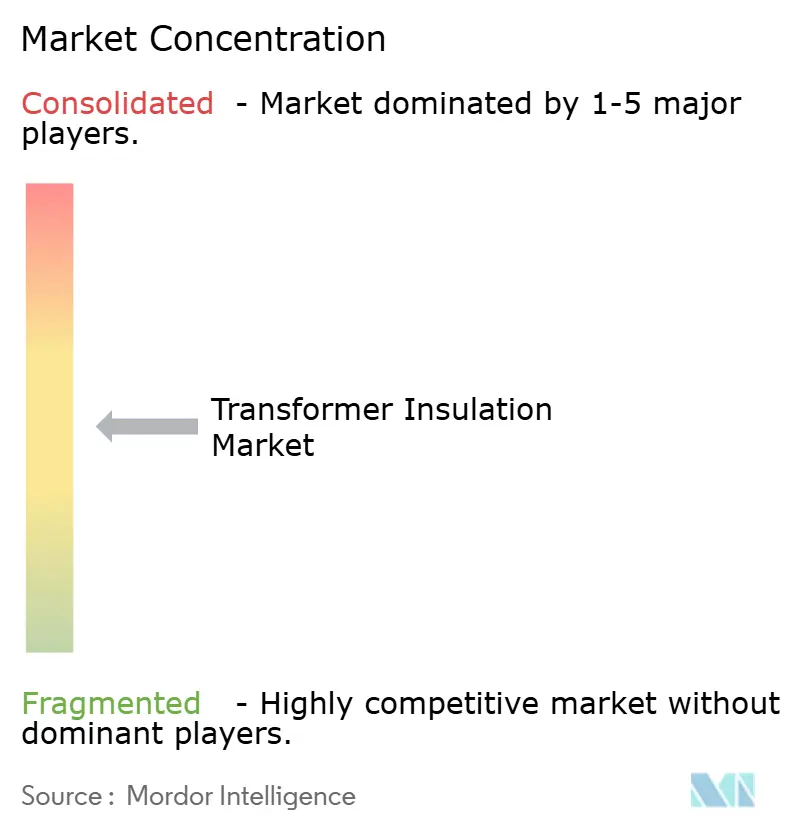
The transformer insulation market is moderately fragmented in performance materials and in standard-grade products. Weidmann, Hitachi Energy, DuPont, and Cargill hold positions in technically qualified categories. Their products serve applications where materials must meet demanding thermal, electrical, and safety requirements. Qualification cycles lasting 2 to 3 years support incumbents with established material records. Chinese and Indian producers compete in standard pressboard and kraft paper through raw-material access and scale. This creates distinct competitive conditions for premium products and standard grades.
Capacity expansion has been a central competitive action in 2025 and 2026. Hitachi Energy committed USD 250 million to address the global transformer shortage in March 2025, followed by an announcement of more than USD 1 billion in U.S. manufacturing investment in September 2025. Cargill doubled FR3 production capacity at Dilovası, Türkiye, in August 2026. These actions address shortages in transformers and related insulation materials while improving supplier coverage in North America, Europe, the Middle East, and Asia. Capacity investment is particularly important because long equipment lead times can delay grid projects and constrain utilities' ability to add new transmission and distribution assets. Suppliers that expand qualified production can strengthen their position with transformer manufacturers facing delivery pressure and long project schedules.
Material innovation remains an important area of competition. Ahlstrom holds a U.S. patent covering electrical insulation paper for liquid-immersed and dry transformer applications. Hitachi Energy uses re-refined transformer oil with up to 8% lower global warming potential over its lifecycle, providing an option for circular material use. High-temperature solid insulation is another focus area, as it can bridge the performance gap between standard kraft and aramid insulation. The Gund Company, PUCARO, and Krempel GmbH serve specialized applications where technical customization is important.
Transformer Insulation Industry Leaders
-
Weidmann Electrical Technology AG
-
DuPont
-
Hitachi Energy Ltd
-
Krempel GmbH
-
ELANTAS
- *Disclaimer: Major Players sorted in no particular order
Transformer Insulation Market Companies Covered in this Report
- 3M
- ABB
- Ahlstrom
- APAR Industries Ltd.
- Cargill, Incorporated
- delfortgroup AG
- DuPont
- ELANTAS
- Hitachi Energy Ltd
- Krempel GmbH
- PUCARO ELECTRICAL INSULATION GMBH
- Siemens Energy
- The Gund Company
- WEG
- Weidmann Electrical Technology AG
Recent Industry Developments in Transformer Insulation Market
- August 2026: Cargill doubled FR3 natural ester dielectric fluid production capacity at its Dilovası, Türkiye, facility in response to growing demand from European, Middle East and Africa, and Asian grid operators for transformer insulation applications. FR3 offers a high-fire-point (typical 350-360°C), 99%+ bio-based alternative to mineral oil, with over 5 million transformer installations worldwide.
- June 2026: Hitachi Energy signed a definitive agreement to acquire Canduct Group, an Ontario-based manufacturer of transformer insulation kits and components for original equipment manufacturers in the United States and Canada. The acquisition integrates over 300 employees and is aimed at expanding North American transformer insulation capabilities.
Global Transformer Insulation Market Report Scope
Transformer insulation is a protective system comprising solid, liquid, or gaseous materials that prevents electric current from flowing between conductive parts, such as the windings and the core, and the ground, while also helping to dissipate heat. This system plays a functional role in maintaining the electrical integrity and thermal stability of a transformer, ensuring safe and reliable operation across various applications.
The transformer insulation market is segmented by material, voltage class, transformer type, end-user industry, and geography. By material, the market is segmented into liquid insulation materials, solid insulation materials, and gaseous insulation materials. By voltage class, the market is segmented into low voltage, medium voltage, high voltage, and extra-high voltage. By transformer type, the market is segmented into liquid-filled transformers and dry-type transformers. By end-user industry, the market is segmented into electrical utilities, data centers, marine and offshore, railways, oil and gas, power generation, and other end-use industries. The report also covers market sizes and forecasts for transformer insulation across 15 countries in major regions. The market sizes and forecasts are provided in terms of value (USD).
Segmentation Overview
| Liquid Insulation Materials |
| Solid Insulation Materials |
| Gaseous Insulation Materials |
| Low Voltage |
| Medium Voltage |
| High Voltage |
| Extra-High Voltage |
| Liquid-Filled Transformer |
| Dry-Type Transformer |
| Electrical Utilities |
| Data Centers |
| Marine and Offshore |
| Railways |
| Oil and Gas |
| Power Generation |
| Other End-Use Industries |
| Asia-Pacific | China |
| India | |
| Japan | |
| South Korea | |
| ASEAN Countries | |
| Rest of Asia-Pacific | |
| North America | United States |
| Canada | |
| Mexico | |
| Europe | Germany |
| United Kingdom | |
| France | |
| Italy | |
| NORDIC Countries | |
| Rest of Europe | |
| South America | Brazil |
| Argentina | |
| Rest of South America | |
| Middle East and Africa | Saudi Arabia |
| South Africa | |
| Rest of Middle East and Africa |
| By Material | Liquid Insulation Materials | |
| Solid Insulation Materials | ||
| Gaseous Insulation Materials | ||
| By Voltage Class | Low Voltage | |
| Medium Voltage | ||
| High Voltage | ||
| Extra-High Voltage | ||
| By Transformer Type | Liquid-Filled Transformer | |
| Dry-Type Transformer | ||
| By End-User Industry | Electrical Utilities | |
| Data Centers | ||
| Marine and Offshore | ||
| Railways | ||
| Oil and Gas | ||
| Power Generation | ||
| Other End-Use Industries | ||
| By Geography | Asia-Pacific | China |
| India | ||
| Japan | ||
| South Korea | ||
| ASEAN Countries | ||
| Rest of Asia-Pacific | ||
| North America | United States | |
| Canada | ||
| Mexico | ||
| Europe | Germany | |
| United Kingdom | ||
| France | ||
| Italy | ||
| NORDIC Countries | ||
| Rest of Europe | ||
| South America | Brazil | |
| Argentina | ||
| Rest of South America | ||
| Middle East and Africa | Saudi Arabia | |
| South Africa | ||
| Rest of Middle East and Africa | ||
Key Questions Answered in the Report
What is current market size of Transformer Insulation Market?
The transformer insulation market size was valued at USD 5.31 billion in 2026 and is estimated to grow from USD 5.60 billion in 2027 to USD 7.45 billion by 2032, at a CAGR of 5.86% during the forecast period (2027-2032).
Why are dry-type transformers gaining adoption?
Dry-type transformers are projected to grow at a CAGR of 6.43% through 2032, driven by data center construction, indoor fire safety needs, and railway electrification.
Which end users are creating new demand for transformer insulation?
Data centers are the fastest-growing end-user group, with a CAGR of 6.82% through 2032, while electrical utilities hold a 38.05% share in 2026.
Which region leads transformer insulation demand?
Asia-Pacific led with a 42.69% share in 2026 and is projected to grow at a CAGR of 6.74% through 2032.